ISSN Online: 2327-4379 ISSN Print: 2327-4352
DOI: 10.4236/jamp.2019.712208 Dec. 6, 2019 2979 Journal of Applied Mathematics and Physics
Simple Singular Perturbation Problems with
Turning Points
Na Wang
Department of Applied Mathematics, Shanghai Institute of Technology, Shanghai, China
Abstract
The paper considers the asymptotic solution of two-point boundary value problems
ε
y′′+A x y( )
′=0, 0≤ ≤x 1, when 0<ε
1, A(x) is smooth withisolated zeros, y
( )
0 =0 and y( )
1 1= . By using perturbation method, thelimit asymptotic solutions of various cases are obtained. We provide a reliable and direct method for solving similar problems. The limiting solutions are constants in this paper, except in narrow boundary and interior layers of nonuniform convergence. These provide simple examples of boundary layer resonance.
Keywords
Singular Perturbations, Asymptotic Methods, Boundary Value Problems, Turning Points, Boundary and Interior Layers, Boundary Layer Resonance
1. Introduction
A typical turning point problem consists of the linear differential equation
0,
y xy ny
ε ′′− ′+ = (1)
for a nonnegative integer n on − ≤ ≤1 x 1 with prescribed boundary values
( )
1y ± and a small positive parameter ε, i.e., 0<
ε
1. Limiting solutions, away from narrow so-called boundary and interior shock layers of rapid change, take the form( )
0 n
Y x =x C (2)
as
ε
→0 for constants C, so satisfy the limiting reduced equation0 0.
xY′ =nY (3)
Determining constants C and the location of layers is a nontrivial task, the
How to cite this paper: Wang, N. (2019) Simple Singular Perturbation Problems with Turning Points. Journal of Applied Mathematics and Physics, 7, 2979-2989. https://doi.org/10.4236/jamp.2019.712208
Received: November 26, 2019 Accepted: December 3, 2019 Published: December 6, 2019
Copyright © 2019 by author(s) and Scientific Research Publishing Inc. This work is licensed under the Creative Commons Attribution International License (CC BY 4.0).
DOI: 10.4236/jamp.2019.712208 2980 Journal of Applied Mathematics and Physics
subject of boundary layer resonance [1]. It involves detailed asymptotic analysis and often uses special functions. The classical techniques of matched asymptotic expansions [2][3] and the boundary function method of Vasil’eva et al.[4] may break down, though the newer composite asymptotic expansions [5] seem to ap-ply. Many experts have studied such problems over the last fifty years [6][7][8]
for surveys. An important application to stochastic differential equations in de-scribed in the 2017 SIAM von Neumann lecture by Matkowsky [9]. Computing solutions to such problems remains a challenge, although Trefethen et al.[10]
succeed for some examples using the program Chebfun.
A simple, but still rich, the related problem concerns the asymptotic solution of the two-point problem [11]
( )
0, 0 1,y A x y x
ε
′′+ ′= ≤ ≤ (4)with the special boundary values
( )
0 0 and 1 1( )
y = y = (5)
and a smooth coefficient A x
( )
. Its unique exact solution is( )
( ) ( ) 0 0 1 d 0 1 d 1 0 e d , . e d s sA t t x
A t t
s y x s ε ε ε − − ∫ ∫ =
∫
∫
(6) Since( )
( ) ( ) 0 0 1 d 1 d 1 0 e , 0, e d x s A t tA t t y x s ε ε ε − − ∫ ∫
′ = >
∫
(7)
the solution y will increase monotonically with x. The asymptotic value of
( )
0 , d
x
I s
ε
s∫
in (6) is the area under the curve( )
, e 10sA t t( )dI s
ε
≡ −ε∫ (8)for
ε
→0. Sophisticated techniques to obtain the asymptotic evaluation ofin-tegrals can be found in Olver [12], Wong [13] and elsewhere. Simple arguments often provide the limiting ratio (6), often after rescaling I.
The variety of limiting behaviors to singularly perturbed linear two-point boundary value problems with turning points has not been clearly described. The first papers by Pearson in 1968 stressed a numerical approach. In the inter-vening fifty years, software has improved tremendously, though finding the li-miting solution is extremely ill-conditioned as Trefethen recently observed. Due to the serious instability of direct numerical methods, the examples found in scattered literature are usually less detailed. Inspired by this, in this paper we consider the asymptotic solution of two-point boundary value problems (4)-(5). In our examples, we’ll find the constant “outer” limits 0, 0.5, and 1.
DOI: 10.4236/jamp.2019.712208 2981 Journal of Applied Mathematics and Physics
Here, I s
( )
,ε
decays exponentially asε
→0, so for any fixed x>0, the numerator and denominator of (6) are both O( )
ε
and the ratio (6) isasymp-totically one. Since y
( )
0,ε
=0, there is an initial boundary layer region of( )
O
ε
thickness involving nonuniform convergence of y. Here, we’re using thebig O order symbol.
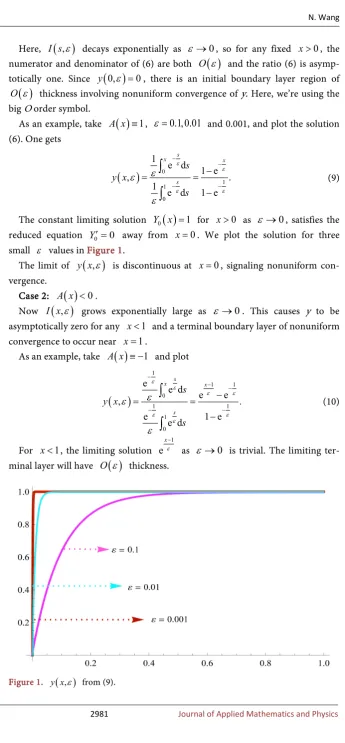
As an example, take A x
( )
≡1,ε
=
0.1,0.01
and 0.001, and plot the solution(6). One gets
( )
01 1
0
1 e d 1 e
, .
1 e d 1 e
s
x x
s s y x
s
ε
ε
ε ε
ε
ε
ε
−
−
− −
−
= =
−
∫
∫
(9)The constant limiting solution Y x0
( )
=1 for x>0 asε
→0, satisfies thereduced equation Y0′ =0 away from x=0. We plot the solution for three
small ε values in Figure 1.
The limit of y x
( )
,ε
is discontinuous at x=0, signaling nonuniform con-vergence.Case 2: A x
( )
<0.Now I x
( )
,ε
grows exponentially large asε
→0. This causes y to beasymptotically zero for any x<1 and a terminal boundary layer of nonuniform
convergence to occur near x=1.
As an example, take A x
( )
≡ −1 and plot( )
1
1 1
0
1 1
1 0
e e d
e e
, .
e e d 1 e
s
x x
s s y x
s
ε ε
ε ε
ε ε
ε ε ε
ε −
− −
− −
−
= =
−
∫
∫
(10)
For x<1, the limiting solution exε1 −
as
ε
→0 is trivial. The limiting [image:3.595.198.544.31.776.2] [image:3.595.211.533.518.733.2]ter-minal layer will have O
( )
ε
thickness.DOI: 10.4236/jamp.2019.712208 2982 Journal of Applied Mathematics and Physics
2. Turning Points
Case 3: A x
( )
= −x 0.5.Now there’s a simple turning point at x=0.5 and
( )
2 2
1 1 1 1 1 1
2 2 4 8 2 2
, e s e e s .
I sε ε ε ε
− − − − − = =
We write the ratio (6) as
( )
( )
( )
0 1 0 , d , . , d xI s s
y x
I s s
ε ε
ε
=
∫
∫
(11)The exact solution is
( )
1 2 2 1
, 1 ,
2 1 2 2 x erf y x erf ε ε ε − = + (12)
where erf z
( )
= 2 0ze d−t2 tπ
∫
is the error function [14]. It satisfiesz xz
′′
+
′
=
0
,it is odd, it increases monotonically, and it tends to ±1 as x→ ±∞.
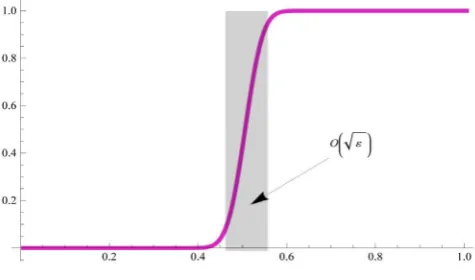
Since the integrands of (11) peak at the turning point and are asymptotically negligible elsewhere, we will have
( )
1 0, for
2 ,
1
1, for .
2 x y x x
ε
< > (13)
The numerator and denominator of (11) are both O
( )
ε
. Clearly,1, 1
2 2
y
ε
= , there’s antisymmetry about
1 2
s= , and an O
( )
ε
thick regionof nonuniform convergence about the midpoint.
Plotting the solution (12) for ε=10−3, we get Figure 2.
Case 4: A x
( )
= −xα
, 0< <α
1.We rescale I to get
( )
( )2 1 2
2 2
e−αεI s,ε =e− ε s−α ,
a function that peaks in an O
( )
ε
interval about s=α and is asymptoticallynegligible elsewhere. This implies that a shock layer of nonuniform convergence occurs about the turning point. The exact solution (6) is
( )
, 2 2 .DOI: 10.4236/jamp.2019.712208 2983 Journal of Applied Mathematics and Physics Figure 2. y x
(
,10−3)
from (12).
For
α
=13 and ε=10−3, we get Figure 3.Not surprisingly, the asymptotic solution is essentially a translation of that for
0.5
α
= . Forα
=0,( )
2 2 2 0 1 2 0 e d , , e d s x s s y x s ε εε
− − =∫
∫
(15)so we again get an O
( )
ε
initial layer (see Figure 4(a) and Figure 4(b)).For
α
=1, there is an analogous terminal layer. Forα
<0 orα
>1, theboundary layer is O
( )
ε
, i.e. thinner.Case 5: A x
( ) (
= x−α
)
3, 0< <α
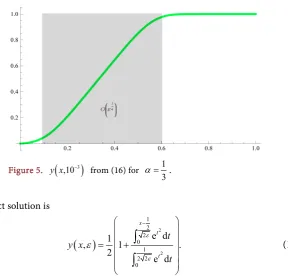
1.We have a third order turning point at x=α. Again, the rescaled integral
( )
,I s
ε
peaks at s=α, causing y to jump there. The shock layer is now 14
Oε
thick. The exact solution is
( )
(
)
(
)
4 4
4 4
1, 1,
4 4 4 4
, ,
1
1, 1,
4 4 4 4
x y x α α ε ε ε α α ε ε −
Γ − Γ
=
−
Γ − Γ
(16)
where
( )
, a1e duz
a z +∞u − − u
Γ =
∫
is the incomplete gamma function.Evaluating y x
( )
,ε
for 13
α
= and ε=10−3, we get Figure 5.To steepen the shock layer, we must take ε much smaller.
We change the sign of A for the next three examples.
Case 6:
( )
12
A x = −x.
Rewriting (6) as
DOI: 10.4236/jamp.2019.712208 2984 Journal of Applied Mathematics and Physics Figure 3. y x
(
,10−3)
from (14) with α=13.
(a)
[image:6.595.215.528.68.717.2](b)
DOI: 10.4236/jamp.2019.712208 2985 Journal of Applied Mathematics and Physics
Figure 5. y x
(
,10−3)
from (16) for 13
α= .
the exact solution is
( )
2 2 1 2 2 0 1 2 2 0 e d 1, 1 .
2 e d
x t t t y x t ε ε ε − = +
∫
∫
(18)We note that the solution could be expressed in terms of Dawson’s integral
( )
2 20 e z ze dt
F z = − t
∫
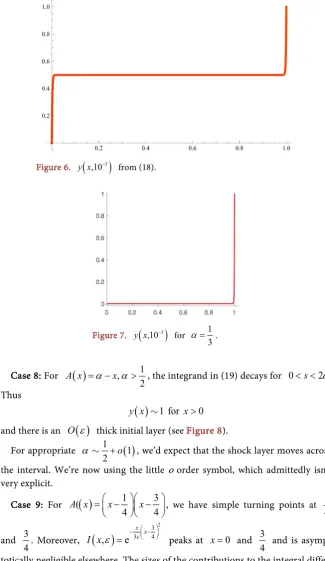
. The integrands in (17) peak symmetrically at s=0 and 1,being asymptotically negligible elsewhere. Moreover, y = 12 12
. Indeed
( )
12
y x for 0< <x 1, and twin O
( )
ε
boundary layers occur near both end-points. For ε=10−3, we have Figure 6.Case 7: For
( )
, 0 12
A x = −α x < <α , we have
( )
( ) ( ) 2 2 0 2 1 2 0 e d , . e d s s x s s s y x s α ε α ε ε − − =∫
∫
(19)Its exact solution is
( )
2 2 2 2 2 2 0 0 1 2 2 0 0e d e d
, .
e d e d
x t t t t t t y x t t α α ε ε α α ε ε ε − − + = +
∫
∫
∫
∫
(20)The integrand of (19) is asymptotically negligible for s<2
α
, but asymptoti-cally large for s>2α
. This implies that( )
0 for 1,y x x<
so there is as O
( )
ε
-thick terminal layer. As an example, consider3 1
10 0.
3
y x y
− ′′+ − ′=
We have Figure 7 for picture of y x
(
,10−3)
DOI: 10.4236/jamp.2019.712208 2986 Journal of Applied Mathematics and Physics Figure 6. y x
(
,10−3)
from (18).
Figure 7. y x
(
,10−3)
for 13
α= .
Case 8: For
( )
, 12
A x = −α x α> , the integrand in (19) decays for 0< <s 2
α
.Thus
( )
1 for 0y x x>
and there is an O
( )
ε
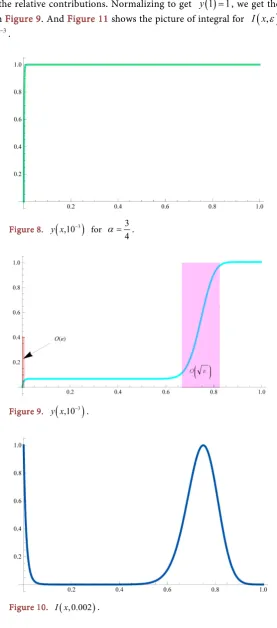
thick initial layer (see Figure 8).For appropriate 1
( )
12 o
α + , we’d expect that the shock layer moves across
the interval. We’re now using the little o order symbol, which admittedly isn’t very explicit.
Case 9: For (
( )
1 34 4
A x =x− x−
, we have simple turning points at
1 4
and 3
4. Moreover,
( )
2
3
3 4
, e x x
I x
ε
= −ε − peaks at x=0 and 34 and is
asymp-totically negligible elsewhere. The sizes of the contributions to the integral differ, however. The area under I near x=0 is O
( )
ε
, but that near 34
x= is
( )
O
ε
, i.e., larger. Thus, the ratio (6) is O( )
ε
for 0 3 4x
< < and O
( )
1for 3 1
DOI: 10.4236/jamp.2019.712208 2987 Journal of Applied Mathematics and Physics
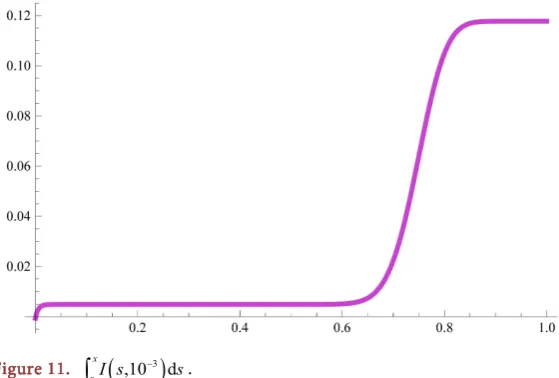
Computing for ε=10−3, we get Figure 9.
This relies on the following figures. We’ve increased ε in Figure 10 to
show the relative contributions. Normalizing to get y
( )
1 1= , we get the solu-tion in Figure 9. And Figure 11 shows the picture of integral for I x( )
,ε
with3 10 ε= − .
Figure 8. y x
(
,10−3)
for α=34.
Figure 9. y x
(
,10−3)
[image:9.595.233.511.106.736.2].
DOI: 10.4236/jamp.2019.712208 2988 Journal of Applied Mathematics and Physics
Figure 11.
(
3)
0 ,10 d
x
I s − s
∫
.3. Conclusion
We have not been exhaustive, but we have certainly demonstrated a wide variety of asymptotic solutions to turning point problems of the form (4) - (5). They mimic the asymptotics of the more general boundary layer resonance problem. When the problem of turning points becomes complicated, numerical methods will become unreliable. Finding the limiting solution is extremely ill conditioned as Trefethen recently observed. Due to the serious instability of direct numerical methods, the examples found in scattered literature are usually less detailed. In this paper, we only give asymptotic solutions for a class of singularly perturbed with a turning point. Indeed, the techniques developed here might be expected to apply to that problem. Readers are encouraged to study other limiting possi-bilities for (4) - (5).
Acknowledgements
This research is supported by the Natural Science Foundation of Shanghai Insti-tute of Technology, Research Fund nos. ZQ2018-22, 391100190016027.
Conflicts of Interest
The author declares no conflicts of interest regarding the publication of this pa-per.
References
[1] Ackerberg, R.C. and O’Malley Jr., R.E. (1970) Boundary Layer Problems Exhibiting Resonance. Studies in Applied Mathematics, 49, 277-295.
https://doi.org/10.1002/sapm1970493277
[2] Fraenkel, L.E. (1969) On the Method of Matched Asymptotic Expansions. Mathe-matical Proceedings of the Cambridge Philosophical Society, 65, 263-284.
https://doi.org/10.1017/S0305004100044236
[3] Skinner, L.A. (2011) Singular Perturbation Theory. Springer, New York.
DOI: 10.4236/jamp.2019.712208 2989 Journal of Applied Mathematics and Physics [4] Vasil’eva, A.B., Butuzov, V.F. and Kalachev, L.V. (1995) The Boundary Function
Method for Singular Perturbation Problems. SIAM, Philadelphia.
https://doi.org/10.1137/1.9781611970784
[5] Fruchard, A. and Schäfke, R. (2013) Composite Asymptotic Expansions. Lecture Notes in Mathematics. Vol. 2066, Springer, Heidelberg.
https://doi.org/10.1007/978-3-642-34035-2
[6] O’Malley, R.E. (2008) Singularly Perturbed Linear Two-Point Boundary Value Prob-lems. SIAM Review, 50, 459-482. https://doi.org/10.1137/060662058
[7] O’Malley, R.E. (2014) Historical Developments in Singular Perturbations. Springer, Cham. https://doi.org/10.1007/978-3-319-11924-3
[8] Sharma, K.K., Rai, P. and Patidar, K.C. (2013) A Review on Singularly Perturbed Differential Equations with Turning Points and Interior Layers. Applied Mathe-matics and Computation, 219, 10575-10609.
https://doi.org/10.1016/j.amc.2013.04.049
[9] Matkowsky, B.J. (2018) Singular Perturbations in Noisy Dynamical Systems. Euro-pean Journal of Applied Mathematics, 29, 570-593.
https://doi.org/10.1017/S0956792518000025
[10] Trefethen, L.N., Birkisson, A. and Driscoll, T.A. (2018) Exploring ODEs. SIAM, Philadelphia.
[11] Wasow, W. (1985) Linear Turning Point Theory. Springer, New York.
https://doi.org/10.1007/978-1-4612-1090-0
[12] Olver, F.W.J. (1974) Asymptotics and Special Functions. Academic Press, New York. [13] Wong, R. (1989) Asymptotic Approximations of Integrals. Academic Press, New York. [14] Olver, F.W.J., Lozier, D.W., Boisvert, R.F. and Clark, C.W. (2010) NIST Handbook