University of Warwick institutional repository: http://go.warwick.ac.uk/wrap
A Thesis Submitted for the Degree of PhD at the University of Warwick
http://go.warwick.ac.uk/wrap/57691
This thesis is made available online and is protected by original copyright. Please scroll down to view the document itself.
The development and use of
tools to support the strategy
process
A dissertation submitted in fulfilment of the requirements for the
degree of Doctor of Philosophy to be awarded for the submission of
published work.
Frances Ann O’Brien
Warwick Business School
University of Warwick
Coventry UK
Table of Contents
Chp Content
Page
Acknowledgements
4
Declaration and collaborative work
5
1
Summary and contribution to knowledge
6
2
Background to the research topic
9
2.1 Defining strategy and the strategy process
9
2.2 What is a tool?
11
2.3 OR & Strategy
11
2.4 Strategy-as-Practice
13
2.5 The importance of studying the development
14
and use of tools to support the strategy process
2.6 Research questions
16
3
Presentation of the papers
17
3.1 Exploring tool use in practice
17
3.2 Developing tools
23
3.2.1 Visioning
23
3.2.2 Scenario planning
27
3.3 Supporting the strategy process
30
3.4 Teaching the use of tools to support the
34
4
Contribution summary, methodology and impact
36
4.1 Contribution summary
36
4.2 Methodology
42
4.3 Impact
43
5
Current and future research
44
5.1 Current research
44
5.2 Future research
45
6
Conclusions
46
References
47
Appendices
1.
Written statements by collaborators
51
2.
Contribution to the submitted papers by the
54
PhD candidate
3.
Demonstrating impact through citations in other
55
works
4.
Demonstrating impact through application in
66
Practice
5.
Bibliography of all published work by FA O’Brien
70
Acknowledgements
Declaration and collaborative work
I declare that this work is not substantially the same as any I have previously submitted or am currently submitting in any form for any qualification at any university or other
institution.
No parts of this work have previously been submitted for any similar qualification.
Chapter 1: Summary and contribution to knowledge
This document presents a collection of peer reviewed journal articles, book chapters and books which together form the submission for PhD by published work. The document demonstrates that the collection submitted forms a significant contribution to knowledge primarily to the field of operational research (OR) and strategy. The contribution covers four key areas: the practice of tool use by practitioners to support the strategy process and one of its particular activities (visioning); the development and application of two specific tools (visioning and scenario planning); the support of the strategy process through tool use; and, teaching the subject of OR and strategy.
The first contribution involves the research presented in four papers (O'Brien and Meadows 2000; O'Brien and Meadows 2003; Meadows and O'Brien 2006; O'Brien 2011) and concerns the use of tools by different groups of practitioners to support the strategy process; in particular the research looks into the practices of strategic planning managers and OR/MS practitioners. For the strategic planning managers, the research covers the use of tools to support a specific strategic activity, namely vision development. This research explores the practices of strategic planning managers and highlights a number of contextual factors and issues that influence vision development within two sectors (financial services and utilities). For the OR/MS practitioners, the research explores their awareness and use of a collection of tools from different domains. The research also links tool use to activities within the strategy process.
improving the scenario method, whilst the other focuses on the development of a method for the use of pre-developed scenarios to develop strategy.
The third contribution covers material presented in two books (Dyson and O'Brien 1998; O'Brien and Dyson 2007) and concerns the use of tools to support the activities throughout a strategy process. The research firstly proposes developments to the strategy process itself and then presents a collection of tools that can be used to support one or more of the activities within the process.
The fourth contribution (O'Brien, Dyson et al. 2011) is to the area of teaching OR where the research describes and reflects upon experiences of designing and delivering courses for degree credit in the field of OR & strategy.
The document is organised as follows. Chapter 2 introduces the background to the research presented in the document by introducing the key terms and themes of the research: strategy; strategy process; definition of tool; strategy as practice and OR & strategy. It then goes on to explain the importance and usefulness of studying the development and use of tools in supporting strategy. Chapter 3 presents the papers within this submission; the papers are organised by area of contribution. First, research documenting the use of tools to support the strategy process and particular activities within it is presented. Second, papers describing the development of two particular tools (visioning and scenario planning) are presented. Third, two books describing the development and support of the strategy process are presented. Finally a paper reflecting on the teaching within the field of OR and strategy is presented. Chapter 4 summarises the contribution to knowledge of the research presented within this submission and considers the impact of the research. Chapter 5 outlines current and future research themes of the author. Chapter 6 presents the conclusions of the submission.
Chapter 2: Background to the research topic
This chapter starts by introducing the terms which are central to the research presented in this submission, namely: strategy; strategy process; tool, OR and strategy; and, strategy-as-practice. It then goes onto explain why it is important to study the development and use of tools to support the strategy process.
2.1 Defining strategy and the strategy process
Whilst authors often differ in how they define strategy, two generic concepts are evident: that of strategy as content, something an organisation ‘has’; and, strategy as a process, something an organisation ‘does’. For example Rumelt (1991) defines strategy thus: “For our purposes a strategy is a set of objectives, policies and plans that, taken together, define the scope of the enterprise and its approach to survival and success.” (p53) In contrast, Andrews (2004)
describes strategy as “an organisation process” within which he distinguishes between formulation (the making of strategy) and implementation (the doing or enacting of strategy).
Much of the research presented in this submission relates to the strategy process and in particular to the activities which together form that process. Authors differentiate between processes that are deliberate and those that are emergent. Johnson et al (2006) define deliberate processes as those which are proactively organised and include activities, workshops and the use of external
consultants. They contrast emergent processes as those involving experimentation and learning from partial commitments amongst other things. Thus an emergent process does not result in a planned strategy, rather strategy emerges over time. Some authors (Grant 2006; Johnson, Scholes et al. 2006) adopt a blended view of the strategy process, suggesting it is helpful to see it as
consisting of both deliberate and emergent elements. Others (Hart and Banbury 1994) go so far as to suggest that organisations adopting multiple strategy processes experience improved
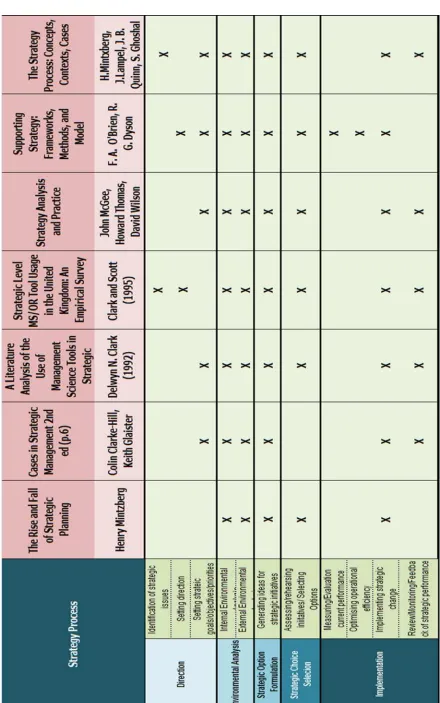
Whilst no two strategy processes within the literature are identical, they share common activities (see Table 1) which can be grouped under the headings:
Direction setting
Creating strategic initiatives
Rehearsing potential strategic initiatives Evaluating / selecting initiatives
Implementing initiatives and monitoring performance
2.2 What is a tool?
Frameworks, methods, models, approaches, methodologies, are just some of the different terms used to describe how a strategy process can be supported. Throughout my research, for the purposes of consistency, I have adopted Stenfors et al (2007) definition and use of the term ‘tool’ which they define as: ‘….a generic name for any method, model, technique, tool, framework, methodology or approach used to provide decision support. Tool
therefore refers to a decision aid used in a methodological manner for specific purposes in decision making or planning activities. A tool can be either quantitative or qualitative and can be manual or computerised. It can be based on OR/MS methods or methods from another discipline. A tool can also be based on one or several methods.’ (p931)
Tools used to support the strategy process are drawn from different fields, including strategy, management and OR/MS. For example Porter’s five forces, PEST and SWOT analysis are drawn from the management field and are commonly found in strategy text books ((Grant 2006; Johnson, Scholes et al. 2006; McGee, Thomas et al. 2010).
2.3 OR & Strategy
models and modelling; and, the emergent/processual view, with its focus on group negotiation. Pidd (2004) adopts a similar approach when classifying the potential for OR/MS to support strategy; he also identifies two ‘possible roles for OR/MS in strategic decision-making and policy development’ (p 799). The first of these roles he describes as developing strategic vision and calls for approaches supporting procedural rationality to ‘encourage debate, deliberation and direction’ (p 799). The second he calls making sense of strategic vision which he describes as being more substantive in nature, drawing from classical OR. Thus Ackermann and Pidd adopt a similar approach to classifying the support that OR/MS has to offer strategy; the rational/analytic sits alongside Pidd’s classical
approaches that are substantive in nature, whilst the emergent/processual view sits more comfortably with the support that is more procedural in nature as suggested by Pidd.
Dyson (2000) takes a different approach to describing OR’s contribution to strategy, identifying three areas. The first he attributes to Bell (1998) who coins the term ‘strategic OR’ which he defines as ‘…OR which achieves a sustainable competitive advantage.’ (p381) Many of the examples Bell refers to are large scale, complex operational problems which quantitative analytic OR work has helped solve. This area sits well with the rational/analytic and substantive categories of Ackermann and Pidd. Dyson’s second area of contribution is to public policy as illustrated, for example, by the work of Rosenhead (1992), where issues are ‘wicked’ in nature and often involve multiple stakeholders with potentially differing perspectives. This second area fits well with the emergent and procedural classifications of Ackermann and Pidd with its emphasis on group based processes involving qualitative or ‘softer’ tools. The third area of contribution, ‘OR and strategy’, provides support to the strategy process and spans the earlier dichotomous classifications of support as it embraces approaches from both categories. The books by Dyson and O’Brien have documented a variety of tools from both hard and soft OR and as well as other fields that have been used to support different activities within the strategy process (Dyson 1990; Dyson and O'Brien 1998; O'Brien and Dyson 2007).
et al. 2011). The 2000 special issue covered a number of approaches including the mapping of distinctive competencies (Eden and Ackermann 2000), a cognitive approach to group strategic decision making (Grinyer 2000), the use of system dynamics to explore the
unintended consequences of the strategy adopted in the UK steel industry (Dangerfield and Roberts 2000); a paper exploring problems of evaluating foreign direct investment (Foster 2000), and a survey of visioning practices (O'Brien and Meadows 2000).
The 2011 special issue covered a variety of tools including scenario planning (Burt 2011; Ram, Montibeller et al. 2011), multi-criteria decision analysis (Montibeller and Franco 2011), systems dynamics (Howick and Eden 2011), balanced scorecard (Tapinos, Dyson et al. 2011) and participative and facilitated approaches to supporting strategy development (Bryant, Darwin et al. 2011; Rouwette 2011). Additionally, there is a survey of the use of tools for strategy support by OR/MS practitioners (O'Brien 2011).
2.4 Strategy as Practice
The previous section defined strategy is terms of content and process. More recently, strategy researchers have explicitly recognised engagement with practice, forming the field of ‘strategy-as-practice.’ (Whittington2006; Jarzabkowski and Spee 2009).
Strategy-as-practice uses a conceptual framework based around three components to organise research:
practitioners, or the actors who are engaged in the work of strategy within organisations
practices, or the routines undertaken by the practitioners (including the use of tools)
praxis, or the activities involved in the development of strategy
2.5 The importance of studying the development and use of tools
to support the strategy process
The extant literature divides into two broad areas: research exploring the use of tools in practice and research documenting the development and application of tools. First I consider previous research into the use of tools in practice.
Gunn and Williams (2007) note that in order to explore the use of tools in practice, we need ‘base data on what tools are being used before we can progress to questions of how and why.’ (p202) There is a body of literature documenting the use of tools by various groups of practitioners and it is to this area that some of the papers in the submission contribute. Within the management field, Rigby and Bilodeau have over a number of years conducted surveys of executives’ use of tools (Rigby 1993; Rigby 2001; Rigby 2003; Rigby and Bilodeau 2005; Rigby and Bilodeau 2007). The most popular reported tools in their surveys include, inter alia, strategic planning (ie the process itself), customer relationship management, benchmarking and mission/vision statements. Other, more recent surveys of this practitioner group include work by Tapinos (2005) and Stenfors et al (2007). Tapinos’s survey of MBA alumni reported that SWOT analysis was the most popular tool for
supporting strategy followed by benchmarking, cost benefit analysis, core capabilities and risk analysis. His survey had also included some of the soft OR tools (cognitive mapping, soft systems methodology) though few reported their use in supporting strategy. Stenfors et al surveyed Finnish executives and also reported that SWOT analysis was the most widely used tool to support strategy, followed by spreadsheet applications, balanced scorecard, risk analysis and analysis of financial statements/investments. Their survey had also included some OR/MS tools such as statistical analysis, optimisation and simulation. It is noticeable that the surveys of Rigby and Bilodeau focus on the use of largely management tools whereas those of Stenfors et al and Tapinos also include tools from the OR field.
strategy process which they divided into three phases (situation assessment, strategic analysis, and strategic implementation); for further details see Table 1. Their list of tools mainly focused on quantitative, sometimes called ‘hard’, OR tools such as simulation, forecasting, linear programming (LP), project management, heuristics, and statistics, though they also included one of the qualitative, or ‘soft’, approaches (soft systems) and two management approaches (brainstorming, Porter’s five forces). Clark and Scott concluded that OR practitioners are engaged in many core strategic activities. They also noted that few respondents mentioned using softer approaches, which generated some debate through their publishing journal’s viewpoints (Clark and Scott 1996; Pidd 1996), their argument suggested that the lack of use of soft approaches may be attributed to the recency of their development.
In comparing the previous surveys of the literature, it is noticeable that the research focuses on different groups of practitioners (managers/executives and OR practitioners). Also, taken as a whole, the research focuses on tools from three fields: management/strategy, OR/MS and soft OR/MS. However different studies cover different tool groups with no study covering all tool groups in detail. It is only the work of Clark and Scott (1995) that makes the link between tools in use and strategic activities supported. Finally, as Gunn and Williams (2007) note, much of the extant literature reports on which tools are used but does not focus on how or why these tools are used, which they suggest are more important questions. The papers presented in this submission not only contribute to the base data, by providing documentation of which tools are used in practice, but some of them go further to explore the questions of how and why the tools are used.
‘In a nutshell, operational research (O.R.) is the discipline of applying advanced analytical methods to help make better decisions………based on…..the latest decision tools and techniques.’http://www.scienceofbetter.co.uk/what/index.htm accessed 15/03/13
It is also noticeable that the definition points to the need for tool development and improvement as it refers to the ‘latest decision tools and techniques’. Evidence of tool development can be found in the literature, for example the origins and evolution of the tool scenario planning has been documented by Bradfield et al (2005). We can also track individual authors and their development of a tool; consider, for example, Eden and Ackermann’s development of cognitive mapping from its use within the tool SODA (1990) through to its use within Journey Making (1998).
2.6 Research questions
Whilst I did not set out on a path defined by a particular set of research questions, three broad research questions serve as useful headings when organising the research that I have conducted over my career which broadly fall into the two areas of exploring tool use and furthering tool development:
Which tools are used to support the strategy process? How are tools used to support the strategy process?
How can tools be developed to improve the support provided to the strategy process?
Chapter 3: Presentation of the papers
This chapter presents the papers for the submission. It is divided into four themes: exploring tool use in practice: developing tools; developing the strategy process and teaching the use of tools to support the strategy process. Each section begins with a box detailing the papers / chapters / books included in this submission.
3.1 Exploring tool use in practice
O’Brien FA & Meadows M (2000) ‘Corporate Visioning: A survey of UK practice’, Journal of the Operational Research Society, 51, 36-44
O’Brien F & Meadows M (2003) ‘Exploring the current practice of visioning: Case studies from the UK financial services sector’, Management Decision, 41: 5, 488-497
Meadows M and O'Brien FA (2006) 'Under Pressure: Visioning in a Regulated Environment', Systemic Practice and Action Research, 19, 537-551
O’Brien FA (2011) Supporting the strategy process: A survey of UK OR/MS practitioners, The Journal of the Operational Research Society, 62:5, 900-920.
activities within the strategy process. The papers are briefly described, highlighting the key findings and contribution to knowledge.
The purpose of the research described within the 2000 JORS paper was to present a
‘window’ on the current practice of visioning amongst UK strategy practitioners. The paper first explored whether the characteristics associated with vision development, identified in the extant literature, were still valid or whether there was evidence of the use of some of the more participative approaches described in the literature. The paper also addressed a gap in the literature, namely how visions are developed, by providing details of the
contextual factors affecting vision development.
The main contribution of this work is that it provides details on how a key activity within the strategy process is conducted in practice. A key finding of the research was the lack of use of formal tools to support vision development, with practitioners preferring informal
settings to promote discussion and debate. It was noticeable that there was some variation in responses to the survey across different sectors for example. This prompted further research in the form of follow-up interviews which formed the subject of two related papers describing the different contextual factors influencing vision development within the
financial services sector and within organisations operating in a regulated environment. (O'Brien and Meadows 2003; Meadows and O'Brien 2006)
In both follow-up papers, a case study approach was adopted. Eight organisations within the financial services sector participated in the research: a venture capital organisation, a ‘traditional’ high street bank, a recently converted building society, a credit card company, three life insurance companies and one non-life insurance company. Four organisations working within a regulated environment formed the second set of case studies – one electricity and three water companies. In both studies, the research explored the practice of vision development within each organisation using Pettigrew’s content, context, process framework (Pettigrew 1987) with a focus on the context surrounding vision development, the process adopted for vision development and the content of the vision statement.
operating within a regulated environment highlighted the tensions that can be observed in organisations struggling to satisfy the expectations of a diverse range of key stakeholders.
The two papers link to later research in that there was a sense expressed by some participants in the lack of participation in the visioning work as being an issue related to communication and gaining buy-in. The desire for participation, particularly where diverse stakeholder views may exist is something that influenced the participative visioning
methodology development the research reported later in this chapter.
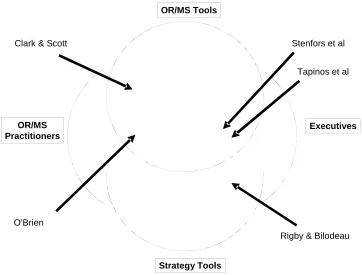
[image:21.595.71.433.399.674.2]The final paper in this section (O'Brien 2011) describes a survey of UK OR/MS practitioners who like the respondents to Clark and Scott’s earlier survey (Clark and Scott 1995), were members of the UK OR Society. One of the diagrams from the paper, highlights how the research contributes to previous research – see Figure 1 below.
Figure 1: Illustrating the focus of previous survey research on the use of tools to support the strategy process (O'Brien 2011) p904
OR/MS Practitioners
Executives OR/MS Tools
Strategy Tools
Rigby & Bilodeau
Clark & Scott Stenfors et al
Tapinos et al
Figure 1 demonstrates that the survey focuses on the OR/MS practitioner and their use of both strategy/management tools and OR/MS tools. This contrasts with previous research which had not explored the use of such a diverse tool set. It also demonstrates that much of the previous research had focused on manager/executives, whereas this research focused on the OR/MS practitioner.
Like the work of Clark and Scott (1995), this research asked respondents to relate their tool use to specific activities within the strategy process. The results indicated that OR/MS practitioners support all activities within the strategy process, from setting direction through to implementation. The research explored both tool awareness and use and covered a range of tools from three identified fields: strategy/management, hard OR/MS and soft OR/MS. The tools project management and financial analysis (classified as hard OR/MS tools) were reported as being most regularly used by practitioners. Given the previous research by Clark and Scott, it was interesting to see that the soft OR/MS tools were amongst those reported as being used least regularly, even though awareness levels were quite high. Awareness levels of some of the strategy/management tools was also quite low, a finding which is not too surprising given the emphasis on OR/MS tools within many UK MSc OR degree programmes. Finally, the research also explored which tools were combined when supporting the strategy process. Most reported combinations came from within a particular tool group (eg simulation with forecasting, or SWOT analysis with scenario planning) though some reported combining tools from different sources (eg simulation with cognitive mapping or SWOT and statistical analyses).
This work concluded that OR/MS practitioners were ‘legitimate strategic actors within organisations who actively support, have responsibility for and are engaged in the strategy process.’ (p916). The research thus contributes to the strategy-as-practice field by
Whilst the research reported tool awareness and use, it was not intended to explore the issues of how and why tools were being used – these issues have been taken forward and are described in section 5.1 on current research.
In summary, the contributions of the papers presented in this section are as follows:
Contributions C1 from O’Brien & Meadows (2000)
o Reports the practice of vision development by strategic planning managers across a wide range of UK based organisations.
o Highlights that typically few senior people develop their organisational vision and that they do not use formal approaches to support its development.
Contributions C2 from O’Brien & Meadows (2003)
o Reports visioning practices within the financial services sector
o Highlights the lack of use of formal methodologies for vision development o Identifies a number of contextual factors influencing vision development eg
changing organisational circumstances such as the arrival of a new CEO (internal) or the introduction of a new regulatory framework (external).
Contributions C3 from Meadows & O’Brien (2006)
o Reports visioning practices within organisations in regulated industries o Highlights the lack of use of formal methodologies for vision development o Identifies a number of contextual factors that drive vision development for
example tensions can be observed in organisations struggling to satisfy the expectations of a diverse range of stakeholders.
Contributions C4 from O’Brien (2011)
o Establishes OR/MS practitioners as strategic actors within organisations o Explicitly considers tools from different backgrounds (Management &
strategy, hard OR/MS, soft OR/MS)
o Reports how tool use maps onto the activities within a strategy process o Reports limited use of soft OR tools to support strategy
3.2 Developing tools
3.2.1 Visioning
Meadows M and O'Brien F.A.: Visioning: A process for strategic development in Frances A O'Brien and Robert G Dyson (ed.)Supporting Strategy: Frameworks, methods and models, Wiley, 27-54 (2007)
O’Brien F & Meadows M (2001) ‘How to develop visions: A literature review, and a revised CHOICES approach for a uncertain world’, Journal of Systemic Practice and Action Research, 14: 4, 495-515
O'Brien FA and Meadows M (2007) ''Developing a visioning methodology: Visioning CHOICES for the future of operational research', Journal of the Operational Research Society, 58, 557-575
Three papers are presented in this section, each covering the development of tools used to support the visioning or direction activity within the strategy process. The first paper
The first publication in this section, a book chapter, contributes methodological
developments to the process of visioning; in particular it focuses on the design of the actual visioning process ie the content and ordering of the different stages. One of the purposes of this chapter was to explore the ‘how’ of a visioning process with the practitioner in mind. The chapter describes three case studies where the authors, working as facilitators, supported the client group through a process of developing a visioning for their organisation. The chapter then reflects on the design of a generic visioning process
consisting of a number of building blocks whose inclusion and sequencing within the process can be varied to suit the particular needs/circumstances of the client group. Thus the
chapter addresses the practical design of the visioning process, providing detail on how it can be conducted, addressing the call for more detail on how and why tools are used in practice (Gunn and Williams 2007). In each of the cases a slightly different combination and ordering of the building blocks was used. The chapter describes each of these and then reflects on the implications of such different orderings; it also compares the building blocks to those used within a CHOICES-based visioning exercise which uses multiple visions as part of the vision development process and is further described later in this section. The chapter represents an original contribution to knowledge in that it explores and reflects upon the content and sequencing of the steps within a visioning process ie its actual design,
something which the extant literature typically doesn’t do.
The last two papers focus on the development of multiple visions, something which
distinguishes them from other published work where typically single visions are developed (Stewart 1993; Lipton 2004; O'Connell, Hickerson et al. 2011).
The 2001 paper begins by reviewing the visioning literature and identifies a set of key stages that capture the similarities and differences in the processes described in the extant
during the vision development process. Whilst multiple visions are used as an input to the process, the ultimate goal is the development of a single vision for the organisation. The paper describes an existing multi-vision visioning approach (CHOICES) along with its development; the paper proposes the addition of the use of scenarios as a means of assessing the external environment and the robustness of the vision. The paper also illustrates an application of the proposed revised approach.
The inspiration for the 2007 JORS paper came from Pidd’s presidential address at a UK OR conference where he presented his thoughts on the futures of OR through the use of CATWOE analysis of SSM (Pidd 2001). The potential for alternative futures resonated with the authors who subsequently developed and won a bid to the OR Society for charitable funding to conduct some research with multiple stakeholder groups concerning their desirable futures for OR. The second paper describes the development of the multi-vision approach (named Visioning Choices) with an emphasis on how the methodology could be developed for use in participative situations. A key driver for the developments carried out within this research was the findings from the earlier visioning survey conducted by the authors (O'Brien and Meadows 2000), in particular the lack of use of a formal visioning approach and the difficulties respondents had reported in gaining buy in and commitment to the vision. The authors believed that developing a visioning approach with an emphasis on participation would contribute to addressing such issues. Their research was conducted with a wide variety of the Society’s stakeholders for example practitioner groups,
academics, regional societies and younger members attending the Young OR conference. Thus they gained wide participation in their project which ultimately fed into the Society’s vision development process. The paper begins by identifying the different influences on the visioning approach: vision and visioning processes; multiple perspectives and facilitating stakeholder involvement, alternative futures in the form of scenarios and CHOICES; and, creativity. The paper illustrates the application of the methodology with a case study considering the future of OR.
development process. The JORS paper considers whether the methodology it presents can be classed as a problem structuring method (PSM) – it concludes that it can as it satisfies the characteristics of PSMs described within the literature.
Within the OR literature, the three papers contribute to an existing body of knowledge of vision development processes. For example, some authors have written about their own approach to vision development such as Vidal’s vision conference (Vidal 2004). Others have written about the development of other approaches which can be combined with an
organisational vision such as the balanced scorecard (Chalmeta and Palomero 2011; Tapinos, Dyson et al. 2011) and multi-criteria assessment (Trutnevyte, Stauffacher et al. 2012). A number of papers focus on participative approaches to working with groups over a variety of topics. For example Bryant et al (2011) describe an approach to supporting a strategy for change when participation was deemed desirable after poor outcome from an employee satisfaction survey. Another feature of much of the extant OR literature related or relevant to visioning is that it sits within the broader ‘soft’ OR field characterised by the involvement of multiple stakeholders, multiple perspectives, differing and potentially conflicting objectives (Rosenhead and Mingers 2001). The visioning papers presented here fit well within the soft OR literature as they share many of the characteristics noted above. However their unique contribution comes firstly in their use of multiple visions (in the case of two of the papers) and in their consideration of generic building blocks (in the case of the firstl paper).
In summary, the contributions of the papers presented in this section are as follows:
Contributions C5 from Meadows & O’Brien (2007)
o Identifies generic building blocks within the visioning process
o Explores and reflects upon alternative designs (content and sequence) for a visioning process
Contributions C6 from O’Brien & Meadows (2001)
o Proposes the use of multiple visions as part of the visioning process. o Proposes the inclusion of scenarios as a means of assessing the external
environment and the robustness of the developed vision.
Contributions C7 from O’Brien & Meadows (2007)
o Develops a methodology involving the use of multiple visions as part of the vision development process.
o Illustrates the application of proposed methodology.
o Presents a case for classifying the methodology as a problem structuring method.
3.2.2 Scenario planning
O’Brien FA (2004) ‘Scenario Planning: Lessons for practice from teaching and learning’, European Journal of Operational Research, 152, 709-722
O’Brien FA & Meadows M (2013), Scenario orientation and use to support strategy development. Technological Forecasting and Social Change, 80:4, 643-656
Two papers are included in this section, both of which focus on developments to the scenario planning tool. Scenarios, typically presented as a set, capture alternative possible future environments that organisations may be faced with. Whilst there are a wide variety of scenario planning processes, much of the literature groups these into different schools (Huss and Honton 1987; Bradfield, Wright et al. 2005). For example, Bradfield et al describe three schools: the intuitive logics school; the French or La Prospective school and the
The earlier paper (O'Brien 2004) presents experiences from teaching the development of scenarios with different student groups. It presents the scenario planning process used for teaching and identifies a number of pitfalls observed from the resulting scenarios developed by student groups. The pitfalls identified include: the predictability of factor and scenario theme choices; a focus on current/looming ‘big’ issues; implicit assumptions made by students; and, unimaginative scenario presentations. The paper then proposes revisions to the scenario planning process to help avoid such pitfalls. The revisions address content and process issues of the steps in the scenario process taught. Included in the content revisions are changes to how students generate factors, present scenario narratives and explicitly assess the impact of the scenarios. Process changes include moving from lectures to facilitated workshops, providing guidance on presenting scenarios, managing student expectations about the process and encouraging the use of technology (eg the internet) to facilitate student research.
The paper fits within the scenario literature and particularly with the work of Schoemaker who both reports research undertaken with student groups (Schoemaker 1993) and potential pitfalls that should be avoided when developing scenarios (Schoemaker 1998). The paper differs from Schoemaker’s student-based research in that it reports on actual scenarios developed whereas Schoemaker’s work reports on student perceptions of specific events. It is similar to Schoemaker’s paper in that it was developed based on observation of and engagement with groups developing scenarios.
The later paper (O'Brien and Meadows 2013) presents experiences from the use of scenarios in contrast to their development, again reflecting on experiences of using scenarios with a particular group of participants which resulted in suggestions for an improved process for scenario use. However within this research, the participants, whilst within an educational setting, were practising managers using scenarios which had been developed for their own organisation and were presenting their strategic recommendations to senior managers from their organisation, some of whom were board members.
but also focuses on the last phase, the use of scenarios. It also suggests that there is a gap between development and use, not previously identified in the literature, which has the potential to cause problems, for example when there is a time delay between development and use, and when the scenario developers are not the scenario users. The paper suggests that these two issues necessitate the inclusion of an activity labelled ‘scenario orientation’ which can help those using the scenarios to familiarise themselves with their content. This focus on scenario orientation and use is a key contribution of this paper to the scenario literature. The paper uses the experiences of working with multiple groups of managers on a scenario-based strategy development exercise to surface the issues and to illustrate revisions to the scenario use process that ameliorate them.
A key theme linking the two papers in this section is that they were both based on experiences of teaching scenario planning and facilitation of scenario development with different groups and reflecting on those experiences in order to propose developments designed to improve the scenario process. The groups included pre-experience degree students such as those on undergraduate and specialist masters programmes and also post-experience students such as those on Executive / Distance Learning MBA degrees and those on in-house management development programmes.
Within the OR and specialist modelling /analytical literature a variety of work exists covering scenario planning. Some authors presents methodological developments, for example Powell and Coyle describe their scenario approach based on field anomaly relaxation to the development of scenarios (Powell and Coyle 1997) whilst Tietje (2005) considers the issue of how to generate a small set of scenarios from a larger set of potential factors. Similarly Schoemaker (1991) describes his scenario approach based on the intuitive logics approach. The later paper sits well within this section of the literature as it considers developments to the scenario process. Other authors have explored combining scenario planning with other approaches: multi-criteria decision analysis (Goodwin and Wright 2001; Montibeller, Gummer et al. 2006; Kowalski, Stagl et al. 2009; Ram, Montibeller et al. 2011; Trutnevyte, Stauffacher et al. 2012); systems thinking (Burt 2011); neural networks and cognitive
literature, consider the issue of how scenario planning is taught to and used with groups, which is a feature of both the papers presented here. Schoemaker’s work has considered issues related to student perceptions of uncertainty for example (Schoemaker 1993). One paper which builds on the author’s 2004 EJOR paper is that of Wright et al (2009) who add their own experiences and reflections of teaching and working with scenario planning.
In summary, the contributions of the papers presented in this section are as follows:
Contributions C8 from O’Brien (2004)
o Highlights practical issues and common pitfalls encountered when developing scenarios with student groups
o Proposes revisions to both the content and process of how scenario planning is taught
Contributions C9 from O’Brien & Meadows (2013)
o Distinguishes three different phases of the scenario process: preparation, development and use
o Highlights issues that can arise between scenario development and use eg time lag, involvement of different people
o Explores the issues through a case study
o Proposes an approach for scenario orientation and use
3.3 Supporting the strategy process
This section presents two books to which the author contributed both in terms of their design and editing, as well as contributing to their content. More specifically, the author was a participant in the design of the strategy process used within the two books. She also was a co-author of two chapters from the 1998 book and four chapters for the 2007 book. In addition, she was lead editor of the 2007 book, co-ordinating chapters from the collection of contributing authors.
Chronologically, the two books represent a ‘series’, originating with Dyson’s text in 1990 (Dyson 1990). Each text shares a similar format in that it begins with an argument
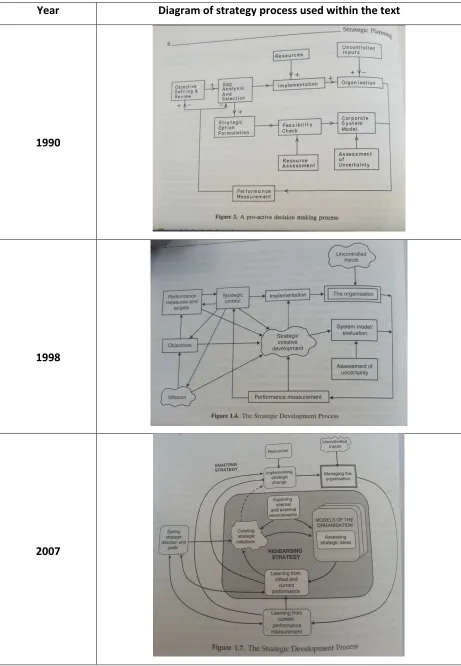
Year Diagram of strategy process used within the text
1990
1998
[image:33.595.67.528.70.736.2]2007
Figure 2 documents the conceptual developments to the strategy process used as the basis of much of the research presented in this submission.
Huff and Reger (1987) distinguish between strategy work that is content focused “on the subject of the strategic decision itself” and that which is process focused “on the actions that lead to and support strategy” (p211-2). The two books included in this submission contribute to the body of strategy process research in that their focus is on providing support to the activities within the strategy process. They also contribute to the field of OR & Strategy since they present a collection of tools from a variety of sources that may be used to support the different activities within the strategy process. Some of the chapters within the texts consider the use of individual tools, whereas others consider the issues surrounding the combination of tools to support the process (Bryant, Meadows et al. 2007).
The two books included in this submission represent a unique contribution to knowledge within the strategy process research field in that they bring together a collection of tools developed by a range of experts to support the different activities within the strategy process. This contrasts with some of the extant literature where authors present their own approach to supporting the whole or component parts of the strategy process (Eden and Ackermann 1998; Grant 2006). Another contribution that the newest volume brings is the consideration it gives to developing the strategy process through the proposal of a
diagnostic tool (Dyson, Bryant et al. 2007).
In summary, the contributions of the books presented in this section are as follows:
Contributions C10 from Dyson & O’Brien (1998)
o Develops a process of inter-related activities that support strategy development within organisations
Contributions C11 from O’Brien & Dyson (2007)
o Develops a process of inter-related activities that support strategy development within organisations
o Differentiates between strategy enactment and strategy rehearsal
o Highlights the use of a range of tools to support different activities within the strategy process
o Proposes a diagnostic tool to support the development/design of the strategy process
3.4 Teaching the use of tools to support the strategy process
O’Brien FA, Dyson RG, Kunc M (2011), Teaching Operational Research and Strategy at Warwick Business School, INFORMS Transactions on Education, 12:1, 4-19
This paper describes the development of a suite of courses on the subject of OR & Strategy that have been taught for over 30 years at Warwick Business School. The focus of the courses is the use of tools to support the strategy process. The paper describes the
structure, content, delivery and assessment of the courses. It also argues that a number of the tools taught on the courses can be classed as soft OR approaches, including visioning, scenario planning and the mapping component of system dynamics. A key contribution of the paper is that it demonstrates how tools from a variety of fields (OR/MS, management and strategy) can be brought together to support activities within the strategy process. Over the years, scenario planning, visioning and different mapping approaches (cognitive
mapping, influence diagrams) have been a common thread throughout the courses. Other soft approaches such as the strategic choice approach, soft systems methodology,
Whilst research exploring the teaching of individual tools exists (O'Brien 2004; Wright, Cairns et al. 2009), there is a gap in the literature exploring how a set of tools may be used in isolation and in combination to support the various activities within the strategy process. This paper addresses this gap and thus represents an original contribution to knowledge.
In summary, the contribution of the paper presented in this section is as follows:
Contributions C12 from Dyson & O’Brien (1998)
o Describes the development of degree-based courses for teaching the subject of OR & Strategy.
Chapter 4: Contribution summary, methodology and
impact
4.1 Contribution summary
In the previous chapters, the work was presented in terms of contributing to four key areas: Exploring tool use in practice
Tool development
Supporting the strategy process through the use of tools Teaching the use of tools to support the strategy process
The main contribution of the research presented in this submission is to the field of OR & strategy. However the research draws on and contributes across subject boundaries and its contribution thus bridges both the OR and strategy fields.
Within the OR field, the published works serve to promote the relevance of strategy-related topics to the field. The surveys of tool use of OR/MS and other practitioners provide insight into the range of tools used but also shed more depth on the reasons influencing tool use. The development of the specific tools of visioning and scenario planning provide a
contribution to the soft OR field by establishing participative approaches to two futures-related areas. The two books establish an OR/MS perspective on the strategy process with an emphasis on rehearsing ideas prior to their enactment; they also highlight the potential for tools to support the strategy process either singly or in combination. Finally the works make a contribution to the teaching of the subject of OR & Strategy by providing reflections on the design and delivery of a suite of courses but also by reflecting on the teaching of particular tools such as scenario planning.
contribute to the growing body of knowledge of tool use both in terms of which tools are used and how they are used.
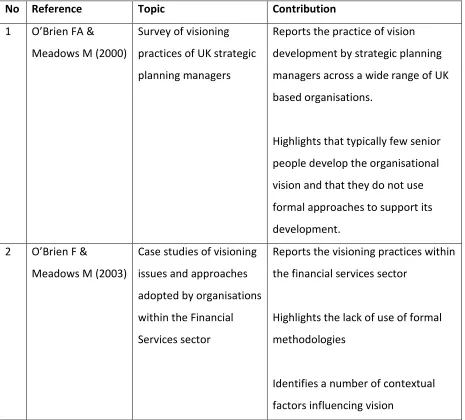
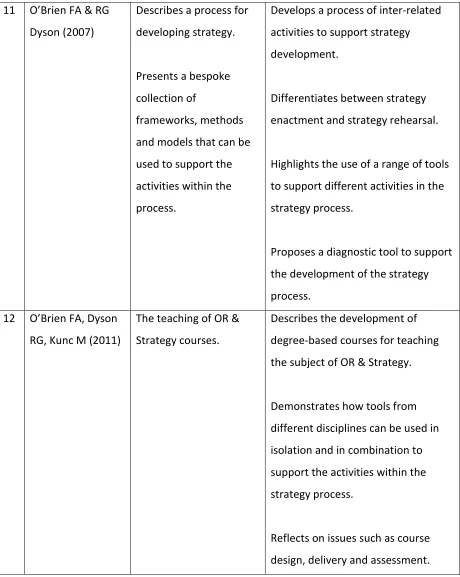
Table 2 lists the papers / chapters and books included in the submission, highlighting the topic covered within the item along with its contribution to knowledge. The papers are organised along the four areas of contribution noted above and are presented in the order of inclusion in chapter 3. Thus contributions from papers 1-4 arise from exploring the use of tools in practice. Contributions from papers 5-9 arise from the development of two tools, visioning and scenario planning. Contributions from books 10-11 arise from developments to the strategy process and the use of tools to support it. Finally contributions from paper 12 address the teaching of the use of tools to support the strategy process.
No Reference Topic Contribution
1 O’Brien FA & Meadows M (2000)
Survey of visioning practices of UK strategic planning managers
Reports the practice of vision development by strategic planning managers across a wide range of UK based organisations.
Highlights that typically few senior people develop the organisational vision and that they do not use formal approaches to support its development.
2 O’Brien F &
Meadows M (2003)
Case studies of visioning issues and approaches adopted by organisations within the Financial Services sector
Reports the visioning practices within the financial services sector
Highlights the lack of use of formal methodologies
development eg changing
organisational circumstances such as the arrival of a new CEO (internal) or the introduction of a new regulatory framework (external).
3 Meadows M and O'Brien FA (2006)
Case studies of visioning issues and approaches adopted by organisations operating within a
regulated environment.
Reports the visioning practices within organisations in regulated industries.
Highlights the lack of use of formal methodologies for vision
development.
Identifies a number of contextual factors that drive vision development for example tensions can be
observed in organisations struggling to satisfy the expectations of a diverse range of stakeholders.
4 O’Brien FA (2011) A survey of the use of tools by UK ORMS practitioners to support the strategy process
Establishes OR practitioners as strategic actors within organisations.
Explicitly considers tools from
different backgrounds (Management & strategy, hard OR/MS, soft OR/MS)
Reports awareness and use of tools by ORMS practitioners.
Reports limited use of soft OR tools to support strategy.
5 Meadows M and O'Brien FA: (2007)
Presents visioning building blocks and case studies of their
application
Identifies generic building blocks within the visioning process
Explores and reflects upon alternative designs (content and sequence) for a visioning process
Uses three case studies to illustrate how alternative designs may be used in practice.
6 O’Brien F &
Meadows M (2001)
Presents a visioning methodology using multiple visions and a case study applying the methodology.
Proposes the use of multiple visions as part of the visioning process.
Proposes the inclusion of scenarios as a means of assessing the external environment and the robustness of the developed vision.
7 O'Brien FA and Meadows M (2007)
Describes the development and application of a participative visioning methodology using multiple visions
Develops a methodology involving the use of multiple visions as part of the vision development process.
Illustrates the application of proposed methodology.
8 O’Brien FA (2004) Issues arising when teaching scenario planning to different groups of students.
Highlights practical issues and common pitfalls encountered when developing scenarios with student groups.
Proposes revisions to both the content and process of how scenario planning is taught.
9 O’Brien FA & Meadows M (2013)
Develops an approach to scenario orientation and use
Distinguishes three different phases of the scenario process: preparation, development and use.
Highlights issues that can arise between scenario development and use eg time lag, involvement of different people.
Explores the issues through a case study.
Proposes an approach for scenario orientation and use.
10 Dyson RG and O'Brien FA (1998)
Describes a process for developing strategy
Presents a collection of frameworks, methods and models that can be used to support the activities within the process.
Develops a process of inter-related activities that support strategy development within organisations.
11 O’Brien FA & RG Dyson (2007)
Describes a process for developing strategy.
Presents a bespoke collection of
frameworks, methods and models that can be used to support the activities within the process.
Develops a process of inter-related activities to support strategy development.
Differentiates between strategy enactment and strategy rehearsal.
Highlights the use of a range of tools to support different activities in the strategy process.
Proposes a diagnostic tool to support the development of the strategy process.
12 O’Brien FA, Dyson RG, Kunc M (2011)
The teaching of OR & Strategy courses.
Describes the development of degree-based courses for teaching the subject of OR & Strategy.
Demonstrates how tools from different disciplines can be used in isolation and in combination to support the activities within the strategy process.
[image:42.595.69.529.70.647.2]Reflects on issues such as course design, delivery and assessment.
4.2 Methodology
The papers included in the published works have typically adopted one of three research approaches:
survey
case study action research
Surveys and case studies have typically been used by the author to explore the practice of tool use by both OR/MS and strategy practitioners. The use of surveys was primarily chosen to provide an overview of a large group of actors. In this they provide a useful snapshot of practice at a particular point in time of the chosen group. Their purpose in the author’s research was largely to provide a springboard to more detailed research which followed the survey and took the form of case studies, where the practices of a smaller subset of actors were reviewed in more depth. Thus surveys typically provide answers to questions such as ‘which tools are being used’ whereas case studies help explore questions such as ‘why and how tools are being used.’
4.3 Impact
The issue of impact is explored from two angles: academia and practice. Firstly the impact on fellow academics, through their citation of the works included in this submission is considered. Second, the impact of the work on practice is considered, through the use of the work by practising managers studying part time for an Executive or Distance Learning MBA at WBS.
Appendix 3 details the citations from a number of the papers/books within this submission. The works are cited by a authors from a variety of backgrounds and fields. A number of the citations come from within the OR/MS literature (eg JORS/EJOR/OMEGA) where authors are for example reviewing recent contributions to a particular area of the OR field, or are
developing and presenting their own approaches. Citations also appear in the specialist futures field (Futures, TFSC) where the author’s work is cited by those developing their own specialist approaches to vision or scenario development.
The two books included in the submission are seen as a useful resource to both students and practitioners. Students are typically those attending one of the three courses taught at WBS on the subject of OR & Strategy, but also include Executive or Distance Learning MBA students at WBS who are in full-time employment as well as practitioners attending a bespoke course on Supporting strategy run by the OR Society. The volume of sales of both books indicate a wider audience than the groups just described however there is no data to identify this group of readers.
Appendix 4 summarises a number of projects conducted mostly by WBS Executive or Distance Learning MBA students where they have directly applied research captured in this submission to live projects within their own organisations. In particular, two areas of impact stand out: the further development of the diagnostic tool (Dyson, Bryant et al. 2007) used to support the evaluation and design of an organisation’s strategy process; and, the
Chapter 5: Current and future research
5.1 Current research
Current research is being conducted within the areas of exploring tool use and tool development.
As a follow up to O’Brien’s survey (O'Brien 2011), and in response to the call of Gunn and Williams (2007) to explore the issue of how tools are used to support strategy, the author conducted a number of interviews with survey respondents to explore in more depth the contextual factors influencing tool use. Analysis of the interviews resulted in the
identification of a number of roles that OR/MS practitioners play in supporting strategy. These roles can be differentiated by the nature of the support provided to clients, the relationship between consultant and client as well as the tools in use. At the time of writing, the following paper is being revised for the Journal of the Operational Research Society: O’Brien FA. On the roles of OR/MS practitioners in supporting strategy, submitted to the Journal of the Operational Research Society, June 2012.
In order to explore in greater depth how specific tools are used in practice, the author, with a colleague (M Meadows) made video recordings of a scenario-based strategy development workshop. The tool SWOT analysis was the subject of the study and the authors are using analysis of video and audio fragments to explore a number of issues inter alia, the use of materials such as post-it notes and flipcharts by participants. At the time of writing, the following submission is under review with the British Journal of Management: Meadows M & O’Brien FA. Exploring the use of SWOT as a boundary object, submitted to the British Journal of Management, January 2013.
selling strategic issues, we identify micro-practices related to strategy development activities. Two papers on this topic have been accepted at the 2013 British Academy of Management and the Strategic Management Society conferences.
Another project that the author is engaged with concerns the use of social media within scenario projects. Traditionally, scenario projects are undertaken through workshops where participants physically come together to develop a set of scenarios for their organisation. The author was involved with an organisation developing scenarios of UK food supply. The project involved a number of specialists with diverse areas of expertise (animal husbandry, medicine, local government, biochemistry, semantic webs, architecture). As part of the project, the organisation engaged a social media organisation to help promote and
encourage virtual engagement with the exercise. The research project is currently exploring the use of a particular social media (twitter) to understand how it was used within the project and to explore its potential for supporting future scenario projects.
5.2 Future research
The development and use of tools to support the strategy process is a field with numerous opportunities for future research. The papers included in this submission demonstrate the potential for exploring the what, how and why of tool use in practice. There are a number of areas for further consideration, for example there is limited recent literature covering the practical use of specific tools. In the case of scenario planning, studies of its use in practice were published a number of years ago thus there is scope for an update to its use in
Chapter 6: Conclusions
This document presents a body of work developed by the author and her collaborators over a period of some 20 years. The body of work covers research into the development and use of tools to support the strategy process. The document introduces the key themes relevant to the research and explains why it is important to conduct research into the subject area. The papers are presented across four key areas of contribution and the chosen
methodological approaches are explained. Current research extending the body of work presented here is summarised along with areas for future research. The research is shown to have had an impact on other research in the field through the citations included in Appendix 3; it has also had an impact on the teaching of the subject.
The research presented in this submission has and continues to contribute to the body of knowledge surrounding the research questions summarised in section 2.6, in terms of identifying the tools that practitioners use to support the strategy process, exploring the use of selected tools in more depth, and researching methodological developments to the tools of visioning and scenario planning.
References
Ackermann, F. (2011). "How OR can contribute to strategy making." The Journal of the Operational Research Society62(5): 921-923.
Andrews, K. (2004). The concept of corporate strategy. Strategy: Process, content and context (third edition). B. de Wit and R. Meyer. London, Thomson.
Bell, P. C. (1998). "Strategic operational research." The Journal of the Operational Research Society
49(4): 381-391.
Bradfield, R., G. Wright, et al. (2005). "The origins and evolution of scenario techniques in long range business planning." Futures37(8): 795-812.
Bryant, J., J. Darwin, et al. (2011). "Strategy making with the whole organisation: OR and the art of the possible." The Journal of the Operational Research Society62(5): 840-854.
Bryant, J., M. Meadows, et al. (2007). Gone fishing: A case study. Supporting strategy: Frameworks, methods and models. F. O' Brien and R. G. Dyson. Chichester, Wiley.
Burt, G. (2011). "Towards the integration of system modelling with scenario planning to support strategy: the case of the UK energy industry." Journal of the Operational Research Society
62(5): 830-839.
Busayapong, P. (2011). Literature analysis on the use of strategic tools in strategic planning. Warwick Business School. Coventry, UK, University of Warwick.MSc Business Analytics and
Consulting:114.
Chalmeta, R. and S. Palomero (2011). "Methodological proposal for business sustainability
management by means of the Balanced Scorecard." The Journal of the Operational Research Society62(7): 1344-1356.
Checkland, P. and S. Holwell (1998). "Action Research: Its nature and validity." System Practice and Action Research11(1): 9-21.
Checkland, P. H. S. (1997). Information, Systems and Information Systems. Chichester, Wiley. Clark, D. N. and J. L. Scott (1995). "Strategic level MS/OR tool usage in the United Kingdom: An
empirical survey." The Journal of the Operational Research Society46(9): 1041 - 1051. Clark, D. N. and J. L. Scott (1996). "Response to "OR/MS and strategic management"." The Journal of
the Operational Research Society47(3): 474 - 476.
Clemens, R. (2009). "Environmental Scanning and Scenario Planning: A 12 month Perspective on Applying the Viable Systems Model to Developing Public Sector Foresight." Systemic Practice and Action Research22(4): 249.
Dangerfield, B. C. and C. A. Roberts (2000). "A strategic evaluation of capacity retirements in the steel industry." The Journal of the Operational Research Society51(1): 53.
Driouchi, T., M. Leseure, et al. (2009). "A robustness framework for monitoring real options under uncertainty." Omega37(3): 698.
Dyson, R. and C. Eden (2000). "OR and Strategy: Editorial Introduction." The Journal of the Operational Research Society51(1): 4.
Dyson, R., G. (2000). "Strategy, performance and operational research." The Journal of the Operational Research Society51(1): 5.
Dyson, R. G., Ed. (1990). Strategic Planning: Models and analytical techniques. Chichester, Wiley. Dyson, R. G., J. Bryant, et al. (2007). The strategic development process. Supporting strategy:
Frameworks, methods and models. F. O' Brien and R. G. DYSON. Chichester, Wiley. Dyson, R. G. and M. J. Foster (1980). "Effectiveness in Strategic Planning." European Journal of
Operational Research5(3): 163-170.
Dyson, R. G. and F. A. O'Brien, Eds. (1998). Strategic Development: Methods and Models. Chichester, Wiley.
Eden, C. (1990). "Strategic Thinking with Computers." Long Range Planning23(6): 35-43.
Eden, C. and F. Ackermann (1998). Making strategy - The journey of strategic management. London, Sage Publications.
Eden, C. and F. Ackermann (2000). "Mapping distinctive competencies: A systemic approach." The Journal of the Operational Research Society51(1): 12-20.
Foster, M. J. (2000). "Evaluating foreign direct investments: New challenges for strategic planners." The Journal of the Operational Research Society51(1): 45-52.
Franco, L., F. O’Brien, et al. (2011). "Supporting strategy: Contributions from OR, The Journal of the Operational Research Society (editorial)." Journal of the Operational Research Society62(5): 815-816.
Goodwin, P. and G. Wright (2001). "Enhancing strategy evaluation in scenario planning: A role for decision analysis." The Journal of Management Studies38(1): 1-16.
Grant, R. M. (2006). Contemporary strategy analysis (Fifth edition). Oxford, Blackwell.
Grinyer, P. H. (2000). "A cognitive approach to group strategic decision taking: A discussion of evolved practice in the light of received research results." The Journal of the Operational Research Society51(1): 21.
Gunn, R. and W. Williams (2007). "Strategic tools: an empirical investigation into strategy in practice in the UK." Strategic Change16(5): 201 - 216.
Harries, C. (2003). "Correspondence to what? Coherence to what? What is good scenario-based decision making?" Technological Forecasting and Social Change70: 797-817.
Hart, S. and C. Banbury (1994). "How strategy-making processes can make a difference " Strategic Management Journal (1986-1998)15(4): 251.
Howick, S. and C. Eden (2011). "Supporting strategic conversations: the significance of a quantitative model building process." The Journal of the Operational Research Society62(5): 868-878. Huff, A. and R. Reger (1987). "A review of strategic process research." Journal of Management13(2):
211-236.
Huss, W. R. and E. J. Honton (1987). "Scenario Planning - What style should you use?" Long Range Planning20(4): 21-29.
Jarzabkowski, P. and A. P. Spee (2009). "Strategy-as-practice: A review and future directions for the field." International Journal of Management Reviews11(1): 69-95.
Johnson, G., K. Scholes, et al. (2006). Exploring corporate strategy (Seventh edition). London, Prentice Hall.
Kaplan, R. S. and D. P. Norton (1992). "The Balanced Scorecard - Measures That Drive Performance." Harvard Business Review70(1): 71 - 79.
Kowalski, K., S. Stagl, et al. (2009). "Sustainable energy futures: Methodological challenges in combining scenarios and participatory multi-criteria analysis." European Journal of Operational Research197(3): 1063.
Lipton, M. (2004). "Walking the talk (really!): Why visions fail." Ivey Business Journal Online: 1. McGee, J., H. Thomas, et al. (2010). Strategy: Analysis and practice (2nd edition). London, McGraw
Hill.
Meadows, M. and F. O'Brien (2006). "Under Pressure: Visioning in a Regulated Environment." Systemic Practice and Action Research19(6): 537.
Meadows, M. and F. O'Brien (2007). Visioning: A process for strategic development Supporting Strategy: Frameworks, methods and models. F. O' Brien and R. Dyson. Chichester, Wiley: 27-54.
Montibeller, G. and A. Franco (2011). "Raising the bar: strategic multi-criteria decision analysis." Journal of the Operational Research Society62(5): 855-867.