Framework Design of Emergency
Management Information System for
Cloud Computing in Chemical Park
Jinfeng Zhang
1, Xin Zhao
2, Xin Liu
1and Limin Hou
11School of Environmental Science and Engineering, Hebei University of Science and Technology, Shijiazhuang, China 2Handan Polytechnic College, Handan, China
Collaborative emergency management mode provides a new idea for further reducing system safety risk in the chemical park. In this paper, the cloud computing and the expert system were used for the framework design of the emergency management information system to enhance emergency response capability of collaborative emer-gency management mechanisms. The use of middleware integrated with multi-source data achieved the unified data manipulation interface. Intelligent delivery of infor-mation system was provided. Using agent-middleware technology to build decision layer could make massive data analysis, data mining and decision from the “cloud computing” platform access for every user. It can provide the necessary theoretical and technical support for enterprises in the chemical park, to give full play to the collaborative emergency management capability.
Keywords: chemical park, emergency management, in-formation system, framework design, cloud computing, emergency decision
1. Introduction
Emergency management work in the chemical park runs through every process of accidents, including prevention, preparation, response and recovery [1]. The four parts often overlap each other, each phase is established on the basis of the former phase, and they form the dynamic cycle of emergency management.
Collaborative emergency management model is based on the theory of Synergetics. The syner-gistic principles apply to the management work, so the concept of collaborative management gives rise to. By conscious organization activ-ities, collaborative management integrates the irregular and disordered elements, and makes
each element of the system into a self-organized and orderly state with certain rules. It fully em-bodies the development law of modern organi-zation, and when reaching the overall optimiza-tion objective, it also achieves the process of “1+1>2”.
Chemical park system is very complex. To achieve the collaborative emergency manage-ment mode among enterprises, efficient emer-gency management information system must be established and the system must be capable of emergency decisions and emergency dispatch
[2]. In order to cope with the massive data, cloud computing and expert system technology are used in this paper to conduct architecture design of the emergency management informa-tion system and improve the emergency capa-bility of collaborative emergency management mechanisms in the chemical park.
2. Main Problems to Conquer and Keep Status Quo of Research
The key to logistics information is to estab-lish an efficient and reliable information service platform. As a support, management mode, service mode and emergency rescue mode of chemical park are built and improved. Digi-tal construction and information development in chemical park are still in the initial stage in China, so many problems and difficulties emerge, which means there is a long way to develop in the future. In chemical park, there are numerous regions to be strengthened with regard to safety management. And the control
grade of equipments and hazardous substances are different. So the higher requirements are put forward about spatiality, timeliness and ac-curacy of data collection.
1. Standardization of basic information. In
chemical park, there are multitudinous equip-ments, hazardous substances and regulatory agencies. Therefore, standardization of ba-sic information is particularly important, es-pecially the design and use of codes and key-words, as well as the standardization of in-formation transfer protocol between differ-ent differ-entities.
2. Processing capability of massive data. Due
to a large quantity of devices, hazardous sub-stances and management departments, the demand for all kinds of information at all levels is growing. So efficient processing capability of massive data need to be config-ured.
3. Intelligent information service. Owing to
the increasing massive data, how to carry on information retrieval and construction of search engine in massive data accord-ing to the need of users, how to complete data mining and processing, and allow users to inquire about various data and instanta-neously get accurate service of information and knowledge, anytime and anywhere, all these become a huge challenge of informa-tion platform construcinforma-tion.
4. Data processing ability and decision support
ability of emergency management. Once
the accidents in chemical park happen, con-sequences of the accident are enormous. Therefore, emergency management of ac-cident is very important. The information platform should have powerful data process-ing ability, monitorprocess-ing ability for real-time data and decision support.
The prerequisite to solve these problems is to build a standardized information platform with powerful storage and computing capacity. Thus, it is necessary to introduce the “cloud comput-ing” and construct corresponding information processing sets.
In China, an event-centric object oriented spatio-temporal data model was put forward by Lin Guangfa in 2002. The organization model of multi-scale spatial data was put forward by Li Yunling, Liu Miaolong and Wu Yuanhua. The
news story segmentation algorithm was put for-ward by Ji Zhong, Su Yuting and Yang Yizheng, which combines audio, subtitles, visual and other multi-modal information. Fan Weicheng and Yuan Hongyong illustrated that emergency management system should take public safety technology as core and information technol-ogy as support to provide emergency protec-tion for emergencies with the combinaprotec-tion of hardware and software. It should also have functions of daily management, risk analysis, monitoring and control, forecasting and warn-ing, dynamic decision, simulation exercises, dispatching, emergency joint action, emergency resource management, emergency assessment. Li Husheng, Wang Ning and other scholars pointed out that emergency management sys-tem framework should include emergency pre-paredness, dispatching, disposal and implemen-tation, aid decision, information management, resource protection etc. Juliette Mattioli illus-trated crisis response scenario model integratied with heterogeneous multi-source information semantics, and provided noumenon of crisis re-sponse management to solve the information sharing between different departments in emer-gency management. Based on cloud storage resource, Lluis put forward planning strategy of cloud storage redundancy data of heterogeneous resources and cloud storage deployment model based on particle swarm optimization by defin-ing the connotation of the hardware reliability and the Erasurecode, with the goal to get the minimum total distributed storage node.There are researches for the development of informa-tion system based on “cloud computing”, im-plementation of algorithm, management mode design and processing of heterogeneous data at home and abroad. But, it’s still a blank to put these techniques into emergency management in chemical park.
3. Collaborative Emergency Management Mode in Chemical Park
involving production secrets, the supervision agency joints work safety information of the enterprises. All enterprises should hold a con-sciousness that “mutual rescue is self-help”, and make full use of limited emergency resources to rescue the surrounding enterprises in accidents
[3]-[5].
Regional collaborative emergency management mode is compatible with the personalities of emergency management in each enterprise. With-out requiring large-scale adjustment from enter-prises, it can be ensured that all enterprises are able to efficiently participate in the regional col-laborative emergency management.
When an accident happens in one enterprise, the emergency management department immedi-ately notifies the emergency management agency in the park and timely sends out warning information according to the prescribed proce-dure. Meanwhile, the accident types dangerous source, the location and other relevant informa-tion is reported to the informainforma-tion system of emergency management.
Through emergency information platform mod-ule the scale of first responders is decided and the corresponding emergency plan starts. Thro-ugh emergency resource scheduling module, the quantity of emergency resources and the list of enterprises providing rescue are decided. After making the decision, the system imme-diately informs the enterprises involved in the rescue and surrounding enterprises through the shared network to quickly enter the normal emergency response phase. During the re-sponse phase of emergency management, emer-gency decision and resource schedule are very important.
4. Architecture Design of Emergency Management Information System
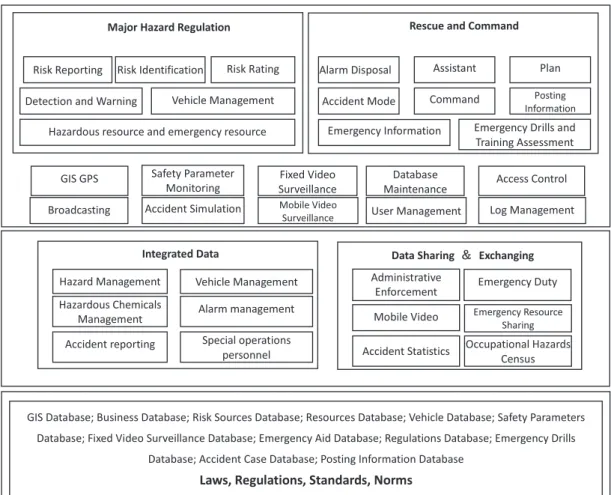
Due to the polymorphism of the chemical park, to achieve the information sharing among enter-prises and the communion of experts support-ing in the decision stage, cloud computsupport-ing and
Risk Reporting Risk Identification Risk Rating
Detection and Warning Vehicle Management
Hazardous resource and emergency resource
Alarm Disposal Assistant Plan
Accident Mode Command Posting Information
Emergency Information Emergency Drills and Training Assessment
Hazard Management Vehicle Management Administrative Enforcement Hazardous Chemicals
Management Alarm management Mobile Video
Accident reporting Special operations
personnel Accident Statistics
Emergency Duty
Emergency Resource Sharing
Occupational Hazards Census
Data Sharing ˂˂ Exchanging Integrated Data
GIS GPS
Broadcasting
Safety Parameter Monitoring
Accident Simulation
Fixed Video Surveillance
Mobile Video Surveillance
Database Maintenance
User Management
Access Control
Log Management
Major Hazard Regulation Rescue and Command
GIS Database; Business Database; Risk Sources Database; Resources Database; Vehicle Database; Safety Parameters
Database; Fixed Video Surveillance Database; Emergency Aid Database; Regulations Database; Emergency Drills
Database; Accident Case Database; Posting Information Database
Laws, Regulations, Standards, Norms
the expert system technology are introduced to conduct the architecture design of emergency management information system.
4.1. Cloud Computing
Cloud computing is based on increase, use and delivery models of Internet services. It usually involves providing dynamic, easily scalable and usually virtualized resources through the Inter-net. The narrowly defined cloud computing refers to the delivery models and using models of IT infrastructure, which means getting neces-sary resources by demand and scalable way on internet. Generalized cloud computing refers to the delivery models and using models of ser-vices, which means getting needed services by demand and scalable way through the network. The services could be IT, software, Internet-related stuff. In another way, computing power can be circulated as a commodity via the Inter-net. Cloud computing is not just a technology. It’s a combination of many technologies, which makes IT probably get the public recognition as a service.
4.2. Architecture Design of Emergency Management Information System with Cloud Computing
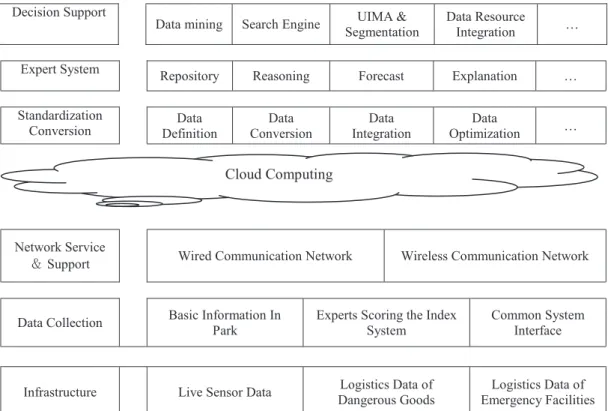
Emergency management system with cloud com-puting in the chemical park adopts the SOA to establish an integrated information manage-ment platform. Its aim is to establish the neces-sary information sharing platform, emergency rescue platform and expert support platform besides the evaluating system. In the system, SaaS is the subject to provide various software and system services. The PaaS offers various web services inside or outside the park. The IaaS provides the perfect computer infrastruc-ture services for users in chemical park. Based on the design approach models are built, includ-ing infrastructure layer, data collection layer, network service and support layer, cloud com-puting support layer, data standardization con-version layer, expert system layer, decision sup-port layer, as Figure 2 shows[6]-[8].
1. Infrastructure layer
The data from sensors and infrastructure for handling emergency events is placed on in-frastructure layer.
Decision Support
Data mining Search Engine UIMA & Segmentation
Data Resource Integration …
Expert System
Repository Reasoning Forecast Explanation …
Standardization Conversion
Data Definition
Data Conversion
Data Integration
Data
Optimization …
Network Service
ୂSupport Wired Communication Network Wireless Communication Network
Data Collection Basic Information In Park
Experts Scoring the Index System
Common System Interface
Infrastructure Live Sensor Data Logistics Data of Dangerous Goods
Logistics Data of Emergency Facilities Cloud Computing
2. Data collection layer
Data collection layer is responsible for pro-viding basic data to the upper layers, such as basic information and basic parameters of the chemical park, experts scoring for the index system, etc. The data is passed up through the network service and support layer.
3. Network service and support layer
Through wired and wireless communication facilities, data from lower layers is trans-ported to the cloud.
4. Cloud computing support layer
Through this layer, data from network ser-vice and support layer gets access to the “cloud” to achieve resources sharing and data processing on the cloud.
5. Data standardization conversion layer The effect of this layer is to conduct the stan-dardization processing on the data under the “cloud”, to establish the unified multivari-ate data model and the middleware as an access to the specific integrated data for var-ious components in chemical park.
6. Expert system layer
Expert system layer consists of expert sys-tems containing lots of knowledge and expe-rience in this field, to helpfully form excel-lent emergency capacity in chemical park. It is a system with abundant expertise know-ledge and experience in applying computer technology.
7. Decision support layer
Relying on advantages of the “cloud com-puting”, this layer provides public service information, integrates the data among en-terprises, provides optimal allocation, opti-mizes scheduling and supplies other related services. Finally, IT support is provided for the decisions of users. Massive data min-ing and information analysis services can be supplied to obtain optimal management.
4.3. Implementation of Middleware Integrated with Multi-source Data
In chemical park, there are various interactive modes of data which cause the difference in the definition format of the basic data resources, the storage and delivery. In other words, the exis-tence of heterogeneous sources data requires the
system to maintain the consistency of data, the necessary model transformation, concurrency control in a certain way and provide a unified manipulation interface, etc. Thus, the middle-ware integrated with multi-source data is used to solve this problem during design phase of system.
1. The process of static data
The static data includes properties of haz-ardous goods and related data of emergency facilities. The data is redefined via the mid-dleware. Through interpretation and conver-sion, the unity of data is achieved. The func-tion provided by the emergency process plat-form can successfully read the data above and convert the abstract entity to structured distributed database.
2. Handling of data from real-time collection The data are mainly from the workstations or sensors in the scene, logistic data of dan-gerous goods, etc. Its features are high fre-quency and large amount, while there are ab-normal data and redundant data. The role of middleware is to mine, clear up and integrate the data from the sensors, get the complete state data and lead the data model into the system.
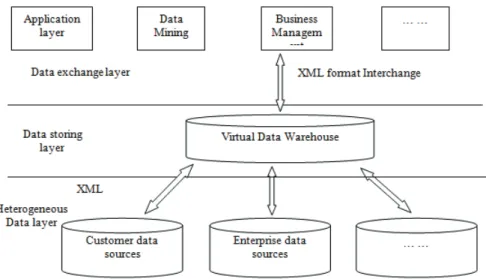
3. In addition, some heterogeneous data can be processed as Figure 3 shows. The data from heterogeneous sources becomes a warehouse of the virtual data via XML, and then be-comes the standard data entering the process system in XML format.
The encapsulating function of heterogeneous data sources on data collecton layer is realized by middleware. The standard XML is used in the request of each data source. Finally, it is converted to the standard query language of each data source and submitted to the corre-sponding database server to conduct the related processing. After data processing, the results are re-packaged into data in XML format to send out. The structures of different data sources are unified by the XML middleware. The middle-ware provides bottom data and data structure information to form a data specification for the information integration and supports that struc-ture changes in the bottom data source can be promptly notified to relevant layers.
Figure 3.The middleware architecture of information management platform.
relational database that meets the data master model of information system is introduced into virtual data warehouse by XML.
4.4. The Realization of Intelligent Push
With the rapid development of information tech-nology, especially widely using of 3G-network and WLAN, all aspects of society are changed profoundly. Based on data mining, natural lan-guage processing, Internet and other technolo-gies, through certain technical standards or pro-tocols, information push is a new technology to reduce information overload by delivering the information users need regularly or in real time on WLAN or Internet. The push technology re-duces searching time on the web by delivering information to users automatically. It searches and filters information due to interests of users and sends them to users regularly or at once, to help discover valuable information efficiently. Emergency information platform provides pow-erful data collection, data mining, data process-ing, dispatchprocess-ing, retrieval, communications ser-vices for each subject in the system and pro-vides data exchanging among different subjects, which conducts intelligent push of necessary business information, knowledge information according to different subjects facing changes and differences of task environment. The data exchange service provides the model and mech-anism of hybrid business data exchange com-patible with equivalence exchange and
master-slave exchange, which achieves data collection and data exchange in multi-interface mode from public information service platform of cloud computing. To be sent, the data needs to achieve the necessary configuration of data transmission agent module. As follows:
1. All data table names involved in data trans-mission, related field names, data types of every tables and association among data ta-bles.
2. The sending way
Specified sending. Sending will be started when the specified data in the database meets the con-dition, for example, some triggers are used in the platform. When the current situation meets requirements of users, the trigger will be ac-tivated and begin to give instructions to send the information according to the preset require-ments.
Regular sending. Sending is started due to the
preset time. In this way, sending conditions in the specified database need setting, for example: daily item status information.
Manual sending. The users can first browse all
the information to be sent in the user interface of management platform, and then choose the specified data to send.
Framework Design of Emergency Management Information System for Cloud Computing in Chemical Park 81
Figure 4.Push mode of information management platform.
5. Decision Supporting Technology of Emergency Management
5.1. Frame Design
Due to the huge data and complex business, a powerful intelligent decision module needs to support the complicated management work. This module involves the field data, dangerous goods logistics data, emergency relief material logistics data and others. It also has predic-tion, simulation and statistical capacity. And this module should provide parameters inter-faces for direct calls or nested calls.
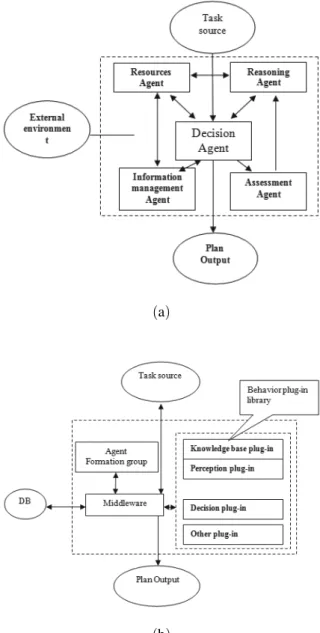
In the frame design, relevant functions are achi-eved by Agent-middleware technology, so the middleware technology and Agent theory will not conflict when they are applied to build the platform system. Agent-middleware technol-ogy is a more efficient construction method of information system achieved by crossing and fusion of the two theories. Agent technology can make the middleware more intelligent, and the middleware principle is used in Agent, so the frame design combines the advantages of these two techniques.
In traditional structure, multi-Agent method is used widely, for example, resource agent, infor-mation management agent and reasoning agent. The disadvantage is that there are so many agents together, so the relationship is too com-plex, due to repeated development and lack of expansion, as shown in Figure 5(a).
G
(a)
pGqGGG }UGSGuUGSGSGYWG G
G
(b)
Agent-middleware technology involves much public and individual information in a multi-Agent system or a functional module. The public information of Agent can be combined as a component to improve the efficiency and save the cost. The common features are com-pleted by the components and different individ-ual information will compose the action plug-in library, which forms Agent with different functions through middleware, as shown in Fig-ure 5(b).
5.2. Middleware Structure Design of Decision Layer
In decision layer, the functions of middleware include communication, assembly, dissolution and others[11].
1. Communication components. They are
re-sponsible for data exchange, database access and conversion among various data.
2. Controller. The task is divided into several
Agents to perform, and it is the initiator to disband or assembly Agents.
3. Agent stacking. It is used to store various
Agents with upcoming assembly, and indi-cates their assembly order.
4. Agent configuration table. It indicates the plug-ins and components Agents needed to assemble and it is the basis to assembly Agent.
5. Temporary Database. It is used to store the
exchange information needed in the opera-tion of various Agents, including supporting data and request data.
The processing sequences are as follows. 1. The middleware intelligent controllers
re-ceive tasks from the communication com-ponents, begin initialization and decompose the tasks into multiple Agents. The con-trollers place Agents in the stack, and the temporary database is emptied;
2. Agent is extracted sequentially from the stack, and then the relevant plug-ins (component library) are assembled from the plug-in li-brary;
3. After assembly, the middleware Agent run the controller;
4. After Agent execution, the stack are writ-ten in and the components and plug-ins are released;
5. Go into the next cycle, until the stack is empty;
6. The analysis results of decision layer are ex-ported.
In the emergency technology platform for a chemical park, systematic decision analysis is an important part of the platform. And the con-clusion of analysis and design will directly af-fect the ability and efficiency to deal with com-plex decision issues. When decision layer is built by Agent-middleware technology, the tra-ditional operation mode is changed. And this technology makes some problems easily man-ageable in the decision layer. So every user can enjoy the massive data analysis, data min-ing and decision support services provided by “cloud computing” platform in chemical park.
6. Conclusion
The collaborative emergency management mode provides a new idea to further reduce the safety risk in chemical park. Cloud computing and expert system are used in technical architecture design of emergency management information system, and the system architecture of emer-gency management information facing cloud computing is designed. Unified data opera-tion interface is achieved by using middleware integrated with multi-source data and intelli-gent push mode in information system is set. Using the Agent-middleware to build decision layer makes every user enjoy the massive data analysis, data mining and decision support ser-vices provided by “cloud computing” platform in chemical park. The necessary theoretical and technical support is provided to give the emergency management collaboration capabil-ity among enterprises full play in the park.
Acknowledgment
This work is financially supported by Natural Science Foundation of Hebei Province, China
References
[1] M.-R. ZENG, Z.-Z. WU, L.-J. WEI, Study on Emer-gency Management Model for Accidents in Chem-ical Industry Park. China Safety Science Journal,
19(2) (2009), 172–176.
[2] B. FERNANDEZ-MUNIZ, J. M. MONTES-PEON, C. J.
VAZQUEZ-ORDAS, Safety management system:
De-velopment and validation of a multidimensional scale. Journal of Loss Prevention in the Process Industries,20(2) (2007), 52–68.
[3] Y.-H. WANG, X.-S. DAI, B.-Z. CHEN, Analysis on Domino Effect of Major Accidents in Chemical In-dustry.China Safety Science Journal,18(5) (2008), 129–136.
[4] A.-M. HEIKKILA, Y. MALMEN´ , M. NISSILA, Chal-lenges in Risk Management in Multi-company In-dustrial Parks.Safety Science,48(3) (2010), 430– 435.
[5] J.-Z. LUO, J.-H. JIN, A.-B. SONG, F. DONG, Cloud computing: architecture and key technologies. Jour-nal on Communications,32(2) (2011), 3–21.
[6] L. QIN, J. ZHANG, Development of Dangerous
Source’s Monitoring & Management and Emer-gency Rescue Decision Making Support Informa-tion System. Journal of Computers, 6(4) (2011), 732–739.
[7] M. ARMBRUST, A. FOX, R. GRIFFITH, Engineering
and Computer Sciences University of California at Berkeley.Technical Report,3(3) (2009), 168–194.
[8] G. ZHANG, C. LI, Y. ZHANG, A Kind of Cloud
Storage Model Research Based on Massive Infor-mation Processing.Journal of Computer Research and Development,5(9) (2012), 32–36.
[9] C.-R. CHOI, Y.-J. SONG, Relative Weight Decision
of Qualiy Attributes in Cloud Computing Service Using ANP.IJACT,4(5) (2012), 240–248.
[10] K. LING, Y. TAN, Application Research of the Plant
Species Monitoring Internet of Things Technology Based on Particle Swarm with Chaotic Mutation.
JCIT,7(11) (2012), 232–238.
[11] Y. SUN, H. YANG, Z. LIU, An Intelligent Logistics
Tracking System Based on WSN.Journal of Com-puter Research and Development, 48(8) (2011), 343–349.
Received:January, 2014
Revised:April, 2014
Accepted:July, 2014
Contact addresses:
Jinfeng Zhang School of Environmental Science and Engineering Hebei University of Science and Technology Shijiazhuang 050018 China
e-mail:[email protected]
Xin Zhao Handan Polytechnic College Handan 056000 China
e-mail:Mr [email protected]
Xin Liu School of Environmental Science and Engineering Hebei University of Science and Technology Shijiazhuang 050018 China
Limin Hou School of Environmental Science and Engineering Hebei University of Science and Technology Shijiazhuang 050018 China
JINFENGZHANGwas born in Huanghua, Hebei, China on Decenmber 26, 1971. He earned a Doctor’s Degree in Engineering from China Uni-versity of Mining and Technology, China in 2007. His major field of study is the teaching and researching of safety engineering. He has been in the research of safety engineering and is now dean of Department of Safety Engineering in the College of Environment Engineering, Hebei University of Science and Technology. He has been teaching more than 10 courses of various levels and published many papers. His research interests are hazard sources control and emergency decision.
XINZHAOwas born in Handan, Hebei, China on November 10, 1977. He earned a Master’s Degree in Engineering from Hebei University of Science and Technology, China in 2008. His major field of study is en-vironmental impact assessment and enen-vironmental hazards monitoring technology.