Enhancing Performance of Image
Retrieval Systems Using Dual Tree
Complex Wavelet Transform and
Support Vector Machines
Adeel Mumtaz, Syed Asif M. Gilani, Kamran Hameed and Tahir Jameel
Faculty of Computer Science and Engineering, Ghulam Ishaq Khan Institute of Engineering Sciences and Technology, Topi, PakistanThis paper presents a novel image retrieval system
(SVMBIR) based on dual tree complex wavelet trans-form (CWT)and support vector machines(SVM). We have shown how one can improve the performance of image retrieval systems by assuming two attributes. Firstly, images that a user needs through query image are similar to a group of images with the same conception. Secondly, there exists non-linear relationship between feature vectors of different images and it can be exploited very efficiently with the use of support vector machines. At the first level, for low level feature extraction, we have used dual tree complex wavelet transform because recently it has been proved to be one of the best for both texture and color-based features. At the second level, to extract semantic concepts, we grouped images of typical classes with the use of one against all support vector machines. We have also shown how one can use a correlation-based distance metric for comparison of SVM distance vectors. The experimental results on standard texture and color datasets show that the proposed approach has superior retrieval performance over the existing linear feature combining techniques.
Keywords: complex wavelet transform(CWT), support vector machine (SVM), content-based image retrieval, texture image retrieval
1. Introduction
Digitization has made a profound effect on our everyday life, from HDTV to digital camera. Global village concept is truly visualized in today’s field of communication where bound-aries of many independent technologies have been merged to a common technology. With the rapid development of computing hardware, digital acquisition of information has become a
popular method in recent years. Every day, G-bytes of images are generated by both military and civilian equipment. Large sets of medical images, architectural and engineering designs, journalism and advertising, are worth mention-ing. Consequently, how to make use of this huge amount of images effectively becomes a highly challenging problem [1]. Historically, the only way to search through these collections was text-based. Images were first annotated us-ing text and then traditional Database Manage-ment Systems (DBMS) were used to retrieve relevant images when required.
There were two main problems with this ap-proach; at first, the amount of labor involved in manually annotating these images and, sec-ondly, the inherent complexity and richness of image contents made the annotation process dif-ficult. For example, it was not easy to label two images containing similar objects, but with dif-ferent meanings. In order to overcome these problems and to make the retrieval process au-tomatic researchers from the field of computer vision proposed a new idea[2], which is known as content-based image retrieval(CBIR). CBIR is also known as query by image content(QBIC) and content-based visual information retrieval
• Security – e.g. image comparison for cor-porate security and law enforcement in-vestigations
• Intellectual Property – e.g. information re-trieval in patent and trademark data (e.g. technical drawings, logos, photos) • Brand protection – e.g. tracking
propri-etary visual data on the Internet
• Media archives – e.g. search, retrieve and manage visual assets(and associated meta-data)
• Scientific imaging – e.g. retrieves and classifies images with respect to specific visual content (e.g. life sciences, health-care, and biotech)
• Military(radar, aerial, satellite target reco-gnition)
• Architectural and engineering design
• Fashion and interior design
• Journalism and advertising
• Medical diagnosis
• Geographical information and remote sens-ing systems
• Cultural heritage
• Education and training
• Home entertainment
• Web searching.
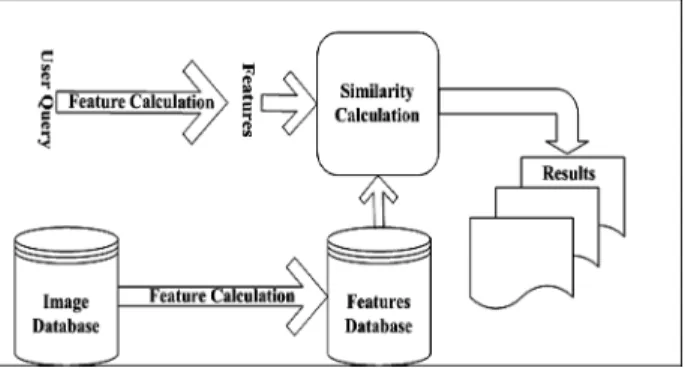
In content-based image retrieval, we automat-ically extract features from images and then compare images using these features. Images having similar features would have similar con-tents. Basic block diagram of a CBIR system is shown in Figure 1.
Figure 1.Typical CBIR system.
At first, features from all images in a database are extracted and stored into a feature database. This process is also known as indexing. When a user tries to search some images from the col-lection, he provides the system with a query image. Different options for query image are possiblei.e.
• Image
• Rough Sketch
• Color or textural layout
• Verbal or semantic description
Features from query image are extracted by the same indexing mechanism. Then these query image features are matched with feature database using a similarity metric and, finally, similar images are retrieved.
A majority of indexing techniques are based on pixel domain features such as color[4], texture
[5], and shape [6]. However, with recent ad-vancements in image compression, compressed domain indexing techniques have gained popu-larity due to their less complexity. The reason for this is that we can get superior features in these domains. Some frequency domain tech-niques include wavelet domain features, Gabor transform and Fourier domain features. Com-prehensive survey of existing CBIR techniques can be found in[1, 2].
Researchers have shown that texture is one of the most important features for CBIR. Texture refers to the visual patterns that have proper-ties of homogeneity not resulting from pres-ence of only one color or intensity. It is an innate property of virtually all surfaces, includ-ing clouds, trees, bricks, hairs, fabric, etc. It contains important information about the struc-tural arrangement of surfaces and their relation-ship to the surrounding environment. There are many review papers on texture-based im-age retrieval. Manjunath and Ma[8]evaluated the texture image annotation by various wavelet transform representations and found that Gabor transform was the best among the tested candi-dates.
retrieval process. Kokare et al. [15] have pro-posed even better extension of this work. Janney et al. [17]have shown how we can enhance the texture extraction capabilities of CWT for color image retrieval. They have shown that we can achieve almost the same precision for color im-age retrieval as well. These properties of CWT have motivated us to use it as feature extraction for our proposed system.
Mostly during the phase of comparison of fea-tures, linear metrics like Euclidean distance etc. were used. Recently, Han et al.[9]have shown how one can improve the performance of im-age retrieval systems by assuming non-linear relationship among feature vectors and group-ing the images into similar classes. We have applied a similar idea for retrieving of texture images. We have used support vector machines for classification of images in the database. The paper is organized as follows: Section 2 provides a brief introduction to dual tree com-plex wavelet transform and some of its applica-tions. Section 3 provides an overview of sup-port vector machines and how SVM can be used for classification. Section 4 describes proposed and implemented CBIR systems. Section 5
dis-cusses the results of our technique in compar-ison with existing techniques. Section 6 gives the concluding remarks.
2. Dual Tree Complex Wavelet Transform
Wavelets are being used in many different ar-eas. Applications of wavelets in signal denois-ing, image, audio and video compression, image smoothing and differential equation solution are active research topics[20]. Wavelets offer some advantages as a tool for image processing, such as the multiresolution formulation, which al-lows the reduction of computational complex-ity. This aspect is of crucial importance, since minimum retrieval time is required for an effi-cient browsing in large databases.
Kingsbury’s[13]dual tree complex wavelet trans-form(CWT)is an enhancement to the discrete wavelet transform(DWT), with important addi-tional properties. The main advantages, as com-pared to the DWT, are that the complex wavelets are approximately shift invariant(meaning that our texture features are likely to be more robust
to translations in the image) and that the com-plex wavelets have separate sub-bands for pos-itive and negative orientations. Conventional separable real wavelets only have sub-bands for three different orientations at each level, and cannot distinguish between lines at 45◦ and
−45◦ respectively.
The complex wavelet transform attains these properties by replacing the tree structure of the conventional wavelet transform with a dual tree. At each scale one tree produces the real part of the complex wavelet coefficients, while the other one produces the imaginary parts. A complex-valued wavelet ψ(t) can be obtained as:
ψ(t) =ψh(t) +jψg(t) (1)
where ψh(t) and ψg(t) are both real valued
wavelets.
CWT like Gabor transform have six orientations at each of four scales (any number of scales can be used, but the number of orientations is built into the method). The main advantage, as compared to the Gabor transform, is speed of computation. It has a redundancy of only 4 in 2-dimensions and so the post-processing stages
(of calculating mean and standard deviations) are also faster as it has less redundancy than the Gabor wavelets.
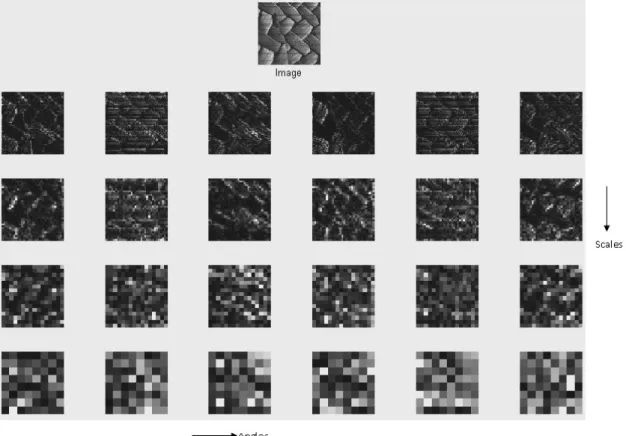
Figure 2 shows magnitudes of CWT coefficients for a texture image. One can see more details related to orientation and scales. Each row rep-resents one scale and the columns represent an-gles within that scale.
3. Support Vector Machines
There are many pattern matching and machine learning tools and techniques for clustering and classification of linearly separable and non-separable data. Support vector machine(SVM)
is a relatively new classifier and it is based on strong foundations from the broad area of statis-tical learning theory[11]. Since its inception in the early 90’s, it is being used in many applica-tion areas such as character recogniapplica-tion, image classification, bioinformatics, face detection, fi-nancial time series prediction etc.
SVM offers many advantages over other classi-fication methods such as neural networks.
Sup-port vector machines have many advantages in comparsion with other classifiers:
• There are computationally very efficient as compared with other classifiers, espe-cially neural nets.
• They work well, even with high dimen-sional data, a factor which limits many efficient classifiers.
• They can work well with less number of training data.
• They attempt to minimize test error rather than training error.
• They are very robust against noisy data
(noise greatly degrades the performance of neural nets).
• The curse of dimensionality and over-fitting problems does not occur during classification.
Fundamentally, SVM is a binary classifier, but can be extended for multi-class problems as well. The task of binary classification can be represented as having, (Xi,Yi) pairs of data.
WhereXi∃Xp, apdimensional input space and
Yi∃[−1,1] for both the output classes. SVM
finds the linear classification function g(x) = W.X+b, which corresponds to a separating hy-perplaneW.X+b=0, whereWandbare slope and intersection. SVM, unlike other classifiers, finds the optimal hyperplane. Examples of op-timal and non-opop-timal hyperplanes are shown in Figure 3.
Figure 3.Optimal and non-optimal hyperplanes.
against one and all at once. Figure 4 shows how one against all SVM can be used for grouping of different classes inside an image database. Each support vector machine separates one class of images from the rest of the database, which is shown by non-linear boundaries. A more de-tailed tutorial on SVM can be found in [19], which is oriented to researchers working on pat-tern recognition.
Figure 4.One against all classification showing three support vector machines.
4. CWT and SVM-based Image Retrieval System
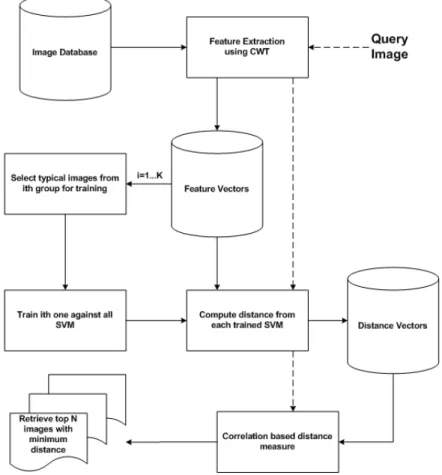
In this section, we describe the structure of the proposed SVMBIR system in detail. Figure 5 shows the main components of the proposed system and the control flows among them.
The proposed system is based on SVM classi-fier. Our system is based on a similar assump-tion as Han et al.[9]that is images users need are often similar to a set of images with the same conception instead of one query image and the assumption that there is a nonlinear relationship between different features. The following steps show the detail of our proposed algorithm:
Step 1: Features are extracted from each im-age included in the imim-age database using the following feature extraction process. First, we performed a four scale(six angles)CWT on an image. We got 24 real and 24 imaginary detailed sub-bands, and 2 real and 2 imaginary approxi-mation sub-bands. By taking the magnitudes of
corresponding real and imaginary coefficients of both approximation and detailed sub-bands, we got 26 sub-bands. To calculate the features we measured the mean and standard deviation of the magnitude of the transform coefficients in each of 26 sub-bands, in the same way as[14]. For color images we applied above process on each RGB color channels to get the feature vec-tor. These features were then stored in feature database for later comparison.
Step 2: From each class of images included
in the image database some typical images(K) were selected for training of support vector ma-chine for that class. Selection of these training images can be done randomly or from a se-quence. In our experiments we used first K images for training. We used one against all training method as it is the best when one needs good speed and reliable performance. This is done usingtrainlssvmfunction of LSSVM[16]. We used ‘RBF’ as kernel function for training of support vector machines. Optimal parame-ter selection is always a bottleneck of support vector machines. LSSVM provides a function
tunelssvm which can be used for stimation of
optimal parameters. We used grid search ap-proach for searching optimal parameters. Our used and final parameter values were 100 and 20 forgamandsig2respectively.
Step 3: In this step, the distance of each im-age included in the database from each trained SVM is calculated. This is done usingsimlssvm function of LSSVM. Each of this distance is grouped in the form of distance vectors. This distance vector will store distance of each im-age from each support vector machine. Finally, we store all these distance vectors in distance vectors database.
Steps 1 – 3 are done offline and after these steps our system is ready to process the user queries.
Step 4: When the user gives the system a query image, features from the query image are ex-tracted. Using this feature vector of query image distance vector of query image is calculated.
Step 5: Query image distance vector is com-pared with all the distance vectors included in the distance vector database. By looking at the type of distance vectors generated we can easily find that following correlation based metric can be used for this comparison.
drs=1− (xr−x¯r) (xs−x¯s)
(xr−x¯r) (xr−x¯r) (xs−x¯s) (xs−x¯s)
(2)
This equation is one minus the correlation co-efficient between vectorsxr andxs. In our case,
xr is the query image distance vector and xs is
the distance vector of images included in the database. svaries from 1. . .N, whereN is the total number of images included in the image database. xr andxsare the means of the vectors
xr andxs.
Step 6: Finally, the topQimages having mini-mum distance are retrieved and presented to the user.
5. Experimental Results
In this section we have shown some experimen-tal results to evaluate the performance of our proposed system.
For texture images we have used the same dataset as was used by Peter and Kingsbury
[14]. The texture data set used in the exper-iments contains 100 texture images from the Massachusetts Institute of Technology (MIT) VisTex [12] database. Each 512x512 image is divided into 16 smaller images of size 128x128 giving a total of 1600 texture images in the database. Each original image is treated as a single class and so we have 16 examples from each of our 100 classes. For color images we use the same dataset as was used by Janney et al. [17]. The color image data set used in the experiments contains 7200 color images from the Columbia University Image Library( COIL-100) [18]. These images are organized as having 100 objects photographed at 72 different angles giving total of 7200 images.
retrieval rate for each of the 1600 images and we simply average these rates to give an overall retrieval rate. In our results, we plot the retrieval rate for a number of choices ofN. A good set of features will give a retrieval rate that rapidly rises to 1. For each object present in coil-100 database we selected first instance out of 72 in-stances giving total of 100 query images and rest of the process is same.
Figure 6.Retrieval rate comparsion using 25% training images.
Figure 7.Retrieval rate comparsion using 50% training images.
Table 1 shows error rate(number of mismatched images)comparison of our technique(with 25% training images)and Peter and Kingsbury’s tech-nique, for different types of texture images. We used 100 query images, one from each class.
Image Category SVMBIR% Error CWT [14]% Error
Bark 12.5 21.87
Brick 15.62 44.79
Buildings 39.84 58.59
Clouds 28.12 50
Fabric 5.46 28.12
Flowers 18.75 33.03
Food 20.62 27.5
Grass 41.66 54.16
Leaves 28.36 39.90
Metal 15.62 33.33
Misc 6.25 43.75
Paintings 22.91 29.16
Sand 11.60 17.85
Stone 6.25 6.25
Terrain 57.81 68.75
Tile 43.75 53.12
Water 13.75 37.5
WheresWaldo 70.83 70.83
Wood 0 0
Average 24.19 37.81
Table 1.Retrieval performance for different categories of images.
Results are accumulated for different categories of images, for example Bricks include ‘Brick.0002’, ‘Brick.0003’, ‘Brick.0004’, ‘Brick.0005’, ‘Brick.0006’, and ‘Brick.0007’ images of the VisTex database. It is very clear from the table that our technique performed well almost in each category.
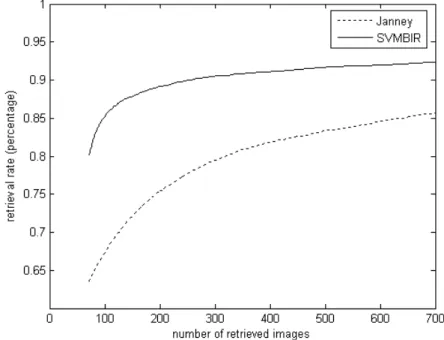
Figure 8 shows the comparison of our technique with Janney et al. [17]. In this comparison we used only 12.5% images from each class for training of support vector machines. As shown in Figure 8, one can see significance improve-ment in results.
Here we also believe that the results can be sig-nificantly improved if we use more images for training. Figure 9 shows the comparison with 25% training images. This shows that we can almost reach over 90% precision by using the idea presented in this paper.
Table 2 shows error rate(number of mismatched images) comparison of our technique (with 12.5% and 25% training images)and Janney’s technique, for different types of color images. We used 20 query images from different classes. Names of query image file in coil-100 database are also shown in the table. It is very clear from the table that our technique performed well al-most in each category.
Figure 9.Retrieval rate comparison using 25% training images.
Imagefile name % ErrorJanney [17]
% Error SVMBIR 12.5% training
images
% Error SVMBIR
25% training
images
Obj5 0.png 6.9444 4.1667 0
Obj10 0.png 22.222 0 0
Obj15 0.png 45.833 22.222 13.889 Obj20 0.png 40.278 19.444 13.889
Obj25 0.png 0 0 0
Obj30 0.png 0 0 0
Obj35 0.png 0 0 0
Obj40 0.png 48.611 16.667 13.889 Obj45 0.png 76.389 69.444 33.333
Obj50 0.png 0 0 0
Obj55 0.png 63.889 30.556 15.278 Obj60 0.png 77.778 61.111 38.889 Obj65 0.png 75 43.056 31.944
Obj70 0.png 0 0 0
Obj75 0.png 30.556 0 0
Obj80 0.png 56.944 58.333 44.444 Obj85 0.png 38.889 30.556 16.667 Obj90 0.png 65.278 25 11.111
Obj95 0.png 0 0 0
Obj100 0.png 40.278 33.333 25
Average 34.444 20.694 12.917
Table 2.Retrieval performance for different categories of images.
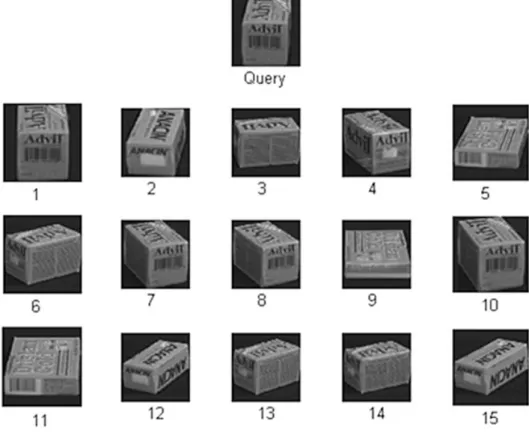
Figure 10 and Figure 11 show the retrieved re-sults of the proposed SVMBIR system, in which the first image is the query image. In Figure 10, the query image is a texture image, while in Figure 11 the query is a color image. We can see from these results that the proposed system is very efficient as set of images with same con-ception can be retrieved, which is more similar to the human visual system.
Table 3 shows execution times for different stages of SVMBIR system. In this simula-tion we have used coil-100 database and 12.5% training images. Simulation was carried out in Matlab 7.4 running on Dell 360 computer hav-ing 3.0 G.Hz CPU and 1.0 GB of RAM.
Stage Time
Feature extraction 0.2 sec/image SVM training 18sec/class Distance vectors 14 sec/svm Query execution 8 sec/query
Figure 10. Retrieved results of SVMBIR system for “Query” image.
6. Conclusion
In this paper, we presented a novel dual tree complex wavelet transform and support vec-tor machine-based image retrieval system. The proposed system is based on the observation that the images users need are often similar to a set of images with the same conception instead of one query image and the assumption that there is a nonlinear relationship between differ-ent features. In addition, we have shown how a correlation-based distance measure can be used to enhance the retrieval accuracy. Finally, we compare the performance of the proposed sys-tem with other image retrieval syssys-tem. Experi-mental results show that it is more effective and efficient to retrieve visually similar images hav-ing non-linear relationship among their feature vectors.
7. Acknowledgment
We thank Ghulam Ishaq Khan Institute(GIKI) for providing very conductive research environ-ment as well as financial and moral support.
References
[1] Y. RUI, T. S. HUANG, Image Retrieval: Current
Techniques, Promising Directions, and Open Is-sues.Journal of Visual Communication and Image Representation,10(1999), 39–62.
[2] S. DEB, Y. ZHANG, An Overview of Content-based
Image Retrieval Techniques.Aina,1(1) (2004).
[3] R. C. VELTKAMP, M. TANASE, Content-based Image
Retrieval Systems: A Survey. UU-CS-2000-34, De-partment of Computer Science, Utretch University, October 2002.
[4] A. DELBIMBO, M. MUGNAINI, P. PALA, F. TURCO,
L. VERZUCOLI, Image Retrieval by Color Regions. ICIAP 97, Image Analysis and Processing, 9th International Conference, Ember, Florence, Italy.
[5] G. L. GIMEL’FARB, A. L. JAIN, On retriving textured images from an image database.Patter Recognition,
29(9) (1996), 1416–1483.
[6] V. N. GUDIVADA, V. V. RAGHAVAN, Content-based
Retrieval Systems.Computer,(1995), 24–33.
[7] M. FLICKNER, H. SAWHNEY, Query by Image and
Video Content: The QBIC System.IEEE Computer,
(1995).
[8] B. S. MANJUNATH, W. Y. MA, Texture features for
browsing and retrieval of image data.IEEE Trans. Patt. Anal. Mach. Int. Special Issue on Digital Libraries,18(8) (1996), 837–842.
[9] J.-H. HAN, D.-S. HUANG, T.-M. LOK, M. R. LYU, A
Novel Image Retrieval System Based on BP Neural Network.International Joint Conference on Neural Networks (IJCNN 2005),(2005)Montr´eal, Qu´ebec, Canada.
[10] P. JANNEY, G. SRIDHAR, V. SRIDHAR, Enhancing capabilities of Texture Extraction for Color Image Retrieval.WEC,5(2005), 282–285.
[11] V. VAPNIK,Statistical Learning Theory. Wiley, New York, 1998.
[12] MIT-VISTEX-DATABASE,
http://vismod.media.mit.edu/vismod/ imagery/VisionTexture/vistex.html
[13] N. G. KINGSBURY, The Dual Tree Complex Wavelet Transform: A New Efficient Tool for Image Restoration and Enhancement.Proc. European Sig-nal Processing Conf.,(1998), 319–322.
[14] R. PETER, N. KINGSBURY, Complex Wavelets Fea-tures for Fast Texture Image retrieval.Proc IEEE Int. Conf. on Image Processing,(1999), 25–28.
[15] M. KOKARE, P. K. BISWAS, B. N. CHATTERJI,
Tex-ture Image Retrieval Using New Rotated Complex Wavelet Filters.SMC-B,35(6) (2005), 1168–1178.
[16] J. A. K. SUYKENS, T. VANGESTEL, J. DEBRABAN -TER, B. DEMOOR, J. VANDEWALLE,Least Squares Support Vector Machines. World Scientific, Singa-pore, 2002.
[17] P. JANNEY, G. SRIDHAR, V. SRIDHAR, Enhancing
Capabilities of Texture Extraction for Color Im-age Retrieval. InProceedings of World Enformatika Conference (Turkey),(2005).
[18] COLUMBIA OBJECT IMAGE LIBRARY (COIL-100),
http://www1.cs.columbia.edu/CAVE/ software/softlib/coil-100.php
[19] C. J. C. BURGES, A Tutorial on Support Vector
Ma-chines for Pattern Recognition.Data Mining and Knowledge Discovery,2(2) (1998), 955–974.
[20] M. G. ALBANESI, M. FERRETTI, A. GIANCANE, A
Compact Wavelet Index for Retrieval in Image Database.Iciap,00(1999), 927.
Received:November, 2006
Revised:August, 2007
Accepted:September, 2007
Contact addresses:
Syed Asif M. Gilani Faculty of Computer Sciences GIK Institute, Pakistan e-mail:[email protected]
Kamran Hameed Faculty of Computer Sciences AJK University, Pakistan e-mail:[email protected]
Tahir Jameel Faculty of Computer Sciences GIK Institute, Pakistan e-mail:[email protected]
ADEELMUMTAZreceived his BS(CIS)from Pakistan Institute of En-gineering and Applied Sciences, Pakistan. At present, he is a graduate student at GIK Institute, Pakistan. His area of interest includes content-based image retrieval, data mining and digital image watermarking.
DR. SYEDASIFGILANIreceived his M.Sc from Islamia University Pak-istan and Ph.D in digital image watermarking from University of Patras, Greece. He is assistant professor at Ghulam Ishaq Khan Institute of En-gineering Sciences and Technology, Pakistan. His research interests include digital image watermarking, steganography and image authen-tication. He has published a number of research papers internationally. At present, he is supervising many MS/Ph.D students at GIK Institute. He is also one of HEC and PCST approved Ph.D supervisors.
KAMRANHAMEEDreceived his MS in computer science from GIK Insti-tute Pakistan At present, he is assistant professor at the AJK university Pakistan. His area of interest includes content-based image retrieval, data mining and digital image watermarking.