INDICATORS OF OPEN SPACE QUALITY FOR CHILDREN IN HIGH-DENSITY SETTLEMENTS
Diah Intan Kusumo Dewi1, Anita Ratnasari Rakhmatulloh2 & Diva Amadea3
1,2,3
Department of Urban and Regional Planning Faculty of Engineering DIPONEGORO UNIVERSITY
Abstract
Open spaces are essential for city sustainability because they offer various functions. One of the benefits of open spaces is their use as outdoor space for physical activities or as learning areas for children. The purpose of this paper is to identify the indicators to measure and define open spaces appropriate for children in urban high-density settlements. This study was conducted in the peri-urban area of Tembalang, Semarang, Indonesia. In order to determine appropriate indicators, this study made use of environmental characteristics as indicators. The result showed that security, safety, comfort, and accessibility were essential factors of appropriate open spaces for children in urban high-density settlements. The contribution of this paper is to promote the importance of open space for children’s activities.
INTRODUCTION
Open space is an area or territory that accommodates human outdoor activities and are among the many fetures attached to neighbourhoods, cities or any other types of human settlements. Therefore, it has direct influence towards the inhabitants; physical, psychology and emotional well being (Mirsa, 2012). The elements of an open space include streets, parks and areas in between buildings which are essential in human interactions and urban sustainability (Omar, Ibrahim, & Mohammad, 2015).
It is suggested by Abbasi, Alalouch, & Bramley (2016), that the quality of open space is related to income level. Poor quality open spaces can be noticed in settlements of those with low income. People with very low income tend to live in areas that are unplanned, overcrowded and squalid. In many cases, proper open spaces are not provided in low-income areas.
Open spaces function as activity and learning areas for children. According to Joga (2013), a city must fulfil the needs of its inhabitants, which include the needs of the children. The availability of open spaces is decreasing in proportion due to other human needs supplied through shopping malls and commercial buildings. Residential needs increase as population increases. In addition, the rural to urban migration also contributes to the rising of residential needs. Thus, resulting in landuse changes from non-constructed landuse to overcrowding settlements.
One of the many issues in the densely populated settlements is the narrow open spaces. Children living in these types of settlements ended up using immediate open spaces available to them, such as streets and terraces for their activities. Prior study suggested that sidewalks and streets are used as open space for children’s activities (Carr, 1992). These are however, sidewalks and streets are unplanned open spaces, hence the lack of quality and appropriateness. This paper therefore aims to recommend the indicators of quality and appropriate open spaces applicable to high-density settlements, particularly to the peri-urban areas.
INDICATORS IN DETERMINING THE QUALITY OF OPEN SPACE FOR CHILDREN
Table 1 Open Space Quality Indicators
Variables Summary/Explanation Indicators
Security
Security in open spaces means to secure the children from any harm such as accidents, trafficking, and other crimes. Security determinants include (i) the distance from the settlement to the open space ≤ 200 m, (ii) absence of physical limitations that limit the view of the parents to open spaces, (iii) absence of perpetrators threatening children’s’ safety, and (iv) distance to the environmental activity center ≤ 100 m (Moore, 1992 in Dewi, 2010; Osman etc.all ,2017). Security features should not expose children to crime-prone avenues such as drug trafficking (Veugelers, Sithole, Zhang, & Muhajarine, 2008 in Zhang & Lin, 2010; Carr, 1992; Alraouf, 2008).
• Absence of barriers limiting parents’ view of the space • Absence of perpetrators
threatening children’s’ child safety
• Distance from settlement to open space ≤ 200 m
• Distance to environmental activity center ≤ 100 m
Safety
Safety in open spaces means not to endanger the children. Safety determinants are (i) the distance from vehicles passing by > 5 m, (ii) absence of sharp borders, (iii) absence of steep/sloping dirt, (iv) absence of risky tools (Moore, 1992 in Dewi, 2010). Traffic safety is the most alarming issue for parents. Parents tend to restrict their children from playing in the open spaces due to lack of traffic safety (Panter, Jones, van Sluijs, & Griffin, 2010; Puglisi, Okely, Pearson, & Vialle, 2010 in Zhang & Lin, 2010; Alraouf, 2008). Parents also need to pay attention to things that might injure the children such as sharp items or broken glasss (Carr, 1992).
• Absence of sharp boarders • Absence of steep slopes of
land
• Absence of tools risking children’s safety
• Distance from passing vehivles > 5 m
Comfort
Comfort determinants include (i) absence of scattered rubbish, (ii) availability of trash can and shady trees, and (iii) absence of vehicles that take up too much of the open spaces (Moore, 1992 in Dewi, 2010). A comfortable environment should demonstrate aesthetics relating to quality home exteriors, such as a garden or greeneries free of vandalism (Saelens et al., 2003; Zhang & Lin, 2010).
• Absence of cars taking up the open spaces
• Absence of scattered litter • Availability of seating areas • Availability of trash cans • Availability of shady areas
Accessibility
Open spaces should be free of high walls or barriers with a height of more than 150 cm enclosing the area. The open spaces should not be located across or along rivers/gullies/highways and in pedestrian paths next to vehicular lanes (Moore, 1992 in Goddess, 2010). A good accessibility offers opportunity to walk instead of driving. High walkability area allows children to walk, run and cycle in the open spaces. (Holt et al., 2008; Holt et al., 2009 in Zhang & Lin, 2010).
• Not located across or along the river/gullies/highways • Availability of pedestrian
paths along vehicular lanes • Absence of high walls or
barriers with a height of more than 150 cm enclosing the area
METHOD
Case Study: Tembalang as a High-Density Settlement
The field study was conducted in Tembalang, Semarang. Tembalang is a peri-urban area in Semarang City, which covers four villages located in the Districts of Banyumanik and Tembalang. Based on the Central Bureau of Statistics (BPS) in Semarang, the population in Tembalang in 2015 amounted to 35,866, covering an area of 922 hectares, resulting in a population density of 36.15 persons/ha. One limitation is that, eventhough Tembalang is reported as an area of low density (Ministry of Public Works, 2004) the population density calculation showed something different. This could be done to the in and out movement of sections of the population, for education purposes.
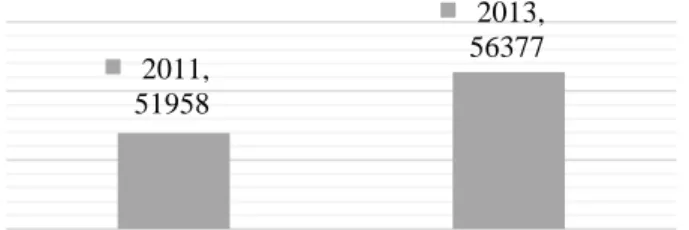
Figure 1 The number of migrants entering Tembalang area
Source: The Central Bureau of Statistic in Semarang, 2013
i. The number of populations recorded cannot represent the actual population as the Tembalang is an academic area, hence the migration rate is very high. Based on the Central Bureau of Statistics (2013), the number of migrants in 2013 was 56,377 consisting of students and employees of academic institutions. The number had increased from 51,958 in the year 2011 (refer to Figure 1).
ii. Boarding houses had increasingly dominated Tembalang. Residents of boarding houses were students and employees of academic institutions. On average, one boarding house was occupied by 10 to 25 residents.
iii. The calculated area did not cover the area of the settlement, instead it merely covered the administrative area.
Based on these limitations, re-calculation was done by (i) identifying the number of boarding houses, (ii) using the assumption that each boarding house was occupied by 25 residents, and (iii) using the area of the settlement instead of the administrative area as the basis for calculation. The re-calculation revealed that the population density in Tembalang was 209.17 persons/ha. Such density was considered as high density (refer to Figure 2) based on Standard National Indonesia (Ministry of Public Works, 2004).
2011, 51958
Figure 2 Tembalang Area Map and Aerial Images
Source: Bappeda (the City Development Planning Agency) Semarang, 2011 and Google Earth
Identifying Characteristics of Open Spaces in Tembalang
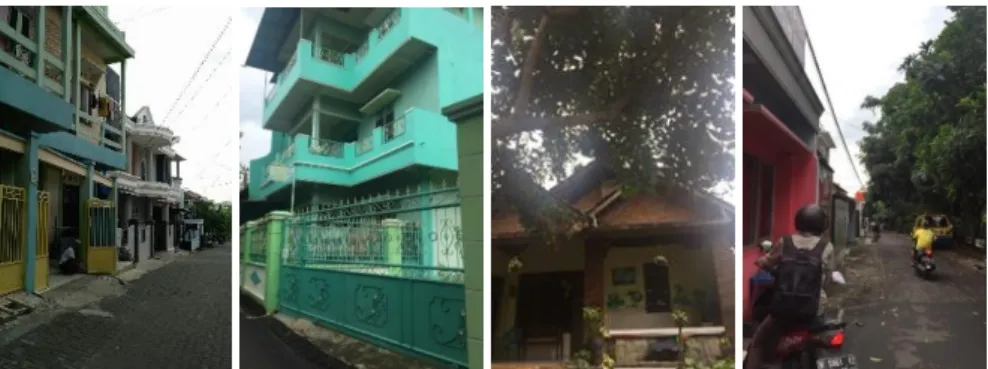
The characteristics of open spaces used by children in Tembalang were streets, fields and yard. Streets used by children were usually the local streets or alleys that were hardly used as roads for vehicles. Children were often seen in open spaces with proximity of 50 - 100 meters from their homes. Carr (1992) stated that the roads can be used as a place of activity for children. Previous studies also suggested that local streets and alleys are the places most often used by children (Ekawati, 2014).
Characteristics of children in the open spaces include children aged 6-12 years old. According to Santrock (206-12), 6 to 6-12 years of age are considered the middle and late childhood. That is, they are more independent than the early childhood and are more often seen in open spaces. Childrens activities in the open spaces in Tembalang were usually physical acitivities with peers, such as sports and recreation. These activities were seen in the afternoon and after school. According to ekawati (2014), there is a difference in activities led by children in local streets and alleys. In local streets, the children usually participate in rigorous activities, while in the alleys, the children tend to have passive activities. The types of activities were attributed to the size of the streets. Local streets have a larger width than the alleys, hence encouraging more activities.
Figure 3 Activities Open Spaces: Gondang and Baskoro Streets and Facing Houses
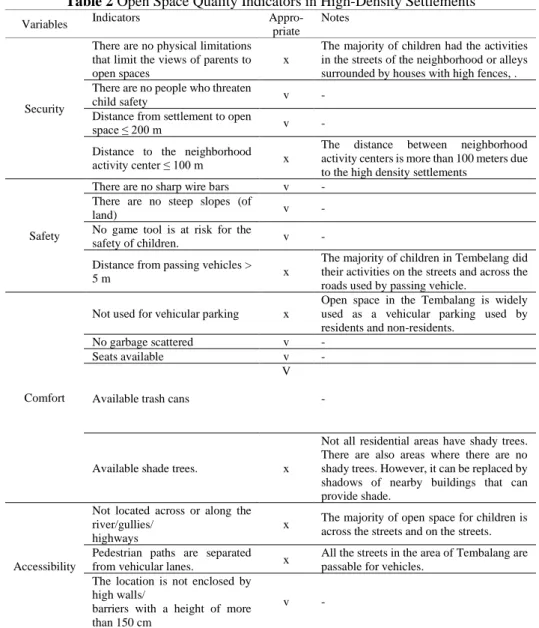
VALIDATION OF OPEN SPACE QUALITY INDICATORS IN HIGH-DENSITY SETTLEMENTS (CASE STUDY TEMBALANG AREA) Based on the theory and the observation, the indicators of quality open space were validated. These indicators can be used to determine ideal residential areas. This study assessed the conditions in Tembalang using the indicators. Tembalang consists of planned and unplanned settlements. Planned settlements refers to housing built by the developers. The majority of settlements in Tembalang is unplanned settlements. As mentioned earlier, Tembalang is a dense residential area due to a high migration rate. Although Tembalang has a considerably large non-built up area, it is a protected area. Additionally, the land in Tembalang is gently undulating, hence some areas could not be built on. Majority settlements in Tembalang consists of vertical residence and houses are built closely to one another. Based on the described characteristics, it is therefore possible to determine the indicators for quality open spaces.
Table 2 Open Space Quality Indicators in High-Density Settlements
Variables Indicators
Appro-priate Notes
Security
There are no physical limitations that limit the views of parents to open spaces
x
The majority of children had the activities in the streets of the neighborhood or alleys surrounded by houses with high fences, . There are no people who threaten
child safety v -
Distance from settlement to open
space ≤ 200 m v -
Distance to the neighborhood
activity center ≤ 100 m x
The distance between neighborhood activity centers is more than 100 meters due to the high density settlements
Safety
There are no sharp wire bars v -
There are no steep slopes (of
land) v -
No game tool is at risk for the
safety of children. v -
Distance from passing vehicles >
5 m x
The majority of children in Tembelang did their activities on the streets and across the roads used by passing vehicle.
Comfort
Not used for vehicular parking x
Open space in the Tembalang is widely used as a vehicular parking used by residents and non-residents.
No garbage scattered v -
Seats available v -
Available trash cans
V
-
Available shade trees. x
Not all residential areas have shady trees. There are also areas where there are no shady trees. However, it can be replaced by shadows of nearby buildings that can provide shade.
Accessibility
Not located across or along the river/gullies/
highways
x The majority of open space for children is across the streets and on the streets.
Pedestrian paths are separated
from vehicular lanes. x
All the streets in the area of Tembalang are passable for vehicles.
The location is not enclosed by high walls/
barriers with a height of more than 150 cm
CONCLUSION
This study investigated the environmental characteristics specifically the characteristics of open spaces that influence children’s activities. Children’s activities depend on the availability of open spaces in the neighborhoods. Environmental characteristics such as street patterns, land use, and population density shape children’s activities. Indicators of quality open space used in this study were based on Western literatures. For the purpose of this study, appropriate adjustments were done in order for the indicators to suit Asian living conditions. Planners should develop more indicators of quality open spaces to promote children’s well being within conducive neighborhood designs in an effort to achieve better living standards.
ACKNOWLEDGEMENT
This study was supported by a grant from the Department of Urban and Regional, Faculty of Engineering, Diponegoro University, Semarang, Indonesia.
REFERENCES
Abbasi, Ayah, Chaham Alalouch, and Glen Bramley. (2016). “Open Space Quality in Deprived Urban Areas: User Perspective and Use Pattern.” Social and Behavioral Sciences, 216, 194–205.
Alraouf, Ali A. (2008). “Towards a Safe Place for Children in Today’s residential Neighbourhoods” Planning Malaysia: Journal of The Malaysian Institute of Planners, VI, 57-73
Badan Pusat Statistik Kota Semarang/BPS (the Central Bureau of Statistic). (2016).
Kecamatan Banyumanik dalam Angka 2016. Semarang: Badan Pusat Statistik
Kota Semarang.
Badan Pusat Statistik Kota Semarang/BPS (the Central Bureau of Statistic). (2016). Kecamatan Tembalang dalam Angka 2016. Semarang : Badan Pusat Statistik Kota Semarang.
Badan Pusat Statistik Kota Semarang/BPS (the Central Bureau of Statistic). (2013). Kota
Semarang dalam Angka Tahun 2013. Semarang: Badan Pusat Statistik Kota
Semarang.
Carr, Stephen. (1992). Public Spaces. New York: Cambridge University Press.
Dewi, Santy Paulla. (2012). “How Does The Playground Role in Realizing Children-Friendly-City?”. Social and Behavioral Sciences, 38, 224–233.
Ekawati, Sri Aliah. (2014). “Children – Friendly Streets as Urban Playgrounds”. Social and Behavioral Sciences, 38, 94–108.
Joga, Nirwono. (2013). Gerakan Kota Hijau. Jakarta: Gramedia Pustaka Utama. Mirsa, Rinaldi. (2012). Elemen Tata Ruang Kota. Yogyakarta: Graha Ilmu.
Perception of Parents and Guardians on Safe Distance for Children to Travel to Public Areas.” Planning Malaysia: Journal of The Malaysian Institute of Planners, 15(1), 201-208
Santrock, John W. (2012). Life-Span Development: Perkembangan Masa Hidup Jilid 1. Edisi Ketigabelas. Terjemahan Benedictine Widyasinta. Jakarta: Erlangga. Ministry of Public Works (2004) Standard National Indonesia 03-1733-2004 by Ministry
of Public Works.