AJPRHC Volume 4 Issue 2 63-69
AJPRHC
Research Article
QUALITATIVE ANALYSIS AND ANTHELMINTIC ACTIVITY OF HYDRO-ALCOHOLIC EXTRACT
OF TABERNAEMONTANA DIVARICATA
B. N. VEDHA HARI,* AKHILA SRAVYA DANTU, P. SHANKARGURU, D. RAMYA DEVI
For Author affiliations see end of the text
This paper is available online at www.jprhc.in
ABSTRACT
Tabernaemontana divaricata is a common shrub found in the tropical regions and is often used for medicinal purposes, particularly the flowers of the plant. The present study is conducted to compare and identify the phytochemical constituents by Thin Layer Chromatography (TLC) and Qualitative Phytochemical analysis and to determine the anthelmentic activity of fresh and driedflower extract of Tabernaemontanadivaricata. The extract is obtained using two different methods like cold maceration and hot solvent extraction by using soxhlet apparatus, first with petroleum ether followed by hydroalcohol as solvents. The preliminary phytochemical analysis of the extract indicated the presence of Alkaloids, Flavanoids, Steroids, Proteins, Carbohydrates and Tannins. The Rf value of TLC is calculated and compared with standard values and analysis proved the presence of the phytochemical constituents. The anthelmentic activity studies are performed using Indian earth worms. For this, the concentrated extract is diluted to various concentrations, and the effect of each solution is studied by measuring the time taken for paralysis and death of the earth worms. It is found to show significant anthelmentic activity at various concentrations compared with that of the standard drug Metronidazole.
Key words: Thin Layer Chromatography; Eudrilus eugeniae; Eisenia foetida
INTRODUCTION
Plant derived agents, an important source of drug possess the ability to treat human ailments and form a major segment in the pharmacopeia. Though medicinal plants have been used in the ancient times they have gained more importance in the recently. The synthetic products are considered to be unsafe as compared to the natural products [1]. It has been estimated that more than half of the world population use plant extracts for treatment of various diseases [2]. About 120 therapeutic agents of known structure have been obtained from flowering plants [3]. Helminthiasis is a disease wherein part of the body is infested with parasitic worms. Though many drugs have been developed for the treatment of helminthiasis their importance is lost because the organisms have become resistant to these drugs. Hence the use of natural products for the treatment of helminthiasis has been exploited.
Tabernaemontana divaricata belonging to the family Apocynaceae is an ornamental, flowering, evergreen shrub that generally grows to a height of 6 ft [4] and comes under the genus Tabernaemontana which consists of 100-110 species of flowering plants. The flowers are white and sweetly fragnant [5], the leaves and flowers of the plant have been used for the opthalmitis and dermatopathy in the folk medicine [6] and other medicinal properties of the plant include Anixolytic[5], Antidiabetic[7] and Anticonvulsant [8]activities.
AJPRHC Volume 4 Issue 2 63-69 earth warms resembles to be similar to warms present in gut region, the effectiveness of the flower extract against helminthiasis is also tested.
MATERIALS AND METHODS:
Plant collection and identification:
Flowers of T.divaricata were collected in the month of January and February at mornings and evenings and authenticated by Dr. N. Ravichandran, CARISM, SASTRA University, Thanjavur- 613 401. The herbarium is stored in the department.
Collection of Worms:
Worms required for evaluation of the anthelmenthic activity of T.divaricata was collected and authenticated by M/s Sri Amman Biocare, Thanjavur, Tamil Nadu, India. Two different species of worms collected were Eudrilus eugeniae and Eisenia foetida. The worms were placed in a ventilated bag with sufficient nutrients until the study was performed.
Preparation of Extract:
The fresh flowers of the plant were shade dried for about 3 weeks and ground to coarse powder using a mixer. Similarly fresh leaves of equivalent weight of the flowers (60 g) were collected in the morning and sliced to coarse powder without drying. Extraction was performed by two different methods for comparison of the components and yield for better understanding and estimation.
1. Soxhlet extraction method(SE):
The powder of dried and coarse mass of fresh flowers were processed with petroleum ether (40-50ºC) for 18 hrs using a soxhlet extraction method in order to remove fat and pigment components. The treated powder was further processed with hydro-alcoholic solution in the ratio of (25:75) by using same extraction process for 18 hrs. In order to get a crude hydro-alcoholic extract devoid of solvents, the extract was concentrated by evaporating the solvent using a water bath maintaining at 60-80º C at ambient conditions. [9]
2. Cold Maceration (CM):
The powder of dried (30 g) and coarse mass of fresh flowers (30 g) were taken in conical flasks separately and hydro-alcohol solution was added. This was placed as such for 48 hrs with intermittent stirring. The supernatant solution was decanted and replaced with fresh media, again the solvent is allowed for extraction for another two days. The extracts were pooled together and was further evaporated using water bath to obtain a concentrated crude extract. [9]
Qualitative Phytochemical screening:
Phytochemical constituentspresent in hydro-alcoholic extract of fresh and shade dried flowers were screened for their comparison using standard chemical test protocols [10]and the resulsts were tabulated.
Thin layer Chromatography:(TLC)
TLC is a technique used to identify the phytochemical constituents present in an extract by capillary action. [11] The following steps were performed for TLC analysis.
Preparation of Stationary Phase (TLC plates):
Silica gel was used as a stationary phase. Required amount of silica gel was taken in a beaker and sufficient amount of water was added to make slurry. A cleaned and dried glass slide of approximately 2cm width and 7 cm length was taken and the silica gel slurry was poured over it to obtain a thin, uniform layer of 1-2mm thickness. The plates were dried by air drying for 30 min and further activated by drying at 110º C for an hour to remove the water molecules attached to the polar band of the plate.
Preparation of Mobile Phase (Solvent System):
Petroleum ether (PE), Hexane (H), Methanol (M) and Ethyl acetate (EA) were the solvents used for preparing the solvent system[12]. The solvents were taken in different ratios in a TLC chamber and a filter paper was placed into the solvent system vertically to obtain saturation of the solvent system.
Spotting the TLC plates:
AJPRHC Volume 4 Issue 2 63-69 plates to obtain optimum quantity of the extract and to avoid tailing. The plates were further placed in the solvent system and after three fourths of the solvent has moved over the plates, the plates were air dried at room temperature. The dried plates were placed in a chamber containing iodine. The iodine vapour oxidizes the substances present on the plates thus making them visible. The Retention factor (Rf) was calculated to identify the
substances present by using the formula:
Rf value = Distance traveled by the substance
Distance moved up by the solvent Anthelmentic activity:
The two different species of worms were washed in saline solution and measured for length and diameter using scale. Worms of similar sizes were placed in petriplates and exposed to different concentrations of (100 - 400) mg/ml of hydro-alcoholic extract obtained by Soxhlet extraction and Cold maceration of dry flowers. Metronidazole (10mg/ml) was used as the positive control and distilled water as the negative control. The time taken for paralysis and the time of death was noted for each organism.
RESULTS AND DISCUSSION
Qualitative Phytochemical analysis:
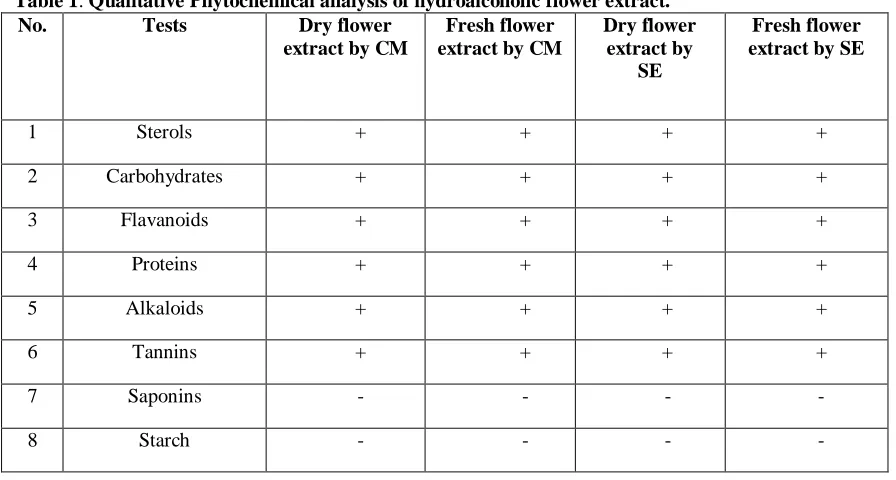
With the addition of appropriate reagent solutions for identification of various compounds by observing the standard inferences, the phytochemical evaluation revealed the presence of sterols, carbohydrates, flavanoids, proteins, alkaloids and tannins in all the four extracts. The results for Phytochemical screening are shown in table 1.
Thin Layer Chromatography:
The TLC analysis of the extracts using different solvent systems showed the presence of various chemical constituents. The separation of the compounds depends on the polarity of the solvents and the extract. Different Rf
values obtained indicated the presence of various phytochemical constituents. The component which shows less Rf
value in a less polar solvent has high polarity and a high Rf value in less polar solvent shows that the component is less polar [13]. From table 2 it can be observed that the time taken for the solvents to move over a fixed distance also differs based on polarity. The time taken by H and PE separately is more as compared to the other solvent mixtures which might be due to the low polarity index of both.
Table 1: Qualitative Phytochemical analysis of hydroalcoholic flower extract.
No. Tests Dry flower
extract by CM
Fresh flower extract by CM
Dry flower extract by
SE
Fresh flower extract by SE
1 Sterols + + + +
2 Carbohydrates + + + +
3 Flavanoids + + + +
4 Proteins + + + +
5 Alkaloids + + + +
6 Tannins + + + +
7 Saponins - - - -
AJPRHC Volume 4 Issue 2 63-69 Table No.: 2 Qualitative analysis by TLC
Sample name PE:E
A (9.5:0. 5) PE:EA (9:1) H:EA (9.5:0.5) H:EA (9:1) PE:ME (9:1)
PE H
Cold maceration
0.038, 0.38, 0.865
0.8, 0 0.096, 0.192, 0.288, 0.423, 0.769, 0.96 0.577,0.73,0 .865, 0.98 0.038, 0.076, 0.115, 0.192 0.057, 0.096, 0.576 0.038, 0.096, 0.576 Soxhlet apparatus 0.096, 0.538, 0.96
--- 0.135, 0.308, 0.423, 0.385, 0.48, 0.577,
0.865
0.288, 0.67, 0.866, 0.96
--- 0.307, 0.711, 0.807 0.057, 0.192 Time* (min)
4.58 3.41 4.18 5.5 4.47 4.70 5.43
Percentage Yield:
The yield obtained for fresh flowers by CM was 37.9766% and by SE was 22.556%. The yield for dry flowers by CM was 87.38% and SE was 46.67%. Since the yield for fresh flowers was less, anthelmintic activity using fresh flower extract was not performed.
‘*’ Time taken for the solvent to move over a fixed distance of 5.2 cm.
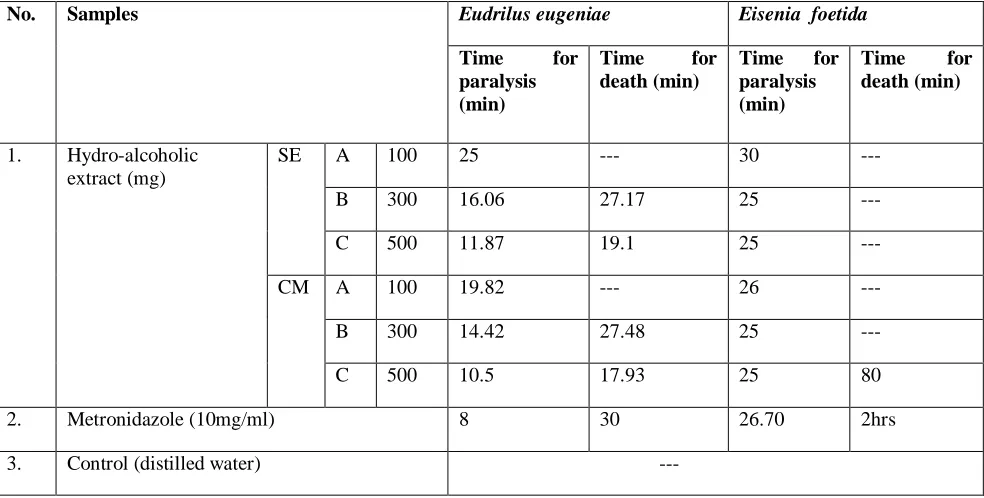
Table 3: Comparative anthelmentic activity of hydroalcoholic extract of dried flowers of T.divaricata in two different species
No. Samples Eudrilus eugeniae Eisenia foetida
Time for
paralysis (min)
Time for
death (min)
Time for paralysis (min)
Time for
death (min)
1. Hydro-alcoholic extract (mg)
SE A 100 25 --- 30 ---
B 300 16.06 27.17 25 ---
C 500 11.87 19.1 25 ---
CM A 100 19.82 --- 26 ---
B 300 14.42 27.48 25 ---
C 500 10.5 17.93 25 80
2. Metronidazole (10mg/ml) 8 30 26.70 2hrs
AJPRHC Volume 4 Issue 2 63-69
Fig 1: TLC profiling of the hydro-alcoholic CM and soxhlet extract of the dry flower.
a- PE:EA(9.5:0.5), b- PE:EA(9:1), c- H:EA(9.5:0.5), d- H:EA(9:1), e- PE:ME(9:1), f- PE, g-H. The spot on the left is for CM extract and that on the right is for SE.
a b c d e f g
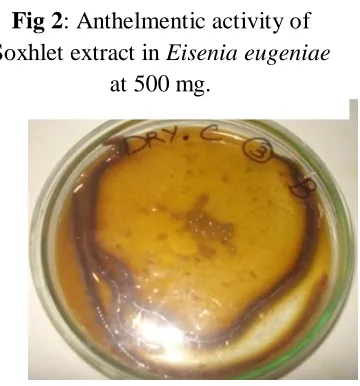
Fig 2
: Anthelmentic activity of
Soxhlet extract in
Eisenia
eugeniae
at 500 mg.
eugeniae
eugeniae
Fig 3
: Anthelmentic activity of CM extract
in
Eisenia
eugeniae
at 500mg
Fig 4
: Anthelmentic activity of CM
extract in
Eisenia foetida
at 500mg
AJPRHC Volume 4 Issue 2 63-69 CONCLUSION
Anthelmentic activity:
From the results of anthelmentic activity shown in table 3 we observed that time taken for paralysis of Eudrilus Eugenia (approximately 7.5cm) by both cold macerated and soxhlet extraction of dry flower extract was within 20 min for a concentration of 300 and 500mg and time of death was around 20 min for 500 mg concentration of both the extracts and around 28 min for 300 mg concentration. Though the time of paralysis was found to be more than that of the standard drug the time of death of the organism was found to be significantly less than the standard drug. The time of paralysis for Eisenia foetida (approximately 12cm) was found to be around 25 min for both extracts which was less than that of the standard drug. The time of death of the organism by CM extract was found to be 80 min at 500 mg concentration. At rest of the concentrations the extract was not much effective over the organisms which might be due to the larger length and diameter of the organism.
The qualitative phytochemical studies and TLC profiling of the extracts indicated the presence of different chemical constituents. The studies carried out using hydroalcoholic extract of Tabernaemontana divariacata revealed that the extract has a good activity against the worms at higher concentrations. Hence we conclude that the flower extract of
Tabernaemontana divariacata can be used against helminthiasis. ACKNOWLEDGEMENT
The authors are grateful to the management of SASTRA University for providing necessary facilities for conducting this project.
REFERENCES
1.
Soriful Islam M, Most. Mauluda Akhtar, Mostafizur Rahman M, Atikur M, et al, Antitumor and Phytotoxic Activities of Leaf Methanol Extract of Oldenlandia diffusa (Willd.) RoxbGlobal Journal of Pharmacology, 2009;3 (2): 99-106.2.
Das BK, Das B, Arpita FK, Hannan JMA et al, Phytochemical Screening And Antioxidant Activity OfLeucas Aspera, IJPSR ,2011;2(7):.
3.
Joy PP, Thomas Samuel Mathew J, Baby, et al, Medicinal plants, 1998.4.
Rahman MD. Ashikur MD. Hasanuzzaman Rahman MD et al, Evauation of anibacterial activity of study of leaves of Tabernaemontana divaricata (L), IRJP, 2011; 2(6): 123-127.5.
Basavaraj P, Shivakumar B, Shivakumar H. Anxiolytic Activity Of Tabernaemontana divaricata (Linn) R.Br. Flowers extract in mice. International Journal of Pharma and Bio Sciences, 2011, 2 (3).6.
Orient Longman, Indian Medicinal Plants, a compedium of 500 species, 1996, 5, 232-234.7.
Masudur Rahman Md, Saiful Islam Md, Sekendar Ali Md, et al, Antidiabetic and Cytotoxic Activities of Methanolic Extract of Tabernaemontana divaricata (L.) Flowers, International Journal of Drug Development & Research, 2011; 3:8.
Basavaraj P, Shivakumar B, Shivakumar H, Manjunath V J et al, Evaluation Of Anticonvulsant Activity OfTabernaemontana Divaricata (Linn) R. Br. Flower Extract. International Journal of Pharmacy and Pharmaceutical Sciences, 2011, 3(3).
9.
Abah SE, Egwari LO, Methods of extrraction and Antimicrobial succesptibility testing of plant extracts,African journal of basic and applied sciences,2011;3(5):205-209.10.
Gupta Shailesh and Kohli Seema, Phytochemical screening of Sarcostigmma acidum W. & Ar., International journal of pharmacy & life sciences, 2011; 4.11.
Dutta Choudhury M, Katyayani Dutta Choudhury, TLC Profiling of Lasianthus lucidus Blume. (Rubiaceae). Assam University Journal of Science & Technology , 2011;7:114-117.12.
Sahu Vinod K, Irchhaiya Raghuveer, Shashi Alok, Gurjar Himanshu Phytochemical investigation and chromatographic evaluation of the ethanolic extract of whole plant extract of Dendrophthoe falcata (l.f.), IJPSR (2010);1 (1): 40-45.AJPRHC Volume 4 Issue 2 63-69 *Address for correspondence
BN. Vedha Hari Asst. Professor,
Department of Pharmaceutical Technology, School of Chemical and Biotechnology, SASTRA University,
Thanjavur-613401.