European Journal of Physical Education and Sport Science
ISSN: 2501 - 1235 ISSN-L: 2501 - 1235 Available on-line at: www.oapub.org/edu
Copyright © The Author(s). All Rights Reserved. doi: 10.5281/zenodo.2593227 Volume 5 │ Issue 7 │ 2019
LIPIDEMIC PROFILE OF MEN PARTICIPATING
IN RECREATIONAL TEAM SPORTS AND INACTIVE MEN
Fotios Mavrovouniotisi School of Physical Education and Sport Sciences,
Aristotle University of Thessaloniki, 54124 Greece
Abstract:
The purpose of the present study was to examine the effects of exercise in the form of recreational team sports on resting lipidemic factors of healthy young men. Thirty-four healthy men, 20-37 years old, volunteered to participate in the research. The subjects were separated in two groups, exercisers who participated regularly during the last six months in recreational team sports such as volleyball, basketball and football (Group A, n=17) and inactive men who did not exercise regularly, with a frequency of more than 1 hour per fortnight during the last six months (Group B, n=17). Measurements of anthropomorphological and hemodynamic characteristics were taken place. For the evaluation of lipidemic profile, triglycerides (TG), total cholesterol (TC), low density lipoproteins (LDL) and high density lipoproteins (HDL) at rest were measured, while ratios TC/HDL and LDL/HDL were estimated. For data analysis, descriptive statistics, and independent samples t-tests of the SPSS ver. 20.0 for windows was used. The results showed that hemodynamic state of exercisers is better than that of inactive men, since they have lower heart rate (64.82+15.23 vs 69.41+11.61 bpm), systolic blood pressure (114+10.58 vs 115.35+12.90 mmHg), and diastolic blood pressure (72.06+10.91 vs 78.65+12.13 mmHg) at rest. In addition, there were observed significantly more increased HDL (+29.25%, p<0.01), but significantly more decreased TG (-37.87%, p=0.05), TC (-16.84%, p<0.01), LDL (-22.38%, p<0.01), TC/HDL (-35.99%, p<0.001) and LDL/HDL (-44.56%, p<0.001) in the group of young men who participate in regular exercise in the form of team sports compared with the group of young men who didn’t participate in any exercise. Thus, from the results of the present study it is obvious that regular participation in recreational team sports improves participants’ lipidemic profile, which may be a favourable effect for cardiovascular system. Consequently, exercise programs in the form of recreational team sports such as football, volleyball and basketball are recommended for young men, in order to be achieved engagement and adherence to an exercise program aiming on health benefits, especially concerning blood lipids.
Keywords: blood lipids, hyperlipidemia, regular exercise, inactivity, physical fitness, cardiovascular health
1. Introduction
Elevated levels of TC, TG and LDL, as well as low levels of HDL, constitute hyperlipidemia (Collins, 2006). In addition, the combination of hypertriglyceridemia, low levels of HDL and a preponderance of small, dense LDL particles also have been named the “atherogenic lipoprotein phenotype”, “atherogenic dyslipidemia” or “lipid triad” and has been associated with the central components of the metabolic syndrome, that is impaired insulin-mediated glucose disposal and abdominal fat accumulation (Carroll, & Dudfield, 2004; Grundy, 1998). Hyperlipidemia does not simply express elevated levels of TC, TG and LDL, and low levels of HDL, but represents a major risk factor for cardiovascular disease (CVD) (Collins, 2006). CVD results in substantial morbidity and mortality in most western countries in the world that appears to be similar in men and women (Carroll, & Dudfield, 2004).
Yusuf et al. (2004) examined approximately 27000 subjects (12461 cases and 14637 control), in 52 countries all over the world (Asia, Europe, Middle East, Africa, Australia, North America, South America). The researchers found that abnormal lipids - raised ApoB/ApoA1 ratio, smoking, history of hypertension, diabetes, abdominal obesity, psychosocial factors, daily consumption of fruits and vegetables, regular alcohol consumption, and regular physical activity, were all significantly related to acute myocardial infarction (p<0.0001 for all risk factors and p=0.03 for alcohol). These associations of risk factors to myocardial infarction and their population-attributable risks were noted in men and women, old and young, and in all regions of the world. Collectively, these nine risk factors accounted for 90% of the population-attributable risks in men and 94% in women (Yusuf et al., 2004).
Genetic and environmental factors are also significant. Metabolic diseases and risk factors, including diabetes mellitus, obesity, dyslipidemia, hypertension, and insulin resistance, have a substantial impact on the development of coronary heart disease (CHD). These risk factors contribute to the development of atherosclerosis and thrombotic complications (Carroll, & Dudfield, 2004). As for hyperlipidemia, there is a strong positive correlation between elevated plasma LDL levels, decreased HDL levels and atherosclerosis development (Butcher et al., 2008). Thus, elevated levels of LDL and low levels of HDL constitute a major risk of developing CVD (Ridker, 2003; Kaptoge et al., 2012).
Reducing the CHD risk factors can slow the progression of CHD and its clinical complications before, and even after, the occurrence of a cardiovascular event (Carroll, & Dudfield, 2004). In addition, approaches to prevention have the potential to prevent most premature cases of myocardial infarction (Yusuf et al., 2004).
benefits. Exercise training programs may induce favorable adaptations on lipoproteins profile, and cardiovascular parameters which are clinically desirable in primary and secondary prevention of CHD (Rankovic et al., 2012).
Regular physical activity has the potential to decrease CHD risk through multiple favorable physiologic effects, which include alteration of the lipoprotein profile. More specifically, regular exercise increases the plasma HDL level, decreases the ratios of TC/HDL and LDL/HDL, and decreases the TG concentration in young, middle-aged and old subjects (Haskell, 1984; Kostka et al., 2001).
As far as, the absolute risk of CHD at any age, even after adjusting for risk factors, is about two to three times greater in men (Collins, 2006) and the regular exercise effects positively the participants’ lipidemic profile (Haskell, 1984; Kostka et al., 2001), the purpose of the present study is to examine the effects of exercise in the form of recreational team sports such as volleyball, basketball and football on the lipidemic profile of healthy men.
2. Methods
2.1 Sample
Thirty-seven young healthy men, 20-37 years old, volunteered to participate in the research. According to their occupation with physical activity and sports, the subjects were separated in two groups, exercisers who participated regularly in recreational team sports (Group A) and inactive men (Group B). There were 18 exercisers and 19 inactive men. Exercisers considered those who participated systematically during the last six months in football, volleyball and basketball teams. Inactive men considered those who, on average, did not exercise regularly with a frequency of more than 1 hour per fortnight during the last six months. In addition, entry criteria included no history of angina, myocardial infarction, stroke, chronic pulmonary disease, diabetes, hypertension, any medication use, current smoking, or exercise-limiting orthopedic impairment.
A written informed consent for the participation in the research was obtained from each man. All the men, before the beginning of the research, underwent medical control so that it could be certified that they do not suffer from any cardiovascular or other disease and, also, that they do not take any medication. Additionally, they answered a questionnaire about any health problems, while a research assistant was present in order to give any essential clarifications if there were any questions.
2.2 Measurements
A. Anthropomorphological characteristics
Measurements of body mass and height were taken place. Body mass was measured using a Microlife WS80 electronic scale with a precision of 0.1 kg. Body height was measured with a precision of 0.5 cm using a Seca 216 height measuring. In addition, Body Mass Index (BMI) was estimated (body mass/height2).
B. Hemodynamic characteristics
Systolic and diastolic blood pressure at rest were measured with an analog sphygmomanometer. In addition, Heart Rate (HR) at rest was measured with a Polar - Sport Tester. Measurements were done with each subject in a resting position for at least 10 min.
C. Lipidemic factors
For lipidemic profile evaluation, TG, TC, LDL, and HDL were measured. In addition, ratios TC/HDL and LDL/HDL were estimated.
D. Blood sampling procedure
All blood samples were drawn between 8:00 and 11:15 AM. Concerning the group of exercisers, samples were drawn at least 36 hours after the last exercise bout to avoid the potential acute effects of exercise. 9 ml of venous blood were taken from the vein of the forearm, the radial or ulnar with venipuncture and 20 or 21 (0.9 or 0.8 mm) gauge needle commonly used for the veins of the forearm. Samples were drawn with each subject in a resting position for at least 20 min. Subjects were fasted for 12-14 hours.
E. Assays
For the determination of lipids and lipoproteins, a tube without anticoagulant was used. Then, after centrifugation at 3000 rpm for 10 min at room temperature, lipids and lipoproteins determination at the supernatant (plasma) was done. More specifically,
TG were determined enzymatically (Human Germany, Cat. No 124393)
TC was determined enzymatically (Boehringer Mannheim, cat. Νο 237564)
LDL were calculated according to the method of Friedwald et al. (1972)
HDL were calculated with fosfovolframic precipitation Mgcl2-Na (Boehringer
Mannheim, Cat. No 15991).
2.3 Statistical Analyses
For data analysis the SPSS ver. 20.0 for windows was used. The non-parametric test kolmogorov-Smirnov showed that sample’s distribution is normal. In addition, descriptive statistics and independent samples t-tests for the evaluation of the differences between the two groups were done.
3. Results
Table 1: Anthropomorphological characteristics
for Group of exercisers and Group of inactive men
Anthropomorphological characteristics Inactive men (n=17)
Exercisers (n=17)
Height (cm) 1.78+8.03 1.88+7.07
Body Weight (Kg) 84.44+10.03 82.88+8.18
BMI (Kg/m2) 26.83+3.22 23.40+1.29
In Table 2, the hemodynamic characteristics of the group of inactive men and the group of exercisers are presented. It is obvious that exercisers’ hemodynamic state is better than that of inactive men, since they have lower HR, systolic blood pressure and diastolic blood pressure at rest. However, from t-tests application, it appears that these differences are not significant.
Table 2: Hemodynamic characteristics for Group of exercisers and Group of inactive men
Hemodynamic Characteristics Inactive men Exercisers
HR (bpm) 69.41+11.61 64.82+15.23
Systolic Blood Pressure (mmHg) 115.35+12.90 114.00+10.58 Diastolic Blood Pressure (mmHg) 78.65+12.13 72.06+10.91
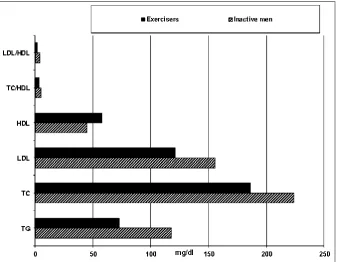
Descriptive statistics for each measure of lipidemic factors for the group of inactive men and the group of exercisers are shown in Figure 1. From the Figure 1, it is obvious that the group of exercisers has higher value of HDL and lower values of TG, TC, LDL, TC/HDL and LDL/HDL.
Figure 1: The values of lipidemic factorsfor Group of inactive men and Group of exercisers
Table 3: Lipidemic factors for Group of inactive men and Group of exercisers
Lipidemic Factors Inactive men Exercisers t & p TG (mg/dl) 117.59+87.28 73.06+26.78 t=2.01 & p=0.05 TC (mg/dl) 223.94+37.93 186.24+28.89 t=3.26 & p<0.01 LDL (mg/dl) 155.66+27.25 120.81+39.91 t=2.88 & p<0.01 HDL (mg/dl) 44.76+7.65 57.86+11.21 t=-3.85 & p<0.01 Ratio TC/HDL 5.17+1.33 3.30+0.71 t=4.69 & p<0.001 Ratio LDL/HDL 3.66+0.98 2.03+0.63 t=5.35 & p<0.001
As it is presented in Table 3, the differences between the two groups are all statistically significant. More specifically, exercisers have at rest very significantly higher level of HDL, but very significantly lower TG, TC, LDL, TC/HDL and LDL/HDL than inactive men.
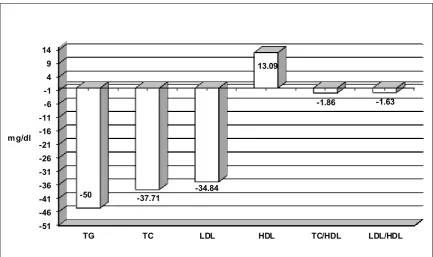
In Figure 2, are presented the mean differences of exercisers’ values in lipidemic factors compared with the values of inactive men.
-51 -46 -41 -36 -31 -26 -21 -16 -11 -6 -1 4 9 14
TG TC LDL HDL TC/HDL LDL/HDL
-50 -37.71 -34.84
13.09
-1.86 -1.63
mg/dl
Figure 2: Mean difference of exercisers’ values vs inactive men values
4. Discussion
Our study shows that young men regularly participating in recreational team sports such as football, volleyball and basketball, had significantly higher values of HDL and lower values of TG, TC, LDL, TC/HDL and LDL/HD, compared with inactive men. The results reveal the significance of the participation in regular exercise. Moreover, it has been proven that the higher prevalence of dyslipidemia, as well as other risk factors of CVD such as hypertension, obesity, metabolic syndrome, depression, and type 2 diabetes, is associated with low levels of physical activity. On the other side, increased levels of physical activity over time have been associated with reduced CHD and CVD mortality risk. In addition, a low level of cardiorespiratory fitness is a well-recognized risk factor for CHD and CVD mortality. It is worth mentioning that for every 1 MET increase in cardiorespiratory fitness over time, all-cause and CVD-mortality were reduced by 15% and 19%, respectively (Lavie et al., 2015; Swift et al., 2013).
From the results of the present study it seems that regular participation in recreational team sports may lead in an improvement of participants’ lipidemic profile. Thus, regular aerobic exercise and favorable fitness levels seem to improve HDL and serum TG concentrations (Tucker, & Silvester, 1996). More specifically, the group of exercisers that participated regularly in recreational team sports represented significant benefits such as decreased TC 16.84%), TG 37.87%), LDL 22.38%), TC/HDL (-35.99%) and LDL/HDL (-44.56%), as well as increased HDL (+29.25%). In agreement, Swift et al. (2013) found that the participation in formal cardiac rehabilitation and exercise training programs leads to benefits such as decreases in TC (-5%), TG (-15%), LDL (-2%) and LDL/HDL (-5%), as well as increases in HDL (+6%) in cohorts with CVD. In addition, Leon and Sanchez (2001), in their meta-analysis, reviewed 51 studies pertaining to intervention trials on the effects of > or = 12 weeks of aerobic exercise training on blood lipids and lipoprotein outcomes in adult men and women. Aerobic exercise training was generally performed at a moderate to hard intensity, with weekly energy expenditures ranging from 2.090 to >20.000 kJ. The researchers demonstrated an average increase in HDL levels of 4.6% and reductions in TG and LDL concentrations of 3.7% and 5.0%, respectively. In similar results led another research that studied the effects of 20 weeks of supervised cycle-ergometer exercise on plasma lipids in 675 healthy, sedentary, normolipidemic white and black men and women, aged 17 to 65 years, participating in the HERITAGE Family Study. Concerning men, HDL increased 1.1 mg/dL (3%) among the 299 men studied, whereas TG and LDL decreased 5.9 and 0.9 mg/dL or 2.7% and 0.8%, respectively (Leon et al., 2000).
1.7%-2.0% and significant decreases in TC (-7.0 %) and TG (-14.5 %) in patients with CAD after 16 weeks of exercise training. Thus, regular physical activity plays an important role in nonpharmacologic management of hyperlipidemia, in both the primary and secondary prevention of CHD (Kostka et al., 2001). However, El-Sayed (1996) who examined the effect of high and low intensity exercise conditioning programs on lipid profile variables in sedentary, but healthy individuals, didn’t find any statistically significant change in the resting baseline of TC, TG or HDL.
Regarding the effects of strength training, Tucker and Silvester (1996) conducted a cross‐sectional study of 8499 male employees of more than 50 companies throughout the United States to determine the relation between the quantity of strength training and hypercholesterolemia (TC≥240 mg/dl) in men. The researchers concluded that high-quantity strength training is strongly associated with a reduced risk of hypercholesterolemia, even after controlling for numerous, potentially confounding factors.
In addition, Goldberg et al. (1984) examined lipid and lipoprotein levels in previously sedentary men with a mean age of 33 years (range 30 to 36 years) and women with a mean age of 27 years (range 24 to 30 years). Subjects participated in a 16-week exercise program of progressive resistance weight training using machine gym equipment and exercised three times each week, on non-consecutive days. The duration of each session was 45 to 60 minutes. Women demonstrated a 9.5% reduction of TC, 17.9% decrease in LDL and 28.3% lowering of TG. The ratios of TC/HDL and LDL/HDL were reduced 14.3% and 20.3%, respectively. Men demonstrated a 6.8% reduction in TC, 16.2% decrease in LDL, 15.8% increase in HDL cholesterol, and an insignificant change in TG. In addition, a 21.6% decrease in TC/HDL ratio and 28.9% lowering of the LDL/HDL ratio were found. Consequently, weight-training exercise appears to result in favorable changes in lipid and lipoprotein levels in previously sedentary men and women. In the question aerobic or resistance exercise training, Goldberg and Elliot (1985) in their review study suggested that persons with higher TC, LDL, and TG levels, as well as individuals with lower HDL levels, have favorable changes in these measurements after either endurance or resistive exercise training.
pressure and HR in physically-active smokers in comparison with inactive ones. According to Whelton et al. (2002), regular rhythmic physical exercise of the lower extremities decreases both systolic and diastolic blood pressure by 5-7 mmHg independently of weight loss, alcohol intake or salt intake.
In similar results led a research of Fagard (2001), who studied at least 44 randomized controlled trials including 2674 participants that examined the effect of exercise training on resting blood pressure. The average reduction in systolic and diastolic blood pressure was 3.4 and 2.4 mmHg, respectively. Baseline blood pressure was an important determinant of the exercise effect. Average systolic and diastolic blood pressures decreased 2.6 and 1.8 mmHg in normotensive subjects and 7.4 and 5.8 mmHg in hypertensive subjects, respectively, suggesting that exercise may serve as the only therapy required in some mildly hypertensive subjects. There was no relationship between the weekly training frequency, time per session, or intensity of exercise training and the magnitude of the blood pressure reduction, which suggests that the dose-response curve for exercise and blood pressure is flat. These results reveal the antihypertensive effects of exercise (Nelson et al., 2007).
As for the ratios TC/HDL and LDL/HDL, the results of the present study show that they are significantly more decreased in the group of exercisers in comparison with the group of inactive men, due to their participation in recreational team sports. In particular, the ratio TC/HDL was 3.30 for the exercisers and 5.17 for inactive men (p<0.001), and the ratio LDL/HDL was 2.03 for the exercisers and 3.66 for inactive men (p<0.001). In agreement, Goldberg et al. (1984) found similar effects after a 16-week weight-training exercise. More specifically, the researchers found significant decreases in the ratios TC/HDL and LDL/HDL both in young men and women. Regarding men, the ratio TC/HDL decreased from 4.22 to 3.31 and the ratio LDL/HDL decreased from 2.84 to 2.02. These effects of exercise programs on the ratios TC/HDL and LDL/HDL are very significant, since these ratios have been considered better discriminators of patients at risk for the development of coronary disease than either cholesterol or HDL alone (Lipinska, & Gurewich, 1982).
The proved effects of the regular physical activity in the form of recreational team sports are very significant since abnormal lipids, together with smoking, are worldwide the two most important risk factors of myocardial infarction. Abnormal lipids and smoking account for about two-thirds of the population attributable risksof an acute myocardial infarction (Yusuf et al., 2004). In addition, it is worth mentioning that the non-smokers with low TC level and low blood pressure had a much lower age-adjusted relative risk (0.09) than the relative risk of the average population (1.0) (Rosengren et al., 2001). The effect of the risk factors is particularly striking in young men (population attributable risks about 93%) and women (about 96%), indicating that most premature myocardial infarction is preventable (Yusuf et al., 2004).
Johannessen et al., 1986; Joseph, & Bena, 1977; Paffenbarger & Hyde, 1980). In addition, physical fitness achieved through the regular participation in recreational team sports effect positively on blood fibrinolytic activity (Mavrovouniotis, 2018). It is worth mentioning that avoiding a sedentary lifestyle during adulthood not only prevents CVD independently of other risk factors but also substantially expands the total life expectancy and the cardiovascular disease-free life expectancy for men and women. This effect is already seen at moderate levels of physical activity, and the gains in cardiovascular disease-free life expectancy are twice as large at higher activity levels (Franco et al., 2005).
However, from one side most populations in the world (at least urban) have lipid abnormalities, which increase the risk of myocardial infarction (Yusuf et al., 2004), and from the other side in Western countries more than one quarter of adults are not sufficiently active and do not participate in regular physical activities except of the usual activities of everyday living (Hallal et al., 2012; Haskell et al., 2009; International Sport and Culture Association, 2015; Valanou et al., 2006).
As far as the most premature myocardial infarction is preventable through the elimination of the two most important risk factors of myocardial infarction, abnormal lipids and smoking (Yusuf et al., 2004), concerted efforts concerning exercise are needed. Consequently, it is important to understand which factors affect exercise participation in order to create exercise regimes tailored to individual needs, which will increase exercise engagement (Zervou et al., 2017). With regard to factors affecting exercise participation, exercise/activity should be well-accepted and pleasant, simple and convenient on participation and relatively low of cost (Grant et al., 2002; King, 2001). As for men, they seem to participate in exercise regimes lead by competitiveness. In addition, exercising individuals with high self-esteem seem to exercise because they feel capable of fulfilling the exercise regimes, thus satisfying their competitive instincts. In addition, they are interested in creating social bonds through exercise as well as improving their physical fitness (Zervou et al., 2017). Such a form of exercise regarding men are recreational team sports in which the group of exercisers of the present study were regularly participated.
5. Conclusions
In conclusion, from the results of the present study it is obvious that regular participation in recreational team sports improves participants’ lipidemic profile, which may be a favourable effect for cardiovascular system. Consequently, exercise programs in the form of recreational team sports such as football, volleyball and basketball are recommended for young men, in order to be achieved engagement and adherence to an exercise program aiming on health benefits, especially concerning blood lipids.
Conflicts of interest
About the Author
Fotios Mavrovouniotis is Associate Professor at the School of Physical Education and Sport Sciences, Aristotle University of Thessaloniki, Greece.
References
Anton, M.M., Cortez-Cooper, M.Y., DeVan, A.E., Neidre, D.B., Cook, J.N., Tanaka H. (2006). Cigarette smoking, regular exercise, and peripheral blood flow. Atherosclerosis, 185(1): 201-205.
Argiriadou, Eir. (2018). Greek Traditional Dances and health effects for middle-aged and elderly people- A review approach. World Journal of Research and Review, 6(6): 16-21.
Butcher, L. Thomas, A., Backx, K., Roberts, A., Webb, R., Morris, K. (2008). Low-intensity exercise exerts beneficial effects on plasma lipids via PPARF. Medicine & Science in Sports & Exercise, 40(7): 1263-1270.
Carroll, S., Dudfield, M. (2004). What is the relationship between exercise and metabolic abnormalities? Sports Medicine, 34(6): 371-418.
Collins, P. (2006). Risk factors for cardiovascular disease and hormone therapy in women. Heart, 92(3): iii24-iii28.
El-Sayed, M.S. (1996). Effects of high and low intensity aerobic conditioning programs on blood fibrinolysis and lipid profile. Blood Coagul Fibrinolysis, 7(4): 484-490. Fagard, R.H. (2001). Exercise characteristics and the blood pressure response to
dynamic physical training. Med Sci Sports Exerc, 33(6 suppl): S484-S492.
Franco, O.H., de Laet, C., Peeters, A., Jonker, J., Mackenbach, J., Nusselder, W. (2005). Effects of physical activity on life expectancy with cardiovascular disease. Arch Intern Med, 165(20): 2355-2360. Doi:10.1001/archinte.165.20.2355.
Goldberg, L., Elliot, D.L. (1985). The effect of physical activity on lipid and lipoprotein levels. Med Clin North Am, 69: 41-55.
Goldberg, L., Elliot, D.L., Schutz, R.W., Kloster, F.E. (1984). Changes in lipid and lipoprotein levels after weight training. JAMA, 27: 504-506.
Grant, S., Corbett, K., Todd, K., Davies, C., Aitchison, T., Mutrie, N., Henderson, Β., Dargie, Ε. (2002). A comparison of physiological responses and rating of perceived exertion in two models of aerobic exercise in men and women over 50 years of age. British Journal of Sports Medicine, 36(4): 276-281.
Grundy, S.M. (1998). Hypertriglyceridemia, atherogenic dyslipidemia, and the metabolic syndrome. Am J Cardiol, 81: 18B-25B.
Haskell, W.L. (1984). The influence of exercise on the concentrations of triglycerides and cholesterol in human plasma. Exerc Sport Sci Rev, 12: 205-244.
Haskell, W.L., Blair, S.N., Hill, J.O. (2009). Physical activity: Health outcomes and importance for public health policy. Preventive Medicine, 49(4): 280-282.
Haskell, W.L., Lee, I.M., Pate, R.R., Powell, K.E., Blair, S.N., Franklin, B.A., Macera, C.A., Heath, G.W., Thompson, P.D., Bauman, A. (2007). Physical activity and public health: Updated recommendation for adults from the American College of Sports Medicine and the American Heart Association. Circulation, 116: 1081-1093. Doi:10.1161/CIRCULATION.107.185649.
Haskell, W. L., Stefanick, M. L., Superko, R. (1988). Influence of exercise on plasma lipids and lipoproteins. In E.S.Horton and R.L.Terjung (Eds), Exercise, nutrition and energy metabolism, (pp 213-227). New York, MacMillan.
International Sport and Culture Association (2015). The economic cost of physical inactivity in Europe. Retrieved from: https://inactivity-time-
bomb.nowwemove.com/download-report/The%20Economic%20Costs%20of%20Physical%20Inactivity%20in%20Eur ope%20(June%202015).pdf
Johannessen, S., Holly, R.G., Lui, H., Amsterdam, E. (1986). High frequency, moderate-intensity training in sedentary middle-aged women. Sports Medicine, 14: 99-102. Joseph, J.J., Bena, L.L. (1977). Cholesterol reduction: A long term intense exercise
program. Journal of Sports Medicine and Physical Fitness, 17: 163-168.
Kaptoge, S., Di Angelantonio, E., Pennells, L. (2012). C-Reactive protein, fibrinogen, and cardiovascular disease prediction. The New England Journal of Medicine, 367(14): 1310-1320.
King, Α. (2001). Interventions to promote physical activity by older adults. Journals of Gerontology, 56A (Special Issue II): 36-46.
Kostka, T., Lacour, J., Bonnefoy, M. (2001). Response of blood lipids to physical exercise in elderly subjects. Prev Cardiol, 4(3): 122-125. https://doi.org/10.1111/j.1520-037X.2001.00535.x
Lavie, C., Arena, R., Swift, D., Johannsen, N., Sui, X., Lee, D., Earnest, C., Church, T., O’Keefe, J., Milani, R., Blair, S. (2015). Exercise and the Cardiovascular System: Clinical science and cardiovascular outcomes. Circ Res, 117(2): 207-219. Doi:
10.1161/CIRCRESAHA.117.305205.
Leon, A.S., Rice, T., Mandel, S., Després, J.P., Bergeron, J., Gagnon, J., Rao, D.C., Skinner, J.S., Wilmore, J.H., Bouchard, C. (2000). Blood lipid response to 20 weeks of supervised exercise in a large biracial population: the HERITAGE Family Study. Metabolism, 49: 513-520.
Leon, A.S., Sanchez, O.A. (2001). Response of blood lipids to exercise training alone or combined with dietary intervention. Med Sci Sports Exerc, 33(6 suppl): S502-S515.
Mavrovouniotis, F. (2018). Fibrinolytic activity in active and sedentary men at rest. European Journal of Physical Education and Sport Science, 5(1): 38-52.
Mavrovouniotis, A., Argiriadou, Eir., Mavrovouniotis, F., Mavrovounioti, Chr., Mountakis, C., Nikitaras, N., Deligiannis, A. (2016). The evaluation of physical health of elderly participants or non-participants in a Greek dances program. Journal of Physical Education and Sport (JPES), 16 Supplement issue (1), Art 116: 713-719.
Nelson, M.E., Rejeski, W.J., Blair, S.N., Duncan, P.W., Judge, J.O., King, A.C., Macera, C.A., Castaneda-Sceppa, C. (2007). Physical activity and public health in older adults: recommendation from the American College of Sports Medicine and the American Heart Association. Circulation, 116(9): 1094-1105.
Paffenbarger, R.S., Hyde, R.T. (1980). Exercise as protection against heart attack. The New England Journal of Medicine, 302(18): 1026-1027.
Ranković, G., Djindjić, N., Ranković-Nedin, G., Marković, S., Nejić, D., Milicić, B., Djindjić, B. (2012). The effects of physical training on cardiovascular parameters, lipid disorders and endothelial function. Vojnosanit Pregl., 69(11): 956-960.
Ridker, P. (2003). C-Reactive Protein: A simple test to help predict risk of heart attack and stroke. Circulation, 108: e81-e85.
Rosengren, A., Dotevall, A., Eriksson, H., Wilhelmsen, L. (2001). Optimal risk factors in the population: prognosis, prevalence, and secular trends. Eur Heart J, 22: 136-44. Swift, D.L., Lavie, C.J., Johannsen, N.M., Arena, R., Earnest, C.P., O’Keefe, J.H., Milani, R.V., Blair, S.N., Church, T.S. (2013). Physical activity, cardiorespiratory fitness, and exercise training in primary and secondary coronary prevention. Circ J, 77: 281-292.
Tucker, L.A., Silvester, L.J. (1996). Strength training and hypercholesterolemia: An epidemiologic study of 8499 employed men. Am J Health Promot, 11: 35-41. Valanou, E., Bamia, C., Chloptsios, C., Koliva, M., Trichopoulou, A. (2006). Physical
activity of 28.030 men and women of the Greek EPIC cohort. Archives of Hellenic Medicine, 23: 149-158.
Volaklis, K.A., Spassis, A.T., Tokmakidis, S.P. (2007). Land versus water exercise in patients with coronary artery disease: effects on body composition, blood lipids, and physical fitness. Am Heart J, 154(3): 560.e1-6.
Whelton, S.P., Chin, A., Xin, X., He, J. (2002). Effect of aerobic exercise on blood pressure: a meta-analysis of randomized, controlled trials. Ann Intern Med, 136(7): 493-503.
Yusuf, S., Hawken, S., Ounpuu, S., Dans, T., Avezum, A., Lanas, F., McQueen, M., Budaj, A., Pais, P., Varigos, J., Lisheng, L. (2004). Effect of potentially modifiable risk factors associated with myocardial infarction in 52 countries (the INTERHEART study): case-control study. Lancet, 364(9438): 937-952.
Creative Commons licensing terms
Authors will retain the copyright of their published articles agreeing that a Creative Commons Attribution 4.0 International License (CC BY 4.0) terms will be applied to their work. Under the terms of this license, no permission is required from the author(s) or publisher for members of the community to copy, distribute, transmit or adapt the article content, providing a proper, prominent and unambiguous attribution to the authors in a manner that makes clear that the materials are being reused under permission of a Creative Commons License. Views, opinions and conclusions expressed in this research article are views, opinions and conclusions of the author(s). Open Access Publishing Group and European Journal of Physical Education and Sport Science shall not be responsible or answerable for any loss, damage or liability caused in relation to/arising out of conflict of interests, copyright violations and inappropriate or inaccurate use of any kind content related or integrated on the research work. All the published works are meeting the Open Access Publishing requirements and can be freely accessed, shared, modified, distributed and used in educational, commercial and