Burnout in Portuguese Healthcare Professionals:
An Analysis at the National Level
Burnout
em Profissionais da Saúde Portugueses:
Uma Análise a Nível Nacional
1. Departamento de Ciências Psicológicas. William James Center for Research. Instituto Superior de Psicologia Aplicada. Lisboa. Portugal. 2. Secção de Estatística. Escola Superior de Comunicação Social. Lisboa. Portugal.
3. Grupo de Disciplinas de Saúde Ocupacional. Escola Nacional de Saúde Pública. Lisboa. Portugal. 4. Serviço de Saúde Ocupacional. Hospital de Santa Maria. Centro Hospitalar Lisboa Norte. Lisboa. Portugal. 5. Serviço de Medicina Geral e Familiar. Agrupamento de Centros de Saúde Lisboa Ocidental e Oeiras. Oeiras. Portugal. 6. Departamento de Enfermagem. Agrupamento de Centros de Saúde Lisboa Ocidental e Oeiras. Oeiras. Portugal.
7. Departamento de Odontologia. Faculdade de Odontologia de Araraquara. Universidade Estatual de São Paulo. São Paulo. Brasil. Autor correspondente: João Marôco. [email protected]
Recebido: 28 de março de 2015 - Aceite: 26 de agosto de 2015 | Copyright © Ordem dos Médicos 2016
João MARÔCO1, Ana Lúcia MARÔCO2, Ema LEITE3,4, Cristina BASTOS5, Maria José VAZÃO6, Juliana CAMPOS7
Acta Med Port 2016 Jan;29(1):24-30
RESUMO
Introdução: O burnout é uma síndrome psicológica, caracterizada por elevada exaustão emocional, elevada despersonalização e baixa realização profissional, que conduz à erosão dos valores pessoais, profissionais e de saúde. Este estudo reporta a prevalência
do burnout em profissionais de saúde Portugueses.
Material e Métodos: Os níveis de burnout foram estimados pelo Maslach Burnout Inventory - Human Services Survey numa escala ordinal de zero (nunca) a seis (sempre) pontos. A amostra foi constituída por 1 262 enfermeiros e 466 médicos com médias de idade de 36,8 anos (DP = 12,2) e 38,7 (DP = 11,0), respetivamente. Os participantes foram provenientes de todos os distritos nacionais (35% Lisboa; 18% Porto; 6% Aveiro, 6% Setúbal, 5% Coimbra; 5% regiões autónomas), com atuação em meio hospitalar (54%), centros de saúde (Unidade de Saúde Familiar - 30%; Unidades de Cuidados de Saúde Primários - 8%) e outras instituições públicas/privadas (8%).
Resultados: A análise dos níveis de burnout revelou que ambas as categorias profissionais apresentaram níveis moderados a elevados de burnout (M = 3,0; DP = 1,7) não sendo significativas as diferenças entre as duas profissões. Vila Real (M = 3,8; SD = 1,7) e a Madeira (M = 2,5; DP = 1,5) são as regiões onde os níveis de burnout são mais e menos elevados, respetivamente. Os níveis
de burnout não diferiram significativamente entre Hospitais, Unidades de Cuidados de Saúde Personalizados e Unidades de Saúde
Familiares. Os profissionais com maior tempo na função são menos acometidos por burnout (r = -0,15) não ocorrendo associação significativa com a duração da jornada de trabalho (r = 0,04). A má qualidade das condições de trabalho foi o melhor preditor do burnout
(r = -0,35).
Discussão: A ocorrência da síndrome de burnout em profissionais de saúde portugueses é frequente, estando associada à percepção de más condições de trabalho e à menor duração do tempo de serviço. A incidência de burnout apresenta diferenças regionais que podem estar associadas ao aumento do stress imposto pelo exercício da profissão em condições sub-ótimas para a prestação dos
cui-ABSTRACT
Introduction: Burnout is a psychological syndrome, characterized by a state of high emotional exhaustion, high depersonalization and low personal accomplishment, which leads to erosion of personal, professional and health values. This study reports the incidence of burnout in Portuguese Healthcare professionals.
Material and Methods: Burnout in Portugal’s health professionals was assessed with the Maslach Burnout Inventory - Human Services Survey, using a zero (never) to six (always) ordinal scale, on a sample of 1 262 nurses and 466 physicians with mean age of 36.8 year (SD = 12.2) and 38.7 (SD = 11.0), respectively. Participants came from all national districts (35% Lisbon, 18% Oporto, 6% Aveiro, 6% Setúbal, 5% Coimbra, 5% Azores and Madeira), working in hospitals (54%), Families’ Health Units (30%), Personalized Health Units (8%) and other public or private institutions (8%).
Results: Analysis of MBI-HSS scores, stratified by district, revealed that both types of professionals had moderate to high levels of burnout (M = 3.0, SD = 1.7) with no significant differences between the two groups. Vila Real (M = 3.8, SD = 1.7) and Madeira (M = 2.5, SD = 1.5) were the regions where burnout levels were higher and lower, respectively. Burnout levels did not differ significantly between Hospital, Personalized Health Units and Families’ Health Centers. Professionals with more years in the function were less affected by Burnout (r = -0.15). No significant association was observed with the duration of the working day (r = 0.04). The strongest predictor of burnout was the perceived quality of working conditions (r = -0.35).
Discussion: The occurrence of the burnout syndrome in Portuguese health professionals is frequent, being associated with a poor working conditions perception and reduced professional experience. The incidence of the burnout syndrome shows regional differences which may be associated with different and suboptimal conditions for health care delivery. Results suggest the need for interventions aimed at improving working conditions and initial job training of health professionals, as requisites for a good professional practice and personal well-being.
Conclusions: At the national level, between 2011 and 2013, 21.6% of healthcare professionals showed moderate burnout and 47.8% showed high burnout. The perception of poor working conditions was the main predictor of burnout occurrence among the Portuguese health professionals.
Keywords: Burnout, Professional; Health Personnel; Portugal.
INTRODUCTION
Burnout is an English medical term meaning ‘burning to exhaustion’ and was originally proposed by the American psychoanalyst professor of German origin Herbert Freud-enberger1 having noted it in himself and in his colleagues when working for the free-clinic movement. According to Freudenberger’s definition, burnout is a “state of mental and physical exhaustion caused by one’s professional life” referred to a set of clinical signs and symptoms related to physical and emotional collapse occurring upon exhaustion of all the available energy, resources or forces aimed to deal with tasks of ‘helping’ others. Despite the presence of dif-ferent theoretical frameworks, the most used in Psychology is the one by Maslach and Jackson.2,3 According to these authors, burnout is a multifactorial disorder involving emo-tional exhaustion, dehumanisation/depersonalisation and poor work achievement that may affect people with occupa-tions that demand constant interaction with others. Burnout syndrome was described by Ferreira and Lucca4 as reflect-ing an ongoreflect-ing process with feelreflect-ing of inadequacy and the lack of resources to cope with work. When not properly managed, a strong physical and emotional wear may arise, associated to physical symptoms such as headaches, diz-ziness, dyspnoea and sleep disorders. It is also associated to psychological disorders with emotional lability, anger and anxiety as well as difficult social interaction. Low produc-tivity and labour conflicts, psychotropic drug-dependence, reduced achievement in work and in personal life, following a spiral of distress, may lead to suicide in severe cases.5,6 According to Gil-Monte7 burnout syndrome is a Public Health issue, considering its implications of physical and mental health and its involvement in quality of life. In a 2011 study by the American Academy of Orthopaedic Surgeons, 87% out of more than 2,000 North-American physicians described as severely stressed and in burnout on a regular working day.8 Burnout syndrome has been therefore
considered a very relevant Occupational Health problem affecting healthcare professionals. Those presenting with burnout syndrome usually have a reduced quality of professional performance, with a higher probability of medical error, higher absenteeism rates, lower commitment with work and with employers, reduced job satisfaction, more frequent sick leaves, higher personal suffering and increased interpersonal conflicts involving supervisors, colleagues and family, alcohol and psychotropic drug abuse and lower levels of physical activity and health lifestyle.3,9,10
The first studies on burnout syndrome exclusively regarded welfare-related professions, such as social assistants, nurses and psychologists.11 A wider range of welfare-related professions (teachers, policemen, firemen, etc.)12-14 as well as other non-remunerated
activities showing similar characteristics to remunerated occupations.15,16 Ferreira and Lucca4 underscored that healthcare professionals are particularly vulnerable to the development of burnout syndrome due to their daily interaction with debilitated/ill patients, apart from dealing with tense and hierarchical relationships in healthcare institutions. Their work schedule format (involving night shift working) is also referred by these authors as a possible contribution to physical, cognitive and emotional overload in healthcare professionals.
Among healthcare professionals, nurses and physicians are clearly vulnerable to the development of burnout syndrome. Although a high level of burnout in healthcare professionals is not a recent conclusion, this is more and more a current issue, considering the amount of studies on burnout syndrome, its causes, effects and prevention strategies regarding healthcare occupations, that have been published over the last few years.17-26 For instance, a recent
Portuguese study by Queirós et al.25 held in four hospitals in Porto, aimed to identify the burnout predictors in nurses and found that gender, age, years of professional experience, work satisfaction and work/home interaction were significant predictors of the incidence of burnout in these professionals. However, apart from the study by Marcelino et al.27 on a group of 153 general practitioners working all over the country, in which a version of a non-previously validated measurement instrument was used, we are not aware of any other study on the evaluation of burnout incidence and its predictors in physicians and nurses nationwide.
It is our view that a comprehensive and representative evaluation of burnout incidence is required in order to support more extensive public interventions in occupational health promotion. Our study aimed to evaluate (1) the levels of burnout in physicians and nurses in different professional contexts nationwide and (2) its association with social, occupational and demographic variables.
MATERIAL AND METHODS
Participants
Physicians and nurses of either gender working in Mainland Portugal and in Azores and Madeira regions were invited to participate in the study, recruited by Occupational Medicine Departments and upon disclosure within professional associations (Ordem dos Enfermeiros, Associação dos Médicos de Família e Clínica Geral, Sindicato dos Médicos do Norte).
The characteristics of the 1,728 professionals that agreed to participate in the study are shown in Table 1. Participants mostly originated in hospitals and Family Heath Units.
ARTIGO ORIGINAL
dados de saúde. Os resultados alertam para a necessidade de intervenções para melhorar as condições de trabalho e formação inicial dos profissionais de saúde de forma a garantir a qualidade do serviço prestado aos utentes e o bem-estar pessoal destes profissionais.
Conclusões: A nível nacional, entre 2011 e 2013, 21,6% dos profissionais de saúde apresentaram burnout moderado e 47,8% burn-out elevado. A perceção de más condições de trabalho foi o principal preditor da ocorrência de burnout nos profissionais de saúde Portugueses.
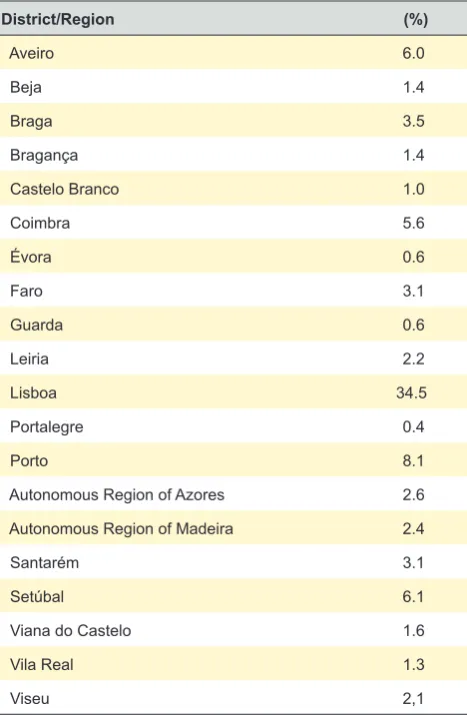
Only 1,685 participants indicated the municipality/ autonomic region where they were working (Table 2). The participants originated in every Portuguese municipality, mainly in Lisbon (34.5%); Porto (18.1%), Setúbal (6.1%), Aveiro (6.0%), Coimbra (5.6%) and the Azores/Madeira Autonomous Regions (5%).
Assessment instruments
The Maslach Burnout Inventory – Human Services Survey (MBI-HSS)28 - a burnout psychological assessment
instrument - has been used in more than 95% of the studies on burnout.29 The version of the MBI-HSS used in our
study was translated and trans-culturally adapted by the authors to Portugal and Brazil upon authorisation by the copyright holder of the instrument (MindGarden© 1986). The
Portuguese version of the MBI-HSS includes 22 ordinal items reflecting three dimensions of burnout: emotional exhaustion (including nine items, as for instance ‘Item 1: (I feel emotionally drained by my work) O meu trabalho deixa-me emocionalmente esgotado’); depersonalisation (five items, as for instance ‘Item 5: (I feel I look after certain patients impersonally, as if they are objects) Sinto que trato alguns dos meus clientes de forma impessoal’) and lack of personal achievement (eight items, as for instance ‘Item 9: (Through my work, I feel that I have a positive influence on people) Sinto que influencio positivamente a vida das pessoas através do meu trabalho’). A seven-point ordinal response format was used, ranging from ‘0 - Never’ to ‘6 – Everyday’. Given the absence of factorial validity when using the original version of the MBI-HSS in our group of participants (χ²/gl = 2.4; CFI = 0.781; GFI = 0.704; TLI = 0.755, RMSEA = 0.114), a five-item short version per each dimension was produced (emotional exhaustion: items 1,3,8,14,20; depersonalisation: items 5,10,11,15,22 and personal achievement: items 9,17,18,19,21), with good factorial validity (χ²/gl = 3.6; CFI = 0.957; GFI = 0.956; TLI = 0.948, RMSEA = 0.027) and high reliability (αExhaustion = 0.87; αDepersonalisation = 0.72; αAchievement = 0.82). The overall burnout score was obtained using the factor score weights in a factorial model where burnout is defined as a second-order construct which is expressed in first-order dimensions of exhaustion (β = 0.73, p < 0.001), depersonalisation (β = 0.76, p < 0.001) and personal
achievement (β = -0.69, p < 0.001). The overall burnout score was then converted into burnout classes according to the recommendation by Maslach et al. (1986): ‘With no burnout/mild burnout’ for average scores <2; ‘moderate burnout’ for average scores [2; 3[ and ‘severe burnout’ for average scores ≥3.
The sociodemographic characteristics of our participants, their professional careers and workplaces were obtained using a socio-demographic questionnaire. Table 1 - Participant characteristics. Portugal, 2011 - 2013.
Variable
Occupation
Nurse Physician
n (%) 1,262 (73) 466 (27)
Gender (% M/F) 17/83 42/58
Workplace (% Hospital/Family Health Unit/Other) (63/36/1) (84/12/4)
Age (years; mean ± standard deviation) 39 ± 12 37 ± 9
Length of service (mean ± standard deviation) 12 ± 9 11 ± 8
Weekly hours of work (mean ± standard deviation) 38.5 ± 6 43 ± 8
Table 2 - Percentage distribution (n = 1,685) of participants per district or autonomous region where they are working. Portugal, 2011 - 2013.
District/Region (%)
Aveiro 6.0
Beja 1.4
Braga 3.5
Bragança 1.4
Castelo Branco 1.0
Coimbra 5.6
Évora 0.6
Faro 3.1
Guarda 0.6
Leiria 2.2
Lisboa 34.5
Portalegre 0.4
Porto 8.1
Autonomous Region of Azores 2.6
Autonomous Region of Madeira 2.4
Santarém 3.1
Setúbal 6.1
Viana do Castelo 1.6
Vila Real 1.3
Viseu 2,1
Procedures
Participants were informed (1) that their participation was voluntary and anonymous, (2) that they could drop-out of the study at any moment, (3) that the study had only scientific objectives with no clinical intervention or individual identification of any kind. Those that agreed to participate were required to respond to a socio-demographic questionnaire and had to complete a battery of psychometric tests. Self-completion questionnaires were used between May 2011 and May 2013, in paper or in a file available from the project’s website. Model invariance ‘paper x internet’ was shown for an equivalent version of the MBI-HSS adapted to college students.16 Our study was approved by the Ethics Committee of the Centro Hospitalar Lisboa Norte, EPE as well as the Ethics Committee of the Unidade de Investigação em Psicologia e Saúde at the ISPA-IU.
Data analysis
The psychometric qualities of the MBI-HSS were analysed through the confirmatory factorial analysis and derived statistics through maximum-likelihood estimation using the AMOS (v. 21, SPSS An IBM Company, Chicago, IL) software. Factorial validity of the measurement model was considered when the usual quality indices of adjustment of the model were χ2/gl ≤ 2; CFI ≥ 0.90; GFI ≥ 0.90; TLI ≥ 0.90; RMSEA ≤ 0.05.30 Descriptive and
inferential analysis were ranked per district/autonomous region using IBM’s SPSS Statistics (v. 21, SPSS An IBM Company, Chicago, IL) software. The comparisons between professionals and districts were made with a two-factor ANOVA upon validity assumption of homoscedasticity of variances. The association between burnout score and the socio-professional context variables was estimated using Pearson’s correlation coefficient (r) for quantitative variables and Spearman’s correlation coefficient (rS) for ordinal variables. A 5% level of significance was used for the decision-making regarding the statistical significance of the results.
RESULTS
Levels of burnout in physicians and nurses
The percentage distribution of the levels of burnout and its average level in physicians and in nurses considering the aggregate national estimations is shown in Table 3.
The levels of burnout in physicians and in nurses was compared to its distribution per district and statistically
significant differences were found between districts (F (15,1609) = 2.04; p < 0.05, Power = 0.968) showing a borderline significant interaction between the occupation and the district (F (14,1609) = 1.694; p = 0.051, Power = 0.908). Nevertheless, no significant differences were found between the average values of burnout in physicians and in nurses (F (1;1609) = 0.212; p = 0.645, Power = 0.075) after considering the effects of the district and the interaction between district and occupation. The presence of a significant interaction shows that the average levels of burnout per district were different between nurses and physicians and the separate analysis per district within each professional group is therefore recommended.
The average levels of burnout in physicians and in nurses grouped according to the level of burnout (mild, moderate and severe) into the 20 Portuguese districts and autonomous regions are shown in Fig. 1.
High levels of burnout were found in 10 (50%) and in 13 (65%) of the 20 districts/autonomous regions in physicians and nurses, respectively. The districts in the Northern and in Central region of Portugal showed a higher concentration of severe burnout in nurses.
How to explain burnout?
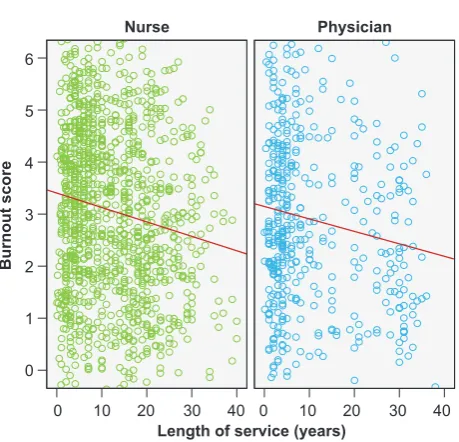
The analysis of some social and occupational variables allows for the definition of some determinants of burnout in healthcare professionals. A statistically significant and negative correlation with the length of service was found either in nurses (r = -0.142, p = 0.01) or in physicians (r = -0.151; p < 0.001) and younger professionals (both physicians and nurses) are more affected by burnout (Fig. 2). However, no significant association between the score of burnout and working hours was observed either in nurses (r = 0.06; p = 0.03) or in physicians (r = 0.08; p > 0.09). The differences in levels of burnout according to working places were not statistically significant either in physicians or in nurses (F (3; 1,622) = 1.319; p = 0.267) (Fig. 3). The variable ’percepção das condições de trabalho’ (perception of working conditions) showed to be the best determinant of burnout in our group of participants. This variable, ranging from ‘1 - Muito más’ (Very poor) to ‘5 - Muito boas’ (Very good), showed a moderately significant and negative association with the levels of burnout either in nurses (rs = -0.34; p = 0.01) or in physicians (rs = -0.36; p = 0.01) (Fig. 4).
Finally, as regards the differences between genders, we did not find any significant differences in the average levels
Table 3 - Mean (± standard deviation) and distribution of the levels of burnout in physicians and in nurses nationwide per district where they are working. Portugal, 2011 - 2013; n = 1,685.
Burnout Physician Nurse
Mean ± standard deviation 2.9 ± 1.67 3.0 ± 1.68
Mild burnout: average score < 2 (%) 32.4 29.9
Moderate burnout: average score [2;3[ (%) 24.0 20.8
Severe burnout: average score ≥ 3 (%) 43.6 49.4
of burnout between male (M = 2.99, SD = 1.69) and female professionals (M = 3.02; SD = 1.67) (F (1;1,726) = 0.063; p = 0.802).
DISCUSSION
Our study aimed to analyse the incidence of burnout in physicians and in nurses, involving all the Portuguese districts, including the autonomous regions of Azores and Madeira. The levels of burnout between 2011 and 2013 in Portuguese physicians and nurses were significantly different according to the different Portuguese districts and autonomous regions. A great number of districts with high level of burnout in both professions was found (50% of the districts in physicians and 65% in nurses). The statistic similarity between the average levels of burnout shown by Portuguese physicians and nurses is in line with the study by Tremolada et al.26 in which a similar high risk of burnout was found in both professions. The length of service and working conditions were significant predictors of burnout either in physicians or in nurses. Younger professionals described higher levels of burnout when compared to more experienced colleagues. These results are also in line with the results found by Bilge31 explained with the fact that less-experienced professionals have not had enough time to develop effective coping strategies to deal with occupational stress and are for that reason more vulnerable to the development of burnout. As regards working
conditions, Ferreira and Lucca4 have confirmed our results and those by Bilge31 and found that poor working conditions may put healthcare professionals at risk as regards burnout syndrome. This fact may relate to the increased work stress imposing sub-optimal conditions for medical or nurse
Figure 2 - Association between the overall score of burnout and the length of service (years) in nurses and in physicians
Length of service (years) Occupation
Nurse Physician
Burnout score
0 0
1 2 3 4 5 6
0
10 20 30 40 10 20 30 40
Castelo Branco
Figure 1 -Average levels of burnout per district or autonomous region, in nurses (A) and in physicians (B) (we were unable to obtain enou-gh sample size in the district of Beja in order to reliably estimate the average level of burnout). Portugal, 2011 - 2013.
A B
Beja Beja
Madeira Madeira
Azores Azores
Viseu Viseu
Viana do Castelo Viana do Castelo
Braga Braga
Bragança Bragança
Guarda Guarda
Porto Porto
Aveiro Aveiro
Coimbra Coimbra
Leiria Leiria
Santarém Santarém
Lisboa Lisboa
Setúbal Setúbal
Faro Faro
Évora Évora
Portalegre Portalegre
Castelo Branco
Vila Real Vila Real
< 2 (mild burnout) < 2 (mild burnout)
[2; 3[ (moderate burnout) [2; 3[ (moderate burnout)
≥ 3 (severe burnout) ≥ 3 (severe burnout)
Castelo Branco
practice.32 In fact, the perception of poor working conditions was the main predictor of the incidence of burnout in our group of Portuguese healthcare professionals.
Our results call the attention to the need for further research on the impact of occupational and organisation characteristics in health, namely on physical and psychological well-being of healthcare professionals, as well as compromising the quality of healthcare. In fact, the research in this area has shown a negative correlation between the dimension of depersonalisation and burnout in healthcare professionals, patients’ satisfaction and post discharge recovery time after controlling for severity of patient’s condition and demographic factors.33
CONCLUSIONS
Moderate burnout was described by 21.6% of the participants in our study and severe burnout by 47.8%, between 2011 and 2013.
The levels of burnout in physicians were moderate nationwide although severe burnout levels were found in 10 out of the 20 Portuguese districts/autonomous regions. Severe burnout was found in approximately 44% of the physicians. Moderate average levels of burnout were found in nurses, when compared to the national average level. Nevertheless, severe levels were found in nurses working in 13 out of the 20 districts and autonomous regions. Severe burnout levels were found in around 50% of the nurses. Perception of poor working conditions was the best predictor of the incidence of burnout either in physicians or in nurses. The results obtained in our study show the need for occupational actions aimed to reduce the incidence of burnout in healthcare professionals, improving their physical and psychological well-being and therefore enhancing the quality of healthcare.
ACKNOWLEDGEMENTS
The authors wish to acknowledge the ACES-Oeiras, Centro Hospitalar Lisboa Norte - EPE, the Ordem dos Enfermeiros, Associação dos Médicos de Família e Clinica Geral, as well as the Sindicato dos Médicos do Norte for having disclosed the study among their associates.
HUMAN AND ANIMAL PROTECTION
The authors declare that the followed procedures were according to regulations established by the Ethics Committee of the Centro Hospitalar Lisboa Norte, EPE as well as by the Ethics Committee of the Unidade de Investigação em Psicologia e Saúde do ISPA-IU and according to the Helsinki Declaration of the World Medical Association.
DATA CONFIDENTIALITY
The authors declare that they have followed the protocols of their work centre on the publication of patient data.
CONFLICTS OF INTEREST
The authors declare that there were no conflicts of interest in writing this manuscript.
FINANCIAL SUPPORT
The authors declare that there was no financial support in writing this manuscript.
Figure 4 -Average levels of burnout according to the perception of working conditions (ranging from ‘1 – Very poor’ to ‘5 – Very good’)
How would you define your working conditions? Occupation
Nurse Physician
Burnout score
1 2 3 4 5 1 2 3 4 5
0
1 2 3 4 5 6
Figure 3 - NAverage levels (± 95% CI) of burnout per place of work in physicians and in nurses
USF: Family Health Unit (Unidade de Saúde Familiar); UCSP: Personalized Family Health Unit (Unidade de Cuidados de Saúde Personalizados); UCC: Long-term Care Unit (Unidade de Cuidados Continuados).
Workplace Occupation
Nurse Physician
Burnout score
0 USF Hospitals UCSP UCC USF Hospitals UCSP UCC
1 2 3 4 5 6
REFERENCES
1. Freudenberger HJ. Staff burn-out. J Soc Issues. 1974;30:159-65. 2. Maslach C, Jackson SE. Maslach Burnout Inventory manual. Palo Alto:
University of California, Consulting Psychologist Press; 1986. 3. Schaufeli WB, Leiter MP, Maslach C. Burnout: 35 years of research and
practice. Career Dev Int. 2009;14:204-20.
4. Ferreira NN, Lucca SR. Síndrome de Burnout em técnicos de enfermagem de um hospital público do Estado de São Paulo. Rev Bras Epidemiol. 2015;18:68-79.
5. Wall M, Schenck-Gustafsson K, Minucci D, Sendén MG, Løvseth LT, Fridner A. Suicidal ideation among surgeons in Italy and Sweden – a cross-sectional study. BMC Psychol. 2014;2:53.
6. Shanafelt TD, Oreskovich MR, Dyrbye LN, Satele DV, Hanks JB, Sloan JA, et al. Avoiding burnout: the personal health habits and wellness practices of US surgeons. Ann Surg. 2012;255:625-33.
7. Gil-Monte PR. Algunas razones para considerar los riesgos psicosociales en el trabajo y sus consecuencias en la salud pública. Rev Esp Salud Publica. 2009;83:169-73.
8. Rosenstein AH. Physician stress and burnout: prevalence, cause, and effect. [consultado 2015 fev 25] Disponível em: http://www.aaos.org/ news/aaosnow/aug12/managing4.asp.
9. Goldberg R, Boss RW, Chan L, Goldberg J, Mallon WK, Moradzadeh D, et al. Burnout and its correlates in emergency physicians: four years’ experience with a wellness booth. Acad Emerg Med. 1996;3:1156-64. 10. Shanafelt TD, Balch CM, Bechamps GJ, Russell T, Dyrbye L, Satele D,
et al. Burnout and career satisfaction among American surgeons. Ann Surg. 2009;250:463-71.
11. Pinto AM, Chambel MJ. Burnout e engagement em contexto organizacional. Lisboa: Livros Horizonte; 2008.
12. Angelo RP, Chambel MJ. The reciprocal relationship between work characteristics and employee burnout and engagement: A longitudinal study of firefighters. Stress Health. 2015;31:105-14
13. Pedditzi ML, Nonnis M. Fonti psico-sociali di stress e burnout a scuola: una ricerca su un campione di docenti italiani. Med Lav. 2014;105:48-62. 14. Shinan-Altman S, Werner P, Cohen M. The connection between illness
representations of Alzheimer’s disease and burnout among social workers and nurses in nursing homes and hospitals: a mixed-methods investigation.Aging Ment Health. 2015:1-10.
15. Maroco J, Tecedeiro M. Inventário de burnout de Maslach para estudantes portugueses. Psicol Saúde Doenças. 2009;10:227-35. 16. Maroco J, Campos JA. Defining the student burnout construct: a
structural analysis from three burnout inventories. Psychol Rep. 2012;111:814-30.
17. Gazelle G, Liebschutz JM, Riess H. Physician burnout: coaching a way out. J Gen Intern Med. 2015;30:508-13.
18. Lee HF, Yen M, Fetzer S, Chien TW. Predictors of burnout among nurses in Taiwan. Community Ment Health J. 2015;51:733-7.
19. Canadas-De la Fuente GA, Vargas C, San Luis C, Garcia I, Canadas GR, De la Fuente EI. Risk factors and prevalence of burnout syndrome in the nursing profession. Int J Nurs Stud. 2015;52:240-9.
20. Vargas C, Canadas GA, Aguayo R, Fernández R, De la Fuente EI. Which occupational risk factors are associated with burnout in nursing? A meta-analytic study. Int J Clin Health Psychol. 2014;14:28-38. 21. Howlett M, Doody K, Murray J, LeBlanc-Duchin D, Fraser J, Atkinson
PR. Burnout in emergency department healthcare professionals is associated with coping style: a cross-sectional survey. Emerg Med J. 2015;32:722-7.
22. Khamisa N, Oldenburg B, Peltzer K, Ilic D. Work related stress, burnout, job satisfaction and general health of nurses. Int J Environ Res Public Health. 2015;12:652-66.
23. Kanai-Pak M, Aiken LH, Sloane DM, Poghosyan L. Poor work environments and nurse inexperience are associated with burnout, job dissatisfaction and quality deficits in Japanese hospitals. J Clin Nurs. 2008;17:3324-9.
24. Lorenz VR, Guirardello Ede B. The environment of professional practice and Burnout in nurses in primary healthcare. Rev Lat Am Enfermagem. 2014;22:926-33.
25. Queiros C, Carlotto MS, Kaiseler M, Dias S, Pereira AM. Predictors of burnout among nurses: an interactionist approach. Psicothema. 2013;25:330-5.
26. Tremolada M, Schiavo S, Tison T, Sormano E, De Silvestro G, Marson P, et al. Stress, burnout, and job satisfaction in 470 health professionals in 98 apheresis units in Italy: a SIdEM collaborative study. J Clin Apher. 2015;30:297-304.
27. Marcelino G, Cerveira JM, Carvalho I, Costa JA, Lopes M, Calado NE,
et al. Burnout levels among Portuguese family doctors: a nationwide survey. BMJ Open. 2012;2:pi:e001050.
28. Maslach C, Jackson SE, Leiter MP, Schaufeli WB, Schwab RL. Maslach Burnout Inventory Manual. Palo Alto: University of California, Consulting Psychologist Press; 1996.
29. Balogun JA, Helgemoe S, Pellegrini E, Hoeberlein T. Test-retest reliability of a psychometric instrument designed to measure physical therapy students’ burnout. Percept Mot Skills. 1995;81:667-72. 30. Maroco J. Análise de equações estruturais: Fundamentos teóricos,
software & aplicações. Pêro Pinheiro: Report Number; 2014.
31. Bilge F. Examining the burnout of academics in relation to job satisfaction and other factors. Soc Behav Pers. 2006;34:1151-60.
32. Bragard I, Dupuis G, Fleet R. Quality of work life, burnout, and stress in emergency department physicians: a qualitative review. Eur J Emerg Med. 2015;22:227-34.
33. Halbesleben JR, Rathert C. Linking physician burnout and patient outcomes: exploring the dyadic relationship between physicians and patients. Health Care Manage Rev. 2008;33:29-39.