Research Article
a
April
2018
Special Issue: National Conference on Emerging Trends in Engineering 2018
Conference Held at Sri Venkatesa Perumal College of Engineering & Technology, Puttur, A.P., India
Computer Science and Software Engineering
ISSN: 2277-128X (Volume-8, Issue-4)
Analysis on Diesel Engine Using Plastic Oil Blends With
Diethyl Ether as Additive
1
M. Ravi Sankar, 2N. Vasukumar
1
Assistant Professor, Department of Mechanical Engineering SVPCET, Puttur, Andhra Pradesh, India
1
[email protected], 2 [email protected]
Abstract: The main aim of this paper is to present the use of plastic oil blends as alternative fuel in single cylinder four stroke water cooled diesel engine. Plastic oil blends with diesel three mixing ratios was prepared as PO15, PO20, and PO30 with diesel blends. Performance and emission of diesel engine with diesel, plastic oil blends can be calculated at constant speed 1500 Rpm. From the optimum plastic oil blend (PO20) additive diethyl ether used different mixing ratios DEE10%, DEE15%and DEE 20%. Emission characteristics of engine such as carbon monoxide (CO2),carbon monoxide (CO) and hydrocarbon (HC) measured by five gas analyzer.
Key words: Plastic oil, alternative fuel, Diethyl ether additive, Performance parameters, emission
I. INTRODUCTION
Plastic consumption is increasing day to day life Due to its less weight, easy carrying low manufacturing cost. The increase in the rate of plastic consumption throughout the world has led to the creation of more and more amounts of waste, and this in turn poses greater difficulties for disposal. In 2015, plastic creation achieved the 322 million tones worldwide and the 59 million tons in the European Union. Plastic is major commodity used in recent years, significant growth in the consumption of plastic globally has been due to the introduction of plastics into newer application areas such as in automotive field, rail, transport, aerospace, medical and healthcare, electrical and electronics, telecommunication, building and infrastructure, and furniture. Waste to energy is the new concept in recent years all over the world researchers are looking for alternative fuel to reduce depend on fossilefuels(2,3,4).Ashish Y. Pund et al (1) studied onExperimental Investigation of Performance Characteristics for CI Engine using Waste Plastic Oil and Ethanol blends as substitute fuel for diesel engine results shows that D-90 WPO 10,D-90 E-10 blends are better than pure diesel.Rajesh Gunturet al (2)reported onExperimental Investigations on the Performance and Emission Characteristics of a Diesel Engine Fuelled with Plastic Pyrolysis Oil Diesel Blends The present investigation was to study the performance and emission characteristics of a single cylinder, four-stroke, air-cooled diesel engine run with waste plastic pyrolysis oil-diesel blends. At full load Brake thermal efficiency of the engine is less than the oil-diesel fuel operation and higher at part loads. Unburned hydrocarbon and Carbon dioxides were marginally higher than that of the diesel baseline. The toxic gas carbon monoxide emission of waste plastic pyrolysis oil was higher than diesel.Kintesh D Patel et al (3)studied onPerformance and Emission Analysis of Diesel Engine using Waste Plastic Pyrolysis Oil and Diesel Blend: A Review Change of waste to energy is one of the recent trends in minimizing the waste transfer as well as could be utilized as a substitute fuel for internal combustion engines As an option, non-biodegradable, and renewable fuel, waste plastic oil is accepting expanding consideration .Ioannis Kalargariset al (4)experimented on The utilization of oils produced from plastic waste at different temperatures in a DI diesel engine. Pyrolysis is a chemical recycling process that can convert plastics into high quality oil, which can then be utilized in internal combustion engines for power and heat generation. The aim of this work is to evaluate the potential of using oils that have been derived from the pyrolysis of plastics at different temperatures in diesel engines. The plastic pyrolysis oils were then tested in a four-cylinder direct injection diesel engine, and their combustion, performance and emission characteristics analyzed and compared to mineral diesel. The engine was found to perform better on the pyrolysis oils at higher loads. The pyrolysis temperature had a significant effect, as the oil produced at a lower temperature presented higher brake thermal efficiency and shorter ignition delay period at all loads.IoannisKalargaris (5)et alstudied onCombustion, performance and emission analysis of a DI diesel engine using plastic pyrolysis oil. The plastic pyrolysis oil was tested on a four-cylinder direct injection diesel engine running at various blends of plastic pyrolysis oil and diesel fuel from 0% to 100% at different engine loads from 25% to 100%. The results showed that the engine is able to run on plastic pyrolysis oil at high loads presenting similar performance to diesel while at lower loads the longer ignition delay period causes stability issues.
From the literature review the present investigation was on single cylinder Four stroke Diesel engine with plastic oil and diesel blends with different mixing ratios likewise PO15, PO20 and PO30.
A. Production of plastic oil and properties
ISSN(E): 2277-128X, ISBN: 978-93-87396-07-4, pp. 281-286
cracked by adding catalyst and the gases are condensed in a series of condensers to give a low sulphur content distillate. All this happens continuously to convert the waste plastics into fuel that can be used for generators.
B. Fractional Distillation of waste plastic pyrolysis oil
Produced plastic oil was heated on electric heater above 100 o c to remove dust particles and impurities present in the oil
.Heated oil vapour was collected and cooled by water to produce distilled plastic oil. This distilled oil was used in single cylinder 4-stroke Kirloskar Diesel engine (HMTO4) to find out performance emission parameters. Waste plastic
pyrolysis oil collected from the plant. Collected PO Heated above 100 0 c and then cooled by fresh water to produce
distilled plastic oil.
Fig 1 Schematic layout of Fractional Distillation Setup
C. Blending of diesel with plastic oil
Plastic oil from the plant was collected. Distillation process was used to convert dust into pure plastic oil blend the diesel with plastic oil. Different blends was prepared with diesel like wise PO15, PO20, PO30 used in single cylinder 4-stroke Diesel Engine kirloskar 5HP to test engine with constant speed with varying load condition.
Engine
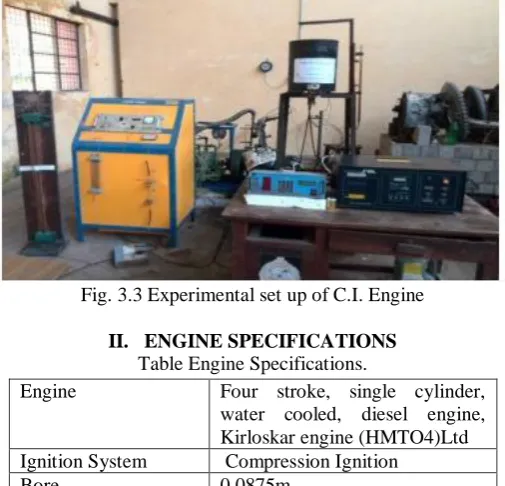
The Engine chosen to carry out experimentation on a single cylinder, four stroke, vertical, water cooled, Kirloskar make CI Engine. This engine can withstand higher pressures encountered and also is used extensively in agriculture and industrial sectors. Therefore this engine is selected for
Fig. 3.3 Experimental set up of C.I. Engine
II. ENGINE SPECIFICATIONS Table Engine Specifications.
Engine Four stroke, single cylinder,
water cooled, diesel engine, Kirloskar engine (HMTO4)Ltd
Ignition System Compression Ignition
Bore 0.0875m
Stroke 0.11m
Compression ratio 17.5:1
Speed 1500 rpm
ISSN(E): 2277-128X, ISBN: 978-93-87396-07-4, pp. 281-286
III. RESULTS AND DISCUSSION Engine Performance
3.1 Brake thermal efficiency.
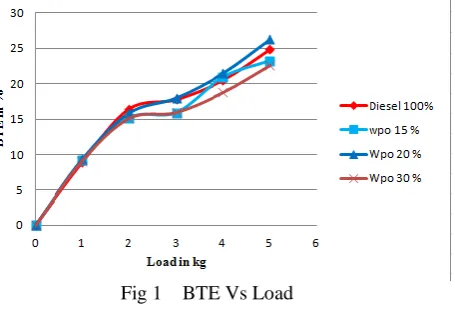
Variations in brake thermal efficiency (BTE), with respect to Load, for all of the fuels of diesel and its blends are shown in fig 1 From the figure it is observed that the Plastic oil content increases, BTE decreases by increasing Load. Maximum brake thermal efficiency was 26.24 % for PO20, which was increase to that of diesel (24.85%) which was higher than that of diesel fuel more oxygen content in the PO 20 blend
Fig 1 BTE Vs Load
3.2 Brake Specific fuel consumption.
Variations in brake specific fuel consumption (BSFC), with respect to engine load are shown in Figure 2 For blends WPO15 and WPO20, BSFC were 0.44, 0.45kg/kW.hr, slightly more than diesel (0.41).
Fig 2 SFC Vs Load
IV. ENGINE EXHAUST EMISSIONS. 4.1 Carbon Monoxide (CO % IN VOLUME).
Figure 4.1 compares the carbon monoxide (CO) emissions, with respect to engine load.. CO emissions were slightly increases with increasing plastic oil content. The percentage of CO emissions of Diesel, PO15, PO20, and PO30 were 3.69,3.72, 3.86 .
Fig 4..1 CO Vs Load
4.2 Carbon Dioxide (CO2).
ISSN(E): 2277-128X, ISBN: 978-93-87396-07-4, pp. 281-286
Fig 4.2 CO2 Vs LOAD
4.3 HC Emission.
The Variation of unburned hydrocarbon with blends with different loads is graphically represented in Fig.4.3 It was observed that the percentage of hydrocarbon in all the blends as compared to diesel was found to be high at all loads. At the brake power of 3.67kW, the hydrocarbon of about 1606 ppm for 100% diesel and 1610 ppm for WPO15.
Fig 4.3 HC Vs LOAD
V. ENGINE PERFORMANCE WITH DEE AS ADDITIVE 5.1 Brake thermal efficiency.
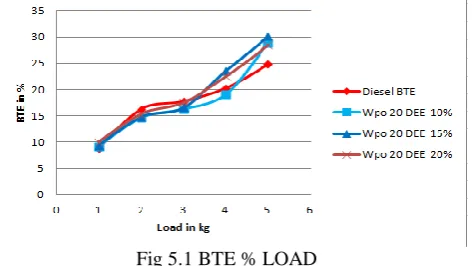
The brake thermal efficiency variation with brake power for the waste plastic oil blends with Diesel Diethyl ether as Additives and is shown in figure 5.1 PO 20 was the optimum blend Brake thermal efficiency of the engine for Diesel, PO20 DEE 10%, and PO20 DEE 15%, PO20 DEE20% respectively.
Fig 5.1 BTE % LOAD
5.2 Brake Specific Fuel Consumption.
Fig 5.2 shows Brake specific fuel consumption variation brake power for the corn oil and pure diesel. It is observed that the brake specific fuel consumption is found to decrease with increase in load. At all brake powers, SFC of PO15, PO20 were nearer to the Diesel and PO30, SFC of the engine for Diesel, PO20 DEE 10%, PO20 DEE 15%, PO20 DEE 20% and for 0.41, 0.43, 0.45, 0.48 Respectively.
ISSN(E): 2277-128X, ISBN: 978-93-87396-07-4, pp. 281-286
20%were lower than that of diesel. Maximum EGT at peak load for Diesel, WPO20 DEE 10%, WPO20 DEE 15% and
WPO 20 DEE 20% were 288◦ C, 268oC, 278oC, and 282oC respectively.
5.4 CO Emissions (%).
The variation of carbon monoxide with brake power is shown in Figure 5.1 Since, CI engines are operating with lean mixtures;. The increase in CO emission at higher loads is due to higher fuel consumption.
Fig 5.1 CO Vs LOAD
5.5 CO2 Emissions:
As shown in 5.4.2, it can be observed that the variation of carbon dioxide emission with load for Diesel and WPO Diesel operation. From the results, it is observed that the amount of CO2 produced while using WPO- Diesel blends is higher than Diesel at all load conditions.
Fig 5.2 CO2 Vs LOAD
5.6 H C Emissions (ppm)
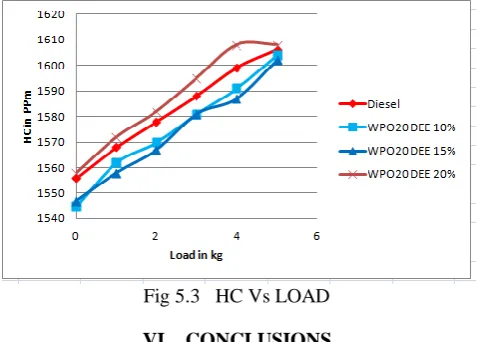
Figure 5.3 shows the graph for Hydro carbons (HC) emissions of the tested fuels operated at the rated engine speed of 1500 rpm at various load conditions. The values of HC emissions for diesel, PO20 DEE 10%, PO 20 DEE 15%, PO 20 DEE 20% were 1606,1603,1605,and 1612 respectively.
Fig 5.3 HC Vs LOAD
VI. CONCLUSIONS
Performance, Emission of single cylinder four stroke diesel engine was run with waste plastic oil blends as alternative fuel DEE as additive.
ISSN(E): 2277-128X, ISBN: 978-93-87396-07-4, pp. 281-286
The BSFC of plastic oil WPO 20 Blend was higher than that of diesel for 8.88% without DEE. By adding of DEE WPO 20 to the BSFC of WPO20 DEE 10% and WPO20 DEE 15% by 28.12 % and 13.88 % as compared to the Diesel. The CO emissions are of Plastic oil Blends was higher than that of diesel without DEE. By adding of DEE 10%, the CO emissions of WPO 20 decreases from 14.24%,for WPO20 DEE 15% it was from 10.14 % as compared to the Diesel.
REFERENCES
[1] Pawar H.R. and Lawankar S.M. Experimental Investigation on Compression Ignition Engine with Waste Plastic
Oil and its blends with Ethanol Research Journal of Engineering Sciences ISSN 2278 – 9472 Vol. 2(5), 1-5,
May (2013) Res. J. Engineering Sci.
[2] Sanjeev1, Dr. Sudhir Kumar21NIT, Kurukshetra Experimental Investigation on Performance of Direct Injection
Diesel Engine Fuelled with Jatropha Methyl Ester, Mechanical Engineering (JMSME) Print ISSN : 2339-9095; Online ISSN : 2393-9109; Volume 2, Number 6; April – June, 2015 pp 72 – 75 KrishiSanskriti Publication
[3] SenthilkumarTamilkolundu1.ChandrasekarMurugesan et The Evaluation of blend of Waste Plastic Oil- Diesel
fuel for use as alternate fuel for transportation 2nd International Conference on Chemical, Ecology and Environmental Sciences (ICCEES'2012) Singapore April 28-29, 2012
[4] Kintesh D Patel1 Dr. Tushar M Patel2Performance and Emission Analysis of Diesel Engine using Waste Plastic
Pyrolysis Oil and Diesel Blend: A ReviewIJSRD - International Journal for Scientific Research & Development| Vol. 4, Issue 12, 2017 | ISSN (online): 2321-0613
[5] Ioannis Kalargaris, Guohong Tian, Sai GuThe utilisation of oils produced from plastic waste at different