Eye-Tracking and Corpus-Based Analyses of Syntax-Semantics
Interactions in Complement Coercion
Matthew W. Lowder1 and Peter C. Gordon2
1University of California, Davis
2University of North Carolina at Chapel Hill
Abstract
Previous work has shown that the difficulty associated with processing complex semantic expressions is reduced when the critical constituents appear in separate clauses as opposed to when they appear together in the same clause. We investigated this effect further, focusing in particular on complement coercion, in which an event-selecting verb (e.g., began) combines with a complement that represents an entity (e.g., began the memo). Experiment 1 compared reading times for coercion versus control expressions when the critical verb and complement appeared together in a subject-extracted relative clause (SRC) (e.g., The secretary that began/wrote the memo) compared to when they appeared together in a simple sentence. Readers spent more time processing coercion expressions than control expressions, replicating the typical coercion cost. In addition, readers spent less time processing the verb and complement in SRCs than in simple sentences; however, the magnitude of the coercion cost did not depend on sentence structure. In contrast, Experiment 2 showed that the coercion cost was reduced when the complement appeared as the head of an object-extracted relative clause (ORC) (e.g., The memo that the secretary began/ wrote) compared to when the constituents appeared together in an SRC. Consistent with the eye-tracking results of Experiment 2, a corpus analysis showed that expressions requiring complement coercion are more frequent when the constituents are separated by the clause boundary of an ORC compared to when they are embedded together within an SRC. The results provide important information about the types of structural configurations that contribute to reduced difficulty with complex semantic expressions, as well as how these processing patterns are reflected in naturally occurring language.
Address correspondence to: Matthew W. Lowder, Department of Psychology, University of California, Davis, Young Hall, One Shields Ave., Davis, CA 95616, [email protected].
1We also tested for differences in gaze duration and regression-path duration in the reverse contrasts (i.e., the target NP in ORCs and the embedded verb in SRCs). As would be expected, gaze durations on the target NP did not differ between the Coercion and Control conditions in the ORCs, ts< 1. Because this region came at the very beginning of the sentence in the ORCs, analysis of regression-path duration is not appropriate. There was a significant difference in gaze duration on the embedded verb in the SRCs (marginal in the item analysis), t1(39) = 2.14, p< .05; t2(35) = 1.98, p < .07, such that reading times were longer on the Coercion verbs than the Control verbs. This difference was not expected, given that the target NP had not yet been fixated and given that we used the exact same verbs in Experiment 1 and found no evidence of a difference in gaze duration. However, as noted above, the verbs in the Coercion condition were on average longer than the verbs in the Control condition (see Experiment 1 Methods), and it is well-known that increases in word length tend to inflate gaze duration (e.g., Rayner, 1998). The notion that this difference in gaze duration reflects differences in verb length rather than differences related to complement coercion is bolstered by the fact that regression-path duration
HHS Public Access
Author manuscript
Lang Cogn Neurosci
. Author manuscript; available in PMC 2017 May 19.Published in final edited form as:
Lang Cogn Neurosci. 2016 ; 31(7): 921–939. doi:10.1080/23273798.2016.1183798.
A
uthor Man
uscr
ipt
A
uthor Man
uscr
ipt
A
uthor Man
uscr
ipt
A
uthor Man
uscr
Keywords
coercion; relative clauses; eye movements; corpus analysis; sentence complexity
A sentence may be considered “complex” for a wide variety of reasons. Semantic
complexity, such as the need for enriched composition (Pustejovsky, 1995), has been shown to increase processing time for syntactically simple sentences like The gentleman began Dickens (McElree, Frisson, & Pickering, 2006). In addition, syntactic complexity, such as that caused by relative clauses, has been shown to increase processing time for sentences like The reporter that the senator attacked admitted the error that have a straightforward semantic interpretation (King & Just, 1991). A fundamental question that has received remarkably little attention involves understanding how processing is influenced when sources of semantic complexity and syntactic complexity combine in the same sentence. Our previous work has demonstrated that the processing of various types of complex semantic expressions is reduced when they appear in syntactically complex sentences; however, several basic questions remain concerning the nature of this effect. One of these involves understanding the precise structural configurations that result in reduced difficulty with complex semantic expressions. Another involves understanding the extent to which
interactions between syntactic complexity and semantic complexity are observed in patterns of naturally occurring language.
In a recent paper, Lowder and Gordon (2015a) demonstrated that sentence structure affects the processing of complement coercion—a linguistic phenomenon traditionally explained as occurring when verbs that semantically select for an event-denoting complement (e.g., begin, start, finish) combine instead with an entity-denoting complement (Jackendoff, 1997; Pustejovsky, 1995). For example, a sentence such as The secretary began the memo has been described as involving a semantic mismatch between the semantic characteristics of the complement and the thematic properties specified by the verb, which triggers the process of coercion. Indeed, several experiments using a variety of methodologies have demonstrated that sentences requiring complement coercion impose a processing cost compared to various types of control sentences (e.g., Frisson & McElree, 2008; Husband, Kelly, & Zhu, 2011; Kuperberg, Choi, Cohn, Paczynski, & Jackendoff, 2010; McElree, Pylkkänen, Pickering, & Traxler, 2006; McElree, Traxler, Pickering, Seely, & Jackendoff, 2001; Pickering, McElree, & Traxler, 2005; Pylkkänen & McElree, 2007; Scheepers, Keller, & Lapata, 2008; Traxler, McElree, Williams, & Pickering, 2005; Traxler, Pickering, & McElree, 2002).
The processing costs associated with complement coercion have traditionally been explained as arising from the detection of the semantic mismatch (e.g., began the memo), which triggers a type-shifting operation that reconfigures the semantic properties of the
complement to allow for an event interpretation (e.g., began [writing] the memo) (see, e.g., Traxler et al., 2005). However, recent work has suggested that the verbs that are typically used in coercion experiments represent a semantically heterogeneous set and that the standard coercion costs that have been previously observed may result solely from aspectual verbs (e.g., begin, start, finish) and not psychological verbs (e.g., endure, prefer, resist) (Katsika, Braze, Deo, & Piñango, 2012; Piñango & Deo, in press; Utt, Lenci, Padó, Zarcone,
A
uthor Man
uscr
ipt
A
uthor Man
uscr
ipt
A
uthor Man
uscr
ipt
A
uthor Man
uscr
2013).The processing dynamics associated with other types of coercion verbs (e.g., attempt, master, try) have not been systematically investigated. Thus, the effects of complement coercion that we and others have reported (e.g., Frisson & McElree, 2008; Lowder & Gordon, 2015a; McElree et al., 2001, 2006; Traxler et al., 2002, 2005) as well as those to be reported in this article may be driven by certain verb subclasses over others. This recent work (Katsika et al., 2012; Piñango & Deo, in press) has argued further that the processing costs associated with the pairing of an aspectual verb with an entity should not be attributed to type-shifting operations triggered by a semantic mismatch because aspectual verbs do not necessarily select for events (as in constitutive uses such as A stern warning began the memo). Alternatively, we would argue that the selectional requirements of these verbs should not be conceptualized as all-or-none, but rather as graded with respect to their preferences for certain types of constituents over others. Thus, although aspectual verbs may sometimes select for complements that represent entities, as in constitutive uses, we
speculate that constructions such as these are likely quite rare, and these verbs are perhaps more likely to select initially for complements that represent events. This example illustrates that an aspectual verb like began can in theory select for more than one type of complement, but may differ with respect to what types of complements it prefers. From this perspective, the processing costs observed for complement coercion could be conceptualized as stemming from the semantic mismatch between the semantic characteristics of the entity-denoting noun phrase(NP) and the selectional restrictions of the verb's preferred event-selecting interpretation. On this characterization, themechanism underlying the
comprehension of a coercion verb with an entity NP as direct object would be similar to those underlying the comprehension of other frequency-dependent constructions, such as whether a given verb is followed more frequently by a direct object or by a complement (see, e.g., Ferreira & Henderson, 1990; Garnsey, Pearlmutter, Myers, & Lotocky, 1997; Kennison, 2001; Mitchell & Holmes, 1985; Pickering & Traxler, 1998; Trueswell,
Tanenhaus, & Kello, 1993; Wilson & Garnsey, 2009). The goal of the current paper is not to present concrete evidence for this view, but rather we propose that this could be a useful framework for future work aimed atisolating the underlying source of complement coercion. However, we acknowledge that a preference-based explanation for complement coercion is potentially complicated by findings that the coercion cost is not modulated by manipulations of previous context (Traxler, McElree, et al., 2005) and survives even when controlling for certain frequency- or surprisal-based factors (Delogu & Crocker, 2012). Thus, it seems that a framework of this sort might not be able to explain the full range of processing dynamics associated with complement coercion. Nonetheless, we believe it is reasonable to expect that the verbs that have been studied in experiments of complement coercion have graded preferences with respect to the complements they select. Our description and
conceptualization of the coercion cost is rooted in this idea of a semantic mismatch between the complement NP and the selectional restrictions of the verb's preferred interpretation. We leave it to future work to test additional predictions associated with this account.
Whereas previous experiments that have investigated complement coercion have done so exclusively in simple one-clause sentences, Lowder and Gordon (2015a) examined the effects of syntactic manipulations on the magnitude of the coercion cost, demonstrating that complement coercion was easier to process when the verb and complement appeared in
A
uthor Man
uscr
ipt
A
uthor Man
uscr
ipt
A
uthor Man
uscr
ipt
A
uthor Man
uscr
separate clauses, compared to when they appeared together in the same clause. The effect emerged in passive structures, where the complement appeared as the sentence subject (e.g., The memo was begun/written by the secretary... versus The memo that was begun/written by the secretary...), as well as in cleft constructions, which differ substantially with regard to which constituent of the sentence is in linguistic focus (e.g., It was the secretary that began/ wrote the memo... versus What the secretary began/wrote was the memo...); for further discussion about clefts and the online processing of linguistic focus, see Lowder and Gordon (2015c).
These findings on complement coercion build on previous findings where we have shown that manipulations of sentence structure can reduce the difficulty associated with inanimate subject-verb integration and metonymy. Lowder and Gordon (2012) demonstrated that the difficulty associated with integrating an inanimate subject with an action verb (e.g., The pistol injured the cowboy...; The cowboy that the pistol injured...) was substantially reduced when the subject and verb appeared in two separate clauses (e.g., The pistol that injured the cowboy...), though this effect may more accurately be attributed to perceived agency rather than animacy per se (Lowder & Gordon, 2015b). Lowder and Gordon (2013) further showed that sentence structure modulates the processing of metonymy—a type of figurative
language where a particular entity is referred to by the name of some other entity that is intimately associated with it. For example, the word college can be used in a literal sense to refer to the physical space of a university (e.g., The journalist photographed the college), or it can be used more figuratively to refer to the administration or other governing body of the institution (e.g., The journalist offended the college). Lowder and Gordon (2013) showed that the processing of familiar place for-institution metonyms (e.g., The journalist offended the college...) was more difficult than literal controls (e.g., The journalist photographed the college...; The journalist offended the leader...) when the metonym appeared as the object of the verb. In contrast, processing difficulty was reduced when the metonym appeared as part of an adjunct phrase (e.g., The journalist offended the honor of the college). This pattern differs from previous work on the processing of metonymy, which has tended to argue that familiar metonyms are no more difficult to process in a figurative context than a literal context (Frisson & Pickering, 1999, 2007; McElree et al., 2006). Instead, our work demonstrates that ease or difficulty associated with figurative-language comprehension depends critically on sentence structure (for further discussion, see Lowder & Gordon, 2013).
Taken together, this work (Lowder & Gordon, 2012, 2013, 2015a, 2015b) demonstrates that the processing of complex semantic expressions depends critically on sentence structure. Under this account, and consistent with the description put forth by Lowder & Gordon (2015a), we conceptualize semantic complexity as any instance in which two or more constituents that must be combined syntactically possess semantic features that are
inconsistent with one another on the basis of the selectional preferences of the verb, and thus constitute a semantic mismatch. For example, a semantic mismatch occurs when an action verb that prefers an animate subject combines instead with an inanimate subject (e.g., The pistol injured the cowboy; Lowder & Gordon, 2012; see also Lowder & Gordon, 2015b), when a psychological verb that prefers an experiencer combines instead with an object that refers to a nonhuman place (e.g., The journalist offended the college; Lowder & Gordon,
A
uthor Man
uscr
ipt
A
uthor Man
uscr
ipt
A
uthor Man
uscr
ipt
A
uthor Man
uscr
2013), or when a verb that prefers an event complement combines instead with an entity (e.g., The secretary began the memo; Lowder & Gordon, 2015a). We have demonstrated that semantic complexities of this sort impose a processing cost on the reader when the critical constituents that convey the semantic mismatch share a close structural relationship. These patterns of processing difficulty are predicted by the indirect-access model for interpretation of figurative language (Grice, 1975; Searle, 1979), as well as models that have been
proposed to explain the processing of complement coercion (Traxler, McElree et al., 2005). According to these accounts, readers make an initial attempt to understand a semantically complex expression by combining the stored meanings of the critical constituents, which triggers the detection of a semantic mismatch (or “defect,” Searle, 1979), and a process of searching for an alternative interpretation, which likely involves different mechanisms depending on the specific type of expression (see Lowder & Gordon, 2015a, for further discussion). Our work also demonstrates a reduction in processing times when the critical constituents are structurally separated. In previous work and in the current study we use terminology that describes these reading-time effects as showing a reduction in processing difficulty; however, it is important to note that reading-time effects may be due to
differences in processing difficulty across conditions or to differences in processing effort across conditions. That is, finding shorter reading times for complex semantic relationships established across a clause boundary versus those established within a single clause may reflect actual differences in the ease with which readers are able to fully compute the meaning of the expression; alternatively, it may be the case that effects of structural separation reflect differences in the depth at which readers engage in complex semantic interpretation, perhaps contributing to incomplete or underspecified representations (e.g., Ferreira, Bailey, & Ferraro, 2002; Ferreira & Lowder, in press; Gordon & Hendrick, 1998; Sanford & Sturt, 2002). Importantly, the effects of complex syntax on processing of complex semantic constructions may also reflect a combination of both of these mechanisms.
Building on the findings of Lowder and Gordon (2015a), the current study further examines the effects of sentence structure on the processing of complement coercion. First, we investigate whether structural deemphasis of both critical constituents is sufficient to reduce the magnitude of the coercion effect. Our previous work showed that there are reductions in processing difficulty when the structure of the sentence deemphasizes the relationship between the constituents by positioning them in separate clauses; however, it is unclear whether a similar pattern would be obtained if the structure of the sentence deemphasizes both constituents. Second, we extend the results of Lowder and Gordon (2015a) by examining the effects of structural separation on the magnitude of the coercion cost, using relative clauses as a test bed. Finally, we examine frequency patterns of complement coercion in naturally occurring language, extending previous corpus work on coercion (e.g., Briscoe, Copestake, & Boguraev, 1990; Lapata, Keller, & Scheepers, 2003; Lapata & Lascarides, 2003) by considering whether the incidence of coercion is related to the kinds of sentence structures in which coercion is easier to understand.
Experiment 1
Linguistic expressions in a defocused portion of a sentence, such as a relative clause or other adjunct phrase, are processed at a shallower level than information presented in the main
A
uthor Man
uscr
ipt
A
uthor Man
uscr
ipt
A
uthor Man
uscr
ipt
A
uthor Man
uscr
clause of the sentence. For example, false information is detected more readily when it is presented in a sentence's main clause rather than in a subordinate clause (Baker & Wagner, 1987). Thus, the coercion cost might be reduced when the critical verb and complement NP appear together in an embedded clause compared to when they appear together in a simple one-clause sentence. Experiment 1 tested this possibility by varying whether the critical verb and complement NP appeared in the main clause of the sentence (1a and 1b) or were embedded in a subject-extracted relative clause (SRC; 1c and 1d).
1a. The secretary began the memo about the new office policy shortly after being hired. (Simple Sentence, Coercion)
1b. The secretary wrote the memo about the new office policy shortly after being hired. (Simple Sentence, Control)
1c. The secretary that began the memo about the new office policy had just been hired. (SRC, Coercion)
1d. The secretary that wrote the memo about the new office policy had just been hired. (SRC, Control)
Lowder and Gordon (2012, Experiment 1) showed that the processing of subject-verb integration is more difficult when an inanimate subject combines with an action verb, compared to when the subject is animate, even when both constituents appeared together inside a relative clause. However, Lowder and Gordon did not directly assess whether the size of this processing cost differed when the two constituents appeared together in the main clause of the sentence compared to when they were embedded together in an RC. The current experiment allows the size of the coercion cost to be compared as a function of whether the critical verb and complement NP appear in the main clause of a simple-sentence context or are embedded in an RC. In addition, it allows for a direct test of whether readers in general spend more time processing linguistic information when it is in a main clause compared to when it is embedded in a subordinate clause. If sentence structure prompts shallower processing of semantic relations within embedded clauses, the coercion cost in the SRC condition should be smaller than the coercion cost in the Simple-Sentence condition. Alternatively, while less time in general may be spent reading the constituents in the embedded as compared to the main clause, the process of computing the relationship between the verb and complement within the same clause may be the same regardless of the type of clause, leading to a constant coercion cost across the types of sentence structure.
Method
Participants—Thirty-six native-English-speaking students at the University of North Carolina at Chapel Hill participated in exchange for course credit.
Materials—Each participant was presented with 36 experimental sentences and 78 filler sentences. The experimental sentences were adapted from Traxler, Pickering, and McElree (2002). In constructing the simple-sentence versions of each item, we used the same subject NP, verb, and complement NP used by Traxler et al. in their Coercion and Preferred conditions. The material following the complement NP was sometimes identical to the material used by Traxler et al., but was sometimes altered. The SRC versions of each item
A
uthor Man
uscr
ipt
A
uthor Man
uscr
ipt
A
uthor Man
uscr
ipt
A
uthor Man
uscr
were created by inserting the complementizer that between the subject NP and verb and then rewriting the remainder of the sentence. See Appendix A for the full set of experimental stimuli.
As noted by Traxler et al. (2002), the verbs in the coercion condition were longer on average than the verbs in the control condition. However, supplementary analyses showed that this difference in length was not responsible for the different processing times observed for these two conditions. The two classes of verbs did not differ in frequency. In addition, Traxler et al. showed that their items did not differ in plausibility and that predictability of the complement NP was low across conditions.
The sentences were counterbalanced across four lists so that each participant saw one version of each item and so that each participant saw the same number of sentences from each of the four conditions.
Procedure—Eye movements were recorded with an EyeLink 1000 system, which was calibrated at the beginning of each session and throughout the session as necessary. At the start of each trial, a fixation point was presented near the left edge of the monitor. Once gaze was steady, the experimenter presented the sentence. After reading the sentence, the
participant pressed a button, which replaced the sentence with a true-false comprehension question. These questions did not probe readers’ interpretation of the coercion expressions. Participants responded using a handheld console. After the participant answered the comprehension question, the fixation point for the next trial appeared.
Each participant first read four of the filler sentences. After this warm-up block, the remaining 110 sentences were presented randomly.
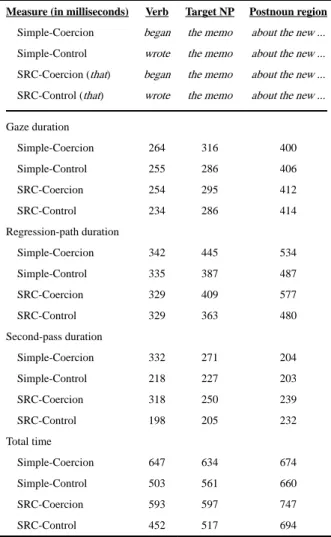
Analysis—Data analysis focused on four standard eye-movement measures (Rayner, 1998). Gaze duration is the sum of all initial fixations on a region; it begins when the region is first fixated and ends when gaze is directed away from the region, either to the left or right (for multiword regions, this measure is commonly referred to as first-pass reading time). Regression-path duration is the sum of all fixations beginning with the initial fixation on a region and ending when the gaze is directed away from the region to the right. Thus, regression-path duration includes time spent rereading earlier parts of the sentence before the reader is ready to proceed with the rest of the sentence. Second-pass duration is the time spent rereading a region after the eyes have exited the right boundary of this region. Unlike the other measures, second-pass duration includes zeroes. Total time is the sum of all fixations on a word or region.
Reading times are presented for three regions of interest. The verb region was the main verb in the Simple-Sentence conditions and the embedded verb in the SRC conditions. The target NP consisted of the determiner and noun that followed the verb. The postnoun region consisted of the three words following the target NP in most cases. For four of the items, there were only two words that remained constant following the target NP between the Simple-Sentence and SRC conditions. For these four items, the postnoun region consisted of only those two words.
A
uthor Man
uscr
ipt
A
uthor Man
uscr
ipt
A
uthor Man
uscr
ipt
A
uthor Man
uscr
An automatic procedure combined fixations that were shorter than 80 ms and within one character of another fixation into one fixation. Additional fixations shorter than 80 ms and longer than 800 ms were removed. We set maximum cutoff values at 1,500 ms for gaze duration and second-pass duration and 2,500 ms for regression-path duration and total time. This procedure is similar to data-exclusion procedures employed in previous eye-tracking experiments on complement coercion (Frisson & McElree, 2008; McElree, Frisson, & Pickering, 2006; Traxler, McElree, et al., 2005). This procedure eliminated less than 1% of the data.
Results
Comprehension-question accuracy—Mean comprehension-question accuracies for each condition were as follows: Simple-Coercion (94%), Simple-Control (96%), SRC-Coercion (95%), SRC-Control (94%). There were no significant differences between conditions.
Verb region—Reading times are presented in Table 1. At the verb, significant main effects of sentence structure emerged in gaze duration, F1(1,35) = 4.20, MSE = 2,029, p < .05;
F2(1,35) = 4.02, MSE = 2,036, p = .05, and in total time (marginal in the item analysis),
F1(1,35) = 7.45, MSE = 13,344, p < .02; F2(1,35) = 3.51, MSE = 25,400, p < .07. For both
measures, reading times were longer in the Simple-Sentence condition than the SRC condition, indicating that readers tended to spend more time processing the verb when it was the main verb of the sentence than when it was embedded in an SRC. In addition, main effects of verb type were observed in both second-pass duration, F1(1,35) = 52.54, MSE =
9,329, p < .001; F2(1,35) = 28.64, MSE = 17,052, p < .001, and total time, F1(1,35) = 55.45,
MSE = 13,253, p < .001; F2(1,35) = 30.21, MSE = 26,202, p < .001, with longer times in the
Coercion condition than in the Control condition. The interaction between verb type and sentence structure was not significant on any measure.
Target NP—Analysis of all measures on the target NP revealed main effects of verb type such that the Coercion condition was more difficult to process than the Control condition. The effect was marginally significant in gaze duration , F1(1,35) = 3.85, MSE = 3,657, p < . 06; F2(1,35) = 4.24, MSE = 3,654, p < .05, but fully significant in regression-path duration, F1(1,35) = 17.55, MSE = 5,503, p < .001; F2(1,35) = 8.62, MSE = 10,930, p < .01, second-pass duration, F1(1,35) = 9.90, MSE = 7,389, p < .005; F2(1,35) = 5.51, MSE = 12,843, p < . 03, and total time, F1(1,35) = 14.40, MSE = 14,583, p < .005; F2(1,35) = 10.58, MSE = 19,866, p < .005. In addition, there was a marginally significant main effect of sentence structure in the total time data, F1(1,35) = 3.41, MSE = 17,447, p < .08; F2(1,35) = 2.89, MSE = 19,541, p < .10, such that there were longer reading times for the target NP in the Simple-Sentence condition compared to the SRC condition. The interaction between verb type and sentence structure was not significant on any measure.
Postnoun region—Regression-path duration on the postnoun region showed a significant main effect of verb type, F1(1,35) = 12.49, MSE = 14,833, p < .005; F2(1,35) = 9.65, MSE = 21,000, p < .005, with longer times seen in the Coercion condition than the Control
condition. In addition, there was a main effect of sentence structure that was marginal in
A
uthor Man
uscr
ipt
A
uthor Man
uscr
ipt
A
uthor Man
uscr
ipt
A
uthor Man
uscr
second-pass duration, F1(1,35) = 3.20, MSE = 11,470, p < .09; F2(1,35) = 3.20, MSE =
9,973, p < .09, and fully significant in total time, F1(1,35) = 7.38, MSE = 13,824, p < .02;
F2(1,35) = 5.99, MSE = 17,124, p < .03. These measures of later processing showed longer
reading times on the postnoun region in the SRC condition compared to the Simple-Sentence condition, a pattern that reverses the effect found for the earlier target verb and target NP regions. Although the words in this region were identical across all conditions, the subsequent words depended on sentence structure, and included the matrix verb for
sentences in the SRC condition. Thus, this effect likely reflects the difficulty associated with processing the SRC matrix verb, with readers being more likely to go back and reread the preceding material in the SRC condition. The interaction between verb type and sentence structure was not significant on any measure.
Discussion
The results of Experiment 1 replicated previous reading-time studies in demonstrating the online costs associated with processing complement coercion (Frisson & McElree, 2008; Lowder & Gordon, 2015a; McElree et al., 2001; McElree, Frisson, & Pickering, 2006; Pickering et al., 2005; Traxler, Pickering, & McElree, 2002; Traxler, McElree, et al., 2005). In line with previous studies, the greater difficulty in processing coerced compared to control expressions emerged in regression-path duration on both the target NP and the postnoun region, as well as in second-pass duration and total time on both the verb and target NP. In addition, there was some evidence that the difficulty with coercion emerged as early as gaze duration on the target NP; effects of coercion have occasionally been observed this early in the eye-tracking record (see Frisson & McElree), though it is not typical.
Critically, Experiment 1 showed no evidence that embedding the verb and complement NP in a relative clause reduced the magnitude of the coercion cost. Although readers did spend less time overall on critical words in the SRC condition compared to the same words in the Simple-Sentence condition (i.e., gaze duration and total time on the verb, as well as total time on the target NP), this effect did not depend on verb type. The finding that a coercion cost emerges when the critical words appear together in an RC is consistent with our previous work on inanimate subject-verb integration (Lowder & Gordon, 2012) and suggests that the embedding manipulation does not influence the depth at which readers compute the relationship between the constituents in a complex semantic expression. In contrast, Lowder and Gordon (2015a) showed that the magnitude of the coercion cost was reduced when the event-selecting verb and entity-denoting complement appeared in separate clauses. This suggests that the difficulty associated with processing a complex semantic expression is reduced when the structure of the sentence deemphasizes the complex relationship but not when sentence structure simply deemphasizes the individual constituents.
Experiment 2
Experiment 2 tested whether placing the event-selecting verb and entity-denoting NP in separate clauses would reduce the coercion cost. As shown in (2), the complement NP was positioned as the main clause subject and the head noun of an ORC that contained the
A
uthor Man
uscr
ipt
A
uthor Man
uscr
ipt
A
uthor Man
uscr
ipt
A
uthor Man
uscr
critical verb (2a and 2b), or both the critical verb and complement NP were embedded in an SRC (2c and 2d).
2a. The memo that the secretary began announced that there would be pay raises for all the employees. (ORC, Coercion)
2b. The memo that the secretary wrote announced that there would be pay raises for all the employees. (ORC, Control)
2c. The secretary that began the memo announced that there would be pay raises for all the employees. (SRC, Coercion)
2d. The secretary that wrote the memo announced that there would be pay raises for all the employees. (SRC, Control)
Lowder and Gordon (2015a) used passive structures and cleft constructions to demonstrate that the magnitude of the coercion cost is reduced when the critical constituents appear in separate clauses. The comparison between ORCs and SRCs represents another structural device that can be used to test for differences in the processing of coercion.
Psycholinguistic experiments frequently make use of the contrast between ORCs and SRCs. Although ORCs and SRCs share the same phrase structure, they differ with respect to the position of the gap, and this syntactic difference in gap position leads to enhanced complexity in the processing of ORCs compared to the processing of SRCs. Indeed, many studies utilizing a broad range of methodologies have shown that ORCs are more difficult to process than SRCs (e.g., Caplan, Alpert, & Waters, 1998; Caramazza & Zurif, 1976; Ford, 1983; Holmes & O'Regan, 1981; Just Carpenter, Keller, Eddy, & Thulborn, 1996; King & Just, 1991; Wanner & Maratsos, 1978). Although the basic ORC-SRC asymmetry is virtually undisputed, explanations as to the source of this effect are abundant, ranging from accounts that emphasize the memory demands associated with these structures, to accounts that describe the semantic or pragmatic functions of RCs, to accounts that focus on the role of one's experience with language (for a review, see Gordon & Lowder, 2012). The current experiment is not designed to further examine the source of the basic ORC-SRC asymmetry. Rather, we capitalize on how this manipulation of structural complexity groups the critical verb-complement pair in the same clause in the case of SRCs but separates them into two separate clauses in the case of ORCs. Thus, just as we have demonstrated that the cost of complement coercion is reduced when the critical constituents are separated via passive structures and cleft constructions (Lowder & Gordon, 2015a), the current design allows us to likewise assess whether coercion costs are reduced when the critical constituents are
separated via an RC.
The current experiment also provides an opportunity to examine factors that influence the difficulty of processing ORCs versus SRCs, though its design presents some challenges for localizing the effect. Whereas many previous experiments have examined differences in reading times on the RC region for ORCs versus SRCs (e.g., Gordon, Hendrick, Johnson, & Lee, 2006; Johnson, Lowder, & Gordon, 2011; Lowder & Gordon, 2012, 2014; Traxler, Morris, & Seely, 2002; Traxler, Williams, Blozis, & Morris, 2005; cf. Staub, 2010), the ORCs in the current experiment always contained an embedded noun that was animate,
A
uthor Man
uscr
ipt
A
uthor Man
uscr
ipt
A
uthor Man
uscr
ipt
A
uthor Man
uscr
whereas the embedded noun in the SRCs was almost always inanimate. This covariation of animacy with sentence structure renders comparison of the RC-region inappropriate. However, all four conditions are identical at the matrix verb (e.g., announced), which is another region of the sentence where ORC-SRC differences are typically observed (e.g., Gordon, Hendrick, & Johnson, 2001, 2004; Gordon et al., 2006; Johnson et al., 2011; King & Just, 1991; Lowder & Gordon, 2012, 2014; Traxler et al., 2002, 2005). Thus, the
comparison of (2b) versus (2d) at the matrix verb tests whether ORCs are more difficult than SRCs in the Control condition, whereas the comparison of (2a) versus (2c) at the matrix verb tests whether the ORC-SRC asymmetry is reduced or eliminated in the case of complement coercion.
Method
Participants—Forty native-English-speaking students at the University of North Carolina at Chapel Hill participated in exchange for course credit. No participants had taken part in Experiment 1.
Materials—Each participant was presented with 36 experimental sentences and 90 filler sentences. The experimental sentences were adapted from the materials used in Experiment 1. The SRCs were identical to the SRCs used in Experiment 1 up to and including the target NP (The secretary that began the memo). The ORCs were created by positioning the target NP as the sentence subject and embedding the agent inside the RC along with the verb (The memo that the secretary began). The remainder of the sentence was rewritten to include a matrix verb and post-verb material that could be attributed to either the animate head NP in the SRCs or the inanimate head NP in the ORCs. See Appendix B for the full set of experimental stimuli.
Predictability—Twenty-four participants, none of whom participated in any other aspect of the study, were presented with initial fragments of the stimuli used in Experiment 2 and instructed to continue each fragment to make a complete sentence. The SRCs for both the Coercion and Control conditions were presented up to and including the determiner before the critical noun (The secretary that began/wrote the...), whereas the ORCs were presented up to the end of the embedded NP (The memo that the secretary...). Participants’ responses were then compared with the actual experimental stimuli to assess the predictability of the critical words. Cloze proportions (i.e., proportions of responses that were completed with the target words) are presented in Table 2. There was a significant main effect of verb type, F(1,23) = 124.64, p < .001, such that cloze proportions in the Control condition were higher than in the Coercion condition. A similar effect was reported by Traxler, Pickering, and McElree (2002), whose stimuli were the basis of those used here; analyses by Traxler et al. suggested that this difference in predictability was unlikely to explain the processing costs reported in their experiments. Of primary importance to the current experiment, the main effect of sentence structure was not significant, but there was a significant interaction between verb type and sentence structure, F(1,23) = 28.87, p< .001, with a larger
discrepancy in cloze probability between the Control and Coercion conditions for the ORCs than for the SRCs. Thus, the upcoming word in the Coercion condition was more predictable
A
uthor Man
uscr
ipt
A
uthor Man
uscr
ipt
A
uthor Man
uscr
ipt
A
uthor Man
uscr
in SRCs than ORCs, a pattern of predictability that is the opposite of the predicted patterns for reading times.
In addition, two independent raters, who were naïve to the purposes of the study, were presented with the NPs supplied in the completion of each SRC and assigned the code of “0” to NPs referring to entities and “1” to NPs referring to events (see Lowder & Gordon, 2015a, for a similar approach). Coders were instructed to code an NP as an “entity” if it represented something that existed or that a person might possess and to code an NP as an “event” if it represented something that could happen and that could be defined by temporal boundaries. Agreement between raters was 91%. Each verb provided for ORC fragments was also coded as “0” for entity-selecting and “1” for event-selecting. Table 2 shows mean event ratings for the two SRC conditions and for the ORCs. Mean scores were higher for the SRC-Coercion condition than the SRC-Control condition, t(23) = 9.38, p < .001, reflecting participants’ greater tendency to provide event-NP completions when the verb provided in the fragment was an event-selecting verb. In addition, mean scores for the SRC-Control condition were significantly higher than mean scores for the ORC condition, t(23) = 2.35, p < .03. This difference reflects the fact that participants were extremely unlikely to complete an ORC fragment with an event-selecting verb. Thus, any reduction in the magnitude of the coercion effect for ORCs compared to SRCs cannot be attributed to readers’ being more likely to predict an event-selecting verb in the ORCs than an event NP in the SRCs.
Procedure—The sentences were counterbalanced across four lists, as in Experiment 1. All aspects of the eye-tracking procedure were identical to the procedure described in
Experiment 1. The comprehension questions did not probe readers’ interpretations of the coercion expressions or the relationships established across the clause boundary.
Analysis—The different word orders of the two types of RCs posed some challenges to analyzing these data. Experiment 1 showed coercion effects early in the sentence (i.e., gaze duration and regression-path duration at the target NP). However, for this experiment the earliest region of the sentence where complement coercion could begin involved different words for SRCs and ORCs (i.e., the embedded NP in SRCs and the embedded verb in ORCs). Therefore, gaze duration and regression-path duration at this initial coercion cue were analyzed separately for the two types of RCs. At the matrix verb, the word orders of SRCs and ORCs are identical, and so the two structures were analyzed together relying on the same reading-time measures used in Experiment 1. Second-pass duration on the target NP and embedded verb was defined as the time spent rereading after the eyes had gotten past the initial coercion cue during first-pass reading. For example, rereading of the target NP in the ORCs (e.g., The memo) was incorporated into second-pass duration if the reader had gotten past the embedded verb (e.g., began), and thus had encountered the cue to begin coercion. As in Experiment 1, total time on the target NP and embedded verb were analyzed. The same data-exclusion criteria used in Experiment 1 were also employed here, eliminating less than 1% of the data.
A
uthor Man
uscr
ipt
A
uthor Man
uscr
ipt
A
uthor Man
uscr
ipt
A
uthor Man
uscr
Results
Comprehension-question accuracy—Mean comprehension-question accuracies for each condition were as follows: SRC-Coercion (96%), SRC-Control (93%), ORC-Coercion (92%), ORC-Control (92%). Accuracy tended to be higher for SRCs than for ORCs, although the main effect of sentence structure was significant only in the subject analysis, F1(1,39) = 5.33, MSE = 52.21, p < .03; F2(1,35) = 1.29, MSE = 194.98, p > .25. Neither the main effect of verb type nor the interaction between sentence structure and verb type was significant.
Initial coercion cue—Reading times are presented in Table 3. To determine whether there was any early evidence of processing difficulty associated with coercion, we analyzed gaze duration on the initial coercion cue (i.e., the target NP in the SRCs and the embedded verb in the ORCs). For SRCs, there was a marginally significant effect of coercion in the subject analysis, t1(39) = 1.79, p = .08; t2(35) = 1.56, p > .12. There was no evidence of a coercion
cost in gaze duration on the embedded verb for the ORCs, ts< 1. Analysis of regression-path duration on the initial coercion cue revealed a significant effect of coercion for the SRCs, t1(39) = 2.24, p< .05; t2(35) = 2.67, p < .02, but no indication of a difference for the ORCs,
ts< 1.2
Matrix verb—The Coercion condition was more difficult than the Control condition at the matrix verb. These significant main effects of verb type emerged in regression-path duration, F1(1,39) = 16.27, MSE = 34,887, p < .001; F2(1,35) = 33.41, MSE = 15,785, p < .001, second-pass duration, F1(1,39) = 18.25, MSE = 7,298, p < .001; F2(1,35) = 12.23, MSE = 10,063, p < .005, and total time, F1(1,39) = 27.19, MSE = 16,039, p < .001; F2(1,35) = 18.72, MSE = 22,986, p < .001. In addition, regression-path duration on the matrix verb showed a main effect of sentence structure (in the subject analysis), F1(1,39) = 7.03, MSE = 13,888, p < .02; F2(1,35) = 2.46, MSE = 24,459, p > .12, such that times were longer in ORCs than SRCs. Critically, analysis of regression-path duration showed a significant interaction between these two factors, F1(1,39) = 7.76, MSE = 12,668, p < .01; F2(1,35) = 5.15, MSE = 21,675, p < .05. Follow-up contrasts revealed that whereas there was a robust coercion effect in the SRCs (169 ms), t1(39) = 4.68, p< .001; t2(35) = 5.68, p < .001, the effect was much weaker in the ORCs (70 ms), and only reached significance in the subject analysis, t1(39) = 2.12, p< .05; t2(35) = 1.96, p < .06. In addition, whereas the Control conditions showed a typical ORC-SRC asymmetry, with ORCs being more difficult than SRCs, t1(39) = 4.56, p< .001; t2(35) = 3.37, p < .005, the ORC-Coercion and SRC-Coercion conditions were identical to one another.
Embedded verb—Measures of later processing revealed robust coercion costs on the embedded verb. These main effects of verb type were seen in second-pass duration, F1(1,39)
2Of course the target NP was always sentence-initial in the case of ORCs versus embedded in the case of SRCs, and this difference could explain the main effect of sentence structure observed here, as it may be the case that readers are more likely to always refixate a sentence-initial word than a sentence-internal word during rereading. This difference of word position could also be argued to explain the interaction observed here, as it may be the case that the inflated rereading times on the sentence-initial target NP in the ORC condition weakened the coercion effect. We cannot rule out the possibility that position contributes to the interaction effect on the target NP; however, we believe that it cannot account completely for the interaction given that we observed a similar pattern at the matrix verb which is in the same position in all four conditions.
A
uthor Man
uscr
ipt
A
uthor Man
uscr
ipt
A
uthor Man
uscr
ipt
A
uthor Man
uscr
= 82.75, MSE = 7,802, p < .001; F2(1,35) = 38.51, MSE = 14,631, p < .001, and in total
time, F1(1,39) = 61.33, MSE = 16,211, p < .001; F2(1,35) = 30.94, MSE = 28,913, p < .001.
In addition, these measures revealed main effects of sentence structure such that reading times were longer for SRCs than for ORCs. These effects were marginally significant in second-pass duration, F1(1,39) = 4.06, MSE = 9,828, p < .06; F2(1,35) = 4.01, MSE = 9,428,
p < .06, and fully significant in total time, F1(1,39) = 4.13, MSE = 23,259, p < .05; F2(1,35)
= 5.75, MSE = 17,052, p < .05. Although the interaction between sentence structure and verb type was not significant, the reversal observed for the ORC-SRC asymmetry can be explained by examining the contrasts separately for the Coercion and Control conditions. Total time on the embedded verb was significantly longer for the SRC-Coercion condition than the ORC-Coercion condition, t1(39) = 2.06, p< .05; t2(35) = 2.33, p < .05; however,
there was no difference between the SRC-Control and ORC-Control conditions, t1(39) =
1.35, p> .18; t2(35) = 1.36, p > .18. Thus, it seems that the reversal in the ORC-SRC
asymmetry was driven primarily by readers’ enhanced difficulty processing the coerced expressions in the SRCs relative to the ORCs.
Target NP—Measures of later processing also revealed coercion costs on the target NP. These main effects of verb type were significant in second-pass duration, F1(1,39) = 20.56, MSE = 12,242, p < .001; F2(1,35) = 30.25, MSE = 7,248, p < .001, and in total time, F1(1,39) = 13.87, MSE = 20,606, p < .005; F2(1,35) = 13.40, MSE = 17,682, p < .005. In addition, there was a main effect of sentence structure in total time, F1(1,39) = 11.95, MSE = 41,999, p < .005; F2(1,35) = 27.06, MSE = 15,680, p < .001, such that ORCs were more difficult than SRCs. Critically, these two factors interacted. Analysis of second-pass duration revealed a marginally significant interaction between verb type and sentence structure, F1(1,39) = 3.66, MSE = 8,514, p < .07; F2(1,35) = 2.48, MSE = 10,782, p > .12, with the coercion cost for the SRCs (107 ms), t1(39) = 4.14, p< .001; t2(35) = 4.08, p < .001, being over twice as large as the coercion cost for the ORCs (52 ms), t1(39) = 2.68, p< .02; t2(35) = 2.77, p < .01. The interaction was fully significant in total time, F1(1,39) = 8.21, MSE = 13,334, p < .01; F2(1,35) = 5.86, MSE = 16,788, p < .03. Follow-up contrasts revealed a robust coercion effect for the SRCs, t1(39) = 4.23, p< .001; t2(35) = 3.97, p < .001, with no effect at all for the ORCs, t1(39) = 1.26, p> .21; t2(35) = 1.03, p > .30. In addition, ORCs were more difficult than SRCs in the Control condition, t1(39) = 4.08, p< .001; t2(35) = 6.31, p < .01, whereas this difference was only marginally significant in the Coercion condition, t1(39) = 1.77, p< .09; t2(35) = 1.66, p > .103.
Discussion
The results of Experiment 2 are consistent with our previous work (Lowder & Gordon, 2015a) in demonstrating that the magnitude of the coercion cost is reduced when the verb and complement NP appear in separate clauses compared to when the critical constituents appear together in the same clause. The results of the predictability study (see Methods section) make it unlikely that this reduction was driven by expectations about the sentences, since completions of ORC fragments very rarely included an event-selecting verb and never included the event-selecting verb that was actually used in the stimuli. Sentence structure led to a reduction in the processing cost of coercion as early as regression-path duration on the first region of the sentence that signaled the need to engage in coercion. Whereas the
A
uthor Man
uscr
ipt
A
uthor Man
uscr
ipt
A
uthor Man
uscr
ipt
A
uthor Man
uscr
Coercion condition was more difficult than the Control condition at the target NP in SRCs, there was no difference at the embedded verb for the ORCs. This difference in processing difficulty carried over onto the matrix verb. Regression-path duration on this region showed a coercion effect that was more than twice as large in the SRCs than in the ORCs. The coercion cost was also larger for SRCs than for ORCs in second-pass duration on the target NP, and analysis of total time on the target NP showed a strong coercion cost for the SRCs and no evidence of a coercion cost at all for the ORCs. Coercion costs also emerged in later processing measures on both the embedded verb and the matrix verb. These effects did not interact with sentence structure.
There was greater difficulty at the matrix verb for ORCs than for SRCs in the Control condition—an effect that has been documented by several previous eye-tracking studies (Gordon et al., 2006; Johnson et al., 2011; Lowder & Gordon, 2012, 2014; Traxler, Morris, & Seely, 2002; Traxler, Williams, et al., 2005). This difference was eliminated completely in the Coercion condition due to the substantial processing difficulty associated with the SRC-Coercion condition. This pattern provides a nice parallel to the findings on structural separation and inanimate subject-verb integration reported by Lowder and Gordon (2012), in which we argued that the effects of animacy on RC processing that had been documented previously (Gennari & MacDonald, 2008; Traxler et al., 2002, 2005) could be explained by patterns of enhanced difficulty when integration occurs within the same clause, as in ORCs (e.g., The sheriff that the pistol injured), and reduced difficulty when integration occurs across a clause boundary, as in SRCs (e.g., The pistol that injured the cowboy). The current experiment produced similar findings with regard to complement coercion, although in this case the structural separation contributes to enhanced difficulty with SRCs (e.g., The secretary that began the memo) and reduced difficulty with ORCs (e.g., The memo that the secretary began).
As noted in the Introduction, recent work has suggested that coercion costs reported in the psycholinguistic literature may depend critically on verb subclass information. For example, Katsika et al. (2012) showed that coercion costs emerge when an entity NP combines as the object of an aspectual verb (e.g., began, start, finish), but not a psychological verb (e.g., endure, prefer, resist), though other types of verbs that have been used in coercion studies were not considered (e.g., attempt, master, try). The current set of items (see Appendix A) was adapted directly from previous work, and consequently was not designed to examine carefully how the coercion cost might be modulated by verb subclass information. Thus, it is unclear whether and to what extent the modulating effects of sentence structure observed in this experiment and in Lowder and Gordon (2015a) depend on verb subclass differences;this remains an important area for future research.
Corpus Study
Experiment 2 showed that the processing difficulty associated with complement coercion is reduced when the event-selecting verb and entity-denoting NP appear in separate clauses compared to when they appear in the same clause. The current corpus study examines the extent to which this pattern is mirrored in naturally occurring language. Finding that the constituents of a complex semantic expression occur more frequently across clause
A
uthor Man
uscr
ipt
A
uthor Man
uscr
ipt
A
uthor Man
uscr
ipt
A
uthor Man
uscr
boundaries than together in the same clause of a sentence would provide evidence consistent with the view that patterns of language usage correspond with patterns of online processing difficulty. Such a correspondence could occur because complement coercion is both easier to produce and easier to understand when the to-be-related expressions are in separate clauses, because language is produced in such a way as to reduce comprehension demands, or because language comprehension is easier for patterns that are encountered frequently than those that are encountered less frequently. While a correlation between language use and ease of comprehension cannot by itself identify an underlying cause, finding a
correspondence between how production and comprehension of coercion is influenced by clausal structure would provide important empirical corroboration of the idea that the processing of coercion does indeed depend on the structural relation between the verb and the complement.
This corpus study examined event-selecting verbs that were embedded in RCs. The critical comparisons involved the frequency with which the complement of the verb referred to an event (i.e., consistent with the selection criteria of the verb) or an entity (i.e., a case of complement coercion), and whether these frequency patterns differed when integration occurred within an SRC versus across the clause boundary of an ORC. If separation of the event-selecting verb and entity-denoting complement into different clauses reduces the cost of coercion, and if these patterns are reflected in frequency patterns of naturally occurring language, then rates of complement coercion should be higher for ORCs than SRCs.
Method
Corpus—The corpus analysis was conducted using the Corpus of Contemporary American English (Davies, 2008), a web-based corpus containing over 450 million words sampled from a wide variety of sources from 1990-2012 (http://corpus.byu.edu/coca/). Although the corpus is not parsed, it can be queried using complex search strings that return tokens satisfying a variety of constraints.
Procedure—The corpus was randomly sampled for 1,000 instances of each of the nine event-selecting verbs used in Experiments 1 and 2 (i.e., attempted, began, endured, finished, mastered, preferred, resisted, started, tried) that also appeared in a sentence where it was preceded by a complementizer (i.e., that, who, which, whom). The sentences were then presented to two native-English-speaking linguistics students who were naïve as to the purpose of the study. These coders judged whether the target word served as the embedded verb of an SRC, the embedded verb of an ORC, or neither. Such a large number of tokens was sampled because these fairly general search criteria returned many constructions that were not actually RCs. In addition, SRCs or ORCs where the target verb combined with another verb phrase (e.g., began to write, began writing) or where the target verb was used intransitively (e.g., The play that began last night was enjoyed by all) were excluded. Thus, the goal was to obtain a sample of SRCs and ORCs where the target verb was embedded in an RC and also combined with a complement NP. The coders were taught these rules and went through several training examples. For the most part, the coders were presented with different sets of sentences to code, although a randomly selected subset of sentences for each of the target verbs was presented to both coders to assess reliability. Agreement for these
A
uthor Man
uscr
ipt
A
uthor Man
uscr
ipt
A
uthor Man
uscr
ipt
A
uthor Man
uscr
items was 95%, and items on which coders disagreed were eliminated. Examples from the corpus of valid SRCs and ORCs for each of the target verbs are presented in Table 4.
The tokens that had been labeled as valid RCs were again randomly sampled to yield 20 SRCs and 20 ORCs for each of the nine target verbs. The complement NPs for each of these were then presented to the coders without their corresponding sentence contexts (e.g., suicide, many months of torment, the candidate, the comic book). Coders were instructed to decide whether each NP more accurately referred to an entity or an event. This judgment was not always easy to make, but coders were told to code an NP as an “entity” if it represented something that existed or that a person might possess and to code an NP as an “event” if it represented something that could happen and that could be defined by temporal boundaries. Coders were given several examples of entities (e.g., banana, money, ability, sense of humor) and of events (e.g., war, race, hike, meeting). Coders assigned a value of “0” to NPs referring to entities and “1” to NPs referring to events. Both coders
independently judged all of the NPs. Agreement between coders was 86%.
Analysis—Judgments from the coders were averaged together such that each NP received a “0” if both coders rated it an entity, a “1” if both coders rated it an event, and “0.5” if the coders disagreed. The ratings were analyzed according to whether the NP had appeared in an SRC or an ORC.
Results
The mean event rating for NPs that appeared in SRCs was 0.64, whereas the mean event rating for NPs that appeared in ORCs was 0.35. This was a highly reliable difference, F(1,8) = 22.45, p < .002, reflecting a greater tendency for complement NPs that appeared in SRCs with an event-selecting verb to refer to events than entities and a greater tendency for complement NPs that appeared in ORCs with an event-selecting verb to refer to entities than events. This pattern was remarkably consistent across all nine of the event-selecting verbs sampled from the corpus (see Table 5). The overall pattern suggests that expressions requiring complement coercion (e.g., began the memo) are more likely to appear in ORCs than in SRCs.
Discussion
The results of the corpus analysis show that expressions requiring complement coercion consisting of an event-selecting verb and an entity-denoting NP are more likely to appear across the clause boundary of an ORC than with both constituents embedded together in an SRC. This pattern is consistent with the reading-time results of Experiment 2, as well as the results of Lowder and Gordon (2015a), where we showed that the online cost of complement coercion is reduced when integration takes place across a clause boundary compared to when integration takes place within the same clause. This pattern indicates that at least part of the reason that readers experience reduced difficulty for coercion expressions when the critical constituents appear in separate clauses may stem from the tendency to produce sentences where an entity-denoting NP and event-selecting verb appear in separate clauses, as opposed to positioning them in the same embedded clause.
A
uthor Man
uscr
ipt
A
uthor Man
uscr
ipt
A
uthor Man
uscr
ipt
A
uthor Man
uscr
A possible explanation for these results may have to do with basic differences in what types of NPs tend to appear in main clauses versus relative clauses. Note that the complement NPs extracted from ORCs always appeared in the main clause of the sentence, whereas the complement NPs extracted from SRCs were always embedded within the RC. It may be the case that inanimate NPs that serve as the head of an RC are more likely to be entities than events because RCs are more likely to modify entities than events. For example, an entity NP like the memo may need to be differentiated from other memos (e.g., Which memo announced the new pay cuts? The memo that the secretary began.). In contrast, it may be less likely that we need to modify an event NP with an RC in order to differentiate it from other events. For example, a sentence like The coffee break that the secretary began lasted five minutes suggests that this coffee break needs to be singled out from other coffee breaks. It may be the case that the broader discourse of natural language has already clarified what sort of event is being discussed, making it unlikely that an RC would be needed for additional modification.
General Discussion
The experiments and corpus analysis reported in this paper replicate and extend previous work showing that the processing cost associated with complement coercion is reduced when the event-selecting verb and entity-denoting NP appear in separate clauses (Lowder & Gordon, 2015a). Experiment 1 compared the magnitude of the coercion cost in a simple-sentence context to a simple-sentence context where the critical verb and complement appeared together inside an SRC. Readers spent less time on the critical words when they were in the SRC compared to when they were in the main clause; however, the magnitude of the coercion cost was unaffected, suggesting that readers still computed the complex
relationship between these constituents when both of them were deemphasized. In contrast, Experiment 2 showed that difficulty was reduced when the complement NP appeared as the main-clause head and the event-selecting verb was embedded in an ORC as compared to when both constituents appeared together inside the SRC. Finally, consistent with the eye-tracking results of Experiment 2, a corpus analysis showed that rates of complement
coercion were higher when the critical constituents were separated by the clause boundary of an ORC as compared to when they were both embedded within an SRC. These findings address two questions concerning the nature of interactions between the processing of complex semantics and complex syntax.
One question is whether the reduction in the difficulty of processing complex semantic expressions is due to structural separation of the critical elements or is a consequence of the defocusing of information in embedded clauses. Our previous work (Lowder & Gordon, 2012, 2013, 2015a, 2015b) has shown that the processing difficulty associated with inanimate subject-verb integration, metonymy, and complement coercion is reduced when one of the constituents that signals the need for a complex interpretation is presented in the main clause of the sentence and another is embedded in a relative clause or other adjunct phrase. Taking a different approach, Experiment 1 of the current study investigated whether the difficulty of complement coercion would be reduced in a sentence where both
constituents were embedded in a relative clause compared to a sentence where both constituents appeared in the main clause. Although the experiment showed main effects of
A
uthor Man
uscr
ipt
A
uthor Man
uscr
ipt
A
uthor Man
uscr
ipt
A
uthor Man
uscr
sentence structure, there was no indication at any point in the eye-movement record that this manipulation affected the coercion cost. This finding, taken together with Experiment 2 of the current study as well as our previous work, suggests that structural separation of two overt constituents—not linguistic defocusing per se—serves to deemphasize the relationship between the constituents that together create a complex meaning. We believe that this pattern can be explainedin part by considering how complex syntactic structures are used to convey new information relative to information that is given or presupposed. For example, the sentence The memo that the secretary began announced that there would be pay raises places the entity-denoting NP (e.g., The memo) in two relationships: the main-clause relationship (e.g., The memo announced...) and the relative-clause relationship (e.g., The secretary began the memo). Given the bounded nature of human cognition, including the
language-comprehension system, processing resources must be allocated efficiently. Thus, the main-clause relationship is processed deeply, whereas the relative-main-clause relationship, which requires coercion, is processed at a shallow or underspecified level. In contrast, the sentence The secretary that began the memo announced that there would be pay raises places the entity-denoting NP in only one relationship (the relative clause), though this relationship is not as important as the information contained in the main clause. This may explain why embedding the two constituents together inside a relative clause does not reduce the cost of coercion but does lead to overall shorter reading times compared to material presented in the main clause (for further discussion on the role of perspective-switching in processing the relationships between constituents in SRCs versus ORCs, see MacWhinney, 1977; MacWhinney & Pleh, 1988).
The second question is whether the interaction between syntactic and semantic complexity in the comprehension of complement coercion is also observed in patterns of naturally occurring language. To our knowledge, the corpus study reported here is the first
investigation of how complex semantic and structural relations covary in natural use. The dependence between the two was robust, with all of the event-selecting verbs in the study being more likely to combine with an entity NP when the two constituents were separated by the boundary of an ORC compared to when they appeared together in an SRC. This pattern provides converging empirical support for a dependence between complement coercion and the structural relationship between the elements that are related in a semantically complex fashion. Further, the consistency between the corpus results and the online processing patterns observed in Experiment 2 may suggest that the syntax-by-semantics interactions observed here and in our previous work are more likely to stem from differences in
processing difficulty as opposed to differences in processing effort. The relationship between ease of comprehension and frequency of occurrence has been a focus of research in sentence processing (e.g., Levy, 2008; MacDonald & Christiansen, 2002; see Gordon & Lowder, 2012, for a review), with some studies showing a correspondence (e.g., Gennari & MacDonald, 2008; Reali & Christiansen, 2007) and others not (e.g., Gordon et al., 2004). Deeper understanding of how language comprehension and production are related and the implications of that relationship for theoretical models of language processing will likely depend on a richer description of the structural and semantic factors that have similar effects on ease of comprehension and frequency of use.