Hubert H. Fernandez, MD
Stewart A. Factor, DO Robert A. Hauser, MD,
MBA
Joohi Jimenez-Shahed, MD
William G. Ondo, MD L. Fredrik Jarskog, MD Herbert Y. Meltzer, MD Scott W. Woods, MD Danny Bega, MD, MSCI Mark S. LeDoux, MD,
PhD
David R. Shprecher, DO, MS
Charles Davis, PhD Mat D. Davis, PhD David Stamler, MD Karen E. Anderson, MD
Correspondence to Dr. Fernandez: [email protected]
Randomized controlled trial of
deutetrabenazine for tardive dyskinesia
The ARM-TD study
ABSTRACT
Objective:To determine the efficacy and safety of deutetrabenazine as a treatment for tardive dyskinesia (TD).
Methods:One hundred seventeen patients with moderate to severe TD received deutetrabena-zine or placebo in this randomized, double-blind, multicenter trial. Eligibility criteria included an Abnormal Involuntary Movement Scale (AIMS) score of $6 assessed by blinded central video rating, stable psychiatric illness, and stable psychoactive medication treatment. Primary endpoint was the change in AIMS score from baseline to week 12. Secondary endpoints included treat-ment success at week 12 on the Clinical Global Impression of Change (CGIC) and Patient Global Impression of Change.
Results: For the primary endpoint, deutetrabenazine significantly reduced AIMS scores from baseline to week 12 vs placebo (least-squares mean [standard error] 23.0 [0.45] vs 21.6 [0.46],p50.019). Treatment success on CGIC (48.2% vs 40.4%) favored deutetrabenazine but was not significant. Deutetrabenazine and placebo groups showed low rates of psychiatric adverse events: anxiety (3.4% vs 6.8%), depressed mood/depression (1.7% vs 1.7%), and sui-cidal ideation (0% vs 1.7%, respectively). In addition, no worsening in parkinsonism, as measured by the Unified Parkinson’s Disease Rating Scale motor subscale, was noted from baseline to week 12 in either group.
Conclusions:In patients with TD, deutetrabenazine was well tolerated and significantly reduced abnormal movements.
Classification of evidence:This study provides Class I evidence that in patients with TD, deutetra-benazine reduces AIMS scores.Neurology®2017;88:2003–2010
GLOSSARY
AE5adverse event;AIMS5Abnormal Involuntary Movement Scale;ARM-TD5Aim to Reduce Movements in Tardive Dyskinesia;CGIC5Clinical Global Impression of Change;CI5confidence interval;DRA5dopamine receptor antagonist;
First-HD5First Time Use of SD-809 in Huntington Disease;HADS5Hospital Anxiety and Depression Scale;HD5
Huntington disease;LS5least-squares;mCDQ-245modified Craniocervical Dystonia Questionnaire;mITT5modified intent-to-treat;PGIC5Patient Global Impression of Change;QTcF5QT interval corrected with the Fridericia formula;SE5
standard error;TD5tardive dyskinesia;VMAT25vesicular monoamine transporter 2.
Tardive dyskinesia (TD) is a movement disorder resulting from exposure to dopamine receptor
antagonists (DRAs), including typical and atypical antipsychotics, antiemetics, and
metoclopra-mide.
1–3TD can affect any part of the body and be debilitating.
1,4Approximately 20% to 50%
of patients receiving antipsychotics develop TD.
5The pathophysiology of TD is unknown, but
upregulation and sensitization of D2 receptors after prolonged blockade may be contributory.
5,6Continued DRA use may worsen symptoms,
1,6while dose reduction can increase the risk of
From the Cleveland Clinic (H.H.F.), Center for Neurological Restoration, Cleveland, OH; Emory University (S.A.F.), Atlanta, GA; University of South Florida Parkinson’s Disease and Movement Disorders Center (R.A.H.), Tampa, FL; Baylor College of Medicine (J.J.-S.), Houston, TX; Methodist Neurological Institute (W.G.O.), Houston, TX; University of North Carolina School of Medicine (L.F.J.), Chapel Hill, NC; North-western University Feinberg School of Medicine (H.Y.M., D.B.), Chicago, IL; Yale School of Medicine (S.W.W.), New Haven, CT; University of Tennessee Health Science Center (M.S.L.), Memphis, TN; University of Utah Health Care (D.R.S.), Salt Lake City, UT; Banner Sun Health Research Institute (D.R.S.), Sun City, AZ; CSD Biostatistics (C.D.), Tucson, AZ; Teva Pharmaceutical Industries (M.D.D.), Frazer, PA; Teva Pharmaceuticals (D.S.), La Jolla, CA; and Georgetown University (K.E.A.), Washington, DC.
Go to Neurology.org for full disclosures. Funding information and disclosures deemed relevant by the authors, if any, are provided at the end of the article. The Article Processing Charge was funded by Teva Pharmaceutical Industries.
psychiatric relapse or acutely worsen TD.
7–10In
.
80% of patients, TD appears irreversible,
even after the causative agent is
discontin-ued.
11There are currently no US Food and
Drug Administration
–
approved treatments
for TD.
12Although some off-label treatments
have been studied for the management of
TD,
8a significant unmet need remains for
a tolerable and efficacious treatment option
that allows the continuation of concomitant
DRA use for underlying comorbidities.
Tetrabenazine is a vesicular monoamine
transporter 2 (VMAT2) inhibitor that
modu-lates synaptic dopamine.
13Tetrabenazine is
rapidly and extensively converted in the liver
to alpha and beta active metabolites, which are
potent and selective inhibitors of VMAT2.
These active metabolites have short
half-lives that necessitate frequent dosing and result
in large plasma fluctuations that are thought
to contribute to the poor tolerability often
observed.
14,15Conventional
tetrabenazine-associated neuropsychiatric adverse events
(AEs), including somnolence, depression,
insomnia, akathisia, and parkinsonism, may
limit its use.
13Deutetrabenazine is a novel, highly selective
VMAT2 inhibitor containing deuterium, a
nat-urally occurring, nontoxic form of hydrogen.
16Incorporation of deuterium attenuates
metab-olism, leading to decreased plasma fluctuations
compared with conventional tetrabenazine,
17,18with potential to reduce AEs associated with
peak concentrations. For example,
deutetrabe-nazine significantly decreased chorea, improved
overall motor function, and was well tolerated,
with low rates of neuropsychiatric symptoms in
patients with Huntington disease (HD),
19a population with high psychiatric
comorbid-ity.
20This study evaluates the efficacy, safety,
and tolerability of deutetrabenazine for the
treatment of TD.
METHODS Primary research question. Is deutetrabena-zine effective at reducing the severity of abnormal involuntary movements of TD as measured using the Abnormal Involuntary Movement Scale (AIMS) score? This study provides Class I evi-dence that in patients with TD, deutetrabenazine reduces AIMS scores.
Standard protocol approvals, registrations, and patient consents.This phase II/III trial is registered at ClinicalTrials.gov (NCT02195700). Written approval of the study protocol was
obtained from the independent ethics committee at each site. Informed consent was secured for each patient. This study was conducted from June 2014 to May 2015.
Patient population.Participants had a TD diagnosis for$3 months before screening and a history of DRA treatment for$3 months ($1 month if age$60 years). Patients were required to have investigator-assessed total AIMS motor score$6 (examina-tion of items 1–7) at both screening and baseline, verified by a blinded central rater at screening. For logistic reasons, the video of the AIMS motor score at baseline could not be assessed by blinded central rating until after randomization. Psychoactive medication use, including antipsychotics, was allowed if stable for$30 days before screening (antidepressants$45 days).
Treatment with tetrabenazine, reserpine,a -methyl-p-tyro-sine, strong anticholinergic medications, metoclopramide, dopa-mine agonists, levodopa, and/or stimulants within 30 days of screening or baseline was exclusionary, as was treatment with botulinum toxin within 3 months of screening. Other exclusions included presence of a neurologic condition that could confound TD assessments, serious untreated or undertreated psychiatric illness, or unstable medical illness. Patients with history of or active suicidal ideation or behavior within 6 months of screening or score$11 on the depression subscale of the Hospital Anxiety and Depression Scale (HADS) were excluded. A corrected QT interval with the Fridericia formula (QTcF) of.450 milliseconds in men or.460 milliseconds in women on 12-lead ECG at screening was also exclusionary.
Study design.This was a 12-week, randomized, double-blind, parallel-group study conducted at 46 sites in the United States and Europe. Patients were centrally randomized 1:1 to receive deutetrabenazine or matching placebo and stratified by use of DRA at baseline (currently taking vs not currently taking a DRA). Randomization and stratification were performed through an Interactive Technology Response System. Both patients and site investigators remained blinded to treatment assignment throughout the study.
After randomization, study drug was started at 12 mg/d (6 mg twice daily) and titrated weekly by 6 mg/d, if required, for up to 6 weeks until adequate dyskinesia control was achieved, a significant AE occurred, or the maximal allowable dose (48 mg/d) was reached; this was followed by maintenance (6 weeks) and a 1-week washout. The investigator, in consultation with the patient and caregiver (if applicable), determined the optimal dose for dys-kinesia control. In patients receiving a strongCYP2D6inhibitor, the maximum allowed dose of deutetrabenazine was 36 mg/d. Clinic visits and AIMS evaluations were performed at weeks 2, 4, 6, 9, 12, and 13. Telephone consultations occurred at weeks 1, 3, 5, and 7.
Efficacy assessments. The primary endpoint was change in AIMS score from baseline to week 12 as assessed by 2 blinded central video raters who were movement disorders experts. For each of the 7 body regions, a consensus AIMS rating was reached. Video recordings were blinded with respect to treatment, visit number, investigation site, and recording date. All videos for a sin-gle patient were reviewed by both raters in a sinsin-gle session.
The change from baseline in modified Craniocervical Dystonia Questionnaire (mCDQ-24) score was also measured. The mCDQ-24 contains domains that are relevant to TD, such as stigma, emotional well-being, pain, activities of daily living, and social/family life, thereby enabling the evaluation of the effect and significance of TD on patients’quality of life.
Because the baseline visit video could not be assessed by cen-tral raters before randomization, some of the enrolled patients had an AIMS motor score,6 when assessed by the central raters; these patients were enrolled in the study on the basis of an AIMS score of$6 at baseline, as assessed by the local site rater. There-fore, a post hoc analysis of patients with centrally read AIMS motor scores$6 at both screening and baseline was performed. Other efficacy endpoints such as CGIC, PGIC, and mCDQ-24 were also analyzed.
Safety assessments.AEs were monitored throughout the study and are reported after randomization. Dose reductions, suspen-sions, and withdrawals due to AEs were also monitored. ECG readings were measured at baseline and weeks 2 and 12; addi-tional readings occurred at weeks 4, 6, and 9 for patients receiving medications that potentially prolong the QT interval. Assessment of Unified Parkinson’s Disease Rating Scale motor subscale, Barnes Akathisia Rating Scale, HADS, Columbia Suicide Severity Rating Scale, and Epworth Sleepiness Scale scores occurred at baseline and all clinic visits. The Montreal Cognitive Assessment scale was performed at baseline and maintenance. Dosing deci-sions were made without knowledge of CYP2D6metabolism status.
Statistical analysis. Efficacy analyses were conducted in the modified intent-to-treat (mITT) population, which included all
randomized patients who received study drug and had at least one postbaseline AIMS assessment. The safety population included patients who received at least one dose of study drug. The primary analysis of change in AIMS score from baseline was conducted with a linear mixed model for repeated measurements that included fixed effects for treatment group, time point, treatment group by time point interaction, and concomitant DRA use at baseline. Baseline AIMS score was included as a covariate, and the unstructured covariance model was used. The primary efficacy analysis compared treatment groups at week 12 with the use of a 2-sided test at the 5% significance level. Secondary endpoints, defined as proportions of patients with treatment success (e.g., CGIC and PGIC), were compared between treatment groups with the Pearsonx2 test. Change in mCDQ-24 score from baseline to week 12 was analyzed with an analysis of covariance model with treatment group and concomitant DRA use at baseline as factors, and with baseline mCDQ-24 score included as a covariate.
Sample size.A 2-sided test at 5% significance was applied and assumed an SD of 4.1 for the change from baseline to week 12 in AIMS score. Approximately 90 patients provided 90% power to detect a treatment difference of 2.8 units in the AIMS and 80% power to detect a treatment difference of 2.4 units.
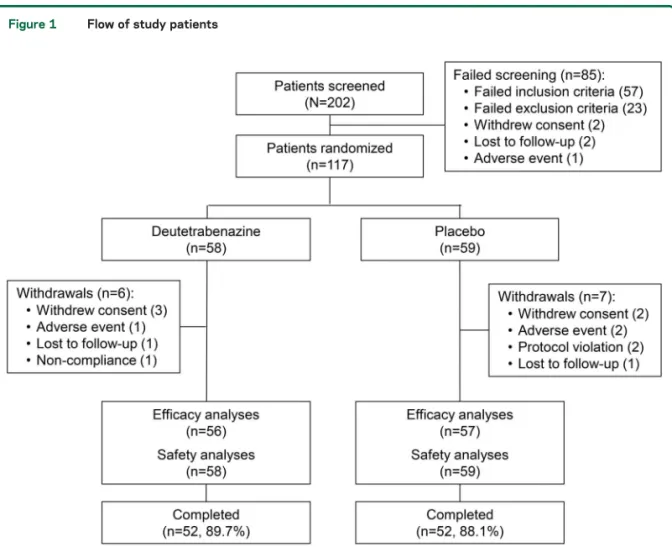
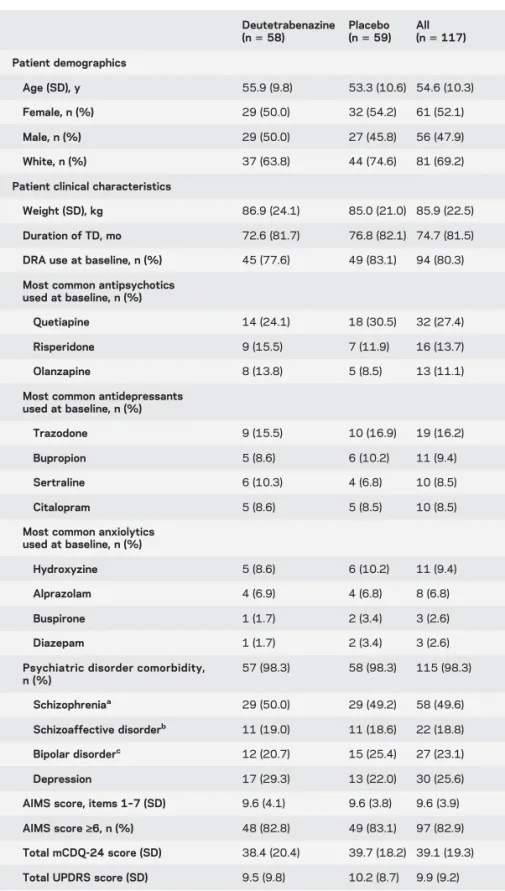
RESULTS Patient baseline characteristics and disposi-tion.A total of 117 patients with TD were random-ized to receive deutetrabenazine (n 5 58) or placebo (n 5 59). A comparable proportion of patients completed the study in both groups (figure 1). Both groups had similar demographics and
Figure 1 Flow of study patients
baseline characteristics (table 1). Approximately 70% of the population had an underlying diagnosis of schizophrenia or schizoaffective disorder (table 1); 23.1% had bipolar disorder; and 25.6% had depres-sion. The majority of patients (80.3%) were being
treated with a DRA at baseline and continued treat-ment throughout the study.
Dose. At the end of the titration period, the mean (SD) total daily dose was 38.8 (7.92) mg/d. The mean [SD] dose remained stable until the end of the treatment period (38.3 [7.97] mg/d).
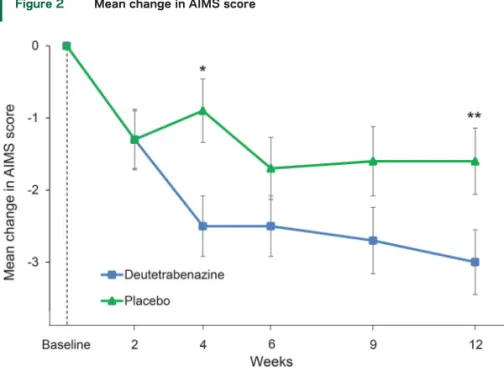
Efficacy assessments.For the primary endpoint, deu-tetrabenazine significantly reduced AIMS scores from baseline to week 12 compared with placebo (least-squares [LS] mean [standard error (SE)]:
23.0 [0.45] vs21.6 [0.46],p50.019; treatment difference 21.4 [0.60], 95% confidence interval [CI] 22.6 to 20.2) (figure 2). Improvement in AIMS score was different between the deutetrabe-nazine and placebo groups by week 4 with a treat-ment effect of21.5 (95% CI22.6 to20.4,p5
0.007).
While the percentage of patients who achieved treatment success on the CGIC (48.2% vs 40.4%) and PGIC (42.9% vs 29.8%) favored deutetrabena-zine, these differences were not statistically signifi-cant. Similarly, deutetrabenazine-treated patients had a greater LS mean [SE] reduction from baseline to week 12 in the mCDQ-24 score than placebo (211.1 [2.14] vs 28.3 [2.31]), but the difference was not statistically significant.
Of the 113 patients in the mITT population, 97 patients (85.8%) had a centrally read AIMS score $6 at both screening and baseline.Because this sub-group represents the intended population for the study, a post hoc analysis was performed on the primary and key secondary endpoints. Similar to the overall population, for the AIMS, deutetrabenazine-treated patients had a greater decrease in LS mean [SE] scores compared with pla-cebo (3.4 [0.48] vs 1.9 [0.51],p50.027; treatment difference 21.5 [0.67], 95% CI 22.8 to 20.2) (figure 3). In the same subpopulation, the difference in the percentage of patients who were classified as a treatment success on the basis of the CGIC wid-ened between the deutetrabenazine vs placebo arms compared with the entire mITT cohort (25 [52.1%] vs 17 [34.7%], p 5 0.084; treatment difference 17.4%, 95% CI22.2% to 35.3%). The treatment difference in this subpopulation was 17.4% com-pared with 7.9% in the mITT cohort. Compared with placebo, a greater percentage of deutetrabenazine-treated patients in this subpopula-tion had treatment success based on the PGIC (45.8% vs 28.6%). Patients in the deutetrabenazine group also had a greater LS mean [SE] reduction from baseline to week 12 in the mCDQ-24 total score (212.2 [2.21] vs 26.6 [2.39]). Similar to the mITT population, these results were not statis-tically significant.
Table 1 Patient baseline characteristics by treatment group
Deutetrabenazine
(n558)
Placebo (n559)
All
(n5117)
Patient demographics
Age (SD), y 55.9 (9.8) 53.3 (10.6) 54.6 (10.3)
Female, n (%) 29 (50.0) 32 (54.2) 61 (52.1)
Male, n (%) 29 (50.0) 27 (45.8) 56 (47.9)
White, n (%) 37 (63.8) 44 (74.6) 81 (69.2)
Patient clinical characteristics
Weight (SD), kg 86.9 (24.1) 85.0 (21.0) 85.9 (22.5)
Duration of TD, mo 72.6 (81.7) 76.8 (82.1) 74.7 (81.5)
DRA use at baseline, n (%) 45 (77.6) 49 (83.1) 94 (80.3)
Most common antipsychotics used at baseline, n (%)
Quetiapine 14 (24.1) 18 (30.5) 32 (27.4)
Risperidone 9 (15.5) 7 (11.9) 16 (13.7)
Olanzapine 8 (13.8) 5 (8.5) 13 (11.1)
Most common antidepressants used at baseline, n (%)
Trazodone 9 (15.5) 10 (16.9) 19 (16.2)
Bupropion 5 (8.6) 6 (10.2) 11 (9.4)
Sertraline 6 (10.3) 4 (6.8) 10 (8.5)
Citalopram 5 (8.6) 5 (8.5) 10 (8.5)
Most common anxiolytics used at baseline, n (%)
Hydroxyzine 5 (8.6) 6 (10.2) 11 (9.4)
Alprazolam 4 (6.9) 4 (6.8) 8 (6.8)
Buspirone 1 (1.7) 2 (3.4) 3 (2.6)
Diazepam 1 (1.7) 2 (3.4) 3 (2.6)
Psychiatric disorder comorbidity, n (%)
57 (98.3) 58 (98.3) 115 (98.3)
Schizophreniaa 29 (50.0) 29 (49.2) 58 (49.6)
Schizoaffective disorderb 11 (19.0) 11 (18.6) 22 (18.8)
Bipolar disorderc 12 (20.7) 15 (25.4) 27 (23.1)
Depression 17 (29.3) 13 (22.0) 30 (25.6)
AIMS score, items 1–7 (SD) 9.6 (4.1) 9.6 (3.8) 9.6 (3.9)
AIMS score‡6, n (%) 48 (82.8) 49 (83.1) 97 (82.9)
Total mCDQ-24 score (SD) 38.4 (20.4) 39.7 (18.2) 39.1 (19.3)
Total UPDRS score (SD) 9.5 (9.8) 10.2 (8.7) 9.9 (9.2)
Abbreviations: AIMS5Abnormal Involuntary Movement Scale (maximum total score528);
DRA5dopamine receptor agonist; mCDQ-245Modified Craniocervical Dystonia
Ques-tionnaire (maximum total score596); TD5tardive dyskinesia; UPDRS5Unified
Parkin-son’s Disease Rating Scale motor assessment (maximum total score556).
aIncludes schizophrenia, schizophrenia paranoid type, and schizophrenia residual type.
bIncludes schizoaffective disorder and schizoaffective disorder depressive type.
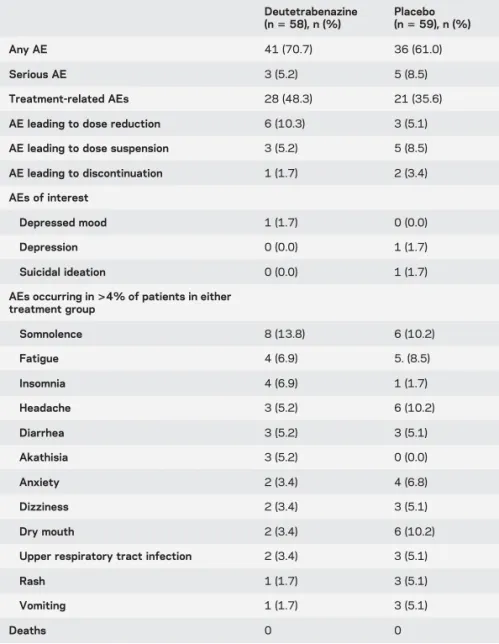
Safety assessments.Patients from the deutetrabenazine and placebo groups reported similar rates of AEs. The most common AEs (.4% of patients in either group) are presented in table 2.
Treatment-related AEs were reported in 48.3% of the deutetrabenazine group compared with 35.6% of
the placebo group. Notably, the incidence of several AEs of interest in the deutetrabenazine group, such as depression/depressed mood and suicidal ideation, was similar to or lower than for placebo.
Serious AEs were reported by 3 patients (5.2%) in the deutetrabenazine group and 5 patients (8.5%) receiving placebo. Serious AEs in the deutetrabena-zine group included community-acquired pneumo-nia, substance-induced manic episode, and exacerbation of schizophrenia (n51 for each). Seri-ous AEs in the placebo group included accidental heroin overdose, jaw fracture secondary to falling, jaw infection, pneumonia, and laryngeal hypertrophy (n5 1 for each). None were considered treatment related. There were no deaths during the study.
For the deutetrabenazine and placebo groups, there were relatively low rates of dose reductions, sus-pensions, and study withdrawals due to AEs, as pre-sented in table 2.
Similar incidences of psychiatric AEs were observed in the overall deutetrabenazine group (20.7%) and in the cohort of patients taking deutetrabenazine with antipsychotics (19.6%), antidepressants (26.5%), or anxiolytics (23.1%). Deutetrabenazine treatment with concomitant antidepressants and anxiolytics was asso-ciated with similar rates of psychiatric AEs compared with placebo; however, there were more psychiatric AEs in patients treated with deutetrabenazine with antipsychotics compared with placebo (19.6% vs 9.8%). Nonetheless, the incidence of depressed mood, Figure 2 Mean change in AIMS score
AIMS score was assessed over 12 weeks by central video rating in the mITT population based on the linear mixed model for repeated measurements. The mean change in AIMS score from baseline at weeks 2, 4, 6, 9, and 12 is depicted. Error bars represent standard
error. AIMS5Abnormal Involuntary Movement Scale; mITT5modified intent to treat.
*p50.007.**p50.019.
Figure 3 Analysis of treatment effect for efficacy parameters
(A) Treatment difference (deutetrabenazine–placebo) of the LS mean change in AIMS score. (B) Proportion of patients who
experience treatment success on the CGIC. Error bars for AIMS are standard error. AIMS5Abnormal Involuntary
depression, and suicidal ideation remained low and was similar to that of the overall deutetrabenazine group in patients receiving concomitant antidepressants.
Small reductions in parkinsonism severity, as measured by the Unified Parkinson’s Disease Rat-ing Scale motor assessment, were observed from baseline to week 12 in the deutetrabenazine (mean [SD] change 20.9 [8.09]) and placebo (23.8 [7.87]) arms. In addition, at week 12, there were no safety signals detected on the Barnes Akathisia Rating Scale, HADS-Anxiety, HADS-Depression, Epworth Sleepiness Scale, or Montreal Cognitive Assessment. No deutetrabenazine-treated patient reported suicidal ideation or behavior on the Columbia Suicide Severity Rating Scale, whereas 3 patients (5.2%) and 1 patient (1.7) in the placebo group reported suicidal ideation or behavior, respectively.
Finally, there were no meaningful differences in the QTcF interval prolongation between groups (p 50.153). One placebo-treated patient exceeded a QTcF interval of 500 milliseconds.
DISCUSSION This study demonstrated that deute-trabenazine is efficacious for the treatment of abnor-mal movements in patients with TD, with a favorable safety and tolerability profile that enables the continued use of DRAs and antidepressants for the management of chronic psychiatric conditions. Almost all patients (98.3%) enrolled in Aim to Reduce Movements in Tardive Dyskinesia (ARM-TD) had an underlying psychiatric comorbidity for which they were receiving concomitant medications, making these results especially relevant to clinical practice for clinicians managing similar patients in a real-world setting.
In general, deutetrabenazine was well tolerated, as supported by the high study completion rate and infrequent dose reductions, dose suspensions, or withdrawals. These results are of particular importance because antipsychotic discontinuation or dose reduction is often not possible for patients with TD because of the high risk of psychotic exac-erbation.9Moreover, deutetrabenazine did not result in reports of depression or suicidal ideation and was associated with low rates of psychiatric AEs, includ-ing anxiety.
Because of possible differences between on-site and centralized video ratings of TD, natural varia-tion in the severity of dyskinesia, and potential dif-ferences among patients’ subjective feelings (e.g., more nervous during the initial video) at screening vs baseline, 20 enrolled patients had AIMS scores
,6 as assessed by a central video rater at baseline, leaving 97 patients (85.8% of the mITT popula-tion) with central video AIMS scores$6 at both screening and baseline. Because this population is consistent with the intended study population, the key efficacy endpoints were assessed for this group to inform future study design. As with the mITT population, a significant improvement in AIMS score at week 12 was also observed with deutetra-benazine compared with placebo for this popula-tion. Deutetrabenazine provided greater clinical benefit, as evidenced by numeric improvement on CGIC, in patients with a central video AIMS score $6 at screening and baseline, suggesting that pa-tients with more severe TD may exhibit better clin-ical response.
The chronic, disabling nature of TD21,22 high-lights the need for an effective treatment. The signif-icant improvement observed in AIMS score was not fully reflected on CGIC and PGIC outcomes. This may be due to variable symptom appreciation by the clinician and the patient. Most patients in this trial were recruited and evaluated by psychiatrist investi-gators who may be less familiar with the motor nu-ances of TD compared with the management of behavioral disorders. Psychiatrists have not been Table 2 Patients who reported adverse events (AEs) in each treatment group
Deutetrabenazine (n558), n (%)
Placebo (n559), n (%)
Any AE 41 (70.7) 36 (61.0)
Serious AE 3 (5.2) 5 (8.5)
Treatment-related AEs 28 (48.3) 21 (35.6)
AE leading to dose reduction 6 (10.3) 3 (5.1)
AE leading to dose suspension 3 (5.2) 5 (8.5)
AE leading to discontinuation 1 (1.7) 2 (3.4)
AEs of interest
Depressed mood 1 (1.7) 0 (0.0)
Depression 0 (0.0) 1 (1.7)
Suicidal ideation 0 (0.0) 1 (1.7)
AEs occurring in>4% of patients in either treatment group
Somnolence 8 (13.8) 6 (10.2)
Fatigue 4 (6.9) 5. (8.5)
Insomnia 4 (6.9) 1 (1.7)
Headache 3 (5.2) 6 (10.2)
Diarrhea 3 (5.2) 3 (5.1)
Akathisia 3 (5.2) 0 (0.0)
Anxiety 2 (3.4) 4 (6.8)
Dizziness 2 (3.4) 3 (5.1)
Dry mouth 2 (3.4) 6 (10.2)
Upper respiratory tract infection 2 (3.4) 3 (5.1)
Rash 1 (1.7) 3 (5.1)
Vomiting 1 (1.7) 3 (5.1)
consistently exposed to rigorous training on the scales used in the study. In addition, the dynamic nature of TD itself may limit the ability of these scales to fully capture meaningful change in involuntary move-ments. It is possible that tolerability issues could have dampened the CGIC and PGIC treatment effects. We believe this is unlikely because the active drug was very well tolerated.
There was, surprisingly, a notable placebo response among patients on the AIMS rating, which could have also affected the CGIC and PGIC ratings, despite the centralized video assessment. This may be attributed to the patients’perception or expectation of improvement due to the titration design and fre-quent clinic visits, compounded by the variability over time of TD, which is not often consistently manifested and is very susceptible to external factors such as stress, time of day, and intake of psychotropic medications. In addition, the positive findings of a related study in HD (First Time Use of SD-809 in Huntington Disease [First-HD]) were publically announced while this study was being conducted.19 The placebo effect on AIMS scores was less likely from the central raters because they were blinded to clinical information, concordance with another cen-tral rater was required, and all videos of each patient were viewed in the same sitting. Using central video raters reduces the potential for interrater variability23 or visit-specific factors, leading to more standardized measures.
There are few available treatment options for involuntary movements related to TD. The American Academy of Neurology guidelines do not conclusively recommend off-label use of tetrabenazine for the treatment of TD symptoms (Class III, Level C, Level U).8This study provides Class I evidence that deute-trabenazine may serve as an efficacious and well-tolerated treatment for abnormal movements in TD, particularly in patients in whom disruption of treatment for underlying psychiatric conditions may not be an option.
AUTHOR CONTRIBUTIONS
Hubert H. Fernandez, Stewart A. Factor, Robert A. Hauser, Joohi Jimenez-Shahed, William G. Ondo, L. Fredrik Jarskog, Herbert Y. Meltzer, Scott W. Woods, Danny Bega, Mark S. LeDoux, David R. Shprecher, David Stamler, and Karen E. Anderson: significant content-related direc-tion, data acquisition and analysis, contribution to the writing of the draft, and feedback on all relevant materials throughout the develop-ment of the manuscript. Charles Davis: significant content-related direction, contribution to the writing of the draft, and feedback on all relevant materials throughout the development of the manuscript. Mat D. Davis: significant content-related direction, statistical analysis, contribution to the writing of the draft, and feedback on all relevant materials throughout the development of the manuscript.
ACKNOWLEDGMENT
The authors thank the patients and site personnel involved with this study and Arianna Grove, PhD (Chameleon Communications International
with funding from Teva Pharmaceutical Industries), for editorial assistance in the preparation of this report.
STUDY FUNDING
This study was funded by Teva Pharmaceutical Industries, Petach Tikva, Israel.
DISCLOSURE
H. Fernandez: honoraria: Prime Education Inc, Ohio State University, International Parkinson and Movement Disorders Society, Carling Com-munications, Medscape (as a speaker in Continuing Medical Education events), Biogen GE Healthcare, Lundbeck, Merz, Pfizer (as a consultant); research support: AbbVie, Acadia, Auspex/Teva, Biotie Therapeutics, Civitas, Kyowa/Prostrakan, Michael J. Fox Foundation, Movement Disorders Society, NIH/National Institute of Neurological Disorders and Stroke, Parkinson Study Group, Rhythm, Synosia; royalties: Demos Publishing; contractual services: AbbVie, Merz Pharmaceuticals, Auspex/ Teva, Xeomin Registry Study, Ipsen Pharmaceuticals; stipend: Interna-tional Parkinson and Movement Disorders Society (for service as medical editor of the Movement Disorders Society website). S. Factor: honoraria: Neurocrine, Lundbeck, Auspex/Teva, Avanir, UCB, Sunovion, US WorldMeds; research support: Ipsen, Allergan, Medtronic, Auspex, US WorldMeds, Pharm-Olam, Cynapsus Therapeutics/Sunovion, Vaccinex, Solstice CHDI Foundation, Michael J. Fox Foundation, NIH; royalties: Demos, Blackwell Futura for textbooks, UpToDate. R. Hauser: consul-ting: Auspex/Teva, AbbVie, Acadia Pharmaceuticals, Acorda Therapeu-tics, Adamas Pharmaceuticals, Allergan Neuroscience, AstraZeneca, Biotie Therapies, Chelsea Therapeutics, Cynapsus Therapeutics, Impax Pharmaceuticals, Lundbeck, Michael J. Fox Foundation, Neurocrine Bi-osciences, Neuropore Therapies, Pfizer, Prexton, UCB BiBi-osciences, and US WorldMeds. J. Jimenez-Shahed: research support: Acadia Pharma-ceuticals, St. Jude Medical, Biotie Therapies, Solstice Neurosciences, Avid Radiopharmaceuticals, Michael J. Fox Foundation; consulting: Auspex/Teva, St. Jude Medical, Medtronic. W. Ondo: research support: Lundbeck, Tremor Research Group, Dystonia Coalition, Restless Legs Syndrome Foundation, Acorda; speaker’s bureau: Teva, Impax, Lund-beck, UCB, US WorldMeds; consulting: Teva, LundLund-beck, Acadia. L. Jarskog: research support: Auspex/Teva, Boehringer Ingelheim, Otsu-ka, NIH; consulting: Roche. H. Meltzer reports no disclosures relevant to the manuscript. S. Woods: research support: Teva, Pfizer; consul-ting: Boehringer Ingelheim, Nutria Health. D. Bega: research support: National Parkinson Foundation; speaker’s bureau: Acadia Pharmaceut-icals, Inc; consulting: Teva, Cynapsus, Acadia. M. LeDoux: speakers’ bureau: Lundbeck, Acadia; consulting: Teva Neuroscience, US World-Meds, Mayo Clinic, Starnes-Davis-Florie, Michael J. Fox Foundation, Benign Essential Blepharospasm Research Foundation, Dorothy/Dan-iel Gerwin Parkinson’s Research Fund, Auspex, Teva, Acorda, CHDI; royalties: Elsevier (for editingAnimal Models of Movement Disordersand
Movement Disorders: Genetics and Models). D. Shprecher: consulting: Teva and Lundbeck; speaker’s bureau: Teva and Lundbeck; research support: Arizona Alzheimer’s Consortium, Adamas, Teva, Kyowa, Michael J. Fox Foundation, Neurocrine, NIH. C. Davis: consultant to Auspex Pharmaceuticals and Teva Pharmaceutical Industries. M. Davis: employee of Teva Pharmaceutical Industries. D. Stamler: employee of Teva Pharmaceutical Industries; personal fees from Auspex Pharmaceuticals outside the submitted work. K. Anderson: Scientific Advisor: North American study co-Principal Investigator for LEGATO-HD (Laquinimod Efficacy and Safety in a Global Trial of Huntington Disease), Global Principal Investigator for AIM-TD (Ad-dressing Involuntary Movements in Tardive Dyskinesia), and Global co-Principal Investigator for ARM-TD. Site Principal Investigator for Pride-HD (Pridopidine Dose Evaluation in Huntington Disease), First-HD, ARC-HD (Alternatives for Reducing Chorea in Huntington Disease): Teva. Scientific Advisor, Site Principal Investigator for ENROLL-HD (A Prospective Registry Study in a Global Huntington Disease Cohort): CHDI Foundation. Scientific Advisor: Prana. Site Principal Investigator: Vaccinex. Consultant to the NeuroNext 105 study with Azevan. Go to Neurology.org for full disclosures.
REFERENCES
1. Aquino CCH, Lang AE. Tardive dyskinesia syndromes: current concepts. Parkinsonism Relat Disord 2014;20 (suppl 1):S113–S117.
2. Tarsy D, Lungu C, Baldessarini RJ. Epidemiology of tardive dyskinesia before and during the era of modern antipsychotic drugs. In: William JW, Eduardo T, editors. Handbook of Clinical Neurology. Amsterdam, Netherlands: Elsevier; 2011:601–616.
3. Woods SW, Morgenstern H, Saksa JR, et al. Incidence of tardive dyskinesia with atypical and conventional antipsychotic medications: prospective cohort study. J Clin Psychiatry 2010; 71:463–474.
4. Samie MR, Dannenhoffer MA, Rozek S. Life-threatening tardive dyskinesia caused by metoclopramide. Mov Disord 1987;2:125–129.
5. Waln O, Jankovic J. An update on tardive dyskinesia: from phenomenology to treatment. Tremor Other Hyperkinetic Mov 2013;3:tre-03-161-4138-4131.
6. Jankelowitz SK. Treatment of neurolept-induced tardive dyskinesia. Neuropsychiatr Dis Treat 2013;9:1371–1380. 7. Bhidayasiri R, Boonyawairoj S. Spectrum of tardive syn-dromes: clinical recognition and management. Postgrad Med J 2011;87:132–141.
8. Bhidayasiri R, Fahn S, Weiner WJ, Gronseth GS, Sullivan KL, Zesiewicz TA. Evidence-based guideline: treatment of tardive syndromes. Neurology 2013;81:463–469. 9. Caroff SN, Hurford I, Lybrand J, Campbell EC.
Move-ment disorders induced by antipsychotic drugs: implica-tions of the CATIE schizophrenia trial. Neurol Clin 2011; 29:127–148.
10. Cloud LJ, Zutshi D, Factor SA. Tardive dyskinesia: ther-apeutic options for an increasingly common disorder. Neurotherapeutics 2014;11:166–176.
11. Zutshi D, Cloud LJ, Factor SA. Tardive syndromes are rarely reversible after discontinuing dopamine receptor blocking agents: experience from a University-based
move-ment disorder clinic. Tremor Other Hyperkinetic Mov 2014;4:266.
12. Rana AQ, Chaudry ZM, Blanchet PJ. New and emerging treatments for symptomatic tardive dyskinesia. Drug Des Devel Ther 2013;7:1329–1340.
13. Huntington Study Group. Tetrabenazine as antichorea therapy in Huntington disease: a randomized controlled trial. Neurology 2006;66:366–372.
14. XENAZINE Prescribing Information. Deerfield, IL: Lundbeck; 2015.
15. Guay DR. Tetrabenazine, a monoamine-depleting drug used in the treatment of hyperkinetic movement disorders. Am J Geriatr Pharmacother 2010;8:331–373.
16. Shao L, Hewitt MC. The kinetic isotope effect in the search for deuterated drugs. Drug News Perspect 2010; 23:398–404.
17. Stamler D, Bradbury M, Brown F. The pharmacokinetics and safety of deuterated-tetrabenazine. Neurology 2013; 80:P07.210.
18. Timmins GS. Deuterated drugs: where are we now? Expert Opin Ther Patents 2014;24:1067–1075. 19. Huntington Study Group, Frank S, Testa CM, Stamler
D, et al. Effect of deutetrabenazine on chorea among patients with Huntington disease: a randomized clinical trial. JAMA 2016;316:40–50.
20. Epping EA, Kim JI, Craufurd D, et al. Longitudinal psy-chiatric symptoms in prodromal Huntington’s disease: a decade of data. Am J Psychiatry 2016;173:184–192. 21. Casey DE. Tardive dyskinesia. West J Med 1990;153:
535–541.
22. Rittmannsberger H. Ten year outcome of tardive dyskine-sia during continuous treatment with first generation anti-psychotics. Psychiatr Danub 2008;20:461–465. 23. Haidet KK, Tate J, Divirgilio-Thomas D, Kolanowski A,
Happ MB. Methods to improve reliability of video-recorded behavioral data. Res Nurs Health 2009;32: 465–474.
BrainPAC
BrainPAC is the American Academy of Neurology’s (AAN) federal political action committee.
• Since its inception, more than 3,600 AAN members have contributed $2,000,000 to
BrainPAC.
• BrainPAC contributed more than $600,000 to individuals who ran for election in 2016,
including several first-time candidates.
• During the 2016 congressional election, 92% of candidates supported by BrainPAC won
election to the US Congress.