EXAMINING SELF-EFFICACY AS A MODERATOR OF THE RELATIONS BETWEEN DIMENSIONAL PERFECTIONISM AND DIETARY RESTRAINT, BINGE EATING, AND
BINGE DRINKING
Stacy L. Lin
A thesis submitted to the faculty at the University of North Carolina at Chapel Hill in partial fulfillment of the requirements for the degree of Master of Arts in the Department of Psychology
(Clinical Psychology).
Chapel Hill 2015
Approved by: Anna Bardone-Cone
Stacey Daughters
© 2015 Stacy L. Lin
ABSTRACT
Stacy L. Lin: Examining Self-Efficacy as a Moderator of the Relations Between Dimensional Perfectionism and Dietary Restraint, Binge Eating, and Binge Drinking
(Under the direction of Anna Bardone-Cone)
Dimensions of perfectionism have been linked to the disordered eating and binge drinking in prior research, with evidence that they may be differentially related to these
behaviors. Self-efficacy is conceptually related to perfectionism, as perfectionism represents the level at which an individual sets her goals, while self-efficacy represents the individual’s
judgment of whether she may attain those goals. Few studies have considered self-efficacy as a possible moderator of the relations between dimensions of perfectionism and disordered
TABLE OF CONTENTS
LIST OF TABLES...vi
LIST OF FIGURES ...vii
INTRODUCTION... 1
Prevalence and Co-occurrence of Disordered Eating and Binge Drinking in College Women... 2
Perfectionism ... 3
Self-Efficacy ... 7
Current Study ...12
METHOD... 14
Participants...14
Procedure... 14
Measures ... 15
Analytic Plan ...18
RESULTS... 21
Descriptive Analyses... 21
Interactive Models of Self-Oriented Perfectionism, Self-Efficacy, and Dietary Restraint... 24
Interactive Models of Self-Oriented Perfectionism, Self-Efficacy, and Binge Eating... 25
Interactive Models of Socially Prescribed Perfectionism, Self-Efficacy, and Binge Eating...26
Exploratory Change Analyses...33
DISCUSSION ... 35
Main Effects...38
Measurement of Dimensional Perfectionism... 41
Strengths and Limitations... 42
Future Directions... 44
APPENDIX 1: FOOTNOTE...46
APPENDIX 2: TABLES OF DATA FINDINGS...47
APPENDIX 3: FIGURES... 58
LIST OF TABLES
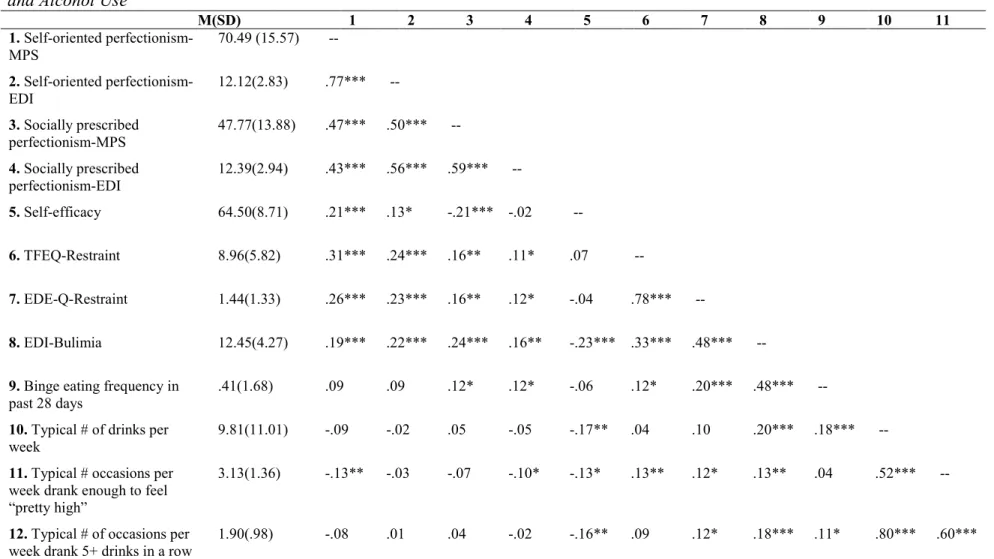
Table 1 – Descriptive Statistics and Correlations between Dimensional Perfectionism, Self-Efficacy, Dietary Restraint, Binge Eating, and
Alcohol Use... 47 Table 2 – Hierarchical Multiple Regression Analyses of the Interaction of
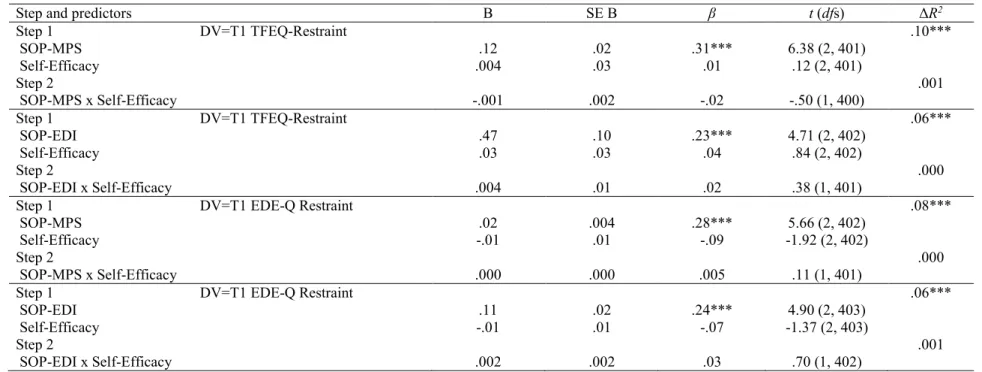
Self-Oriented Perfectionism and Self-Efficacy in Relation to Dietary
Restraint (Cross-Sectional)...48 Table 3 – Hierarchical Multiple Regression Analyses of the Interaction of
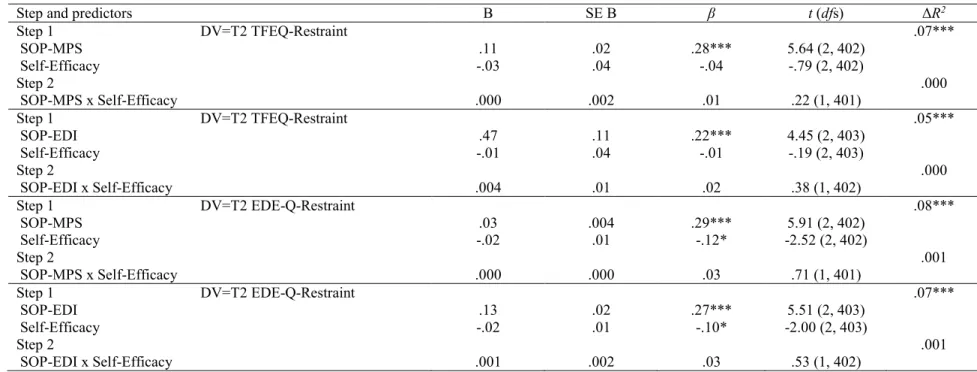
Self-Oriented Perfectionism and Self-Efficacy Predicting Dietary
Restraint (Longitudinal)...49 Table 4 – Hierarchical Multiple Regression Analyses of the Interaction of
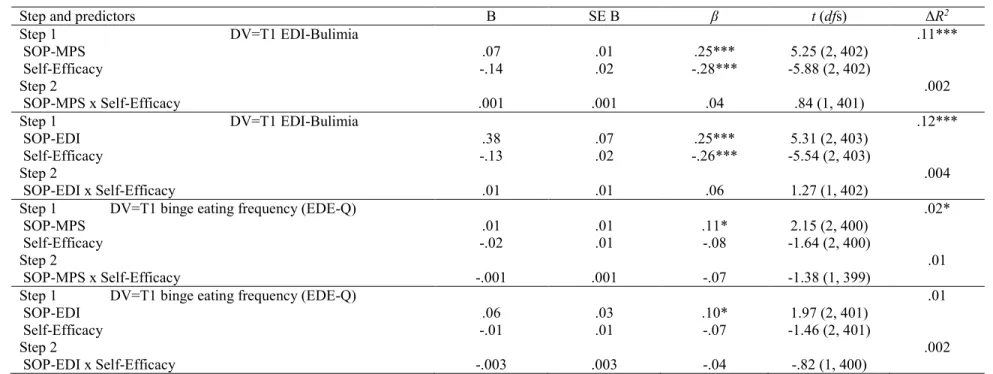
Self-Oriented Perfectionism and Self-Efficacy in Relation to Binge
Eating (Cross-Sectional)... 50 Table 5 – Hierarchical Multiple Regression Analyses of the Interaction of
Self-Oriented Perfectionism and Self-Efficacy Predicting Binge
Eating (Longitudinal)... 51 Table 6 – Hierarchical Multiple Regression Analyses of the Interaction of
Socially Prescribed Perfectionism and Self-Efficacy in Relation to
Binge Eating (Cross-Sectional)...52 Table 7 – Hierarchical Multiple Regression Analyses of the Interaction of
Socially Prescribed Perfectionism and Self-Efficacy Predicting
Binge Eating (Longitudinal)... 53 Table 8 – Hierarchical Multiple Regression Analyses of the Interaction of
Self-Oriented Perfectionism and Self-Efficacy in Relation to
Alcohol Use (Cross-Sectional)... 54 Table 9 – Hierarchical Multiple Regression Analyses of the Interaction of
Self-Oriented Perfectionism and Self-Efficacy Predicting Alcohol
Use (Longitudinal)... 55 Table 10 – Hierarchical Multiple Regression Analyses of the Interaction
of Socially Prescribed Perfectionism and Self-Efficacy in Relation
to Alcohol Use (Cross-Sectional)... 56 Table 11 – Hierarchical Multiple Regression Analyses of the Interaction
of Socially Prescribed Perfectionism and Self-Efficacy Predicting
LIST OF FIGURES
Figure 1 – Proposed model, based on escape theory (Heatherton & Baumeister, 1991), through which high dimensional perfectionism and low self-efficacy
lead to increased binge eating and binge drinking...58 Figure 2 – Simple slope graph of self-efficacy as a moderator of the relation
between socially prescribed perfectionism from the Multidimensional Perfectionism Scale (SPP-MPS) and typical occasions per week of drinking
5+ drinks in a row at Time 2...59 Figure 3 – Simple slope graph of self-efficacy as a moderator of the relation
between socially prescribed perfectionism from the Multidimensional Perfectionism Scale (SPP-MPS) and typical occasions per week of drinking 5+ drinks in a row at Time 2, controlling for Time 1 typical occasions per
INTRODUCTION
College women are at risk for engaging in unhealthy behaviors that potentially carry serious consequences for both physical and mental health. In particular, two types of these unhealthy behaviors, disordered eating and binge drinking, are notably prevalent and often co-occur in this group (Ferriter & Ray, 2011; Gadalla & Piran, 2007). Disordered eating can have physical effects such as insufficient intake of essential nutrients, chronic fatigue, electrolyte imbalances, and menstrual dysfunction (Beals & Manore, 1999; Gibbons, Wertheim, Paxton, & Petrovich, 1995). Disordered eating behaviors are also associated with higher risk of developing a clinical eating disorder, as well as engagement in other unhealthy behaviors such as smoking and substance use (Fisher, Schneider, Pegler, & Napolitano, 1991). Additionally, disordered eating behaviors are associated with adverse psychological effects such as depression, emotional instability, and feelings of failure (Beals & Manore, 1999). Like disordered eating, excessive alcohol consumption has also been linked to a number of negative consequences in college women, including physical injury or death from alcohol-related incidents (Hingson, Heeren, Zakocs, Kopstein, & Wechsler, 2002), increased likelihood of sexual victimization (Lawyer, Resnick, Bakanic, Burkett, & Kilpatrick, 2010), and engagement in risky sexual behavior (Bersamin, Paschall, Saltz, & Zamboanga, 2012).
for engaging in these behaviors and better target prevention and intervention efforts toward more specialized groups (Striegel-Moore & Bulik, 2007). In this study, we consider how
perfectionism and self-efficacy may combine to identify and predict elevated levels of disordered eating and binge drinking.
Prevalence and Co-occurrence of Disordered Eating and Binge Drinking in College Women
College women have been found to engage in disordered eating behaviors at high rates across a number of studies (e.g., Berg, Frazier, & Sherr, 2009; Krahn, Kurth, Gomberg, & Drewnowski, 2005; Lynch, Everingham, Dubitzky, Hartman, & Kasser, 2000; Schwitzer, Rodriguez, Thomas, & Salimi, 2001). One study by Berg et al. (2009) found that 49% of their sample of female undergraduates at a large Midwestern university reported engaging in at least one disordered eating behavior one or more times per week. Krahn and colleagues found that about 22% of their sample of college women were dieting extremely enough to be characterized as “at risk” for an eating disorder, while an additional 44% were “intense” dieters (Krahn et al., 2005).
In addition to reporting high rates of disordered eating, college women also report high rates of binge drinking (e.g., Dawson, Grant, Stinson, & Chou, 2004; Hingson et al., 2002; Nelson, Xuan, Lee, Weitzman, & Wechsler, 2009; Wechsler et al., 2002). In 2001, Wechsler and colleagues (2002) found a 40.9% prevalence of binge drinking reported by female college
same age group (Grucza, Norberg, & Bierut, 2009). In 2006, the binge drinking threshold for women was lowered from five or more drinks to four or more drinks per episode, further increasing the number of women who reported what is considered to be a dangerous level of drinking (Chavez, Nelson, Naimi, & Brewer, 2011).
Research suggests that disordered eating and binge drinking often occur in tandem in college women, in both clinical and subclinical groups (e.g., Gadalla & Piran, 2007; Krahn et al., 2005). For example, Piran and Robinson (2011) found a significant association between a binge eating, dieting, and purging behavior cluster and a binge drinking, drinking with negative consequences, and cocaine behavior cluster, while Baker and colleagues (2010) found that women with anorexia nervosa (AN) were twice as likely as women without AN diagnoses, and women with bulimia nervosa (BN) were two to three times as likely as women without BN diagnoses, to have alcohol use disorders. Furthermore, a meta-analytic review of the
co-occurrence of eating disorders and alcohol use disorders by Gadalla and Piran (2007) found that the strongest associations between the two were found when study participants were drawn from student populations.
Perfectionism
Perfectionism has been consistently identified as an important factor affecting the
development and maintenance of eating disorders (e.g., Bardone-Cone et al., 2007; Cassin & von Ranson, 2005; Egan, Wade, & Shafran, 2011; Stice, 2002). Research has found that both
for an “ideal” or “perfect” body and equate it with self-worth. This aspect of holding oneself to an unrealistically high standard has been characterized as intrinsically related to perfectionism (Fairburn, Cooper, & Shafran, 2003) and may lead individuals to set goals for themselves which they are unable to attain. An important consequence of perfectionism is that when an individual fails to attain her unrealistic goals, this causes a negative self-evaluation, which can then trigger further eating pathology (Fairburn et al., 2003).
While previously conceptualized as a unidimensional construct, new multidimensional measures of perfectionism were created during the early 1990s, which consequently led to increased attention to multidimensional perfectionism in the literature. and the identification of varying relations between different dimensions of perfectionism and psychopathology. Most of the multidimensional perfectionism/psychopathology research has focused on anxiety and
depression (e.g., DiBartolo, Li, & Frost, 2008; Saboonchi, Lundh, & Ost, 1999), with less known regarding dimensions of perfectionism and eating disorders.
The literature on eating disorders has most commonly used the unidimensional
perfectionism subscale of the Eating Disorder Inventory (EDI; Garner, Olmsted, & Polivy, 1983) to assess perfectionism. Though it was created as a unidimensional measure, confirmatory factor analyses now suggest that it might be better understood as a two-factor model of perfectionism, comprising the factors of self-oriented perfectionism and socially prescribed perfectionism (Joiner & Schmidt, 1995; Sherry, Hewitt, Besser, McGee, & Flett, 2004).
As our understanding of perfectionism has progressed, several multidimensional measures of perfectionism have been created to capture different dimensions of the construct. One of the most commonly used measures of multidimensional perfectionism is the
perfectionism into three dimensions: oriented perfectionism (SOP), representing self-imposed high standards; socially prescribed perfectionism (SPP), representing perceived high standards imposed by others; and other-oriented perfectionism (OOP), representing high expectations for others. This measure is of particular interest as the first two dimensions it was created to capture have also been found in the older EDI-Perfectionism subscale and thus may serve as a link between the older unidimensional research and more recent multidimensional research.
negative outcomes such as depression and disordered eating (Gilbert et al., 2006; Pratt, Telch, Labouvie, Wilson, & Agras, 2001).
The limited research on perfectionism dimensions and eating disorders indicates that these dimensions may be differentially linked to specific eating disorder symptoms. Several studies have suggested that self-oriented perfectionism may be related to elevated symptoms of disordered eating (Bardone-Cone, 2007; Bastiani, Rao, Weltzin, & Kaye, 1995; Cockell et al., 2002; Hewitt, Flett, & Ediger, 1995; Watson, Raykos, Street, Fursland, & Nathan, 2011). More specifically, studies have found that self-oriented perfectionism is strongly related to symptoms of AN, particularly highlighting the symptom of dietary restraint (Bardone-Cone, 2007; Chang, Ivezaj, Downey, Kashima, & Morady, 2008; McLaren, Gauvin, & White, 2001). Further, in two separate studies, participants with AN scored significantly higher on self-oriented perfectionism, as well as socially prescribed perfectionism, than normal controls (Bastiani et al., 1995; Cockell et al., 2002). Both self-oriented perfectionism and socially prescribed perfectionism have been found to correlate with symptoms of BN (Bardone-Cone, 2007; Chang et al., 2008), although in one study socially prescribed perfectionism no longer predicted unique variance in symptoms of bulimia after controlling for negative affect (Bardone-Cone, 2007). Though existing research suggests a link between self-oriented perfectionism, socially prescribed perfectionism, and disordered eating symptoms, further study is necessary to clarify how each of these dimensions of perfectionism relates to specific disordered eating behaviors.
also with undergraduates, found the same relation between self-oriented perfectionism and binge drinking (Flett et al., 2008). In contrast, some research has found a positive relation between self-oriented perfectionism and alcohol abuse, but no relation between socially prescribed
perfectionism and alcohol abuse (Hewitt & Flett, 1991a). These inconclusive and limited
findings indicate that further study is necessary to clarify the relation between perfectionism and binge drinking.
Though preliminary evidence suggests a link between dimensional perfectionism and both disordered eating and binge drinking, there is a lack of research on potential moderators of the relation between dimensional perfectionism and eating disorder symptoms and binge
drinking. This is an important area to investigate as not considering moderators may obscure the relations between different perfectionism dimensions and disordered eating. Identifying
moderators will help us better understand the nature of disordered eating and binge drinking, as well as identify possible targets of prevention and intervention efforts. For example, past research has examined how unidimensional perfectionism interacts with feeling overweight to identify elevated levels of bulimic symptoms (Joiner, Heatherton, Rudd, & Schmidt, 1997). Regarding alcohol use, stress may interact with socially prescribed perfectionism to increase difficulty controlling drinking when experiencing negative affect (Bardone-Cone, Brownstone, Higgins, Harney, & Fitzsimmons-Craft, 2012). Furthermore, Flett and colleagues (2008) posit that there may be a particular subset of highly perfectionistic individuals (i.e., identified by a moderator) who are more vulnerable to developing drinking problems.
Self-efficacy
have described self-efficacy in two ways: general self-efficacy and domain-specific self-efficacy. General self-efficacy can be thought of as a trait reflecting an individual’s broad expectation that he/she will be able to perform tasks successfully across a number of situations (e.g., Eden & Zuk, 1995; Sherer et al., 1982); domain-specific self-efficacy, in contrast, refers to an individual’s perception of her/his ability to control her/his own engagement in particular behaviors such as binge eating and binge drinking, or to achieve goals in specific situations (Bandura, 1978).
Both general and domain-specific self-efficacy have been linked to disordered eating behaviors in a number of studies, alone and in interactions with other factors (e.g., Ackard, Cronemeyer, Franzen, Richter, & Norstrom, 2011; Bardone, Perez, Abramson, & Joiner, Jr., 2003; Etringer, Altmaier, & Bowers, 1989; Gormally, Black, Daston, & Rardin, 1982; Striegel-Moore, Silberstein, Frensch, & Rodin, 1989). For example, Miller and colleagues found that lower general self-efficacy was associated with more severe binge eating in a sample of
overweight individuals (Miller, Watkins, Sargent, & Rickert, 1999). Lower general self-efficacy has also been associated with higher levels of disordered eating in a clinical sample of
participants with AN versus healthy controls (Paterson, Power, Yellowlees, Park, & Taylor, 2007). MacNiel and colleagues found lower coping self-efficacy to be associated with overall higher eating disorder attitudes and behaviors in a nonclinical sample of undergraduates
Self-efficacy has also been linked to frequency and level of alcohol consumption (e.g., Blume, Schmaling, & Marlatt, 2003; Ilgen, Tiet, Finney, & Moos, 2006; Lozano & Stephens, 2010; Norman, 2011; Oei, Hasking, & Phillips, 2007; Schulenberg, Wadsworth, O’Malley, Bachman, & Johnston, 1996). In their review of self-efficacy in substance use disorder treatment, Kadden and Litt (2011) noted that the vast majority of alcohol studies that have measured self-efficacy have found low self-self-efficacy, both general and domain-specific, to be significantly associated with more frequent, higher volume alcohol consumption. Oei and colleagues (2007) found that lower general self-efficacy was significantly related to the volume and frequency of alcohol consumption in a clinical sample of participants, but not in their community comparison sample. In another study, Blume, Schmaling, and Marlatt (2003) found that lower drinking self-efficacy, or belief in one’s ability to resist alcohol use, was significantly related to more binge drinking episodes at baseline and predicted more binge drinking episodes at follow-up in their sample of young adults.
Self-efficacy is of particular interest in conjunction with perfectionism as it represents an individual’s judgment of her own ability to attain goals, while perfectionism affects the level at which an individual sets her goals. According to Bandura and Cervone (1986), whether
repeatedly fall short of their excessively ambitious goals, which causes them to feel helpless and decreases motivation. Particular combinations of self-efficacy and perfectionism may have different implications for an individual’s behavior; for example, an individual with high perfectionism and high self-efficacy might be motivated to try harder to attain her high standards, whereas an individual high in perfectionism but low in self-efficacy might be
discouraged by the belief that she does not have the ability to meet those high standards. While a body of research supports domain-specific self-efficacy (e.g., high/low self-efficacy to abstain from drinking) as an important focus in understanding behavioral outcomes, we argue that understanding the effects of general self-efficacy is also important. Indeed, the global nature of general self-efficacy, that is, how capable one feels about meeting goals in general, means it has the potential to explain and predict a number of behaviors across different domains instead of a single focal behavior. Thus, this study focuses on general self-efficacy, in relation to dimensional perfectionism and unhealthy behaviors; hereafter, “self-efficacy” refers to general self-efficacy.
Considering the influence self-efficacy can have on individuals’ behavior, it seems reasonable to theorize that we could observe two different pathways through which
that she has high standards for herself or others have high standards for her, but that she is unable to achieve those standards. This could lead to negative affect (such as discouragement,
depression, and anxiety) due to the large discrepancy between the high standards and her self-perception of her ability, which might lead to increased binge eating and binge drinking as ways to cope with those negative feelings. According to Heatherton & Baumeister’s escape theory of binge eating, binge eating functions as an escape from the aversive self-awareness that results from falling short of standards (Heatherton & Baumeister, 1991). That is, when individuals fall short of standards set either by themselves or perceived to have been set by others, as might occur for someone high in perfectionism and low in self-efficacy, this leads to an increase in aversive self-awareness. During this state, the individual becomes acutely conscious of negative views of the self and concern over others’ perceptions of them. This experience of aversive self-awareness is accompanied by an increase in negative affect, which individuals are motivated to escape due to the discomfort it causes. Binge eating serves as a way through which individuals may escape their heightened negative affect, due to narrowing attention to the immediate physical environment and avoiding high-level thought (e.g., about the self). The tension
reduction hypothesis of alcohol use positions binge drinking in a similar way, as a means through which individuals may escape heightened negative affect (Conger, 1956). A proposed model, based on escape theory (Heatherton & Baumeister, 1991), through which high dimensional perfectionism in combination with low self-efficacy may lead to binge eating and binge drinking is depicted in Figure 1. Of note, in the current work we focus on distal factors (e.g.,
Currently, research investigating the moderating effect that self-efficacy may have on the relation between dimensional perfectionism and disordered eating symptoms and binge drinking is minimal. Some research supports the hypothesis that self-efficacy acts as a moderator of the relation between dimensional perfectionism and disordered eating symptoms. For example, Bardone-Cone and colleagues (2008) found that in a sample of individuals with both subthreshold and full diagnoses of BN, three-way interactions that included self-efficacy, dimensional perfectionism, and weight/shape concern were significantly associated with binge eating and vomiting frequency. To our knowledge, no work has examined how perfectionism and self-efficacy may combine to identify and predict binge drinking. More research is needed to examine the relation between dimensional perfectionism, self-efficacy, and the behaviors of food restriction, binge eating and binge drinking.
Current Study
The current study aims to investigate whether self-efficacy acts as a moderator of the relation between self-oriented perfectionism and socially prescribed perfectionism dimensions of perfectionism and two broad domains of unhealthy behaviors: disordered eating and alcohol use. The study uses a longitudinal design and a sample of undergraduate women, a group known to endorse high rates of disordered eating behaviors and alcohol use. Novel aspects of this study include the examination of perfectionism dimensions/self-efficacy interactive models in relation to dietary restraint, binge eating, and alcohol use, both cross-sectionally and longitudinally.
We propose that dimensional perfectionism will interact with self-efficacy to differentially predict dietary restraint, binge eating, and alcohol use as follows:
levels of dietary restraint prospectively than any other combination of self-oriented perfectionism self-efficacy. In an exploratory fashion, we will also examine whether self-oriented
perfectionism and self-efficacy interact to predict changes in dietary restraint; no specific hypothesis is made for this exploratory aim.
METHOD
Participants
Participants were 426 undergraduate women randomly selected from introductory psychology classes at a large, public Midwestern university, with the only inclusion criterion of being female. Of the 426 participants who began the study, 20 dropped out or were excluded from analyses due to reasons such as illness and habitually late data, leaving a group of 406 completers (95.3% retention rate). Descriptive statistics and analyses will refer to this group.
Participants who completed the study ranged in age from 17 to 25 years old (M=18.6 years, SD = .97 years). Self-reported race/ethnicity was 92.4% Caucasian, 3.2% Asian, 2% Hispanic, 1.2% African-American, and 1.1% other races/ethnicities.
Procedure
Potential participants were contacted by phone and described the study; if they were interested, they were enrolled and scheduled for an in-person baseline session. At baseline in small groups, participants completed questionnaires that included self-report measures of perfectionism, self-efficacy, dietary restraint, binge eating, and binge drinking. The same measures were administered at Time 2, 11 weeks after baseline, again in small groups. There were also weekly questionnaires completed between these two time points; those data are not included in this study. Participants received course credit for their participation. Prior to
Measures
Perfectionism. Dimensional perfectionism was measured at baseline using the
Multidimensional Perfectionism Scale (MPS; Hewitt & Flett, 1991a). Analyses in this study used the Self-Oriented Perfectionism (SOP; 15 items, 1 = strongly disagree to 7 = strongly agree) and Socially Prescribed Perfectionism (SPP; 15 items, 1 = strongly disagree to 7 = strongly agree) subscales. Subscales were scored by summing individual item responses, with higher scores reflecting higher levels of each subscale construct. The self-oriented perfectionism subscale assesses self-imposed high standards, while socially prescribed perfectionism refers to perceived excessively high standards imposed by others. The third subscale, other-oriented perfectionism, has not been found to relate to eating behaviors or binge drinking, and was excluded (Flett et al., 2008; Hewitt et al., 1995). The MPS subscales have demonstrated adequate reliability, with Cronbach’s alpha of .86 for self-oriented perfectionism and .87 for SPP in an undergraduate sample (Hewitt & Flett, 1991a). The MPS subscales have also demonstrated adequate construct validity in a sample of undergraduates: self-oriented perfectionism was significantly correlated with several self-related constructs, including high self-standards and self-criticism, while SPP was significantly correlated with measures of social behaviors including need for approval, external locus of control, and fear of negative social evaluation (Hewitt & Flett, 1991a). In the current study, the alphas at baseline were .89 for self-oriented perfectionism and .85 for SPP.
Dimensional perfectionism was also measured at baseline using the perfectionism subscale (EDI-Perfectionism; six items, 1 = never to 6 = always) of the Eating Disorder
sensitivity (Garner et al., 1983). Though the EDI-Perfectionism was not originally developed as a dimensional measure, confirmatory factor analyses in undergraduate samples have since
suggested that the EDI-Perfectionism is best represented by a two-factor structure reflecting self-oriented perfectionism and socially prescribed perfectionism, consisting of three items each (Joiner & Schmidt, 1995; Sherry et al., 2004). In this study, these factors were scored by summing individual item responses, with higher scores reflecting higher levels of each factor construct. In the current study, the Cronbach’s alphas at baseline were .73 for the self-oriented perfectionism factor and .70 for the socially prescribed perfectionism factor.
Self-efficacy. Self-efficacy was measured at baseline using the General Self-Efficacy subscale (GSES; 17 items, 1 = disagree to 5 = agree) of the Self-Efficacy Scale (SES; Sherer et al., 1982). This measure was scored by summing individual item responses, with higher scores reflecting higher levels of self-efficacy. The General Self-Efficacy subscale has demonstrated good reliability in a sample of undergraduates, with Cronbach’s alpha of .86. It has also demonstrated construct validity through its significant correlations with other personality measures of locus of control, personal control, and self-esteem (Sherer et al., 1982). In the current study, the Cronbach’s alpha for this subscale at baseline was .87.
Dietary restraint. Dietary restraint was measured at baseline and at Time 2, using the Cognitive Restraint subscale (21 items, true-false and 1 = unlikely to 4 = very likely) of the Three Factor Eating Questionnaire (TFEQ-R; Stunkard & Messick, 1985). The items in this subscale assess for conscious control of eating behavior, with higher scores reflecting higher levels of cognitive dietary restraint. The TFEQ-R subscale has demonstrated good reliability, with
construct validity, as restraint scores were significantly negatively correlated with daily caloric intake, and positively correlated with more lifetime episodes of dieting (Laessle, Tuschl,
Kotthaus, & Pirke, 1989). In the current study, the Cronbach’s alpha for this subscale was .91 at baseline and .93 at Time 2.
Dietary restraint was also measured with the Restraint subscale (five items, 0 = no days in past 28 days to 6 = every day in the past 28 days) of the Eating Disorder Examination—
Questionnaire (EDE-Q-R; Fairburn & Beglin, 1994), a self-report measure adapted from the Eating Disorder Examination (EDE; Fairburn & Cooper, 1993). The subscale was scored by computing a mean of the individual item responses, with higher scores reflecting higher levels of dietary restraint behaviors. The EDE-Q-R has demonstrated adequate reliability, with
Cronbach’s alpha = .85 in a sample of undergraduate women (Luce & Crowther, 1999). It has also demonstrated concurrent validity, with scores on this subscale correlating significantly with scores on the Restraint subscale of the EDE in community samples of women (Fairburn & Beglin, 1994; Mond, Hay, Rodgers, Owen, & Beumont, 2004). In the current study, Cronbach’s alpha for the EDE-Q-R at was .83 at baseline and .84 at Time 2.
sample of female AN patients (Garner et al., 1983). In the current study, the alpha for this subscale was .82 at baseline and .79 at Time 2.
Binge eating was also measured using an item from the Eating Disorder Examination Questionnaire (EDE-Q; Fairburn & Beglin, 1994) at baseline and Time 2. Participants reported on the number of days out of the past 28 in which they engaged in binge eating (“On how many days of the past 28 days have you had episodes of overeating…during which you experienced a loss of control?”).
Alcohol use. Alcohol use was measured at baseline and Time 2. Items were developed for this study based on the alcohol and binge drinking literature, with three items structured to provide information related to binge drinking. At baseline and Time 2, participants reported on the number of days they drink in a typical week along with the number of drinks they drink on a typical drinking occasion, permitting the computation of the typical number of alcoholic
beverages consumed per week. A drink was defined as a glass of wine, a bottle or can of beer, a bottle of wine cooler, a shot glass of liquor, or for mixed drinks, 1.5 ounces of liquor per drink. Additionally, participants reported at both baseline and Time 2 the typical number of occasions per week they drank enough to feel pretty high, with the response options of 1 = on no occasions, 2 = on few occasions, 3 = on about half the occasions, 4 = on most occasions, and 5 = on nearly all occasions. They also reported at baseline and Time 2 on how many times, in a typical week,
they had five or more drinks in a row; response options were 1 = none, 2 = once, 3 = twice, 4 = three times, 5 = four to five times, and 6 = six times or more. In this document, these measures
will be referred to as a set of measures of binge drinking, though we acknowledge that only the measure of five or more drinks in a row assesses binge drinking in the technical sense.
We computed descriptive statistics for our variables of interest (i.e., means, standard deviations) prior to conducting inferential analyses. We also examined bivariate Pearson correlations among our independent variables (self-oriented perfectionism, socially prescribed perfectionism, and self-efficacy) and dependent variables (dietary restraint, binge eating, and binge drinking). To test our interactive models, we used hierarchical multiple regression analyses. All continuous independent variables entering into interactions in the regression models were centered, as recommended by Frazier, Tix, and Barron (2004). Significant interactions were probed through graphing and simple slope analyses. Main effects were examined when interactions were non-significant.
For our first hypothesis, involving self-oriented perfectionism, self-efficacy, and dietary restraint, Step 1 was the simultaneous entry of self-oriented perfectionism and self-efficacy, both assessed at baseline, and Step 2 was the two-way interaction of self-oriented perfectionism and self-efficacy (SOP x self-efficacy). We tested this interaction using both self-oriented
perfectionism from the MPS and the conceptually related self-oriented factor of the
EDI-Perfectionism. When this hypothesis was testing concurrent relations, the dependent variable was dietary restraint at baseline; when this hypothesis was testing prospective relations, the
dependent variable was dietary restraint at Time 2. For the exploratory aim involving the
prediction of dietary restraint at Time 2 by the interaction of oriented perfectionism and self-efficacy, after controlling for baseline levels of dietary restraint, the regression steps described above were preceded by the baseline level of dietary restraint (Step 0) and the dependent variable was dietary restraint at Time 2.
binge drinking, we began by conducting a group of regressions where Step 1 was the
simultaneous entry of self-oriented perfectionism and self-efficacy, and Step 2 was the two-way interaction of self-oriented perfectionism and self-efficacy (SOP x self-efficacy). We tested this interaction using both self-oriented perfectionism from the MPS and the conceptually related self-oriented factor of the EDI-Perfectionism. When these regressions were testing concurrent relations, the dependent variables were binge eating or binge drinking at baseline; when they were testing prospective relations, the dependent variables were binge eating or binge drinking at Time 2. For the exploratory aim involving the prediction of binge eating or binge drinking at Time 2 by the interaction of self-oriented perfectionism and self-efficacy, after controlling for baseline levels of dietary restraint, the regression steps described above were preceded by the baseline level of binge eating or binge drinking (Step 0) and the dependent variables were binge eating or binge drinking at Time 2. We repeated these analyses with the MPS and
RESULTS
Descriptive Analyses
The means, standard deviations, and correlations for dimensional perfectionism, dietary restraint, binge eating, and binge drinking are reported in Table 1. The mean MPS self-oriented perfectionism for the study sample was 70.49, with an observed range of 26 to 105. Mean MPS socially prescribed perfectionism was 47.77, with an observed range of 16 to 90. The sample means for MPS dimensional perfectionism were comparable to means observed in similar nonclinical college samples (e.g., Hewitt & Flett, 1991a; Hill, Hall, & Appleton, 2011; Mills & Blankstein, 2000; Saddler & Sacks, 1993). The mean EDI-Perfectionism self-oriented
perfectionism for the study sample was 12.12, with an observed range of 4 to 18. Mean EDI-Perfectionism socially prescribed perfectionism was 12.39, with an observed range of 3 to 18. The sample means for EDI-Perfectionism self-oriented perfectionism and socially prescribed perfectionism were comparable to means observed in prior samples described in the literature, falling in an intermediate range between nonclinical samples and clinical samples of eating disorder patients (e.g., Joiner & Schmidt, 1995; Lethbridge, Watson, Egan, Street, & Nathan, 2011; Sherry & Hall, 2009). Mean self-efficacy, measured with the GSES, was 64.50 (observed range: 29-84) and was similar to means observed in similar nonclinical college samples (e.g., Betz & Klein, 1996; DeWitz & Walsh, 2002; DeWitz, Woolsey, & Walsh, 2009).
Hardman, Scott, Field, & Jones, 2014; Langlois et al., 2011; Loxton, Dawe, & Cahill, 2011). For the EDE-Q-Restraint subscale, the sample mean was 1.44 (observed range: 0-5.80), similar to the mean reported by Luce, Crowther, and Pole (2008), based on their normative sample of undergraduate women. Mean EDI-Bulimia was 12.45, with an observed range of 7 to 32, comparable to means observed in female college samples (e.g., Kwan et al., 2014; Smith, Hames, & Joiner, 2013). Mean number of binge eating occasions in the past 28 days, measured by the EDE-Q item, was .41 occasions, with an observed range of 0 to 15. These frequencies are comparable to or slightly lower than frequencies reported in other nonclinical college samples (e.g., Nevo, 1985; Smith et al., 2013).
drinks per week; e.g., Corbin, Bernat, Calhoun, McNair, & Seals, 2001; Murphy, McDevitt-Murphy, & Barnett, 2005). The mean number of occasions of drinking enough to feel “pretty high” was reported as “on about half of the occasions” in the current sample, with an observed range of no occasions to nearly all occasions. To the author’s knowledge, there are no
comparison samples currently available for this measure of binge drinking.
Thus, the current sample looked similar to other nonclinical college female samples in terms of perfectionism, self-efficacy, and dietary restraint. The sample was also similar to slightly lower in binge eating frequency compared to similar samples, and similar to slightly higher on binge drinking indices.
MPS self-oriented perfectionism subscale scores were significantly associated with the EDI-Perfectionism self-oriented perfectionism factor scores (r = .77, p < .001), and MPS socially prescribed perfectionism subscale scores were significantly associated with the EDI-Perfectionism socially prescribed perfectionism factor scores (r = .59, p < .001). The correlation between the MPS self-oriented perfectionism and socially prescribed perfectionism subscales was .47 (p < .001), while the correlation between the EDI self-oriented perfectionism and socially prescribed perfectionism subscales was .56 (p < .001). In general, bivariate correlations between the perfectionism dimensions and disordered eating variables were positive and
with which it demonstrated a significant negative correlation. In contrast, self-efficacy was significantly negatively associated with the three measures of binge drinking. The bivariate correlations between the different measures of disordered eating were positive and significant. Similarly, the bivariate correlations between the three measure of binge drinking were also positive and significant.
Interactive Models of Self-Oriented Perfectionism, Self-Efficacy, and Dietary Restraint
Cross-sectional findings. Self-oriented perfectionism did not interact with self-efficacy
to identify levels of concurrent TFEQ dietary restraint at baseline, regardless of perfectionism measure used (SOP-MPS: t(400) = -.50, β = -.02, p = .619, ΔR2 = .001; SOP-EDI: t(401) = .38, β = .02, p = .702, ΔR2 = .000; Table 2). There was a main effect of self-oriented perfectionism,
such that individuals who reported higher levels of self-oriented perfectionism tended to report higher levels of TFEQ dietary restraint at baseline. There was no main effect of self-efficacy for concurrent TFEQ dietary restraint (ps > .402).
Self-oriented perfectionism also did not interact with self-efficacy to identify levels of concurrent EDE-Q dietary restraint at baseline, regardless of perfectionism measure used (SOP-MPS: t(401) = .11, β = .01, p = .910, ΔR2 = .000; SOP-EDI (t(402) = .70, β = .03, p = .482, ΔR2 = .001; Table 2). There was a main effect of self-oriented perfectionism, such that individuals who reported higher levels of self-oriented perfectionism tended to report higher levels of EDE-Q dietary restraint at baseline. There was no main effect of self-efficacy for concurrent EDE-EDE-Q dietary restraint (ps > .055).
Prospective findings. Self-oriented perfectionism did not interact with self-efficacy to
predict levels of dietary restraint as measured by the TFEQ at Time 2, regardless of
t(402) = .38, β = .02, p = .703, ΔR2 = .000; Table 3). There was a main effect of self-oriented perfectionism, such that individuals who reported higher levels of self-oriented perfectionism tended to report higher levels of TFEQ dietary restraint at Time 2. There was no main effect of self-efficacy for Time 2 TFEQ dietary restraint (ps > .428).
Self-oriented perfectionism also did not interact with self-efficacy to predict levels of dietary restraint at Time 2 as assessed by the EDE-Q, regardless of perfectionism measure used (SOP-MPS: t(401) = .71, β = .03, p = .475, ΔR2 = .001; SOP-EDI: t(402) = .53, β = .03, p = .596, ΔR2 = .001; Table 3). There was a main effect of self-oriented perfectionism, such that
individuals who reported higher levels of self-oriented perfectionism tended to report higher levels of EDE-Q dietary restraint at Time 2. There was also a main effect of self-efficacy, such that individuals who reported higher levels of self-efficacy at baseline tended to report lower levels of EDE-Q dietary restraint at Time 2.
Interactive Models of Self-Oriented Perfectionism, Self-Efficacy, and Binge Eating
Cross-sectional findings. Self-oriented perfectionism did not interact with self-efficacy
Self-oriented perfectionism also did not interact with self-efficacy to identify frequency of binge eating (EDEQ) at baseline, regardless of perfectionism measure (SOPMPS: t(399) = -1.38, β = -.07, p = .170, ΔR2 = .005; SOP-EDI: t(400) = -.82, β = -.04, p = .413, ΔR2 = .002; Table 4). There was a main effect of self-oriented perfectionism, such that individuals who reported higher levels of self-oriented perfectionism tended to report higher frequencies of binge eating (EDE-Q) at baseline. There was no main effect of self-efficacy for concurrent frequency of binge eating (EDE-Q; ps > .102).
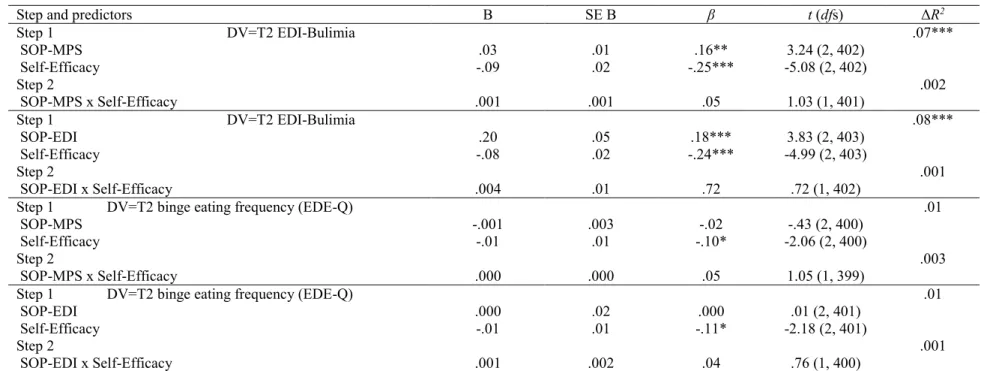
Prospective findings. Self-oriented perfectionism did not interact with self-efficacy to predict levels of binge eating at as measured by the EDI-Bulimia subscale at Time 2, regardless of perfectionism measure used (SOP-MPS: t(401) = 1.03, β = .00, p = .304, ΔR2 = .002;
SOP-EDI: t(402) = .72, β = .04, p = .470, ΔR2 = .001; Table 5). There was a main effect of self-oriented perfectionism, such that individuals who reported higher levels of self-self-oriented perfectionism tended to report higher levels of EDI-Bulimia binge eating at Time 2. There was also a main effect of efficacy, such that individuals who reported higher levels of self-efficacy at baseline tended to report lower levels of EDI-Bulimia binge eating at Time 2.
Self-oriented perfectionism also did not interact with self-efficacy to predict frequency of binge eating (EDE-Q) at Time 2, regardless of perfectionism measure used (SOP-MPS: t(399) = 1.05, β = .05, p = .293, ΔR2 = .003; SOP-EDI: t(400) = .76, β = .04, p = .447, ΔR2 = .001; Table 5). There was no main effect of self-oriented perfectionism for Time 2 binge eating frequency (EDE-Q; ps > .666). There was a main effect of self-efficacy, such that individuals who reported higher levels of self-efficacy at baseline tended to report lower frequencies of binge eating (EDE-Q) at Time 2.
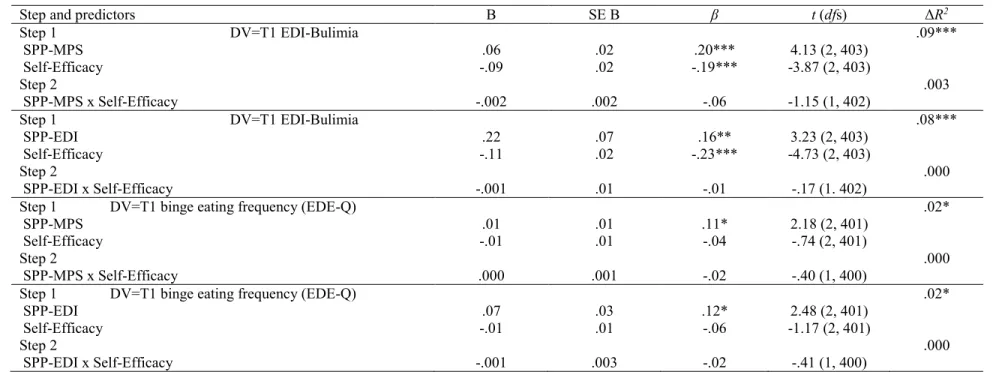
Cross-sectional findings. Socially prescribed perfectionism did not interact with
self-efficacy to identify concurrent levels of binge eating as measured by the EDI-Bulimia subscale at baseline, regardless of perfectionism measure used (SPP-MPS: t(402) = -1.15, β = -.06, p = .252, ΔR2 = .003; SPP-EDI: t(402) = -.17, β = -.01, p = .869, ΔR2 = .000; Table 6). There was a main effect of socially prescribed perfectionism, such that individuals who reported higher levels of socially prescribed perfectionism tended to report higher levels of EDI-Bulimia binge eating at baseline. There was also a main effect of self-efficacy, such that individuals who reported higher levels of self-efficacy at baseline tended to report lower levels of EDI-Bulimia binge eating at baseline.
Socially prescribed perfectionism also did not interact with self-efficacy to identify frequency of binge eating (EDE-Q) at baseline, regardless of perfectionism measure used (SPP-MPS: t(400) = -.40, β = -.02, p = .689, ΔR2 = .000; SPP-EDI: t(400) = -.41, β = -.02, p = .685, ΔR2 = .000; Table 6). There was a main effect of socially prescribed perfectionism, such that individuals who reported higher levels of socially prescribed perfectionism tended to report higher frequencies of binge eating (EDE-Q) at baseline. There was no main effect of self-efficacy for concurrent frequency of binge eating (EDE-Q; ps > .245).
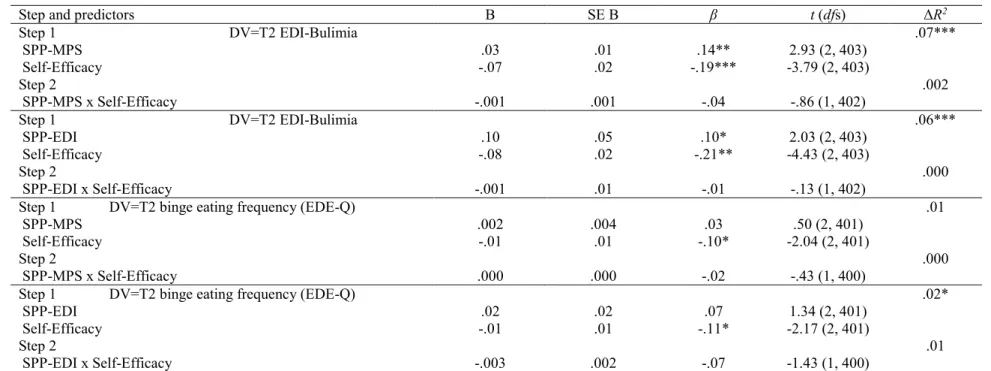
Prospective findings. Socially prescribed perfectionism did not interact with
self-efficacy to predict levels of binge eating as measured by the EDI-Bulimia at Time 2, regardless of perfectionism measure used (SPP-MPS: t(402) = -.86, β = -.04, p = .388, ΔR2 = .002; SPP-EDI: t(402) = -.13, β = -.01, p = .897, ΔR2 = .000; Table 7). There was a main effect of socially
also a main effect of efficacy, such that individuals who reported higher levels of self-efficacy at baseline tended to report lower levels of EDI-Bulimia binge eating at Time 2.
Socially prescribed perfectionism also did not interact with self-efficacy to predict frequency of binge eating (EDE-Q) at Time 2, regardless of perfectionism measure used (SPP-MPS: t(400) = -.43, β = -.02, p = .669, ΔR2 = .000; SPP-EDI: t(400) = -1.43, β = -.07, p = .155,
ΔR2 = .005; Table 7). There was no main effect of socially prescribed perfectionism for Time 2 frequency of binge eating (EDE-Q; ps > .181). There was a main effect of self-efficacy, such that individuals who reported higher levels of self-efficacy at baseline tended to report lower
frequencies of binge eating (EDE-Q) at Time 2.
Interactive Models of Self-Oriented Perfectionism, Self-Efficacy, and Binge Drinking
Typical number of drinks per week.
Cross-sectional findings. Self-oriented perfectionism did not interact with self-efficacy
to identify typical number of drinks reported per week at baseline, regardless of perfectionism measure used (SOP-MPS: t(401) = .81, β = .04, p = .420, ΔR2 = .002; SOP-EDI: t(402) = -.01, β = .00, p = .994, ΔR2 = .000; Table 8). There was no main effect of self-oriented perfectionism for
concurrent typical number of drinks per week (ps > .238). There was a main effect of self-efficacy, such that individuals who reported higher levels of self-efficacy tended to report fewer typical number of drinks per week at baseline.
self-oriented perfectionism tended to report fewer typical number of drinks per week at Time 2. There was no main effect of EDI self-oriented perfectionism on Time 2 typical number of drinks per week (p = .429). There was a main effect of self-efficacy, such that individuals who reported higher levels of self-efficacy at baseline tended to report fewer typical number of drinks per week at Time 2.
Typical number of occasions of drinking enough to feel “pretty high” per week.
Cross-sectional findings: Self-oriented perfectionism did not interact with self-efficacy to identify typical number of occasions of drinking enough to feel “pretty high” reported per week at baseline, regardless of perfectionism measure used (SOP-MPS: t(401) = -.46, β = -.02, p = .648, ΔR2 = .001; SOP-EDI: t(402) = -.16, β = -.01, p = .873, ΔR2 = .000; Table 8). There was
a main effect of self-oriented perfectionism when measured by the MPS, such that individuals who reported higher levels of MPS self-oriented perfectionism tended to report fewer typical occasions of drinking enough to feel “pretty high” at baseline. There was no main effect of self-oriented perfectionism as measured by the EDI for concurrent occasions of drinking enough to feel “pretty high” (p = .752). There was a main effect of self-efficacy, such that individuals who reported higher levels of self-efficacy tended to report fewer occasions of drinking enough to feel “pretty high” at baseline.
Prospective findings: Self-oriented perfectionism did not interact with self-efficacy to
typical occasions of drinking enough to feel “pretty high” per week at Time 2. There was no main effect of EDI self-oriented perfectionism on Time 2 occasions of drinking enough to feel “pretty high” (p = .712). There was no main effect of efficacy in the model with MPS self-oriented perfectionism for Time 2 occasions of drinking enough feel “pretty high” (p = .065). There was a main effect of self-efficacy in the model with EDI self-oriented perfectionism for Time 2 occasions of drinking enough to feel “pretty high,” such that individuals who reported higher levels of self-efficacy at baseline tended to report fewer occasions of drinking enough to feel “pretty high.”
Typical number of occasions per week of drinking five or more drinks in a row.
Cross-sectional findings: Self-oriented perfectionism did not interact with self-efficacy to identify typical number of occasions of drinking five or more drinks in a row per week at baseline, regardless of perfectionism measure used (SOP-MPS: t(401) = 1.57, β = .08, p = .117, ΔR2 = .006; SOP-EDI: t(402) = .98, β = .05, p = .873, ΔR2 = .002; Table 8). There was no main effect of self-oriented perfectionism for concurrent typical number of occasions of drinking five or more drinks in a row per week (ps > .342). There was a main effect of self-efficacy, such that individuals who reported higher levels of self-efficacy tended to report fewer occasions of drinking five or more drinks in a row per week at baseline.
Prospective findings: Self-oriented perfectionism did not interact with self-efficacy to predict typical number of occasions per week of drinking five or more drinks in a row at Time 2, regardless of perfectionism measure used (SOP-MPS: t(401) = -.09, β = -.01, p = .926, ΔR2 =
individuals who reported higher levels of self-efficacy at baseline tended to report fewer occasions per week of drinking five or more drinks in a row.
Interactive Models of Socially Prescribed Perfectionism, Self-Efficacy, and Binge Drinking
Typical number of drinks per week.
Cross-sectional findings: Socially prescribed perfectionism did not interact with self-efficacy to identify typical number of drinks reported per week at baseline, regardless of
perfectionism measure used (SPP-MPS: t(402) = -1.78, β = -.09, p = .076, ΔR2 = .008; SPP-EDI: t(402) = -1.03, β = -.05, p = .303, ΔR2 = .003; Table 10). There was no main effect of socially prescribed perfectionism for concurrent typical number of drinks per week (ps > .271). There was a main effect of efficacy, such that individuals who reported higher levels of self-efficacy at baseline tended to report fewer typical number of drinks per week at baseline.
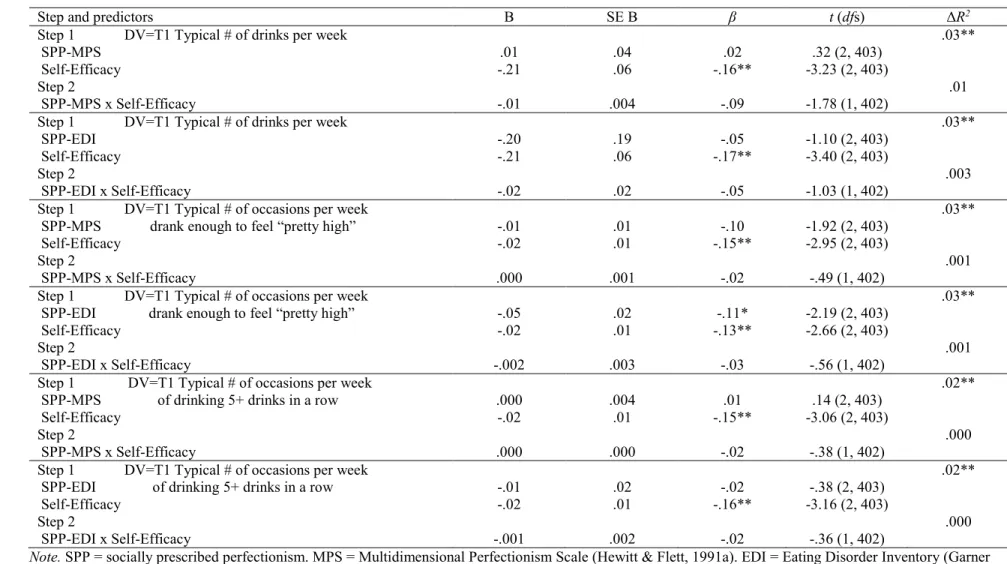
Prospective findings: Socially prescribed perfectionism did not interact with self-efficacy
to predict typical number of drinks reported per week at Time 2, regardless of perfectionism measure used (SPP-MPS: t(402) = -1.94, β = -.09, p = .054, ΔR2 = .009; SPP-EDI: t(402) = -.86, β = -.04, p = .391, ΔR2 = .002; Table 11). There was no main effect of socially prescribed
perfectionism for typical number of drinks per week at Time 2 (ps > .066). There was a main effect of self-efficacy, such that individuals who reported higher levels of self-efficacy at baseline tended to report fewer typical number of drinks per week at Time 2.1
Typical number of occasions of drinking enough to feel “pretty high” per week.
There was no main effect of socially prescribed perfectionism when measured by the MPS on concurrent typical number of occasions of drinking enough to feel “pretty high” per week (p = .056). There was a main effect of EDI socially prescribed perfectionism, such that individuals who reported higher levels of EDI socially prescribed perfectionism tended to report fewer typical occasions of drinking enough to feel “pretty high” per week. There was also a main effect of self-efficacy, such that individuals who reported higher levels of self-efficacy at baseline tended to report fewer typical number of occasions of drinking enough to feel “pretty high” per week at baseline.
Prospective findings: Socially prescribed perfectionism did not interact with self-efficacy
to predict typical number of occasions of drinking enough to feel “pretty high” reported per week at Time 2, regardless of perfectionism measure used (SPP-MPS: t(402) = -.24, β = -.01, p = .814, ΔR2 = .000; SPP-EDI: t(402) = .26, β = .01, p = .793, ΔR2 = .000; Table 11). There was a main effect of socially prescribed perfectionism, such that individuals who reported higher levels of socially prescribed perfectionism tended to report fewer typical occasions of drinking enough to feel “pretty high” per week at Time 2. There was also a main effect of self-efficacy, such that individuals who reported higher levels of self-efficacy at baseline tended to report fewer typical occasions of drinking enough to feel “pretty high” at Time 2.
Typical number of occasions per week of drinking five or more drinks in a row.
per week of drinking five or more drinks in a row (ps > .705). There was a main effect of self-efficacy, such that individuals who reported higher levels of self-efficacy tended to report fewer typical number of occasions of drinking five or more drinks in a row at baseline.
Prospective findings: The interaction of socially prescribed perfectionism as measured by the MPS and self-efficacy significantly predicted typical number of occasions per week of drinking five or more drinks in a row at Time 2, SPP-MPS: t(402) = -2.06, β = -.10, p = .040, ΔR2 = .010; Table 11. Figure 2 depicts the nature of the interaction with high and low levels of MPS socially prescribed perfectionism and self-efficacy representing one standard deviation above and below the mean, respectively. Simple slope analyses indicated that MPS socially prescribed perfectionism was significantly associated with Time 2 occasions of drinking five or more drinks in a row at high levels of self-efficacy (β = -.16, t(402) = -2.38, p = .018). However, at low levels of self-efficacy, MPS socially prescribed perfectionism was no longer significantly associated with occasions of drinking five or more drinks in a row at Time 2 (β = .03, t(402) = .37, p = .712).
Socially prescribed perfectionism, as measured with the EDI, did not interact with self-efficacy to identify typical number of occasions per week of drinking five or more drinks in a row at Time 2 (SPP-EDI: t(402) = -1.05, β = -.05, p = .293, ΔR2 = .003; Table 11). There was no main effect of EDI socially prescribed perfectionism for Time 2 typical number of occasions per week of drinking five or more drinks in a row (p = .165). There was a main effect of
self-efficacy, such that individuals who reported higher levels of self-efficacy tended to report fewer typical number of occasions of drinking five or more drinks in a row at Time 2.
One significant interaction emerged from the exploratory analyses investigating
prediction of change in dietary restraint, binge eating, and binge drinking at Time 2. Similar to the main body of analyses, socially prescribed perfectionism, as measured by the MPS,
DISCUSSION
The current study investigated the moderating role of self-efficacy on the relations between dimensional perfectionism and the risky behaviors of dietary restraint, binge eating, and binge drinking. Results of our analyses indicated that overall, self-efficacy is not supported as a significant moderator of the relations between dimensions of perfectionism and the disordered eating behaviors of dietary restraint and binge eating. However, the picture becomes more complicated when considering the relations between self-efficacy and binge drinking across both the primary and exploratory analyses.
Interestingly, the theoretical basis of this study had suggested that an interaction might be found identifying a group of individuals more likely to report high levels of binge drinking—that is, individuals uniquely at risk of engaging in an unhealthy behavior. Thus, the hypotheses were formulated to focus on vulnerable groups. Instead, what was found was a group of individuals who appear to enjoy a protective effect offered by the combination of high socially prescribed perfectionism and high self-efficacy. In considering the case of these particular individuals, it is possible to imagine a prototypical person who perceives that others have high standards for her behavior, one of which is an expectation that she not drink to excess, but remain focused on her academic pursuits. This, combined with high self-efficacy, might create a situation in which the person is both aware of high standards for her conduct, and has the perception that she is able to live up to those high standards, empowering her to moderate her drinking behavior successfully.
drinking, it is potentially the best-positioned to capture the types of drinking occasions that are more concerning behavior-wise.
Surprisingly, the interaction between self-efficacy and socially prescribed perfectionism was not significantly associated with weekly occasions of drinking five or more drinks in a row at baseline, despite being predictive of Time 2 occasions of the same. This may have been due to the timing of the baseline and Time 2 assessments with respect to events of the school semester. Baselines and Time 2 collections occurred in two successive semesters: for some participants, data collection occurred in the fall semester, and for others, data collection occurred in the spring semester. Baselines were collected toward the beginnings of the semesters, and Time 2s were collected toward the ends of the semesters. Due to this timing, it could be expected that the Time 2s were uniformly collected shortly before final exams and end-of-semester assignments were due, at a time when academic stress was higher for the participants. In contrast, the baselines would have been collected at times of lower academic stress, as students are not typically under high academic pressure at the beginning of the semester. Our observed findings may reflect a relation between binge drinking, socially prescribed perfectionism, and self-efficacy that becomes more salient in times of stress.
certain aspect of college culture that encourages excessive drinking in social settings. This dual aspect of binge drinking as being acceptable to many and discouraged by many may add complexities to how drinking behavior manifests in the lives of college women.
There are some reasons that may explain why self-efficacy is not supported as a significant moderator of the relations between dimensions of perfectionism and the disordered eating behaviors of dietary restraint and binge eating. Self-efficacy was measured using an instrument capturing general self-efficacy rather than domain-specific self-efficacy. Due to the general nature of the self-efficacy examined, there may have been a lack of concordance between domains that participants felt perfectionistic about and domains that they felt self-efficacious about. This might be illustrated by situations in which individuals either have high standards for themselves, or perceive that others have high standards for them in general, but do not feel that they have the ability to regulate their engagement in specific activities that may help them to meet those standards. It is also possible that self-efficacy may function as a state-level rather than a trait-level predictor of the disordered eating behaviors. Because the current study did not assess for short-term fluctuations in self-efficacy, it may have been unable to capture more short-term relations between self-efficacy, dimensional perfectionism, and disordered eating.
Main Effects
individuals higher in self-oriented perfectionism reported more binge eating. When binge eating was measured with the item from the EDE-Q assessing frequency, its relations with self-oriented perfectionism became inconsistent, indicating that the EDI-Bulimia may be capturing a facet of binge eating not covered by an item that only measures frequency of binge eating.
In general, self-oriented perfectionism was not significantly associated with alcohol use above and beyond the effects of self-efficacy at baseline. However, self-oriented perfectionism as measured by the MPS showed a significant negative association with number of occasions of drinking enough to feel pretty high at baseline. At Time 2, self-oriented perfectionism as
measured by the MPS was significantly predictive of typical number of drinks per week and frequency of drinking enough to feel pretty high per week.
Socially prescribed perfectionism. Socially prescribed perfectionism was positively associated with binge eating at baseline above and beyond the effects of self-efficacy, regardless of measure of socially prescribed perfectionism and binge eating. This pattern of association changed slightly at Time 2, when socially prescribed perfectionism was only predictive of binge eating as measured by the EDI-Bulimia subscale.
Self-efficacy. In general, self-efficacy was not significantly associated with dietary restraint above and beyond the effects of dimensional perfectionism, although there was a
significant negative relationship between self-efficacy and EDE-Q Restraint such that individuals reporting lower levels of self-efficacy tended to report higher levels of dietary restraint at Time 2. While there was an overall pattern of a significant negative relationship between self-efficacy and binge eating, this depended somewhat on the time at which binge eating was measured. At baseline, self-efficacy was significantly negatively associated with binge eating only as measured by the EDI-Bulimia. However, at Time 2, self-efficacy was significantly negatively associated with binge eating regardless of binge eating measure used.
There was a significant negative relationship between self-efficacy and all three measures of alcohol use above and beyond the effects of dimensional perfectionism at both time points, such that individuals reporting lower levels of self-efficacy tended to report consuming more alcoholic drinks per week, more weekly occasions of drinking enough to feel pretty high, and more weekly occasions of drinking five or more drinks in a row.
feeling self-efficacious may protect against binge drinking due to these individuals’ beliefs in their power to regulate their drinking.
Measurement of Dimensional Perfectionism
Regarding our comparison of the two different measures of dimensional perfectionism, the MPS and the EDI-Perfectionism, results from our analyses suggest that the MPS may be more closely tied to the outcomes of interest than the EDI-Perfectionism, as there were several regressions in which individual dimensions of perfectionism as measured by the MPS seemed to demonstrate a more consistent pattern of association with the behaviors being investigated. There were several cases in which the MPS measure of a dimension of perfectionism was significantly associated with an outcome behavior, but the EDI measure of the same dimension of
perfectionism was not when analyzed in a parallel model. There was only one example in which the reverse was true.
Additionally, both of the significant interactions involved the interaction between the MPS-measured socially prescribed perfectionism dimension and self-efficacy, while the EDI-Perfectionism dimension of socially prescribed perfectionism did not significantly interact with self-efficacy to identify the same behavior of weekly occasions of drinking five or more
alcoholic drinks at Time 2. Given these results, it is possible that, due to the theoretical
conceptualization that drove the development of the MPS and due to the greater number of items on the MPS compared to the perfectionism subscale of the EDI, the MPS may offer more
It should be noted that the overall patterns of association between the dimensions of perfectionism and the behaviors of interest were generally consistent regardless of perfectionism measure used, as they were overwhelmingly in the same direction, even in cases where they differed in strength. Thus, while the MPS may be a more comprehensive measure of
self-oriented and socially prescribed perfectionism, investigators who find it prohibitively long in the context of their studies may still gain useful information about the main effects of dimensional perfectionism through the much shorter EDI-Perfectionism scale. Nonetheless, due to increased construct coverage, it is suggested that investigators who wish to replicate an interactive effect involving dimensional perfectionism use the MPS as their measure of self-oriented and socially prescribed perfectionism.
Strengths and Limitations
This study benefits from its large sample size with a high rate of retention, drawn from a population of undergraduate women, a group that has been found to be vulnerable to the
unhealthy behaviors of dietary restraint, binge eating, and binge drinking. Dimensional
perfectionism has also been found to relate differentially to disordered eating in this population (e.g., Bardone-Cone, 2007) thus facilitating a direct extension of an existing body of literature. The longitudinal design allowed for testing of prospective relations between dimensional perfectionism, self-efficacy, and unhealthy behaviors. A further strength is the theoretical background upon which the hypotheses were built.
alcohol use behaviors presents a way to bridge current research on substance use and eating disorders.
This study also had some limitations which should be considered when interpreting the findings. The measure of self-efficacy used was broad, in the sense that it was intended to capture self-efficacy at a general level. Considering the observed differential relations between self-efficacy and the outcome behaviors of dietary restraint, binge eating, and binge drinking, measuring self-efficacy using domain-specific measures (e.g., self-efficacy in the eating behaviors domain) may have offered a more nuanced picture of how the construct might affect individuals’ likelihood of engaging in specific behaviors.
Another limitation of this study was that the predictors investigated were considered to be trait-level factors in influencing individual engagement in the target behaviors. While these stable factors may offer important information regarding individuals’ propensities for engaging in unhealthy coping behaviors, we lack information about more temporary, state-level factors, such as life stressors, that may interact with trait-level factors to influence how likely an individual is to engage in dietary restraint, binge eating, and binge drinking. For example, individuals experiencing more temporary life stressors such as problems in interpersonal
relationships or low test grades might be protected from or vulnerable to engagement in different coping behaviors, depending on their individual levels of dimensional perfectionism and self-efficacy.
Measurement-wise, there were limitations in assessing the construct of binge drinking. As acknowledged earlier, only one of the alcohol items closely captured binge drinking: the item asking about the frequency of drinking five or more drinks in a single occasion. However, although this operationalization was in use for binge drinking at the time of data collection, the boundary for binge drinking in women has since been lowered to four or more drinks in a single occasion (Chavez et al., 2011). Thus, the data collected from participants in this study may underrepresent the proportion of women who engage in binge drinking, as it is now defined for this group.
Another limitation relates to the absence of a construct theoretically relevant to the escape model. Though negative affect was conceptualized as a vehicle through which the
interaction of dimensional perfectionism and self-efficacy might result in the outcome behaviors of dietary restraint, binge eating, and binge drinking, it was not directly measured in this study. As such, we are unable to evaluate a causal mechanism in which perfectionism and self-efficacy lead to negative affect, which then results in unhealthy behaviors.
Finally, as with any investigation involving many regressions analyses, there was an increased potential for Type 1 error due to the number of regressions run. After consultation, we chose not to use an alpha adjustment as it might have compromised our ability to detect true effects. As with other studies, results of these analyses should be replicated in different settings.
Future Directions
ways in which these two traits may interact to protect individuals or place them at risk of engaging in unhealthy coping strategies.
Additionally, more detailed data on individual trajectories in disordered eating behaviors and alcohol use would inform our understanding of shorter-term fluctuations and long-term changes in engagement in these behaviors. Repeated measures over longer periods of study would allow for the use of different analytic methods to model individual growth curves of unhealthy coping behaviors over time. These models could incorporate both trait-level factors such as perfectionism and state-level factors such as state self-efficacy and life stressors (e.g., interpersonal problems, poor academic performance, body dissatisfaction), thus facilitating a more nuanced understanding of the interplay between stable characteristics and temporary states that might render individuals more vulnerable to seeking out potentially risky ways of coping.
Studies that directly compare mechanisms of how personality and environmental factors might lead to different unhealthy coping behaviors could inform future efforts in intervention design, to better target interventions toward specific behaviors such as binge eating and binge drinking. Considering the findings of this study, in which differential relations between dimensions of perfectionism and self-efficacy and specific coping behaviors were found,