Bayesian and Frequentist Methods for Approximate Inference in
Generalized Linear Mixed Models
Evangelos A. Evangelou
A dissertation submitted to the faculty of the University of North Carolina at Chapel Hill in partial fulfillment of the requirements for the degree of Doctor of Philosophy in the Department of Statistics and Operations Research (Statistics).
Chapel Hill 2009
Approved by,
Richard L. Smith, Advisor
Zhengyuan Zhu, Advisor
Chuanshu Ji, Committee Member
Bahjat F. Qaqish, Committee Member
© 2009
Abstract
EVANGELOS A. EVANGELOU: Bayesian and Frequentist Methods for Approximate Inference in Generalized Linear Mixed Models
(Under the direction of Richard L. Smith and Zhengyuan Zhu)
Closed form expressions for the likelihood and the predictive density under the Generalized
Linear Mixed Model setting are often nonexistent due to the fact that they involve integration
of a nonlinear function over a high-dimensional space. We derive approximations to those
quantities useful for obtaining results connected with the estimation and prediction from a
Bayesian as well as from a frequentist point of view. Our asymptotic approximations work
under the assumption that the sample size becomes large with a higher rate than the number
of random effects.
The first part of the thesis presents results related to frequentist methodology. We derive
an approximation to the log-likelihood of the parameters which, if maximized, gives estimates
with low mean square error compared to other methods. Similar techniques are used for the
prediction of the random effects where we propose an approximate predictive density from the
Gaussian family of densities. Our simulations show that the predictions obtained using our
method is comparable to other computationally intensive methods. Focus is given toward the
analysis of spatial data where, as an example, the analysis of the rhizoctonia root rot data is
presented.
The second part of the thesis is concerned with the Bayesian prediction of the random effects.
First, an approximation to the Bayesian predictive distribution function is derived which can
be used to obtain prediction intervals for the random effects without the use of Monte Carlo
methods. In addition, given a prior for the covariance parameters of the random effects we
derive approximations to the coverage probability bias and the Kullbak-Leibler divergence of
the predictive distribution constructed using that prior. A simulation study is performed where
we compute these quantities for different priors to select the prior with the smallest coverage
probability bias and Kullbak-Leibler divergence.
Acknowledgments
I would like to acknowledge particularly my advisors, Richard Smith and Zhengyuan Zhu for
their guidance, advice, and financial support. Special thanks go to all my teachers for providing
Table of Contents
List of Tables . . . vii
List of Figures . . . .viii
1 Introduction . . . 1
2 Background . . . 5
2.1 Generalized Linear Mixed Models . . . 5
2.1.1 Maximum Likelihood Estimation . . . 7
2.1.2 Prediction . . . 13
2.1.3 Bayesian solution . . . 14
2.2 Modeling Geostatistical Data with GLMM . . . 16
2.2.1 Gaussian Random Fields . . . 16
2.2.2 Spatial GLMM . . . 19
2.3 Contribution of the thesis . . . 21
3 General Results . . . 23
3.1 Model and Notation . . . 23
3.2 Asymptotic Expansions of Integrals . . . 26
3.2.1 Modified Laplace approximation . . . 26
3.2.2 Approximation to the ratio of two integrals . . . 28
4 Likelihood Methods . . . 30
4.1 The Conditional Distribution of the Random Effects . . . 31
4.2 Fisher Information Matrix . . . 32
4.3 Approximation to the Likelihood . . . 34
4.3.1 Bootstrap bias correction and bootstrap variance . . . 35
4.3.2 Assessing the error of the approximation . . . 36
4.3.3 Example: Binomial Spatial Data . . . 39
4.3.4 Simulations . . . 40
5 Prediction Methods . . . 45
5.1 Plug-in Predictive Density . . . 46
5.1.1 Plug-in corrections . . . 48
5.2 Simulations . . . 49
6 An Application: The Rhizoctonia Disease . . . 52
7 Bayesian Prediction . . . 55
7.1 Bayesian Predictive Distribution . . . 55
7.1.1 Expansion of the Bayesian Predictive Distribution . . . 56
7.1.2 Asymptotic approximation to the Bayesian predictive density . . . 59
7.2 Coverage Probability Bias . . . 63
7.3 Kullback-Leibler Divergence . . . 65
7.3.1 Approximation to the Bayesian predictive density . . . 65
7.3.2 Approximation to the Kullback-Leibler divergence . . . 67
7.4 Computations . . . 69
7.4.1 Log-likelihood derivatives and Cumulants . . . 69
7.4.2 Derivatives of the distribution function . . . 72
7.4.3 Simulations . . . 74
7.5 Summary . . . 80
8 Summary and Future Work . . . 93
Appendix . . . 95
List of Tables
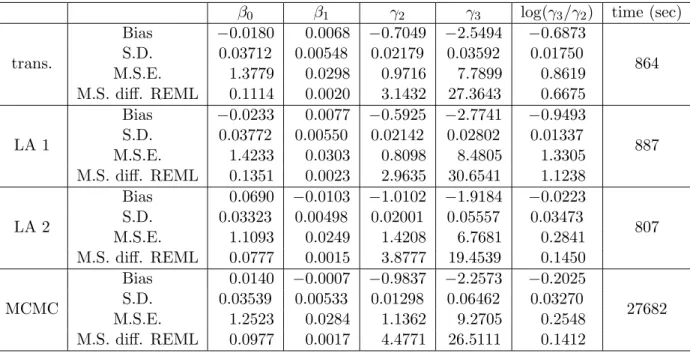
4.1 Simulations for estimation when nugget is known. . . 43
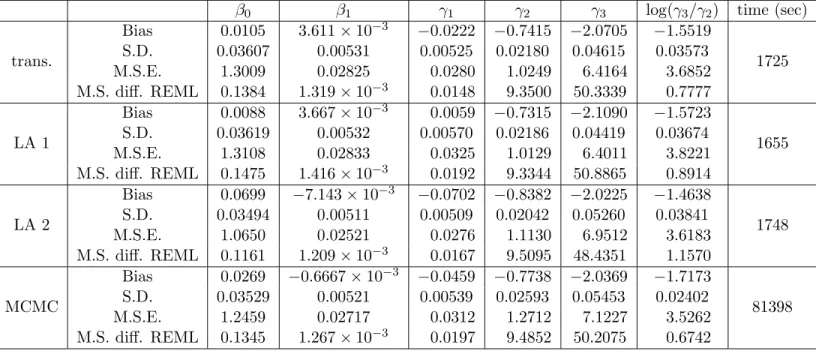
4.2 Simulations for estimation when nugget is unknown. . . 44
5.1 Measures for comparing different methods for prediction. . . 51
6.1 Measures of scoring for comparison of plug-in and MCEMG. . . 53
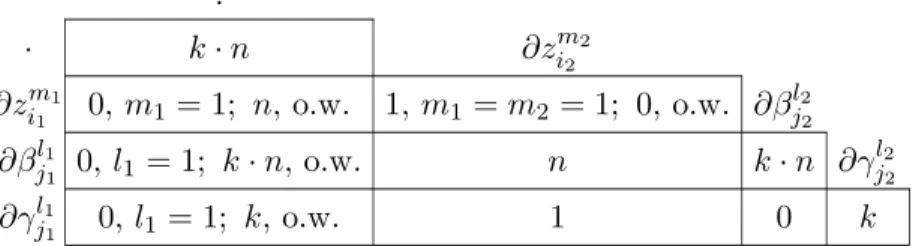
7.1 Derivatives of the joint log-likelihood. . . 57
7.2 Order of magnitude of the derivatives of the log-likelihood. . . 59
7.3 Priors used for the simulations. . . 75
7.4 Approximate coverage probability bias. . . 76
7.5 Comparison of the absolute coverage probability bias. . . 81
7.6 Coverage probability bias computed by simulations. . . 88
7.7 Comparison of the absolute coverage probability bias by simulations. . . 88
7.8 Kullback-Leibler divergence . . . 88
7.9 Proportions for comparing the Kullback-Leibler divergence. . . 92
List of Figures
1.1 Infected number of roots and total number of roots observed at locations. . . 2
3.1 Connected and unconnected partitions. . . 26
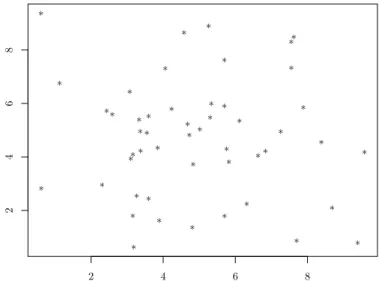
4.1 Observed locations for estimation. . . 41
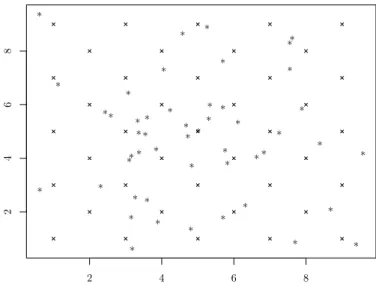
5.1 Observed locations and locations for prediction. . . 50
6.1 Map of the predicted random effects (disease intensity). . . 53
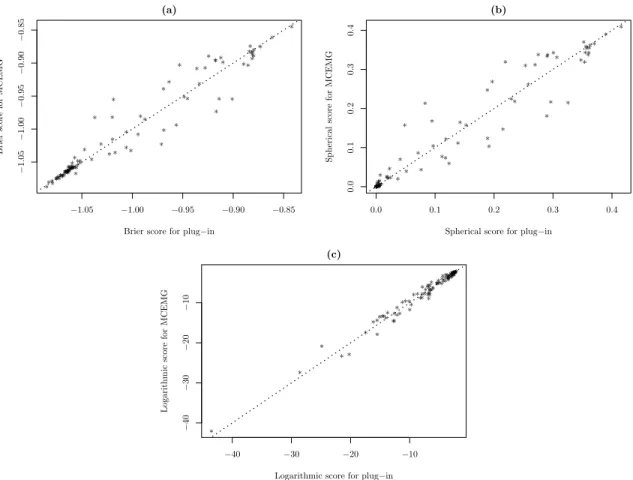
6.2 Calculated scores for plug-in and MCEMG.. . . 54
7.1 Coverage probability bias at the 2.5% and 5% quantiles with range varying.. . . . 82
7.2 Coverage probability bias at the 95% and 97.5% quantiles with range varying. . . . 83
7.3 Coverage probability bias at the 2.5% and 5% quantiles with sill varying. . . 84
7.4 Coverage probability bias at the 95% and 97.5% quantiles with sill varying. . . 85
7.5 Coverage probability bias at the 2.5% and 5% quantiles with nugget varying. . . . 86
7.6 Coverage probability bias at the 95% and 97.5% quantiles with nugget varying. . . 87
7.7 Boxplots of coverage probability bias for 2.5% and 5% quantiles. . . 89
7.8 Boxplots of coverage probability bias for 50% and 95% quantiles. . . 90
7.9 Approximated and simulated coverage probability bias at the 2.5% quantile under priors 1 and 2 against sill . . . 91
7.10 Approximated and simulated coverage probability bias at the 2.5% quantile under priors 3 and 4 against sill . . . 91
CHAPTER 1
Introduction
A statistical model is a tool for describing random phenomena in terms of mathematical
equations. Although such models rarely manage to capture the phenomenon exactly, they are
still useful in the sense that they provide a way of understanding the phenomenon under study.
Here we focus on a specific model that is general enough to find many applications such as
in medical experiments (ex. 6.2 in Breslow and Clayton, 1993), genetics (ex. 6.6 in Breslow
and Clayton, 1993), environmental sciences (ex. 1 in Diggle et al., 1998), epidemiology (Zhang,
2002) among others.
The Generalized Linear Mixed Model (GLMM) is a type of model that is general enough
to be used for modeling data from discrete as well as continuous distributions and to allow for
different sources of variability in the mean response. The first feature is achieved by specifying
the mean of the response as a function (usually nonlinear) of some explanatory variables. The
second feature is achieved by modeling the mean of the response as a function of random
variables called the random effects.
An example
Consider the following example adapted from Zhang (2002). In this example, a plantation
of wheat and barley suffers from a disease called rhizoctonia that attaches to the roots of plants
and hinders the absorption of water and nutrients by them. In order to be able to apply
sufficient treatment to the plantation, we would like to construct a map showing the severity
of the disease in the whole area. To achieve that, a sample of 15 plants where each plant has
multiple roots was collected at 100 different locations and the number of roots and infected
roots out of the total number of roots observed at each location.
0 200 400 600 800
0 100 200 300 400 500 14/167 21/154 5/127 3/105 38/116 41/166 62/159 45/98 8/164 38/130 9/125 18/115 30/127 5/116 33/114 30/122 28/126 14/170 23/194 12/90 18/144 29/120 15/125 13/132 22/120 17/110 30/167 50/172 9/138 15/128 26/152 27/143 45/133 37/95 12/165 16/105 70/145 21/133 35/145 17/132 26/155 25/102 16/141 11/126 16/178 27/109 37/140 23/140 30/154 30/80 46/152 9/91 36/149 39/128 27/124 13/135 42/113 20/104 27/142 29/154 27/142 9/153 29/145 20/133 46/139 37/160 17/133 31/156 18/121 19/127 40/141 11/184 22/135 12/145 2/147 1/126 5/153 5/116 16/154 14/138 13/125 19/121 17/143 8/152 44/187 21/151 9/144 37/108 25/123 24/116 3/151 42/160 50/165 18/165 35/141 30/1235/143 42/197 22/159 13/166
Figure 1.1: Figure showing the infected number of roots out of the total number of roots observed at the different locations.
The nature of the data does not allow us to model them as continuous variables but instead
they should be modeled as binomial where the probability of observing an infected root is
higher where the disease is more severe. In addition, since the data depend on the locations
that were drawn from, a separate sampling involving data from different locations would result
to a different disease mapping, therefore, the effect of the disease intensity at each location
should be considered random in order to account for the variability due to sampling, hence a
random effect. Furthermore, it is natural to assume that observations at nearby locations are
highly correlated compared to observations from locations that are far apart.
In this example we are interested in estimating any parameters associated with the
prob-ability of an infected root as well as any parameters associated with the correlation structure
of the random effects. Furthermore, a disease map should be constructed by predicting the
random effects associated with the probability of an infection.
Two questions related to Generalized Linear Mixed Models with statistical interest are (i)
for solving these questions, suitable for each problem. They can be split into two categories,
those that calculate the likelihood and the predictive density by simulations and those that
evaluate those quantities by approximating them. On the one hand, simulation based methods
become very accurate if the simulation is carried to a large size, but that is sometimes too
computationally intensive. On the other hand, approximation methods are faster but the error
of the approximation can be significant if the sample size is not sufficiently large, which makes
these methods biased.
This thesis is focused on results related to asymptotic methods. Approximate techniques
are used to derive an approximation to the likelihood with small error when the sample size
is large. Parameter estimation is then performed by maximizing the proposed approximation.
We compare the proposed method with other methods by simulations and find that it performs
very well compared to the other methods.
The same techniques are used for approximating the predictive likelihood. These lead us
to the definition of an approximate plug-in predictive density which has the Normal density.
Prediction intervals for the random effects are constructed by obtaining the necessary quantiles
of this approximate distribution. This method is also compared to other existing methods and
shows good performance compared to them.
From a Bayesian point of view, estimation and prediction is performed by drawing random
samples from the posterior distributions of the parameters and the random effects given the
sample. We derive a similar approximation to the Bayesian predictive distribution function and
show how our approximation can be used to derive corrections to the Bayesian (and frequentist)
prediction intervals using random sampling. Furthermore, we propose criteria for assessing
the performance of the prior based on approximations to the coverage probability bias and
Kullback-Leibler divergence.
The rest of the thesis is organized as follows. In chapter 2 we review the literature in
Generalized Linear Mixed Models and related topics. The model under study in this thesis
is defined in chapter 3 where we also derive some useful results that will be used later in
the thesis. Chapter 4 deals with issues related to the maximum likelihood estimation and
chapter 5 contains similar results in the case of the predictive density. An example on how
the theory in the previous chapters can be applied is presented in chapter 6. In chapter 7
we derive approximations to the Bayesian prediction quantiles. We also show how the bias of
the Bayesian predictive density and the Kullabck-Leibler divergence can be approximated and
describe how these quantities can be computed. A comparison of several Bayesian predictive
densities is performed constructed under different priors by comparing the coverage probability
CHAPTER 2
Background
2.1
Generalized Linear Mixed Models
Statistical models are generally used to explain the variability in the values of one variable,
theresponse, in terms of the values of other variables, thepredictors. From a statistician’s point of view, the challenges of any model fitting are developing a methodology for estimating the
parameters of the model, as well as predicting any unobserved random variables.
The simplest model, and the most widely studied, is theLinear Model. Its main assumptions are that (i) the observations are independent, (ii) the mean equals a linear combination of the
predictors, and (iii) the variance of the response is constant for every observation. An additional
fourth assumption is sometimes made, that (iv) the observations are a sample from the Normal
distribution. Procedures for fitting linear models which are very easy to implement have been
developed. However, the above assumptions are not always satisfied, therefore the use of more
general models is necessary. Such models include theGeneralized Linear Model (GLM) and the
Generalized Linear Mixed Model (GLMM).
The GLM generalizes on the assumptions (ii), (iii), and (iv) above in the following way:
(ii’) a monotone transformation of the mean equals a linear combination of the predictors, (iii’)
the variance is a function of the mean of each observation, and (iv’) the distribution of the
observations is a member of the exponential family. More specifically, suppose that we have
the sample
which we want to model with respect to a set of covariates
x1,x2, . . . ,xn
Our data consist of a realization of the random variablesY1, . . . Ynwhich according to
assump-tion (iv’), theith variable follows a distribution with probability density/mass function
f(y;θ, ω) = exp[ω−1{y θ−b(θ)}+c(y, ω)] (2.1)
for known functions b and c, and with canonical parameter θ and dispersion parameter ω. Examples of distributions with density/mass function (2.1) are the Normal, Poisson, Binomial,
and Gamma distributions. For certain members of this family of distributions, the dispersion
parameter ω is known and is in general of less importance. The parameter θ on the other
hand, plays an important role, especially because of its relationship with the mean µ of the
distribution by the equation
µ=b0(θ) (2.2)
and needs to be estimated from the data. Furthermore, the variance, as a function of θequals
v(θ) =ω b00(θ) (2.3)
The functionbis called thecumulant function andvis called thevariance function (McCullagh and Nelder, 1999).
A linear combination ηi =xTiβ of the response is called the linear predictor and according
to assumption (ii’), for some strictly increasing function g, called the link function,
g(µi) =ηi (2.4)
In the special case of the linear model,g is the identity function.
Note that by (2.2) and (2.4), a one-to-one relationship exists between θi and ηi. A natural
choice would be to choose g such that θi = ηi in which case g is called the canonical link
the matrix with rows xi’s and ythe vector ofyi’s.
The GLMM introduces a further generalization of the linear model by relaxing the
assump-tion (i) that the observaassump-tions are independent and assuming (i’) that they are conditionally independent given an unobserved random variable Zcalled therandom effect. In this case, the linear predictor is written as
ηi =xTiβ+uTiZ (2.5)
for knownui. A usual assumption of the distribution of the random variableZis that is Normal
with mean zero and some varianceΣ=Σ(γ) that is parameterized by an unknown parameter
γ, called the variance components, that is
Z∼N(0,Σ) (2.6)
In applications, assuming that the correct model is being used, two main questions arise
with statistical interest:
1. How to estimate the parameters β and γ, and
2. how to predict the random effectsZ.
The solution to the first question is related to the notion of the likelihood while the solution to
the second question with the predictive distribution.
2.1.1 Maximum Likelihood Estimation
The most broadly used method for estimation in parametric models is that of maximum
likelihood estimation (MLE) originally proposed by Fisher (1912). The idea is to choose the
value of the parameters that maximizes the joint density of the observations, called the likeli-hood. Under fairly weak regularity conditions the estimate obtained is asymptotically unbiased and asymptotically efficient as the sample size increases.
In linear models, the calculations for deriving the MLE can be done analytically and closed
form expressions for the estimators of the parameters exist. This is not the case for the GLM and
the GLMM so numerical methods are used instead. The MLE for GLM is obtained by applying
the Iterated Weighted Least Squares algorithm (IWLS) as shown in Nelder and Wedderburn
(1972).
For the GLMM, the log-likelihood of the parameters (β, γ) given the observationsycan be
written (up to a constant), using (2.1) as
`(β, γ|y) =−1
2log|Σ(γ)|+ log Z
exp (
X
i
yiθi(β,z)−
X
i
b θi(β,z)−
1 2z
TΣ−1(γ)z
) dz
(2.7)
whereθi(β,z) is the expression ofθas a function of (β,z) obtained from (2.2), (2.4), and (2.5).
To understand the difficulties in calculating the MLE let’s consider the simple example
where there is only one random effect z ∼N(0, γ), β is just an intercept term, and for each i,
yi|z∼Po(eβ+z). Then the likelihood of (β, γ) equals
L(β, γ|y) =eβPyie−12logγ
Z exp
zXyi−neβ+z−
1 2γz
2
dz (2.8)
The integral in (2.8) does not have a closed form solution which makes it difficult to calculate
the likelihood accurately. Evaluation of (2.8) is possible using numerical techniques such as
Gauss-Hermite quadrature but as the dimension of z becomes larger, these methods become
unreliable. More advanced methods have been developed for estimation in GLMM. These
include simulation based methods, as in McCulloch (1997) and Booth and Hobert (1999), and
approximation methods as in Breslow and Clayton (1993) and Shun and McCullagh (1995).
Approximate Likelihood
The idea of the approximate methods is to approximate the log-likelihood in (2.7) by
replac-ing the integrand with an approximation of it which can be integrated analytically. Typically
the approximation is performed by applying Taylor expansion to the exponent of the integrand
in (2.7) around the point ˜z that the exponent is maximized. This method of approximating
integrals is known as Laplace approximation (Barndorff-Nielsen and Cox, 1989, sec 3.3). The estimates are then obtained by maximizing the approximate likelihood.
Penalized Quasi Likelihood
second degree and suggested using an IWLS algorithm for obtaining the MLE. Their method
is outlined below:
Let
ψ(y,z;β, γ) =−X
i
yiθi+
X
i
b θi
+1
2z
T
Σ−1z (2.9)
i.e. the log-likelihood is `(β, γ|y) =−12log|Σ|+ logRexp{−ψ(y,z;β, γ)}dz. Let
˜
z = argmin
z
ψ(y,z;β, γ). (2.10)
Note that ˜z is a function of (y;β, γ). Then by Laplace approximation (eq. 4 in Breslow and
Clayton, 1993)
`(β, γ|y)≈ −1
2log|Σ| − 1
2log|ψzz(y,z˜;β, γ)| −ψ(y,z˜;β, γ) (2.11)
whereψzz(y,z˜;β, γ) denotes the matrix of the second order derivatives ofψwith respect to the
components of z evaluated at ˜z. For fixedγ, Breslow and Clayton (1993) noted that the term
log|ψzz(y,z˜;β, γ)|varies very little with respect to β, therefore the estimate ofβ is obtained
by maximizing −ψ(y,z˜;β, γ), which is of the form of the log-likelihood for GLM. Hence, the
IWLS algorithm which is used for obtaining the MLE ˆβ in GLM can be used for estimating
β. Substituting ˆβ into (2.11) and noting that the profile likelihood for γ has the form of the
likelihood if the data were following a Normal distribution, the estimate ˆγ is obtained by REML.
The obvious procedure to follow is first to set a starting value for γ, estimate β and use ˆβ to
estimate γ. Then ˆγ is used to obtain a new ˆβ which is in turn used to re-estimate γ. These
steps are repeated until the algorithm converges.
From computational point of view, apart from the challenge of finding ˜zwhen its dimension
is large, the algorithms suggested are easy to implement. Breslow and Clayton (1993) provided
several examples that their method applies but they noted that it doesn’t perform well in certain
examples, e.g when used to analyze binary clustered data. Breslow and Lin (1995) and Lin and
Breslow (1996) improved the method of Breslow and Clayton (1993) by including higher order
terms in the Taylor expansion of ψ but even so there are cases where the estimates are highly
biased. This is the case when the dimension of the random effects is comparable with the
sample size.
Direct Laplace Approximation
Shun and McCullagh (1995) looked at problems where the dimension of the random effects
increases with the sample size. This assumption is necessary for the variance components to
be estimated consistently but under this framework it is not clear if the remainder term in
the classical Laplace approximation is bounded. In their paper Shun and McCullagh derived a
formula that takes this into account by grouping terms according to their asymptotic order, an
application of which can be found in Shun (1997).
More specifically, they noted that a suitable approximation to the log-likelihood in (2.7) is
−ψ˜−1
2log|Σ| − 1
2log|ψ˜zz|+ 1 8
X
ijkl
˜
ψijklψ˜ijψ˜kl
−18 X
ijklmt
˜
ψijkψ˜lmtψ˜ijψ˜klψ˜mt−
1 12
X
ijklmt
˜
ψijkψ˜lmtψ˜ilψ˜jmψ˜kt (2.12)
Here, the subscripts on ψ denote differentiation with respect to the elements of z, the
su-perscripts denote the inverse elements of the Hessian of ψ, ψzz and the tilde means that the
function ψ and its derivatives are evaluated at the ˜z defined in (2.10). In addition, the
in-dices in the summations range over the dimension of z. The expression in (2.12) is maximized
simultaneously over (β, γ) to obtain the corresponding estimates.
It should be noted here that although their method performs well for small sample sizes,
it becomes slow even for moderate samples because it involves the summation of many terms.
In fact, Shun in his application excluded some non-small terms from the likelihood to speed
up the convergence of the algorithm. Later, Noh and Lee (2007) found a way to include these
terms when the design matrix of the random effects has many zeros, which is the case of the
crossed random effects.
Although these approximation methods perform very well in many situations, the estimates
obtained are biased because of the error in the Taylor expansion. Of course the bias can become
smaller by including more terms in the expansion, as in Raudenbush et al. (2000), but on the
Simulation based methods
The idea behind simulation based methods is to evaluate any integrals that occur by
simu-lating random numbers from an appropriate distribution. Under some regularity conditions, if
X1, . . . , XN is an i.i.d. sequence andh(x) is some function then, by the Law of Large Numbers,
E(h(X1))≈N−1Ph(Xi).
Note that the log-likelihood in (2.7) can be expressed as E(f(y|Z)) where the expectation
is taken over the distribution of Z which is N(0,Σ). A rather naive method to evaluate this expectation would be to simulate a large number of random effects from (2.6), plug them into
f(y|z) and then average over the simulations. Unfortunately this simple method fails if the
sample size is large, and that is because the conditional density f(y|z) would be so small that
is numerically indistinguishable from 0.
Three suggestions were proposed by McCulloch (1997) with the key point of using the
Metropolis-Hastings algorithm to simulate from the distribution ofZ|y.
Monte Carlo EM
The EM algorithm is an iterative method for maximizing the likelihood in the presence of
latent variables. In each iteration the parameters are chosen such that they maximize the
expec-tation E(logf(y,Z)|y) over the distribution of Z|y with parameters taken from the previous
iteration. The parameters are updated until convergence of the estimates.
In GLMMβ is updated by maximizing
E(logf(y|Z;β)|y) (2.13)
and γ is updated by maximizing
E(logf(Z;γ)|y) (2.14)
Since none of (2.13) or (2.14) can be evaluated analytically, McCulloch (1997) suggests using the
Metropolis-Hastings algorithm to simulate a sample from the distribution of Z|y and evaluate
the expectations numerically. On the other hand, some testing has to be made on whether the
sample produced is approximately an i.i.d. sample from the target distribution. Alternatively
Booth and Hobert (1999) suggested two other algorithms that don’t require the simulation of
a Markov Chain, and hence are more efficient than the one proposed by McCulloch.
Monte Carlo Newton-Raphson
In another point of view, instead of trying to maximize the log-likelihood, McCulloch (1997)
proposes estimating the parameters by setting the scores equal to 0. In this case, an estimate
forβ is obtained by solving
E
∂
∂βlogf(y|Z;β)
y
= 0 (2.15)
and for γ by solving
E
∂
∂γ logf(Z;γ)
y
= 0 (2.16)
The left hand side of (2.16) has an analytical expression and it can be solved easily. On the other
hand (2.15) is not so easy to solve but it is evaluated numerically using the same algorithms as
with the Monte Carlo EM case.
Simulated Maximum Likelihood
The idea of Simulated Maximum Likelihood is as follows. Suppose there exists a random
variableZ∗ with density functionf∗such that f∗(z;β, γ)>0 wheneverf(z|y;β, γ) >0. Then
the log-likelihood can be written as
`(β, γ|y) = logE
f(y,Z∗;β, γ)
f∗(Z∗;β, γ)
(2.17)
where the expectation is taken over the distribution ofZ∗. The expectation is then calculated
numerically by simulating from the distribution of Z∗ and averaging. We noted earlier that
evaluating the log-likelihood by naive Monte Carlo integration is not possible but here if f∗ is
chosen appropriately then the simulated likelihood should be possible to evaluate. (In fact, the
best choice forf∗(z) is f(z|y).) To this end, McCulloch (1997) did not give a clear answer as
to what to choose for f∗ and in his example he chose f∗(z;β, γ) = f(z;γ) which is of course
unknown, but even in this case his method did not perform as well as the MCEM or MCNR
2.1.2 Prediction
We now review methods for predicting the random effects themselves or other random
variables that are correlated with them such that conditioned on the random effects, they are
independent on the observations. We use the symbolZ0 for the variable that we want to predict
given a sampleY.
Best Prediction
The best prediction for the random variableZ0is defined as the random variable ˆZ0= ˆZ0(Y)
such that the mean square prediction error E{( ˆZ0 −Z0)2} is minimized. This reduces to
ˆ
Z0 = E(Z0|Y) which also depends on the parameters of the model. If the parameters were
known, the best predictor can be calculated either by using the Metropolis-Hastings algorithm
as was proposed by McCulloch (1997) or any of the two sampling methods of Booth and Hobert
(1999), or approximate the expectation using Laplace approximation (see Vidoni, 2006, for the
case of independent random effects). Of course, in most applications the parameters are not
known. A way to overcome this problem is to replace them with a good estimate, obtained using
one of the methods described in the previous section. This is known as the plug-in approach.
Plug-in approach
A method for obtaining prediction intervals is by constructing thepredictive density, that is the conditional density of the variable we want to predict given the observations: f(z0|y;β, γ).
It can be expressed as
f(z0|y;β, γ) =
R
f(zR0|z;γ)f(y|z;β)f(z;γ) dz
f(y|z;β)f(z;γ) dz (2.18)
Similarly, the predictive distribution function is written as
F(z0|y;β, γ) =
R
F(zR0|z;γ)f(y|z;β)f(z;γ) dz
f(y|z;β)f(z;γ) dz (2.19)
As we mentioned earlier, (2.18) and (2.19) depend on the parameters which are unknown. The
plug-in predictive density is constructed by replacing the parameters with their estimates based on the sampleyand is a rather simple to construct but on the other hand it has been criticized
as failing to take into account the uncertainty in estimating the parameters and assumes that
they are the true values.
Barndorff-Nielsen and Cox (1996) made some suggestions on correcting the plug-in
ap-proach, although these have not been applied to GLMM. They considered the fact that the
plug-in and the true predictive distribution are related asymptotically by
F(z0|y; ˆβ,γˆ) =F(z0|y;β, γ) +k−1D(z0|y;β, γ) +O(k−3/2) (2.20)
ask→ ∞ wherekis some constant related with the sample size andD is a known expression.
Let zα be the quantiles obtained by inverting the true predictive distribution and ˆzα be the
quantiles obtained by inverting the plug-in predictive distribution. Their first suggestion was to
estimatezαby ˆzα1 whereα1=α−k −1D(ˆz
α|y; ˆβ,γˆ) in which caseF(ˆzα1|y; ˆβ,γˆ) =α+O(k −3/2)
instead of O(k−1) that would have been if we used just ˆz
α. We should note though, that if
the correction is too large, then α1 might not be between 0 and 1. Their second suggestion
corrects ˆzα directly by using ˆzα −k−1Df(ˆ(ˆzzα|y; ˆβ,ˆγ)
α|y; ˆβ,γˆ) as an estimator for zα which doesn’t have
the disadvantage of the first method and gives the same order of accuracy. Furthermore, they
derived an approximation to the predictive density of order O(k−3/2) given by
f(z0|y;β, γ) = (1 + ˆr0(z0))f(z0+ ˆr(z0)|y; ˆβ,ˆγ) (2.21)
where ˆr(z0) =D(z0|y; ˆβ,γˆ)/f(z0|y;β, γ) and ˆr0(z0) = (d/dz0)ˆr(z0).
2.1.3 Bayesian solution
We describe the Bayesian approaches to GLMM in a different section since from the Bayesian
point of view, there is no distinction between estimation and prediction.
A major concern regarding Bayesian analysis is the choice of prior distribution for the
parameters. On this subject, we note the papers by Zeger and Karim (1991) where they discuss
Gibbs sampling in longitudinal GLMM, Karim and Zeger (1992) for similar ideas in crossed
random effects models, Berger et al. (2001) and Diggle et al. (1998) discuss prior selection in
general setting.
Bayesian Monte Carlo Methods
After the prior is selected, say β ∼ π(β) and independently γ ∼ π(γ), one proceeds by
calculating confidence regions from the posterior distributionsπ(β|y),π(γ|y), andf(z0|y). The
Monte Carlo methods proceed by constructing the conditional distributionsπ(β|y,z), π(γ|z),
f(z|y, β, γ), andf(z0|z, γ). As in general, these conditional distributions cannot be obtained
analytically (besidesf(z0|z, γ) which is Normal), Markov Chain Monte Carlo techniques, such
as Gibbs sampler and Metropolis-Hastings, are used to simulate from them which sometimes can
be burdensome (see Clayton, 1996). In a recent paper, Fan et al. (2008) proposed a Sequential
Monte Carlo algorithm for simulating from the posterior distributions which is faster than
MCMC, though it does not completely avoid the simulation of Markov Chains.
Integrated Nested Laplace Approximation
Alternatively, Rue et al. (2009), suggest a new methodology based on Laplace
approxima-tion. Writing θ= (β, γ), they express the posterior as
π(θ|y)∝ f(y,z;θ)π(θ)
f(z|y;θ) (2.22)
and the Bayesian predictive density as
f(z|y) = Z
f(z|y;θ)π(θ|y) dθ (2.23)
The idea is to replace the denominator of (2.22) with its Normal approximation using first
order Laplace approximation, centered around the point ˆz = argmaxzf(y,z;θ). Denoting the
aforementioned approximation by ˜fG(z|y;θ) define
˜
π(θ|y)∝ f(y,zˆ;θ)π(θ) ˜
fG( ˆz|y;θ)
(2.24)
Equation (2.24) is an approximation to the posterior of θ which can be used to substitute the
second term of the integrand in (2.23). The first term of the integrand is also computed by a
separate application of Laplace approximation. Finally, the integration in (2.23) is performed
numerically by Gauss-Hermite quadrature.
This approach provides a quick and accurate way of obtaining approximations to the
con-ditional distributions of interest and therefore obtain accurate predictions to the parameters
and the random effects. On the other hand, the computational advantages of this method
are in effect when the inverse covariance matrix of f(z|γ) is sparse and when the number of
parameters is small.
Bayesian Predictive Distribution Function
In analogy to the plug-in predictive distribution, we note here the Bayesian predictive
distribution function
F(z0|y) =
RRR
F(z0|z;γ)f(y|z;β)f(z;γ)π(β)π(γ) dzdβdγ
RRR
f(y|z;β)f(z;γ)π(β)π(γ) dzdβdγ (2.25)
Several authors have argued for the Bayesian predictive distribution against the plug-in one in
the sense that it naturally takes into account the uncertainty in the parameters by assigning
the prior distribution (see Geisser, 1993), nevertheless this should not always be conceded as
Smith (1999) mentions examples where the plug-in predictive density performs better.
2.2
Modeling Geostatistical Data with GLMM
In this section we review methods for analyzing geostatistical data, that is, correlated data
observed over a continuous spatial domainSwhose correlation arises through their dependence
on an unobserved spatial process Z = {Z(s), s ∈ S}. (s here is an index representing the
individual elements ofS.) In practice, only a finite sampleY1, . . . , Yn is observed corresponding
to the sampling sites s1, . . . , sn and the objective is to predict the spatial process Z over the
whole domain S. In practice this is done by predictingZ(s) on a fine grid that covers S.
2.2.1 Gaussian Random Fields
A Random Field over the spatial domain S is a process Z = {Z(s, ω), s ∈ S, ω ∈Ω} such that for fixed s, Z(s, ω) is a random variable on a probability space, say (Ω,A,Pr) while for
The mean µ(s) and covariance c(s, s0) of the random field Z are defined on S and S2
respectively in the following way
µ(s) = Z
Ω
Z(s, ω) d Pr(ω) (2.26)
c(s, s0) = Z
Ω{
Z(s, ω)−µ(s)}{Z(s0, ω)−µ(s0)}d Pr(ω) (2.27)
For simplicity, hereafter, we will avoid writing explicitly the second argument ω when we
describe Random Fields.
Note that the definitions in (2.26) and (2.27) can be written asµ(s) =E(Z(s)) andc(s, s0) =
Cov(Z(s), Z(s0))
Homogeneous Gaussian Random Field
In this section, we present a class of Random Fields, theisotropic Gaussian Random Field, that is usually assumed in order to assist with the inference regarding the probability measure
Pr.
The random fieldZ(s) with meanµ(s) and covariance c(s, s0) is calledweakly stationary if
for all s, s0 ∈S the following three conditions hold:
1. E(Z(s)) =E(Z(s0)),
2. Cov(Z(s), Z(s))<∞, and
3. Cov(Z(s), Z(s0)) can be expressed as a function of s−s0.
A weaker form of stationarity is a process that is intrinsically stationary defined by replacing condition 3 above by
3’. Var(Z(s)−Z(s0)) can be expressed as a function ofs−s0.
If in addition to 1, 2 and 3’, the following condition holds
4. Var(Z(s)−Z(s0)) can be expressed as a function ofks−s0k.
then the process is calledisotropic. If all conditions 1, 2, 3, and 4 hold then the process is called
homogeneous.
A Gaussian Random Field is the Random Field Z onSwhere for every subset{s1, . . . , sk} of S, the joint distribution of (Z(s1), . . . , Z(sk)) is Gaussian. In connection with the previous
definitions the distribution of a homogeneous Gaussian Random Field is characterized by its
mean µ, which without loss of generality we will assume that µ = 0, and by its covariance
functionc(dii0) =c(si, si0) wheredii0 =ksi−si0k.
Intuitively, the probability measure underlining a stationary Gaussian Random Field is
invariant under parallel transition of the co-ordinate system while for an isotropic Random
Field it is invariant under rotations of the co-ordinate system.
Here we only consider zero-mean homogeneous Gaussian Random Fields.
Covariance Structure
A common practice is to assume that the covariance function c(·) is parameterized by a few
parameters γ that have a reasonable interpretation regarding the structure of the covariance
between two sampling sites. Some forms of the covariance function c(·) are
1. Exponential:
c(d) =
γ1+γ2, ifd= 0
γ2exp{−d/γ3}, ifd >0
(2.28)
2. Gaussian
c(d) =
γ1+γ2, ifd= 0
γ2exp{−(d/γ3)2}, ifd >0
(2.29)
3. Spherical:
c(d) =
γ1+γ2, ifd= 0
γ2{1−1.5(d/γ3) + 0.5(d/γ3)3}, if 0< d < γ3
0, ifd≥γ3
(2.30)
4. Mat´ern:
c(d) =
γ1+γ2, if d= 0
γ2
Γ(ν) 2ν−1
2√ν d
γ3
ν
Kν(2√ν d/γ3) if d >0
γ1 is called the nugget and is interpreted as the variability due to measurement error and
microscale variation (i.e. the part of the variation that cannot be estimated because there are no
two sampling sites close enough to indicate it). γ2 is called thepartial sill and is interpreted as
the variance of the random field if there was no nugget. γ3 is called therange and is interpreted
as the distance at which the correlation function reaches 0 for the spherical form, or 5% of
the partial sill for the other forms. In (2.31), ν is called the smoothness parameter and Kν
corresponds to the modified Bessel function of the second kind of order ν (Abramowitz and
Stegun, 1964).
The Gaussian Geostatistical Model
Suppose a Gaussian Random FieldZ onS. In practice, we sample ats1, . . . , skand observe
Y = (Y1, . . . , Yk) whose mean is affected by a set of covariates X. For simplicity, let Z =
(Z1, . . . , Zk), Zi = Z(si), i = 1, . . . , k so that Z ∼ Nk(0,Σ) where the (i, i0) element of Σ is
c(ksi−si0k), parameterized by γ.
The simplest type of relationship we can have between the observations and the covariates
is to express the mean of Y as a linear combination of the covariates:
Y =Xβ+Z (2.32)
The model in (2.32) implies that the distribution of Y is k-dimensional Gaussian with mean
Xβ and covariance matrixΣand in this case estimation ofβ and γ can be performed by either weighted least squares, maximum likelihood, or restricted maximum likelihood.
Several tools under the namekriging have been developed for predicting the random variable
Z0associated with the sampling sites0under the model (2.32). The original work on this subject
was done by Krige (1951) and later developed by Matheron in a series of papers and books (e.g.
Matheron, 1962, 1963). For a collection of these methods see Cressie (1993).
2.2.2 Spatial GLMM
In many applications, for example when the observations involve counts, the Gaussian
Geo-statistical model (2.32) is not appropriate. Diggle et al. (1998) extended the Gaussian
tistical model to include parametric families depending only on the mean of the spatial process
in the same way that the classical linear model is extended to the generalized linear mixed
model. In other words they define the linear predictor by
η=Xβ+Z (2.33)
and they assumed that the conditional distribution of the observationsY given the random field
Z is a member of the exponential family as defined in (2.1). In addition, all the assumptions
regarding GLMM also hold for the spatial GLMM and as a consequence, all methods that have
been developed for the analysis of GLMM can also be used for this model. Here we present a
few from the literature.
Bayesian MCMC
As we mentioned earlier, when we want to predict the random effect Z0 under GLMM, the
Bayesian approach has the advantage that it incorporates the unknowing of the parameters
into the prior. In their paper Diggle et al. (1998) assigned independent uniform priors with
bounded support for the components of β and γ and used Metropolis-Hastings to simulate
from the posterior distribution ofγ while random samples from the posteriors ofβ andZ0 were
obtained by simulating from the normal distribution. Later on, Christensen et al. (2000) and
Christensen and Waagepetersen (2002) commented on the use of Langevin-Hastings algorithm
for the MCMC simulation as it leads to better convergence and mixing properties than the
Metropolis-Hastings algorithm. They also suggested the use of non-informative flat priors for
the components of β and non-informative inverse Gamma for the partial sill γ2. For the range
parameterγ3, the use of improper prior results to improper posterior, hence they used uniform
proper prior in the first paper and exponential prior in the second. The estimation of the nugget
γ1 was not considered.
Monte Carlo EM Gradient
In connection with the MCEM idea of McCulloch (1997), Zhang (2002) uses a
Metropolis-Hastings algorithm to simulate from the distribution of Z|y and calculate the expectations
(2.13) and (2.14) needed for the E step but instead of maximizing those expectations at the
maximization of the expectations which can be cumbersome. For prediction, he noted that the
best predictor is expressed in terms of the expectations of the random effects at the sampling
sites conditioned on the observations, i.e.
E(Z0|y) =
k
X
i=1
wiE(Zi|y) (2.34)
where the vector of wi’s,w=cTΣ−1,c= Cov(Z, Z0). Therefore, after the covariance parame-ters are estimated, the best predictor forZ0 is obtained by evaluating (2.34) for each iteration
of Z|y and then averaging over all simulations.
Simulated Maximum Likelihood
Christensen (2004) demonstrated the use of Simulated MLE for the spatial GLMM. He
wrote the likelihood function in the form of (2.17) and used simulation to approximate it. As
we mentioned earlier, the best choice for f∗ is f(z|y;β, γ) which depends on the unknown
parameters. For this reason the author suggested simulating fromf(z|y;β0, γ0) for some fixed
values (β0, γ0) which are believed to be close to the true ones and which are updated after a
few iterations.
2.3
Contribution of the thesis
This thesis contributes on topics related to Bayesian and frequentist methods for the analysis
of Generalized Linear Mixed Models. The basic idea is to use asymptotic expansions to compute
quantities of interest such as the likelihood or the predictive density. A key role is played by
Laplace approximation, a method for approximating integrals, where an approximation of this
type, suitable for our case, is derived. The particular feature of our approximation is that
it allows the dimension of the variable that is integrated to increase to infinity, a necessary
assumption for estimation and prediction for these models.
For parameter estimation, we propose an approximate likelihood method. There are several
advantages when estimating the parameters this way. First, as our simulations show, the
estimates obtained have low bias and mean square error and second, our method is fast to
compute. Some details are also given on correcting the bias of the approximation.
We also suggest an approximate prediction method based on the same idea. We apply a
high order approximation to the predictive density and replace the unknown parameters with
their estimates, what is known as the plug-in approach. The proposed density belongs to the
Gaussian family and prediction intervals can be easily computed. We present a simulation study
where we compare our method with other approximate and simulation based methods and show
that our method has similar performance with the other methods with less computation time.
From Bayesian perspective, we investigate the issue of prior selection. We derive
approxima-tions to the coverage probability bias and Kullback-Leibler divergence of the Bayesian predictive
density constructed under different priors. These are computed for different simulations and
for possible choices for priors that are found in the literature. We make selection based on the
criterion of minimum coverage probability bias and minimum Kullback-Leibler divergence. Our
approximation to the coverage probability bias agrees mostly to the one obtained by simulations
but has smaller variation. We find that the best choices are uniform priors for the nugget and
range parameter while for the partial sill we recommend either uniform prior or inverse gamma.
Using exponential prior for the range, results to higher coverage probability bias unless the true
CHAPTER 3
General Results
3.1
Model and Notation
Throughout this document we use indices to denote components, derivatives and
summa-tions. For the last purpose, any index that appears in an expression as a subscript and as
a superscript, a summation over all possible values of that index is implicit. For this reason
we will denote the components of a vector sometimes by subscripts and sometimes by
super-scripts. For example, the components of the three dimensional vector x will be written as
x1, x2 and x3 or as x1, x2 and x3 depending on the expression i.e. xixi = xixi =P3i=1(xi)2
but xixi is the square of the ith element of x: (x
i)2. The (i, j) component of a matrix A
will be written as aij and its inverse (when exists) will have componentsaij. It is also
conve-nient to enclose any set of indices within square brackets to denote the sum over all partitions
of those indices of the products of the corresponding arrays and a number withing square
brackets to denote the different permutations of indices for the corresponding partition, i.e.
x[ijk]=xijk+ [3]xijxk+xixjxk=xijk+xijxk+xikxj+xjkxi+xixjxk.
For any real function f(x), x ∈ Rk, its derivative with respect to the ith component of
x is denoted by a subscript i.e. fi(x) := ∂f∂x(xi) and fij(x) := ∂
2
f(x)
∂xi∂xj. Furthermore, fx is the
gradient of f and fxx is the Hessian matrix. Based on our notation on matrix inversion, fij
is the (i, j) element of f−1
xx: the inverse of the Hessian matrix. Finally, when we refer to the
probability density/mass function of a random variable, we will use the generic symbol f(·;·)
with the random variables written at the left of the semicolon and the parameters at the right,
i.e. f(x;θ) is the density/mass ofX depending on parameterθ andf(x|y;θ) is the conditional
function. An exception will be made when the distribution is Gaussian, in which case we will
use the letters φand Φ for the pdf and cdf respectively.
The vector of the response variable is denoted by Y with components {Yili= 1, . . . , k, l =
1, . . . , ni} repeatedly sampled at k different locations within a spatial domain S. We assume
the existence of an unobserved homogeneous Gaussian random field Z over the whole spatial
region S such that conditioned on Z the observations are independent. We denote by Z the
k-dimensional vector that consists of the components ofZ that correspond to the sampled sites
and we refer to it as the random effects. Furthermore, the meanµi =E(Yil|Zi) =b(θi) for some
known differentiable functionb, called the cumulant function, such thatb0 is strictly increasing,
and variance vi(µi) where vi is a known function called the variance function (McCullagh
and Nelder, 1999). The parameterθi relates to the linear predictorηi=xTiβ+Zi through the
relationshipµi =b(θi) =g−1(ηi) for some functiongcalled the link function. In our asymptotic
analysis we consider the case in which k and ni increase to infinity with the ni’s having the
same order, min{ni}=O(n) butkis increasing in a lower rate, k/n→0.
We assume that the joint distribution of the random field Z is Normal with mean 0 and
covariance matrix parameterized by γ, i.e. for the random effects Z we have,
Z∼Nk(0,Σ(γ)) (3.1)
Conditioned onZ, the density ofY has the form
f(y|z;β) = exp
( k
X
i=1
yi(xTiβ+zi)− k
X
i=1
nib(xTiβ+zi) + k
X
i=1 c(yi)
)
(3.2)
for known functions b and c, where yi = Pnj=1i yij. Note that the form of the density implies
conditional independence among the observations given the corresponding random effects.
Al-though in (3.2) we implicitly used the canonical link for the distribution of y, the results that
follow don’t necessarily require this restriction.
We are interested in estimating the parameters (β, γ) of the model as well as predicting a
Under our model, the likelihood for the parameters is
`(β, γ;y) = Z
f(y|z;β)φ(z;γ) dz (3.3)
which does not have an analytic expression. In addition, writing the distribution function of
Z0|Z as
Φ(z0|z;γ) = Φ
z0−µ τ
(3.4)
where Φ(·) denotes the standard normal distribution function and
µ=cTΣ−1z (3.5)
τ2=σ20−cTΣ−1c (3.6)
σ02= Var(Z0) (3.7)
c= Cov(Z, Z0) (3.8)
the predictive distribution function forZ0 given the dataY is
F(z0|y;β, γ) =
R
Φ(zR0|z;γ)f(y|z;β)φ(z;γ) dz
f(y|z;β)φ(z;γ) dz (3.9)
Similarly, the predictive density is written as
f(z0|y;β, γ) =
R
φ(z0|z;γ)f(y|z;β)φ(z;γ) dz
R
f(y|z;β)φ(z;γ) dz (3.10)
Neither (3.9) nor (3.10) have an analytic expression and hence exact prediction intervals cannot
be calculated exactly.
Before we reach the point of proposing methods for obtaining maximum likelihood estimates
and prediction intervals, we derive a formula that allows us to approximate the likelihood and
the predictive likelihood when the sample size is large.
3.2
Asymptotic Expansions of Integrals
3.2.1 Modified Laplace approximation
Shun and McCullagh (1995) proposed a modification of Laplace’s approximation that can
be used for evaluating integrals of the form
I1 =
Z
e−g(z)dz (3.11)
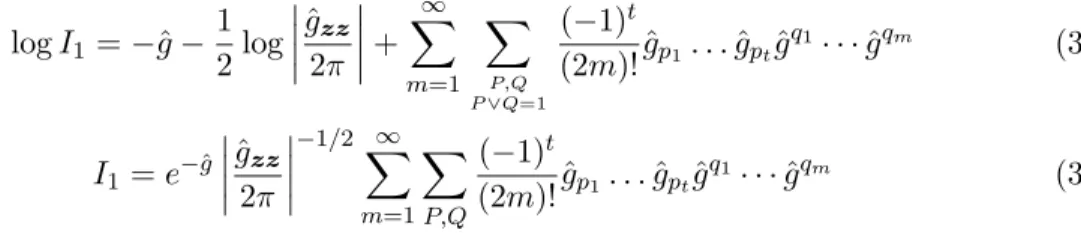
where g=O(n). Assuming thatg has a unique minimum at ˆz, Shun and McCullagh suggest
an expansion of the integral around that minimum. They derive the identities
logI1 =−ˆg−
1 2log
ˆg2zzπ
+
∞
X
m=1
X
P,Q P∨Q=1
(−1)t
(2m)!gˆp1. . .ˆgptˆg
q1
· · ·gˆqm (3.12)
I1 =e−ˆg
ˆ
gzz
2π
−1/2 X∞
m=1
X
P,Q
(−1)t
(2m)!gˆp1. . .gˆptgˆ
q1
· · ·ˆgqm (3.13)
where the second sum in each of (3.12) and (3.13) is over all partitions P, Q such that P =
p1|. . .|pt is a partition of 2mindices into tblocks, each of size 3 or more and Q=q1|. . .|qm is
a partition of the same indices into m blocks, each of size 2. P ∨Q= 1 means that the union
of the graphs produced by joining elements in the same block of the two partitions is connected
e.g. Q=i1i2|i3i4 is connected withP1 =i1|i2i3|i4 but not withP2=i1|i2|i3i4 (see Figure 3.1).
The summation over all the possible values of the 2m indices is also implicit.
i1
i2
i3
i4
i1
i2
i3
i4
Figure 3.1: Connected partitionsQand P1 (left) and unconnected Qand P2 (right)
These formulae require expressing the integrand in a fully exponential form while for the
In our approach, we consider the following integral:
I2 =
Z
exp{−g(z)} ×f(z) dz (3.14)
where f is not necessarily positive. Suppose that z ∈ Rk, g(z) = O(n) has a minimum at 0
and f and its derivatives areo(n). We will develop a formula for the approximation of (3.14).
Taylor expansion of garound 0 gives
g(z) = ˆg+ 1 2!z
i1zi2gˆ
i1i2+
1 3!z
i1zi2zi3ˆg
i1i2i3 +
1 4!z
i1zi2zi3zi4ˆg
i1i2i3i4+. . . (3.15)
where the subscripts underg imply differentiation with respect to the indicated component of
z and the hats imply that the function or its derivatives are evaluated at 0. The indices range
from 1 tokand the sums are over all indices. Let ˆgzzdenote the hessian matrix of gevaluated
at 0.
A similar expansion of f around the same point gives
f(z) = ˆf + ˆfj1z
j1 +1
2fˆj1j2z
j1zj2+. . . (3.16)
Thus
I2 =e−ˆg
Z
e−12zTˆgz zzexp
−3!1ˆgi1i2i3z
i1zi2zi3
−4!1gˆi1i2i3i4z
i1zi2zi3zi4
−. . .
×
ˆ
f+ ˆfj1z
j1+1
2fˆj1j2z
j1zj2+. . .
dz
=e−ˆg
Z
e−12zTˆgz zz
1− 1
3!gˆ[i1i2i3]z
i1zi2zi3
− 1
4!ˆg[i1i2i3i4]z
i1zi2zi3zi4
−. . .
×
ˆ
f+ ˆfj1z
j1+1
2fˆj1j2z
j1zj2+. . .
dz
=e−ˆg
ˆ gzz 2π
−1/2
E
1− 1
3!gˆ[i1i2i3]Z
i1Zi2Zi3
−4!1ˆg[i1i2i3i4]Z
i1Zi2Zi3Zi4
−. . .
×
ˆ
f+ ˆfj1Z
j1 +1
2fˆj1j2Z
j1Zj2+. . .
whereZ is a normally distributed random variable with mean0 and covariance matrix ˆgzz−1.
Then,
I2 =e−ˆg
ˆg2zzπ
−1/2 X
r∈{0,3,4,...} ∞
X
s=0
(−1)r 1
r!s!ˆg[i1...ir]fˆj1...jsE
Zi1
· · ·Zir
·Zj1
· · ·Zjs
where we make the convention if r = 0 then ˆg[i1...ir] = 1, if s = 0 then ˆfj1...js = ˆf and if
r=s= 0 thenEZi1
· · ·Zir·Zj1
· · ·Zjs= 1
Using equation (2.8) from McCullagh (1987), I2 becomes
I2 =e−ˆg
ˆ gzz 2π
−1/2 X∞
m=0 2m X s=0 X P,Q
(−1)t
(2m)!fˆj1...jsgˆp1. . .gˆptgˆ
q1· · ·ˆgqm (3.17)
whereP is a partition of 2m−sindices intotblocks each of size 3 or more andQis a partition
of the same indices together with {j1, . . . , js} intom blocks of size 2. It is not required for P
and Qto be connected.
In the special case wheref(z)>0, say f(z) = exp{h(z)}, then from (3.17),
logI2 =−ˆg+ ˆh−
1 2log
21πˆgzz
+ ∞ X m=1 1 (2m)!
X
P,Q P∨Q=1
χp1. . . χpt·gˆ
q1. . .gˆqm (3.18)
where
χi1···is =
ˆ
hi1···is ifs≤2
ˆ
hi1···is−gˆi1···is ifs≥3
3.2.2 Approximation to the ratio of two integrals
In the following sections we will need to approximate ratios of integrals e.g. when we want
to approximate conditional densities. Suppose we want to approximate
I2 I1
= R
exp{−g(z)} ×f(z) dz R
e−g(z)dz (3.19)
Using equations (3.13) and (3.17)
I2 I1
=
P∞
m=1
P2m
s=0
P
P,Q
(−1)t
(2m)!fˆj1...jsgˆp1. . .ˆgptˆgq
1· · ·gˆqm
P∞
m=1
P
P,Q
(−1)t
= ∞ X m=1 2m X s=1 X P,Q
(−1)t
(2m)!fˆj1...jsgˆp1. . .gˆptgˆ
q1
· · ·ˆgqm (3.20)
As a demonstration of (3.20) suppose kn−1 → 0, and that f and its derivatives are O(1)
as k → ∞. In addition g and its derivatives are O(n) when the differentiation is performed
with respect to the same component of z, otherwise they are O(1). As we will show later in
Lemma 1, the inverse Hessian matrix of g is O(n−1) at the diagonal and O(n−2) at the off
diagonal elements as k → ∞. This a typical situation which we encounter in the subsequent
sections. The numerator of (3.19) is approximated by
ˆ
f−1
8fˆgˆi1i2i3i4gˆ
i1i2gˆi3i4 +1
8fˆgˆi1i2i3gˆi4i5i6ˆg
i1i2ˆgi3i4gˆi5i6 + 1
12fˆˆgi1i2i3gˆi4i5i6gˆ
i1i4ˆgi2i5ˆgi3i6
− 12fˆi1gˆi2i3i4gˆ
i1i2gˆi3i4+1
2fˆj1j2ˆg
j1j2+O(n−1
∨k2n−2) (3.21)
where besides the first term: ˆf, all the other terms in (3.21) areO(k n−1). A similar expansion
exists for the denominator by replacingf in (3.21) by 1. Thus (3.20) becomes after we take ˆf
as a common factor
I2 I1
= ˆf 1− 1
8ˆgi1i2i3i4gˆ
i1i2ˆgi3i4+ 1
8gˆi1i2i3ˆgi4i5i6ˆg
i1i2gˆi3i4gˆi5i6+ 1
12ˆgi1i2i3ˆgi4i5i6gˆ
i1i4gˆi2i5ˆgi3i6
−1
2 ˆ
fi1
ˆ
f ˆgi2i3i4gˆ
i1i2gˆi3i4+1
2 ˆ
fj1j2
ˆ
f gˆ
j1j2 +O(k2n−1)
!
×
1−1
8gˆi1i2i3i4ˆg
i1i2gˆi3i4 +1
8gˆi1i2i3gˆi4i5i6gˆ
i1i2ˆgi3i4gˆi5i6
+ 1
12gˆi1i2i3gˆi4i5i6gˆ
i1i4ˆgi2i5gˆi3i6 +O(n−1)
−1
(3.22)
Employing the identity (1−)−1= 1 ++O(2) we have in (3.22) after canceling between
the numerator and the denominator
I2 I1
= ˆf 1−1 2
ˆ
fi1
ˆ
f gˆi2i3i4gˆ
i1i2gˆi3i4+1
2 ˆ
fj1j2
ˆ
f gˆ
j1j2+O(k2n−1)
!
= ˆf−1
2fˆi1ˆgi2i3i4ˆg
i1i2gˆi3i4 +1
2fˆj1j2ˆg
j1j2+O(n−1) (3.23)
CHAPTER 4
Likelihood Methods
Define
`(β, γ|y,z) = logf(y|z;β) + logf(z;γ) (4.1)
to be the log-likelihood when the complete dataset (y,z) is observed. Then, the likelihood based only ony is defined by integrating over the unobserved random effects:
`(β, γ|y) = log Z
exp{`(β, γ|y,z)}dz (4.2)
which is of the form (3.11). Joint maximization of (4.2) with respect to (β, γ) results to the
Maximum Likelihood Estimates for those parameters. In order to be able to derive the order
of the asymptotic approximations, we need to know the order of the elements of`−1
zz(β, γ|y,z),
the inverse Hessian matrix of the log-likelihood of the complete data. The following lemma
gives the answer
Lemma 1. If k = o(n) then the diagonal elements of `−1zz(β, γ|y,z) are O(n−1) and the off diagonal are O(n−2).
Proof. Keeping only the terms that depend on z, the Hessian of the complete log-likelihood has the form
`zz =n D−Σ−1
whereDis diagonal with elements of orderO(1) whileΣ−1 has elements of orderO(1) and the dimension of these matrices isk×k. Then, using the identity
we have
`−1zz = (n D−Σ−1)−1
=n−1D−1{I−n−1(DΣ)−1}−1
=n−1D−1{I+n−1(DΣ)−1+O(k n−2)} =n−1D−1+n−2(DΣD)−1+O(k n−3)
where we can see that the diagonal elements of `−1
zz(β, γ|y,z) are O(n−1) and the off diagonal
areO(n−2).
4.1
The Conditional Distribution of the Random Effects
We derive an approximation to the conditional distribution of the random effectsZgiven the
observationsY and the parameters (β, γ) by approximating the cumulant generating function of
the distribution in question. We first start by approximating the moment generating function.
Let `(z) be the complete likelihood defined in (4.1). For given (y, β, γ), ˆz = argmaxz`(z)
and denote the evaluation of `(z) and its derivatives at ˆz by a hat over the corresponding
function. Then
E(etTZ|Y) = R
etTz
e`(z)dz
R
e`(z)dz
=etTzˆ−1
2e
tTzˆt
i1ti2`ˆ
i1i2 +1
2e
tTzˆt
i1`ˆi2i2i2`ˆ
i1i2`ˆi2i2 +O(k2n−2)
=etTzˆ
1− 1
2ti1ti2`ˆ
i1i2+1
2ti1`ˆi2i2i2`ˆ
i1i2`ˆi2i2 +O(k2n−2)
(4.3)
Therefore, by taking logarithms on (4.3) and using the fact that log(1 +) ≈ +o(2), we
observe that the cumulant generating function of the conditional distribution of the random
effects matches up to orderO(k2n−2) the one of ak-dimensional Normally distributed random
variable with mean whoseith element is ˆzi+12`ˆi1i1i1`ˆ
i1i1`ˆi1i and covariance matrix whose (i 1, i2)
element is −`ˆi1i2.