New Treatment Paradigm for Lead Poisoning by Modeling Lead
Toxicokinetics with the Pharmacokinetics of an Orally
Administered Chelator
Yang Wu1, Carla Coste Sanchez1, John Prybylsk1, Yong Zhang1,2, Michael Jay1*
1Division of Pharmacoengineering and Molecular Pharmaceutics, UNC Eshelman School of Pharmacy,
University of North Carolina, Chapel Hill 27599-7362
2College of Pharmacy, Weifang Medical University, Weifang, 261053, China
* Corresponding Author: Michael Jay Ph.D.
Division of Pharmacoengineering and Molecular Pharmaceutics UNC Eshelman School of Pharmacy
University of North Carolina
Address: 125 Mason Farm Road, CB #7362, Chapel Hill, NC 27599-7362, USA E-mail: [email protected]
ABSTRACT
Introduction
Lead poisoning is a serious public health issue that has gained intense attention due to the discovery of excessive amounts of lead in the drinking water in Flint, Michigan. Although treatment recommendations are updated continuously, the medications for lead chelation therapy have not changed substantially for decades. In addition, the current agents have limitations. Therefore, an orally bioavailable novel compound, named C2E2 (diethyl ester of diethylenetriaminepentaacetic acid), may offer a new treatment option for the management of large populations affected by lead contamination. In order to establish a dosing regimen for C2E2 for treatment of lead toxicity, the binding property of C2E2 for lead must be first measured in a series of laboratory experiments. Objective: To assess the binding affinity of C2E2 for lead at 5 µg/dL, 45 µg/dL, and 80 µg/dL blood lead levels and in comparison to DTPA.
Methods
A series of centrifugation and filtration steps separated the samples into three fractions: C2E2-bound lead, protein-bound lead, and free lead. Inductively Coupled Plasma Mass Spectrometry (ICP-MS) then measured the lead content of each fraction, which allowed the creation of binding affinity curves via Gauss-Newton non-linear least squares regression analysis.
Results
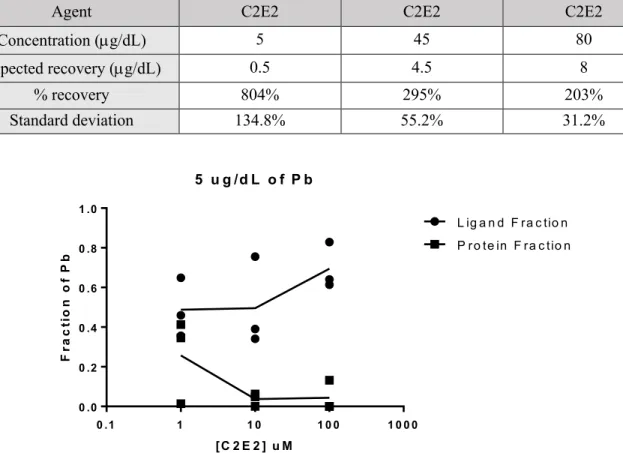
Percentage recoveries for 5 µg/dL, 45 µg/dL, and 80 µg/dL blood lead concentrations with C2E2 were 804%, 295%, and 203%, respectively. The percentage recovery for DTPA was 14.3% with one hour incubation. The percentage recovery for C2E2 was 20.5% and 15.7% with one hour and four hours of incubations.
Conclusions
The binding profiles for C2E2 and DTPA did not show competitive binding relationships, as indicated by arbitrarily high or very low percentage recoveries of lead. These results suggest that further in vitro
1. INTRODUCTION
1.1 Background
Recent large-scale lead contamination incidents, such as the Flint water crisis, have raised public concerns over potentially detrimental effects of lead exposure and have spurred research interest in the pharmacological treatment of lead poisoning. Lead is a naturally occurring element that has been widely used in a variety of consumer products, such as batteries, ceramics, cosmetics, gasoline, lead-based paints, pipes, plumbing materials, and solders. However, lead is also a neurotoxin that can accumulated and be stored in the human body which may cause long-term toxicities, especially in children under the age of six years old.1 Since the 1980s, the primary focus to reduce lead poisoning has been through prevention. Federal and state agencies monitor population blood lead levels intermittently and updated relevant guidelines to control lead levels in the air, soil, water, consumer products, and occupational settings.2 Historically, impactful regulations include banning leaded gasoline in 1975 and lead-based paints in 1978.3
Although national surveillance and regulations of environmental lead levels are well in place, the 2014 Flint water crisis still occurred resulting in the declaration of a federal emergency. This incidence raised concerns nation-wide over lead toxicity, which resurfaced as a threat to the public’s health. Over 100,000 Flint residents were potentially exposed to improperly treated water that had concentrations of lead much higher than established national standards.4 A study revealed that the percentage of children with elevated blood lead levels raised from 2.4% to 4.9% before and after the Flint water crisis.4 Exposure to high concentrations of lead can cause irreversible adverse effects and even death. 2, 5 Developing brains and organ systems in young children are especially vulnerable. Children under the age of six have the highest risk for suffering long-term health consequences, neurologically and behaviorally.6 After entering the body, lead is redistributed to many vital organs including the brain, kidneys, and liver, and can accumulate and be stored for decades in teeth and bones. Exposure to lead may cause both acute and chronic damages to the immunological, hematological, and cardiovascular systems, and neurotoxicity, nephrotoxicity, and reproductive toxicity are possible as well.1
Although, there is no established safe level of lead, the CDC currently references an elevated blood lead level (BLL) as greater than or equal to 5 micrograms per deciliter (µg/dL) for adults, pregnant women, and children. 5, 6, 7, 8 NIOSH designated the reference BLL as 5 µg/dL.9 This was lowered from 10 µg/dL due to researches showing increased risk of subsequently developing hypertension, renal toxicity, and cognitive and reproductive dysfunctions as a result of slow, cumulative exposures. The Association of Occupational and Environmental Clinics (AOEC) Medical Management Guidelines for Lead-Exposed Adults strongly recommends to consider chelation therapy in adults with BLLs above 80 µg/dL and showing significant signs and symptoms of toxicity, and for those who are at high risk for long-term cumulative exposure.10, 11
The Flint water disaster also brought the safety and efficacy of current lead chelation therapies to the public’s attention.4 Currently, there is no evidence-based guidance to chelation therapy due to lack of relevant studies.13 Existing recommendations also lack consistence and are outdated. For decades, the primary management to keep population BLL less than 5 µg/dL (10 µg/dL prior to 2015) has been preventive, including removal from the source, reducing exposure, and preventing entry. However, we may need alternative strategies for acute management of large populations who are potentially affected by lead. Since chelation therapy is not used unless the BLL is greater than 80 µg/dL, which may occur years after exposure, by the time these people begin to show toxicity, it may already be too late to reverse the damages.11 Unfortunately, the likelihood of another population-wide lead intoxication may be greater than anticipated. Studies have showed that lead contamination problems extend beyond Flint, Michigan. A recent EPA analysis revealed that between 2012 and 2015, around 350 school and daycare centers failed lead tests approximately 470 times.14 These children may have already been exposed to too much lead even under existing preventive strategies. In preparation for future large-scale lead contamination, it is essential to determine efficacious medical therapy ready to treat many people, quickly and safely.
Current lead chelation therapies utilize injectable, oral or a combination of injectable and oral medications for moderate to severe intoxications depending on the BLL.10 Two FDA approved chelating agents for the treatment of lead poisoning are calcium disodium ethylenediaminetetraacetate (CaNa2EDTA) and meso 2,3-dimercapto-succinic acid (DMSA).15 However, the safety profile of CaNa2EDTA limits its usage, while DMSA lacks appropriate dosing regimen for adults and is less efficacious. High doses of CaNa2EDTA increases the risks for lead encephalopathy and fatal cerebral edema.16 Also, CaNa2EDTA must be administered at low doses through continuous infusions slowly, in order to ensure safety and maximize effectiveness. However, intravenous chelation therapy generally entails five days or more of continuous infusion, which may be costly and difficult to manage large populations of people. DMSA is an oral chelating agent, approved by the FDA for the treatment of lead poisoning in pediatrics.17, 18 Its use in adults is off-label. Extrapolating the dosing regimen for DMSA from pediatrics parameters to adults based solely on weight may exceed the maximum daily dosage recommendation, especially in obese adult patients.
Another agent with FDA approval for treatment of internal radionuclide contamination is diethylenetriamine pentaacetic acid (DTPA). DTPA has eight potential coordination sites that allow tight binding to toxic metals.19, 20 However, due to its 3% bioavailability, DTPA requires intravenous administration by medical professionals, which would prevent timely distribution to a large population of contaminated individuals. Aiming to improve the oral bioavailability of DTPA, the Jay lab at the University of North Carolina has developed a novel synthetic di-ethyl ester analog of DTPA, named C2E2. C2E2 has been demonstrated to be bioavailable after oral administration, has low risk for toxicity, and high affinity for heavy metals.19, 20
Comparing DTPA, EDTA, and DMSA using established data showed that DTPA is a superior chelator for lead than CaNa2EDTA. Based on the structural and functional similarities between DTPA and C2E2, it is extrapolated that C2E2 will also have a higher binding affinity for lead than CaNa2EDTA, but a lower binding affinity than DTPA. In order to verify this estimation and test the efficacy of C2E2, the association constants of C2E2 in human plasma must be first determined in vitro. This is because C2E2 does not enter red blood cells and its chelation action occurs in the plasma. This information can then be combined with pharmacokinetic data in vivo to establish dosing regimens for human.
1.2 Specific Aims
attributed to prolonged or high levels of exposure to lead.4 In adults, chronically elevated blood lead level (BLL) can result in hypertension, hyperuricemia, and gout. Because lead has multiple biochemical mechanisms for causing toxicity, elevated BLL in adults can also cause neurotoxicity, nephrotoxicity, reproductive dysfunction, and cardiovascular complications.21
Developing organ systems in young children are much more vulnerable to lead’s toxic effects, which have been observed at much lower blood concentrations than in adults.6 Children younger than the age of six have the highest risk of suffering neurological adverse effects from lead exposure, and the effects may persist into adulthood. The Centers for Disease Control and Prevention (CDC) estimates that at least 4 million households in the United States today have children who are exposed to high levels of lead.6 In children, the CDC determined that a blood lead level (BLL) above 45 µg/dL warrants chelation treatment; however, chelation in adults is only considered at a BLL above 50 µg/dL and with symptoms of lead toxicity.12 Lustberg and Silbergeld estimated at least 1.7 million occupationally exposed workers in the United States have BLL of 20 µg/dL or greater.21 The authors drew population data from 1976 to 1980 and found that a BLL increase from 20 to 29 µg/dL were associated with a 46 percent increase in mortality from all causes, a 39 percent increase in mortality from cardiovascular disease, and a 68 percent increase in mortality due to cancer, in years subsequently from 1976 through 1992. Therefore, lead toxicity continues to pose a serious public health concern, and 1.7 million occupationally exposed workers can be at risk for detrimental effects.21
Calcium disodium ethylenediaminetetraacetate (CaNa2EDTA) and meso 2,3-dimercapto-succinic acid (DMSA) are two chelating agents currently indicated for treatment of lead poisoning, but both agents have limitations.15 CaNa2EDTA has a poor bioavailability of 3-5%. Also, it can cause urinary loss of essential minerals. In addition, due to increased risks of lead encephalopathy and fatal cerebral edema when used at high doses, CaNa2EDTA is the safest and the most effective when administrated at lower concentrations through continuous infusion at slower rates.16,22 However, because intravenous chelation therapy for lead toxicity generally requires repeated dosing and extended duration of therapy for five days or more, CaNa2EDTA continuous infusion may be inconvenient and costly to treat large populations of patients. On the other hand, DMSA is an oral chelator, which is only approved for treatment of lead poisoning in pediatrics.23 Its use in adults is off-label. Since the dosing regimen of DMSA is based off of pediatric parameters, the maximum recommended dose may be inadequate for adults, especially those who are obese. Dosing beyond the maximum recommended daily dose may result in more adverse effects than benefits. DMSA is also less efficacious than CaNa2EDTA. The binding affinity of DMSA to lead (log K = 17.4) is much smaller than the binding affinity of EDTA to lead (log K = 18.04).24
Aiming to improve the oral bioavailability of diethylenetriamine pentaacetic acid (DTPA), a chelating agent that is superior at binding lead than CaNa2EDTA, the Jay lab at the University of North Carolina has developed a novel synthetic diethyl ester analog of DTPA, called C2E2. C2E2 has high affinities for heavy metals and has been shown to be 29% orally bioavailable in Sprague-Dawley rats.19 Comparing the association constants of DTPA, EDTA, and DMSA to lead, it is expected that C2E2 will have a higher binding affinity than either CaNa2EDTA or DMSA for lead. Specifically, C2E2 has been shown to possess a smaller association constant for heavy metals than DTPA, but an greater association constant than EDTA. Furthermore, the association constant of DTPA to lead is greater than the association constant of EDTA to lead by 6.31 fold and that of DMSA to lead by 21.8 fold. Based on existing information about the association constants of C2E2 for americium and gadolinium, the association constant of C2E2 to lead is expected to be three to four times greater than that of EDTA to lead and ten to fifteen times greater than DMSA to lead.19, 20 However, this information is unknown.
In order to test this hypothesis, the following specific aims are proposed:
Specific Aim 1: Determine the affinity binding constant of C2E2 for lead in human plasma in vitro.
Specific Aim 2: Generate a dose-response curve based on competitive binding affinities of C2E2 and
human serum proteins for lead.
Specific Aim 3: Comparison of C2E2 binding for lead to DTPA binding for lead.
The binding constants and pharmacokinetic parameters determined as part of this study can be combined with efficacy data to create a pharmacokinetic-pharmacodynamic model, which can be used to predict chelating efficacies at different doses, dosing schedules and durations. We believe that an optimized treatment regimen for C2E2 will allow chelation therapy to be efficacious at blood lead levels below currently established toxic levels, as well as enable us to extrapolate the therapy regimen to other heavy metals currently without adequate and safe oral pharmacological decontamination options.
2. METHODS
2.1 Affinity Binding Constant of C2E2 for Lead in Human Plasma.
In order to conduct pharmacokinetic modeling of C2E2 for lead using association constants adjusted for competitive binding with human plasma components, the ability of C2E2 to chelate protein-bound lead in human plasma were quantified experimentally in vitro. Binding of lead to C2E2 versus lead binding to protein in plasma samples were measured at three concentrations of lead, 5 µg/dL, 45 µg/dL, and 80 µg/dL, and three concentrations of C2E2, 1 µM, 10 µM, and 100 µM.
The method used for investigation were developed and validated in the Jay Lab for chelation of radionuclides.19, 20 The binding affinities of C2E2 to americium and gadolinium were determined using this method.19 The assumption for this methodological extrapolation was that C2E2 would bind statistically significant amount of lead at blood lead concentrations of 5 µg/dL, 45 µg/dL, and 80 µg/dL. These concentrations were selected based on current guidelines and recommendations for monitoring and treating lead toxicity in adults.
Lead Standard ICP 1000 mg/L (lead (II) nitrate) was diluted with Milli-Q water to prepare stock lead solutions, which when added to plasma samples with C2E2 had 0.5 µg/dL, 4.5 µg/dL, and 8 µg/dL as final concentrations. These concentrations were used because previous studies indicated that around 99% of lead present in the blood are bound to red blood cells. This meant that about 1% of lead in the human blood were present in the plasma.25, 26 Solid C2E2 was available from previous chemical synthesis performed in the Jay Lab. Solid C2E2 was dissolved in human plasma to contain 1 µM, 10 µM, and 100
µM of C2E2. Additionally, plasma only served as control since it contained 0 µM C2E2. Pierce Strong Cation Exchange Spin Columns were purchased from Thermo Fisher Scientific (Rockfold, IL, USA), and Amicon Ultra centrifugal filters with an Ultracel 3K membrane were purchased from Millipore (Billerica, MA, USA).
All samples were prepared using fixed volumes of the constituents by combining 7µL of stock lead solution and 393 µL of plasma, in which C2E2 solid was dissolved. Immediately after combining the constituents, the samples were incubated at 37°C with mild agitation for 60 minutes. After incubation, the samples were transferred to Amicon Ultra centrifugal filter devices fitted with Ultracel 3K membranes and centrifuged at 14,000 x g for 30 minutes to extract the protein-bound lead fraction. Filtrates from the filter devices were then transferred to Pierce Strong Cation Exchange Spin Columns, which were preconditioned with 0.8 M ammonium hydroxide. The columns were centrifuged at 2,000 x g for 5 minutes to separate positively charged lead ions from the neutrally charged C2E2-bound lead fraction. The positively charged lead ions retained on the column were subsequently eluted with 400 µL aliquots of 1 M nitric acid wash twice. The free lead fraction was eluted with centrifugation of the columns at 2,000 x g for 5 minutes. The lead contents of each fraction were measured by Inductively Coupled Plasma Mass Spectrometry.
Taking variability of the results into consideration and to improve the power, all samples were prepared in triplicates to account for statistical variations and human errors during the experimental processes. Such errors might include inaccurate pipetting and incomplete transfer of samples.
2.2 Dose-Response Curve Based on Competitive Binding Affinities of C2E2 and Human Serum Proteins for Lead.
Dose-response curves were constructed by calculating the fraction of total lead bound to C2E2 or bound to plasma proteins. Sigmoidal regression profiles were generated by Gauss-Newton non-linear least squares regression analysis using SAS 9.3 (SAS, Cary, NC, USA). The regression applied the logistic equation:27
𝑦 = 𝑐
1 + 𝑒'()*+) ,
where a described the slope as the curve approached the asymptote, b was the inflection point, c was the asymptote, and x was the log transformed concentration of C2E2 that corresponded to y, the fraction of bound lead. The EC50 and EC90 values were determined by setting y equal to 50% and 90%, respectively, of the c term and calculating for x. The same regression analysis was applied to the data for protein-bound lead fraction; however, a transformation was applied to yprotein such that,
𝑦/= 100 − 𝑦
2345678 ,
where y’ was used for the regression analysis. Subsequent reversal of the transformation produced the final binding curves.
would ideally achieve goodness-of-fit (R2) greater than 0.92 in all cases. All data were reported as mean ± standard deviation from the given number of observations.
2.3 C2E2 Binding for Lead Versus DTPA Binding for Lead.
The in vitro experimental method described in Section 2.1 Affinity Binding constant of C2E2 for Lead in Human Plasma were repeated three more times, with the following variations. Dose-response curves were generated using the same method as described in Section 2.2, Dose-Response Curve Based on Competitive Binding Affinities of C2E2 and Human Serum Proteins for Lead, for these three additional experiments.
2.3.1 One Hour Incubation for DTPA.
Solid DTPA was dissolved in human plasma to obtain 1 µM, 10 µM, 100 µM, and 1000 µM of DTPA. Human plasma with 80 µg/dL blood lead concentration (0.0386 µM) were incubated with DTPA at concentrations of 1 µM, 10 µM, 100 µM, and 1000 µM at 37°C with mild agitation for 60 minutes. DTPA was used in place of C2E2 in the procedure, and all other experimental steps were kept the same.
2.3.2 One Hour Incubation for C2E2.
Human plasma with 80 µg/dL blood lead concentration (0.0386 µM) were incubated with C2E2 at concentrations of 1 µM, 10 µM, 100 µM, and 1000 µM at 37°C with mild agitation for 60 minutes. All other experimental steps were kept the same.
2.3.3Four Hours Incubation for C2E2.
Human plasma with 80 µg/dL blood lead concentration (0.0386 µM) were incubated with C2E2 at concentrations of 1 µM, 10 µM, 100 µM, and 1000 µM at 37°C with mild agitation for 240 minutes. All other experimental steps were kept the same.
3. RESULTS
3.1 Affinity Binding Constant of C2E2 at 5 µg/dL, 45 µg/dL, and 80 µg/dL Blood Lead
Concentrations.
Three concentrations of C2E2, 1 µM, 10 µM, and 100 µM, were utilized to determine the affinity binding constant of C2E2 for lead in human plasma through separation methods. Additionally, 0 µM C2E2 served as control. The resulting three fractions, C2E2-bound lead, protein-bound lead, and free lead were collected, and the lead content of each fraction was measured by Inductively Coupled Plasma Mass Spectrometry.
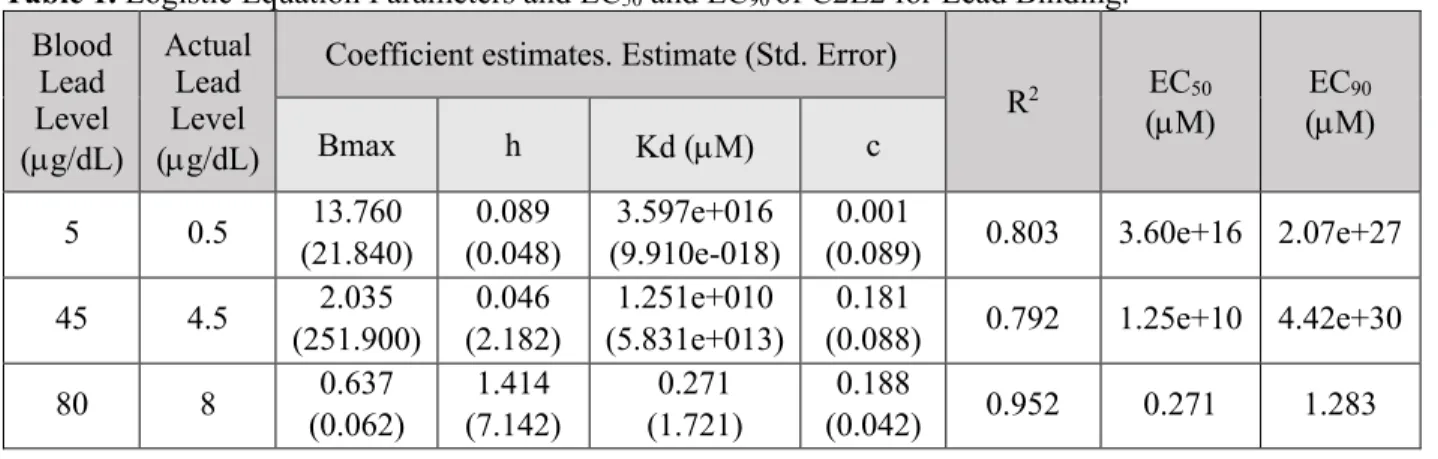
Also, three C2E2 regression models, as shown in Figures 1, 2, and 3, were generated and the logistic equation parameters are summarized in Supplemental Materials Table 1. From these results, the EC50 and EC90 values were calculated for 5 µg/dL, 45 µg/dL, and 80 µg/dL blood lead levels. The EC50 and EC90 values represent the concentration of C2E2 at which 50% and 90% of maximal binding occurs. The model achieved goodness-of-fit (R2) greater than 0.92 in blood lead level at 80 µg/dL. The EC50 and EC90 of C2E2 for lead at 80 µg/dL blood lead concentration are 0.271 µM and 1.283 µM, respectively. However, the models for 5 µg/dL and 45 µg/dL did not achieve expected fits, with R2 0.803 and 0.792 respectively.
Table 1. Percent Lead Recovery and Standard Deviations for blood lead concentrations at 5
µg/dL, 45µg/dL, and 80 µg/dL with C2E2.
Agent C2E2 C2E2 C2E2
Concentration (µg/dL) 5 45 80
Expected recovery (µg/dL) 0.5 4.5 8
% recovery 804% 295% 203%
Standard deviation 134.8% 55.2% 31.2%
Figure 1. Dose-Response Curve of C2E2 at 5 µg/dL Blood Lead Level.
Figure 2. Dose-Response Curve of C2E2 at 45 µg/dL Blood Lead Level.
5 u g /d L o f P b
0 .1 1 1 0 1 0 0 1 0 0 0
0 .0 0 .2 0 .4 0 .6 0 .8 1 .0
L ig a n d F ra c tio n P ro te in F ra c tio n
[C 2 E 2 ] u M
F
ra
c
ti
o
n
o
f
P
b
4 5 u g /d L o f P b
0 .1 1 1 0 1 0 0 1 0 0 0
0 .0 0 .2 0 .4 0 .6 0 .8 1 .0
L ig a n d F ra c tio n P ro te in F ra c tio n
[C 2 E 2 ] u M
F
ra
c
ti
o
n
o
f
P
Figure 3. Dose-Response Curve of C2E2 at 80 µg/dL Blood Lead Level.
3.2 Affinity Binding Constant of C2E2 at 80 µg/dL Blood Lead Concentration In Comparison to
DTPA.
Five concentrations of DTPA were utilized to determine the affinity binding constant of DTPA for lead in human plasma with 80 µg/dL blood lead level and 1 hour incubation time. Additionally, 0 µM DTPA served as control. The resulting fractions were analyzed by ICP-MS, and a regression model was generated, as shown in Figure 4. Five concentrations of C2E2 were utilized to determine the affinity binding constant of C2E2 for lead in human plasma with 80 µg/dL blood lead level, at 1 hour incubation time and 4 hours incubation time. Additionally, 0 µM C2E2 served as control. The resulting fractions were analyzed by ICP-MS, and regression models were generated, as shown in Figure 5.
All three models did not achieve goodness-of-fit (R2) greater than 0.92. The percentage recovery for DTPA was 14.3%. The percentage recovery for C2E2 was 20.5% with 1 hour incubation and 15.7% with 4 hours of incubation, as summarized in Table 2.
Table 2. Percent Lead Recovery and Standard Deviations for blood lead concentration at 80 µg/dL with
DTPA and C2E2, at 1 hour incubation versus 4 hours incubation.
Agent DTPA 1 Hour C2E2 1 Hour C2E2 4 Hours
Concentration (µg/dL) 80 80 80
Expected recovery (µg/dL) 0.8 0.8 0.8
% recovery 14.3% 20.5% 15.7%
Standard deviation 2.2% 1.1% 1.8%
8 0 u g /d L o f P b
0 .1 1 1 0 1 0 0 1 0 0 0
0 .0 0 .2 0 .4 0 .6 0 .8 1 .0
L ig a n d F ra c tio n P ro te in F ra c tio n
[C 2 E 2 ] u M
F
ra
c
ti
o
n
o
f
P
Figure 4. Dose-Response Curve of DTPA at 80 µg/dL Blood Lead Level with 1 Hour Incubation.
Figure 5. Dose-Response Curve of C2E2 at 80 µg/dL Blood Lead Level with 1 Hour Versus 4
Hours Incubation.
4. DISCUSSION
4.1 Discussion.
We attempted to fit the data into regression models, but it seems that lead binding is not concentration dependent regardless of the C2E2 concentration. The binding profiles for C2E2 at 5 µg/dL, 45 µg/dL blood lead levels are inadequate to conclude a binding relationship due to percentage recoveries of over 100%, invalid Bmax values, and largely variable standard deviations. For blood lead concentration at 80 µg/dL, R2 achieved 0.9516, but a competitive binding relationship cannot be concluded, as percentage recovery was 203%. Due to these invalid percentage recoveries, the results are inconclusive for the first three experiments. The reason for such percentage recoveries are unclear. These high percentage recoveries also lead to more rigorous experimental oversight for repeated experiments, in order to eliminate errors.
0 .0 3 8 6 u M P b
0 .1 1 1 0 1 0 0 1 0 0 0 1 0 0 0 0
0 .0 0 .2 0 .4 0 .6
L ig a n d F ra c tio n P ro te in F ra c tio n
[D T P A ] u M
F
ra
c
ti
o
n
o
f
P
b
0 .1 1 1 0 1 0 0 1 0 0 0 1 0 0 0 0 0 .0
0 .2 0 .4 0 .6
0 .0 3 8 6 u M P b
[C 2 E 2 ] u M
F
ra
c
ti
o
n
o
f
P
b
On the contrary, the experiments subsequently had very low percentage recoveries, for both C2E2 and DTPA with one hour incubation time (14.3% and 20.5%). Even DTPA, a current lead chelation therapy agent, did not achieve an applicable EC50. We suspect that significant amount of lead are lost during the initial step of the separation method. We also suspect that lead (II) nitrate may have formed into alterative lead species, which are trapped within the Ultracel 3K membrane filters.
To investigate the reason for low recovery, we prolonged the incubation time from 60 minutes to 240 minutes. Unfortunately, the recovery for C2E2 with four hours of incubation was still low (15.7%). Although the percentage recovery was lower with four hours of incubation when compared to one hour of incubation, the percentage recoveries for C2E2 differ significantly. The two-tailed p-value for student’s t-test is less than 0.0001. Also, higher fraction of lead is binding to the ligand fraction in the four-hour C2E2 experiment, in comparison to the one-hour C2E2 experiment. These differences in recoveries and fraction of C2E2-bound lead suggest that longer incubation may have allowed more time for the alternative lead species to form and bind to the Ultracel 3K membrane filters. In addition, due poor percentage lead recoveries, EC50 and EC90 were not calculated for DTPA nor C2E2 with one- or four-hour incubations.
Because of these low percentage recoveries for both DTPA and C2E2, further experiments are performed with higher blood lead concentrations than 80 µg/dL (0.0386 µM). We propose that higher concentrations of lead will saturate the system to overcome the loss of lead during the separation steps due to the formation of alterative lead species. Results are pending.
Furthermore, future studies may need to repeat these experiments in order to validate the experimental method. There may have been calculation errors that resulted in the unreasonably high and low percentage recoveries. Also, small errors in measurements in each fraction may have magnified calculation errors since the concentration of lead being tested is extremely low. Another limitation of these experiments is that human plasma was used to test for C2E2 competitive binding instead of human whole blood. In order to extrapolate the results of these experiments into animal models and human subjects, further studies are required to determine the differences between C2E2 binding to lead in plasma and in whole blood.
4.2 Innovation.
The treatment protocols for lead poisoning were established decades ago and have not been updated accordingly to reflect modern therapy goals that emphasize safety and convenience for the patient. Treatments for lead toxicity may involve oral DMSA, intravenous CaNa2EDTA, or a combination of oral and intravenous therapies. The hypothesis is that oral DMSA is effective at removing lead from soft tissues and blood, but not effective at chelating lead from bone. The latter is achieved by intravenous CaNa2EDTA. However, CaNa2EDTA treatment can result in redistribution of lead to essential organs, most notably the brain and liver. Instead of effectively clearing lead from the body, utilization of CaNa2EDTA always carries risks for severe adverse effects, such as lead encephalopathy. It is our contention that orally administered C2E2, a diethyl ester analog of DTPA, will be safer and more efficacious than intravenous CaNa2EDTA in removing lead from bone with minimal risk for lead redistribution to other organs. Also, since DMSA cannot effectively chelate lead from bones, we further propose that C2E2 will be more effective than DMSA in removing lead from soft tissues considering its greater binding affinity for lead. C2E2 will not only be more cost-effective in terms of manufacturing and administration processes compared to injectable CaNa2EDTA, but will also allow initiation of chelation therapy at blood lead levels lower than 80µg/dL to prevent asymptomatic progression of lead toxicity.
5. REFERENCES
1. Learn About Lead [Internet]. United States Environmental Protection Agency; c2016 [cited 2017 Feb 17]. Available from: https://www.epa.gov/lead/learn-about-lead#effects.
2. Lead Toxicity What Are the Physiologic Effects of Lead Exposure? [Internet]. Agency for Toxic Substances and Disease Registry; c2007 [cited 2017 Feb 17]. Available from:
https://www.atsdr.cdc.gov/csem/csem.asp?csem=7&po=10.
3. Kitman JL. The Secret History of Lead [Internet]. The Nation; c2000 [cited 2017 Feb 17]. Available from: https://www.thenation.com/article/secret-history-lead/.
4. Hanna-Attisha M, LaChance J, Sadler RC, Champney Schnepp A. Elevated Blood Lead Levels in Children Associated With the Flint Drinking Water Crisis: A Spatial Analysis of Risk and Public Health Response. Am J Public Health. 2016 Feb;106(2):283-90. doi:
5. Lead Poisoning and Health [Internet]. World Health Organization; c2016 [cited 2017 Feb 17]. Available from: http://www.who.int/mediacentre/factsheets/fs379/en/.
6. Childhood Lead Poisoning [Internet]. Centers for Disease Control and Prevention; c2017 [cited 2017 Feb 17]. Available from: https://ephtracking.cdc.gov/showLeadPoisoningEnv.
7. Lead Toxicity What Are the U.S. Standards for Lead Levels? [Internet]. Agency for Toxic Substances and Disease Registry; c2007 [cited 2017 Feb 17]. Available from:
https://www.atsdr.cdc.gov/csem/csem.asp?csem=7&po=8.
8. Ettinger, AS, Wengrovitz AG. Guidelines for The Identification and Management of Lead Exposure in Pregnant and Lactating Women. Centers for Disease Control and Prevention. 2010. 9. Adult Blood Lead Epidemiology & Surveillance (ABLES). Centers for Disease Control and
Prevention [Internet]; c2015 [cited 2017 Feb 17]. Available from: https://www.cdc.gov/niosh/topics/ables/description.html.
10. Medical Management Guidelines for Lead-Exposed Adults Revised 04/24/2007. AOEC. Updated 2013.
11. Khan A. Our Water in Crisis: Assessing and Treating Lead Poisoning [Internet]. Pharmacy Times; c2016 [cited 2017 Feb 17]. Available from: http://www.pharmacytimes.com/contributor/ayesha-khan-pharmd-bcps/2016/05/our-water-in-crisis-assessing-and-treating-l.
12. Warniment C, Tsang K, Galazka SS. Lead poisoning in children. Am Fam Physician. 2010 Mar 15;81(6):751-7. Review.
13. Riess ML, Halm JK. Lead poisoning in an adult: lead mobilization by pregnancy? J Gen Intern Med. 2007 Aug;22(8):1212-5.
14. Unger L [Internet]. Lead taints drinking water in hundreds of schools, day cares across USA. USA Today. c2016 - [cited 2017 Feb 17]. Available from:
http://www.usatoday.com/story/news/nation/2016/03/17/drinking-water-lead-schools-day-cares/81220916/.
15. Bradberry S, Vale A. A comparison of sodium calcium edetate (edetate calcium disodium) and succimer (DMSA) in the treatment of inorganic lead poisoning. Clin Toxicol (Phila). 2009 Nov;47(9):841-58. doi: 10.3109/15563650903321064. Review.
16. Edetate calcium disodium (calcium EDTA): Drug information [Internet]. UpToDate (Lexicomp); c1978-2017 [cited 2017 Feb 17]. Available from:
http://www.uptodate.com.libproxy.lib.unc.edu/contents/edetate-calcium-disodium-calcium-edta-drug-information?source=.
17. Dimercaptosuccinic acid (succimer): information [Internet]. UpToDate (Lexicomp); c1978-2017 [cited 2017 Feb 17]. Available from:
http://www.uptodate.com.libproxy.lib.unc.edu/contents/dimercaptosuccinic-acid-succimer-drug-information?source=search_result&s.
18. Aposhian HV. DMSA and DMPS--water soluble antidotes for heavy metal poisoning. Annu Rev Pharmacol Toxicol. 1983;23:193-215.
19. Huckle JE, Sadgrove MP, Mumper RJ, Jay M. Species-dependent chelation of (241)Am by DTPA Di-ethyl ester. Health Phys. 2015 Apr;108(4):443-50.
DTPA in plasma for chelation of 241Am. Health Phys. 2013 Aug;105(2):208-14. Barry PS. A comparison of concentrations of lead in human tissues. Br J Ind Med. 1975 May;3.
21. Lustberg M, Silbergeld E. Blood lead levels and mortality. Arch Intern Med. 2002 Nov 25;162(21):2443-9.
22. Morgan JM. Chelation therapy in lead nephropathy. South Med J. 1975 Aug;68(8):1001-6. 23. Bradberry S, Vale A. Dimercaptosuccinic acid (succimer; DMSA) in inorganic lead poisoning.
Clin Toxicol (Phila). 2009 Aug;47(7):617-31. doi: 10.1080/15563650903174828. Review. 24. Wesley R. Harris, Yong Chen, Jana Stenback & Bharat Shah (2009) Stability Constants for
Dimercaptosuccinic Acid with Bismuth(III), Zinc(II), and Lead(II), Journal of Coordination Chemistry, 23:1-4, 173-186, doi: 10.1080/00958979109408249.
25. Barry PS. A comparison of concentrations of lead in human tissues. Br J Ind Med. 1975 May;32(2):119-39.
26. Marcus AH. Multicompartment kinetic model for lead. III. Lead in blood plasma and erythrocytes. Environ Res. 1985 Apr;36(2):473-89.
ADDENDUM
DISCLOSURE
- MJ is an inventor on intellectual property related to this research. The intellectual property is licensed to Capture Pharmaceuticals Inc in which MJ owns equity.
ACKNOWLEDGMENTS/ FUNDING SUPPORTS
- This work was partially funded by an NSF Fellowship (DGE-1144081) and UNC Dissertation Completion Fellowship awarded to CCS.
- Research reported in this publication was supported by the National Institute Of General Medical Sciences of the National Institutes of Health awarded to JPP (Award Number F32GM125197). The content is solely the responsibility of the authors and does not necessarily represent the official views of the National Institutes of Health.
- Analytical support from the Biomarker Mass Spectrometry Facility, UNC Environmental Science and Engineering which is partially funded by CEHS NIH Grant P30-ES10126 is appreciated.
CONFLICTS OF INTEREST
SUPPLEMENTAL MATERIAL
Table 1. Logistic Equation Parameters and EC50 and EC90 of C2E2 for Lead Binding.
Blood Lead Level (µg/dL)
Actual Lead Level (µg/dL)
Coefficient estimates. Estimate (Std. Error)
R2 EC50 (µM)
EC90 (µM)
Bmax h Kd (µM) c
5 0.5 13.760 (21.840)
0.089 (0.048)
3.597e+016 (9.910e-018)
0.001
(0.089) 0.803 3.60e+16 2.07e+27
45 4.5 2.035 (251.900)
0.046 (2.182)
1.251e+010 (5.831e+013)
0.181
(0.088) 0.792 1.25e+10 4.42e+30
80 8 0.637
(0.062)
1.414 (7.142)
0.271 (1.721)
0.188