R E S E A R C H A R T I C L E
Open Access
Corporate foresight: developing a process
model
Sohail Dadkhah
1*, Rohullah Bayat
1, Safar Fazli
1, Einallah Keshavarz Tork
1and Aboalghasem Ebrahimi
2Abstract
Based on previous studies on corporate foresight, companies and organizations still suffer from the lack of a framework to encounter future economic conditions as well as assuring all relevant external changes and providing proper responses. This study developed capabilities of corporate foresight and the ability for companies and organizations to utilize foresight activities successfully. The research methodology of this study was mixed. The first step of this study was to extract components to devise a proposed model. The second step of this study was to validate the proposed model quantitatively. Findings indicate that the proposed framework of the study facilitated the analysis of future scenarios and developed a strategy by incorporating foresight methodologies. Part of the strategic planning included a plan for companies to recover against discontinuous changes and yield to decrease the uncertainty of companies.
Keywords:Foresight, Corporate foresight
Introduction
Researchers indicate the explicit evidence on corporate foresight for companies and organizations still suffering from the lack of a framework to encounter future eco-nomic conditions as well as assuring all relevant external changes and providing proper responses. Many re-searchers have attempted to provide such framework for foresight. However, there is a lack of models for organiza-tions and companies, and many authors including Rohr-beck and Bade [27] believe that these models are not responsive to a proper model for corporate foresight. Therefore, it is necessary to utilize foresight in corpora-tions to encounter difficult future condicorpora-tions, to forecast future trends, and to identify and interpret weak signals and entry into new markets. On the other hand, there are some barriers for the successful execution of foresight models such as future inaccessibility, changes in forecasts, contribution increases, keeping different insights, data col-lection, cost reduction, and needs for new methods. These barriers need to be taken into consideration to develop foresight capacities in organizations [27].
Considering the necessity of entry into global markets and the necessity of using foresight capacities to reduce
existing uncertainties, recognizing/evaluating the condi-tion to enter these markets, awareness of existing oppor-tunities, and affecting factors on how to enter into the international market can be all practical steps in long-term planning or organizations and companies.
To enhance corporate foresight performance, it seems necessary to recognize affecting factors on corporate fore-sight as well as raised models in this field in order to im-prove corporate’s capability against discontinuous changes and to design a special structured and professional frame-work in order to operationalize and develop corporate fore-sight capabilities. An approach or model should be able to combine and aggregate raised issues and acts as a key factor in assuring on-time organizational adaptability with envir-onmental changes. Proposed model by companies is cus-tomized and utilized. On this basis, the question to which present study attempts to answer is that “which foresight model can be used for successful utilization of foresight ac-tivities in companies in order to enter global markets?”
Therefore, there is an expectation that the proposed corporate foresight model can help to decrease uncertain-ties of companies and can analyze future scenarios in this field and can facilitate strategy formulation process to sup-port company’s strategic decision-making by incorporat-ing foresight methodologies and strategic plannincorporat-ing.
For this study, it was important first to explain the funda-mental research concepts. Based on provided definitions, * Correspondence:[email protected]
1Future Studies Department, Faculty of Social Sciences, Imam Khomeini International University, Qazvin, Iran
Full list of author information is available at the end of the article
© The Author(s). 2018Open AccessThis article is distributed under the terms of the Creative Commons Attribution 4.0
International License (http://creativecommons.org/licenses/by/4.0/), which permits unrestricted use, distribution, and
there was an identification of common foresight models and frameworks. Researchers’backgrounds were taken into consideration by studying and analyzing recent researchers. Next, it was essential to address the research methodology of the study. Finally, based on explained methodology and analyses on models, theories, and previous studies, a pro-posed corporate foresight model is devised.
Concepts and definitions
The research title and central concepts including foresight and corporate foresight are explained below.
Foresight
Foresight is a vital issue for both public and private com-panies. To determine the stats of foresight in planning, one can recall Mintzberg’s calcification for strategic affairs. Mintzberg has divided strategic affairs to two groups of strategic planning (with an analytical, logic, comparative, and practical approach to realize the goals) and strategic thinking (with an inspirational, creative, and test-and-error approach to transcend the borders of logic and lin-ear thinking). On this basis, foresight removes the need for strategic planning to strategic thinking and nonlinear creativity. However, such use does not mean to limit the role of foresight to a preliminary element of strategic man-agement; instead, foresight (future study) has (exclusive) methods and tools which leads to the recommendation, prescription, and action. FOREN1 [18] attitude on fore-sight is considered as the significant definition of this study. However, one should note that various definitions altogether generate a fuller perception [18].
“Foresight is a structured process which gathers insight-making information on future in mid- and long-term hori-zons which targets today decisions and continuous progres-sive actions. Foresight emerges from the convergence of hidden trends in developing knowledge fields of policy ana-lysis, strategic planning, and future study.”
In line with this study, the definition of foresight is a process of beneficiaries by aggregating knowledge on po-tential factors and trends that can impact on the industry in international level. Foresight is based on in-depth atti-tudes toward current trends in technology, demography, laws, and lifestyles which seems to play a vital role in fu-ture development of industry, its laws, and creation of new spaces for competitiveness. There are various classifi-cations of foresight. Since the aim of this study is not fore-sight typology, this study pays more attention to corporate foresight process. Only the most general classification in organizational level namely corporate foresight is identi-fied in this study.
Corporate foresight
Due to the multidimensional definition of corporate fore-sight, it is hard to use foresight at the corporate level. On
the corporate level, success is mainly measured by such criteria as market share increase, productivity growth, and profitability. Additionally, companies are simultaneously involved in many projects, and they pursue a different level of success. Hence, researchers in corporate level neg-lect high diversity of foresight activities inside the com-panies and, instead, they focus on foresight development projects. The relevant literature on corporate foresight de-fines corporate foresight through different aspects that in-volve a range of innovation, technology, marketing, commerce, exploring investment opportunities, and tem-poral turning points in organizational growth.
The historical trend of corporate foresight in the view of Rohrbeck et al. [26] (Fig.1).
Of the most recent developments in this field, one should point out the introduction of corporate foresight as an organizational capacity and capability raised by Slaughter and developed by Rohrbeck. In his book titled Toward corporate foresight mature model, Rohrbeck [25] provided a five-element model aimed at conceptualizing organizational capability [25, 30]. This model is a useful starting point for conceptualizing and empirical studying corporate foresight role in improving the performance of the firm. In recent years, this model is extended to a set of measurement scales and is used in different studies.
According to some scholars, corporate foresight is in the field of strategy and business economy [1]. However, others believe that corporate foresight is a part of a future study field. Future study field is used for all ranges of stud-ies in individual, organizational, and governance levels.
According to Rohrbeck [25] who is among those con-noisseurs that studied corporate foresight in the strategy field, corporate foresight is used to identify, observe, and interpret factors which stimulate changes. Corporate fore-sight is also utilized to determine different implications for the company and target proper reactions. Corporate foresight involves multiple stakeholders and leads into value generation through access to critical resources for superiority in competition, prepares the company for changes, and allows it to step forward desired future.
Corporate foresight increases environment conception through monitoring company’s business environment and acquiring a deep vision of environmental changes and the ability to reduce uncertainty [29].
Upon reviewing the literature on future study in the most recent 30 years, Rohrbeck and Bade [27] claimed that the starting point of future study paradigm in planning the companies under uncertainty condition is the need to move from prediction to identification of multiple likely futures. Multiple futures are used to plan flexible strategies, to im-prove strategic agility, and to evaluate strategy establish-ment in strategic manageestablish-ment researchers.
foresight is defined by Slaughter [34] as the ability to look at future and to achieve a vision in the organization to form a strategy and to define new mar-kets, products, and services [34].
Researchers on corporate foresight in the future study field are not mature enough, and they are mainly looking for theory building, not theory testing [25]. Hence, like an-other research field, there are different definitions for a field. In some definitions, organizational foresight is defined as a set of steps, activities, studies, methods, and capabilities [1,25]. Corporate foresight is also defined as a process [5] and even the ability of a company in future recognition [1]. Most authors have defined corporate foresight as a future study methodology aimed at identifying successful methods and processes in organizational level [7,33].
Corporate foresight aims to study potential changes and to reveal what may lead to systematic or fundamental changes in next 10–25 years (or even longer). Future study is not only economic hunches, sociological analyses, or prediction on technology field but also a multidisciplinary study on changes in all main fields of life. This study aims to study those forces that impact on each other and shape corporate future.
In this study, the definition of corporate foresight by Hojland and Rohrbeck [16] is considered.
A set of methods which support exploring new businesses through identifying stimulants or change conducting factors (conception), describing the consequences of stimulants both individually and collectively (discovery) and initiatives that permit valued choices and designing services, products and market admiration (exploration).
Corporate foresight capabilities
Corporate foresight concept relates to different concepts dis-cussed by experts. They include environmental analysis [9], weak signal [3], sense-making [8], and so on. On this basis, various advantages and capabilities are mentioned for cor-porate foresight including the following: the ability of identi-fying and interpreting environmental changes [36]; strategic management processes improvement, growing innovation capabilities, and improving organizational learning ability [28,38]; and implementing strategic decisions [29].
These can be used in big companies and SMEs and in different economic sections. In fact, one can consider them relevant to “dynamic capabilities” introduced by Teece et al. [35].
Considering above points, one can divide these capabil-ities into two external (capabilcapabil-ities related to environmen-tal search and analysis) and internal (capabilities related to receive information and how to use them) aspects.
External aspect
By studying references, corporate foresight is mainly seen as the process of external environmental infor-mation collection, interpretation, and utilization [17] or“future intelligence gathering process”[7]. For hori-zon scanning, companies use different methods pro-vided by various experts.
Another concept emphasized in external aspect is to identify and analyze signals especially weak ones to combat unexpected events [3]. Strategic foresight is to use the capabilities of weak signals to recognize external changes in environment before encountering a crisis [3, 25]. However, one should say that talking about signals
and resources of receiving them would not give much in-formation about them rather they facilitate distribution of new ideas due to personal differences. According to Batsi-tal and Tony, one should develop each external network in order to have different information resources.
Internal aspect
In the second step, companies need the capability of transferring, discovering, and utilizing environmental information and smart collection of future informa-tion from different resources. Such attitude is taken from resource-based approach which looks for achiev-ing intra-organizational value.
While the search ability leads into increasing future-re-lated information flow, huge amount of information is lost inside the organization in a decision-making process. Therefore, companies need organizational reliable capabil-ities and trends to diagnose new external information value and to attract and use information for commercial goals in order to use such resources.
In organizational learning literature, such capability was coined by Cohen and Levinthal [6] as the ability of attrac-tion. On this basis, three attraction factors are introduced: management-positive attitude toward external resources, broad perspective, long-term thinking, and risk taking; cultural ability to share and communicate the activities and to disseminate knowledge as a strong internal source; and knowledge-based company by which employees diag-nose the value of new information and how to use it.
Implementing strategic foresight can be too different in organizations. Such differences depend on environment and company’s vision [8]. Therefore, various foresight ma-turity models are provided by authors like Rohrbeck and Grim [13,25]. In these models, upon investigating the sta-tus the company and determining foresight, maturity can be planned in any organization differently to develop fore-sight capabilities.
In addition to the above two models, 7S model is also provided to analyze organization’s current status as well as future proposed situation and to diagnose the insufficiencies.
Applied models and frameworks
In this section, we review well-known foresight models, and then, we provide applied models and frameworks on entry into international markets. Since the primary func-tion for management in an export company is to facilitate the entry of companies into international markets, we ad-dress this issue in the second part.
Foresight models
There are various models on foresight. However, since the aim of this research is not foresight typology and it pays
more attention to corporate foresight process, the most general process models are represented here (Table1).
Studying and analyzing conducted studies in the field of corporate foresight
This part of the study includes an identification of all conducted studies and remarkable works on the topic of corporate foresight. Based on all the points covered in this study, all previous studies on the topic of cor-porate foresight were taken into consideration. To val-idate this study, other researchers on the topic of corporate foresight were mentioned. To analyze and compare these other studies, findings were summa-rized based on the researcher’s results and essential points (Tables2and3).
A process approach on foresight is designed in three phases by Daft and Weick [8] including investigation, in-terpretation, and learning. Such learning cycle can be con-sidered as a basis for foresight process steps provided by different authors so far.
Based on these other studies, one can say that Rohr-beck’s studies since 2010 so far have paved the way for conducting corporate foresight studies. The main point in his work is to provide bi-dimensional models of corporate foresight. In fact, considering future study capacities and its combination with a unique knowledge field, foresight model is devised. Another point in his studies is to investigate the impact of cor-porate foresight on such fields as identifying new busi-nesses and markets. Other mentioned researchers in background section are, among other things, the most updated and well-known researchers on corporate foresight used in the proposed model. Another critical point in these other studies was to use qualitative techniques so that most other researchers have used qualitative especially case study techniques while simi-lar domestic studies are entirely different.
Overall, by studying corporate foresight background in detail, one can say that there is no similar work with this study’s research title either internally or externally; however, Rohrbeck’s studies show the highest similarity and have paved the way for conducting this research.
Methodology
Relevant components were identified upon literature review by using meta-synthesis technique and considering experts’ opinions. In the next step, modeling was done by the de-scriptive, structural method. Ultimately and in quantitative phase, the model was validated.
Research findings
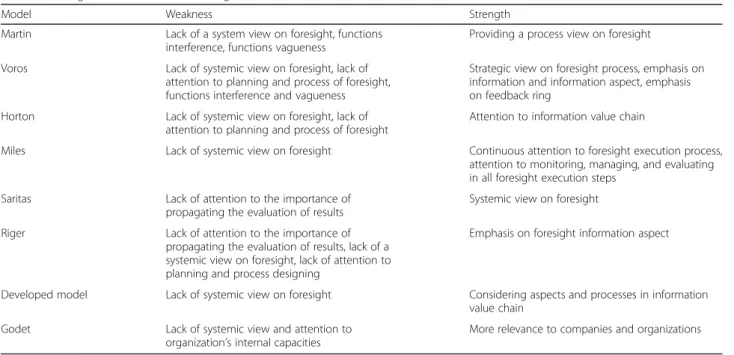
Table 2Strength and weakness of foresight common models
Model Weakness Strength
Martin Lack of a system view on foresight, functions interference, functions vagueness
Providing a process view on foresight
Voros Lack of systemic view on foresight, lack of attention to planning and process of foresight, functions interference and vagueness
Strategic view on foresight process, emphasis on information and information aspect, emphasis on feedback ring
Horton Lack of systemic view on foresight, lack of attention to planning and process of foresight
Attention to information value chain
Miles Lack of systemic view on foresight Continuous attention to foresight execution process, attention to monitoring, managing, and evaluating in all foresight execution steps
Saritas Lack of attention to the importance of propagating the evaluation of results
Systemic view on foresight
Riger Lack of attention to the importance of propagating the evaluation of results, lack of a systemic view on foresight, lack of attention to planning and process designing
Emphasis on foresight information aspect
Developed model Lack of systemic view on foresight Considering aspects and processes in information value chain
Godet Lack of systemic view and attention to organization’s internal capacities
More relevance to companies and organizations
Table 1Foresight common models
Author Steps Descriptions
Martin [20] Pre-foresight, foresight, post-foresight Pre-foresight (jobs which should be done before foresight); foresight and post-foresight (foresight results execution process)
Saritas [32] Internal and external context Internal context is a combination of structures (e.g., internal processes, trends, equipment, and technologies) and behaviors (e.g., culture, policy, social interactions, skills, motivation, capability, and management style). Also, foresight locates in external context and their surrounding systems
Miles [21] Pre-foresight, best utilization, creating an image of future, execution, revision
Horton Inputs, foresight, outputs In input step, existing information yield to foresight knowledge generation. Acquired knowledge is translated and interpreted so that a future conception is made. Finally, such conception is synchronized and evaluated to create a kind of commitment for action and execution in organization
Reger [23] Determining information needs, selecting research scope, data collection, data scanning, analyzing and interpreting, preparing the decision Evaluation, decision-making, executing, and implementing
Voros [37] Data collection, analysis, interpretation, output perspective making, strategy formulation
Strategic general foresight process framework
Godet [12] Brainstorming, decision-making, operation design A three-phase (and nine-step) process
Developed model [10] Selecting the methodology and designing details, creating the network of stakeholders, goal setting, choosing the issue, execution and decision-making
Execution includes (1) current knowledge gathering and analysis, (2) description process on current trends and future facilities and providing proposals, and (3) commitment which means to disseminate proposals among stakeholders and finally, formulating strategies and proposals and developing strategic choices understanding among decision-makers
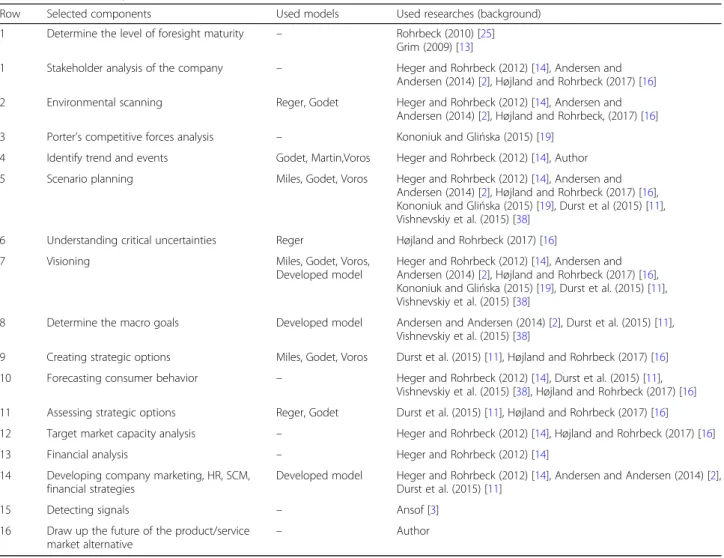
the corporate foresight field. Finally, this proposed corpor-ate foresight model was developed. The combination of such components is shown below (Table4).
Upon analyzing the elements of the different model, above components were finally extracted and their prerequisite, background, and foreground relations are determined. The role of experts is to determine such relations.
According to tables on extracted components and pre-requisite relations, the proposed model is drawn below (Fig.2).
As explained in methodology, significant elements of the proposed model are submitted, and finally, the model was validated by analyzing the questionnaires.
Conclusions
Based on corporate foresight models and theories, this study attempted to cover weaknesses of corporate fore-sight models and proposed a framework that combines
corporate foresight and strategic planning approaches which led to the creation of new structures in compan-ies. In macro levels, these structures address to scan international environment based on company’s local ad-vantages. A company’s analytical level needs a thorough plan with corporate foresight approach to which mar-keting system of the company should adopt and its fu-ture markets should be devised based on this new system which puts the establishment of international environment scanning units in the first step. The exe-cution of such step is manifested in planning and mar-keting system companies. The basic methodology of strategic marketing planning would yield to creation and recommendation new patterns and executive struc-tural changes and generation of new approaches of such changes. One can name products, customers, competitors, and technology in future studies before starting conventional marketing process to recognize future transformations and company’s adaptability with
Table 4Selected components
Row Selected components Used models Used researches (background)
1 Determine the level of foresight maturity – Rohrbeck (2010) [25] Grim (2009) [13]
1 Stakeholder analysis of the company – Heger and Rohrbeck (2012) [14], Andersen and Andersen (2014) [2], Højland and Rohrbeck (2017) [16]
2 Environmental scanning Reger, Godet Heger and Rohrbeck (2012) [14], Andersen and Andersen (2014) [2], Højland and Rohrbeck, (2017) [16]
3 Porter’s competitive forces analysis – Kononiuk and Glińska (2015) [19]
4 Identify trend and events Godet, Martin,Voros Heger and Rohrbeck (2012) [14], Author
5 Scenario planning Miles, Godet, Voros Heger and Rohrbeck (2012) [14], Andersen and Andersen (2014) [2], Højland and Rohrbeck (2017) [16], Kononiuk and Glińska (2015) [19], Durst et al (2015) [11], Vishnevskiy et al. (2015) [38]
6 Understanding critical uncertainties Reger Højland and Rohrbeck (2017) [16]
7 Visioning Miles, Godet, Voros,
Developed model
Heger and Rohrbeck (2012) [14], Andersen and Andersen (2014) [2], Højland and Rohrbeck (2017) [16], Kononiuk and Glińska (2015) [19], Durst et al. (2015) [11], Vishnevskiy et al. (2015) [38]
8 Determine the macro goals Developed model Andersen and Andersen (2014) [2], Durst et al. (2015) [11], Vishnevskiy et al. (2015) [38]
9 Creating strategic options Miles, Godet, Voros Durst et al. (2015) [11], Højland and Rohrbeck (2017) [16]
10 Forecasting consumer behavior – Heger and Rohrbeck (2012) [14], Durst et al. (2015) [11], Vishnevskiy et al. (2015) [38], Højland and Rohrbeck (2017) [16]
11 Assessing strategic options Reger, Godet Durst et al. (2015) [11], Højland and Rohrbeck (2017) [16]
12 Target market capacity analysis – Heger and Rohrbeck (2012) [14], Højland and Rohrbeck (2017) [16]
13 Financial analysis – Heger and Rohrbeck (2012) [14]
14 Developing company marketing, HR, SCM, financial strategies
Developed model Heger and Rohrbeck (2012) [14], Andersen and Andersen (2014) [2], Durst et al. (2015) [11]
15 Detecting signals – Ansof [3]
16 Draw up the future of the product/service
market alternative –
probable changes. Other concepts including organizational foresight maturity can have huge impacts on companies’ performance not discussed in this study, and they should be investigated as a separated phase in future studies. Ul-timately, it is predicted in this study that future corporate foresight can enjoy a more significant relationship with international marketing.
Endnotes
1
FOREN = Foresight for Regional Development Network
Availability of data and materials
The datasets supporting the conclusions of this article are available in the references section.
Authors’contributions
SD is the responsible author. RB and SF are the supervisors. EKT and AE are the advisors. All authors read and approved the final manuscript.
Ethics approval and consent to participate Not applicable in this section
Consent for publication Not applicable in this section
Competing interests
The authors declare that they have no competing interests.
Publisher’s Note
Springer Nature remains neutral with regard to jurisdictional claims in published maps and institutional affiliations.
Author details
1Future Studies Department, Faculty of Social Sciences, Imam Khomeini International University, Qazvin, Iran.2Management Department, Faculty of Economic, Management and Social Sciences, Shiraz University, Shiraz, Iran.
Received: 25 April 2018 Accepted: 17 September 2018
References
1. Amsteus M (2011) Managerial foresight: measurement scale and estimation.
Foresight 13(1):58–76
2. Andersen AD, Andersen PD (2014) Innovation system foresight.
Technological Forecasting & Social Change 88:276–286
3. Ansoff HI (1980) Strategic issue management. Strateg Manag J 1(2):131–148
4. Battistella, C. and Toni, A. (2010) The organization for corporate foresight: a
multiple case study, in the telecommunication industry, Paper presented at
the 21st Annual Conference, Vancouver, Canada, 2010.https://www.
pomsmeetings.org/ConfPapers/015/015-0443.pdf
5. Becker, P. (2002) Corporate foresight in Europe: a first overview, institution for
science and technology studies, Bielefeld, Germany.http://www.
forschungsnetzwerk.at/downloadpub/2003_st_corporate_foresight_040109.pdf
6. Cohen, W. M., & Levinthal, D. A. (2000) Absorptive capacity: a new
perspective on learning and innovation, Strategic Learning in a Knowledge
economy 39–67
7. Daheim C, Uerz G (2008) Corporate foresight in Europe: from trend-based
logics to open foresight. Tech Anal Strat Manag 20(3):321–336
8. Daft RL, Weick KE (1984) Toward a model of organizations as interpretation
systems. Acad Manag Rev:284–295
9. Daft RL, Sormunen J, Parks D (1988) Chief executive scanning,
environmental characteristics, and company performance: an empirical
study. Strateg Manag J 9(2):123–139
10. De Miranda Santo M, Coelho GM, dos Santos DM, Fellows Filho L (2006)
Text mining as a valuable tool in foresight exercises: a study on
nanotechnology. Technol Forecast Soc Chang 73(8):1013–1027
11. Durst C, Durst M, Kolonko T, Neef A, Greif F (2015) A holistic approach to
strategic foresight: a foresight support system for the German federal armed
forces. Technological Forecasting & Social Change 97:91–104
12. Godet, M. (2001) Creating futures—scenario planning as a strategic
management tool, economics, Washington
13. Grim, T. (2009) Foresight Maturity Model (FMM): achieving best practices in
the foresight field. J Futures Stud 13(4):69–80
14. Heger T, Rohrbeck R (2012) Strategic foresight for collaborative exploration
of new business fields. Technological Forecasting & Social Change 79:819
15. Hideg E, Nováky E, Alács P (2014) Interactive oversight on the Hungarian
SMEs. Foresight 16(4):344–359
16. Højland J, Rohrbeck R (2017) The role of corporate foresight in exploring
new markets: evidence from 3 case studies in the BOP markets, technology
analysis and strategic management, pp 1–13
17. Horton A (1999) A simple guide to successful foresight. Foresight 1(1):5–9
18. FOREN, A practical guide to regional foresight, 2001
19. Kononiuk A, Glińska E (2015) Foresight in a small enterprise. A case study,
Procedia - Social and Behavioral Sciences, Paper presented at the 20th International Scientific Conference Economics and Management -
(ICEM-2015), vol 213, pp 971–976
20. Martin BR (1995) Foresight in science and technology. Tech Anal Strat
Manag 7(2):139–168
21. Miles, I. (2002) Appraisal of alternative methods and procedures for
producing Regional Foresight, STRATA-ETAN High-level expert group Mobilizing, the Potential Foresight Actors for and Enlarged EU
22. Popper R (2008) How are foresight methods selected? Foresight 10(6):62–89
23. Reger G (2001) Technology foresight in companies: from an indicator to a
network and process perspective. Tech Anal Strat Manag 13(4):533–553
24. Rohrbeck R, Thom N, Arnold H (2015a) IT tools for foresight: the integrated
insight and response system of Deutsche Telekom Innovation Laboratories.
Technological Forecasting & Social Change 97:115–126
25. Rohrbeck R (2010) Corporate foresight: towards a maturity model for the
future orientation of a firm. Physica-Verlag, Springer, Heidelberg and New York
26. Rohrbeck R, Battistella C, Huizingh E (2015b) Corporate foresight: an
emerging field with a rich tradition. Technol Forecast Soc Chang 101:1–9
27. Rohrbeck, R., Bade, M. (2012) Environmental scanning, futures research,
strategic foresight and organizational future orientation: a review,
Fig. 2According to tables on extracted components and
integration, and future research directions, presented at the annual conference (ISPIM), Barcelona, Spain
28. Rohrbeck R, Gemünden HG (2011) Corporate foresight: its three roles in
enhancing the innovation capacity of a firm. Technol Forecast Soc Chang
78(2):231–243
29. Rohrbeck R, Schwarz JO (2013) The value contribution of strategic foresight:
insights from an empirical study of large European companies. Technol
Forecast Soc Chang 80:1593–1606
30. Rohrbeck R, Thom N, Arnold H (2015c) IT tools for foresight: the integrated
insight and response system of Deutsche Telekom Innovation Laboratories.
Technological Forecasting & Social Change 97:115–126
31. Ruff F (2006) Corporate foresight: integrating the future business environment
into innovation and strategy, Int. J Technol Manag 34(3/4):278–295
32. Saritas, O., Taymaz, E., & Tumer, T. (2006) Vision 2023: Turkey’s National
Technology Foresight Program–a contextualized description and analysis
(No. 0601). ERC-Economic Research Center, Middle East Technical University
33. Schwarz JO (2009) Business war-gaming: developing foresight within a strategic
simulation. Technology Analysis & Strategic Management 21(3):291–305
34. Slaughter RA (1997) Developing and applying strategic foresight. ABN
Report 5(10):13–27
35. Teece DJ, Pisano G, Shuen A (1997) Dynamic capabilities and strategic
management. Strateg Manag J 18(7):509–533
36. Tsoukas H, Shepherd J (2004) Coping with the future: developing
organizational foresightfulness. Futures 2(36):137–144
37. Voros J (2003) A generic foresight process framework. Foresight 5(3):10–21
38. Vishnevskiy K, Karasev O, Meissner D (2015) Integrated roadmaps and
corporate foresight as tools of innovation management: the case of Russian