Assessment of the tribological performance of ionic liquid additive
in engine oil for automotive application
A.C. Mohammed Shameem, Bilal Abdul Samad, George Koshy, T.G. Abhinand Suresh, Anil Payyappalli Mana *
Vellore Institute of Technology, Vellore, Tamil Nadu 632014, INDIA. *Corresponding author: [email protected]
KEYWORDS ABSTRACT
Ionic liquids Engine lubricant
Internal combustion engines Friction
Wear
Ionic Liquids (ILs) have been explored as possible additives in engine oil for optimizing the tribological performances of Internal Combustion engines. Several articles published in the recent past have discussed Trihexyltetradecyl phosphonium bis (2, 4, 4-trimethylpentyl) phosphinate as a potential additive due to its high miscibility and low corrosive nature. This study focuses on the tribological behaviour of various concentrations of Trihexyltetradecyl phosphonium bis (2, 4, 4-trimethylpentyl) phosphinate and ZDDP additives and their blends in mineral base oil and engine oil. Wear of cylinder sleeve–pin specimens was analysed using a reciprocating wear test rig. Further, surface morphology was analysed using SEM analysis. Addition of a 3% concentration of IL Trihexyltetradecyl phosphonium bis (2, 4, 4-tri-methylpentyl) phosphinate into engine oil demonstrated significant reduction in friction and wear.
1.0 INTRODUCTION
Lubricants are one of the most important components that influence the working of any machine with moving parts. From the basic manufacturing processes to the complex mechanical inventions, their usage is inevitable. Lubricants create a fluidic layer between the contact surfaces and reduces the friction. Various types of additives are added to the base stock of a lubricant in order to enhance its tribological as well as other properties (Li et al., 2018; Tang et al., 2014; Lee et al., 2009; Zhou et al., 2009)
the normal boiling point of water. Low miscibility and the corrosive nature of ILs in non-polar oils have limited the use of ILs as possible lubricant additives. In the family of ILs, phosphonium based ILs stood out as a potential candidate as an engine oil additive due to its ability to offer several advantages over other groups of ILs, including but not limited to, higher thermal stability, lower viscosity, and higher stability in strongly basic or strongly reducing conditions.
Ionic liquids (ILs) are in essence, low melting point organic salts. Their characteristics such as negligible vapor pressure, high thermal stability, electrical conductivity and controllable physical and chemical properties have raised their potential to be a high-performance green lubricant. With these properties, they are being researched as a solution to many lubrication problems in engineering applications (Palacio and Bhushan, 2010). Some studies proved that ILs could be effective due to a molecularly ordered layer formed at a static IL-solid interface. Further formation of a low friction boundary layer is facilitated when surfaces are set in relative motion (Horn, Evans, and Ninham, 1988). Even so, these ordered layers are found to be disrupted in a rubbing contact and resulted in the missing of an effective slip plane (Atkin and Warr, 2007; Gebbie et al., 2013; Min et al.,2009; Perkin et al., 2010; Perkin, 2012; Smith et al., 2012).
In 2001, Ye et al. were the first to investigate the use of ILs as lubricants and propose ILs as an alternative to conventional liquid lubricants. Since then, the number of published papers on the topic has increased steadily. In the past few years, researches have shown that ILs possess properties like non-flammability, high polarity, non-volatility, high viscosity and thermal stability. Various potentials of ILs have been developed and introduced to function as part of industrial devices, equipment and machinery (Bermúdez et al., 2007; Dörr, 2012; Thuy Pham et al., 2009; Wasserscheid and Welton, 2007).
Due to the presence of ions, ILs have been shown to have influence in ready adsorption onto metal ions, which typically possess some form of charged layers. The reduction in friction and wear in boundary lubrication is due to the formation of relatively thick and low friction layers, which are thought to be because of surface adsorption and long alkyl chains (Somers et al., 2013). ILs have the ability to form an adequate lubricant layer which can provide higher load carrying capacity on the metal asperities during different lubricating regimes such as hydrodynamic, elastohydrodynamic and boundary lubrication. It also has the capability of supplying wide temperature range for cooling action, which is larger, compared to conventional fluid lubricants (Amiril et al., 2017).
chemical process. This causes chemical reactions, which could lead to faster adsorption rate during metal-IL interaction (Brinksmeier et al., 2015; Davis et al., 2015; Guoet et al., 2015).
From the several investigations done on the capability of ILs as lubricant additives, maintaining an optimum lubrication performance level was found difficult. This was due to the corrosive attack of ILs on lubricated metal surfaces and low miscibility of ILs in the non-polar oils (Qu et al., 2009; Yu et al., 2012). Besides this, considering the large cost of ILs, they are being used only in smaller quantities than bulk quantities for engineering applications. Nevertheless, the overall cost of using ILs in real applications can be brought down by the multiple recycling of ILs after use (Plechkova et al. 2008). This cost efficiency factor of IL inspired further investigations into this matter. Anand et al. in 2016 performed a study on the interaction between ILs and prevailed additives in engine-aged lubricants and their tribological behavior of ring-liner tribo-system. The ionic liquids used were Trihexyltetradecyl phosphonium bis (2, 4, 4-tri-methylpentyl) phosphinate and Trihexyltetradecyl phosphonium bis (2-ethyl- hexyl) phosphate. The phosphonium based ILs used in this case helped in the recovery of tribological performance of aged lubricants towards the end of their service life.
Zinc dithiophosphates (also known as ZDDP) are among the most successful and effective additives ever invented for lubricant application due to its corrosion and oxidation inhibition capacity, low cost and multi-functionality. Introduced in over 60 years ago, these chemical compounds are still widely used and present in almost all the engine oil produced (Spikes. H, 2004).
From the literature, it was observed that research work related to analysing the tribological behaviour of the blended mix of IL and ZDDP with a fully formulated engine oil at various temperatures is limited. The present research work focuses on analysing the friction and wear behaviour of ionic liquid, Trihexyltetradecyl phosphonium bis (2, 4, 4-trimethylpentyl) phosphinate and ZDDP at various proportions when blended with mineral base oil and engine oil.
2.0 EXPERIMENTATION
2.1 Sample Preparation
Figure 1: Pin and cylinder sleeve samples after cutting and machining.
2.2 Test Lubricant Preparation
The test lubricant solutions were prepared using mineral base oil, Trihexyltetradecyl phosphonium bis (2,4,4-trimethylpentyl) phosphinate and Zinc dialkyl dithiophosphate (ZDDP). ZDDP is used here to investigate its interaction with IL. The IL for the present experiments was procured from Zigma Aldrich®. To mix the IL and ZDDP at an optimum concentration, the concentration of ZDDP that offers the minimum coefficient of friction and wear was determined first. Table 1 presents the properties of the mineral base oil SAE 30.
Table 1: Properties of the mineral base oil
Property Standard Value
Viscosity Index 97
Flashpoint ‘C D-92 252
Sulphur,% mass D-129 0.0178(T)
KV @ 100’C, cSt D-445 10.72
KV @ 40’C, cSt D-445 92.77
PMCC Flashpoint, ‘C D-93 234
Pour point ‘C D-97 -3
To conduct the experiments, lubricant blends were prepared with concentrations of the additives as given in Table 2. To obtain the desired concentration, a pre-calculated amount of additive was measured using a micropipette and poured into a premeasured quantity of base oil. This mixture was then stirred thoroughly to ensure a homogeneous mixture.
Table 2: Prepared lubricants with varying concentrations of the additives
Test set-I Test set-II Test set-III Test set-IV
% of IL in base oil % of ZDDP in base oil IL and ZDDP in base oil IL and ZDDP in engine oil
1 1 1% IL with 1% of ZDDP
3 0.5 3% IL with 1% of ZDDP
5 0.1 5% IL with 1% of ZDDP
2.3 Experimental Setup
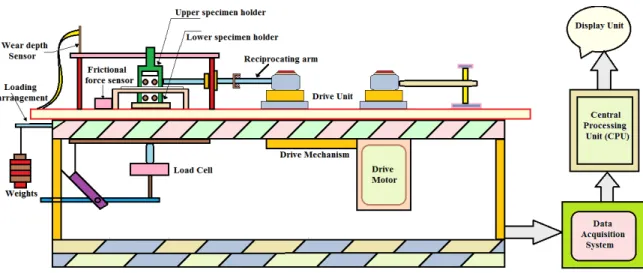
Figure 2: Schematic sketch of the reciprocating friction and wear testing machine.
The equipment is provided with various sensors for measuring wear depth, load, temperature and frictional force. A dead weight loading arrangement is used to apply the normal load acting on the upper sample. A heating coil positioned below the lower sample fixture controls the sample temperature. The frictional force is recorded by a pressure transducer. A linearly variable resistance transducer (LVRT) measure the cumulative wear of the upper and lower samples.
Figure 3: Sample setup on the wear testing machine.
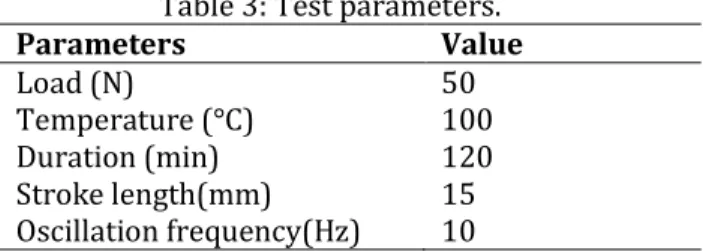
Table 3: Test parameters.
Parameters Value
Load (N) 50
Temperature (°C) 100
Duration (min) 120
Stroke length(mm) 15
Oscillation frequency(Hz) 10
The tests were performed for a duration of 120 minutes with the four sets of blends (Test set-I, Iset-I, III and IV) as mentioned in Table 2. After completion of each test, the wear scar on the sleeve specimen was analyzed under a high-resolution digital microscope to determine the wear track width. This data was used to compare the wear track width obtained with various samples. Since the length of the wear track correspond to 15mm stroke length in the wear testing machine, the widths of the wear tracks were compared in order to determine the test solutions with the least wear.The coefficient of friction data was analyzed and comparative graphs were plotted. The surface of the tested specimens was analyzed using a Scanning Electron Microscope (SEM) and the composition of the material on the surface was examined by Energy dispersive X-Ray spectroscopy (EDS).
3.0 RESULTS AND DISCUSSION
3.1 Wear Tests with Lubricants with 1%, 3% and 5% of IL in Mineral Base Oil (Test set-I)
(a) (b)
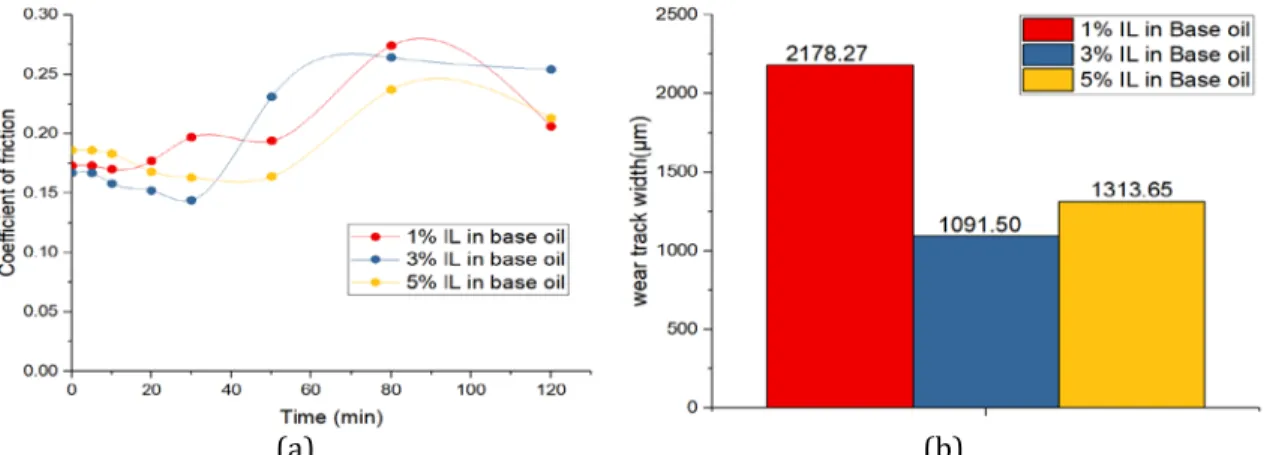
Figure 4: (a) Comparison of COF of samples tested with 1%, 3% and 5% IL in base oil, (b) Comparison of wear track width of samples tested with 1%, 3% and 5% IL in base oil
3.2 Wear Tests with Lubricants with 0.1%, 0.5% and 1% of ZDDP in Mineral Base Oil (Test set-II)
Figure 5 presents the test results of Test set-II. The plot clearly shows that the least average coefficient of friction was obtained when 1% ZDDP was added in mineral base oil. The coefficient of friction was about 0.22 in the beginning and reduced progressively to 0.16 at the end of 120 minutes of sliding. Furthermore, the coefficient of friction values obtained with 0.1 % ZDDP blend exhibited values close to 0.26 initially and progressed with a fluctuating trend. For the 0.5% blend, it was found to highly fluctuating from the beginning. This fluctuating trend in coefficient of friction is due to the breakdown of the protective film (Qu et al., 2012). Wear track width also showed a minimum value in the case of 1% blend. However, the wear track width was nearly the same for 0.1 % and 0.5 % blends. The resemblance in wear track widths were also reflected in the coefficient of friction values for these blends.
(a) (b)
3.3 Wear Tests with the Mixture of 1% ZDDP and Varying Concentrations of IL in Base Oil (Test set-III)
Tests conducted with ZDDP in the base oil showed that 1 % exhibited the lowest wear and coefficient of friction. When tested as per Test set-I, it was confirmed that 3 % IL in base oil exhibited the least coefficient of friction and wear track width. Similarly when tested as per Test set-II, it was demonstrated that 1% ZDDP presented the best tribological behaviour. Furthermore, the interaction of these two additives have to be analysed in base oil and engine oil. For achieving this, blends were prepared in base oil with each having 1% ZDDP and 1%, 3% and 5% concentrations of IL as mentioned in Table 2 for Test set-III. Similar to the previous tests, the COF and wear track widths were compared.
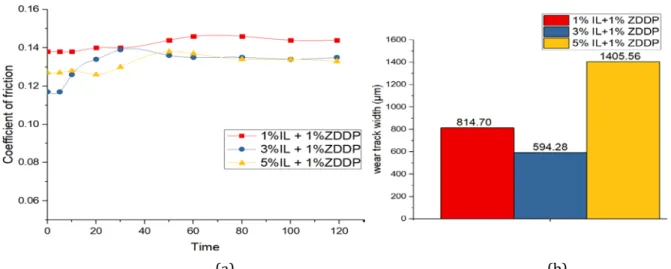
From Figure 6, it may be noted that the initial coefficient of friction varied between 0.115 and 0.14 for the three blends. The coefficient of friction was found to be progressively increasing for the 1% IL blend with ZDDP and remained at 0.145 at the end of 120 minutes of sliding. 3% and 5% blends with 1% ZDDP exhibited a similar friction behaviour from 60 to 120 minutes. However, from the wear track width plot, it was observed that 3% IL exhibited the least width. Furthermore the 5% IL blend showed the maximum wear track width that is nearly 2.5 times that of 3% blend.
(a) (b)
Figure 6: (a) Comparison of COF values of specimens tested with blends of IL and ZDDP in base oil (b) Comparison of wear track width of specimens tested with blends of IL and ZDDP in base
oil
3.4 Wear tests with IL in fully formulated engine oil (Test set-IV)
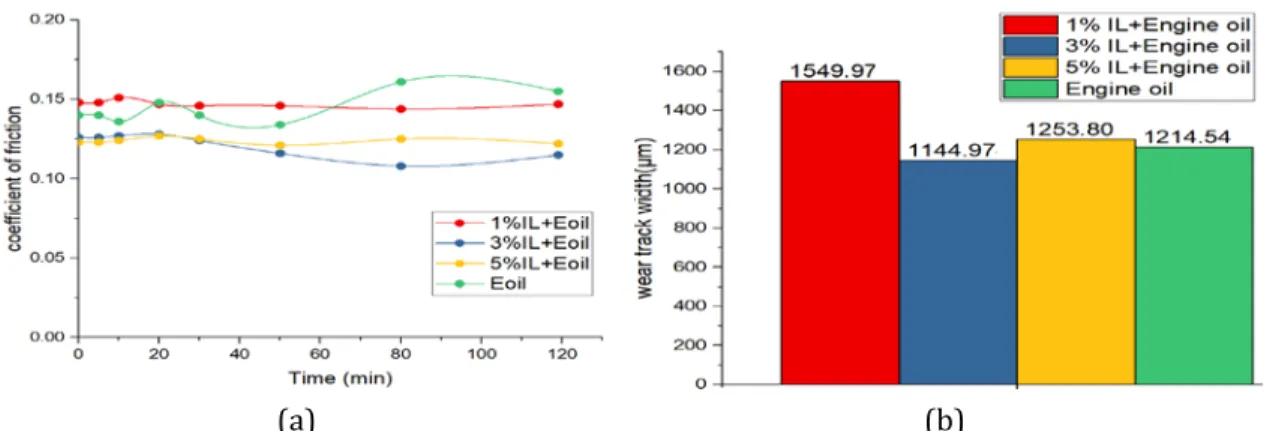
reduction with the 3% IL + Engine oil when compared to pure engine oil. This can be clearly observed from the Figure 7.
(a) (b)
Figure 7: (a). Comparison of COF values of specimens tested with blends of IL and engine oil, (b) Comparison of wear track widths of specimens tested with blends of IL and engine oil
Table 4: Comparison of wear track widths.
Test
Minimum coefficient of friction in the test sets at the end of 120 minutes of sliding
Minimum Wear track width (micrometers) in the test sets at the end of 120 minutes of sliding
Set-I 0.21 1091.50
Set-II 0.22 825.74
Set-III 0.13 594.28
Set-IV 0.11 1144.97
simultaneous occurrence of a steady coefficient of friction and progressive removal of material resulting in an increased wear track width.
3.5 Surface Analysis
Figures 8-10 show the SEM morphological analysis of the wear scar on the surface of samples tested with 1%, 3% and 5% of IL and 1% ZDDP blends in mineral base oil. Figure 11 presents the unworn surface of the cylinder sleeve specimen. The honing marks can be clearly observed on the surface. The samples were observed under two magnifications, 1000X and 2000X. Figure 8 presents the samples with 1% IL lubrication, Figure 9 presents 3% IL lubricated samples and Figure 10 presents 5% IL lubricated samples.
From an initial observation at 1000X magnification, it is evident that all the samples had mild scuffing damage from the wear test. Material has been pulled away spontaneously from the surface similar to a spalling process. The counter facing pin used was hemispherically tipped. As the contact zone are is very small, it resulted in high initial contact pressures. High contact pressures along with sliding produced sufficient tractive forces to pull away the material from the surface. The flake like appearance much evident on the surface of 3% IL tested sample (Figure 9) indicates high contact pressures and traction. Furthermore, the mechanism of wear is a combination of mild adhesion as well as mild abrasion, even though the dominant mechanism is adhesion. Since the pin material was AISI 52100 steel and has a higher hardness compared to the cast cylinder sleeve sample, mild abrasion is seen on the 5 % IL tested sample (Figure 10). Surface films were not detected in any of the three samples.
(a) (b)
(a) (b)
Figure 9: SEM of the wear scar on the cylinder sleeve surface with 3% IL (a) 1000X (b) 2000X.
(a) (b)
Figure 10: SEM of the wear scar on the cylinder sleeve surface with 5% IL (a) 1000X; (b) 2000X.
Table 6: Comparison of the EDS results.
Element 1% IL Weight % of Elements Sample 3% IL Sample 5% IL Sample
C K 12.76 7.44 8.06
O K 7.62 4.31 5.47
P K 0.55 1.02 1.66
Fe L 78.75 82.03 80.50
Zn L 0.33 2.17 3.37
Si K 0.0 1.90 0.0
S K 0.0 1.14 0.93
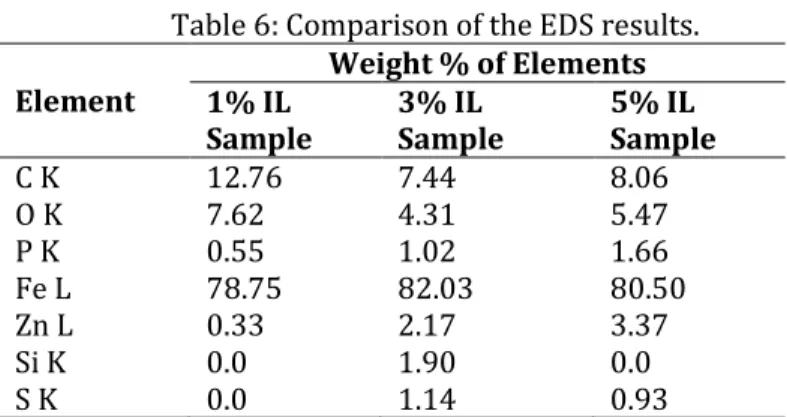
Table 6 presents the EDS results of the samples tested with 1%, 3% and 5 %ILs. The presence of constituents of ZDDP and IL are observed on the wear track surface. The presence of P as well as Zn is found to be maximum in the 5% sample. The higher percentage of phosphorous may be due to the presence of the same in both IL as well as ZDDP.
4.0 CONCLUSIONS
The ionic liquid Trihexyltetradecyl phosphonium bis (2,4,4-tri-methyl pentyl) phosphinate was mixed with base oil at different weight percentages, viz. 1%, 3% and 5% by volume. Base oil blends with varying concentrations of Zinc dialkyldithiophosphate (0.1%, 0.5%, and 1%) were also prepared. These blends were tested individually and also in blends of specific combinations. One set of tests were conducted with engine oil blended with IL and ZDDP. The observations were that:
(a) The blend of 3% IL and 1% ZDDP in base oil exhibited a low coefficient of friction and wear track width compared to the other samples.
(b) The blend of 3% IL and 1 % ZDDP in engine oil also exhibited a low coefficient of friction without any fluctuations during the entire test. A good synergy was observed in this case with the IL and ZDDP.
(c) SEM analysis of the wear track surfaces revealed a combination of mild adhesive and abrasive wear when tested with IL and ZDDP in base oil. However, a tribofilm formation was not detected in any of the samples.
REFERENCES
Amiril, S. A. S., Rahim, E. A., & Syahrullail, S. (2017). A review on ionic liquids as sustainable lubricants in manufacturing and engineering: Recent research, performance, and applications. Journal of Cleaner Production, 168, 1571-1589.
Anand, M., Hadfield, M., Viesca, J. L., Thomas, B., González, R., Cantrill, R., & Hernández Battez, A. (2016). Assessing boundary film forming behavior of phosphonium ionic liquids as engine lubricant additives. Lubricants, 4(2), 17.
Atkin, R., & Warr, G. G. (2007). Structure in confined room-temperature ionic liquids. The Journal of Physical Chemistry C, 111(13), 5162-5168.
Bermúdez, M. D., Jiménez, A. E., & Martínez-Nicolás, G. (2007). Study of surface interactions of ionic liquids with aluminium alloys in corrosion and erosion–corrosion processes. Applied Surface Science, 253(17), 7295-7302.
Brinksmeier, E., Meyer, D., Huesmann-Cordes, A. G., & Herrmann, C. (2015). Metalworking fluids— Mechanisms and performance. CIRP Annals, 64(2), 605-628.
Davis, B., Schueller, J. K., & Huang, Y. (2015). Study of ionic liquid as effective additive for minimum quantity lubrication during titanium machining. Manufacturing Letters, 5, 1-6.
Dörr, N. (2012). Special issue on ionic liquids as lubricants, 889-890.
Gebbie, M. A., Valtiner, M., Banquy, X., Fox, E. T., Henderson, W. A., & Israelachvili, J. N. (2013). Ionic liquids behave as dilute electrolyte solutions. Proceedings of the National Academy of Sciences, 110(24), 9674-9679.
Guo, Y., Qiao, D., Han, Y., Zhang, L., Feng, D., & Shi, L. (2015). Application of alkylphosphate ionic liquids as lubricants for ceramic material. Industrial & Engineering Chemistry Research, 54(51), 12813-12825.
Horn, R. G., Evans, D. F., & Ninham, B. W. (1988). Double-layer and solvation forces measured in a molten salt and its mixtures with water. The Journal of Physical Chemistry, 92(12), 3531-3537. Jiménez, A. E., Bermudez, M. D., Iglesias, P., Carrión, F. J., & Martínez-Nicolás, G. (2006).
1-N-alkyl-3-methylimidazolium ionic liquids as neat lubricants and lubricant additives in steel– aluminium contacts. Wear, 260(7-8), 766-782.
Li, X., Murashima, M., & Umehara, N. (2018). Effect of nanoparticles as lubricant additives on friction and wear behavior of tetrahedral amorphous carbon (ta-C) coating. Jurnal Tribologi, 16, 15-29.
Lee, K., Hwang, Y., Cheong, S., Choi, Y., Kwon, L., Lee, J., & Kim, S. H. (2009). Understanding the role of nanoparticles in nano-oil lubrication. Tribology Letters, 35(2), 127-131.
Mendonça, A. C., Malfreyt, P., & Padua, A. A. (2012). Interactions and ordering of ionic liquids at a metal surface. Journal of chemical theory and computation, 8(9), 3348-3355.
Min, Y., Akbulut, M., Sangoro, J. R., Kremer, F., Prud’homme, R. K., & Israelachvili, J. (2009). Measurement of forces across room temperature ionic liquids between mica surfaces. The Journal of Physical Chemistry C, 113(37), 16445-16449.
Palacio, M., & Bhushan, B. (2010). A review of ionic liquids for green molecular lubrication in nanotechnology. Tribology Letters, 40(2), 247-268.
Perkin, S., Albrecht, T., & Klein, J. (2010). Layering and shear properties of an ionic liquid, 1-ethyl-3-methylimidazolium ethylsulfate, confined to nano-films between mica surfaces. Physical chemistry chemical physics, 12(6), 1243-1247.
Perkin, S. (2012). Ionic liquids in confined geometries. Physical Chemistry Chemical Physics, 14(15), 5052-5062.
Pham, T. P. T., Cho, C. W., & Yun, Y. S. (2010). Environmental fate and toxicity of ionic liquids: a review. Water research, 44(2), 352-372.
Plechkova, N. V., & Seddon, K. R. (2008). Applications of ionic liquids in the chemical industry. Chemical Society Reviews, 37(1), 123-150.
Popov, V. L. (2010). Contact mechanics and friction (pp. 231-253). Berlin: Springer Berlin Heidelberg.
Qu, J., Bansal, D. G., Yu, B., Howe, J. Y., Luo, H., Dai, S. & Smolenski, D. J. (2012). Antiwear performance and mechanism of an oil-miscible ionic liquid as a lubricant additive. ACS applied materials & interfaces, 4(2), 997-1002.
Smith, A. M., Lovelock, K. R., Gosvami, N. N., Licence, P., Dolan, A., Welton, T., & Perkin, S. (2013). Monolayer to bilayer structural transition in confined pyrrolidinium-based ionic liquids. The journal of physical chemistry letters, 4(3), 378-382.
Somers, A. E., Khemchandani, B., Howlett, P. C., Sun, J., MacFarlane, D. R., & Forsyth, M. (2013). Ionic liquids as antiwear additives in base oils: influence of structure on miscibility and antiwear performance for steel on aluminum. ACS applied materials & interfaces, 5(22), 11544-11553.
Somers, A. E., Howlett, P. C., MacFarlane, D. R., & Forsyth, M. (2013). A review of ionic liquid lubricants. Lubricants, 1(1), 3-21.
Spikes, H. (2004). The history and mechanisms of ZDDP. Tribology letters, 17(3), 469-489. Tang, Z., & Li, S. (2014). A review of recent developments of friction modifiers for liquid lubricants
(2007–present). Current opinion in solid state and materials science, 18(3), 119-139. Wasserscheid, P., & Welton, T. (Eds.). (2008). Ionic liquids in synthesis. John Wiley & Sons. Yu, B., Bansal, D. G., Qu, J., Sun, X., Luo, H., Dai, S., ... & Smolenski, D. J. (2012). Oil-miscible and
non-corrosive phosphonium-based ionic liquids as candidate lubricant additives. Wear, 289, 58-64. Tribological characteristics of alkylimidazolium diethyl phosphates ionic liquids as lubricants for
steel–steel contact