A Method for Improving Efficiency
of Static Program Graph Scheduling
Aleksander Kvas and Milan Ojsterˇsek
Faculty of Electrical Engineering and Computer Science, University of Maribor, Slovenia
Obtaining maximum performance from parallel dis-tributed memory machines depends on partitioning parallel programs into modules and scheduling those modules for the shortest possible execution time. The scheduling problem is known to be NP-hard and heuristic algorithms have been proposed to obtain optimal and sub optimal solutions. The partitioning algorithm partitions an application into tasks with appropriate grain size and represents them in the form of a directed acyclic graph. The nodes of the resulting graph are then scheduled onto the processors of a parallel computer system. We can see that almost all coarse grained program graph nodes don’t need all of their input operands at the beginning of their execution. Thereafter, they can be scheduled a bit earlier. This type of program graph nodes triggering is called partial strict triggering. The missing operands will be requested later, during the execution. Coarse grained program graph nodes send their output operand to all successors, as soon as they produce them. Successors of coarse grained program graph nodes will be scheduled earlier too, because they will receive their input operands sooner. An evaluation of improved CPM, VL and DSH scheduling algorithms is done in this paper. We have improved them with partial strict triggering of coarse grained program graph nodes.
Keywords: static scheduling, parallel computers,
pro-gram graphs, partial strict triggering.
1. Introduction
Optimal execution of parallel programs which are executed on a parallel computer system de-pends on partitioning programs into modules and scheduling those modules for the short-est possible execution time. In this paper, we present three efficient algorithms for schedul-ing modules to the processschedul-ing units of a parallel computer system. An algorithm for the parti-tioning programs into modules is discussed in
(Ojsterˇsek 1994). We will make only a brief description of it in Section 2.
The general problem of multiprocessor schedul-ing can be stated as schedulschedul-ing a set of partially ordered computational tasks onto a multipro-cessor system so that a set of performance cri-teria is optimised. The difficulty of the problem depends heavily on the topology of the pro-gram graph representing the precedence rela-tions among the tasks, the topology of the mul-tiprocessor system, the number of parallel pro-cessors, the uniformity of the node processing time and the performance the criteria chosen. In general, the multiprocessor scheduling prob-lem is computationally intractable even under simplified assumptions. Because of this com-putational complexity issue, many heuristic al-gorithms have been proposed to obtain optimal and suboptimal solutions to various scheduling problems(Palis et al. 1996, Gerasoulis & Yang 1992, Darbha & Agrawal 1998, Park & Chloe 2002).
program is running. Hybrid scheduling tech-nique are a mix of static and dynamic methods, where some preprocessing is done statically to guide the dynamic scheduler and/or reduce the amount of undeterminism.
We have improved three well known static sche-duling algorithms (CPM, VL and DSH) with partial strict triggering of program graph nodes. We compare our improved algorithms with orig-inal CPM static scheduling algorithm.
This paper is organised as follows. First we give a brief description of our partitioning algorithm. In Section 3 we present partial strict triggering of program graph nodes. Next, a brief descrip-tion of improved scheduling algorithms is given in Section 4. In Section 5 we present a model of a macro dataflow computer which supports partial strict triggering of program graph nodes. Performance evaluation of improved scheduling algorithms with execution of program graph on the macro dataflow computer simulator is done in Section 6. And, finally, Section 7 presents concluding remarks, as well as directions for future research work.
2. Description of the Partitioning Algorithm
We have used similar grain size determina-tion algorithm as Sarkar’s "internalisadetermina-tion" al-gorithm (Sarkar 1989), which clusters nodes together to minimise the schedule length on an unbounded number of processors. The algo-rithm initially places each task in a separate cluster and considers the arcs in descending or-der according to the amount of data transferred over each arc. Given arc Aij connecting nodes Ni and Nj, the algorithm merges the clusters
containing these nodes to ’internalise’ any com-munications between nodes in these respective clusters. This merging step is accepted if it does not increase an estimate of the parallel execution time of the program graph on an in-finite number of processors, where nodes in the same cluster are constrained to be executed on the same processor. The partitioning process in ’internalisation’ algorithm is stopped when a cluster’s execution time is equal or greater than one percent of ideal parallel execution time. A cluster must also satisfy a convexity constraint, which ensures that a cluster can run to comple-tion once all its inputs are available. Our
opin-ion is that the size of clusters(execution time)is computer architecture-dependent, so our parti-tioning algorithm stops further aggregation into bigger clusters when the size of a cluster is equal or greater than maximal granularity of cluster which depends on the organisation of the macro dataflow computer architecture.
3. Partial Strict Triggering of Program Graph Nodes
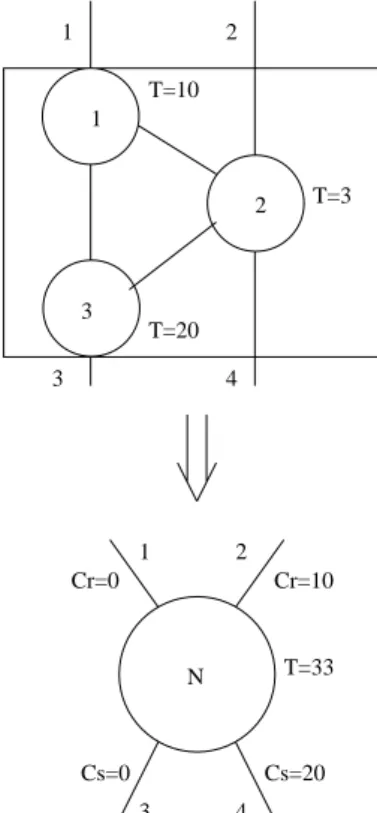
Now, let us consider a group of program nodes that are connected with the precedence relation. If the sum of communication delays for transfer-ring operands between the nodes is greater than the sum of their execution times, it is possible to achieve fastest execution time by joining them in a larger program grain. Of course, there are other techniques for grain size determination, but it is interesting that joining small grains into larger one enables the processing element to start with execution of a new grain without all input operands. An example is shown in Fig-ure 1. We aggregate fine grain program graph nodes (1, 2, 3) into a coarse grained program graph node. The new node N can start with the execution on a free processing unit immediately
3 1
2 T=10
T=3
T=20 3
1 2
4
1 2
3 4
Cr=0
Cs=0
Cr=10
Cs=20 T=33 N
after operand number 1 is available, although operand number 2 is not present. This operand must be available at least 10 time units after the beginning of the node N execution to avoid the node execution delay. The operand number 4 is sent to the successor nodes 20 time units before the end of the execution of node N, so the trig-gering of successors which use this operand is faster.
We have introduced two new attributes for each communication arc. CS represents operand’s
relative sending time. It defines the time from the moment when the operand is sent to the end of a node execution. CR represents operand’s
relative receiving time. It defines the time from the beginning of a program graph node exe-cution to the moment when this operand must be present to avoid delaying the node’s execu-tion. Operands which have CRequal to zero are
called strict operands and must be present be-fore the execution of their program graph nodes. Operands which have CR greater than zero are
called nonstrict operands. These operands must be present between the beginning of a program graph node execution and CR.
The following notation is used throughout this paper:
G : graph G(N E), N(G) : set of nodes in G, E(G) : set of arcs in G,
n : number of nodes in in G, ni : i-th node in G; i=1::n, T(ni) : execution time of node ni, Ns(ni) : set of successors of the node ni, nsi : number of successors of the node ni, O(G) : set of output nodes of graph G, CP(nj) : the length of exit path for node nj, I(nij) : set of input operands of njthat
originates from ni,
C(ni nj nii noj): communication delay time between nodes ni and nj, ni is the source and njis the destination, nii is the number of
partic-ular input operand of node nj, noj is the number
of particular output operand of node ni,
CS(ni nj nii noj): relative sending time of ope-rand between nodes ni and nj, ni is the source
and nj is the destination, nii is the number of
particular input operand of node nj, noj is the
number of particular output operand of node ni,
CR(ni nj nii noj) : relative receiving time of operand between nodes niand nj, niis the source
and nj is the destination, nii is the number of
particular input operand of node nj, noj is the
number of particular output operand of node ni.
4. Description of Scheduling Algorithms with Partial Strict Triggering of
Program Graph Nodes
CPM scheduling algorithm(Kohler 1975, Ojs-terˇsek 1994, Shirazi et al. 1990)assigns the pro-gram graph nodes to the processing elements on the basis of the priority list scheduling method. A priority weight for each node is the length of the longest path from program graph node to the terminal node. The original CPM algo-rithm computes the priority weight(the length of exit path)of each node without using com-munication delay time for transferring operands between nodes. We have defined new priority weight which is computed by using execution time of a node and communication delay times CSand CRof its input and output operands. The
length of exit path for node ni(CP(ni))is com-puted in the following way:
8ni2O(G): CP(ni)=T(ni)
8ni62O(G)^8nj2Ns(ni)^8nj9CP(nj): CP(ni)=MAXj
=1 nsi
(CP(nj)
+C(ni nj nii noj);CR(ni nj nii noj) ;CS(ni nj nii noj)+T(ni)) (4.1)
In an improved CPM algorithm we also make sure that all nonstrict operands are present in time from the beginning of a program graph node execution to the moment when these ope-rands must be present to avoid delaying the node’s execution. If we can’t assure this con-dition for nonstrict operand, we assign its CR
to zero. Time complexity of the original CPM algorithm is O(n
2
), where n is the number of program graph nodes. Time complexity of im-proved CPM algorithm is also O(n
2
).
Vertically Layered (VL) scheduling algorithm
(Hurson et al. 1990, Kvas et al. 1994, Ojsterˇsek 1994)is based on two philosophies:
2. assigning nodes connected serially to the same processing element.
Main idea of this algorithm is the distribution of program graph nodes into vertical layers, where nodes constituting a single layer can be allo-cated to a processing element. Actual alloca-tion is done in two phases: the separaalloca-tion and optimisation phases. In the separation phase critical path(CP)is identified and nodes on CP are assigned to one vertical layer. Rearrang-ing is done in an iterative manner as follows: nodes on the longest directed path emanating from an arc in a node that is already assigned are assigned to the next available vertical layer.
The separation phase does not take into ac-count communication delays among processing elements (PEs). The optimisation phase rear-ranges nodes by considering inter-PE commu-nication delays. For example, if two subsets of nodes are arranged in two distinct vertical layers, and there is the transitory relationship between them, there will be inter-PE commu-nication costs associated with the execution of two vertical layers. In order to improve over-all execution time, we can consider combin-ing the subsets of nodes into a scombin-ingle vertical layer. This eliminates the communication time between two layers and the overall execution time is now the sum of execution times of sub-sets. However, if the new execution time results in a larger delay, two subsets are assigned to different PEs.
We improved VL algorithm optimisation phase that rearranges nodes by considering communi-cation delay times CS and CR. Original
equa-tions (Hurson et al. 1990) that are used to compare communication and execution time between nodes contain simple communication time delays. Now, if we use partial strict trigger-ing, we can change the communication delays in the following way:
Cu(ni nj)=MAX
nii2I(nij)
(C(ni nj nii noj) ;CS(ni nj nii noj);CR(ni nj nii noj))
(4.2)
Then we use Cu in equations instead of C.
We also assure that all nonstrict operands are present in time from the beginning of a pro-gram graph node execution to the moment when
these operands must be present to avoid delay-ing the node’s execution. If we can’t assure this condition for nonstrict operand, we assign its CR to zero. Time complexity of original
VL algorithm is O(n
4
), where n is the number of program graph nodes. Time complexity of improved VL algorithm is also O(n
4
).
Duplication scheduling heuristic algorithm
(Benko et al. 1995, Kruaratrachue & Lewis 1988, Ojsterˇsek 1994) maximises parallelism and minimises communication delays by inser-tion of ready program graph nodes into idle time slots of Gantt chart and by duplication of criti-cal program graph nodes. We have focused our research efforts to three main extensions of the original heuristic:
We have converted program graphs that have nonstrict operands into program graphs that have all strict operands. A new type of program graph is called a strictly triggered program graph. Each program graph node of original program graph is transformed into several nodes of the strictly triggered program graph. We call them a group of strict nodes. All nodes of a group have to be executed on the same PE. PE pre-empts the execution of a group if in the execution phase a non-strict operand is not present. While this operand is not present, PE executes other groups. When a nonstrict operand arrives, PE continues with the execution of the pre-empted group.
similar if one of the tasks is a direct or an indirect predecessor of the other one. SSS considers two tasks as similar if they have at least one successor task in common, i.e. they both send at least one message to the same destination.
We have also extended DSH algorithm to take into account a finite number of com-munication channels between processing units. In this way, the accuracy of the re-sults obtained from simulation of coarse grained program graph execution on the model of parallel computer has been im-proved.
Time complexity of the original DSH algorithm is O(n
4
), where n is the number of program graph nodes. Time complexity of improved DSH algorithm is O(n
6
).
5. The Model of Macro Dataflow Computer
We have introduced our model of a macro data-flow computer (Figure 2) which supports par-tial strict triggering of coarse grained program graph nodes. Our model of a macro dataflow computer (MMDC) is a loosely coupled mul-tiprocessor with processing elements(PE) and an interconnection network.
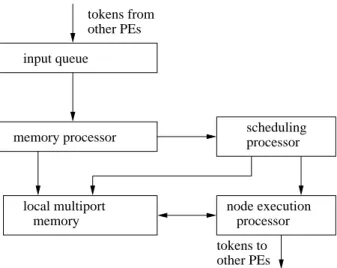
Every PE(Figure 3)contains an input queue, a local multiport memory, a memory processor, a scheduling processor and a node execution pro-cessor. Program graphs are loaded on the model of a macro dataflow computer at the beginning of their execution. Inputs of nodes (tokens) are matched together in the memory processor. When all required inputs of a particular node are present, the memory processor forms the exe-cutable node(activity)and sends a node number
INTERCONNECTION NETWORK
PE1 PE2 . . . PEn
Fig. 2. The Model of a Macro Dataflow Computer.
input queue
memory processor
memory local multiport
scheduling processor
node execution processor tokens to other PEs tokens from
other PEs
Fig. 3. A Structure of a Processing Element of the
MMDC.
to the scheduling processor. The scheduling processor selects the executable nodes on the basis of a Gantt chart which has been produced by the static scheduling algorithm. It sends ac-tivities to the node execution processor. The node execution processor executes activities. If a nonstrict operand of executed activity has not arrived in time when it is required, the node execution processor preempts execution of this activity and executes another activity. When the nonstrict operand of preempted activity arrives in the memory processor, the memory proces-sor sends the address where the activity has been preempted into the queue of preempted activi-ties, which are in multiport memory. When the node execution processor finishes with the exe-cution of temporary executed activity, it contin-ues with the execution of the preempted activity. The node execution processor also sends results of computed activities to the memory processor if the successor node is in the same PE. Other-wise, the results are sent to other PEs.
In our simulation we assume that the model of a macro dataflow computer has the following features:
All PEs have equal performances.
A PE executes nodes and communicates with other units simultaneously.
A memory space, needed for matching tokens in sets of tokens, forming activi-ties, scheduling and executing activities of program graphs that are executed on the MMDC, must be less than the capacity of available memory space in the model of the MMDC.
6. Performance Evaluation of Improved Scheduling
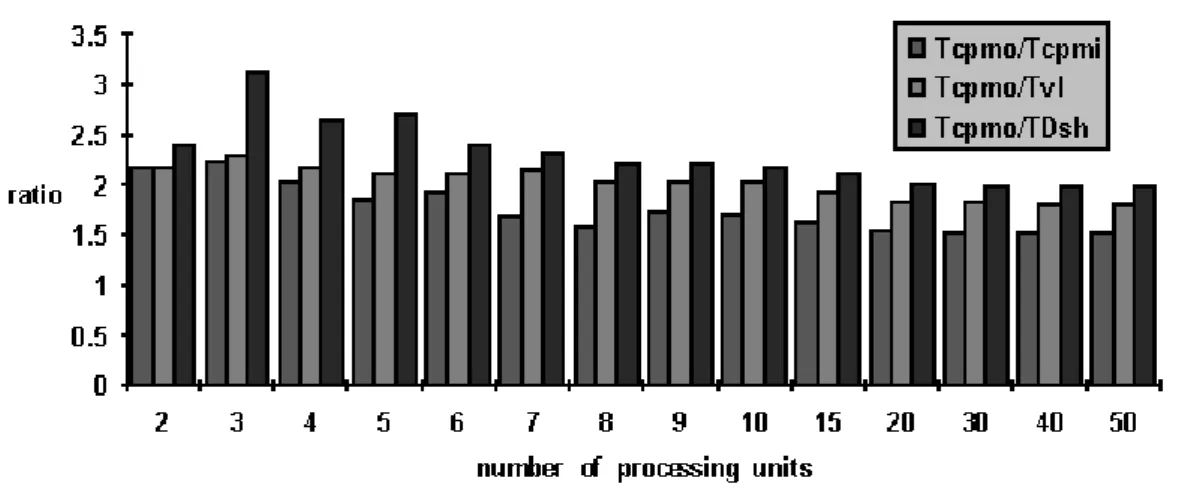
We have evaluated improved scheduling algo-rithms with a simulation of a program graph execution on the MMDC. Program graph con-sisted of 200 nodes and 374 operands (306 strict operands and 68 nonstrict operands). Its level of granularity (average execution time of nodes/average communication delay time of operands) has been 0.092. We have used program graph and Gantt charts produced by original CPM algorithm and improved algo-rithms as simulation inputs. A comparison of ratios between total execution times of pro-gram graph with usage of original CPM algo-rithm and improved scheduling algoalgo-rithms is depicted in Figure 4. As shown in Figure 4, all improved scheduling algorithms outperform original CPM algorithm. Improvements have been from 30% to 60%. From Figure 4 we can see that the improved DSH algorithm gave the best improvement, but it has the highest
com-putational complexity(O(n
6
)). VL algorithm obtained better results than improved CPM al-gorithm, but it has higher computational com-plexity than the CPM algorithm.
We have observed that improvements of our al-gorithms are higher if level of granularity is lower than one. If level of granularity is greater than one, then improvements are only few per-cents. In that case we use improved CPM al-gorithm, because it has the lowest computation complexity.
7. Conclusion
This paper presented performance evaluation of three different static scheduling algorithms improved with partial strict triggering of pro-gram graph nodes. The new model of a macro dataflow computer, which supports partial strict triggering of program graph nodes, is also pre-sented. Simulation results of program graph execution on the MMDC with usage of Gantt charts produced by improved scheduling al-gorithms showed promising improvement over original CPM algorithm.
In our future research we will incorporate sche-duling algorithms into our integrated program-ming environment for static partitioning and scheduling of time critical tasks which are exe-cuted on the macro dataflow realtime computer.
Fig. 4. Comparison of improved scheduling algorithms with original CPM algorithm. The total execution time of
program graph produced with usage of: (1)original CPM scheduling algorithm is represented by Tcpmo(PG),(2)
improved CPM scheduling algorithm is represented by Tcpmi(PG),(3)improved VL scheduling algorithm is
References
1] B. BENKO, M. OJSTERSEKˇ , V. ˇZUMER, Improvement
of Duplication Scheduling Heuristic Algorithm with Nonstrict Triggering of Program Graph Nodes.
Pro-ceedings of First Aizu International Symposium on Parallel Algorithms/Architecture Synthesis, Aizu–
Wakamatsu, Fukushima, Japan, IEEE Computer Society Press,(1995), pp. 227–233.
2] S. DARBHA ANDD. P. AGRAWAL, Optimal
Schedu-ling Algorithm for Distributed–Memory Machines.
IEEE Trans. on Parallel and Distributed Systems,
January, vol. 9, No. 1,(1996), pp. 87–95.
3] A. GERASOULIS AND T. YANG, A Comparison
of Clustering Heuristics for Scheduling Directed Acyclic Graphs on Multiprocessors. J. Parallel and
Distributed Computing, vol. 16,(1992), pp. 276–
291.
4] A. R. HURSON, B. LEE, B. SHIRAZI, M. WANG, A
Program Allocation Scheme for Data Flow Com-puters. Proc. of the 1990 Intern. Conf. on Parallel
Processing, University Park, Peen, Pennsylvania
State Univ., vol. 1,(1990), pp. 415–423.
5] W. H. KOHLER, A Preliminary Evaluation of the
Critical Path Method for Scheduling Tasks on Mul-tiprocessor Systems. IEEE Trans. on Computers, December,(1975), pp. 1235–1238.
6] B. KRUARATRACHUE, T. LEWIS, Grain Size
Deter-mination for Parallel Processing. IEEE Software, January,(1988), pp. 23–33.
7] A. KVAS, M. OJSTERSEKˇ , V. ˇZUMER, Evaluation
of Static Program Allocation Schemes for Macro Data–flow Computer. Proceedings of the 20th
EU-ROMICRO Conference, Liverpool, England, IEEE
Computer Society Press,(1994), pp. 573–580.
8] M. OJSTERSEKˇ , V. ˇZUMER, Improving a Time
Crit-ical Task Execution Time Using an IPRESPS. Mi-croprocessing and Microprogramming, Amsterdam, 34, 1–5,(1992), pp. 197–200.
9] M. OJSTERSEKˇ , Partitioning and Scheduling
Pro-gram Graphs onto Parallel Computer System. PhD thessis. University of Maribor, Faculty of Technical Sciences Maribor, June 1994(in slovene).
10] M. A. PALIS, J. C. LIOU, D. S. L. WEI, Task
Cluster-ing and SchedulCluster-ing for Distributed Memory Parallel Architectures. IEEE Trans. on Parallel and
Dis-tributed Systems, January, vol. 7, No. 1,(1996), pp.
46–55.
11] C.–I. PARK ANDT.–Y. CHOE, An Optimal
Schedul-ing Algorithm Based on Task Duplication. IEEE
Trans. on Computers, April, vol. 51, No. 4,(2002),
pp. 444–448.
12] V. SARKAR, Partitioning and Scheduling Parallel
Programs for Execution on MultiProcessors, MIT Press, 1989.
13] B. SHIRAZI, M. WANG, G. PATHAK, Analysis and
Evaluation of Heuristic Methods for Static Task Scheduling. Journal of Parallel and Distributed
Computing, October, No. 10,(1990), pp. 222–232.
Received: March, 2003 Revised: May, 2003 Accepted: June, 2003
Contact address: Aleksander Kvas Faculty of Electrical Engineering and Computer Science University of Maribor Smetanova 17 SI–2000 Maribor Slovenia e-mail:[email protected]
Milan Ojsterˇsek Faculty of Electrical Engineering and Computer Science
University of Maribor Smetanova 17 SI–2000 Maribor Slovenia e-mail:[email protected]
ALEKSANDERKVASis a teaching asistant at the Faculty of Electrical En-gineering and Computer Science in Maribor, Slovenia. He received his M.Sc. degree in computer and information science from the University of Maribor in 2001. His research interests include parallel computer systems and computer architecture.