CLOLINK: An Adapted Algorithm
for Mining Closed Frequent Itemsets
Adebukola Onashoga
Department of Computer Science, Federal University of Agriculture, Abeokuta, Nigeria.
Mining of the complete set of frequent itemsets will lead to a huge number of itemsets. Fortunately, this problem can be reduced to the mining of closed frequent itemsets, which results in a much smaller number of itemsets. Methods for efficient mining of closed frequent itemsets have been studied extensively by many researchers us-ing various strategies to prove their efficiencies such as Apriori-like methods, FP growth algorithms, Tree projec-tion and so on. However, when mining databases, these methods still encounter some performance bottlenecks like processing time, storage space and so on. This paper integrates the advantages of the strategies of H-Mine, a memory efficient algorithm for mining frequent itemsets. The study proposes an algorithm named CLOLINK, which makes use of a compact data structure named
L structthat links the items in the database dynamically during the mining process. An extensive experimental evaluation of the approach on real databases shows a better performance over the previous methods in mining closed frequent itemsets.
Keywords: frequent pattern growth, closed frequent itemsets, data mining, mining methods and algorithm, CLOLINK
1. Introduction
Frequent pattern mining is the identification of frequent itemsets from large database. Given a transaction database, frequent patterns can be found in those transactions. For example, run-ning a large shop requires maintairun-ning terabytes of customer transactions. Frequent patterns in this situation, for example, could be items that are frequently bought together. The main goal of frequent itemset mining is to identify all fre-quent itemsets, that is, itemsets that have at least a specified minimum support; the percentage of transactions containing the itemset [14]. The rationale behind using support is that only item-sets with high frequency are of interest to users.
According to [14], “the practical usefulness of the frequent itemset mining is limited by the significance of the discovered itemsets”.
Definition 1: (Frequent itemset)
LetI={x1, . . . ,xn}be a set of items. An
item-setX is a subset of items, i.e.,X ⊆ I. For the sake of brevity, an itemsetX ={x1,x2. . . ,xm}
is also denoted asx1,x2, . . . ,xm. A transaction
T = (tid,X)is a 2-tuple, where tid is a trans-action identifier (i.e. customer identifier) and
X, an itemset. A transaction T = (tid,X) is said to contain itemset Y if Y ⊆ X. A trans-action databaseTDB is a set of transactions in
TDB containing itemset X, the support of an itemsetX is the number of times it occurs in a transaction, denoted as sup(X). Given a trans-action database TDB and a support threshold, min sup, an itemsetX is a frequent pattern, or a pattern in short, if sup(X)≥min sup. Efficient algorithms for mining frequent item-sets are crucial for mining association rules. An example of algorithm for mining frequent item-sets is Apriori [18] algorithm, which suffered from two drawbacks: (1) multiple scans of a dataset to compute the frequency of itemsets;
(2)high number of generated association rules. The bottleneck of Apriori method rests on the candidate set generation and test. Alternatively,
depth-first search approaches, such as MAFIA
[15] and FP-growth [16], have several advan-tages over level-wise approaches. Their future research considers whether the pruning strate-gies proposed in the UMining algorithm can be incorporated into an approach such as FP-growth. As pointed out by[9], FP-Tree loses its compactness on sparse datasets.
In classical frequent pattern mining algorithms, huge number of frequent patterns are generated, whereas among them exist redundant informa-tion. Closed frequent pattern mining, how-ever, solves this problem by returning a succinct result with redundancies being removed. The following scenario below gives a good under-standing of closed frequent patterns.
Suppose the frequent patterns generated are:
{bread, butter: 10};{sugar, butter: 10};{bread, sugar: 10};{bread, sugar , butter: 10}. Closed frequent pattern mining will return one itemset only: {bread, sugar, butter: 10}. This itemset, however, represents the complete information about the frequency of its three sub-itemsets.
Definition 2: (Closed frequent itemset)
A frequent itemsetXis said to be a closed item-set if there exists noXsuch thatX is a proper superset of X and every transaction containing
X also contains X. This simply means that a closed itemsetXis an itemset that is not included in another itemset having the same support. In a mathematical form, given the functions:
f(T) ={x∈I | ∀t∈T,x∈t},
which returns all the itemsets included in the set of transactionsT, and
g(I) ={t∈T | ∀x ∈I,x∈t},
which returns the set of transactions support-ing a given itemsetI(its tid-list), the composite functionf ◦gis called Galois operator or closure operator.
Definition 3: An itemsetI is said to be closed iff
c(I) =f(g(I)) =f ◦g(I) =I.
Proposition 1 [1]: Given an itemset X and an itemx,
g(X)⊂g(x)⇒x∈c(X).
Proof: Since
g(X)⊂g(x)⇒g(X∪x) =g(X).
Therefore, ifg(X∪x) = g(X)then
f(g(X∪x)) =f(g(X))⇒c(X∪x) =c(x)
⇒x∈c(x).
Given an itemsetX, by exploiting proposition 1, an itemxcan be determined whether it belongs toc(X)or not. This proposition is used by most algorithms to calculate closures incrementally. Another important proposition, also by Claudio et al.(2004)is:
Proposition 2: Given two itemsets X and Y, if X ⊂ Y and sup(X) = sup(Y) i.e. |g(X)| = |g(Y)|, thenc(x) =c(Y).
Proof: If X ⊂ Y, then g(Y) ⊂ g(X). Since
|g(Y)|=|g(X)|then
g(Y) =g(X), g(X) =g(Y)
⇒f(g(X)) =f(g(Y))
⇒c(X) =c(Y).
Proposition 2 is to check for any duplicates. According to[1], it is intuitive that the closure operator defines a set of equivalence classes over the lattice of frequent itemsets: two item-sets belong to the same equivalence class if they have the same closure, i.e. their support is the same and is given by the same set of transac-tions. Knowledge about closed frequent pat-terns is interesting and useful when efficient algorithms are used. The efficiency of any algo-rithm involves the processing time and the space utilized. Several researchers [9, 13] have also adapted existing algorithms in mining closed frequent, frequent sequential patterns in order to provide an efficient closed pattern mining al-gorithm.
In this paper, an adaptation of the H-Mine al-gorithm[5]is proposed for mining closed item-sets. H-Mine is a memory based pattern growth algorithm for mining frequent itemsets. It is tested to be more space and memory efficient than pattern growth methods like FP-growth
[16] and TreeProjection, when running sparse and very large datasets[5]. This paper presents a pattern growth algorithm named CLOLINK
use of node-link to access items) for mining the complete sets of closed frequent itemsets, by using a data structure named L struct ( us-ing the hashtable class in Visual basic.NET). CLOLINK is experimented on different datasets and then compared with CHARM, a tree projec-tion algorithm. Experimental results revealed that CLOLINK is a scalable algorithm on any size of datasets by using a limited space in stor-ing closed patterns. It also eliminates the bottle-neck of the FP-growth and does not incorporate the features of candidate set generation.
The remaining part of this paper is organized as follows: Section 2 details the approaches used in mining closed frequent itemsets while Section 3 presents the steps in the proposed al-gorithm with an elaborate illustration using a sample database. Each of the steps described is followed by its comparison with H-Mine algo-rithm. Section 4 discusses the implementation and performance study of the algorithm. Sec-tion 5 concludes the paper and gives an exten-sion of future work.
2. Review of Related Works
The strategies developed to speed up the process of mining closed frequent itemsets can be di-vided into two categories. The first is the candi-date generation and test approach. Algorithms in this category include Apriori e.g. A-Close[2]
which runs very slowly on long pattern data sets because of the huge number of candidate item-sets it has to generate and test. [7]. A-Close is the first algorithm for mining closed item-sets based on the Apriori heuristic, but looks for frequent closed itemsets and prunes the fre-quent itemsets that are not closed. The major cost of the A-Close is from two aspects: (1) it has to generate a lot of candidates and scan the transaction database again and again to count candidates; and (2) in the last scan to com-pute closures, there could be a large number of surviving frequent itemsets. For each transac-tion, the intersection with each surviving fre-quent itemsets is done. This makes the closure computation quite costly.
The second approach is Pattern growth which avoids the candidate generation and test by us-ing the pattern growth algorithms e.g. Tree Pro-jection, FP-growth (Frequent Pattern-growth)
and so on. It also uses the Apriori property,
but instead of generating candidate sets, it re-cursively mines patterns in the database count-ing the support for each pattern. Algorithms in this category make use of non-linear struc-tures to store their databases which is more complicated when traversing [8], for example FP-Tree for FP-growth and lexicographical tree for CHARM.
The authors of FP-growth proposed CLOSET
[4] for mining closed frequent patterns. This algorithm inherits from FP-growth, the com-pact FP-Tree data structure and the exploration technique based on recursive conditional pro-jections of the FP-Tree. Frequent single items are detected after a first scan of the dataset, and with another scan, the pruned transactions are inserted in the FP-Tree stored in the main mem-ory. Despite the efficiency of this FP-growth, if the database is huge, the FP-tree will be large and the space requirement for recursion is a challenge[3].
CHARM, a Tree Projection algorithm for find-ing closed frequent itemsets is proposed by
[10]. CHARM performs a bottom-up depth first browsing of a prefix tree of frequent item-sets built incrementally. As soon as a fre-quent itemset is generated, its tid-list is com-pared with those of the other itemsets having the same parent. When two tid-lists are equal, or one includes the other, the associated nodes are merged since the itemsets surely belong to the same equivalence class. Itemset tid-lists are stored in each node by using the diff-set tech-nique[11].
Mao in[12]finds out that CHARM scales much better than the FP-growth and Apriori based algorithms. So, in this context, CHARM is considered to be better. In an experimental evaluation by[7], CLOSET is unable to handle long biological datasets because of two reasons. First, the FP-Tree is unable to give good com-pression for long rows. Second, there are too many combinations when performing column enumerations.
3. Algorithm Design
3.1. Description of the Proposed Algorithm
Algorithm: Mining closed frequent patterns integrating the pattern growth method.
Input: Transaction database, TDB which con-sists of a set of items.
Output: Closed frequent itemsets.
Method: The algorithm can be divided into several steps as below:
Step 1 – Find frequent items
In this step, the transaction database is scanned once. During this scan, the count for each item is taken. In the meanwhile, their counts are now compared with the minimum support threshold to generate the frequent items. Those items that do not meet up with the minimum support are considered infrequent and hence, discarded. For each itemset of a transaction, letFreq(X)be the frequent-item projection of itemsetXwhich includes only the frequent items found in each transaction. The order should be left as in the original database; the ordering is time efficient, since the objective of the study is to reduce the processing time. If multiple transactions share an identical frequent itemset, they can be merged into one with the number of occurrences registered as count. It is easy to check whether two sets are identical if the frequent items in all of the transactions are sorted according to an original fixed order.
To illustrate this step, see the example below:
Example 1: Using Table 1, let the first two columns be the transaction database,TDB, and setting the minimum support to 2. The frequent-item projection is shown in the third column.
Transaction ID Items Freq(X) 10 a,c,d,e,f a,c,d,e,f
20 a,b,e a,e
30 c,e,f c,e,f
40 a,c,d,f a,c,d,f
50 c,e,f c,e,f
Table 1.The Transaction database(to be used as the running example).
By scanning the database once, the complete set of frequent items(a: 3,c: 4,d: 2,e: 4,f : 4)
are found and the output which forms theF List. Note that item b has been pruned because its
support is 1 and does not meet up with the min sup=2.
Following the order of theF List, the complete set of closed frequent patterns can be partitioned into 5 subsets as follows:
(1)those containing itema(2)those containing itemc, but no itema(3)those containing item
d, but no itemanorc(4)those containing item
e, but not itemanorcnord(5)those containing only itemf.
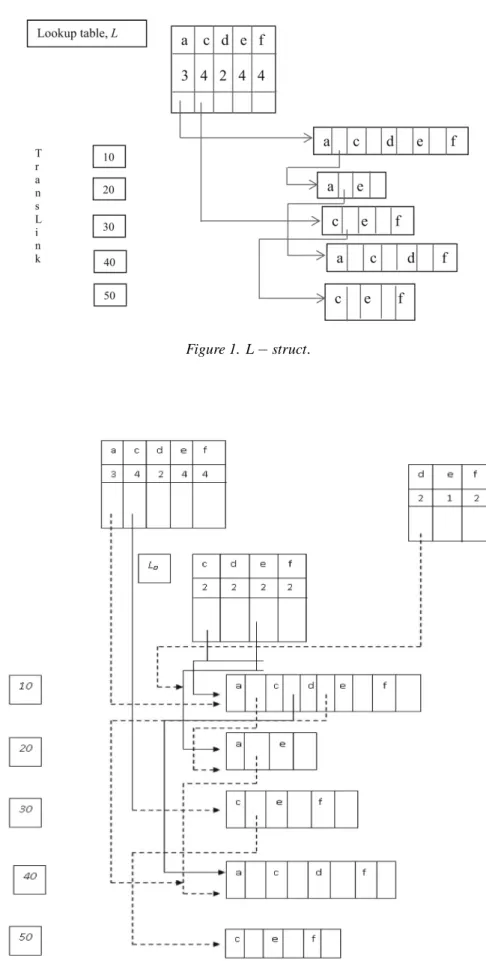
Step 2 – Construct theL-struct for the frequent-item projection in Table 1
Definition 4: L-struct is a data structure defined below:
(1)It consists of a Lookup table,L(user-defined)
such that every occurrence of a frequent item is stored in an entry with three fields: an
item-id, the support count and a node-link. There is also a structure called TransLink
which constitutes one for each of the frequent-item projections with two fields: anitem-id
and a node-link, and the other one identi-fying the first by its Trans-id, (denoted as
Tj, where T represents each structure and j
denotes each transaction) [see Figure 1].
(2)When the frequent-item projections are load-ed into memory, those with the same first item (in the order of F List) are linked to-gether as a queue, and the entries in the Lookup table as the head of the queue. The proposed algorithm uses the concept of data structure proposed in H-Mine, though there is a difference in the way it builds and adjusts links in other structure on identifying the closed itemsets.
Step 3 – Mining the L-struct to generate closed frequent patterns
Based on this definition, the remaining mining process can be performed on theL−structonly without referencing any information in the orig-inal database. After that the sets of frequent pat-terns will be generated, each of these mined one by one to generate the closed frequent patterns as follows:
transaction, create a table-like structure la-beled “L −struct” as described in Defini-tion 4. Its support count registers the occur-rence of each frequent item in the transaction database.
• Following the subsets of the frequent items, to mine the i-projected database (where i
represents each frequent item), create a new structure that registers only the postfix items of each of the subsets,Li-Lookup table. The
support count of these items records the oc-currence of the corresponding item withiin each frequent item projection. Then do the following:
Let the sorted items in theLiLookup
ta-ble be[i|I], whereIdenotes each item in the postfix item-list. Call insert struct([i | I]), The function insert struct([i | I]) is per-formed as follows:
Check the occurrence ofIin theLiLookup
table, ifI occurs withiin theTjtable, incre-ment its count by 1. In this case, the set of locally frequent items i.e. the items appear-ing at least the defined min sup times in the
i-projected database is found. Then each I
will now be combined withito formiI1,iI2,
. . .iIn, wherenis the number of frequent pat-terns generated fromLi. After getting each iIk(wherek =1,n), build up links forLi.
Note: thei-projected database consists of all the frequent-item projections containing itemi.
• Going by the definition of closed frequent patterns in Section 1, the set of frequent patterns obtained (including i itself) from the above algorithm are checked to generate closed frequent patterns. The procedure is:
◦ First check which of these itemsets is closed, if there is one, then this is the output, while Lookup table is created for the remaining ones so far as they are frequent. This Lookup table i.e.
LiIk (where k = 1,n) will be drawn
using the Li Lookup table. The same
process for finding frequent patterns is applied and then check for their corre-sponding closed itemsets. This contin-ues until all possible combinations have been found.
◦ After the closed frequent itemsets con-taining itemiare found, thei-projected database i.e.i-queue is no longer needed
in the remaining of mining. To tra-verse thei-queue once more, each fre-quent item projection in the queue is ap-pended to the queue of the next item in the projection followingiin theF List. The following pseudocode shows the procedure that handles this part:
Procedure CloMine(y, z, s)
//for generating closed frequent itemsets
y:=the projected item being mined
z:=concatenation of item being mined and its postfix
tid:=transaction identifier
s:=support
Addyto set of frequent itemset,F
For all frequent itemsets,F
Ifs(Fi) =s(Fj) [wherei=1,nandj=2,n]
Iftid(Fi) =tid(Fj)
AddFiandFjto closed itemset Else
For all itemsetk ∈Fiandk∈Fj
Ifsize(Fi)>size(Fj)
DeleteFifrom list
EndIf EndFor EndIf Else
AddFito closed itemset
EndIf EndFor
In comparison with H-Mine, CLOLINK checks on the closed itemsets on every build of the structure for thei-projected database. L−struct
does not store any other items aside the closed frequent itemsets generated. The Construct()
function checks and prunes out all duplicated itemsets. CLOLINK dynamically adjusts the links in the mining process.
3.2. Illustration
The general idea of CLOLINK is shown us-ing the same transaction database in Table 1. Following the highlighted steps, the CLOLINK algorithm is illustrated using Table 1 in Exam-ple 1 (the same table used for illustration of algorithms in referenced articles). On getting the frequent-item projection, Figure 1 shows the
Figure 1. L−struct.
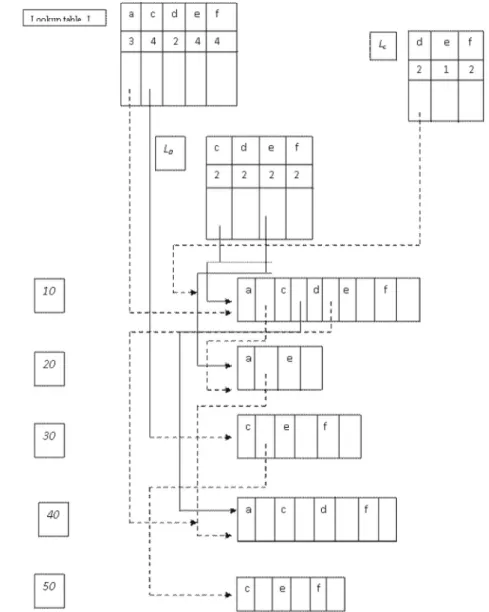
Figure 3.Adjusted node-links after mining thea-projected database andLcLookup table.
To mine the a-projected database, create a -Lookup table, La as shown in Figure 2. In La, every frequent item except for aitself, has
an entry with the same three fields as L. The support count in La records the support of the corresponding item in thea-projected database. For example, itemcappears twice withain the
a-projected database, thus the support count in entrycofLais 2.
By traversing the a-queue once, the set of lo-cally frequent items, i.e., items appearing at least 2 times, in the a-projected database is found, which is {c : 2,d : 2,e : 2,f : 2}. This scan outputs frequent patterns{ac: 2,ad: 2,ae: 2,af : 2}. A link is now built forLa
ta-ble as shown in Figure 2. To check for closure itemsets, itemais contained in 3 transaction-ID i.e.[10,20,40], whereas,ac,ad,af are not
con-tained in same transactions asa, thus{a: 3}is closed. It remains to check whether the frequent patterns are closed.
Similarly, the process continues for the ac -Lookup table. This output itemsd and f with same supports: 2 and are thus considered to be frequent, and then{e: 1} which is infrequent. The frequent patterns {acd : 2,acf : 2} are generated, which are now checked for closed patterns. Since acd is contained in the same transaction ascd, as andacdbeing a larger set, it is then said to be closed.
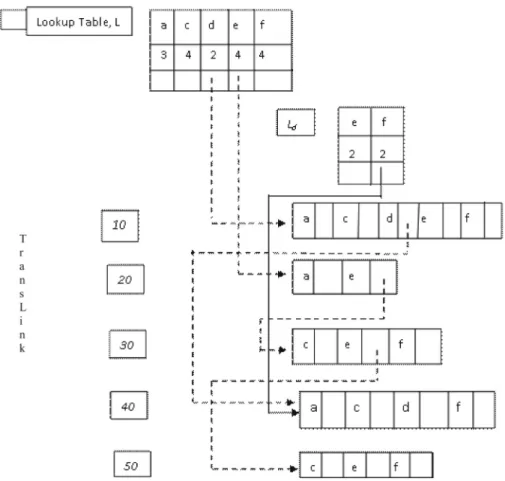
Figure 4.Adjusted node-links after mining thec-projected database and Lookup Table,Ld.
Foracd-projected database, there are{e: 1,f : 2}, only f is frequent and thus {acdf : 2} is output as frequent pattern. Since there is no larger set of it, it is considered to be closed. Foracd-projected database,d has already been considered and there is no link for iteme, thus
acf : 2 is output as closed itemset. The same process continues forad-projected database us-ing theLatable, then the recursion backtracks to
find patterns containingaandd, but noc,(item
chas been considered in the mining ofac), this outputs {e : 1,f : 2}, only item f is frequent with ad. Thus, pattern {adf : 2} is frequent. To check whether it is closed or not, it occurs in the same transaction asadand there is no larger set of it, so it is considered to be closed.
Forae, fromLatable, only itemf will be
consid-ered whose support is 1 and thus not frequent. Hence, itemset{ae : 2}is closed(note: items
canddhave been considered).
There will be no link for af in the La table,
since all other items have been considered, thus considered closed.
The overall output from thea-projected database includes{a : 3,adf : 2,ae : 2,acdf : 2,acf : 2,af : 2}.
After the closed frequent patterns containing itemahave been found, thea-projected database i.e.q-queue is no longer needed in the remaining of the mining.
The next step is to mine thec-projected database, i.e. find closed itemsets containing itemc, but no
a, using the same Lookup table,L, the lookup ta-ble forc-projected database(Figure 3)is drawn which includes only the postfix items of c, but noa.
To mine all frequent patterns containing itemc
but noaother subsets of frequent patters, there is a need to insert all the projections in the queue to the proper queues. By traversing thea-queue is appended to the queue of the next item from in the projection i.e.cas shown in Figure 3. For thec-projected database, on creating theLc
table, the set of frequent items e, d and f is found. This outputsed : 2, ce : 3, and cf : 4
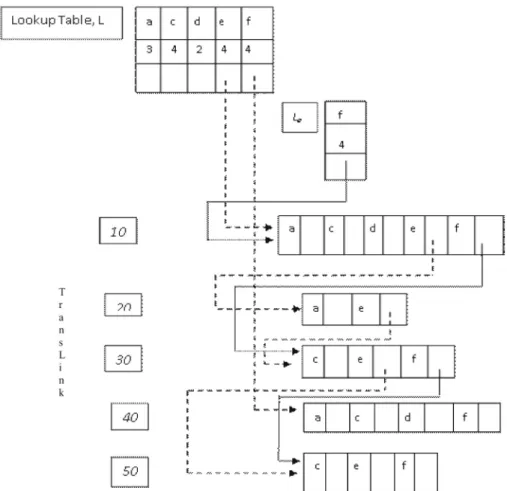
Figure 5.Adjusted node-links after mining thed-projected database and Lookup Table,Le.
f four times withc)as frequent patterns, a link is now built for Lc table. To check for closed
itemsets, item c is contained in 4 transactions i.e. Trans-Id: 10, 30, 40, 50 and only {cf : 4}
is contained in the same transactions unlikecd
and ce. Thus{cf : 4} is output as close item-set. To check any combination ofcdandcethat can be closed, lookup tables for cd and ceare created i.e.LcdandLcetable.
ForLcd-projected database, using theLclookup
table, items e and f are checked withcd with supports of 1 and 2 respectively. Since item f
is the only one frequent withcd, thuscdf : 2 is frequent and it is contained in the same transac-tion ascd : 2.
For ce-projected database, only f : 3 is fre-quent and thus {cef : 3} is frequent and thus
{cef : 3} is output as frequent pattern. Since every transaction containingcealso hasf, there is a need to check whether there is any larger set thancef : 3 and it is discovered that there is no larger set of it. Thus, it is considered to be closed, i.e.,cef : 3.
To check if there is any combination of cdf
andcef that are closed, the link in theLcd and Lce will be changed dynamically. For thecdf
-projected database, only itemeis to be checked and it has been considered infrequent in cd, there is no link for it.
Conclusively, in the c-projected database the following patterns are derived as closed: {cdf : 2,cef : 3,cf : 4}.
To check thed-projected database, only itemse
and f will be considered without aand c. By traversing thed-queue once, the locally frequent item is {f : 2}(Notee : 1 is not frequent and thus will not be considered). This scan outputs frequent pattern(df : 2) and builds up link as shown in Figure 4. To check for the closed fre-quent pattern, item d is contained in the same transaction asdf, but there is no larger set than
df : 2, thus picked as a closed itemset.
Therefore, thed-projected database has onlydf
as a closed itemset.
As for the e-projected database, create the Le
table which contains only itemf, but noanorc
nordas shown in Figure 5. On checking theLe
table, the only locally frequent item isf : 3, the outputef : 3, as the frequent pattern. To check for the closed pattern, since item eoccurs in 4 different transactions whereef does not occur, the closed pattern will bee: 4.
Frequent pattern ef is now checked to see if it has any combination that can be closed. On checking theLetable,ef has no projected
data-base, thus considered as closed itemset.
The closed itemset for thee-projected database includese: 4 andef : 3.
The remaining partition to be mined is that con-taining only itemf, i.e. the f-projected database. On trying to create a lookup table forf, it is dis-covered thatf does not have any postfix items, thus the mining completes on generating only
f : 4 as a closed frequent itemset.
The last scan is to check for any duplication
[1] in the following closed patterns generated:
{a : 3}, {acdf : 2}, {af : 2}, {acf : 2},
{ae : 2}, {cf : 4}, {cdf : 3}, {cef : 3},
{df : 2}, {e : 4}, {ef : 3}, {f : 4}. On cross-checking, it is discovered that itemsets:
{acdf : 2}, {adf : 2}, {acf : 2}, {cdf : 2},
{df : 2} all occur in the same transactions where {acdf : 2} is the largest set of all, thus picked as the closed frequent itemsets. Also {ef : 3} occurs in the same transaction as {cef : 3}, thus {cef : 3} is picked as closed itemset. Likewise, itemsets {cf : 4}
and{f : 4}both occur in the same transaction, butcf : 4 being a larger set, is picked as a closed frequent itemset.
The overall output of the closed itemsets gener-ated from the transaction database after remov-ing duplication[1]is the set{a: 3},{acdf : 2},
{ae : 2}, {cf : 4}, {cef : 3}, {e : 4}which is the same closed pattern generated by A-Close, CLOSET and CHARM.
The efficiency of the algorithm, as highlighted below, comes from the comparison with other closed frequent pattern mining methods:
• First, the complete search can be done in one database scan by constructing the Lookup
tables at all levels simultaneously and dy-namically changing the links.
• Also, it can be seen that the transaction iden-tifiers in the structure make it easy to see where each item occurs.
• Lastly, CLOLINK confines its search in a dedicated space. All information needed can be obtained from the structure, unlike with some other algorithms where you have to be checking through the database on every scan.
4. Implementation and Performance Study
All the tests were performed on a 733MHz Pen-tium III PC, WITH 128 MB RAM and 20 GB HD running Microsoft Windows XP. CLOLINK is written in Microsoft VISUAL Basic.NET. In this paper, the runtime is the CPU time( start-ing from the construction of the data structure to the generation of patterns)and the support is the absolute occurrence frequency. The databases used are:
i. a telecommunication database from a PABX telecommunication switch of historical life of 7 months with size 11.8 MB. It is repre-sented asT60I35D660k, whereTrepresents the number of Callers’ names(i.e. 60);I rep-resents the numbers of areas called(i.e. 35); and D represents the number of records in the database(i.e. 660,000).
ii. a customer – transaction database from a su-permarket in Nigeria of historical life of 4 months with size 3.1 MB. It is represented as T28I7D12K, whereT,in this case, is the number of the customer-identifiers(i.e. 28),
I is the number of items bought per transac-tion(i.e. 7)andDis the number of records in the database(i.e. 12,498).
Figure 6 shows the flexibility of the proposed algorithm. With the growth of pattern length the support threshold is decreasing. As the sup-port threshold goes down, there is a change in the number of patterns generated. The differ-ence between the numbers of patterns gener-ated in situations of applying various support constraints is also depicted.
databases respectively. It can be seen that at high support threshold, CLOLINK is a bit faster than CHARM and at very low support thresh-old the CLOLINK has difference from CHARM and thus performs better.
Figure 6.The Minimum support with the number of closed patterns generated.
Figure 7.The Minimum support with the runtime(in seconds)onT60I35D660k.
Figure 8.The Minimum support with the runtime in seconds onT28I7D12K.
In order to calculate the percentage difference between the two algorithms, the following equa-tion is used on bothT60I35D660K andT28I
7-D12K.
⎛
⎝
Runtime(CLOLINK)−Runtime(CHARM) Runtime(CHARM)
N
⎞ ⎠·100
Based on the above equation, it is discovered that onT60I35D660k, CLOLINK is by 17.12% better than CHARM. Also, on T28I7D12K, CLOLINK is better by 17.92%. Conclusively, CLOLINK performs better than CHARM at an average of 18%.
5. Conclusion
This paper adapted the ideas of the H-Mine al-gorithm to find closed frequent itemsets because of its efficiency. This adaptation allows a pre-sentation of a data structure calledL structand a memory efficient algorithm called CLOLINK for discovering closed frequent itemsets. The algorithm needs to scan the database only once. In the experimental comparison of the perfor-mance of CLOLINK against CHARM onT60I -35D660kandT28I7D12K, the result shows that
the proposed algorithm outperforms
CHARM on this database for the given ranges of support levels. A major distinction of CLOLINK from the previously proposed methods for min-ing closed frequent itemsets is that CLOLINK readjusts its link in mining different projected databases. It integrates the advantages of the previously proposed effective strategies to achi-eve a higher performance. Furthermore, it is shown that the interestingness of the closed fre-quent itemsets can be shown by pushing various support constraints.
6. Future Work
Real-time mining
References
[1] C. LUCCHESE, S. ORLANDO ANDR. PEREGO, Mining frequent closed itemset without Duplicates genera-tion,Proc. of the 2004 ACM-SIGMOD Int. Conf. on Management of Data(2004).
[2] N. PASQUIER, Y. BASTIDE, R. TAOUIL, AND L.
LAKHAL, Discovering frequent closed itemsets for
association rules, Proc. of the 7th Int. Conf. on Database Theory (ICDT’99),(1999).
[3] J. PEI, J. HAN, B. MORTAZAVI-ASL, H. PINTO, Q.
CHEN, U. DAYAL, AND M. C. HSU, PrefixSpan:
Mining Sequential Patterns Efficiently by Prefix-Projected Pattern Growth, Proc. of the 2001 Int. Conf. on Data Engineering (ICDE’01),(2001). [4] J. PEI, J. HAN, AND R. MAO, CLOSET: An
Ef-ficient Algorithm for Mining Frequent Closed Itemsets, Proc. of the 2000 ACM-SIGMOD Int. Workshop Data Mining and Knowledge Discovery (DMKD’00),(2000).
[5] J. PEI, J. HAN, H. LU, S. NISHIO, S. TANG, D. YANG, H-Mine: Hyper Structure Mining of Frequent Pat-terns in Large Databases,ICDM 2001 Proceedings of the 2001 IEEE International Conference on Data Mining,(2001).
[6] J. HAN, J. PEI,ANDY. YIN, Mining Frequent Pat-terns without Candidate Generation, Proc. of the 2000 ACM-SIGMOD Int. Conf. on Management of Data (SIGMOD’00),(2000).
[7] P. G. RAJ ANDG. S. YUDHO, ITL-MINE: Mining
Frequent Itemsets More Efficiently, Proc. of the 2002 Int. Conf. on Knowledge Discovery and Data Mining (KDD’00), pp. 35–49,(2000).
[8] L. SEYMOND,Schaum’s Outline Series: Theory and
Problems of Data Structures, McGraw-Hill Inc., Singapore, 1986.
[9] M. BENHADJHAMIDA ANDY. SLIMANI, A
Patricia-Tree Approach for Frequent Closed Itemsets,World Academy of Science, Engineering and Technology, 2005.
[10] M. J. ZAKI ANDC. HSIAO, CHARM: An efficient
algorithm for closed itemset mining, In SDM’02, April,(2002).
[11] M. J. ZAKI ANDK. GOUDA, Fast vertical mining
using diffsets,Technical Report 01-1, RPI, 2001. [12] R. MAO, Adaptive-FP: An efficient and effective
methods for Multi-level Multi-dimensional frequent pattern mining,M.Sc. Computer Science thesis, Si-mon Fraser University,(2002).
[13] U. NIRANJAN, R. B. V. SUBRAMANYAM, V. KHANAA, An Efficient System Based on Closed Sequential Patterns for Web Recommendation System, Inter-national Journal of Computer Science Issues, Vol. 7, Issue 3, No. 4, May 2010.
[14] H. YAO, H. J. HAMILTON, Mining itemset utilities from transaction databases,Data & Knowledge En-gineering (Elsevier), Vol. 59, pp. 603–626,(2006).
[15] D. BURDICK, M. CALIMLIM, J. FLANNICK, J.
GEHRKE, T. YIU, MAFIA: a maximal frequent item-set algorithm, IEEE Transactions on Knowledge and Data Engineering, 17(11), pp. 1490–1504, (2005).
[16] J. HAN, J. PEI, Y. YIN, R. MAO, Mining frequent
patterns without candidate generation: a frequent-pattern tree approach,Data Mining and Knowledge Discovery, 8(1), pp. 53–87,(2004).
[17] F. PAN, G. CONG, A. K. H. J. YANG M. J. ZAKI,
CARPENTER: Finding Closed Patterns in Long Biological Datasets, SIGKDD ’03, August 2427, Washington, DC, USA,(2003).
[18] R. AGRAWAL ANDR. SRIKANT, Fast algorithms for
mining association rules, Proc. of the 1994. Int. Conf. on Very Large Data Bases (VLDB ’94), pp. 487–499,(1994).
Received:November, 2011
Revised:December, 2012
Accepted:December, 2012
Contact address:
Adebukola Onashoga, Ph.D. Department of Computer Science University of Agriculture P.M.B 2240 Abeokuta Ogun State Nigeria e-mail:[email protected]
ADEBUKOLAONASHOGAis a lecturer at the Department of Computer