1 Household Food Insecurity in Al-Haymah Ad-Dakhiliyah district, Sana’a, Yemen: a mixed
methods approach
By Rawan Ajeen
Senior Honors Thesis Department of Nutrition
University of North Carolina at Chapel Hill 2019
2 ACKNOWLEDGEMENTS
3 Table of Contents
Lists of Tables and Figure……….…4
Introduction and Study Aims………...5
Methods……….10
Results: Quantitative Analysis………19
Results: Qualitative Analysis………..27
Discussion……….41
Strength and Limitations………44
Conclusions………...45
4 List of Tables and Figures
Tables
Table 1………...23
Table 2………...24
Table 3………...25
Table 4………...26
Table 5………...39
Table 6………...39
Table 7………...40
Figures Figure 1……….14
Figure 2……….35
Figure 3……….36
Figure 4……….37
5 INTRODUCTION AND STUDY AIMS
Introduction
“Hunger is the most extreme manifestation of poverty and human deprivation. Hunger in a world of plenty is not just a moral outrage, it is an infringement of the most basic of human rights: the right to adequate food.” (FAO, AHP, 2002) Although the primary basic human rights, as defined by the United Nations, consist of the right of life and liberty, freedom from slavery and torture, freedom of opinion and expression, and many more socially empowering rights, but the emphasis on adequate food is not elaborate enough (UDHR, 1948). Arguably, food is a form of social empowerment, as empowering people entails that people are able to have more control over their lives (African Human, 2012). Empowered individuals or groups are better able to shape and benefit from political, economic and social processes (African Human, 2012). Therefore, not having access to adequate food, focuses the attention of an individual or household on satiety, diverting attention from working toward objectives driving human and economic development. This ideology is supported by Abraham Maslow’s Hierarchy of Needs, which states that until an individual address a deficit in their physiological needs (thirst, hunger, bodily comforts, etc), their efforts to address areas of cognitive growth such as self-actualization will be greatly hindered (Maslow, 1971).
6 times, have physical and economic access to sufficient safe and nutritious food that meet their dietary needs and food preferences for an active and healthy life (FAO, 2008). Food insecurity can be a result of a multitude of factors including, but not limited to political climate, war, conflict, economic stability, income inequality, gender inequality, arable land, and water availability (“Factors”, 2014). In the Middle East, the rate of hunger, poverty, and food
insecurity is at an all-time high (Lagi, Bertrand, & Bar-Yam, 2011). The Middle East is one of the most water scarce areas in the world (World Bank, 2007), which is a contributing factor to food insecurity. However, the ongoing conflicts and political unrest in many Middle Eastern and North African countries has exacerbated food insecurity (FAO et. al, 2017). The food security situation in countries such as South Sudan, Somalia, Syria, Iraq, and Yemen has worsened following the rise of conflict. Most notably, the political tension between different governmental authorities in North and South Yemen has resulted in a widespread famine, thus making the humanitarian crisis in Yemen a top priority for the United Nations as 24 million Yemenis, close to 70% of the overall population are facing severe acute food insecurity, as by the Integrated Food Security Phase Classification (IPC) (IPC, 2018).
7 to diffuse the situation, the Saudi Arabia government, along with several other Arab countries, entered the Yemeni Civil War (BBC, 2019). Now in 2019, four years later, the Saudi-led coalition has acheived no promising solution for the people of Yemen. In fact, four years of protracted conflict has left Yemen’s critical economic and civil infrastructure significantly damaged, displaced close to three million people, with over half of the population living in severe food insecurity, thus resulting in food security assessments conducted at the end of December 2018 confirming that this is the worst level of hunger ever experienced in Yemen (UNOCHA, 2018).
Food insecurity in Yemen is currently being addressed by numerous humanitarian
organizations and global donations. The Food and Agriculture Organization (FAO) of the United Nations released a report in 2017 that highlights an emphasis and discussion around the issue of peace and food security, a topic that was not included in previous reports, such as the report released in 2013. With this more recent report provided by the FAO, a proposal to end hunger and prevent all forms of malnutrition by 2030 has been issued. The 2030 Agenda for Sustainable Development and the UN Decade of Action on Nutrition calls on all countries and stakeholders to act together to ensure that such goals of alleviating food insecurity are met (FAO et. al, 2017). However, conflict is a key driver of situations of severe food crisis (FAO et. al, 2017) and therefore household or regions that are victims of war and conflict terror, require humanitarian organizations to further organize, develop, and evaluate extensive frameworks specifically used to address food insecurity in emergency situations.
Study Questions and Aims
8 1) Are typical food insecurity trends applicable in conflict situations? Are women who are
the head of the household, internally displaced people, and households with a large number of dependents more food insecure than other members of the population? 2) What role does food access play in the prevalence of food insecurity amongst those
currently residing in Yemen?
To address these questions, this research study will investigate four main aims as outlined below:
AIM 1: Use quantitative methods to investigate whether head of the household (female or male) impacts household food insecurity as measured by the 9 item Household Food
Insecurity Access Scale (HFIAS). It is hypothesized that households in which the head of the household is a female will be associated with a higher HFIAS score.
AIM 2: Use quantitative methods to investigate whether the status of the household (Internally displaced people (IDP) vs. non-IDP) impacts household food insecurity as measured by the 9 item Household Food Insecurity Access Scale (HFIAS). It is hypothesized that those who are categorized as IDP’s will have a more adverse HFI score.
AIM 3: Use quantitative methods to investigate whether the time it takes to access the nearest food market (by walking and by vehicle) impacts household food insecurity.
It is hypothesized that greater time required to travel to the nearest food market is associated with greater household food insecurity.
9 AIM 4: Use qualitative methods to assess the perspective of personnel, working closely with the Yemen humanitarian crisis on the diet, nutritional value, and food access/availability of vulnerable community members.
10 METHODS
Quantitative Methods: Sample
The data used in this project came from a Food Security Baseline study that was conducted in Al Haymah Ad-Dakhiliyah district in July, 2018 by the non-governmental
11 Variables and Measures
The households used in this study reside in the district, Al-Haymah Ad-Dakhiliyah, in the Sana’a governorate of North Yemen. A representative member of each household completed the DRA4 Yemen Baseline Questionnaire in July 2018, administered by an official from the non-governmental organization, War Child UK. The survey consisted of five subsections, which includes questions regarding household demographics, access to markets, food consumption, coping strategies, and the Household Food Insecurity Access Scale (HFIAS).
12 Baseline Questionnaire requires respondents to report how much money they estimate spending on different types of household necessities such as electricity, water, food, shelter, and
healthcare, as well as report any debt or loans, and how they plan on using any additional income. All income or monetary values are reported in Yemeni Riyal (YER) currency.
The second section in the questionnaire is regarding the respondents’ access to food markets. In this section, respondents are asked to indicate where they source their food from (purchase food, own production, labour paid with food, gifts/loans/begging, food assistance programs, or other) pre-conflict and following the conflict. Households are also asked to indicate how far they must travel to source their food from a food market as well as any alternative sources of food, and the overall quality and availability they are able to find at a food market or alternative source. The last set of questions in this section pertain to food assistance: the type of assistance received (cash, food basket, voucher), the name of the organization providing the assistance, frequency of food assistance, and the quality of the food assistance.
The third section of questions is about food consumption. This section of the
questionnaire asks respondents to list the number of days each of the food groups listed have been eaten by the household in the past seven days. The food groups asked about includes cereals and grains, roots, vegetables, fruits/fruit juices, legumes/nuts, eggs, dairy products, meat/poultry/fish, oil, sugar/honey, and “other” section.
13 the question about whether the household has had to rely on less preferred and less expensive foods in the past seven days. The second coping strategy is to “increase short-term household food availability” and the questions to assess this strategy are how many times in the past seven days have you had to borrow food from a friend or relative, purchase food on credit, gather wild food, hunt, or harvest immature crops, and consume seed stock held for next season. The third coping strategy is “decrease numbers of people”, which includes how many times in the past seven days have households had to send children to go eat with neighbors and send household members to beg. The last coping strategy assessed was “rationing strategies”, which asks
respondents how many times in the past seven days has their household had to limit portion sizes at mealtimes, restrict consumption by adults in order for small children to eat, feed working members of the household at the expense of non-working members, reduce number of meals eaten in a day, and skip entire days without eating.
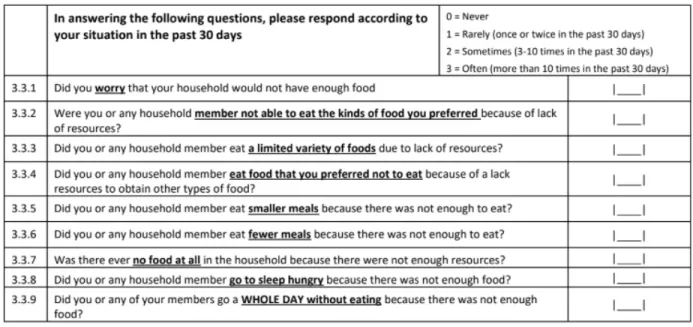
14 lack of resource to obtain other types of food, did you or any household member eat smaller meals because there was not enough to eat, did you or any household member eat fewer meals because there was not enough to eat, was there ever no food at all in the household because there were not enough resources, did you or any household member go to sleep hungry because there was not enough food, did you or any of your member go a WHOLE DAY without eating because there was not enough food. The HFIAS score was assigned based on summing up the values indicated by each household. This score was then used to assign whether the household is categorized as high food insecurity, moderate food insecurity, or low food insecurity, which was only used for descriptive statistic purposes.
Figure 1. Household Food Insecurity Access Scale from the DRA4 Yemen Baseline Questionnaire
Statistical Analyses
15 information (count, percentage, and 95% confidence interval) on gender of the head of the
household, marital status of the head of household, education status of the head of household, average household size, income range, status of household, HFI category, time to access nearest food market by foot and by vehicle, and whether or not household is receiving food by food assistance program. Descriptive statistics for coping strategies were also included to reflect frequency of each type of coping strategy. The most frequently responded to question from the survey for each category of coping strategy was included in the descriptive statistics table for coping strategies.
A Shapiro Wilk test for normality was conducted prior to any t-Tests. The normality assumption was violated, however due to the robust nature of a t-Test, we proceeded with analysis. Independent t-Tests were conducted to see if gender of head of the household, status of household, access to the closest food market by foot or vehicle was associated with household food insecurity. Chi-squared tests were run to determine the association between receiving food assistance and gender of head of household and status of household.
A linear regression was conducted to determine the nature of the relationship between explanatory and the HFIAS score. Two linear regression models were conducted, one was composed of demographic variables and the second model had behavioral variables. The first linear regression model included the variables such as gender of head of household, education of head of household, IDP status, marital status, income, and access to the nearest food market. The second linear regression include the same variables, but had additional behavioral variables, such as average coping strategy score for each of the four categories, which are dietary change,
16 Qualitative Methods:
In order to gain a more comprehensive understanding of the food insecurity and
humanitarian crisis in Yemen and any confounding factors and impact of food insecurity on the livelihoods of Yemenis, qualitative methods were used to understand (key informant interviews) this complex situation from the personal perspective of humanitarian field officers from
international NGOs.
Ethical Considerations
This study is under review by the Institutional Review Board at the University of North Carolina at Chapel Hill. Additionally, consent was received from the individuals who
participated in the Key Informant Interviews. All interviews were conducted in both Arabic and English.
Setting and Population
The study site was in Yemen, with key informants working in various governorates, including Sana’a, Aden, Hodeida, and Hajja. According to the 2019 Yemen Humanitarian Needs Overview, Yemen is home to close to 30.5 million people (UNOCHA, 2018).
Participants
17 Council. A total of five humanitarian officers from a variety of different sectors including food security officers, education officers, evaluation and assessment, and child protection services were interviewed through a semi-structured interview. Names, ages and specialties of
humanitarian personnel will not be disclosed with their quotes in order to maintain anonymity.
Data Collection and Analysis
All interview guides focused on themes of food insecurity, nutrition, health, and the current livelihoods of Yemenis. All interviews were conducted via Skype, in either Arabic or English, and audio-recorded. Recordings were transcribed, translated and coded for themes. Verbatim transcriptions were made of the audiotaped interviews and checked for accuracy. Next, these original transcriptions were carefully re-transcribed, with altering of syntax and grammar to make language more readable in common English. Because English was not the participants’ primary language, re-transcription corrected the grammar and syntax to make their stories flow more smoothly. Key informants were selected based on availability and work relevance to the topic of food insecurity. Key informant interviews were conducted by the author of this paper. Participants were asked about the current food insecurity, malnutrition, food access, and nutrition-related health in Yemen.
19 RESULTS: QUANTATIVE ANALYSIS
Gender of Head of Household
Our dataset contained information collected from 86 different household in Al-Haymah Ad-Dakhiliyah, of the Sana’a governorate in Yemen. Of these households, 37 were headed by a male (43.00%) and 49 were headed by a female (57.00%) [Table 1]. To identify whether gender has a role in the household food insecurity an independent t-Test was conducted to compare the average household food insecurity access score of male headed households and female headed households. There was not a significant difference (significance level of 0.05) between the average household food insecurity score amongst male headed households (M=18.16, SD=7.43) and female headed households (M=18.96, SD=5.52); t(84)= -0.571, p=0.058. Given the binary categorical nature of the variables, gender of head of household and whether a household received food from food assistance, a Chi-Square test was considered over a t-Test. To test the association between households receiving food assistance and whether those households were headed by a male or female, a Chi-Square test was conducted. We found no association between households receiving food assistance and the gender of the head of the household (X2(2)=0.240,
p=0.431). An independent t-Test was also conducted to compare the average time spent walking or driving to access the nearest food market in the area amongst male and female headed
20 get to the nearest food market, while male headed households (n=34, M=1.79, SD=1.61) had an average travel time of one to two hours to get to the nearest food market.
Internally Displaced People (IDP)
From the 86 households that were surveyed in Al-Haymah Ad-Dakhiliyah, 56 households (65.10%) reported being permanent residents of the area and 27 households (31.40%) were IDPs [Table 1]. To determine if there is a significant difference amongst household food insecurity between IDP households compared to non-IDPs, an independent t-Test was conducted. There is no significant difference between the average household food insecurity score for households classified as IDPs (M=18.33, SD=7.01) and non-IDPs (M=18.89, SD=5.64); t(81)=0.391, p=0.228. Additional tests were conducted to determine other differences that may exist between IDP and non-IDP households. To test the association between households receiving food assistance and whether those households were classified as IDPs or non-IDPs, a Chi-Square test was conducted. There was no association between households receiving food assistance and the households status (X2(1)=0.074, p=0.760). An independent t-Test was also conducted to compare
the average time spent walking or driving to access the nearest food market in the area, amongst IDP and non-IDP households. There was a significant difference between the time spent
21 and the status of the household, IDP (n=23, M=1.74, SD=1.51) and non-IDP (n=51, M=1.08, SD=1.37), t(72)=-1.86, p=0.067 [Table 2].
Household Food Insecurity and Coping Strategies
The first linear regression model was conducted to predict Household Food Insecurity based on several different explanatory, demographic variables which include head of household gender, the education status of the household head, IDP status of household, total income of household, marital status of head of household, and the time it takes to access nearest market by foot and vehicle. As displayed in Table 3, none of the independent variables tested had
significant association with the dependent variable.
A second linear regression model was conducted to the predict the effect of coping strategies on household food insecurity [Table 3 for descriptive statistics on coping strategies, Table 4 for linear regression]. The second linear regression model contained the original independent variables used in the first linear regression model but also included four different coping strategies as seen in Table 4. All the original independent variables from the first linear regression model continued to have no association with household food insecurity, except for one variable, average time to get to the nearest food market by foot (β = 2.040, p=0.039). In the behavioral model, two of the four coping strategies showed a significant association with
22 strategies, the higher a household’s food insecurity. This second linear regression model
indicated that these three predictors explained 58.5% of the variance (R2 =0.343, F(8,57)=3.194,
p=0.005). The more die The remaining two coping strategy variables, increasing short-term
household food availability (β = -0.424, p=0.618) and decreasing the number of people in the
household eating (β = 0.348, p=0.638), were not significant predictors of household food
23 Table 1. Descriptive statistics of gender of head of household, education of head of household, marital status of head of household, average household size, status of household, household food insecurity classification, food assistance, and time it takes to walk or travel by car to get to nearest food market.
Total
Descriptive Statistics n % CI
Gender of Head of Household
Male 37 43.00 (0.328-0.538)
Female 49 57.00 (0.462-0.671)
Education of Head of Household
Illiterate 42 48.80 (0.404-0.620)
No formal schooling but can read and write 15 17.30 (0.113-0.283)
Primary Schooling 7 8.10 (0.041-0.170)
Secondary 15 17.40 (0.113-0.283)
Higher 3 3.50 (0.011-0.109)
Marital Status of Head of Household
Single 5 5.80 (0.024-0.133)
Married 62 72.10 (0.615-0.806)
Divorced 5 5.80 (0.024-0.133)
Widowed 14 16.30 (0.098-0.258)
Average Household Size
0-5 3 3.50 (0.011-0.104)
6-10 35 40.70 (0.307-0.514)
11-16 42 48.80 (0.383-0.594)
17+ 6 7.00 (0.031-0.148)
Status of Household
Permanent Resident 56 65.10 (0.011-0.1-4)
Internally Displaced People (IDP) 27 31.40 (0.543-0.745)
Other 3 3.50 (0.224-0.421)
Household Food Insecurity
High Food Insecurity 54 64.80 (0.018-0.104)
Moderate Food Insecurity 28 30.40 (0.227-0.425)
Low Food Insecurity 4 4.80 (0.017-0.896)
Receive Food Assistance
Yes 13 15.10 (0.104-0.281)
No 61 70.90 (0.719-0.896)
Income Range (YER)
0-9,999 26 30.20 (0.214-0.409)
10,000-19,999 25 29.20 (0.223-0.421)
20,000-29,999 29 33.70 (0.223-0.421)
30,000+ 6 7.10 (0.031-0.148)
Time it takes to walk to nearest food market
Less than 30 min 26 30.20 (0.216-0.413)
30 min - 1 hour 9 10.50 (0.055-0.192)
1 to 2 hours 3 3.50 (0.011-0.105)
3 to 4 hours 10 11.60 (0.064-0.207)
More than 4 hours 17 19.80 (0.127-0.300)
Don’t Know 21 24.40 (0.156-0.338)
24
Less than 30 min 36 41.90 (0.322-0.532)
30 min - 1 hour 7 8.10 (0.039-0.164)
1 to 2 hours 17 19.80 (0.127-0.300)
3 to 4 hours 7 8.10 (0.039-0.164)
More than 4 hours 9 10.50 (0.055-(0.193)
Don’t know 10 11.60 0.055-0.193)
Significant differences are denoted by: *p<0.05, **p£0.01
Table 2. Independent t-Test results for gender of head of household and status of household on average time it takes to get to nearest food market by foot or by vehicle.
Male Female IDP non-IDP
M SD M SD t-test M SD M SD t-test
Time it takes to travel to nearest
food market by foot 2.08 1.71 1.53 1.70 1.28 2.50 1.82 1.42 1.58 -2.41*
Time it takes to travel to nearest
food market by vehicle 1.79 1.61 0.88 1.15 2.88** 1.74 1.51 1.08 1.37 -1.86
25 Table 3. Descriptive statistics of the four different areas of coping strategies, including the most answered to question from each section.
Total
Descriptive Statistics (Coping Strategies)
In the past 7 days, how many times did the household implement these strategies?
n % CI
Dietary Change*
Rely on less preferred and less expensive foods
0 (not applied) 15 17.4
(0.108-0.264)
1 3 3.5 (0.011-
0.105)
0.2 8 9.3 (0.047-
0.179)
3 9 10.5 (0.055-
0.192)
4 1 1.2 (0.002-
0.081)
5 4 4.7 (0.018-
0.120)
6 0 0
(0.00-0.00)
7 45 52.3 (0.422-
0.634) Increase Short-Term Household Food Availability
Borrow food from a friend or relative
0 (not applied) 15 17.4
(0.107-0.271)
1 11 12.8
(0.072-0.218)
2 9 10.5
(0.055-0.191)
3 13 15.1
(0.089-0.245)
4 11 12.8
(0.072-0.218)
5 3 3.5
(0.011-0.104)
6 0 0
(0.00-0.00)
7 24 27.9
(0.194-0.384) Decrease Numbers of People
Send household members to beg
0 (not applied) 68 79.1
(0.710-0.881)
1 3 3.5
(0.011-0.107)
2 0 0
(0.00-0.00)
3 1 1.2
(0.002-0.082)
4 4 4.7
(0.018-0.122)
5 1 1.2
(0.002-0.082)
6 0 0
26
7 7 8.1
(0.040-0.167) Rationing Strategies*
Restrict consumption by adults in order for small children to eat
0 (not applied) 28 32.6
(0.234-0.433)
1 0 0
(0.00-0.00)
2 6 7
(0.031-0.148)
3 10 11.6
(0.063-0.204)
4 6 7
(0.031-0.148)
5 3 3.5
(0.011-0.104)
6 0 0
(0.00-0.00)
7 33 38.4
(0.286-0.492) Significant differences are denoted by: *p<0.05, **p£0.01
Table 4. Linear regression analyses of the association of household food insecurity with the following explanatory variables: head of household gender, education status of head of household, IDPs, total income, time it takes to get to nearest food market by foot and by car, and marital status. For the second linear regression model, coping strategies: dietary change, increase short-term household food availability, decrease numbers of people, and rationing strategies, were included to assess association of these variables on household food insecurity.
Model 1 Model 2
Explanatory Variables b (SE) b (SE)
Head of Household Gender 0.629(1.754) 0.584(1.470) Education Status of Head of Household -0.115(0.639) 0.087(0.537)
IDPs -0.061(1.838) -2.162(1.603)
Total Income 3.364x10⁻⁵(0.000) 7.010x10⁻⁵(0.000)
How long does it take to walk to the nearest food market 0.899(1.113) 2.040(0.963)* How long does it take to get to the nearest food
market by car/public transportation -0.317(1.563) -1.127(1.321)
Married vs. Single 0.497(1.843) -0.675(1.564)
Coping Strategies
Dietary Change 1.195(0.254)**
Increase Short-Term Household Food Availability -0.424(0.845)
Decrease Numbers of People 0.348(0.735)
Rationing Strategies 1.364(0.430)**
R 0.211 0.585
R2 0.045 0.343
27 RESULTS: QUALITATIVE ANALYSIS
Food Insecurity
The participants interviewed for this study all shared similar perspectives on the current food insecurity situation in Yemen and used their unique professional backgrounds to address the effects of food insecurity on society and other covariates that are potentially exacerbating current the food crisis. Focusing on similar topics such as the rate of famine, high demand of food assistance, extreme poverty, politics, and the state of emergency in Yemen.
Respondents described the relationship of these topics as stemming from the political climate that has impacted Yemen for the past four years. Additionally, they stated how the political climate is affecting the economy, while directly causing Yemen to enter a state of emergency, which is also a direct cause of the extreme case of food insecurity that has affected the entire nation [Figure 2]. A participant highlighted the result of food insecurity given the emergency context.
“The areas that have food insecurity have to implement coping strategies that include not feeding or limiting food intake at meals, having children beg or sending them to other homes to eat or have their children work so that they can cover gaps and have enough for the rest of the household.” [War Child UK]
A participant spoke about the magnitude of the food insecurity and malnutrition status of Yemen. “As mentioned in the news, this is one of the worst food insecurity crises in the world and also the worst malnutrition that has ever happened to a population around this time, aside from South Sudan and Somalia. Here in Yemen we are facing a very bad food insecurity crisis inside the country, as well as malnutrition.” [War Child UK]
28 “Food insecurity and malnutrition is almost chronic…You can’t expect to eat lunch and then do something different for dinner, you can’t even dream of this in Yemen. It is not like how you all are living over there.” [UN-OCHA]
Food insecurity manifests in the population as famine, malnutrition, that result in the
implementation of coping strategies. All participants mentioned the Integrated Food Security Phase Classification. Recent reports show that several districts present pockets of population categorized as belonging to Phase 5 (highest classification, which indicates catastrophe), and the rest of the governorates are at a Phase 4 or Phase 3. Just as participants indicated, the food insecurity crisis is a historic high for Yemen, primarily driven by the emergency situation, which includes the factors of war and conflict. The political climate, driven by government instability, no income, and extreme poverty directly impact the intensity of the emergency and food crisis [Figure 2]. In describing the food insecurity crisis in Yemen, participants held a passionate tone when talking about their community, and emotional devastation about the harsh realities of the current outlook and livelihoods of households. Several of the participants apologized at least once in the course of the interview for having to share intense reports of the food insecurity conditions.
Additionally, Figure 2 displays that while “Politics” is a cause of the emergency situation and extreme food insecurity, the political climate contradicts a solution. All participants agreed that the most promising solution for Yemen would be to eliminate foreign powers, military groups, and restore a stable government to rebuild the infrastructure. One participant highlighted the long-standing issue between political climate and possibilities of a promising solution by stating:
29 For most of us in the NRC [Norwegian Refugee Council] we look at these things like this as hypocrisy. If they want to assist Yemen they have to sit and agree amongst themselves. They who are fueling the conflict among Yemen must stop it, because it is the main reason for the food insecurity and this crisis that the Yemenis are experiencing.” [Norwegian Refugee Council]
Figure 3, further asserts that the political climate contradicting or hindering, a proposed solution will be detrimental to society, as “solution” is part of “society”, which is affected by food insecurity.
Co-occurrences of Food Insecurity, Society, Assistance, and Politics
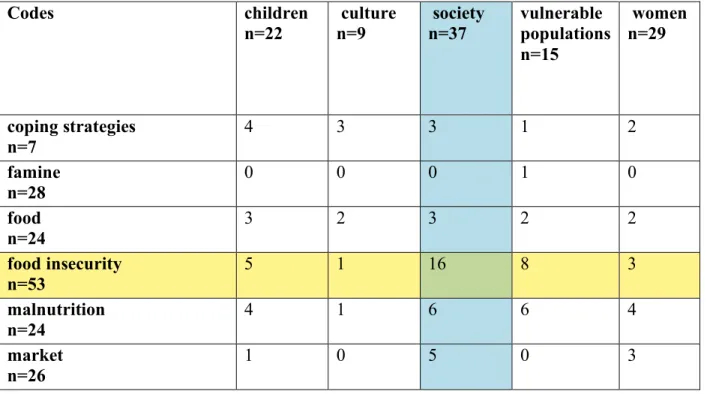
In order to identify the three themes, present in this study, co-occurrence tables were produced using ATLAS.ti8 software. In Table 5, food insecurity codes were cross-tabulated with society related codes. The co-occurrence of codes between “food insecurity” (n=53) and “society” (n=37) was 16. This means that the codes “food insecurity” and “society” were referenced together 16 times through the set of interviews. In Table 6, food insecurity related codes were cross-tabulated with assistance related codes. The co-occurrence of codes between “food
insecurity” (n=53) and “assistance” (n=66) was 15. Table 7, displays the co-occurrence of topics between food insecurity relates codes and political climate related codes. The co-occurrence of codes between “food insecurity” (n=53) and “politics” (n=23) was 16. Additionally, the co-occurrence of “food insecurity” and “poverty” (n=35), was 17, thus indicating a relationship to be explored and also indicated by Figure 2.
30 the multitude of international NGOs in Yemen is still not adequate in addressing the needs of households. Food assistance efforts are implemented on a long-term strategy, versus short term. This is due to the current political state of Yemen, in which the government is not able to address food insecurity, thus this responsibility is turned over to NGOs. We introduce the theme of short-term versus long-short-term, in reference to the type of food and humanitarian assistance that is needed in Yemen. This theme also suggests that the magnitude of food insecurity in Yemen is much different than the previous cases of food insecurity. Though participants agree that acute malnutrition or food insecurity was present before the start of the war and political instability before 2011, the conditions that currently exist surpass such acuity, thus the type of assistance that is provided and further needed is different. Figure 4 displays the relationship between the emergency status of Yemen, food insecurity, and the effect it has on society.
One participant states the following about the condition of society and the assistance being received:
“They are living in very bad conditions and need all kinds of assistance and think the best way to address this is to have integrated projects or programs targeting these people with different kinds of assistance.” [UN-OCHA]
In reference to the difference between an acute case of food insecurity assistance and more chronic, long-term case of food insecurity, one participant states the following:
“There are some emergencies that don’t last that long like floods, which people have displaced, but returned back and you will assist for a certain period of time these sort of programming might work, but people who have been displaced for 4+ years and have no solution (have no idea how long they will stay in displacement), this sort of program and assistance is not effective, as people have different needs that NGOs are not able to meet.” [UN-OCHA]
31 given in order to address basic needs, but even that may not be sufficient as long as the war exists. One participant states the following regarding the impact of the war on food insecurity:
“Since the war is ongoing, we cannot serve the problem the need is increasing day by day, because of ongoing war. I am giving you society as it is my point of view and how I see and perceive it, which is that we cannot cover all vulnerable families and households and all the people in need. “ [War Child UK]
Another participant weighed in on the same theme, with the following response:
“This is a difficult question, of course the food assistance programs are effective, but in Yemen there are families who have more than 10 family members. While we distribute food once a month, and with the minimum food items that they will need to meet 2500 calories a day, this calculation of a food basket is calculated for a family of 6 people. However, many households have more than 6 people. Also, this food basket is supposed to cover 80% household needs for a month, and we must assume that they can cover 20%, which is not true all the time.” [UN-OCHA]
Stability vs. Instability: “Our disaster or crisis is man-made, so it could be solved”
The theme of an unstable political system was seen as the primary reason for a collapsed nation, extreme poverty, lack of education and healthcare infrastructure, malnutrition, increase in disease (cholera), no income and little employment opportunities, and famine-like situations. In response to assistance in this emergency-complex situation, higher level assistance, such as integrated models of assistance and multiple modalities, along with a high emphasis on a political intervention, were among the solutions posed by participants. One participant states the following regarding a solution for food insecurity in Yemen:
“The problem behind food insecurity are the political parties who do not reach any solutions. They try to be on the same page, but still have no solutions, so the food insecurity increases. The political situation is the most important factor or reason behind the food insecurity.” [War Child UK]
Another participant shares a similar message:
32 One participant gives another perspective on how to best address food insecurity in Yemen, while proposing a potential solution:
“From my personal perspective on the nutritional food insecurity, is that this is one of those issues that needs an integrated project. Such that whenever you give people cash, they use cash differently from what was the main objective of the project because of different needs, so for me the best way to address these needs is to have integrated
projects that consist of different components, especially for displaced people.” [UN-OCHA]
Another participant builds on the topic of displaced people and the issue that the political climate poses in terms of reaching just even a short-term solution or any form of assistance for IDPs:
“You can say in general the status is totally miserable. The situation is very difficult. There are some governorates that are very hard to reach, and we have no access and ability to assist. However, we do know that they are suffering from extreme poverty, famine, clashes, IDPs, but it is not easy to reach because there are still ongoing clashes. Two governorates, as reported by OCHA, Al-Bayda and ‘Amran, have many IDPs, but there are no international organizations that have access to these governorates because the clashes are still ongoing there. This indicates that they are pre-famine and in 3-5 months and they will be in famine. Sorry to tell you about this information.“ [War Child UK]
As noted through interviews, participants strongly encourage that a political solution be proposed soon. NGOs and other forms of humanitarian assistance are not sustainable, especially in a long-term conflict. Participants fundamentally agree that a stable government will be able to better provide and address the needs of society than humanitarian assistance could. This is due to the fact that the government is responsible for the infrastructure and overall development of a country, and with no government, or political instability, the country’s infrastructure is weak, fragile, and thus not able to sustain the basic needs (such as food needs) of its people.
Food for Thought: “They need to know the importance of Education“
33 different areas and types of projects. In Yemen’s case, the lack of overall infrastructure has caused for many sectors to be affected, which includes education. One participant describes the education situation in conjunction with food insecurity as the following:
“The food security situation has impacted the education such that teachers are not going to work or students are unable to go to school. As a coping strategy, children are working or supporting families and not in school.” [War Child UK]
Another participant asserts a similar message, but rather through a personal encounter while working on the field in Yemen. They state:
“Last time I visited a working area I came across two girls, I saw that they were wearing caps that said “War Child UK”, so I greeted them and introduced myself. I asked them if they go to school and the girl said that the girl next to them doesn't go to school and I asked why, she is old enough to go to school so why doesn't your neighbor study? The girl responds, it is necessary that she help support her family and work instead of go to school.” [War Child UK]
Though in an emergency situation, direct physiological needs such as maintaining thirst and hunger are prioritized over education, the impacts of a poor educational system will continue to hinder communities. One participant spoke about the role of education on women and how it has impacted women’s health education. They share the following:
“We do not come across many women while out in the field that have a solid foundation of education and literacy. This results in women not having a high level of health education or awareness. You find women that are very thin and have poor health because they have repetitive pregnancies and do not pause for their body to properly heal or recover.” [War Child UK]
A few participants emphasized the need for some sort of stable education, as noted above due to previous lack of education in Yemen, women and women’s health has been impacted. In
38 Figure 5. Displays the relationship between the political climate on food insecurity and the
39 Table 5. Co-occurrence table between food related codes (rows) and society related codes (columns) that include the count of occurrence of the code in the qualitative analyses, as well as the co-occurrence of the codes. This table highlights the topic of food insecurity and society.
Codes children
n=22 culture n=9 society n=37 vulnerable populations n=15
women n=29
coping strategies
n=7 4 3 3 1 2
famine
n=28 0 0 0 1 0
food n=24
3 2 3 2 2
food insecurity n=53
5 1 16 8 3
malnutrition
n=24 4 1 6 6 4
market
n=26 1 0 5 0 3
Table 6. Co-occurrence table between food related codes (rows) and assistance related codes (columns) that include the count of occurrence of the code in the qualitative analyses, as well as the co-occurrence of the codes. This table highlights the topic of food insecurity and assistance.
Codes access
n=30 assistance n=66 availability n=19 food assistance n=26 NGOs n=28 coping strategies
n=7 0 3 1 2 1
famine n=28
3 5 3 3 2
food n=24
10 7 5 5 5
food insecurity n=53
5 15 2 9 6
malnutrition n=24
7 12 7 6 4
market n=26
40 Table 7. Co-occurrence table between food related codes (rows) and political related codes (columns) that include the count of occurrence of the code in the qualitative analyses, as well as the co-occurrence of the codes. This table highlights the topic of food insecurity and political climate, as well as food insecurity and poverty.
Codes conflict n=15 emergency n=22 government n=8 politics n=23 poverty n=35 solution n=13 coping strategies n=7
0 0 0 2 4 1
famine
n=28 2 1 0 0 5 0
food n=24
1 2 0 1 8 1
food insecurity n=53
7 9 3 16 17 3
malnutrition n=24
2 3 0 5 13 0
market n=26
41 DISCUSSION
In this study of households living in the Al-Haymah Ad-Dakhiliyah district in the Sana’a governorate of Yemen, we discovered that the typical food insecurity trends are not reflective of this sample. Vulnerable populations, women, children, and displaced people, are typically expected to have a higher indication of food insecurity (Abdallah et. al, 2017). However, in our sample we did not observe such trends. Our results display that there is no significant difference between the average food insecurity score among male and female headed households as well as IDP and non-IDP households. Other demographic variables relating to the dynamic of the household such as education level of the head of household, marital status, income, household size, and access to the nearest food market had no association with household food insecurity. However, when a second model was created that included behavioral variables such as coping strategies, we noticed a few noteworthy associations. Not only did we see an increase of variance between the demographic variable model and the mixed demographic and behavioral model, but one of our previous demographic variables, time it takes to walk to the nearest food market was of significance, alluding to the idea that access might be a covariate when included with coping strategies. Female headed households reported that it takes significantly less time to get to the nearest food market by a vehicle than it does for male headed households, suggesting that a cultural or societal component might need to be further evaluated when discussing household access to food markets [Table 2]. A potential explanation for this trend can be due to the
consequence of the local security situation compounded with gender inequality that is rather well documented in Yemeni society (Almosaed, 2004). Such environment and context often
42 maximizing the amount of food they are able to obtain with their cash transfer assistance.
Additionally, IDP households took a significantly longer amount of time to walk to the nearest food market, compared to non-IDP households, which can suggest that IDP shelters may not be conveniently located in an accessible distance to food markets and can be contributing to their level of household food insecurity [Table 2]. Another suggestion for this trend can also be attributed to IDP households choosing to travel farther for the lower food prices. The significant coping strategies that were associated with household food insecurity include rationing strategies and dietary change, and they were also the most employed strategies in our sample. This can also suggest that the other coping strategies asked about in the questionnaire are not of societal
relevance to this district and future assessments can include a different set of coping strategies to evaluate and assess.
A potential explanation as to why our demographic variables produced no significant association, while our behavioral variables were more insightful, may be due to the fact that our behavioral variables are able to capture day-to-day life and direct impact on livelihoods, as a result of food insecurity. Public health social-ecological models and intervention methods are dependent on observed and practiced health behaviors (Sutton, 2004), thus attesting to the strength and reliability of behavioral variables. Given this trend, in order to better assist emergency situations, it is important to understand the impact on livelihoods through
measurement of behavioral variables, and implement change or structure centered around such variables.
43 key informant interviews conducted as part of this study. Our qualitative results support recent reports published by UNOCHA, the Humanitarian Needs Overview, which state that roughly 80% of the overall population requires humanitarian food assistance (UNOCHA, 2018), as key informants highlighted that no matter where in Yemen (North or South) or the dynamics of the household, almost every person needs some sort of food assistance given the conditions of the ongoing war.
44 STRENGTHS AND LIMITATIONS
The current study has several strengths, including the use of mixed methods, qualitative and quantitative data collection, but also presents some limitations. Quantitatively, the measurement of household food insecurity used by War Child UK in their Baseline Questionnaire, the
45 CONCLUSION
This study concludes that majority of the households assessed in Al-Haymah Ad-Dakhiliyah are facing high levels of food insecurity [Table 1], therefore in dire need of food assistance. The emergency food insecurity situation in Yemen has been exacerbated by the ongoing political clashes and conflict over the course of the past four years. Given the extent of famine, malnutrition, and inevitable food insecurity rates in the country, it is important to take into consideration a long-term solution, rather than long-term assistance to address this
humanitarian crisis. The findings from this study further asserts the stance and solution that individuals in Yemen would like to see happen and humanitarian organization. The findings from this study can also provide background for further integration of emergency-complex situation models regarding food insecurity of humanitarian assistance intervention methods.
Based on the information provided from key informant interviews, recommendations that can be made to alleviate the burden of food insecurity in Yemen. The first recommendation is that humanitarian assistance should be an integrated model, rather than focusing on a specific sector, assistance should be a holistic approach that can efficiently address basic needs and protect and restore livelihoods. Second, not only is Yemen in need of additional humanitarian assistance funding, but also political leaders must reconcile and propose a long-term political solution to address the heightened political instability in Yemen. As efforts, reports, and statistics show, despite humanitarian assistance, this is not a long-term solution or replacement for a stable and operable government, thus the efforts of any type of assistance will not be sufficient in improving current food insecurity conditions.
47 REFERENCES
Abdullah, Zhou, D., Shah, T., Ali, S., Ahmad, W., Din, I. U., & Ilyas, A. (2017). Factors
affecting household food security in rural northern hinterland of Pakistan. Journal of the
Saudi Society of Agricultural Sciences. doi:10.1016/j.jssas.2017.05.003
Almosaed, Nora. (2004) Violence against women: a cross-cultural perspective, Journal of Muslim Minority Affairs, 24:1, 67-88
BBC. (2019, March 21). Yemen crisis: Why is there a war?
Deitchler et al., (2010). Validation of a Measure of Household Hunger for Cross- Cultural Use".
Factors Affecting Food Security. (2014). In Food Security: Concepts & Issues (pp. 120-160).
FAO, AHP. (2002). Anti-Hunger Programme: Reducing hunger through agriculture and rural development and wider access to food. Rome, FAO.
FAO Food Security Programme. (2008). An Introduction to the Basic Concepts of Food Security. [PDF File]. Retrieved from http://www.fao.org/3/al936e/al936e00.pdf
FAO, IFAD, UNICEF, WFP, and WHO. (2017). The State of Food Security and Nutrition in the World 2017. Building resilience for peace and food security. Rome, FAO.
IBM Corp. Released 2017. IBM SPSS Statistics for Windows, Version 25.0. Armonk, NY: IBM Corp.
48 IPC. (2018). Yemen: IPC Acute Food Insecurity Analysis December 2018 – January 2019 -
Yemen.
Lagi, M., Bertrand, K. Z., & Bar-Yam, Y. (2011). The Food Crises and Political Instability in North Africa and the Middle East. SSRN Electronic Journal. doi:10.2139/ssrn.1910031
Maslow, A. (1971). The farther reaches of human nature. New York, NY. The Viking Press.
Mongáin, C. (2018, October 20). Yemen: The civil war and how it came about.
Sutton, S. (2004). Determinants of Health-Related Behaviours: Theoretical and Methodological Issues. In The Sage Handbook of Health Psychology: Determinants of Health-Related Behaviors (pp. 94-122).
The United Nations. (1948). Universal Declaration of Human Rights.
United Nations. (2012). Empowerment for Social Justice, Gender Equality and Food for Everyone. In Africa Human Development Report (pp. 115-127)