https://dx.doi.org/10.22161/ijaems.4.8.11 ISSN: 2454-1311
Design of GCSC Stabilizing Controller for
Damping Low Frequency Oscillations
Mohamed Osman Hassan
1, Ahmed Khaled Alhaj
21Department of Electrical Engineering, Sudan Uni. Of Science & Technology -Sudan
Email: [email protected]
2Department of Electrical & Electronics Engineering, Khartoum Uni.-Sudan
Email: [email protected] m
Abstract— This paper presents a systematic procedure for modeling and simulation of a power system equipped with FACTS type Gate Controlled Series Compensator (GCSC) based stabilizer controller. Single Machine Infinite Bus (SMIB) power system was investigated for evaluation of GCSC stabilizing controller for enhancing the overall dynamic system performance. PSO algorithm is employed to compute the optimal parameters of damping controller. Eigenvalues of system under various operating condition and nonlinear time domain simulation is employed to verify the effectiveness and robustness of GCSC stabilizing controller in damping low frequency oscillations (LFO) modes.
Keywords—SMIB, GCSC, LFO, PSO, POD.
I. INTROUDUCTION
Nowadays, providing of electrical energy with high quality and reliability became more difficult than the past due to continuous growing of demand beside the environmental restrictions of building new generation plants and transmission lines and limited resources. As a result, transmission lines becomes heavily loaded, which in turns leads to system stability problem. In addition to that, operating of power system under this conditions lead to arising Low Frequency Oscillations (LFO), if not sufficiently damped leads to instability of power system. The LFOs can be divided into two major oscillatory modes. Local mode with the frequency range from 0.8-3 Hz and inter area mode has the frequency range of 0.1-0.8 Hz [1-3].
In recent years, a great efforts have been employed to full utilizing of existing power system facilities and operate it near to safe stability limits. Flexible AC Transmission System (FACTS) controllers are one of important emerging technology, which used recently for fixing many power system problems. Due to the operational features of FACTS devices, a number of improvements to power system became possible like power flow control, enhancement of power system stability (transient and dynamic) [3, 4]. Gate Controlled
Series Capacitor (GCSC) is one of FACTS devices family, which installed in series with transmission lines as shown in Fig.2. A schematic diagram of GCSC shown in Fig.1 and a GCSC can control the series compensation
percentage of lines by regulating the blocking angle (γ).
Many features like ability to control, simple composition and flexibility in operation had made the GCSC one of candidate solutions for fixing the power system problems. As consequence, a GCSC can be considered as an effective alternative for damping the low frequency oscillations. FACTS devices may not add sufficient damping component for system oscillatory modes. Due to that, supplementary controllers with high flexibility and adjustable parameters are required for generated the needed damping component by FACTS [4-7].
In the last two decades, the heuristics methods have been mentioned as the robust methods for optimizing the engineering problems. Ease of use, wide application and ability to achieve close optimal results are including reasons for the increasing s uccess of these techniques. The paper approaches focuses on study the capability of GSCS in providing a more robust stabilizer function for a Single Machine Infinite Bus (SMIB). So that, supplementary damping controller is assumed to be optimally designed in order to assist the GCSC for providing the damping component. The Particle Swarm Optimization algorithm (PSO) is assigned to compute the optimal parameters of damping controller through minimizing the eigenvalues of electromechanical mode of oscillations (EM) based objective function. In addition, the nonlinear time domain simulation is employed the verified the eigenvalues results [8, 10].
https://dx.doi.org/10.22161/ijaems.4.8.11 ISSN: 2454-1311
II. SINGLE MACHINE INFINITE BUS MODEL
SMIB is considered as investigated system as shown in Fig.2. The generator is connected to infinite bus via transmission lines while the GCSC is in series with transmission line. Machine is represented by third order model with including the excitation system. Equations from (1-4) represent the nonlinear equation of power system and excitation system while the other equations for algebraic and GCSC controller [4, 7].
Fig.2: SMIB Equipped with GCSC.
𝑑𝛿
𝑑𝑡 = 𝜔𝑏(𝜔 − 𝜔𝑠)(1) 𝑑𝜔
𝑑𝑡 = 1
𝑀[𝑃𝑚 − 𝑃𝑡 − 𝐷(𝜔 − 𝜔𝑠)](2) 𝑑𝐸́𝑞
𝑑𝑡 =
1
𝑇𝑑0́ [−𝐸𝑞 − 𝐸̀ − (𝑥𝑞 𝑑− 𝑥̀𝑑)𝑖𝑑+ 𝐸𝑓𝑑](3) 𝑑𝐸𝑓𝑑
𝑑𝑡 =
1
𝑇𝐴[−𝐸𝑓𝑑 + 𝐾𝐴(𝑉𝑟𝑒𝑓 − 𝑉𝑡)](4) Where:
𝑃𝑡 = 𝐸́𝑞𝑉𝑏
𝑥́𝑑∑ sin 𝛿 −
𝑉𝑏2( 𝑥𝑞−𝑥́𝑑)
2𝑥́𝑑∑𝑥𝑞 ∑ sin 2𝛿(5)
𝐸𝑞 = 𝐸́𝑞𝑥𝑑∑
𝑥́𝑑∑ −
𝑉𝑏(𝑥𝑑−𝑥́𝑑)
𝑥́𝑑∑ cos 𝛿(6)
𝑉𝑡 = √𝑉𝑡 𝑑2+ 𝑉𝑡𝑞2(7)
𝑋𝐺𝑐𝑠𝑐(𝛾) = 𝑋𝐶[1 − 2𝛾
𝜋 +
sin 2𝛾 𝜋 ](8)
Where the Pm, Pt, Vt, 𝑋𝐺𝑐𝑠𝑐,γ are the mechanical input power, electrical power, terminal voltage GCSC reactance and blocking angle of GCSC respectively. In state space representation the power system can modeled in form:
[∆𝑋̇] = [𝐴][∆𝑋] + [𝐵][∆𝑈](9) Where the state vector;
[∆𝑋] = [∆𝛿 ∆𝜔 ∆𝐸́𝑞 ∆𝐸𝑓𝑑 ∆𝑋𝐺𝑐𝑠𝑐] 𝑇
(10)
[∆𝑈] = [𝑢𝐺𝐶𝑆𝐶](11)
[𝐴] =
[
0 𝜔𝑆 0 0 0
−𝐾1 𝑀 −𝐾𝐷 𝑀 −𝐾2 𝑀 0 −𝐾𝑃 𝑀 −𝐾4 𝑇̀𝑑𝑜
0 −𝐾3
𝑇̀𝑑𝑜
1 𝑇̀𝑑𝑜
−𝐾𝑞
𝑇̀𝑑𝑜
−𝐾5𝐾𝐴 𝑇𝐴
0 −𝐾6𝐾𝐴 𝑇𝐴
− 1 𝑇𝐴
−𝐾𝑉𝐾𝐴 𝑇𝐴
0 0 0 0 −1
𝑇𝐺𝐶𝑆 𝐶 ]
[𝐵] = [0 0 0 0 1
𝑇𝐺𝐶𝑆𝐶] 𝑇
(12)
III. GCSC DAMPING CONTROLLER
The aim of GCSC damping controller is providing sufficient damping component in power system through FACTS device to improve the system performance and stability. Due to the simplicity, adaptability and availability of conventional Lead-Lag controllers, they are still preferred by electrical utilities. Fig.3 shows the block diagram of GCSC damping controller which comprises washout signal, gain block and two stages of phase compensators block.Providing robust and sufficient damping (lead) component to face the lag component which arises between input and output signals of power system is the main role of damping controller. This implies optimal determination of Ks, 𝜏1, 𝜏2, 𝜏3 and 𝜏4. 𝜏w is time constant of washout which take values ranged from 1-20 s. in addition the lead lag compensator take values ranged from 0.1-1.5 s. Accelerating power (ΔP) or rotor
speed deviation (Δω) is usually chosen as input to GCSC
damping controller. Equation (13) represent the transfer function of GCSC supplementary controller [8, 9].
𝑢𝐺𝐶𝑆𝐶 = 𝐾𝑠( 1+𝑠𝑇1 1+𝑠𝑇2
) (1+𝑠𝑇3
1+𝑠𝑇4) 𝛥𝜔 (13)
Fig.3: GCSC Supplementary Controller.
IV. OBJECTIVE FUNCTION
Determination of optimal parameters of GCSC damping controller depend on the selected objective function and
approaches followed to compute controllers’ parameters.
In this paper, the proposed objective problem for the controllers design is based on eigenvalue and can be given as:
𝐽1= 𝑀𝑎𝑥 (−𝜎⁄√𝜎2+ 𝜔2) (14)
It’s aimed to maximize this objective to enhance the
system damping. Design problem can be formulated as:
Optimize J1, Subject to:
𝐾𝑆𝑚𝑖𝑛 ≤ 𝐾𝑠≤ 𝐾𝑆𝑚𝑎𝑥
𝜏1𝑚𝑖𝑛≤ 𝜏1≤ 𝜏1𝑚𝑎𝑥
𝜏2𝑚𝑖𝑛≤ 𝜏2≤ 𝜏2𝑚𝑎𝑥
𝜏3𝑚𝑖𝑛≤ 𝜏3≤ 𝜏3𝑚𝑎𝑥
𝜏4𝑚𝑖𝑛≤ 𝜏4≤ 𝜏4𝑚𝑎𝑥
The Proposed approach employs PSO to search for the optimum parameters configurations of the given controllers:
+
𝐾𝑠[ 𝑠𝜏𝑤 1 + 𝑠𝜏𝑤
] [1 + 𝑠𝜏1 1 + 𝑠𝜏2
] [1 + 𝑠𝜏3 1 + 𝑠𝜏4 ]
𝛥𝜔
𝛾0
𝛥𝛾
[ 1
https://dx.doi.org/10.22161/ijaems.4.8.11 ISSN: 2454-1311
V. PARTICLE SWARM OPTIMIZER
Fig.4: PSO Flow Chart.
In order to compute the optimum solution of GCSC supplementary controller, optimization tools play an important role access of arriving to global solution or at least near to it through formulating the problem in optimization form. Particle Swarm Optimization (PSO) algorithm considered one of optimization techniques, it models the behavior of food searching for birds flocking or fish schooling. PSO features comparing with the other algorithms, are easily programming, the required memory size and time consumed for computation are little and adaptable convergence with the potential to yield better quality of candidate solutions. PSO uses random real numbers and the global commutation among the swarm members called particles forming an initial population. In each iteration, population members are generate new
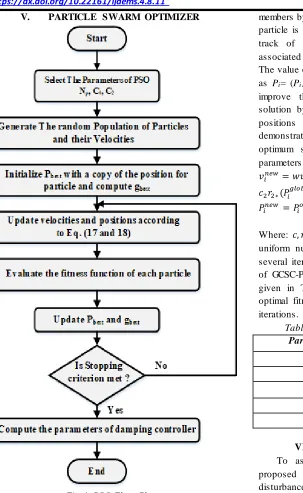
members by the best values of itself and the group. Each particle is represented by Xi = (xi1, xi2… xin) and keeps track of its coordinates in hyperspace, which are associated with the fittest solution it has achieved so far. The value of the fitness for particle i (Pbest) is also stored as Pi= (Pi1, Pi2… Pin). While PSO have new update to improve the performance in computing the optimal solution by tracking the best solutions (gbest) and its positions for any member in population. Fig.4 demonstrates the process of PSO algorithm to find out the optimum solution of GCSC supplementary controller parameters [8-10].
𝑣𝑖𝑛𝑒𝑤= 𝑤𝑣𝑖𝑜𝑙𝑑 + 𝑐1𝑟1∗ (𝑃𝑖𝐿𝑜𝑐𝑎𝑙 𝑏𝑒𝑠𝑡 − 𝑃𝑖𝑜𝑙𝑑) +
𝑐2𝑟2∗(𝑃𝑖
𝑔𝑙𝑜𝑏𝑎𝑙 𝑏𝑒𝑠𝑡
− 𝑃𝑖𝑜𝑙𝑑) (15)
𝑃𝑖𝑛𝑒𝑤 = 𝑃𝑖𝑜𝑙𝑑 + 𝑣𝑖𝑛𝑒𝑤 (16)
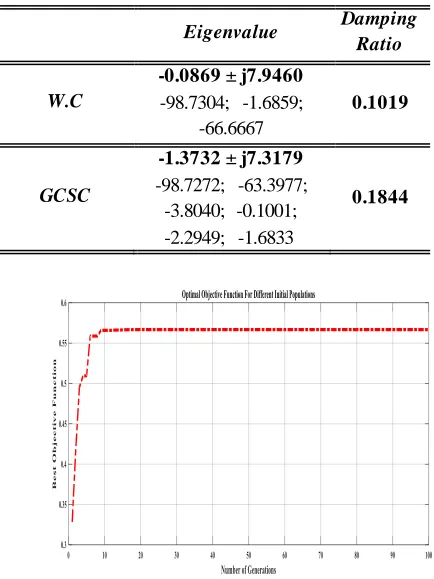
Where: 𝑐, 𝑟 are learning factor and independent random uniform numbers respectively. PSO algorithm runs for several iterations and determines the optimal parameters of GCSC-POD controller. The optimized parameters are given in Table (1) and the Figure (5) represents the optimal fitness function of SMIB plus GCSC post 100 iterations.
Table 1. GCSC POD Controller Parameters.
Parameters
Ks 5.0
𝜏1 1.0
𝜏2 0.3706
𝜏3 1.0
𝜏4 0.3706
VI. SIMULATION AND RESULTS
To assess effectiveness and robustness of the proposed controller and design approach, a severe disturbance is considered that is tripping a line for 5 cycles and the fault cleared and then returning the line in service. SMIB was tested system to evaluate the performance of GCSC based stabilizer controller in improvement the steady state and transient stability. In addition, eigenvalues of system under different operating conditions tabulated in tables (2-4) with consider the EM mode of oscillation and damping ratio highlighted by bold line.
Table.2: Eigenvalues Analysis (Normal Operating Condition).
Eigenvalue Damping Ratio W.C
-0.1479 ± j9.4457
-98.8179; -1.4764; -66.6667
https://dx.doi.org/10.22161/ijaems.4.8.11 ISSN: 2454-1311
GCSC
-3.8471 ± j5.5924
-98.8019; -54.5678; -7.9460; -0.1001;
-2.1696; -1.4738
0.5668
Table 3. Eigenvalues Analysis (Heavy Operating Condition).
Eigenvalue Damping Ratio W.C
0.1203 ±j9.9481
-98.8015; -1.5479; -66.6667
0.0121
GCSC
-3.8791 ± j4.7804
-98.7571; -50.9364; -11.4867; -0.1002;
-2.1739; -1.5410
0.6301
Table 4. Eigenvalues Analysis (Light Operating Condition).
Eigenvalue Damping Ratio W.C
-0.0869 ± j7.9460
-98.7304; -1.6859; -66.6667
0.1019
GCSC
-1.3732 ± j7.3179
-98.7272; -63.3977; -3.8040; -0.1001; -2.2949; -1.6833
0.1844
Fig. 5: Optimal Objective Function Graph.
In order to verify the robustness of optimized controller tables (2-4) shows the eigenvalues of system at various operating points beside the damping ratio of electromechanical (EM) mode of oscillations. It’s clear the damping ratio of EM of system without any supplementary controllers is low comparing when added the FACTS controller type GCSC which led to increase the damping ratio and also decreasing the settling time of system oscillation and overshoot of system. Figu res
(6-10) shows the system response when subjected to large disturbance before and after adding the supplementary controllers.
Fig.6: Rotor Angle.
Fig.7: Rotor Speed.
Fig. 8: Speed Deviation.
https://dx.doi.org/10.22161/ijaems.4.8.11 ISSN: 2454-1311
Fig.10: Acceleration Power.
VII. CONCLUSION
In this paper, GCSC damping controller is deigned based on PSO algorithm. Maximization of damping ratio of EM mode of oscillation is selected as objective function to be optimized. The GCSC supplementary controller has succeeded in increasing the damping ratio and then improve the system overall performance. Different loading conditions and a severe disturbance is employed to reveal the efficiency of damping controller. Assessment the nonlinear time domain simulation results and analyzing the eigen-proporties of system supported the robustness of the designed damping controller besides showing the superior performance of the eigenvalue based objective function in enhancing the steady state stability of system.
REFERENCES
[1] P.Kundur, Power system stability and control, 1st ed., McGraw-Hill, Inc., 1994.
[2] P.W.Sauer, M.A.Pai, Power system dynamics and stability, Prentice Hall, 1998.
[3] H.Wang, W.Du, Analysis and damping control of power system low frequency oscillations, Springer, 2016.
[4] E.Acha, V.G.Agelidies, O.Anaya-Lara, T.J.E.
Miller, “Power Electronics Control in Electrical Systems”, Newnes Power Engineering Series, first
publish 2002.
[5] Narian.G.Hingorani, Laszlo.Gyugyi, Understanding Facts, Wiley Interscience, 2000.
[6] Swakshar Ray, Ganesh Kumar, Edson H. Watanabe, A Computational approach to optimal damping controller design for a GCSC, IEEE Transactions on power delivery , Vol.23, No.3, July 2008.
[7] D.Mondal, A.Chakrabarti, Power system small signal stability analysis and control, Elsevier, 2014. [8] N.Rezaei, A.Safari, H.A.Shayanfar,”A Particle
Swarm Optimizer to Design A GCSC Based
Damping Controller of Power System”,
International Journal on Technical and Physical problems of power system, Sept. 2011-issue – volume-number 3- page 17-24.
[9] M.Abido, “Power System Stability Enhancement
Using FACTS Controllers: A Review”, The Arabian
Journal for Science and Engineering, Sept. 2008, Volume 34.
[10]Randy L.Haupt, Sue Ellen Haupt, Practical Genetic Algorithm, 2nded, Wiley Interscience, 2004.
APPENDIX
The investigated system parameters are:
Machine: 𝑥𝑑= 1, 𝑥𝑞= 0.8, 𝑥́𝑑= 0.15, 𝑀 = 6 𝑠, 𝑓 =
50 𝐻𝑧, 𝑇́𝑑𝑜= 5.044 𝑠,
𝑉𝑏 = 1, Pb=0.95.
Exciter: 𝐾𝐴= 10 , 𝑇𝐴= 0.05 𝑠. Transmission line:
𝑥𝐿1= 𝑥𝐿2= 0.7 , 𝑅𝑒 = 0 GCSC: Xc=0.7, TGCSC=15 msec.
BIOGRAPHIES
Mohammed Osman Hassan:Received his Bachelor degree in Electrical Engineering, and his Master degree in Power System from Sudan University of Science and Technology –Sudan, and his Ph.Dfrom Huazhong University of Science and Technology (HUST) - China. Currently, he is Assistant professor in Sudan University of Science and Technology (SUST) - Sudan. His main research interests are power system control, power s stability analysis, FACTS devices and application of AI in power systems