Patterns of Nonrandom Mating Within and Across 11 Major
Psychiatric Disorders
Ashley E. Nordsletten, PhD, Henrik Larsson, PhD, James J. Crowley, PhD, Catarina Almqvist, MD, PhD, Paul Lichtenstein, PhD, and David Mataix-Cols, PhD
Department of Clinical Neuroscience, Karolinska Institutet, Stockholm, Sweden (Nordsletten, Crowley, Mataix-Cols); Department of Medical Epidemiology and Biostatistics, Karolinska Institutet, Stockholm, Sweden (Larsson, Almqvist, Lichtenstein); Department of Genetics, University of North Carolina at Chapel Hill (Crowley); Astrid Lindgren Children’s Hospital, Karolinska University Hospital, Stockholm, Sweden (Almqvist)
Abstract
IMPORTANCE—Psychiatric disorders are heritable, polygenic traits, which often share risk alleles and for which nonrandom mating has been suggested. However, despite the potential etiological implications, the scale of nonrandom mating within and across major psychiatric conditions remains unclear.
OBJECTIVE—To quantify the nature and extent of nonrandom mating within and across a broad range of psychiatric conditions at the population level.
DESIGN, SETTING, AND PARTICIPANTS—Population-based cohort using Swedish population registers. Participants were all Swedish residents with a psychiatric diagnosis of interest (attention-deficit/hyperactivity disorder, autism spectrum disorder, schizophrenia, bipolar disorder, major depression, generalized anxiety disorder, agoraphobia, social phobia, obsessive-compulsive disorder, anorexia, or substance abuse), along with their mates. Individuals with select nonpsychiatric disorders (Crohn’s disease, type 1 and type 2 diabetes mellitus, multiple sclerosis, or rheumatoid arthritis) were included for comparison. General population samples were also derived and matched 1:5 with each case proband. Inpatient and outpatient diagnostic data were
Corresponding Author: Ashley E. Nordsletten, PhD, Department of Clinical Neuroscience, Karolinska Institutet, Gävlegatan 22, SE-113 30 Stockholm, Sweden ([email protected]).
Supplemental content at jamapsychiatry.com
Author Contributions: Dr Nordsletten had full access to all the data in the study and takes responsibility for the integrity of the data and the accuracy of the data analysis.
Study concept and design: Nordsletten, Larsson, Lichtenstein, Mataix-Cols. Acquisition, analysis, or interpretation of data: All authors.
Drafting of the manuscript: Nordsletten, Crowley.
Critical revision of the manuscript for important intellectual content: Larsson, Crowley, Almqvist, Lichtenstein, Mataix-Cols. Statistical analysis: Nordsletten.
Obtained funding: Larsson, Almqvist, Lichtenstein, Mataix-Cols.
Administrative, technical, or material support: Crowley, Almqvist, Lichtenstein. Study supervision: Larsson, Lichtenstein, Mataix-Cols.
Conflict of Interest Disclosures: Dr Larsson reported serving as a speaker for Eli Lilly & Company and Shire and reported receiving a research grant from Shire, all outside of the present work. No other disclosures were reported.
HHS Public Access
Author manuscript
JAMA Psychiatry
. Author manuscript; available in PMC 2016 October 27.Published in final edited form as:
JAMA Psychiatry. 2016 April ; 73(4): 354–361. doi:10.1001/jamapsychiatry.2015.3192.
A
uthor Man
uscr
ipt
A
uthor Man
uscr
ipt
A
uthor Man
uscr
ipt
A
uthor Man
uscr
derived from the Swedish National Patient Register (1973-2009), with analyses conducted between June 2014 and May 2015.
MAIN OUTCOMES AND MEASURES—Correlation in the diagnostic status of mates both within and across disorders. Conditional logistic regression was used to quantify the odds of each diagnosis in the mates of cases relative to matched population controls.
RESULTS—Across cohorts, data corresponded to 707 263 unique case individuals, with women constituting 45.7% of the full population. Positive correlations in diagnostic status were evident between mates. Within-disorder correlations were marginally higher (range, 0.11-0.48) than cross-disorder correlations (range, 0.01-0.42). Relative to matched populations, the odds of psychiatric case probands having an affected mate were significantly elevated. Differences in the magnitude of observed relationships were apparent by disorder (odds ratio range, 0.8-11.4). The number of comorbidities in a case proband was associated with the proportion of affected mates. These relationships were not apparent or weaker in magnitude among nonpsychiatric conditions (correlation range, −0.03 to 0.17).
CONCLUSIONS AND RELEVANCE—Nonrandom mating is evident in psychiatric
populations both within specific disorders and across the spectrum of psychiatric conditions. This phenomenon may hold important implications for how we understand the familial transmission of these disorders and for psychiatric genetic research.
The term marital resemblance refers to the observed tendency for mated pairs to be more
phenotypically similar for a given characteristic than would be expected by chance.1 A
modest body of literature has suggested the presence of marital resemblance for a range of
psychiatric features2-5 and clinical diagnoses,6-8 with a small subset of this work noting
resemblance across disorders.9,10 However, the limited range of conditions considered
within these investigations and their collective reliance on small volunteer samples and self- or informant reports highlights the need for work that can assess this phenomenon in larger, more diverse psychiatric populations.
Psychiatric disorders are thought to stem from a complex interplay between genetic and environmental risk factors, with the magnitude of their respective influence varying by
disorder, sex, and time.11,12 In this context, spousal resemblance becomes an important
phenomenon because the pairing of individuals with a psychiatric condition (a complex trait) at a rate greater than chance would have population-level effects on each of these
determinant factors: increasing the genetic variance of these offspring (from the population mean) while also producing familial environments that are more likely to be shaped by the
relevant conditions.13,14 In this manner, if present, nonrandom mating could have important
implications for our understanding of the transmission and persistence of psychiatric illness.
Known overlaps in the genetic risks for psychiatric disorders only add to this rationale15-18
and underscore the need to extend such examination to cross-disorder mating patterns.
The primary aim of the present study was, therefore, to extend work in this area and determine the extent to which nonrandom mating is present within and across a broad range of psychiatric conditions at the population level.
A
uthor Man
uscr
ipt
A
uthor Man
uscr
ipt
A
uthor Man
uscr
ipt
A
uthor Man
uscr
Methods
National Registers and Sample Identification
Ethical approval was obtained from the research ethics committee at Karolinska Institutet, Stockholm, Sweden. The requirement for informed consent was waived because the study was register based and the included individuals were deidentified. Data were linked across 3 Swedish national registers using unique personal identification numbers that have been assigned at birth in Sweden since 1947. The study dates were defined by the psychiatric outcomes of the population as defined using the Swedish National Patient Register (NPR), with analyses conducted between June 2014 and May 2015.
The NPR includes diagnostic information on all individuals admitted to a Swedish hospital, with complete nation-wide psychiatric records from 1973. Since 2001, the NPR has also contained data on outpatient consultations, including psychiatric care. Each consultation is recorded as a unique entry in the NPR, with a corresponding discharge diagnosis (as determined by the treating physician). These diagnoses are documented using the World Health Organization’s International Statistical Classification of Diseases and Related Health Problems, including ICD-8 (1969-1986), ICD-9 (1987-1996), and ICD-10 (1997 onward). This register has been heavily used in research, leading to standardized and validated protocols for selecting psychiatric populations. These protocols have been adhered to in the present investigation, with established codes (eMaterial in the Supplement) used to define
cases of the following: schizophrenia,19 bipolar disorder,19 autism spectrum disorder
(ASD),19 anorexia nervosa,19 substance abuse,19 attention-deficit hyperactivity disorder
(ADHD),15 obsessive-compulsive disorder (OCD),20 major depressive disorder (MDD),19
social phobia, agoraphobia,21 and generalized anxiety disorder (GAD).21 Individuals with
tic disorder were also selected, although small case numbers precluded examination of mating patterns in these populations. For purposes of comparison, cases of select nonpsychiatric conditions of similar incidence and age at onset were also identified,
including Crohn’s disease,22 type 1 and type 2 diabetes mellitus, multiple sclerosis,23 and
rheumatoid arthritis.24,25
Case probands were defined as any individual with a diagnosis of interest as indicated by at least 1 relevant ICD diagnosis (2 for schizophrenia and bipolar disorder) registered in the NPR. These diagnoses were identified using a nonhierarchical structure. Therefore, an individual with multiple diagnoses (eg, ASD and OCD) was permitted to appear as a “case” in both the ASD and OCD data sets. To each case proband, we matched 5 population controls on the basis of age, sex, and area of residence in Sweden at the time of the proband’s first diagnosis.
Mating relationships were identified through (1) a record of an individual’s marriage (Total Population Register, which contains demographic information [eg, sex and marital status] for all individuals born or living in Sweden, with complete coverage from 1968 onward) or (2) a record of an individual being the biological parent of a child in the Multi-Generation Register. Because many couples in Sweden remain in unregistered, cohabitating
relationships, the use of the birth of a child was integral to capturing Sweden’s true “mated” population. Although imperfect, this process has ensured inclusion of the largest possible
A
uthor Man
uscr
ipt
A
uthor Man
uscr
ipt
A
uthor Man
uscr
ipt
A
uthor Man
uscr
segment of these individuals. In the Multi-Generation Register, the father is defined as the spouse at the time of the child’s birth or, alternatively, the individual acknowledged as the father. Due to the register’s emphasis on biological relationships in recording parentage, all pairs included in the present study were heterosexual.
For each member of a mated case pair, a comparison sample was again generated and matched 1:5 on age, sex, and county of residence. The matching criteria also specified that population controls must not have the diagnosis of interest. For example, if matching for a man with ADHD, controls were selected from all male individuals who did not have an ADHD diagnosis. No further restrictions were placed to allow for representative comparison populations.
Statistical Analysis
The statistical analysis was conducted using a software program (Stata, release 13;
StataCorp LP).26 Analyses were performed by disorder, with tests repeated in each
disorder-specific population (eg, ADHD cases and their matched population controls). Individuals were permitted to mate more than once, with matched controls selected anew for each separate pairing and treated as independent in the analysis. Where relevant, the software program’s survey routines were used to account for the matching, with reported standard errors robust to this structure. To permit testing of sex-specific effects and to avert duplication of affected pairs, all analyses were conducted by sex.
The proportions of mated pairs in each full case and matched control sample were first summarized. Using the mated subsets, tetrachoric correlations—run first within and subsequently across disorders—were then used to evaluate the magnitude and significance of the relationship between mates’ diagnostic status. Simple or conditional (cross-disorder relationships only) logistic regressions followed to illustrate the odds of each diagnosis in the mates of cases relative to the odds among the mates of matched population controls. A final analysis then merged all of these populations by ID into a single data set to (1) test the relative effect of any diagnosis (in a proband) on the odds of any diagnosis in mates and (2) explore the relationship between the number of comorbidities (in a case proband) and the presence of any psychiatric diagnoses in mates.
Due to the possible confounding effects of certain comorbidities and in an effort to isolate the mating profile of the disorder of interest, pairs were omitted from conditional analyses if (1) cases had the outcome diagnosis of interest or (2) mates had the predictor diagnosis of interest. Therefore, if examining the odds of ADHD cases selecting mates with OCD, the restricted sample would exclude pairs in which case probands had a diagnosis of OCD or mates had a diagnosis of ADHD. Figures 1, 2, 3, and 4 reflect the results of these restricted analyses. Where reported, significance was set at P < .001.
Results
Case SamplesThe initial size of each disorder-specific sample and the proportion of these cases that mated is provided in Table 1 and Table 2. Across all samples, case probands showed significantly
A
uthor Man
uscr
ipt
A
uthor Man
uscr
ipt
A
uthor Man
uscr
ipt
A
uthor Man
uscr
reduced odds of mating relative to their matched populations. The magnitude of these reductions varied by disorder and sex, with particularly attenuated rates observed among individuals with schizophrenia. Low rates of mating in ADHD, ASD, and tic disorder reflect, in part, the youth of these populations, with a respective 21.5%, 22.3%, and 19.6% of these indexes being younger than 20 years (≤2.5% for all other samples). Due to an insufficient number of paired cases, one disorder group (tic syndrome) was omitted from further analysis, while the low number of men with anorexia nervosa led to the consideration of mating patterns only among women.
Mating Patterns
Within each disorder sample (eg, ADHD case and control probands), the mates of both sexes were meaningfully correlated for diagnostic status (range, 0.11-0.48) (Figure 1). Cross-disorder correlations (range, 0.01-0.42) were also evident, being typically lower than within-disorder correlations. Patterns of these correlations varied for each within-disorder sample, although some clustering of pronounced interdisorder correlations was observed for the
neurodevelopmental conditions (eg, ASD and ADHD) and, to a lesser extent, the anxiety disorders.
As shown in Figure 2, a disorder in a case was typically associated with a 2-fold to 3-fold increase in his or her mate’s odds of having the same or an alternate condition. These risks were compounded in select conditions, such as ADHD, ASD, and schizophrenia, although small samples for some analytic combinations, particularly ASD, require cautious
interpretation (the 95% CIs are shown in eFigures 1 through 11 in the Supplement).
An analysis considering the odds of any diagnosis among the mates of case probands found a significant increase for both male cases (odds ratio [OR], 2.24; 95% CI, 2.21-2.27; P < . 001) and female cases (OR, 2.11; 95% CI, 2.08-2.14; P < .001). The proportion of case probands having an affected mate increased linearly with the number of comorbidities in the proband (Figure 3).
Nonpsychiatric Conditions
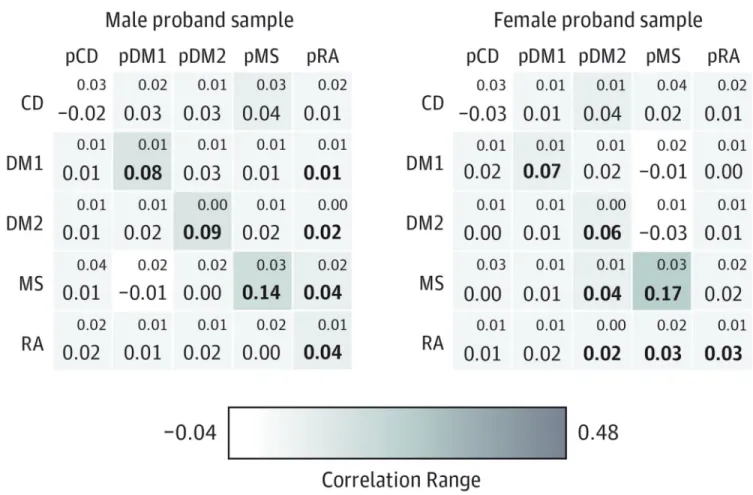
In contrast to psychiatric samples, mating rates were consistently high among both men and women with nonpsychiatric diagnoses (eTable in the Supplement). Meaningful spousal correlations within and across these conditions were rare (correlation range, −0.03 to 0.17) (Figure 4), with the presence of a nonpsychiatric condition in one spouse associated with little increase in his or her spouse’s risk for the same or any other diagnoses (eFigure 12 in the Supplement). Of the 5 nonpsychiatric conditions, only multiple sclerosis showed a spousal correlation comparable to that observed in the psychiatric samples.
Discussion
This study aimed to describe patterns of mating in a broad range of psychiatric disorders using a large population-based cohort. Our results, which extend previous work in this area, indicate that (1) nonrandom mating is often present in psychiatric patients, (2) this mating exists both within and across conditions, (3) there is substantial variation in the pattern
A
uthor Man
uscr
ipt
A
uthor Man
uscr
ipt
A
uthor Man
uscr
ipt
A
uthor Man
uscr
according to diagnosis, and (4) this phenomenon is not observed to the same degree in nonpsychiatric conditions.
In psychiatric samples, disorders exhibiting more marked spousal correlations and risk increases tended to be those that either emerge at an early age (eg, ADHD and ASD) or are associated with especially severe symptoms (eg, schizophrenia and substance abuse). These populations generally showed higher within-disorder correlations, with some also exhibiting marked cross-disorder correlations (eg, ADHD with ASD). Notably, some of these disorders (schizophrenia and ASD) are among those most likely to reduce overall reproductive
success,19 suggesting that these phenotypes (and, by extension, genotypes) may be under
strong negative selection in the general population while being positively selected for within certain psychiatric populations. This result is an important finding given its potential implication for the maintenance of these conditions in the general population, with the possibility raised that these mating patterns compensate, to some degree, for the reductions
in fecundity observed in these same mental disorders.19
Mating patterns varied by condition, with most psychiatric samples characterized by modest correlations across the range of disorders, while a few showed marked relationships within a select set of conditions. These spousal correlations were often higher than those observed elsewhere for traits like personality (approximately 0.10) or height and weight
(approximately 0.20).13,14,27,28 Disorders exhibiting the former, low-variance pattern
included the mood disorders (eg, MDD and bipolar disorder) and select anxiety disorders (eg, GAD). Such a profile could account for the conflicting findings of prior resemblance
studies1,9,29,30 in the affective and anxiety disorders, which have rarely had the large-scale
data necessary to draw out these more subtle relationships. The few multidisorder studies9,10
that have considered resemblance for similar patient groups have found comparable
correlations, generally ranging between 0.1 and 0.3. In a meta-analysis31 considering
spousal resemblance for MDD, an OR of 2.38 was reported, which is slightly higher than our estimate of approximately 1.80.
The general absence of these patterns in nonpsychiatric conditions is noteworthy,
particularly given the variation of the examined conditions in terms of typical onset, course, and symptoms. The rates of mating success observed in these populations, even for early-onset conditions with behavioral symptoms (eg, type 1 diabetes mellitus), suggest clear differences between psychiatric and nonpsychiatric conditions in regard to an affected individual’s mating success and selection.
Implications for Psychiatric Genetics Research
To the extent that phenotype reflects genotype, nonrandom mating of individuals who share a psychiatric disorder will result in mates who have a nonrandom distribution of the genetic variants associated with that condition. Given that a family history positive for a psychiatric disorder (eg, schizophrenia) has been associated with increased polygenic risk scores in
subsequent generations,32 it seems reasonable to anticipate a meaningful increase in genetic
variance among the offspring of these dual-diagnosis pairs. Work in population genetics suggests that such an increase would be specific to additive genetic variance, with this increase aggregating over generations in the continued presence of nonrandom mating until
A
uthor Man
uscr
ipt
A
uthor Man
uscr
ipt
A
uthor Man
uscr
ipt
A
uthor Man
uscr
equilibrium is reached.33 While this finding does not imply a determinant risk in a given child, at the population level, this tendency toward spousal concordance will result in a subpopulation of offspring who differ substantially from the genetic mean and are, as a whole, at heightened genetic risk for psychiatric disorders.
Most case samples also demonstrated cross-disorder mating. The genetic implications of this mating will differ depending on the degree to which these conditions stem from shared genetic risks. For instance, substance use disorders have been proposed to have largely
unique genetic risk factors.34 In theory, this hypothesis would mean that the pairing of an
individual with substance abuse to an individual with a different psychiatric condition would result only in a phenotypic, rather than genotypic, correlation. However, this degree of genetic heterogeneity is highly unusual for psychiatric disorders. For instance, the genetic risks for MDD appear to be almost entirely shared by those for GAD, while the risks for both ADHD and bipolar disorder are shared to a meaningful degree with
schizophrenia.15-17,35,36 Under these circumstances, the mating of individuals with different
conditions would have effects similar to a within-disorder pairing, increasing the concentration of the variants shared by these disorders while also introducing unique variants associated with the individual phenotypes. Offspring from these pairings would be at increased genetic risk for both conditions as well as for other conditions that share a similar liability profile.
Further work will be needed to quantify these risks, untangling their effects on offspring psychopathology and the maintenance of these conditions in the population. Although few, existing population-based examinations suggest that up to 67.5% of offspring from dual-schizophrenia couples and 44.2% from dual–bipolar disorder couples may develop these
disorders, suggesting strong phenotypic effects from these concentrated genetic risks.37
Cross-pairings have been associated with attenuated, albeit still increased, proportions of
diagnosed offspring.37 A longitudinal investigation capable of examining the mating
mechanisms would be a valuable addition to this discussion because such genetic effects may aggregate and differentiate over time. Certainly, nonrandom mating could offer a
mechanism of origin for disorder-dense pedigrees observed in the literature,38 with
polygenic risks compounding as such mating perpetuates in a family over generations (eg, due to geographical or social isolation).
Finally, spousal resemblance for psychiatric conditions has implications for genetic models, which are usually conducted under the assumption of random mating. The presence of resemblance across most conditions refutes this assumption and indicates that models should allow for the correlation of spouses to avoid potential bias in heritability estimates (eg, in twin studies, where neglect of spousal correlations may underestimate heritability). The extra additive genetic variance also has implications for genome-wide association studies and single-nucleotide polymorphism–based heritability estimates because these methods are limited to additive genetic variance.
Limitations
Our definition of mating fails to capture some alternative pairings (eg, childless, unmarried, and cohabitating partners). As the registers continue to develop, better capture of these
A
uthor Man
uscr
ipt
A
uthor Man
uscr
ipt
A
uthor Man
uscr
ipt
A
uthor Man
uscr
relationships may be anticipated. Furthermore, reliance on register diagnoses inherently limits our examination to individuals who have sought outpatient or inpatient care for psychiatric concerns, with such populations potentially constituting a unique subset of the whole affected population. While it is difficult to quantify the impacts of this detection bias, it may be noted that we have found largely comparable results for disorders that frequently require in patient admissions and are thus well captured in the registers (eg, schizophrenia and bipolar disorder) and those that are typically managed in outpatient settings and may therefore be more variably captured (eg, MDD and GAD). In addition, the magnitude of the relationships observed in our samples accord, to a large degree, with prior research
conducted in related populations sampled using different approaches.9,10
We are also limited in the comment we can offer on the mechanisms underlying the mating patterns observed (eg, assortative mating vs marital interaction). Certainly, it is possible that the presence of a disordered behavior in one spouse (eg, alcohol dependence) could
influence his or her mate’s consumption (interaction) or spur the development of an alternative condition (eg, MDD) as a reaction (contagion). Individuals with an affected mate may also be more likely to access services and receive their own diagnosis (detection bias). This being said, prior work has failed to find a relationship between marriage duration and either the magnitude of resemblance or the rates of spousal concordance for psychiatric
conditions.9,10 Furthermore, the negligible shared environment effects observed in many
heritable psychiatric conditions would favor the phenotypic assortment alternative.6
Moreover, our finding of marked resemblance for neurodevelopmental conditions suggests a role for assortment in at least some populations because these conditions would be present over the life span.
Finally, while the samples used in this investigation are degrees of magnitude larger than those of prior investigations, low rates of mating in some case populations (most notably ASD) require conservative interpretation. Studies offering further coverage of these populations would be a valuable addition to this area of inquiry. Given the relationship observed in our samples between the number of comorbidities and the risk of nonrandom mating, work exploring the role of comorbidity in this phenomenon would also be of interest.
Conclusions
This work suggests that nonrandom mating is widespread in psychiatric populations both within and across the spectrum of psychiatric disorders. This phenomenon, which is not observed in nonpsychiatric populations, may hold important implications for how we understand the familial transmission of these conditions and the ubiquity of comorbidity and complex symptoms in clinical populations. Furthermore, the results challenge a fundamental assumption of current genetic research methods, suggesting that more attention to this issue is warranted.
Supplementary Material
Refer to Web version on PubMed Central for supplementary material.
A
uthor Man
uscr
ipt
A
uthor Man
uscr
ipt
A
uthor Man
uscr
ipt
A
uthor Man
uscr
Acknowledgments
Funding/Support: This work was supported by framework grant 340-2013-5867 from the Swedish Research Council through the Swedish Initiative for Research on Microdata in the Social and Medical Sciences.
Role of the Funder/Sponsor: The funding source had no role in the design and conduct of the study; collection, management, analysis, and interpretation of the data; preparation, review, or approval of the manuscript; and decision to submit the manuscript for publication.
REFERENCES
1. Merikangas KR, Spiker DG. Assortative mating among in-patients with primary affective disorder. Psychol Med. 1982; 12(4):753–764. [PubMed: 7156249]
2. Boomsma DI, Saviouk V, Hottenga JJ, et al. Genetic epidemiology of attention deficit hyperactivity disorder (ADHD index) in adults. PLoS One. 2010; 5(5):e10621. doi:10.1371/journal.pone. 0010621. [PubMed: 20485550]
3. Krueger RF, Moffitt TE, Caspi A, Bleske A, Silva PA. Assortative mating for antisocial behavior: developmental and methodological implications. Behav Genet. 1998; 28(3):173–186. [PubMed: 9670593]
4. Grant JD, Heath AC, Bucholz KK, et al. Spousal concordance for alcohol dependence: evidence for assortative mating or spousal interaction effects? Alcohol Clin Exp Res. 2007; 31(5):717–728. [PubMed: 17378921]
5. Agrawal A, Heath AC, Grant JD, et al. Assortative mating for cigarette smoking and for alcohol consumption in female Australian twins and their spouses. Behav Genet. 2006; 36(4):553–566. [PubMed: 16710775]
6. Mataix-Cols D, Boman M, Monzani B, et al. Population-based, multigenerational family clustering study of obsessive-compulsive disorder. JAMA Psychiatry. 2013; 70(7):709–717. [PubMed: 23699935]
7. Isomura K, Boman M, Rück C, et al. Population-based, multi-generational family clustering study of social anxiety disorder and avoidant personality disorder. Psychol Med. 2015; 45(8):1581–1589. [PubMed: 25215596]
8. Lichtenstein P, Björk C, Hultman CM, Scolnick E, Sklar P, Sullivan PF. Recurrence risks for schizophrenia in a Swedish national cohort. Psychol Med. 2006; 36(10):1417–1425. [PubMed: 16863597]
9. Maes HH, Neale MC, Kendler KS, et al. Assortative mating for major psychiatric diagnoses in two population-based samples. Psychol Med. 1998; 28(6):1389–1401. [PubMed: 9854280]
10. van Grootheest DS, van den Berg SM, Cath DC, Willemsen G, Boomsma DI. Marital resemblance for obsessive-compulsive, anxious and depressive symptoms in a population-based sample. Psychol Med. 2008; 38(12):1731–1740. [PubMed: 18304384]
11. Kendler KS, Gardner CO, Lichtenstein P. A developmental twin study of symptoms of anxiety and depression: evidence for genetic innovation and attenuation. Psychol Med. 2008; 38(11):1567– 1575. [PubMed: 18578897]
12. Kendler KS, Eaves LJ, Loken EK, et al. The impact of environmental experiences on symptoms of anxiety and depression across the life span. Psychol Sci. 2011; 22(10):1343–1352. [PubMed: 21948854]
13. Plomin, R. Genetics and Experience: The Interplay Between Nature and Nurture. Vol. 6. SAGE Publications; Thousand Oaks, CA: 1994. SAGE Series on Individual Differences and
Development
14. Plomin R, Deary IJ. Genetics and intelligence differences: five special findings. Mol Psychiatry. 2015; 20(1):98–108. [PubMed: 25224258]
15. Larsson H, Rydén E, Boman M, Långström N, Lichtenstein P, Landén M. Risk of bipolar disorder and schizophrenia in relatives of people with attention-deficit hyperactivity disorder. Br J Psychiatry. 2013; 203(2):103–106. [PubMed: 23703314]
16. Lee SH, Ripke S, Neale BM, et al. Cross-Disorder Group of the Psychiatric Genomics Consortium; International Inflammatory Bowel Disease Genetics Consortium (IIBDGC). Genetic relationship
A
uthor Man
uscr
ipt
A
uthor Man
uscr
ipt
A
uthor Man
uscr
ipt
A
uthor Man
uscr
between five psychiatric disorders estimated from genome-wide SNPs. Nat Genet. 2013; 45(9): 984–994. [PubMed: 23933821]
17. Cross-Disorder Group of the Psychiatric Genomics Consortium. Identification of risk loci with shared effects on five major psychiatric disorders: a genome-wide analysis. Lancet. 2013; 381(9875):1371–1379. [PubMed: 23453885]
18. Cederlöf M, Lichtenstein P, Larsson H, et al. Obsessive-compulsive disorder, psychosis, and bipolarity: a longitudinal cohort and multigenerational family study. Schizophr Bull. 2015; 41(5): 1076–1083. [PubMed: 25512596]
19. Power RA, Kyaga S, Uher R, et al. Fecundity of patients with schizophrenia, autism, bipolar disorder, depression, anorexia nervosa, or substance abuse vs their unaffected siblings. JAMA Psychiatry. 2013; 70(1):22–30. [PubMed: 23147713]
20. Rück C, Larsson KJ, Lind K, et al. Validity and reliability of chronic tic disorder and obsessive-compulsive disorder diagnoses in the Swedish National Patient Register. BMJ Open. 2015; 5(6):e007520. doi:10.1136/bmjopen-2014-007520.
21. Li X, Sundquist J, Sundquist K. Sibling risk of anxiety disorders based on hospitalizations in Sweden. Psychiatry Clin Neurosci. 2011; 65(3):233–238. [PubMed: 21507129]
22. Andersson RE, Olaison G, Tysk C, Ekbom A. Appendectomy is followed by increased risk of Crohn’s disease. Gastroenterology. 2003; 124(1):40–46. [PubMed: 12512028]
23. Ahlgren C, Odén A, Lycke J. High nationwide prevalence of multiple sclerosis in Sweden. Mult Scler. 2011; 17(8):901–908. [PubMed: 21459810]
24. Askling J, Fored CM, Brandt L, et al. Risk and case characteristics of tuberculosis in rheumatoid arthritis associated with tumor necrosis factor antagonists in Sweden. Arthritis Rheum. 2005; 52(7):1986–1992. [PubMed: 15986370]
25. Baecklund E, Iliadou A, Askling J, et al. Association of chronic inflammation, not its treatment, with increased lymphoma risk in rheumatoid arthritis. Arthritis Rheum. 2006; 54(3):692–701. [PubMed: 16508929]
26. StataCorp LP. Stata Statistical Software. StataCorp LP; College Station, TX: 2013. computer programRelease 13
27. Whitaker KL, Jarvis MJ, Beeken RJ, Boniface D, Wardle J. Comparing maternal and paternal intergenerational transmission of obesity risk in a large population-based sample. Am J Clin Nutr. 2010; 91(6):1560–1567. [PubMed: 20375189]
28. Vandenburg SG. Assortative mating, or who marries whom? Behav Genet. 1972; 2(2):127–157. [PubMed: 4664207]
29. Heun R, Maier W. Morbid risks for major disorders and frequencies of personality disorders among spouses of psychiatric inpatients and controls. Compr Psychiatry. 1993; 34(2):137–143. [PubMed: 8485983]
30. Merikangas KR. Assortative mating for psychiatric disorders and psychological traits. Arch Gen Psychiatry. 1982; 39(10):1173–1180. [PubMed: 6751267]
31. Mathews CA, Reus VI. Assortative mating in the affective disorders: a systematic review and meta-analysis. Compr Psychiatry. 2001; 42(4):257–262. [PubMed: 11458299]
32. Agerbo E, Sullivan PF, Vilhjálmsson BJ, et al. Polygenic risk score, parental socioeconomic status, family history of psychiatric disorders, and the risk for schizophrenia: a Danish population-based study and meta-analysis. JAMA Psychiatry. 2015; 72(7):635–641. [PubMed: 25830477]
33. Falconer, DS.; Mackay, TFC. Introduction to Quantitative Genetics. 4th ed.. Benjamin Cummings; San Francisco, CA: 1996.
34. Kendler KS, Prescott CA, Myers J, Neale MC. The structure of genetic and environmental risk factors for common psychiatric and substance use disorders in men and women. Arch Gen Psychiatry. 2003; 60(9):929–937. [PubMed: 12963675]
35. Lichtenstein P, Yip BH, Björk C, et al. Common genetic determinants of schizophrenia and bipolar disorder in Swedish families: a population-based study. Lancet. 2009; 373(9659):234–239. [PubMed: 19150704]
37. Gottesman II, Laursen TM, Bertelsen A, Mortensen PB. Severe mental disorders in offspring with 2 psychiatrically ill parents. Arch Gen Psychiatry. 2010; 67(3):252–257. [PubMed: 20194825] 38. Collins AL, Kim Y, Szatkiewicz JP, et al. Identifying bipolar disorder susceptibility loci in a
densely affected pedigree. Mol Psychiatry. 2013; 18(12):1245–1246. [PubMed: 23247078]
A
uthor Man
uscr
ipt
A
uthor Man
uscr
ipt
A
uthor Man
uscr
ipt
A
uthor Man
uscr
Key Points
Question
What is the nature and extent of nonrandom mating in psychiatric populations, and to what degree does it vary by disorder?
Findings
Nonrandom mating was widespread in psychiatric populations both within and across psychiatric disorders but was not observed in nonpsychiatric populations.
Meaning
This phenomenon may hold important implications for how we understand the familial transmission of psychiatric disorders and for genetic research.
A
uthor Man
uscr
ipt
A
uthor Man
uscr
ipt
A
uthor Man
uscr
ipt
A
uthor Man
uscr
Figure 1. Within-Disorder and Cross-Disorder Partner Correlations, by Psychiatric Proband Sex, in Restricted Case Samples
The magnitude of the spousal correlations is reflected in the figure’s coloration, with darker boxes indicating stronger correlations between the diagnostic status of the relevant proband (indicated by row labels) and the corresponding diagnostic status of his or her mate
(indicated by column labels). pXXX is the opposite-sex partner of a proband with diagnosis XXX. Large figures in each box reflect the correlation for that row or column, with small figures indicating the standard error. Large figures in bold indicate that the correlation is statistically significant (P < .001). Due to unique matched populations and the possibility of multiple pairings per individual, within-disorder correlations may be asymmetric for the same comparison depending on the proband sex. Empty values in ANO and pANO rows and columns reflect confinement of analyses to female probands or partners. ADHD indicates attention-deficit/hyperactivity disorder; AGO, agoraphobia; ANO, anorexia nervosa; ASD, autism spectrum disorder; BIP, bipolar disorder; DEP, major depressive disorder; GAD, generalized anxiety disorder; OCD, obsessive-compulsive disorder; SCZ, schizophrenia; SOC, social phobia; and SUB, substance abuse.
A
uthor Man
uscr
ipt
A
uthor Man
uscr
ipt
A
uthor Man
uscr
ipt
A
uthor Man
uscr
Figure 2. Dot Plot of Odds Ratios Illustrating Mating Patterns Within and Across Major Mental Disorders, by Psychiatric Proband Sex
Plotted points illustrate the increased odds, relative to matched populations, of each individual diagnosis among the opposite-sex partners of case probands (whose sex and diagnosis are labeled on the x-axis). mXXX is a male proband with diagnosis XXX, fXXX is a female proband with diagnosis XXX, and pXXX is the opposite-sex partner of a proband with diagnosis XXX. ADHD indicates attention-deficit/hyperactivity disorder; AGO, agoraphobia; ANO, anorexia nervosa; ASD, autism spectrum disorder; BIP, bipolar disorder; DEP, major depressive disorder; GAD, generalized anxiety disorder; OCD, obsessive-compulsive disorder; SCZ, schizophrenia; SOC, social phobia; and SUB, substance abuse.
A
uthor Man
uscr
ipt
A
uthor Man
uscr
ipt
A
uthor Man
uscr
ipt
A
uthor Man
uscr
Figure 3. Linear Plot Depicting the Relationship of Psychiatric Proband Diagnosis (Total No.) to the Proportion of Partners With a Diagnosis
The proportion of case probands having an affected mate increased linearly with the number of comorbidities in the proband.
A
uthor Man
uscr
ipt
A
uthor Man
uscr
ipt
A
uthor Man
uscr
ipt
A
uthor Man
uscr
Figure 4. Within-Disorder and Cross-Disorder Partner Correlations, by Nonpsychiatric Proband Sex, in Restricted Case Samples
The magnitude of the spousal correlations is reflected in the figure’s coloration, with darker boxes indicating stronger correlations between the diagnostic status of the relevant proband (indicated by row labels) and the corresponding diagnostic status of his or her mate
(indicated by column labels). pXXX is the opposite-sex partner of a proband with diagnosis XXX. Large figures in each box reflect the correlation for that row or column, with small figures indicating the standard error. Large figures in bold indicate that the correlation is statistically significant (P < .001). Due to unique matched populations and the possibility of multiple pairings per individual, within-disorder correlations may be asymmetric for the same comparison depending on the proband sex. CD indicates Crohn’s disease; DM1, type I diabetes mellitus; DM2, type 2 diabetes mellitus; MS, multiple sclerosis; and RA,
rheumatoid arthritis.
A
uthor Man
uscr
ipt
A
uthor Man
uscr
ipt
A
uthor Man
uscr
ipt
A
uthor Man
uscr
A
uthor Man
uscr
ipt
A
uthor Man
uscr
ipt
A
uthor Man
uscr
ipt
A
uthor Man
uscr
ipt
Table 1
Odds of Case Probands Mating, Relative to Matched Population Probands, by Diagnosis and Gender
All Men
Total Proband, No. Proportion Mated
Proband Diagnosis Case
Matched
Population Case, No. %
Matched
Population, No. % ORa (95% CI)
ADHD 41 157 205 784 6383 15.5 34 413 16.7 0.92 (0.90-0.93)
ASD 18 052 90 260 880 4.9 16 766 18.6 0.22 (0.21-0.24)
Schizophrenia 37 019 185 095 9632 26.0 147 253 79.6 0.09 (0.09-0.09)
Bipolar 30 438 152 190 19 775 65.0 118 788 78.1 0.52 (0.51-0.53)
Depression 132 640 663 199 88 746 66.9 475 133 71.6 0.80 (0.79-0.81)
GAD 9984 49 920 5784 57.9 33 387 66.9 0.68 (0.66-0.71)
Agoraphobia 3557 17 785 1863 52.4 10 623 58.7 0.74 (0.70-0.79)
Social phobia 8528 42 640 3230 37.9 22 623 53.1 0.54 (0.52-0.56)
OCD 8778 43 890 2570 29.3 20 489 46.7 0.47 (0.45-0.49)
Substance 266 680 1 333 400 173 810 65.2 1 000 606 75.0 0.62 (0.62-0.63)
Anorexia 2759 13 795 614 22.3 3945 28.6 0.71 (0.65-0.78)
Tics 3628 18 140 464 12.8 3346 18.4 0.65 (0.60-0.70)
Abbreviations: ADHD, attention-deficit/hyperactivity disorder; ASD, autism spectrum disorder; GAD, generalized anxiety disorder; OCD, obsessive compulsive disorder; OR, odds ratio.
a
A
uthor Man
uscr
ipt
A
uthor Man
uscr
ipt
A
uthor Man
uscr
ipt
A
uthor Man
uscr
ipt
Table 2
Odds of Case Probands Mating, Relative to Matched Population Probands, by Diagnosis and Gender
All Women
Total Proband, No. Proportion Mated
Proband Diagnosis Case
Matched
Population Case, No. %
Matched
Population, No. % ORa (95% CI)
ADHD 19 502 97 510 6167 31.6 31 775 32.6 0.96 (0.94-0.98)
ASD 8044 40 220 975 12.1 11 056 27.5 0.36 (0.34-0.39)
Schizophrenia 33 562 167 810 17 236 51.4 140 203 83.6 0.21 (0.20-0.21)
Bipolar 46 381 231 905 33 977 73.3 186 325 80.4 0.67 (0.66-0.68)
Depression 212 670 1 063 350 156 683 73.7 796 813 74.9 0.93 (0.93-0.94)
GAD 18 540 92 700 13 280 71.6 68 477 73.9 0.89 (0.87-0.92)
Agoraphobia 5720 28 600 3849 67.3 19 603 68.5 0.94 (0.90-0.99)
Social phobia 9250 46 250 4790 51.8 26 629 57.6 0.79 (0.76-0.82)
OCD 11 319 56 595 5249 46.4 31 289 55.3 0.70 (0.68-0.72)
Substance 117 870 589 350 81 815 69.4 418 505 71.0 0.93 (0.92-0.94)
Anorexia 13 976 69 880 5018 35.9 30 967 44.3 0.70 (0.68-0.73)
Tics 1125 5625 339 30.1 2034 36.2 0.76 (0.69-0.84)
Abbreviations: ADHD, attention-deficit/hyperactivity disorder; ASD, autism spectrum disorder; GAD, generalized anxiety disorder; OCD, obsessive compulsive disorder; OR, odds ratio.
a