JPRHC
Research Article
FORMULATION AND PROCESS OPTIMIZATION OF GASTRO-RETENTIVE FLOATING TABLET OF ONDANSETRON HCL
MEHTA KALPESH K1., PATEL NAVNIT K.1, GANATRA MAULIK H.1, PATEL TUSHAR D.1, DR. PATEL N.J For author affiliations, see end of text
This paper is available online at www.jprhc.in
ABSTRACT
Ondansetron HCl is a potent, highly selective 5-HT3 receptor-antagonist used to prevent nausea and vomiting, mainly in patients undergoing chemotherapy and radiation treatments. The aim of present work was to formulate, evaluate and optimize gastro-retentive tablet of Ondansetron HCl which would be advantageous, that can provide prolong gastric retention and increase efficacy of the dosage form. In formulation optimization, different formulation of HPMC polymer, NaCMC and NaHCO3 were studied with help of 32full factorial designs. It was found that HPMC K4M with concentration 40%, NaCMC 5% and NaHCO3 with 17% concentrations showed good
sustained and floating ability and it releases 94.51% drug within 24 hrs. During study of effect of process parameters, it was concluded that release of drug decreases with decreasing granular size. The drying time (10 and 20 min) and drying temperature (40° and 50°C), does not have any significant effect on the release profile of drug.
KEY WORDS
Ondansetron HCL, gastro retentive, 5-HT3 receptor-antagonist, 32 full factorial design, HPMC(Hydroxy Propyl Methyl Cellulose) K4M, NaCMC (Na Carboxy Methyl Cellulose), NaHCO3
INTRODUCTION
Chemotherapy-induced nausea and vomiting (CINV) is a significant adverse side effect for patients receiving chemotherapy. Patients treated with chemotherapy may experience anticipatory, acute, and delayed nausea and vomiting. The choice of antiemetic therapy is a vital part of preventing these symptoms and enhancing patient satisfaction. In addition, consideration of the emetogenic potential of chemotherapy agents is important for appropriate prescribing of antiemetics. This program will review the pathophysiology of CINV, antiemetic pharmacology, and appropriate guidelines for prophylaxis of CINV.
Ondansetron is used to prevent the nausea and vomiting that may occur after therapy with anticancer medicines (chemotherapy) or radiation, or after surgery. Ondansetron hydrochloride has a short biological half-life (3.5 ± 1.2 hours) and 62 % absolute bioavailability. Dose of the drug is 0.15 mg/kg, 3 times/day beginning 30 minutes prior to chemotherapy or 0.45 mg/kg once daily or 8-10 mg 1-2 times/day or 1-24 mg or 31-2 mg once daily.[2]
To reduce frequency of administration of the drug and for patient compliance, gastro retentive tablet of Ondansetron HCl were prepared in order to release loading dose as well as maintenance dose of Ondansetron HCl through increasing residence time in stomach with the help of floating mechanisms. Tablets were prepared by wet granulation method using different polymer like HPMC, Klucel HXF, Carbopol 934P, and NaCMC. Sodium bicarbonate used as a gas
generating agents. Tablet was also tested with physicochemical properties.[1-3]
MATERIALS & METHODS
Materials
Ondansetron HCl was obtained as a gift sample from Lincoln Pharmaceuticals Ltd, Ahmedabad, India. HPMC K4M was obtained as gift sample from Jaxani Pharma, Ahmedabad, India. Klucel HXF was obtained from cadila Pharma, Ahmedabad. Carbopol 934P, Sodium carboxy methyl cellulose, Sodium bicarbonate was obtained from S. D. Fine chemicals, Mumbai, India. All other ingredients were of laboratory grade.
Methods
Preparation of standard calibration curve of ondansetron HCL
JPRHC
Research Article
Calculation of total dose and theoritical drug release profile[3,4]
The pharmacokinetic parameters of Ondansetron HCl were utilized for the calculation of theoretical drug release profile for 24 hrs dosage form. The immediate release part (loading dose) of Ondansetron HCl was calculated using following equation.
F
Vd
Css
IRD
Where, Css is steady-state plasma concentration, Vdis
volume of distribution, and F is fractional bioavailability. The total dose of Ondansetron HCl required for 24 hrs release profile was calculated using following equation.
Dose = Immediate release part {1 + (0.693 * t/t1/2)}
Drug excipients interaction study[5]
The pure drug, Ondansetron HCl and a mixture of drug with the polymer HPMC K4M and NaCMC was examined by DSC using a shimadzu DSC-50 differential scanning calorimeter at 20° C/min over a temperature range of 50° - 300° C.
Measurement of viscocity of polymer[6]
To prepare 2% (w/v) an aqueous solution, it is recommended that hypromellose is dispersed and thoroughly hydrated in about 20–30% of the required amount of water. The water should be vigorously stirred and heated to 80–90°C, and then the remaining hypromellose should be added. Sufficient cold water should then be added to produce the required volume.The viscosity of solution was measured using Brookfield digital viscometer.
Optimization of HPMC concentration using 32full factorial design
A 32randomized full factorial design was utilized in the present study. In this design two factors were evaluated, each at three levels, and experimental trials were carried out at all nine possible combinations. The factors were selected based on preliminary study. The Content of HPMC (X1) and Viscosity of HPMC (X2) were selected as independent variables. The time required for 50% drug release (t50%), release at 24hrs
(Q24hrs) and similarity factor f2 were selected as
dependent variables.
In vitro dissolution study[1]
The release rate of Ondansetron HCl from sustained release tablets was determined using United State Pharmacopoeia (USP) XXIV dissolution testing apparatus II (paddle method). The dissolution test was performed using 900 ml of 0.1 N HCl (PH=1.2), at 37
0.5C and 50 rpm.
Comparison of dissolution profile[7]
The similarity factor (f2) given by SUPAC guidelines
for modified release dosage form was used as a basis to compare dissolution profile. The dissolution profiles are considered to be similar when f2 is
between 50 and 1007. The dissolution profiles of products were compared using f2This similarity factor
is calculated by following formula,
100
1
1
log
50
5 . 0
1
2 2
n
t
t
t
T
R
n
f
Where, n is the number of dissolution time and Rtand
Ttare the reference and test dissolution values at time
t.
In vitro buoyancy study[8]
The tablets were placed in 100 ml beaker containing 0.1 N HCl (PH=1.2). The time required for the tablets,
to rise to the surface and float, was determined as floating lag time.
Optimization of NaCMC & NaHCO3
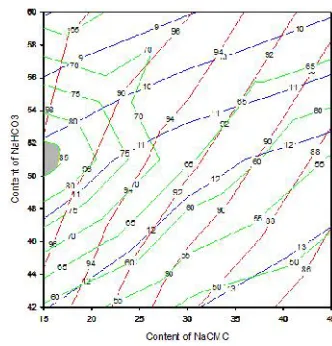
A 32randomized full factorial design was utilized in the present study. In this design two factors were evaluated, each at three levels, and experimental trials were carried out at all nine possible combinations. The Content of NaCMC (X1) and Content of NaHCO3
(X2) were selected as independent variables. The time required for 50% drug release (t50%), release at 24hrs
(Q24hrs) and similarity factor f2 were selected as
dependent variables.
Evaluation of physical parameters of prepared tablets[9]
Prepared gastro retentive tablets of Ondansetron HCl tablet were evaluated for various parameters like, weight variation test, hardness, friability etc.
Kinetic modeling and mechanism of drug release [10]
Data obtained form In vitro drug release studies were fitted to dissocalculation softeware. The kinetic
models used are zero order, first order, Korsmeyer’s,
Hexon crowell and Higuchi equation.
n t
kt
M
M
JPRHC
Research Article
Process Optimization of Ondansetron floatingtablet
Effect of granule size,
Effect of drying time & drying temperature,
Effect of thickness.
RESULTS & DISCUSSIONS:
Calculation of total dose
IR = Css x Vd
F
= 39 ng/ml x 1.9 lit/kg
0.62 = 39 * 10-6mg/ml x 1.9 * 103ml x 60
0.62 = 7.17 mg
Total Dose (TD) TD = IR [1 + (0.693 x t/t1/2)]
= 7.17 [1 + (0.693 x 23/ 4.1)]
= 35 mg.
Drug excipient compatibility study
From the drug excipient compatiblity study, it is concluded that the given drug ondansetron is compatible with all excipients.
Measurement of viscocity of polymers
The viscosity of polymer of different grade of HPMC K4M, HPMC15M & HPMC K100M solution was measured using Brookfield digital viscometer.
In vitro dissolution profile of factorial batches
The statistical analysis of the factorial design batches was performed by multiple linear regression analysis carried out in Microsoft Excel 2003. The data clearly indicated that the values of Q24hrs,t50%, and f2 were
strongly dependent on the independent variables. The fitted Equations relating the response Q24hrs,t50%, and
f2 to the transformed factor are shown in following
Equations.
Q24Hrs=88.17–3.44 X1–12.24 X2–0.475 X1X2–
0.42 X12–3.32X22 (R2= 0.9965)
t50%= 9.94 + 1.5 X1 + 4.07 X2 - 0.14 X1X2 +0.38
X12+ 1.21 X22 (R2= 0.9935)
f2= 51.08 + 0.71 X1 - 10.38 X2–9.13 X1X2 + 3.95
X12 - 2.75 X22 (R2= 0.8090)
The value of correlation coefficient indicates good fit. The polynomial Equation can be used to draw conclusions after considering the magnitude of coefficient and the mathematical sign it carries, (i.e. positive or negative).
In case of depended variable Q24hrs,p value for factor
X1 and X2 was found to be 0.0042 and 0.0001 respectively which clearly depicts that the both the factors i.e content of HPMC and viscosity of HPMC has individually influence on drug release. All other factor has P values greater than 0.005 (p > 0.005). Thus, it was concluded that the percentage of drug release depends on both, content and viscosity of HPMC.
In case of depended variable t50%,p value for factor X2
was found to be 0.0002 which clearly depicts that factor X2 i.e. viscosity of HPMC has influence on drug release. All other factor has P values greater than 0.005 (p > 0.005). Thus, it was concluded that the percent of drug release depends on viscosity of HPMC.
Comparison of dissolution profiles
In vitro drug release profile of all batches of factorial design was compared with theoretical drug release profile. The result shows that Batch N3 (120mg of HPMC K4M) shown highest f2 value which is 77.33
and it releases the loading dose (18.73%) which is nearest to theoretical drug release profile (20.48%).
Swelling Index[11]
The swelling index of tablets was determined in 0.1 N HCl (PH1.2) at room temperature. The swollen weight
of the tablets was determined at predefined time intervals. The swelling index was calculated by the following equation. Determinations were made in triplicate.
Wt–W0
Swelling index = Wt
Where, W0is the initial weight of tablet, and Wtis the
weight of the tablet at time t.
Physical parameters of prepared tablets[9,12] All the tablet formulations showed acceptable pharmacopoeial properties and complied with the in-house specifications for weight variation, hardness and friability.
Effect of granule size
So it was clearly seen that the tablets prepared with 20# granules has high porosity. Due to its high porosity it has the low hardness and thus it has low floating lag time (35 sec). This batch showed highest f2 value which is 81.37. So, granules pass through
JPRHC
Research Article
Effect of drying time & drying temperatureEffect of drying time and drying temperature were not so much on release of drug. So, 10 min drying time and 50°C drying temperature were kept optimum.
Effect of tablet thickness
As the thickness of tablet decrease, tablet became harder and thus friability of the tablets decreases and drug release is also retarded. So, batch T2 having 3.6 mm thickness of tablet was kept optimum.
*All weights are in mg
Table 1 : Formulation using 32full factorial design in
optimization of NaCMC.
Ingredients Quantity (mg) Ondansetron
HCl 35
HPMC K4M 120
NaCMC 15
NaHCO3 51
PVP K-30 20 IPA q.s. Lactose 50 Mg-stearate 3
Talc 6
Total weight 300
Table 2 : Optimized formula of ondansetron floating tablet
0 10 20 30 40 50 60 70 80 90 100
0 5 10 15 20 25
TIME (Hr.)
%
R
EL
EA
SE
N1 N2 N3 N4 N5 N6 N7 N8 N9
FIG 1 : Drug release profile of factorial batches in HPMC optimization
FIG 2 : Overlapping Counter plot of content of NaCMC (X1) and
content of NaHCO3(X2) versus Q24hrs,t50%, f2
CONCLUSION :
A 32full factorial design was applied to systemically optimize polymer concentration. The content of HPMC (X1) and Viscosity of HPMC (X2) were selected as independent variables. The time required for50%drugs released (t50%), Q24hrs, similarity factor f2
were selected as dependent variables. The results of full factorial design was indicated that the X2 (content of HPMC) and X2 (Viscosity of HPMC) both have significant effect on in vitro drug release profile. Optimized area was obtained with help of counter plot. From contour plot, it was conclude that HPMC having content 120 mg and viscosity 5600 cps will give the satisfactory drug release. The similarity factor f2was applied between the in vitro drug release profile
of factorial design batches and theoretical drug release
profile. It was conclude that batch N3 containing HPMC K4M, 40% was optimize for further work. From in-vitro buoyancy studies, it was found that floating lag time of all factorial batches was less than two minutes. From all above study it was cleared that process parameters like thickness, granules size, drying time and drying temperature have great influence on performance of the floating tablets. So such parameters are critically maintain or put at their optimum level during the manufacturing of the floating tablets to obtained desired properties of floating tablets, like floating lag time and floating time, optimum hardness and friability and drug release.
REFERENCES Formulations
Code
A B C D E F G H I
Ondansetron HCl 35 35 35 35 35 35 35 35 35
HPMC K4M 120 120 120 120 120 120 120 120 120
NaCMC 15 15 15 30 30 30 45 45 45 NaHCO342 51 60 42 51 60 42 51 60
PVP K-30 20 20 20 20 20 20 20 20 20
IPA q.s. q.s. q.s. q.s. q.s. q.s. q.s. q.s. q.s.
Lactose 59 50 41 44 35 26 29 20 15
Mg-stearate 3 3 3 3 3 3 3 3 3
Talc 6 6 6 6 6 6 6 6 6
JPRHC
Research Article
1. The United States Pharmacopoeia 30 /The National Formulary 26, Ondansetron HCl , United States Pharmacopeial Convention, Inc, 2000.
2. Leak R.E. and Woodford J.D., Eur.J.Cancer Clin. Oncol, 25 (suppl 1), S67 (1989). 3. Makinnon J.W. and Collin D.T.,
Eur.J.Cancer Clin. Oncol, 25 (suppl 1), S61 (1989).
4. Methocel Cellulose Ethers: Technical Handbook, Product Information, Form No. 192-01062-697GW, The Dow Chemical Company; Midland, MI, 2000: 11.
5. Harry. G. Brittain, Analytical profile of drug substance and excipients, vol-27.
6. Rowe R.C., Sheskey P.J. and Weller P.J., Handbook of Pharmaceutical Excipients; 4th edition, 2003, 297-300.
7. Paulo Costa, Jos Manuel Sousa Lobo, Modeling and comparison of dissolution profiles., European journal of pharmaceutical sciences; 2001, 12: 123-133. 8. Timmermans, J., Moës, A.J., 1990. How well do floating dosage forms float? Int. J. Pharm. 62, 207–216.
9. Lachman L., Lieberman A., Kinig J.L., The Theory and Practice of Industrial Pharmacy, 4th edition, Varghese Publishing House, Bombay.1991: 67-68.
10. J Moore, H Flanner, Mathematical comparison of dissolution profiles., Pharm Tech.; 1996, 20: 64-74.
11. Barbro J, Go¨ran A. The effect of shape and porosity on the compression behavior and tablet forming ability of granular materials formed from microcrystalline cellulose Euro J Pharm and Biopharm. 2001; 52: 347–357. 12. Indian Pharmacopoeia, 4th edition, Ministry
of Health and Family Welfare, Govt. of India. The controller of publications, New Delhi.1996: A-54.
AUTHORS AFFILIATION AND ADDRESS FOR COMMUNICATION:
Mehta Kalpesh K1., Patel Navnit K.1, Ganatra Maulik H.1, Patel Tushar D.1, Dr. Patel N.J.1
1
S. K. Patel College of Pharmaceutical Education and Research,
Ganpat University, Kherva- Mehsana, Gujarat, India, PIN-382711