Implementing Task-based Instruction in ESP
Class — An Empirical Study in Marine
Engineering English
Xuehua Wu
Jiangsu Maritime Institute, China
Lihui Liao
The University of Oklahoma, USA
Teresa K. DeBacker The University of Oklahoma, USA
Abstract—This study investigated teaching English for Specific Purposes (ESP) within the paradigm of
task-based language teaching, concentrating on marine engineering English teaching in a Chinese vocational college. Two natural groups of students taking their ESP courses took part in the study as a control group (N=28) and an experimental group (N=33) from 2014 spring to 2014 fall. Teacher-designed reading, listening and speaking pre-test and post-test (simulating the governmental tests held by China Maritime Safety Administration Bureau), and survey were used as the basis for study. The students in the control group and the experimental group were taught in traditional approach and task-based approach respectively. At the end of one academic year study, the students were given a post-test to determine whether there was effect of the treatment on the experimental group. Data analysis showed that there was no statistically significant difference in reading achievement between students in the control group and students receiving task-based instruction, but there was effect on students’ listening and speaking competency. In the investigation, most students were satisfied with task-based instruction, and they proposed some feedbacks and suggestions for the task-based instruction in ESP courses which are beneficial for future instruction.
Index Terms—task-based instruction, ESP, reading, listening and speaking
I. INTRODUCTION
A. Statement of Problems
Safety of life at sea and friendly marine environment depend on professionalism and competence of seafarers. According to recent IMO statistics, 80% of accidents taking place at sea are caused by human error, with half due to poor communication (Maritime Tests of English Language, n.d.). Ziarati, M., Ziarati R., and Calbas (2009) claimed that the inadequacy of Maritime English standards has been a major contributory factor in causes of accidents, some involving loss of life, large numbers of injuries and extensive financial loss. Good communication in maritime English is essential for promoting and maintaining effective working environments and safety of the crew, ship, cargo and marine environment. Recently, when the supply ship Maersk detector ran into an oil derrick, investigators concluded that the accident was primarily the result of poor communication (Transportation Safety Board of Canada, 2011). “The problem of communication can be quite challenging on a multinational, and hence, multicultural and multilingual crews on board ships, especially among international crews who may speak different languages” (Wu, 2015, p. 47). In China, most college and institute teachers are used to applying the traditional methods to teach ESP. Among them lecture-based instruction are the most commonly used ones. Just like Shokouhi (2006) stated that inadequate approaches including Grammar Translation Method had been dominant in current ESP textbooks and classrooms, significant approaches had somewhat been neglected in this trend. The teachers think that ESP is a challenge for students to learn, especially new words, complicated sentence structure and specific knowledge, so they spend a significant amount of time explaining new technical words, grammar, sentence structure, and translating specific learning materials into Chinese paragraph by paragraph for students in reading class. Although they know the importance of communication for learning ESP, most time is spent on translation in the class and no meaningful interaction occurs among students.
B. Addressing the Problem of Current Teaching Situation
feasibility and effectiveness of task-based language teaching as the alternative of traditional grammar translation method on ESP reading comprehension. They found that task-based instruction had significant effect on focusing students’ attention to performing tasks or activities and discussion as well as improving the students’ ESP reading comprehension. Likewise, Sarani and Sahebi (2012) tested the effect of task-based instruction on learning vocabulary in ESP courses, finding that the task-based approach was more effective in teaching technical vocabularies compared to the traditional one and male learners outperformed the female learners. However, the effect of task-based instruction on ESP, especially in the very specific field of marine engineering English reading, speaking, and listening in a Chinese context for an intermediate language level vocational institute students has not been demonstrated. And few have done researches on whether students show satisfaction with task-based instruction, their feedbacks and suggestions for ESP reading class, which actually are introspective to future task-based instruction.
II. LITERATURE REVIEW
A. Task-based Language Learning (TBLL)
Task-based language learning has been paid much attention by many researchers since 1980s. Richards and Rodgers (2001) claimed, “Task-based language teaching refers to an approach based on the use of tasks as the core unit of planning and instruction in language teaching” (p. 223). J. Willis (1996) pointed out “Task instructions can be adapted to provide opportunities for practices of the different skills your learners need: e.g., beginning with spontaneous exploratory interaction or writing individual notes or reading a text prior to doing the task, and then planning an oral (or written) public presentation of the task outcome ” (p. 4). Such tasks can include booking a ticket, making out a plan, or checking the stores and spare parts ordered. Assessment is basically based on appropriate accomplishment of real world tasks, rather than on accuracy of language forms. Instructors adopted the task-based language learning to directly connect to real-life situations.
J. Willis (1996) defined the task as an activity where the target language is used by the learner for a communicative purpose (goal) in order to achieve an outcome. TBLL consists of the pre-task, the task cycle, and the language focus.
Pre-task: Introduce the topic and task instructions, getting students prepared for completing the task. Brainstorming useful topic words and phrases is an effective way of involving students in this phase.
In the pre-task, the teacher will demonstrate what the students will be expected in the task phase. Task cycle: Learners use language in varying circumstances and are exposed to others using it.
During the task phase, the students perform the task, typically in small groups. The teacher’s role is usually an observer or a counselor —thus a more student-centered methodology. In this phase, some types of tasks can be applied, like listing, ranking, comparing or contrasting, problem-solving, and even higher demanding creative task.
Language focus: Analysis and practice. Learners will focus on form and ask questions about language features. Nunan (1991, p.279) outlines the five characteristics of task-based instruction in language learning:
1. An emphasis on learning to communicate through interaction in the target language, 2. The introduction of authentic texts into the learning situation,
3. The provision of opportunities for learners to focus not only on language, but also on the learning process itself, 4. An enhancement of the learner’s own personal experience as important contributing elements to classroom learning,
5. An attempt to link classroom language learning with language activities outside the classroom.
Task-based instruction is a learner-centered teaching method, providing numerous chances for the meaning-focused contextual communication-oriented negotiation. It is different from the pure language practice. But how to implement task-based instruction in reading, and listening & speaking classes need to be further studied.
B. English for Specific Purpose (ESP)
ESP has received attention and a great number of studies have been done since 1960s. A plethora of definitions and scopes have been suggested in the field of ESP research. Robinson (1980) has defined it as teaching of English to the learners who have specific goals and purposes. According to him, these goals might be professional, academic, scientific, etc. Strevens (1998) asserted that one of the absolute characteristics of his definition identified ESP as being “in contrast to General English”. Dudley-Evans (1998, p.4) gave the definition of ESP that was commonly accepted.
Absolute Characteristics
ESP is defined to meet specific needs of the learners
ESP makes use of underlying methodology and activities of the discipline it serves
ESP is centered on the language appropriate to these activities in terms of grammar, lexis, register, study skills, discourse, and genre
Variable Characteristics
ESP may be related to or designed for specific disciplines
ESP may use, in specific teaching situations, a different methodology from that of General English
ESP is likely to be designed for adult learners, either at a tertiary level institution or in a professional work situation. It could, however, be for learners at secondary school level
Most ESP courses assume some basic knowledge of the language systems
“ESP is not limited to any specific disciplines but meant for the specific needs of the learners” (Javid, 2013, p.141). In conclusion, ESP is for the specific needs of the learners, and the language learned in the learning environment will be used in the future workplace and it is different from General English in ways of expressing, specific vocabulary, and subject knowledge.
C. Marine Engineering English
Marine engineering English falls in the scope of ESP, under the branch of English for Occupational Purposes according to the “Tree of ELT” (Hutchinson & Waters, 1987, p.6). Students were expected to learn professional knowledge about marine engineering and professional language that will be used later in working environment. This class involves teaching professional language and skills, including reading instruction books about various machines’ structures, working principles, trouble-shooting, and international conventions concerning marine shipping; listening to and understanding orders given by bridge, senior engineers, bunkering workers, and port state control officers; writing reports, application form for bunkering, stores and spare parts; negotiating with shipmates, company security officers, suppliers, shipyard engineers, port state control officers, etc. The goal of this course is to ensure appropriate use of English in the specific maritime related situation and foster clear and effective ship-shore, ship-ship and onboard crew’s communication. According to International Convention on Standards of Training, Certification and Watchkeeping for Seafarers (STCW1995), officers in charge of an engineering watch should have the competence of using English in written and oral form and be able to use engineering publications and to perform engineering duties.
Applying task-based instruction in marine engineering English course is a challenging approach for language instructors because of the dominant traditional teaching methods. What are the feedbacks and suggestions for the task-based instruction from the learners are crucial for the implementation of task-based instruction, which is one of the attempts of this study through survey.
This study is an attempt to investigate whether task-based instruction is effective on students’ reading, listeningand speaking development in an ESP course and how students think about the instruction. In addition, this pilot study aims to tackle the problems experienced by the Chinese ESP teachers and verify the advantages and implications of task-based instruction on students majoring marine engineering.
The following three hypotheses are to be investigated in this study: 1. The task-based instruction has effect on ESP reading competency;
2. The task-based instruction has effect on ESP listening and speaking competency;
3. Students are satisfied with the task-based instruction and perceive that it is an effective instruction to improve their English reading, speaking, and listening skills.
III. METHODOLOGY
A. Participants
Sixty-one in two natural classes (when they were enrolled in our institute) of marine engineering students in a Chinese vocational college were recruited for the study. They aged 20-24, all male, and were from different parts of China. They all had finished one year college General English learning. Twenty-eight students in Class 1 were assigned to the control group who received traditional lecture-based instruction and thirty-three students in Class 2 to the experimental group who received task-based instruction.
B. Instruments
The quantitative data included students’ standardized test scores in teacher designed reading tests, listening and speaking tests and survey. Qualitative data included the interview on their perception of, suggestions for the task-based learning.
Teacher–designed reading test
The reading tests include pre- and post-test, which are designed based on the form, length, and difficulty of China MSA (Maritime Safety Administration) reading test. The China MSA reading test serves as a basis for the students accessible to the potential ocean-going ships’ engineers like a driving test, which mainly tests vocabulary, sentence structure, specific knowledge of on-board machines’ working principle, structure, trouble shooting and international conventions related to marine engineering management.
Teacher-designed listening and speaking test
Listening and speaking test also includes pre- and post- tests taken in a computer lab. The whole exam time is 60 minutes and there is one-minute break between listening and speaking. The listening and speaking pre-test and post-test are also designed in terms of the form, length and difficulty of China MSA listening and speaking test. In the listening part, there are three subparts that are all multiple-choice questions. They can listen to the recording twice at most. For the first subpart, students listen to a sentence, and click the sentence that is closest to the meaning of the sentences they hear from the four choices. Altogether there are ten questions, and each correct answer is scored 1.5. For the second subpart, the students listen to dialogues, and then choose the one from the four choices that can answer the question to the dialogue they hear. There are ten questions and each correct answer is scored 1.5. For the third subpart, students listen to four short passages and answer four multiple-choice questions following each passage. Each correct answer is scored 1.25. The questions are related to the life, duties, specific knowledge, international conventions and understanding of talks or bridge orders. Computer will calculate the total scores automatically at the moment students submit their tests.
In the speaking part, students read one short passage on the screen in a correct tone, pronunciation, and fluency (10 points); talk about one topic which is shown on the screen (10 points); and answer ten questions that are not shown on the screen (3 points per question). Computers record what they say into the microphone. The recording of each separate piece of answer is submitted to the server at the time of completion. The students’ responses to each question, topic and reading will be graded anonymously by the experienced and authorized auditors according to the assessment criteria.
Survey
Students in the experimental group took part in the survey. The survey consists of two parts. Part I is about their demographic information, like age, year of learning English, time spent on reading English after class. Part II is about their perception of task-based instruction. Likert Scale with a range from 1 (strongly disagree or extremely not willing to) to 5 (strongly agree or extremely willing to) was used. The Cronbach’s Alpha was .633, which suggested the reliability of survey was not poor. The survey was carried out five days after one academic year’s study and delivered to the students online. They answered the survey within two days at home or in the campus lab. Thereafter, they submitted the survey to the collector online. Besides the Likert-type questions, there are two open-ended questions to investigate students’ suggestions for future marine engineering English teaching and their difficulties in learning marine engineering English.
C. Procedure
The study lasted 22 weeks in a whole academic year, four hours a week, altogether 88 hours. Teachers in the control group and the experimental group applied the same textbook and the same schedule of instruction, except the teaching method. Both groups were given some after-class reading materials and links to International Maritime Organization and MARLINS English websites. Each student had an after-class exercise book including multiple choices and reading comprehension passages. Pre-test and post-test of reading, listening and speaking were administrated in each group at the beginning and end of the academic year. A survey was carried out in experimental group at the end of the study.
The students in the control group received the traditional lecture-based instruction. That is, the teacher presents the meaning and usages of vocabulary, grammar and subject knowledge, translates texts into Chinese, then asks students to practice these vocabulary, grammar, and subject knowledge by doing exercises such as multiple choices, reading comprehension, answering questions, and translation. The students in the experimental group received the task-based instruction. The same learning materials were redesigned by the researchers to fit J. Willis’ task-based framework: pre-task, task cycle, and language focus. The tasks used are role-plays, brainstorming, ordering, and problem solving. Learners are required to engage in real-work interaction to complete tasks. Take the reading material “Bunkering” as an example:
Pre-task: Introduce the topic and task instructions. Show the video of bunkering. Brainstorm useful topic words and phrases.
Task cycle: Learners use language in varying circumstances, performing the task in small groups. Ask students to read the text about bunkering and get the main idea of the text. Listen to a recording about bunkering, and then fill in the blanks with the missing words they hear. Afterwards, ask students to join the group discussion, talking about fuel’s quantity, type, specification, anti-pollution, and fire-fighting procedures and measures related to bunkering. After group discussion, students are asked to make out a bunkering plan; present the results to the whole class; perform role play among workers on oil barge and ship engineers talking about the bunkering plan, procedures, antipollution and fire prevention measures during bunkering, checking the quantity filled and signing the receipt; and exchange the procedures with peers in group.
Language focus: Analysis and practice. Analyze the grammar used in the text and language features in the task, like attributive clause, imperative sentence. Practice the word formation present in the text like compound word.
D. Data Analysis
group and control group from pre-test to post-test. After the experiment, survey data were collected and analyzed by SPSS to find out the students’ perception of the task-based language learning. Qualitative data obtained from open-ended questions in the survey were analyzed to find out students’ difficulties and suggestions in learning marine engineering English.
IV. RESULTS AND DISCUSSION
A. Reading Performance
To answer the first question concerning the effect of task-based instruction on ESP reading competency, descriptive statistics and a set of paired and independent t-test were run.
An independent sample t-test was used to verify the pre-test results on both groups to see if there was much difference between the control group and experimental group in reading pretest. The difference between mean scores of the pretest of the control group (M = 55.161, SD = 8.478, N = 28) and the pretest of the experimental group (M = 68.424, SD = 10.955, N = 33) was significant (t= 5.215, df= 59, p<.001).
At the end of the study, results showed that the difference between the mean of the pre-test (M = 55.161, SD = 8.478, N = 28) and the post-test (M = 75.196, SD = 9.670, N = 28) for the control group was significant, t = 11.437, df = 27, p < .05. And for the experimental group, the difference between the pre-test (M = 68.424, SD = 10.955, N = 33) and the post-test (M = 74.000, SD = 9.354, N = 33) was also significant, t = 4.394, df = 32, p < .05. It can be concluded that reading competence of both groups improved noticeably after one academic year learning.
In order to find out if the task-based instruction did have effect on reading between the control group and experimental group, an independent sample t-test was run. The mean scores of the post-tests of both control (M = 75.196, SD = 9.670, N = 28) and experimental group (M = 74.000, SD = 9.354, N = 33) was not statistically different. The result demonstrated that t = .490, df = 59, p >.05, which meant no significant difference was detected between control group and experimental group in the post-tests. It suggests although there was much significant difference between the control group and the experimental group before the treatment (the mean score of the experimental group is much higher than that of the control group), after one year’s study, there was no significant difference between the two groups in the post-tests (the mean score of the experimental group is almost the same as that of the control group). So we can conclude that teaching ESP reading through task-based instruction has no significant effect on the students’ reading improvement. As previously stated, this type of reading test mainly tests the students’ knowledge of vocabulary, sentence structure, specific knowledge and ability to find related information to answer the questions following the reading passage. The task-based instruction, which focuses on communication and negotiation, may not show particular advantages in reading performance. Numerous factors may affect reading ability and use of reading strategies, like reading time, familiarity with text, motivation and so on.
B. Listening and Speaking Performance
To answer the second question concerning the effect of task-based instruction on ESP listening and speaking competency, descriptive statistics and a set of paired sample t-test were run to test if the difference between the mean of the pre-test and the post-test in control group and experimental group was significant. An independent sample t-test was run to see if there was much difference between the control group and experimental group in listening and speaking pretest. Statistically difference was detected (t= -.4104, df= 59, p<.001) between the mean scores of the pretest of the control group (M = 73.964, SD = 9.045, N = 28) and the pretest of the experimental group (M = 60.515, SD = 15.197, N = 33).
At the end of the study, the paired-samples t test result showed that there was some improvement on the students’ listening and speaking mean scores between the pre-test (M = 73.964, SD = 9.045, N = 28) and the post-test (M = 78.232, SD = 10.389, N = 28) for the control group, t = 2.519, df = 27, p < .05. And for the experimental group, there was great improvement between the pretest (M = 60.515, SD = 15.197, N = 33) and the post-test (M = 81.606, SD = 7.780, N = 33), t = -9.021, df = 32, p <.05. To find if the task-based instruction had effect on listening and speaking, the mean scores of the post-tests of both control and experimental group were compared and an independent sample t-test was run. The result showed that there was no significant difference on the mean scores between the control group (M = 78.232, SD = 10.389, N = 28) and the experimental group (M = 81.606, SD = 7.780, N = 33), t = 1.448, df = 59, p >.05). As a result, no significant difference was detected between control group and experimental group in the post-test. It means although before treatment there was significant difference between the two groups, and the mean score of the experimental group is much lower than control group (60.515 vs 73.964), after one year’s study, there was no significant difference and the mean score of the experimental group is higher than control group (81.606 vs 78.232). The mean score of the experimental group rose from 60.512 to 81.606 (p<.05). So it can be concluded that applying task-based instruction in ESP produced significant effect on listening and speaking skills improvement.
C. Students’ Perception of Task-based Instruction
To answer the third question, a survey was conducted to find out their perceptions of task-based instruction and suggestions or feedbacks for the task-based instruction they received.
collect their personal information data, like age, year of learning English, time spent on reading English after class. Part II was to assess their perception of the task-based instruction.
The average age of the subjects is 22.56, and the average year of learning English is 8.5 years. The time spent on reading English after class is only 2.2778 (1=never, 2=10 minutes a day, 3=20 minutes a day, 4=30 minutes day, 5=40 minutes or more a day). From Table 1, we know that the time students spent on reading English after class is too limited. About 27.8% students never read English after class, 50% students spend 10 minutes a day. Only 5.6%, 11.1%, 5.6% students spend 20, 30, 40 minutes or more a day on English reading after class.
TABLE 1
TIME SPENT ON READING ENGLISH AFTER CLASS
Time Frequency Percent
1=never 5 27.8
2=10 minutes a day 9 50.0
3=20 minutes a day 1 5.6
4=30 minutes a day 2 11.1
5=40minutes or more a day 1 5.6
Total 18 100.0
About 77.78% (mean score =1.5556, 1=yes, 2=no) students think the teaching method in the marine engineering English class is different from General English class. This result corresponds with the Dudley-Evans’ (1998) claim about characteristics of ESP. As to the question about the preference for the task-based instruction or lecture-based instruction, about 77.77% (mean score=2.3333, 1=lecture-based instruction, 2=neutral, 3=task-based instruction) students answered “preferring task-based instruction”. It indicated that the students liked the task-based instruction method, but the time spent on reading English after class was not adequate. That might be one of reasons accounting for the fact that their reading scores did not rise to such an extent to verify the assumption “task-based instruction has effect on ESP reading competency”. The students spent too limited time on reading after class, the most possible reason was the difficulty and unfamiliarity with the reading passages, such as too many new technical words, complicated sentence structure, unfamiliar specific field knowledge, etc. Chen and Lai (2012, p.105) conducted a research in Taiwan on the cultural familiarity with a text on Chinese students’ reading comprehension performance and reading time. It was found that “students’ reading comprehension performance and reading time were both significantly affected by their familiarity with the target culture.” Carrell and Eisterhold (1983) claimed that the reader’s contribution, to be more specific, the reader’s background knowledge, plays a crucial role in reading comprehension. This was supported in the following open-ended questions. Students met several difficulties in new technical words and unfamiliar specific field knowledge.
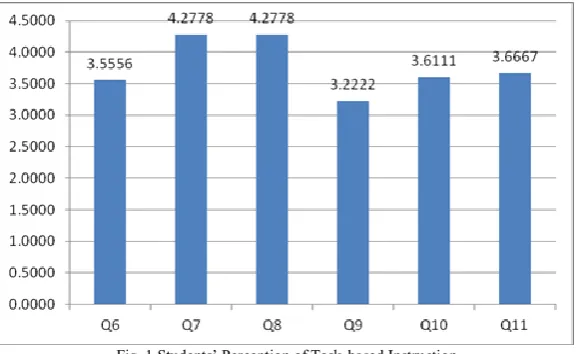
After-class reading is the extension of classroom learning. It helps to consolidate the already acquired language and skills, thus improving reading ability. How to motivate students to read after class is also a challenge. Besides, teachers should select appropriate, interesting, and understandable reading materials for students. Moreover, it is necessary to construct the assessment and evaluation system for after-class reading, like self-evaluation, peer evaluation, and teacher evaluation, and apply various appropriate reading strategies to reading, like planning, monitoring, evaluating, and so on. As shown in Figure 1, most students thought that task-based instruction gave them many opportunities to know about the future tasks on board ship so that they could adapt to the future work more quickly. The task-based instruction simulates the real working environment and provides the students with the context to learn by doing. They are exposed to a large amount of authentic and comprehensible input by watching the power point, pictures, animation and flow diagrams and sometimes the real objects in the lab. Listen and read through books, videos, CDs, tapes, online sources, etc. Also in the class, students are given chances to discuss, write and practice, like making out a bunkering plan, filling out the application form, writing up an accident report, reporting the troubles and solutions to the troubles, and negotiating with related persons. This result reflects the idea “Task-based learning has the notion of learning by doing, which has been recognized by some educators as the fundamental principle” (Long & Doughy 2003). Through trial, error and modification, they achieve the goals of using language and other skills. Especially in marine engineering, the students will conduct a number of tasks in the real environment. For example, they are given chances to discuss and make out bunkering plan.
As to the question about their willingness to “participate in the tasks in class like reading maintenance records, making out repair list, talking about the working principles of machines, discussing the PSC inspection after watching the video”, the mean score of willingness is 4.2778 (85.55%). This indicates that students prefer taking part in the task-based activities. This could be attributed to the reason why students’ listening and speaking skills improved through the task-based instruction treatment.
Fig. 1 Students’ Perception of Task-based Instruction
To conclude, students are satisfied with the task-based instruction and willingness to take part in tasks in the class. They perceived that task-based instruction improved their reading, writing, listening and speaking abilities.
As to their feedback and suggestions about the task-based instruction, some students hoped to “take some real objects to classroom”, “give more chances to speak up”, “integrate with the specific knowledge when talking about the important points”, “explain the working principles of machines, new words and phrases in more detail”, “hope to establish ‘reward and punish’ system to involve more students in the group discussion”, and “provide more chances of group learning”. Also they proposed the suggestions for the teacher’s reduction of speech rate. From their answers, we can summarize that although the instructors put their best effort to introduce the authentic materials to help students develop an understanding of the very complicated authentic materials in class, the students hope to get more vivid and visual idea about the on-board machines and their working principles. For example, when introducing the portable fire extinguisher, instructors can bring the real portable extinguishers to the classroom and explain the type, usage and application of each type of extinguisher. If possible, the instructors can simulate a fire and let students find out the fire source and select the proper extinguisher. In marine engineering English class, there are many rarely used technical words. When instructors employ the task-based instruction, they can design some tasks to help students understand the meaning and usages of the rarely used words in the context, like word-formation contest, blank-filling, sentence-making, listing the synonyms and antonyms, etc. During the process of task-based instruction, performing tasks is critical, but the problems concerned with accomplishing goals and raising participation rates need to be solved too. Especially for these 22-year-old intermediate level vocational college students whose level of language proficiency, motivation, and self-dependency are not so high to fully take part in the group discussion and after-class reading. So the instructors have to consider establishing “incentive mechanism” to encourage more students to engage in both in- class and outside classroom activities.
As for the difficulties experienced in studying marine engineering English, the students showed most concerns regarding new specific words, sentence meaning, and specific knowledge. These difficulties hinder their understanding of the text.
V. LIMITATION OF THE STUDY
The sample size is a little small. Only twenty-eight students in the control group and thirty-three in the experimental group took part in the study. Only eighteen students took part in the survey. The results might vary if the sample size were larger and subjects of other levels of language proficiency were involved.
Authenticity and interest have not been fully emphasized. In the survey, students require bringing more real objects to the classroom for better understanding and the activities should be more interesting to activate their motivation.
Language forms have not been received much attention during instruction. Especially in marine engineering English, there are a lot of new rarely used words, complicated sentence structure, and specific knowledge make learning experience frustrated for some students.
VI. CONCLUSION AND PEDAGOGICAL IMPLICATIONS
Generally speaking, this study was conducted to find out the possible advantages of task-based instruction on Chinese vocational college students’ reading, listening, and speaking competency in ESP class. The performance of both groups was calculated by SPSS and mean score, t value and covariance of the scores were reported. The results indicate that students in experimental group show progress in listening and speaking ability but no significant improvement in reading from pre-test to post-test.
skills, although the time spent on reading English after class was too limited. They also proposed some feedbacks and suggestions for future task-based instruction.
Some pedagogical implications are suggested to be considered:
First, task-based instruction, which focuses on ability to perform a task or an activity, shows the benefit of improving the ability of problem-solving and integrating with real work task. These real work tasks are called goal-oriented but they are “form-unfocused” tasks that promote comprehension and production of language for communicative purposes (Pyun, 2013). Focused tasks, unlike unfocused tasks, are designed to draw learners’ attention to specific linguistic forms (Ellis, 2003). Whereas D. Willis and J. Willis (2007) confined tasks to communicative ones, not including an explicit focus on form. Other researchers proposed to integrate both form-focused and form unfocused tasks in TBLL (Loschky & Bley-Vroman, 1993; Nunan, 2004). In the fields of engineering, chemistry, medicine English, an abundance of technical words and complicated sentence structure may raise the load of text comprehension and task performance. Long and Norris (2000) recommended that tasks be designed in such a way as to incorporate both focus-on-meaning and focus-on-form. During instruction, besides meaning negotiation, we must pay attention to the technical words and complicated sentence structure. Therefore “a good balance should be achieved between form and meaning. Fluency and accuracy are complementary, and students must have a good command of language form if they are to understand and express meaning effectively” (Meng, 2009, p.89).
Second, tasks should be designed taking the learner’s needs and interest into account, trying to make the classroom teaching more vivid and more appropriate to the students’ level of cognition, needs, characteristics of age and interest. This conception is supported by other scholars (Lockwood, Jordan, & Kunda, 2002, p.23), “ESP workplace syllabus planning should reflect the needs of the students as well as the needs of the business.”
Third, authentic materials and even real objects should be integrated in the task-based instruction, suggesting that the instruction as much as possible be implemented in the lab, where there are real machines, machine parts or simulated control process. Background knowledge should be introduced before learning the specific knowledge which is delivered in English.
Finally, there should be a mechanism or evaluation system for increasing after- class reading and classroom activity participation.
Nowadays, the exam-oriented education still dominates in China. Students and teachers may make effort in memorizing vocabularies and do a lot of multiple choice exercises related to exam. This shallow level of information processing may have immediate short-term effect on test results, but less effect on communication skills in the medium- to- long term. Therefore, how to improve pre-service mariners’ communicative skills and successful implementation of task-based instruction still has a long way to go.
ACKNOWLEDGEMENT
We would like to express our gratitude to our supervisors, Dr. Sherry Cox and Dr. Lawrence A. Baines, for their continuous support and invaluable feedback throughout the study. They provided us with constant guidance and encouragement that turned this article writing into a smooth and a fruitful process.
We also appreciate Xueying Cai in Jiangsu Maritime Institute who helped us collect the survey data. Our thanks also go to Dr. Alica O. Burris for her help in using the software and giving us feedback.
We would like to express our special thanks to CEDaR at Jeannine Rainbolt College of Education of the University of Oklahoma.
APPENDIX SURVEY
Dear students!
We would like to conduct a survey about your Marine Engineering English study. First, let us explain the task-based instruction. It focuses on the use of authentic language and on asking students to do meaningful tasks using the target language. For easy understanding, the instructor will clarify the tasks you will perform in the future work on board the ship, and try to create a real working environment to learn at school. For example, you will take bunkers at sea, the instructor will tell you what kind of work it is, what information will you exchange with workers on oil barge, what preventive measures will you take to prevent overflow and fire in English, and then you do some reading, oral and listening practice. And sometimes, the instructor will show the documents like maintenance records for the engines, the application form for stores and spare parts, and ask you to fill out these forms. Second, the traditional method, such as the lecture-based instruction, means that instructor explains the knowledge in the textbook, translate the sentences into Chinese paragraph by paragraph, focusing on grammar, vocabulary and sentence structure. Students mainly listen to the teachers' lectures. It is a "one-to-many" form of communication. Please answer the following questions honestly.
Thank you for your time!
Q1 What is your age? ___________
Q2 How long have you been learning English? __________ Q3 How much time do you spend on reading English after class?
Q4 Was Marine Engineering English taught differently from your general English courses in Grade 1? 1=yes 2=no
Q5 Do you like the lecture-based instruction or the task-based instruction? 1=lecture-based instruction 2=neutral 3=task-based instruction
Q6 I think the task-based instruction gives me much chance to know about the future tasks on board, so that I can adapt to the future work more quickly.
1= strongly disagree 2=disagree 3=neutral 4= agree 5=strongly agree
Q7 I am willing to participate in in-class tasks like reading maintenance records, making out repair list, talking about the working principles of machines, discussing the PSC inspection after watching the video.
1=extremely not willing to 2= not willing to 3= neutral 4= willing to 5=extremely willing to
Q8 Task-based ESP instruction can improve my English reading. How much do you agree with the above statement? 1= strongly disagree 2=disagree 3=neutral 4= agree 5=strongly agree
Q9 Task-based ESP instruction can improve my English writing. How much do you agree with the above statement? 1= strongly disagree 2=disagree 3=neutral 4= agree 5=strongly agree
Q10 Task-based ESP instruction can improve my English speaking. How much do you agree with the above statement?
1= strongly disagree 2=disagree 3=neutral 4= agree 5=strongly agree
Q11 Task-based ESP instruction can improve my English listening. How much do you agree with the above statement?
1= strongly disagree 2=disagree 3=neutral 4= agree 5=strongly agree
Q12 Do you have any suggestions for the future Marine Engineering English teaching? Please feel free to give us suggestions.
Q13 What are the difficulties in leaning Marine Engineering English? Tell us your true story.
REFERENCES
[1] Carrell, P. L. & Eisterhold, J. C. (1983). Schema theory and ESL reading pedagogy. TESOL Quarterly, 17(4), 553-573. http://www.readcube.com/articles/10.2307%2F3586613?r3_referer=wol&tracking_act (accessed 5/6/2015).
[2] Chen, H. L. & Lai, S. F. (2012). The functions of cultural schemata in the Chinese reading comprehension and reading time of college students in Taiwan. Journal of International Education Research, 8(2), 105-112. http://eric.ed.gov/?id=EJ982689 (accessed 12/5/2016).
[3] Dudley-Evans, T. (1998). Developments in English for specific purposes: A multi-disciplinary approach. Cambridge: Cambridge University Press.
[4] Ellis, R. (2003).Task-based language learning and teaching. Oxford: Oxford University Press.
[5] Hutchinson, T., and A. Waters (1987). English for specific purposes: A learning-centered approach. Cambridge: Cambridge University Press.
[6] International Maritime Organization. (2005). International Convention on Standards of Training, Certification and Watchkeeping
for Seafarers .
http://www.imo.org/en/About/Conventions/ListOfConventions/Pages/International-Convention-on-Standards-of-Training,-Cert ification-and-Watchkeeping-for-Seafarers-(STCW).aspx (accessed 10/5/2016).
[7] Iranmehr, A., Erfani, S. M. & Davari, H. (2011). Integrating task-based instruction as an alternative approach in teaching reading comprehension in English for special purposes: An action research. Theory and Practice in Language Studies, 1 (2), 142-148. doi:10.4304/TPLS.1.2.142-148.
[8] Javid, C. Z. (2013). English for specific purposes: Its definition, characteristics, scope and purpose. European Journal of
Scientific Research, 112 (1), 138-151
http://www.academia.edu/8519119/English_for_Specific_Purposes_Its_Definition_Characteristics_Scope_andPurpose (accessed 18/6/2015).
[9] Lockwood, P., Jordan, C. H., & Kunda, Z. (2002). Motivation by positive or negative role models: Regulatory focus determines who will best inspire us. Journal of Personality and Social Psychology, 83 (4), 854-864. doi: 10.1037/0022-3514.83.4.854. [10] Long, M. H. & Doughy, C. J. (2011). The handbook of language teaching. Oxford: Wiley Blackwell.
[11] Long, M. H. & Norris, J. M. (2000). Task-based language teaching and assessment. In Byram, M. (Ed.), Encyclopedia of
language teaching. London: Routledge, 597-603.
[12] Loschky, L. & Bley-Vroman, R. (1993). Grammar and task-based methodology. In G. Crookes & S. Gass (Eds.), Tasks and
language learning: Integrating theory and practice. Clevedon, England: Multilingual Matters Ltd, 123-167.
[13] Maritime Tests of English Language. (no date). http://www.martel.pro/ (accessed 12/5/2016).
[14] Meng, Y. F. (2009).Application of the task-based approach to navigation English reading in vocational college. MA thesis, Dalian Maritime University, China. http://www.dissertationtopic.net/doc/500319 (accessed 16/4/2015).
[15] Nunan, D. (1991). Language teaching methodology: A textbook for teachers. New York: Prentice Hall. [16] Nunan, D. (2004). Task-based language leaching. Cambridge: Cambridge University Press.
[17] Richards, J. C., & Rodgers, T. S. (2001). Approaches and methods in language teaching (2nd ed). Cambridge: Cambridge University Press.
[18] Robinson, P. (1980). ESP (English for Specific Purposes). New York: Pergamon Press Ltd.
[19] Pyun, D. O. (2013). Attitudes toward task-based language learning: A study of college Korean language learners. Foreign
Language Annals, 46 (1):108-121. doi:10.1111/flan.12015.
Teaching, 5 (10), 118-128. doi: 10.5539/elt.v5n10p118.
[21] Shoukouhi, H. (2006). A new discourse plan for the Iranian university ESP textbooks. In Kiani & Khayamdar (Eds.) Proceedings
of the First National ESP/EAP Conference, (3). Tehram: SAMT Publication.
[22] Strevens, P. (1998). ESP after twenty years: A re-appraisal. In M. L. Tickoo (Ed), ESP: State of the art. Singapore: SEAMEO Regional Language Center, 1-13.
[23] Transportation Safety Board of Canada. (2011). Marine Investigation Report M11N0047. http://www.bst-tsb.gc.ca/eng/rapports-reports/marine/2011/m11n0047/m11n0047.asp (accessed 21/10/2015).
[24] Willis, D., & Willis, J. (2007). Doing task-based teaching. New York: Oxford University Press. [25] Willis, J. (1996). A Framework for Task-based Learning. London: Longman.
[26] Wu, X. H. (2015). Using task-based instruction to foster clear communications on Chinese ocean-going vessels. International
Education Research, 3 (2), 47-56. doi: org/10.12735/ier.v3i2p47.
[27] Ziarati M., Ziarati R. & Calbas B. (2009). Improving safety and ports by developing standards for maritime English. Proceedings
from Bridge Conference, Finland.
https://scholar.google.com/scholar?hl=en&q=IMPROVING+SAFETY+AT+SEA+AND+PORTS+BY+DEVELOPING+STAN DARDS+FOR+MARITIME+ENGLISH&btnG=&as_sdt=1%2C37&as_sdtp= (accessed 20/10/2015).
Xuehua Wu was born in Jiangsu, China in 1970. She received her MA degree in English Linguistics and Literature from Nanjing University - Nanjing, China in 2004.
She published paper “Using task-based instruction to foster clear communications on Chinese ocean-going vessels” in International Education Research, 3(2), 47-56.
She is currently an associate professor of English at the Marine Engineering Department, Jiangsu Maritime Institute, China. She was a visiting scholar at the Jeannine Rainbolt College of Education at the University of Oklahoma in Norman, Oklahoma throughout the year of 2015.
Lihui Liao was born in Sichuan, China in 1985. She received her MA degree in Foreign Linguistics and Applied Linguistics, Southwest University of Political Science and Law - Chongqing, China in 2010. She is currently taking PhD program in instructional psychology and technology at the Jeannine Rainbolt College of Education at the University of Oklahoma in Norman, Oklahoma.