AUSTRALIAN JOURNAL OF BASIC AND
APPLIED SCIENCES
ISSN:1991-8178 EISSN: 2309-8414 Journal home page: www.ajbasweb.com
Open Access Journal
Published BY AENSI Publication
© 2016 AENSI Publisher All rights reserved
This work is licensed under the Creative Commons Attribution International License (CC BY). http://creativecommons.org/licenses/by/4.0/
To Cite This Article: J. Mahalakshmi and K.Kuppusamy., An efficient Image Encryption Method based on Improved Cipher Block Chaining in Cloud Computing as a Security Service. Aust. J. Basic & Appl. Sci., 10(2): 297-306, 2016
An efficient Image Encryption Method based on Improved Cipher Block
Chaining in Cloud Computing as a Security Service
1J. Mahalakshmi and 2K.Kuppusamy
1 Ph.D, Research Scholar, Alagappa University, Department of Computer Science and Engineering, Karaikudi, India 2 Professor, Alagappa University, Department of Computer Science and Engineering, Karaikudi, India
Address For Correspondence:
J. Mahalakshmi, Ph.D, Research Scholar, Alagappa University, Department of Computer Science and Engineering, Karaikudi, India.
A R T I C L E I N F O A B S T R A C T Article history:
Received 04 December 2015 Accepted 22 January 2016 Available online 14 February 2016
Keywords:
Security-as-a-Service, Sensitive Medical Images, RGB color Image, Decryption, Encryption, Block ciphers
Background: Cloud computing offers numerous services to users on demand, and gains it significance in current era. Securing the information stored in the cloud data center is one of the prominent issues. Sensitive information such as medical images attains much concentration regarding its security, when it is uploaded to data centers for outsourcing. Cryptographic algorithms are generally used for the encryption process, in which block cipher algorithms are frequently applied for image encryption methods. Objective: In this paper, an innovative Security-as-a-Service application for image encryption is proposed that paves high security for images during transmission through cloud networks. The proposed method uses the improved cipher block chaining encryption mode that enhances the algorithm to encrypt the RGB images of various volumes. Key generation is crafted as complex with mathematical model that overcomes the predicament key problem exists in earlier methods, which also upgrades quality of encryption. Results: Experimental results with standard test images and their analysis proves the robustness of this method. Performance of the proposed method is analyzed with some security analysis like entropy measure, statistical measure and compared with existing methods. Conclusion: The results reveal, that the proposed method serves not only better for RGB image encryption and also resists to various cryptanalytic attacks.
INTRODUCTION
An advance in current internet technology allows hardware and software resources as applications, delivered on demand through cloud computing that can be accessed remotely (Hasan Omar Al-Sakran, 2015). One of the major obstacle regards the cloud storage is its concern over authenticity and security of the data being stored, and probability of protecting it from unauthorized access. Based on the security policies guaranteed by the service providers the integrity of the data remains safe. High sensitive data such as medical images, records related to patient’s health management, insurance policies records while outsourced should maintains its security level high. One of the recent developments in cloud computing paradigm is the Security-as-a-Service that recommends the user to encrypt the data through application models. Sharing of resources should be liberated from various vulnerabilities arises in the network. In present cloud computing security models, there is a lack of solving security threats in data centers (Ibrahim Elashry et al., 2012).
integral part of cryptography (Yas. Alsultanny, 2008). In current era, images are widely used as a medium to share information over public networks in secured manner (StrunkJr et.al., 2013). Encryption of the image converts it into unintelligible form to the human vision. Basically, the image encryption algorithms are divided into two, full encryption and partial encryption (Lahieb Mohammed Jawad, and Ghazali Bin Sulong, 2013). Secret key algorithm further divided as stream and block ciphers. The block ciphers are allowed to work on block of bits as well as bytes at a time for processing (Panduranga, and Naveen Kumar, 2012). Maintaining the reliability, security, and discretion of secret image is a critical issue (Mishra, and.Sharma, 2014). Image encryption takes place by scrambling the position of image pixels with different methods (Reddy Jyoteeswara Prasad and Sathyanarayana, 2013). This paper focuses on the symmetric key algorithm, also called as secret key algorithm.
In the proposed method , security of data can be expressed by means of mathematical analysis formulated along with improved cipher block chaining, the mode used for encrypting data at chunks. It is the self synchronizing mode where the error propagation is less since every block output remains different. The proposed method is probably good for RGB image encryption, and is computed with complex key generation. It prevails over various security threats to the images transferred between communication medium by enabling encryption mechanisms. High profiled encryption algorithm is applied to images for authenticated access.
Rest of this paper is structured as follows. Section 2 presents the recent and related study regarding image encryption in cloud computing. Section 3 describes the proposed method, RGB color image encryption, for high sensitive images resided at cloud data centers. In Section 4, the experimental results are demonstrated to reveal and analyze the encryption quality and robustness acquired. Section 4 also brings out the detailed scenario of results evaluated along with the security analysis and statistical analysis. A comparative study is also made with existing algorithms. Section 5 explains the advantages and future phase of the proposed image encryption method.
Related Work:
Heba Elhoseny et al., (2015), presented a technique for chaotic map encryption, using various modes of operations. The authors concentrated on Fractional Fourier transform domain for image encryption. According to the results evaluated the Cipher feedback mode operation is suited for encryption, rather than the in block cipher mode. It remains better, with its simplicity, high speed, good security, and noise immunity. Ali et al., 2015 proposed a method that, overcomes the fixed S-box limitations and improves the performance of AES when applied for encrypting images, particularly when the image resolution is large. Replacement is done in the Mix Column Stage, with that of Chaotic Mapping and the Exclusive Disjunction operation is done to reduce computational complexity.
Adbul Hamid .Ragab et al., (2015), designed the robust chaotic block cipher (RCBC) encryption algorithm for images. The authors of the paper have compared the performance of their algorithm against the RC6 and RC5 algorithms. The results of the algorithm shows, it would stands better in the parameters of avalanche effect of the encrypted image, the correlation coefficient, maximum and irregular deviation and entropy factors. Yas. Alsultanny (2008), presented the use of Output Feedback mode, for testing an image. From the results evolved the author suggested, the need for the encryption on images that are transmitted through open networks. The Output Feedback mode achieved a mid range level of encryption. Results showed that higher degree of encryption achieved when the input block and the feedback block are of the same size.
Padhmavathi, et al.,(2013), have explained the improvement of Cipher Block Chaining encryption method by using the Merkle-Hellman Knapsack Cryptosystem that allows, only the authenticated receiver of the message to decipher the message. Xinxian Li et.al., (2015), reported the use of private cloud file encryption methodology with the aid of tripartite secret key protocol. A certificate less encryption algorithm is recommended in this work, which yields better results for large scale environment. The limitation lies with the computational cost for the key exchange between the consigner and consignee. Despite this the results made by the authors reveals that the files are communicated with high security. Thamizhselvan et al.(2014), presented the V-GRT methodology for data security model in cloud computing. The authors made changes in the way of key generation and named it as Chaive Unica which is an advanced substitution method. The results from the author’s algorithm depict the security analysis and the way it defends against various cryptanalytic attacks.
Sravan Kumar, et al., (2011), explained the use of exclusive disjunction operator and its working strategy in block cipher operational mode. From their experimental results, the key scheduled algorithm is less prone to the timing attacks. Rijndael and RC6 block ciphers in Electronic Code Book (ECB) mode, was proposed by the authors. The method provided by them solves the encryption leakage problem with the aid of preprocessing step that reduces the repeated patterns of encryption. The preprocessing step consists of two parts: an addition part and a Substitution-Permutation Network called Permuted XORing of Bytes. The revealed experimental result shows that both the Rijndael, RC6 algorithms remains better to encrypt the images efficiently.
along with hybrid spatial and transformation technique. The result reveals the algorithm specified by the researchers serves better in protecting images from various cryptanalytic attacks. Salim Wadi et al., (2013), described for Gray Scale High quality digital image encryption, based on the AES Algorithm a rapid encryption scheme. Some modifications were proposed by the authors that increased the performance of AES algorithm in terms of time ciphering and pattern appearance. Decreasing the number of rounds taken place initially, that is subsequently followed by replacement of the S-box. It decreases the hardware requirements. The modified form reduces the time taken for an image to get encrypted and thus increases the execution speed. The method is compatible with High Definition images while fulfills the security requirements.
Wang Xing-Yuan et al., (2010), takes the credit of designing the compound mode of confusion with diffusion for encrypting the images. The chaotic mapping technique is involved for the encryption process. The authors reveal the statistical analysis with higher order, key sensitivity and space analysis that show the effectiveness of the author’s image encryption procedure. A block cipher encrypts plaintext in fixed-size n-bit blocks. Various modes of operation are there in literature to encrypt the data in blocks. One of the standard and efficient mode is the cipher block chaining, that is identical ciphertext blocks result when the same plaintext is enciphered under the same key and Initialization Vector. Changing the Initialization Vector, key or first plaintext block results in different ciphertext (Ibrahim Elashry et al., 2012). This asset of the Cipher block
chaining mode acts as the basic principle of the proposed method to encrypt the image. Osama Faragallah
(2011), described on the digital image encryption, by using the RC5, a block cipher algorithm. Efficiency of the encryption algorithm was tested for variable size images under different modes.
The literature review describes the use of various encryption modes that yields better results. Use of logical operators is also discussed. Various security based services offered by the cloud paradigm along with the limitations is explained by the state of art. In this paper a novel application model for image file encryption is proposed to enhance the encryption quality as well as to minimize the complexities in terms of cost and time with better results than traditional one.
Proposed Methodology For Rgb: Image Encryption:
Authentication and integrity maintenance of the images when uploaded in cloud architecture is considered in this paper. Security policies must be examined by both sender and receiver so as to maintain the authenticity of the image. The image encryption method proposed in this paper, is based on block cipher combined with logical substitution operations to strengthen the encryption code. The proposed public cloud image encryption method consists of complex key generations that remain difficult to compute.
A) Preliminaries:
The state of art makes it easy to define each entity prominently converted into matrix mathematical model. The proposed RGB image encryption method also converts the structure of various size images into their corresponding matrix structure for alleviate of access. The image consists of the uncompressed image format and converted to individual color bands as red band, green band and blue band respectively. Followed by this, conversion of pixel values into binary values is performed. These values are transformed as blocks; usually the block size is 8 ˣ 8. It is considered that, Mij is an 8 ˣ 8 matrix, in which i, j represents number of rows and columns, whose elements where represented using 8 bit binary structure. The improved Cipher Block Chain operation mode is then followed by this conversion. The confidentiality of image can be enhanced with the aid of encryption. Block ciphers were used to encrypt in bulk at specific size. Each block size is predominantly defined, as well as the key value passed for every block is identified. A block cipher specification identifies the pixel of image to be encrypted on each block with key. For the inimitable decryption every single element in the block is encrypted with the fixed key generated. The matrix Mij whose elements are in binary form and between the key matrixes, exclusive disjunction operation is performed.
B) Preprocessing:
C) Security – as – a – Service for Image Encryption:
In the cloud computing archetype encryption of images is the most important security risk to be considered. In this proposed method an algorithm for encryption is developed based on the block chaining mode of operation with substitution of logical operations so as to encrypt images. The key management takes concern on the exchange of keys between the consigner and consignee to maintain authenticity. The main advantage of including the block ciphers in proposed model is to perform against the parallelization and also allows the data to be encrypted at chunks at same time. The conversion of the data to binary bits ends in minimized storage space and also considerably increases the execution time. As in traditional model the matrix block of data allows them to operate on sequential basis and thus eliminates the computational complexity. The approximate size of the block for the proposed method is from 8 x 8, extended up to 256 x 256 bits and that of the key size varies from 64 to 256 bits. Various types of image formats such as the bmp, gif, jpg, jpeg and on various volumes are tested by using the proposed encryption method.
D) Improved Cipher Block Chaining Algorithm for RGB Image Encryption:
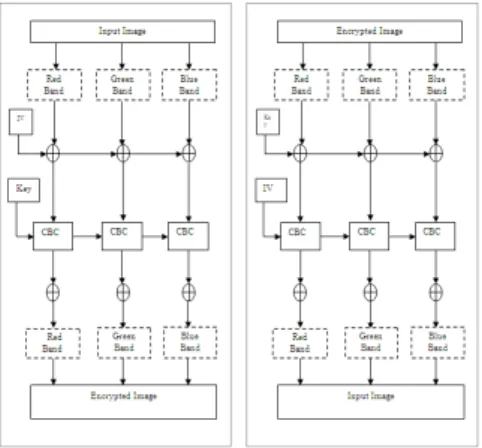
The proposed method consists of the encryption and decryption algorithm with multiple key generations. The proposed method ciphers the input secret image. Figure 1(a), (b) shows the block diagram for the encryption and decryption method. Figure 2 demonstrates the construction of Cipher Block Chaining encryption mode. The proposed method for the color image encryption falls under symmetric key encryption method that applies similar key for both encryption and decryption. The method is the combined architecture of improved cipher block chaining encryption mode with Exclusive Disjunction operator. The description of the method is as follows. Consider the given input image as the format with the pixel resolution of 256 x 256. Each color band of the input image will get separately encrypted. This method well encrypts the image given by the user into inarticulate format. The input secret image is initially separated into respective red band, green band and blue band as (Sample Image) SI = (Ra, Ga, Ba)..( Rn, Gn, Bn). It is then followed by conversion of every input pixel value into binary format.
The binary value is stored at the 8 x 8 matrix is taken as input. It is then fed to the improved cipher block chaining encryption mode. Set the Initialization vector (IV) with 8-bit binary input. The original input image is constructed along with the pixel values that are assigned as follows, with the separate matrix for each bands SI = (Ra, Ga, Ba). The pixel value of the each color bands is then separated individually as R1 = (Ra, Rb ,Rc, ….Rn.) and G1 = (Ga, Gb, Gc, ….Gn.) , B1 = (Ba, Bb, Bc, ….Bn.). After the band separation, pixel values are converted to its equivalent binary code and assigned to matrix. In any cryptographic process key generation is most significant part. In this technique multiple key generations takes place to strengthen encryption quality. The first key generation is taken after the cipher block chaining process, which is not found in the basic CBC mode. This inbuilt key generation step makes it more complex while fed as input and again exclusively disjunt with key generated. The second key generation is done using pseudo random number generators. Totally 32 matrices are created for every color bands is 8 x 8 matrix.
Fig. 1(a): Block diagram of proposed Encryption Method. (b): Block Diagram of proposed Decryption Method.
The resultant ciphered matrix is now allowed for exclusive disjunction with the second key matrix. The output is again matrix which consists of the Red band, green band and the blue band independently which is completely ciphered. The process is repeated recursively until all the pixels of the secret image are computed. Finally, the three bands are combined to generate the completely ciphered image.
Proposed Encryption Algorithm:
Input: Input RGB image Output: Encrypted Image Algorithm:
Step 1: Separate the pixels to individual color bands Red band, Green band and Blue band respectively (Sample
Image) SI = (Ra, Ga, Ba).
Step 2: Separate each color band independently as R1 = (Ra, Rb,Rc, ….Rn) and G1 = (Ga, Gb,Gc, ….Gn) , B1 = (Ba,
Bb,Bc, ….Bn.).
Step 3: Convert the image pixels as binary sequence.
Step 4: Store the binary sequence on a matrix as 8 ˣ 8 blocks for each color band.
Step 5: Set the initialization vector (IV) with 8 – bit binary input, and the improved cipher block chaining
operation mode follows.
Step 6: The key is generated from the result of cipher block chaining. This key value is passed as the first key to
be XORed with the original matrix computed.
Step 7: Compute the second key matrix K, of 8 ˣ 8 blocks, where the 8-bit input are from pseudo random number
generators.
Step 8: Perform XOR operation on every color bands, with the generated key matrix.
Step 9: Modified sequence containing the binary message bits according to the appropriate type of the intended is
generated.
Step 10: Perform combination of independent color bands SI = (Ra, Ga, Ba).
Step 11: Repeat the steps until all the pixels are encrypted.
Decryption of the proposed algorithm is reverse process in which the key remains similar for both encryption and decryption. The encrypted image matrix is XORed with the key matrix. The resultant matrix is then fed to the cipher block chaining operation mode. Finally, the conversion to the pixel value is done. The detach bands are again combined to produce the original secret RGB image.
RESULTS AND DISCUSSIONS
The proposed method is implemented with Visual Studio 2010, C# language under the configuration of windows 7 operating system with Core-i3 and 3 GB RAM. The performance evaluation factors NPCR and UACI are computed which show the differential attacks status to reveal the efficiency of the algorithm. Efficiency of the proposed system is demonstrated through the entropy measure. The experimental result is done for various standard test images and their outputs are analyzed. These Standard test Images were taken from the source (http://www.hlevkin.com/TestImages and http://www.petitcolas.net/steganography).
A) Experimental Analysis:
The following section illustrates the implementation results that contain the original, encrypted and decrypted image of the Lena, Baboon, Barbara, Bandon, Brandy rose and Pueblo bonito test images as represented in the Figure 3.1 to 3.6 by using the proposed encryption algorithm. The standard pixel resolution followed for the proposed encryption method is 256 ˣ 256. So, the images of various standards are preprocessed and convert to the necessary format. The image after preprocessing fed to the encryption algorithm and encrypted.
B) Performance Analysis: i) Entropy:
Encryption on the digital images are done to convert the original image to decipherable and made it mysterious to the unauthenticated persons. Encryption Quality (Entropy) is the parameter analyzed to prove the strength of the algorithm. The entropy is one of the most outstanding features for measuring the randomness of image encryption algorithm (Eq.1). The entropy values of original images are rarely generate uniformly distributed random messages and far from the ideal original images since they are highly redundant.
(1)
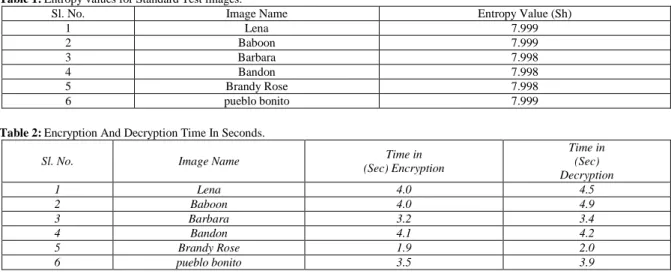
emitting, the entropy should be M. Entropy is measured in the units of Shannon (Sh) that describes the unit of information between two images. Table 1 shows the entropy value gained from the proposed method.
ii) Encryption and Decryption time:
Encryption speed is calculated for the proposed method that shows the improvement in execution speed. The average execution time for both the encryption and decryption takes minimum time seconds. The following table 2 shows the time taken for both image encryption as well as decryption for the test images.
Table 1:Entropy values for Standard Test images.
Sl. No. Image Name Entropy Value (Sh)
1 Lena 7.999
2 Baboon 7.999
3 Barbara 7.998
4 Bandon 7.998
5 Brandy Rose 7.998
6 pueblo bonito 7.999
Table 2:Encryption And Decryption Time In Seconds.
Sl. No. Image Name Time in
(Sec) Encryption
Time in (Sec) Decryption
1 Lena 4.0 4.5
2 Baboon 4.0 4.9
3 Barbara 3.2 3.4
4 Bandon 4.1 4.2
5 Brandy Rose 1.9 2.0
6 pueblo bonito 3.5 3.9
C) Differential Attack Results:
The differential attack analysis is one of the measure in which the attackers try to determine a rapport between the original and the cipher images, through evaluating the differences in an input pixel. It can affect the resultant difference at the output image to obtain the key. NPCR (Number of Pixels Change Rate – Eq.2) and UACI (Unified Average Changing Intensity – Eq.3) are the two important measures used to test the influence of single-pixel change on the original and encrypted image. A big difference among encrypted forms is expected, to maintain the secrecy of the image that also measures the efficiency of the diffusion phase.
(2)
(3)
Where M, N denotes the dimension of the image and (i,j) stands for the image co-ordinates. The results from the NPCR and UACI computations in Table 3 indicates that the method provided for image encryption is highly sensitive with respect to small changes in the original images. Hence, the given method is strongly capable of resisting the differential attack.
Table3:Npcr And Uaci Values For Encryped Images.
Sl. No. Image Name Size UACI (%) NPCR (%)
1 Lena 256 ˣ 256 32.17 99.60
2 Baboon 256 ˣ 256 29.08 99.62
3 Barbara 256 ˣ 256 29.52 99.59
4 Bandon 256 ˣ 256 30.09 99.68
5 Brandy Rose 256 ˣ 256 32.18 99.59
6 pueblo bonito 256 ˣ 256 33.4 99.67
i) Histogram Analysis:
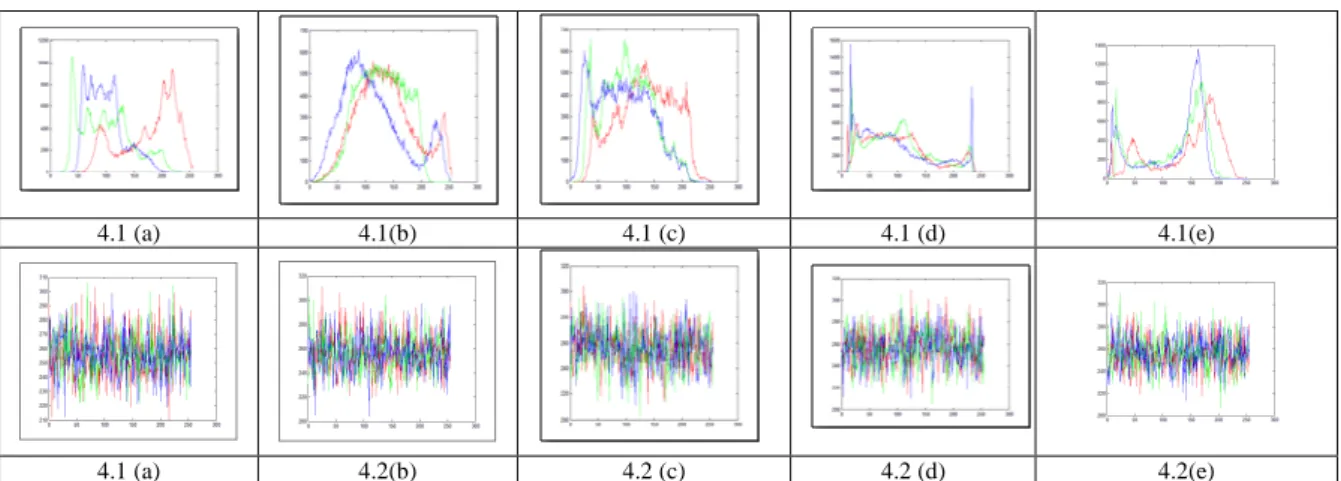
Histogram Analysis is done, to demonstrate the frequency distribution of continuous pixels between the original and encrypted image. It also determines the density of the given image. The cipher image with uniform histogram is found to be free from cryptanalytic attack. The below indicated figure 4.1(a-e) and 4.2 (a-e) shows the histogram evaluated for the original image to that of encrypted images. The axis x and y represents the number of pixels of the images.
ii) Comparative Analysis:
existing method works on the exclusive logical operator and chaotic mapping is formulated for the color image encryption. A single standard test image results are presented to show the efficiency of the proposed method. The size of the image is converted to 256 ˣ 256 for the proposed algorithm standard.
Table 4:Comparision Between The Existing And Proposed Method.
Parameters Image Name
(256ˣ 256)
Existing Method- RCBC
[Ref - 1] Proposed Method (ICBC)
NPCR (%) Lena 78.4 99.60
UACI (%) Lena 31.2 32.17
Entropy (Sh) Lena 7.926 7.999
From the experimental analysis it is observed that the entropy value is very close enough to the ideal value 8 by using the proposed method. Hence, it is defense against the attack. Figure 5(a) and 5(b) plotted the variation in percentage of NPCR and UACI between the existing and proposed method. In the graph the x-axis represents the method used for encryption and y-axis represents the value in percentage. The NPCR and UACI value computed are 99.60 % and 32.17 % says that a single pixel conversion in the image leads to major difference in encryption results. Thus it withstands the differential attacks effectually and is compared with the existing method.
Fig. 5(a): Comparative Analysis of existing and Proposed Method based on NPCR Measure.
Fig. 5(b): Comparative Analysis of existing and Proposed Method based on UACI Measure.
Conclusion:
decryption time calculation between the proposed than the existing demonstrates the enhancement in time complexity reduction and increased storage space. Histogram Analysis reveals the uniform distribution of pixels in the encrypted image. The performance metrics shows that the proposed image encryption method yields better security. This algorithm can be applied in the arena of cloud data centers so as to protect the sensitive images in robust manner.
(a) Original Image (b) Encrypted Image (c) Decrypted Image
Fig. 3.1: Experimental Results of the Lena Image.
(a) Original Image (b) Encrypted Image (c) Decrypted Image
Fig. 3.2: Experimental Results of the Baboon Image.
(a) Original Image (b) Encrypted Image (c) Decrypted Image
Fig. 3.3: Experimental Results of the Barbara Image.
(a) Original Image (b) Encrypted Image ( c) Decrypted Image
Fig. 3.4: Experimental Results of the Bandon Image.
Fig 3.5 (a) Original Image (b) Encrypted Image ( C)Decrypted Image
Fig. 3.5: Experimental Results of the Brandy rose Image.
Fig 3.6 (a) Original Image (b) Encrypted Image ( C)Decrypted Image
4.1 (a) 4.1(b) 4.1 (c) 4.1 (d) 4.1(e)
4.1 (a) 4.2(b) 4.2 (c) 4.2 (d) 4.2(e)
Fig. 4.1(a-e): Histogram Analysis of Original Image (a) Lena, b) Baboon, c) Barbara, d) Bandon and e) Brandy
Rose.
ACKNOWLEDGMENTS
This research is supported by the AURF (Alagappa University Research Fellowship – Grant No. Ph.D/0833/AURF Fellowship/2015), Alagappa University, Karaikudi, India.
REFERENCES
Abdul Hamid M. Ragab, Osama S. Farag Alla, Amin Y. Noaman, 2015. Encryption Quality Analysis of the RCBC Block Cipher Compared with RC6 and RC5 Algorithms.In International Bio-Metrics and Smart Government Summit, FTI Conference, Tunisia
Ali Abdulgader, MahamodIismail,Nasharuddin Zainal and Tarik Idbeaa, 2015. Enhancement of AES Algorithm based on Chaotic Maps and Shift Operation for Image Encryption. Journal of Theoretical and Applied Information Technology, 71 (1): 1-12.
Fatma, E.Z., A. Elgamal, Noha A. Hikal and F.E.Z. Abou-Chadi, 2013. Secure Medical Images Sharing over Cloud Computing environment. International Journal of Advanced Computer Science and Applications, 4 (5): 30-137.
Hasan Omar Al-Sakran, 2015. Accessing Secured Data in Cloud Computing Envionment.International Journal of Network Security and its applications,7(1):19-28.
Heba, M., Elhoseny, HossamE.H.Ahmed, Alaa M. Abbas, Hassan B. Kazemian, Osama S. Faragallah,Sayed M. El-Rabaie, Fathi E. Abd El-Samie, 2015.Chaotic ncryption of Images in the Fractional Fourier Transform domain using different modes of operation. Springer Verlag, 9: 611–622.
Ibrahim, F. Elashry, Osama, S. Faragallah, Alaa, M. Abbas, S. El-Rabaie ,Fathi E. AbdEl-Samie, 2012. A New Method for Encrypting Images with Few Details Using Rijndael and RC6 Block Ciphers in the Electronic Code Book Mode. Information Security Journal: A Global Perspective, Taylor & Francis, 22 (1):193–205.
Khaled Loukhaoukha, Jean-Yves Chouinard, Abdellah Berdai, 2012. A Secure Image Encryption Algorithm Based on Rubik’s Cube Principle. Hindawi Publishing Corporation,Journal of Electrical and Computer Engineering:1-13.
Kundankumar Rameshwar Saraf, Vishal Prakash Jagtap, Amit Kumar Mishra, 2014. Text and Image Encryption Decryption Using Advanced Encryption Standard.International Journal of Emerging Trends & Technology in Computer Science, 3:118 – 126.
Lahieb Mohammed Jawad, Ghazali Bin Sulong, 2013. A Review of Color Image Encryption Techniques.International Journal of Computer Science, (10): 266 – 275.
Mishra, D.C., R.K. Sharma, 2014. Application of algebra and discrete wavelet transform in two-dimensional data (RGB-images)security. International Journal of Wavelets,Multiresolution and Information Processing, 12: 1-25.
Osama, S., Faragallah, 2011. An Efficient Block Encryption Cipher Based on Chaotic Maps for Secure Multimedia Applications.Information Security Journal: A Global Perspective,20:135-147.
Panduranga, H.T., S.K. Naveen Kumar, 2012. A Novel Image Encryption Technique using Multi- wave based carrier Image. International Conference on Modeling, Optimization andComputing, in Sciverse Science Direct, Procedia Engineering, 38: 2998-3004.
Poonam Jindal, Brahmjit Singh, 2015. RC4 Encryption-A Literature Survey. In International Conference on Information and Communication Technologies, Procedia Computer Science, 46: 697-705.
Reddy Jyoteeswara Prasad, S., R.V.S. Sathyanarayana, 2013. Image Encryption Using Color Key Images. International Journal of Electrical and Electronic Engineering and Telecommunications, 2: 37-46.
Salim, M., Wadi, Nasharuddin Zainal, 2013. Rapid Encryption Method Based on AES Algorithm for Grey Scale HD Image Encryption. In the 4th International Conference on Electrical Engineering and Informatics, Procedia Technology, 11(5): 1-5.
Shiping Wen, Zhigang Zeng, Tingwen Huang, Qinggang Meng, Wei Yao, 2015. Lag Synchronization of Switched Neural Networks via Neural Activation Function and Applications in Image Encryption. IEEE Transactions On Neural Networks And Learning Systems, 1-11.
Sravan Kumar, D., C.H. Suneetha, A.Chandrasekhar, 2011. A Block Cipher Using Rotation and Logical XOR Operations. International Journal of Computer Science Issues , 8:142-147.
StrunkJr W., Ch, H. Lin, T.H. Chen, Ch, S. Wu, 2013. A batch image encryption scheme based on chaining random grids.Scientia Iranica, Transactions D: Computer Science & Engineering and Electrical Engineering, 20: 670-681.
Thamizhselvan, M., R. Raghuraman, S. Manoj, Gherson, Paul P.Victer, 2014. Data Security model for Cloud Computing using V-GRT methodology. In Proceedings of Intelligent System and Control ISCO 8th IEEE
Conference, 224-228.
Wang Xing-yuan and Chen Feng, Wang Tian, 2010. A new compound mode of confusion and diffusion for block encryption of image based on chaos. Communication in Nonlinear Science Numerical Simulation, 15: 2479–2485.
Xinxian Li, Weiqin Li and Daisong Shi, 2015. Enterprise private cloud file encryption system based on tripartite secret key protocol. In International Industrial Informatics and Computer Engineering Conference, Published by Atlantis Press, 166-169.
Yas, A., Alsultanny, 2008. Testing Image Encryption by Output Feedback (OFB). Journal of Computer Science, 4: 125-128.
Yuansheng Liu, Eric Yong Xie,Ge Cheng,Chengqing Li, 2014. Deciphering a novel image cipher based on mixed transformed Logistic maps. Elsevier, arXiv: 1404.3600:1-6.
Image Processing / Videocodecs/ Programming : http://www.hlevkin.com/TestImages/Boats.bmp