Sharif University of Technology
Scientia IranicaTransactions E: Industrial Engineering http://scientiairanica.sharif.edu
A Lagrangian relaxation approach to fuzzy robust
multi-objective facility location network design problem
D. Shishebori
a;, A. Youse Babadi
b, and Z. Noormohammadzadeh
aa. Department of Industrial Engineering, Yazd University, Yazd, P.O. Box 1684613114, Iran. b. School of Industrial and Systems Engineering, University of Tehran, Tehran, Iran. Received 26 May 2016; received in revised form 13 November 2016; accepted 6 March 2017
KEYWORDS Facility location; Network design; Robust optimization; Mixed integer programming; Fuzzy;
Multi-objective; Sub-gradient based Lagrangian relaxation.
Abstract. This study considers a multi-objective combined budget constrained Facility Location/Network Design Problem (FL/NDP), in which system uncertainty is considered. The most obvious practical examples of the problem are territorial designing and locating of academies, airline networks, and medical service centers. In order to assure network reliability versus uncertainty, an ecient robust optimization approach is applied to model the proposed problem. The formulation is minimizing the total expected costs, including transshipment costs, Facility Location (FL) costs, and xed cost of road/link utilization as well as minimizing the total penalties of uncovered demand nodes. Then, in order to consider several system uncertainties, the proposed model is changed to a fuzzy robust model by suitable approaches. An ecient sub-gradient based Lagrangian relaxation algorithm is applied. In addition, a practical example is studied. In the following, a series of experiments, including several test problems, is designed and solved to evaluate of the performance of the algorithm. The obtained results emphasize that considering practical factors (e.g. several uncertainties, system disruptions, and customer satisfaction) in modelling of the problem can lead to signicant improvement of the system yield and, subsequently, more ecient utilization of the established network.
© 2018 Sharif University of Technology. All rights reserved.
1. Introduction
Nowadays, most of the production industries, logistic systems, and supply chains constantly look for systems to simultaneously decrease several total costs and improve the eciency of their structures. FL, Network Design (ND), and allocation of demands to them are the problems, which can obviously help to achieve cost reduction and performance improvement goals, eciently.
In this paper, we combine 3 topics, namely, FL, ND, and facility covering, and study a multi-objective
*. Corresponding author. Tel.: +98 353 1232410 E-mail address: [email protected] (D. Shishebori); doi: 10.24200/sci.2017.4447
FL/NDP with regards to system uncertainty. The proposed problem is considered as a two-objective-function mathematical model such that the rst objec-tive function optimizes the xed costs and operational costs and the second objective function optimizes the total penalty costs for any nodes that cannot be cov-ered. The model simultaneously optimizes the network costs and uncovering costs. Therefore, minimizing the total costs and optimizing the customer satisfaction are studied simultaneously. Accordingly, the proposed model amplies the joint prots of customers and the network.
Several applications of the proposed problem can be found in dierent industries, services, and logistics systems. There are some Supply Chains (SCs) and logistics systems with a variety of uncertainties in various practical problems. Simultaneously considering
SC, logistics systems, ND, and a variety of system uncertainties is critical in order to ameliorate the eciency, productivity, and system safety. Some of the well-known examples are airline and railroad networks, pipelines for gas and water, and delivering services systems such as re stations, education centers, universities, and health care centers. As a concluding point, the best examples are SCs of dierent spare parts, food products, petrochemicals, etc.
The rest of the paper is organized as follows: In Section 2, a brief review of the relevant literature on the proposed problem is provided, and the research gap and our contribution are explained in the following. In Section 3, the mathematical model description and its formulation are presented. In details, rst, the assumptions and notations are described. Then, the multi-objective facility location network design problem is described and, nally, the fuzzy robust model formulation is proposed. In Section 4, general overview of the Lagrangian relaxation approach is presented. In Section 5, the proposed approach for the fuzzy robust multi-objective facility location network design problem is explained. A practical example and experimental analysis are discussed in Section 7. Finally, conclusions and future works are explained. 2. Literature review and research gap
2.1. Background
To clearly describe our contribution, 3 main trends in the literature can be reviewed that may be interesting for comparison: (1) the FL/ND problem, (2) the multi-objective FL Problems (FLPs), and (3) the FL with parameter uncertainty. Clearly, these 3 research trends are greatly related to the topic of this paper, i.e. locating of facility concerning the ND multi-objective problem and parameter uncertainty.
The rst trend of research is on the FL problem with respect to ND. Several studies have considered FL, ND, and demand allocation problems, separately. By simultaneously considering the FL and ND, the proposed problem can be clearly explained in a more practical modeling and formulation. The literature emphasizes that the classical FLPs consist of the uncapacitated FLPs, the maximum covering [1], the p-center and p-median [2], and the set covering prob-lems [3]. However, some studies have been done on the FLPs with regards to the ND topic. Drezner and Wesolowsky [4] presented some two-objective formula-tions for designing of an initial network with potential bi-directional links, each of which could be either opened at a predetermined cost or not. Rahmaniani and Ghaderi [5] formulated a Capacitated FL/ND Problem (CFL/NDP) with multi-type transshipment links and multi-type construction costs. Their math-ematical formulation minimized the operational and
total transshipment costs. Also, Ghaderi and Jabal-ameli [6] formulated a dynamic version of uncapac-itated budget constrained FL/NDP with regards to the planning horizon. This study was extended by Ghaderi [7] with respect to equity-based objective. At each time period, his model optimized the summation of the total dynamic costs of the maximum travel time. In another study, Rahmaniani and Ghaderi [8] eectively solved the CFL/NDP by several simple suit-able meta-heuristics according to the Varisuit-able Neigh-borhood Search (VNS) approach. Hassanzadeh Amin and Baki [9] proposed a multi-objective mixed-integer linear programming model for a closed-loop supply chain network by considering global factors, including exchange rates and customs duties under uncertain demand. A solution approach based on fuzzy pro-gramming was developed for solving the optimization problem. Taleizadeh et al. [10,11] developed a multi-product multi-constraint supply chain problem under fuzzy environment. Taleizadeh et al. [12] developed a single-product single-period problem under fuzzy demand in which a hybrid fuzzy simulation and meta-heuristics algorithm was applied to optimize the prob-lem.
The second trend of research is on multi-objective FLPs. Nozick [13] modelled a xed-charge FLP considering some coverage constraints to minimize cost and maintain a convenient service level, simul-taneously, in recognizing FLs. Also, they presented and tested two Lagrangian relaxations according to two heuristics. Villegas et al. [14] formulated the Colombian coee supply network as a bi-objective (coverage and cost) uncapacitated FLP. They designed two multi-objective evolutionary algorithms according to the Pareto Archive Evolution Policy (PAEP) and the Non-dominated Sorting Genetic Algorithm (NSGA II). Farhan and Murray [15] presented some mathe-matical formulations that simultaneously considered some issues, including partial regional service, coverage range, and the distance of the potential demand in facility siting. Taleizadeh et al. [16] developed a manufacturing system with scrap and rework process. They considered a mutli-product single-manufacturing facility to manufacture the items. Murray et al. [17] presented two models for the Location Set Covering Problem (LSCP) as LSCP-Explicit and LSCP-Implicit. In the LSCP-Implicit approach, it was presumed that each request region could be partially covered by one facility, i.e. the whole demands of one region could be covered by more than one facility. Jabalameli and Mortezaei [18] considered a limited capacity for each link for transferring the demands and formulated an extension of the CFL/NDP. Maliszewski et al. [19] combined the p-dispersion model with other FL objec-tives as 4 multi-objective models. The objecobjec-tives were relevant to siting critical assets, such as the center,
p-median, p-maxian, and max-cover models. Taleizadeh et al. [20] and Taleizadeh and Pentico [21] studied two incentive policies in inventory and supply chain system. Xifeng et al. [22] proposed a methodology that provided a multi-objective function optimization model for the classical Uncapacitated FLP (UFLP) in order to characterize the trade-o among economic, service, and environmental considerations. Eskandarpour et al. [23] developed a multi-objective post-sales ND formulation with regards to tactical and strategic decisions, which was conducive to optimize the environmental pollu-tion, all tardiness, and all xed and variable costs, simultaneously. Ozgen and Bahadir [24] studied an uncertain four-stage SC network and simultaneously minimized the maximum qualitative factors of ben-et and total costs by combining a fuzzy analytical hierarchical process approach and a two-phase pos-sibility linear mathematical programming approach. Sadjadi et al. [25] studied a capacitated multi-product multi-level reverse logistics ND with fuzzy returned products. Their model determined both locations of the facilities and treatment activities. Afshari et al. [26] studied the forward and reverse streams in a multi-objective, multi-period, multi-commodity green distribution-service network. They simultaneously op-timized sustainability of the system, client euphoria, and protability by optimizing FL agreements. They simultaneously minimized the location and operational costs, and maximized the customer sustainable satis-faction. Pasandideh et al. [27] formulated a multi-period multi-product three-level SC network in which the expected and the variance of the total location and operational costs were simultaneously minimized. Tavakkoli-Moghaddam et al. [28] formulated a multi-objective facility location problem with congestion and pricing policies. Their formulation dealt with situations in which immobile service facilities were congested by a stochastic demand following M/M/m/k queues. Zhang et al. [29] modelled a multi-objective public health-care facility location problem in which health-care facilities should be located to improve the equity of accessibility, raise the total accessibility for the entire population, reduce the population that fell outside the coverage range, and decrease the cost of building new facilities. Hajipour et al. [30] formulated a multi-objective multi-layer facility location-allocation model with congested facilities using classical queuing systems. The goal was to determine the optimal number of facilities and service allocation at each layer. They dealt with three objective functions aiming at: 1. Minimizing the sum of aggregate travel and waiting
times;
2. Minimizing the cost of establishing the facilities; 3. Minimizing the maximum idle probability of the
facilities.
Karasakal and Ahmet [31] proposed a bi-objective facility location model that investigated both service to uncovered demands and partial coverage. Due to the limited number of facilities to be opened, some of the demand nodes might not be within full or partial coverage distance of a facility. Their objectives were maximization of full and partial coverage, and mini-mization of the maximum distance between uncovered demand nodes and their nearest facilities.
The third trend of research is on the FL with parameter uncertainty. In general, by formulating a scenario-based stochastic program, this approach has traditionally been incorporated into the FLP. One of the rst studies was done by Sheppard [32] who proposed a scenario-based approach to FLPs. Tsiakis et al. [33] studied a multi-level multi-product SC with regards to the scenario-based demand uncertainty. Shishebori and Jabalameli [34] and Shishebori et al. [35] studied the reliable FL/NDP with respect to system disruptions. They developed a Mixed Integer Nonlinear Programming (MINLP) formulation for the problem. In another study, Shishebori et al. [36] considered the cost of system failures as the maximum accpetable disruption cost and formulated the reliable FL/NDP as MINLP. Shishebori and Youse-Babadi [37] studied a reliable and robust health care station location ND problem, which simultaneously took an investment budget constraint, system disruptions, and uncertain parameters into account. Lu et al. [38] formulated a reliable facility location design, which allowed dis-ruptions at dierent locations to be correlated with an uncertain joint distribution. They distributionally applied robust optimization to minimize the expected cost under the worst-case distribution with predeter-mined marginal disruption probabilities. Their worst-case distribution had a practical interpretation with disruption propagation and its sparse structure allowed solving the problem eciently. Huang and Di [39] mod-eled an uncapacitated facility location problem with customers' positions subject to experts' estimations. They used some uncertain variables to explain the estimations of customers' positions and proposed an expected distance minimization model. Jalali et al. [40] formulated a bi-objective reliable FLP with multiple capacity levels in a three-echelon SCM, while there was a constraint on the coverage levels. Also, they considered a provider-side uncertainty for Distribution-Centers (DCs). Their goal was to nd a near-optimal solution including suitable locations of DCs and plants, the fraction of satised customer demands, and the fraction of items sent to DCs to minimize the total cost and maximize ll rate, simultaneously. Keyvanshokooh et al. [41] proposed a novel hybrid robust-stochastic programming approach for a exible closed-loop supply chain networks design in order to cover demands and returns based on market conditions. They applied
Figure 1. A general scheme of a FL/NDP.
Latin Hypercube Sampling with backward reduction for scenario generation.
In the background, another approach to the parameter uncertainty is fuzzy theory. In several decision making states, great grade of uncertainties, as fuzziness aspect, is enmeshed in the data collection. Some studies introduced the fuzzy theory and its application [42,43]. Also, some studies explained the application of fuzzy optimization approaches to Linear Programming (LP), Goal Programming (GP), and other mathematical programming problems [43-54]. 2.2. Research gap
Although much eort has been done for understanding and mitigating several practical factors in dierent FLPs, early models assumed these practical factors sep-arately. Accordingly, separately assuming these factors can lead to unreal models, which cannot be suitable and useful in the practical environment. Moreover, sometimes these models do not adequately capture the simultaneous impacts of several practical factors in dierent FLPs.
A signicant point in the formulating of FLPs is to develop a suitable programming model, which can obtain a reasonable practical solution. Four remarkable subjects, which can help to achieve this goal, are FL, ND, demand uncertainty, and multi-objectivity. We briey explain the role of these subjects in formulating FLPs, separately.
The contribution of this paper, versus the past studies, is investigating an integrated scenario-based approach to FLPs with regards to the mentioned topics, which is conducive to improve the eciency of FLPs. The problem is named fuzzy robust multi-objective FL/NDP (FR/MO/FL/NDP). Simultane-ously, considering 3 practical topics, namely, ND, multi-objectivity, and parameter uncertainty, to pro-pose the mathematical modeling of FLPs is the main motivation of this research. To the best of the authors' knowledge, this integrated subject has not been studied yet.
3. Mathematical formulation and description 3.1. Denition
In a geographic area, there are a set of towns as demand nodes and a set of roadways as transshipment links. In this region, there are some facility centers (e.g. chain stores). Some new facility centers should be located; some transshipment links should be selected for utilization such that the total FL costs, xed costs of link utilization, and the variable transshipment costs are minimized. On the other hand, it is desired to maximize the covering of demand nodes. Thus, the rst objective optimizes the xed cost (including FL costs and link utilization costs) and operational costs (including the variable transshipment costs), and the second objective optimizes the total penalty costs for any nodes that cannot be covered. One point that should be considered is that the number of demands of each node has stochastic behavior, i.e. this parameter is not certain. Figure 1 illustrates a scheme of an FL/NDP.
The major assumptions of the problem can be described as follows: (I) All facility centers and transshipment roads/links are capacitated; (II) Each customer is either completely covered or not covered at all; (III) The xed cost of road/link utilization includes the xed costs of vehicle rent, the xed contract costs with vehicle transportation companies, the toll costs, and other marginal costs on that road/link. This denition of cost only depends on the quality and distance of the considered road/link; (IV) All transshipment costs and the demand of the node j are uncertain and have stochastic behavior; (V) A specic robust weight of solution variance is dened for each objective function; (VI) The number of facilities is predetermined.
3.2. Notications Sets:
Set of demand nodes
Parameters:
Pf Number of new facilities to locate;
i Fixed location cost of a facility at node
i (i 2 );
pij Fixed cost of link utilization (i; j)
((i; j) 2 );
tij Transshipment cost of a unit ow on
link (i; j) ((i; j) 2 );
LIB Maximum level of investment budget constraint;
di Demand value at node i, (i 2 );
i Capacity of facility i (i 2 );
M A big number;
ij Capacity of road/link (i; j) ((i; j) 2 );
i Penalty of the uncoverage of demands
of node i (i 2 );
kij 1 if the facility at node j covers
the demand of node i (i; j 2 ); 0 otherwise.
Decision variables:
Vi 1 if a facility center is located at node
i (i 2 ), 0 otherwise;
Uij 1 if a road/link (i; j) is selected for
utilization ((i; j) 2 ), 0 otherwise; Nij Demand value on road/link (i; j)
((i; j) 2 );
Wi 1 if demand of node i is not covered
(i 2 ), 0 otherwise. 3.3. Model formulation 3.3.1. The rst objective
In the rst objective, the total cost includes xed cost of facilities locating, xed cost of links utilizing, and variable transshipping cost. The rst objective function is organized as follows:
Minimize X
i2
iVi+
X
(i;j)2
pijUij+
X
(i;j)2
tijNij;
where P
i2iVi and
P
(i;j)2pijUij are the x costs and
P
(i;j)2tijNij is the transshipment costs.
3.3.2. The second objective
The second objective function optimizes the total penalty costs of demand nodes that are not covered by other opened facilities. The second objective can be arranged as:
Minmize X
i2
iWi:
When Wi = 1, node i is not covered by opened
facilities; thus, the penalty cost is equal to iWi.
3.3.3. The multi-objective counterpart formulation According to the assumptions and notations, the MIP model of the Multi-Objective FL/NDP (MO/FL/NDP) can be expressed as:
((MO/FL/NDP)): Obj(I) =MinimizeX
i2
iVi+
X
(i;j)2
pijUij
+ X
(i;j)2
tijNij; (1)
Obj(II) = MinimizeX
i2
iWi; (2)
s.t. X
(i;j)2
Nji
X
(i;j)2
Nij+di i+M(1 Vi) 8i 2 ;
(3) X
(i;j)2
Nij
X
(i;j)2
Nji di+ M(Vi) 8i 2 ;
(4) X
(i;j)2
Nij
X
(i;j)2
Nji di M(Vi) 8i 2 ;
(5) X
j2
kijVj+ Wi 1 8i 2 ; (6)
X
i2
fiVi+
X
(i;j)2
cijUij LIB; (7)
Uij+ Uji 1 8(i; j) 2 ; (8)
X
i2
Vi= Pf; (9)
Nij ijUij 8(i; j) 2 ; (10)
Vj; Wi 2 f0; 1g 8i; j 2 ; (11)
Uij 2 f0; 1g 8(i; j) 2 ; (12)
Nij 0 8(i; j) 2 : (13)
Eqs. (1) and (2) are objective functions. The rst one presents minimization of the total costs, including FL, road/link utilization, and transshipment costs; the second one illustrates minimization of the total penalty costs of demands uncovering. Constraints (3) -(5) present the ow conservation constraints. Con-straint (6) ensures that Wi = 1 when the demand point,
i is covered by no facilities. The investment budget con-straint is illustrated in Concon-straint (7). Concon-straints (8)
presents that the transshipment link cannot be selected for utilization in both directions of (i; j) and (j; i). Constraint (9) presents the predetermined number of facilities that have to be opened. Constraint (10) is the capacity of the links. Constraints (11)-(13) are non-negativity and standard integrality constraints of decision variables.
3.3.4. Robust optimization approach
Basically, most of the SCs and logistic systems can be aected by two broad categories of risk. The rst category is parameter (e.g. demand, xed costs, operational costs, and lead times) uncertainty and the second category is system disruptions (e.g. economic disruptions, strikes, natural disasters, and terrorist attacks). One of the most ecient approaches to deal with the rst category is Robust Optimization (RO). This approach has been applied broadly in the area of uncertain control and optimization since the late 1990s. The most common RO approaches are Mulvey et al. [55] , Ben-Tal and Nemirovski [56-58], and Bertsimas and Sim [59,60]. As the Mulvey approach is easily understandable for many designers/architects and it has a scenario-based problem, this robust ap-proach is considered, which is conducive to cope with related parameter uncertainties. For more details of this robust optimization approach, the readers can refer to Mulvey et al. [55], Yu and Li [61], Leung et al. [62], Bozorgi-Amiri et al. [63], and Shishebori and Youse-Babadi [37].
3.3.5. The robust multi-objective counterpart formulation
The robust MO/FL/NDP (R/MO/FL/NDP) model is an uncertain model, which can be reduced by using Eqs. (26)-(28). Accordingly, the R/MO/FL/NDP can be modelled as follows (before the representation of the robust model, some new nomenclature should be introduced):
Sets:
Set of uncertain scenarios; =
f1; 2; :::; sg Parameters:
1 Determined weight of the solution
variance of the rst objective; 2 Determined weight of the solution
variance of the second objective; ds
i Demand at node i under uncertain
scenario s (i 2 ; s 2 ); ts
ij Transshipment cost of a unit ow
on road/link (i; j) under uncertain scenario, s ((i; j) 2 ; s 2 ); s Probability of uncertain scenario s
(S 2 ).
Decision variables: s
1 Robust method variable for the rst
objective function; s
2 Robust method variable for the second
objective function; Ns
i;j Demand value of transshipment
road/link (i; j) under uncertain scenario s ((i; j) 2 ; s 2 ). R/MO/FL/NDP:
min Z1=
X
s2
s:s+ 1 X s2 s: s X
s02
s0
:s0
+ 2s 1
+X
i2
iVi+
X
(i;j)2
pijNij; (14)
min Z2=
X
s2
s:&s+ 2
X
s2
s&s X s02
s0
:&s0
+ 2s 2 ; (15) s.t. s X s2
s:s+ s
1 0 8s 2 ; (16)
&s X s2
s:&s+ s
2 0 8s 2 ; (17)
X
(j;i)2Njis
X
(i;j)2
Ns
ij+ dsi i+ M(1 Vi)
8i 2 ; 8s 2 ; (18)
X
(i;j)2Nijs
X
(i;j)2
Ns
ji dsi + M(Vi)
8i 2 ; 8s 2 ; (19)
X
(i;j)2Nijs
X
(i;j)2
Ns
ji dsi M(Vi)
8i 2 ; 8s 2 ; (20)
Ns
ij ijUij 8(i; j) 2 ; 8s 2 ; (21)
Ns
ij 0 8(i; j) 2 ; 8s 2 ; (22)
s
1; 2s 0 8s 2 ; and integer, (23)
and Constraints (6)-(9), (11), (12), where s =
P
(i;j)2t s
ijNijs, and &s=
P
i2 s iWi.
Constraints (14)-(15) present the robust objective function by Muley et al. [55] approach. Constraints (16)-(17) represent the linearization of the objective function in the RO method. Constraints (6)-(9), (11), (12), (21), and (22) have been described previously. In addition, Constraint (23) illustrates the general integrality constraints of decision variables.
3.3.6. Fuzzy goal programming
The weighted "-constraint, Goal Programming (GP), Pareto optimal, and the LP-norm are the most popular methods in the literature for treating multi-objective optimization problems [63-67]. In multi-objective prob-lems, since the objective functions have several conicts with each other, obtaining an optimal solution, which can optimize all of the objective functions altogether, is very dicult in most of the times (or impossible sometimes). Accordingly, instead of obtaining an op-timal solution, nding an ecient solution, which can satisfy all of the objective functions near optimality, can signicantly help several decision makers to ap-proach some practical reasonable solutions for dierent industries/services environments. Due to its numerous applications in solving multi-objective problems and being easily understandable to several decision makers, the GP is employed. Moreover, due to the capability of fuzzy set theory for nding the suitable crisp solutions in uncertain environments, Fuzzy Goal Programming (FGP) is employed for solving the R/MO/FL/NDP.
The rst studies applied the concept of mem-bership functions and, accordingly, proposed an FGP formulation [45,68,69]. If the ith goal of the multi-objective mathematical model is obtained and the Decision Maker (DM) is generally satised, then its membership function is equal to 1; otherwise, the membership function has a value between 0 and 1. Accordingly, the membership functions have values in the interval [0, 1]. The readers can study the detailed formulation of FGP problem in [43,44,70].
3.3.7. The fuzzy robust goal programming counterpart formulation
The necessary sets and variables can be dened as follows:
Sets:
T Set of objective functions, T = 1; 2 Variables:
Min fmembershipsg FR/MO/FL/NDP:
max ; (24)
s.t.
1 (Zt Lt)
(Ut Lt) 8t 2 T; (25)
and Constraints (6)-(9), (11), (12), (16)-(23), where is named the value of decision maker satisfaction [44]. The more this index approaches 1, the better it becomes.
3.3.8. Complexity
Property 1 establishes that the FR/MO/FLNDP prob-lem is NP-hard, since it has the P -median probprob-lem and capacitated location-allocation problem, which are themselves NP-hard, as a special case.
Property 1. The FR/MO/FLNDP problem is NP-hard.
Proof. The FR/MO/FLNDP is an extension of the MO/FLNDP. If we remove the second objective of the MO/FLNDP, and if we remove Eqs. (3)-(5), (8), and (10) and set pij = uij = 0 and LIB = 1,
then the FR/MO/FLNDP reduces to the classical P -median problem. Since the P --median problem is NP-hard [71], because the FR/MO/FLNDP is an extension of the classical P -median problem, it is also an NP-hard problem.
On the other hand, it can be said that the FR/MO/FLNDP is an extension of the MO/FLNDP. If we remove the second objective of the MO/FLNDP, and if we remove Eqs. (3)-(5), (8), and (10) and set
uij = 0 and LIB = 1, then the FR/MO/FLNDP
reduces to the classical capacitated location-allocation problem. Since the capacitated location-allocation problem is NP-hard [72], the FR/MO/FLNDP is an extension of the capacitated location-allocation prob-lem; therefore, it is an NP-hard problem.
4. Lagrangian relaxation
Solving the FR/MO/FL/NDP by GAMS software is very time consuming, especially for large-scale prob-lems. Accordingly, it can be concluded that proposing an ecient solution approach is necessary. Regarding the eciency of the Lagrangian relaxation approach for solving several FLPs, this approach is applied and customized. In the following, the proposed customized algorithm for the FR/MO/FL/NDP is described in details.
4.1. General points
The literature on the Lagrangian Relaxation (LR) dates back to 1970. In 1970 and 1971, Held and Karp [72,73] applied an LR approach based on the minimum spanning trees in order to design a well-organized algorithm for the Traveling Salesman Prob-lem (TSP). This successful application motivated some researchers. Fisher [74-76] was one of the researchers who developed the application of this algorithm to the general integer programming models and the
schedul-ing problems. Since then, this algorithm has been ap-plied to eciently solve several practical mathematical programming models. In the following, some studies related to the subject of this study are mentioned. Fisher [74-76] provided great discussions on the numer-ical perspectives and applications of LRs.
The LR was successfully applied in solving dif-ferent types of FLPs (FLP). CFLP is one of the several types of FLPs that have been solved by the LR approach, see [73,77-84].
Also, LR has been successfully applied for other types of FLPs, see [85-89].
4.2. The main structure
The combinatorial optimization problem P is modeled as an Integer Programming (IP) mathematical formu-lation:
(P ):
Z = min ; (26)
s.t.
T ; (27)
= #; (28)
0; and integer; (29)
where , , and # are matrices with dimensions n 1, k 1, and m 1, respectively. Also, the remaining matrices have related similar dimensions. Assume that LRP represents the problem P with relaxing of
Constraint (28) and it is added as a penalty to the objective. The optimal value of LRP is illustrated by
ZLP.
Suppose that the constraints of the (P ) are categorized as two constraint sets: I) = #, II) T ; therefore, the Lagrangian problem can be solved easily.
LRP : ZD( ) = min; + ( #); (30)
s.t.
T ; (31)
0; and integer, (32)
where = ( 1; :::; m) is the vector of Lagrangian
coecients. Z presents the obtained solution to the
problem (P ) from the CPLEX solver of GAMS soft-ware. Since Constraint (33), as a complex constraint, is relaxed, the problem (LRP) can be solved easier
than the problem (P ). Suppose that the set XX = fjT ; 0 and integerg presents the possible bounded solution to the LR and (P ) is a feasible
problem. Accordingly, ZD( ) will be bounded for all
values of ~l (i.e., 8 2 ; l = 1; 2; :::; m).
Accordingly, we have ZD( ) Z. Also, if
presents the optimal solution to problem P , it will be concluded that:
ZD( ) + ( #) = Z: (33)
Therefore, if = is substituted by in (P ), then 0 is needed and the armation leads to:
ZD( ) + ( #) Z: (34)
In a similar way, 0 is necessary for establishing the equation ZD( ) Z. Mainly, there is not any
guarantee for nding the suitable such that ZD( ) =
Z; however, it can be easily observed that the suitable
is found most of the times.
Since ZD( ) = Z, (LRP) can be substituted
with (LR ) in order to provide some ecient lower bounds in exact algorithms (e.g. the B & B algorithm) for (P ). This is known as the most usual application of the LR and other applications can be dened, e.g. it can be an indicator for selecting the suitable variables and the next branch of search operation. Perturbing nearly feasible solutions to (LR ) can lead to suitable possible solutions to (P ) [87,90].
As it was mentioned, ZD( ) presents a lower
bound of the problem Z. To catch an upper bound of the problem, the value of , obtained from solving ZD( ), is substituted in the main (P ) and an upper
bound is obtained. In the following, the proposed LR approach is presented.
5. The proposed approach
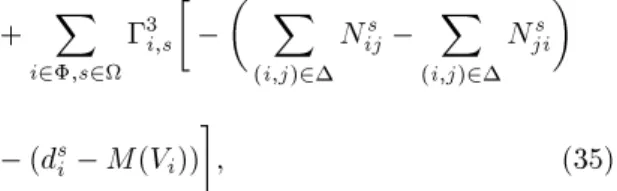
Since the highest complexities of the model (FR/MO/FL/NDP) are related to Constraints (18)-(20), they are relaxed. Accordingly, the Sub-Gradient based Lagrangian Relaxation (SGbLR) of the model (FR/MO/FL/NDP) can be rewritten as follows: SGbLR/FR/MO/FL/NDP:
max
+ X
i2;s2 1 i;s
X
(i;j)2
Ns ji
X
(i;j)2
Ns ij+ dsi
(i+ M(1 Vi))
+ X
i2;s2 2 i;s
X
(i;j)2
Ns ij
X
(i;j)2
Ns ji
(ds
i + M(Vi))
+ X
i2;s2 3 i;s
X
(i;j)2
Ns ij
X
(i;j)2
Ns ji
(ds
i M(Vi))
; (35)
s.t. Constraints (6)-(9), (11), (12), (16), (17), (21)-(23), and (25), where, in the objective function (Con-straint (35)), the values of 1
i;s; 2i;s; 3i;s are 1i;s
0; 2
i;s 0; 3i;s 0, because 3i;s, which is related to
Constraint (30), should be 3
i;s 0 in order to satisfy
the inequation ZD( ) Z.
Several methods (e.g. gradient, surrogate sub-gradient, coecients correction, column generation, bundle, cutting plane) have been proposed for up-dating Lagrangian coecients. However, the sub-gradient method is known as a popular method in
the literature [74]. This method has had a suitable performance for several mathematical programming problems. The sub-gradient method is a repetitive approach, which starts with some initial values for the Lagrangian coecients. Then, the values of these coecients are changed via a systematic procedure. The goal is maximizing the lower bound, obtained by the Lagranian problem (SGbLR/FR/MO/FL/NDP), via nding the best values of the Lagrangian coe-cients. Therefore, the Sub-Gradient based Lagrangian Relaxation (SGbLR) approach is used to solve the presented FR/MO/FL/NDP mode.
Suppose that the constraint Pj2ijj
i; 8i 2 , is selected to be added to the objective
function. Accordingly, the sub-gradient method of Stage 2 in Figure 2 is briey outlined as follows:
Step 1: is a parameter that is determined by
decision makers between 0 and 2 (i.e. 0 < 2). ZUB is a possible solution to the main problem, which
is acquired by heuristic methods. Also, presents
the initial arbitrary Lagrangian coecients;
Step 2: The Lagrangian problem is gured out with the Lagrangian coecients of Step 1. Accordingly, the value of the lower bound of the main problem (ZLB) and the value of decision variables (j) are
determined;
Step 3: For each relaxed constraint, a sub-gradient, named Gi, is dened as follows:
Gi= i
X
j2
ijj; 8i 2 : (36)
Step 4: In order to update of the direction of the SGbLR vector ( ), a step scale, named T , is dened as follows:
T = (ZPUB ZLB)
i 2 G2i : (37)
It is recommended that, at rst, should be set to 2 ( = 2). If in the predetermined number of iterations, no improvement of ZD( ) is obtained,
can be reduced to half its previous value;
Step 5: The value of i is updated via Eq. (38).
Then, we come back to Step 2 and gure out the La-grangian problem with new LaLa-grangian coecients:
i = max(0; i+ T Gi); 8i 2 : (38)
It is noted that one of the following conditions (or similar cases) can be the termination condition: (I) reducing until this parameter reaches a predeter-mined value and (II) doing a predeterpredeter-mined number of iterations.
6. A practical example
Here, a practical example is described with 30 nodes. Five nodes should be selected and constructed among the 30 proposed nodes. Other information (e.g. FL costs and transshipment costs) has been provided by Shishebori and Youse-Babadi [37]. The problem is solved by applying the proposed SGbLR approach and, after solving, 0.88 is obtained for .
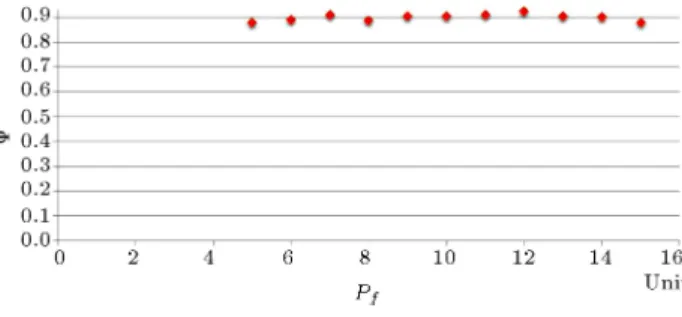
Figure 3 presents the behavior of the objective value of SGbLR/FR/MO/FL/NDP ( ) versus Pf.
Based on Figure 3, it is obvious that locating of excessive facilities cannot improve decision maker satisfaction. Figure 3 emphasizes that if 12 facilities of 30 potential facilities are located, the maximum decision maker satisfaction will be attained.
Another important factor, which can aect the objective value, is the value of Budget Constraint (BC).
Figure 3. Changes of decision maker satisfaction ( ) versus the Pf.
Figure 4. Changes of decision maker satisfaction for dierent values of investment budget.
Figure 4 shows how the changes of BC can aect the optimal objective value of FR/MO/FL/NDP.
Through Figure 4, it can be claried that exces-sive budget investment does not necessarily lead to designer satisfaction. Figure 4 emphasizes that the optimal budget investment value, which can lead to the maximum value of decision maker satisfaction, is 16,000,000 MU (Monetary Unit).
7. Numerical results
In order to evaluate the performance of the SGbLR solution algorithm, relatively comprehensive numerical experiments were done. The algorithm was coded in GAMS 24.1.2 and performed by the CPLEX solver on a computer with a core 2 Due @ 2.0 GHz and 8 GB RAM operating with windows 7.0.
7.1. Experimental design
Fifty-seven test problems with several sizes were solved. These problems were randomly generated by the uni-form distribution function with several uncertainty sce-narios. According to the historical data, some changing conditions (e.g. climate change, uctuations in stock market costs, etc.) can lead to uncertainty in some of the input parameters of the proposed model. In this study, the demands of each node as well as the trans-shipment unit costs are stochastic as some scenarios. Therefore, the value of demand transshipment will be stochastic. These uncertain situations are categorized as follows: excellent, good, medium, and bad with probabilities of 0.25, 0.28, 0.32, and 0.2, respectively. The transshipment cost for each client in kilometers is
dened as a proportion of distance for the 4 mentioned scenarios as follows, 0.0040, 0.0035, 0.0025, and 0.0015, respectively. The xed cost of opening each facility uniformly varies between [27,000,000{48,000,000] MU (Monetary Unit). The xed cost of link utilization is obtained by multiplying a coecient (85,000) by the distance between each two nodes. The capacity of the facilities is obtained by multiplying a coecient (10) by the expected value of node's demand. Also, the robust parameters, including the determined weight of the solution variance of the rst objective (1),
the determined weight of the solution variance of the second objective (2), and probability of uncertain
scenario (s), are randomly generated between (0.2,2),
(0.2,2), and (0.1,1), respectively. In order to normalize the generated data, the summation of sis limited to 1
for all scenarios. It is noted that the procedure for gen-erating these parameters is according to Bozorgi-Amiri et al. [63] and Shishebori and Youse-Babadi [37]. 7.2. Algorithm performance
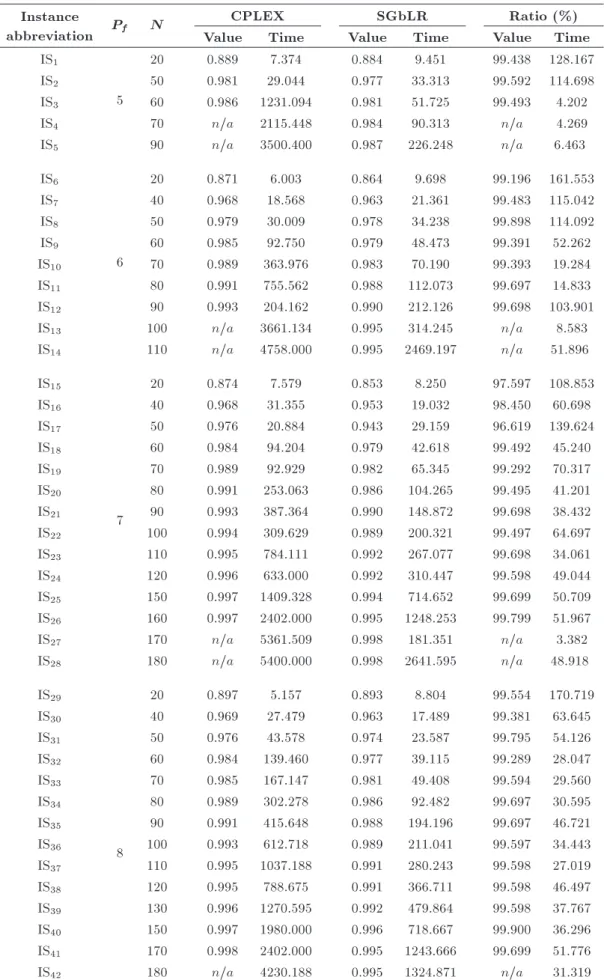
Table 1 compares the performance of the CPLEX with that of the proposed SGbLR algorithm. For each algorithm, the table illustrates the objective value (\Value") and the CPU time (\Time"). The CPU time for the proposed algorithm includes the computational time required to solve the SGbLR in Stage 2 in Figure 2, which is then used as an input to the main stage (Stage 3 in Figure 2) of the algorithm. In addition, Table 1 presents the objective function values from the SGbLR (\LRB") and CPLEX (\CB"). \LRB" presents the CPU time of the SGbLR solved in Step 2 of the proposed algorithm. The ratio of the objective value of the best solution obtained from the CPLEX to the corresponding value from the proposed algorithm can be calculated as follows:
RatioObj.Fun( )(%)
=Objective function( )Objective function( )SGbLR
Cplex 100; (39)
RatioTime(%) = TimeTimeSGbLR
Cplex 100: (40)
In Table 1, values less than 100% in the \Ratio (%)" column (with \Value" and \Time" sub-columns) indicate that the proposed SGbLR algorithm out-performs the CPLEX concerning CPU time and the objective function value, respectively. The applied SGbLR algorithm is faster than the CPLEX for most of the test problems. In addition, no feasible solution in the allowed time (i.e. 6000s) is specied by the symbol \n=a" in the table. It is shown that for a few instances (especially for small-size instances), the CPU time of the SGbLR algorithm is more than that of the CPLEX; because, basically, the SGbLR
algorithm is applied to a vast variety of instances with several sizes and the performance of the algorithm is better observable when the amount of the instances grows.
Table 1 shows that the solutions attained by the algorithm are, on average, 0.458% (100% 99:542% = 0:458%) less than those attained by CPLEX, i.e. it can provide similar or better solutions than CPLEX does for medium and relatively great-scale instances. Moreover, the SGbLR is much faster; it requires only 50.766% of the CPLEX's time, on average, and does not fail to obtain solutions to any of the test problems throughout the time bound, whilst CPLEX fails to do so for 16 out of the 70 test problems.
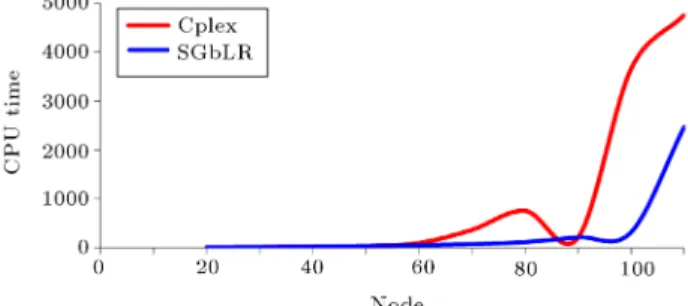
With attention to Table 1 and Figures 5-16, it is clear that the SGbLR algorithm has signicantly low CPU time in comparison with CPLEX, while the objective values of both the SGbLR algorithm and CPLEX are almost similar. However, it is observed
Figure 5. Varying of CPU time for several values of demand nodes with Pf = 5.
Figure 6. Varying of the for several values of demand nodes with Pf = 5.
Figure 7. Varying of CPU time for several values of demand nodes with Pf = 6.
Table 1. Comparison of the performance of the proposed SGbLR versus CPLEX. Instance
abbreviation Pf N
CPLEX SGbLR Ratio (%)
Value Time Value Time Value Time
IS1
5
20 0.889 7.374 0.884 9.451 99.438 128.167
IS2 50 0.981 29.044 0.977 33.313 99.592 114.698
IS3 60 0.986 1231.094 0.981 51.725 99.493 4.202
IS4 70 n=a 2115.448 0.984 90.313 n=a 4.269
IS5 90 n=a 3500.400 0.987 226.248 n=a 6.463
IS6
6
20 0.871 6.003 0.864 9.698 99.196 161.553
IS7 40 0.968 18.568 0.963 21.361 99.483 115.042
IS8 50 0.979 30.009 0.978 34.238 99.898 114.092
IS9 60 0.985 92.750 0.979 48.473 99.391 52.262
IS10 70 0.989 363.976 0.983 70.190 99.393 19.284
IS11 80 0.991 755.562 0.988 112.073 99.697 14.833
IS12 90 0.993 204.162 0.990 212.126 99.698 103.901
IS13 100 n=a 3661.134 0.995 314.245 n=a 8.583
IS14 110 n=a 4758.000 0.995 2469.197 n=a 51.896
IS15
7
20 0.874 7.579 0.853 8.250 97.597 108.853
IS16 40 0.968 31.355 0.953 19.032 98.450 60.698
IS17 50 0.976 20.884 0.943 29.159 96.619 139.624
IS18 60 0.984 94.204 0.979 42.618 99.492 45.240
IS19 70 0.989 92.929 0.982 65.345 99.292 70.317
IS20 80 0.991 253.063 0.986 104.265 99.495 41.201
IS21 90 0.993 387.364 0.990 148.872 99.698 38.432
IS22 100 0.994 309.629 0.989 200.321 99.497 64.697
IS23 110 0.995 784.111 0.992 267.077 99.698 34.061
IS24 120 0.996 633.000 0.992 310.447 99.598 49.044
IS25 150 0.997 1409.328 0.994 714.652 99.699 50.709
IS26 160 0.997 2402.000 0.995 1248.253 99.799 51.967
IS27 170 n=a 5361.509 0.998 181.351 n=a 3.382
IS28 180 n=a 5400.000 0.998 2641.595 n=a 48.918
IS29
8
20 0.897 5.157 0.893 8.804 99.554 170.719
IS30 40 0.969 27.479 0.963 17.489 99.381 63.645
IS31 50 0.976 43.578 0.974 23.587 99.795 54.126
IS32 60 0.984 139.460 0.977 39.115 99.289 28.047
IS33 70 0.985 167.147 0.981 49.408 99.594 29.560
IS34 80 0.989 302.278 0.986 92.482 99.697 30.595
IS35 90 0.991 415.648 0.988 194.196 99.697 46.721
IS36 100 0.993 612.718 0.989 211.041 99.597 34.443
IS37 110 0.995 1037.188 0.991 280.243 99.598 27.019
IS38 120 0.995 788.675 0.991 366.711 99.598 46.497
IS39 130 0.996 1270.595 0.992 479.864 99.598 37.767
IS40 150 0.997 1980.000 0.996 718.667 99.900 36.296
IS41 170 0.998 2402.000 0.995 1243.666 99.699 51.776
Table 1. Comparison of the performance of the proposed SGbLR versus CPLEX (continued). Instance
abbreviation Pf N
CPLEX SGbLR Ratio (%)
Value Time Value Time Value Time
IS43 190 n=a 4723.669 0.996 2024.569 n=a 42.860
IS44 200 n=a 5435.678 0.998 2244.402 n=a 41.290
IS45
9
50 0.973 49.607 0.969 29.159 99.589 58.780
IS46 60 0.976 101.222 0.972 42.618 99.590 42.103
IS47 70 0.985 143.017 0.981 65.345 99.594 45.690
IS48 80 0.989 245.595 0.986 104.265 99.697 42.454
IS49 90 0.990 205.437 0.987 174.196 99.697 84.793
IS50 100 0.991 361.219 0.990 201.041 99.899 55.656
IS51 110 0.993 539.674 0.991 260.243 99.799 48.222
IS52 120 0.994 859.818 0.993 356.711 99.899 41.487
IS53 130 0.993 1326.328 0.991 459.864 99.799 34.672
IS54 150 0.998 2358.214 0.994 479.453 99.599 20.331
IS55 160 n=a 3865.686 0.996 598.667 n=a 15.487
IS56 170 n=a 4019.557 0.997 1047.030 n=a 26.048
IS57 200 n=a 5115.975 0.998 1674.296 n=a 32.727
IS58
10
80 0.987 161.000 0.987 47.670 100.000 29.609
IS59 90 0.990 214.700 0.989 84.210 99.899 39.222
IS60 100 0.992 221.870 0.992 106.230 100.000 47.879
IS61 120 0.994 449.860 0.991 170.050 99.698 37.801
IS62 140 0.996 712.250 0.994 314.780 99.799 44.195
IS63 170 0.997 1166.610 0.996 590.510 99.900 50.618
IS64 180 0.997 2290.960 0.996 817.990 99.900 35.705
IS65 190 0.997 2297.740 0.997 1068.100 100.000 46.485
IS66 200 0.998 3076.370 0.995 1217.180 99.699 39.565
IS67 230 n=a 6920.730 0.997 3042.070 n=a 43.956
IS68 250 n=a 8120.380 0.997 4779.590 n=a 58.859
IS69 270 n=a 21060.000 0.998 5820.000 n=a 27.635
IS70 300 n=a 25342.657 0.998 6234.340 n=a 24.600
Average 0.981 2125.263 0.981 696.980 99.542 50.766
Figure 8. Varying of the for several values of demand nodes with Pf = 6.
that the CPU time of CPLEX has considerably grown with increase in the number of demand nodes and the size of the problem. Moreover, sometimes, the CPLEX cannot nd any feasible solution to the prob-lem.
8. Conclusion
The fuzzy robust multi-objective FL/NDP was studied concerning two additional aspects of budget invest-ment constraints and system reliability. The problem was called the fuzzy robust multi-objective FL/NDP (FR/MO/FL/NDP) and formulated as an MIP model. In addition, an ecient algorithm based on SGbLR was applied. The obtained results by the experimental design showed the eciency of the algorithm versus CPLEX with regards to solution speed, while it still maintained excellent solution quality.
For future research, some directions are recom-mended. First, we considered the fuzzy aspect of the FR/MO/FL/NDP; however, other aspects of uncer-tainty (e.g. several probability distributions, intervals,
Figure 9. Varying of CPU time for several values of demand nodes with Pf = 7.
Figure 10. Varying of the for several values of demand nodes with Pf = 7.
Figure 11. Varying of CPU time for several values of demand nodes with Pf = 8.
Figure 12. Varying of the for several values of demand nodes with Pf = 8.
etc.) can be considered. Second, dierent applications of the FR/MO/FL/NDP in several industrial environ-ments and service systems, as a case study, can be considered and studied. Third, and nally, proposing an ecient approach (e.g. Sample Average
Approx-Figure 13. Varying of CPU time for several values of demand nodes with Pf = 9.
Figure 14. Varying of the for several values of demand nodes with Pf = 9.
Figure 15. Varying of CPU time for several values of demand nodes with Pf = 10.
Figure 16. Varying of the for several values of demand nodes with Pf = 10.
imation (SAA), Monte Carlo simulation, etc.) for the FR/MO/FL/NDP, when the number of scenarios increases, can be another consideration.
Acknowledgement
This research was nancially supported by the Iranian National Science Foundation (INSF) grant number 93042256. This support is honestly appreciated.
References
1. Kuehn, A.A. and Hamburger, M.J. \A heuristic
pro-gram for locating warehouses", Management Science, 9(4), pp. 643-666 (1963).
2. Hakimi, S.L. \Optimum locations of switching centers
and the absolute centers and medians of a graph", Operations Research, 12(3), pp. 450-459 (1964).
3. Toregas, C., Swain, R., ReVelle, C., and Bergman, L.
\The location of emergency service facilities", Opera-tions Research, 19, pp. 1363-1373 (1971).
4. Drezner, Z. and Wesolowsky, G.O. \Network design:
Selection and design of links and facility location", Transportation Research, Part A, 37, pp. 241-256 (2003).
5. Rahmaniani, R. and Ghaderi, A. \A combined facility
location and network design problem with multi-type of capacitated links", Applied Mathematical Modelling, 37(9), pp. 6400-6414 (2013).
6. Ghaderi, A. and Jabalameli, M.S. \Modeling the
budget-constrained dynamic uncapacitated facility location-network design problem and solving it via two ecient heuristics: a case study of health care", Mathematical and Computer Modelling, 57, pp. 382-400 (2013).
7. Ghaderi, A. \Heuristic algorithms for solving an
inte-grated dynamic center facility location-network design model", Networks and Spatial Economics, 15(1), pp. 43-69 (2015).
8. Rahmaniani, R. and Ghaderi, A. \An algorithm with
dierent exploration mechanisms: experimental results to capacitated facility location/network design prob-lem", Expert Systems with Applications, 42(7), pp. 3790-3800 (2015).
9. Saman Hassanzadeh, A. and Baki, F. \A facility
location model for global closed-loop supply chain network design", Applied Mathematical Modelling, 41, pp. 316-330 (2017).
10. Taleizadeh, A.A., Niaki, S.T.A., and Aryanezhad,
M.B. \A hybrid method of Pareto, TOPSIS and genetic algorithm to optimize product multi-constraint inventory control systems with random fuzzy replenishments", Mathematical and Computer Modeling, 49(5-6), pp. 1044-1057 (2009).
11. Taleizadeh, A.A., Niaki, S.T.A., and Aryanezhad,
M.B. \Replenish-up-to multi chance-constraint inven-tory control system with stochastic period lengths and total Discount under fuzzy purchasing price and hold-ing costs", International Journal of System Sciences, 41(10), pp. 1187-1200 (2010-a).
12. Taleizadeh, A.A., Barzinpour, F., and Wee, H.M.
\Meta-heuristic algorithms to solve the fuzzy single pe-riod problem", Mathematical and Computer Modeling, 54(5-6), pp. 1273-1285 (2011).
13. Nozick, L.K. \The xed charge facility location
prob-lem with coverage restrictions", Transportation Re-search, part E., 37, pp. 281-296 (2001).
14. Villegas, J.G., Palacios, F., and Medaglia, A.L.
\So-lution methods for the bi-objective (cost-coverage) unconstrained facility location problem with an il-lustrative example", Annals of Operations Research, 147(1), pp. 109-141 (2006).
15. Farhan, B. and Murray, A.T. \Distance decay and
coverage in facility location planning", The Annals of Regional Science, 40(2), pp. 279-295 (2006).
16. Taleizadeh, A.A., Naja, A.A., and Niaki, S.T.A.
\Multi product EPQ model with scraped items and limited production capacity", Scientia Iranica, Trans-actions E., 17(1), pp. 58-69 (2010-b).
17. Murray, A.T., Tong, D., and Kim, K. \Enhancing
clas-sic coverage location models", International Regional Science Review, 33(2), pp. 115-133 (2010).
18. Jabalameli, M.S. and Mortezaei, M. \A hybrid model
for multi-objective capacitated facility location net-work design problem", International Journal of Indus-trial Engineering Computations, 2, pp. 509-524 (2011).
19. Maliszewski, P.J.K., Michael, J., and Horner, M.W.
\A comparison of multi-objective spatial dispersion models for managing critical assets in urban areas Computers", Environment and Urban Systems, 36(4), pp. 331-341 (2012).
20. Taleizadeh, A.A., Pentico, D.W., Jabalameli, M.S.,
and Aryanezhad, M.B. \An economic order quantity model with multiple partial prepayments and partial backordering", Mathematical and Computer Modeling, 57(3-4), pp. 311-323 (2013).
21. Taleizadeh, A.A. and Pentico, D.W. \An economic
order quantity model with known price increase and partial backordering", European Journal of Opera-tional Research, 28(3) pp. 516-525 (2013).
22. Xifeng, T., Zhang, J., and Peng, X. \A multi-objective
optimization model for sustainable logistics facility location", Transportation Research, Part D: Transport and Environment, 22, pp. 45-48 (2013).
23. Eskandarpour, M., Zegordi, S.H., and Nikbakhsh, E.
\A parallel variable neighborhood search for the multi-objective sustainable post-sales network design prob-lem", International Journal of Production Economics, 145(1), pp. 117-131 (2013).
24. Ozgen, D. and Bahadir, G. \Combining
possibilis-tic linear programming and fuzzy AHP for solving the multi-objective capacitated multi-facility location problem", Information Sciences, 268, pp. 185-201 (2014).
25. Sadjadi, S.J., Soltani, R., and Eskandarpour, A.
\Location based treatment activities for end of life products network design under uncertainty by a robust multi-objective memetic-based heuristic approach", Applied Soft Computing, 23, pp. 215-226 (2014).
26. Afshari, H., Shara, M., Elmekkawy, T., and Peng, Q.
\Optimizing multi-objective dynamic facility location decisions within green distribution network design", Procedia CIRP, 17(1), pp. 675-679 (2014).
27. Pasandideh, S.H.R., Niaki, S.T.A., and Asadi, K. \Bi-objective optimization of a multi-product multi-period three-echelon supply chain problem under uncertain environments: NSGA-II and NRGA", Information Sciences, 292, pp. 57-74 (2015).
28. Tavakkoli-Moghaddam, R., Vazifeh-Noshafagh, S.,
Taleizadeh, A.A., Hajipour, V., and Mahmoudi, A. \Pricing and location decisions in multi-objective fa-cility location problem with M/M/m/k queuing sys-tems", Engineering Optimization, 49(1), pp. 136-160 (2017).
29. Zhang, W., Cao, K., Liu, S., and Huang, B. \A
multi-objective optimization approach for health-care facility location-allocation problems in highly developed cities such as Hong Kong", Computers, Environment and Urban Systems, 59, pp. 220-230 (2016).
30. Hajipour, V., Fattahi, P., Tavana, M., and Di,
Caprio, D. \Multi-objective multi-layer congested fa-cility location-allocation problem optimization with Pareto-based meta-heuristics", Applied Mathematical Modelling, 40(7), pp. 4948-4969 (2016).
31. Karasakal, E. and Ahmet, S. \A multi-objective
ge-netic algorithm for a bi-objective facility location problem with partial coverage", Top, 24(1), pp. 206-232 (2016).
32. Sheppard, E.S. \A conceptual framework for dynamic
location-allocation analysis", Environment and Plan-ning A, 6, pp. 547-564 (1974).
33. Tsiakis, P., Shah, N., and Pantelides, C.C. \Design
of multi-echelon supply chain networks under demand uncertainty", Industrial & Engineering Chemistry Re-search, 40, pp. 3585-3604 (2001).
34. Shishebori, D. and Jabalameli, M.S. \Improving the
eciency of medical services systems: a new inte-grated mathematical modeling approach", Mathemat-ical Problems in Engineering, pp. 1-13 (2013).
35. Shishebori, D., Jabalameli, M.S., and Jabbarzadeh, A.
\Facility location-network design problem: Reliability and investment budget constraint", Journal of Urban Planning and Development, 140(3), pp. 4001-4005 (2013).
36. Shishebori, D., Snyder, L.V., and Jabalameli, M.S.
\A Reliable budget-constrained FL/ND problem with unreliable facilities", Networks and Spatial Economics, 14(3-4), pp. 549-580 (2014).
37. Shishebori, D. and Youse-Babadi, A. \Robust and
re-liable medical services network design underuncertain environment and system disruptions", Transportation Research, Part E., 77, pp. 268-288 (2015).
38. Lu, M., Ran, L., and Shen, Z.J.M. \Reliable facility
lo-cation design under uncertain correlated disruptions", Manufacturing & Service Operations Management, 17(4), pp. 445-455 (2015).
39. Huang, X. and Di, H. \Modelling uncapacitated
facility location problem with uncertain customers' positions", Journal of Intelligent & Fuzzy Systems, 28(6), pp. 2569-2577 (2015).
40. Jalali, S., Seifbarghy, M., Sadeghi, J., and
Ah-madi, S. \Optimizing a bi-objective reliable facility location problem with adapted stochastic measures using tuned-parameter multi-objective algorithms", Knowledge-Based Systems, 95, pp. 45-57 (2016).
41. Keyvanshokooh, E., Sarah M.R., and Kabir, E.
\Hy-brid robust and stochastic optimization for closed-loop supply chain network design using accelerated Benders decomposition", European Journal of Operational Re-search, 249(1), pp. 76-92 (2016).
42. Zadeh, L.A. \Fuzzy sets", Information and Control, 8,
pp. 338-353 (1965).
43. Zimmermann, H.J. \Description and optimization of
fuzzy systems", International Journal of General Sys-tems, 2, pp. 209-215 (1976).
44. Zimmermann, H.J. \Fuzzy programming and linear
programming with several objective functions", Fuzzy Sets and Systems, 1, pp. 45-56 (1978).
45. Hannan, E.L. \On fuzzy goal programming", Decision
Sciences, 12, pp. 522-531 (1981-b).
46. Yager, R.R. \Multiple objective decision-making using
fuzzy sets", International Journal of Man-Machine Studies, 9, pp. 375-382 (1977).
47. Pickens, J.B. and Hof, J.G. \Fuzzy goal programming
in forestry: an application with special solution prob-lems", Fuzzy Sets and Systems, 39(3), pp. 239-246 (1991).
48. Shankar, R. and Vrat, P. \Some design issues in
cellular manufacturing using fuzzy programming ap-proach", International Journal of Production Re-search, 37(11), pp. 2345-2363 (1999).
49. Zangi abadi, M. and Maleki, H.R. \Fuzzy goal
pro-gramming technique to solve multiobjective trans-portation problems with some non-linear membership functions", Iranian Journal of Fuzzy Systems, 10(1), pp. 61-74 (2013).
50. Kanani Nezhad, A.A., Roghanian, E., and Azadi, Z.
\A fuzzy goal programming approach to solve multi-objective supply chain network design problems", In-ternational Journal of Industrial Engineering Compu-tations, 4, pp. 315-324 (2013).
51. Cebi, F. and Otay, _I. \Multi-criteria and multi-stage
facility location selection under interval type-2 fuzzy environment: a case study for a cement factory", International Journal of Computational Intelligence Systems, 8(2), pp. 330-344 (2015).
52. Yang, T., Ignizio, J.P., and Kim, H.J. \Fuzzy
program-ming with nonlinear membership functions: piecewise linear approximation", Fuzzy Sets and Systems, 11, pp. 39-53 (1991).
53. Rao, S.S., Sundaraju, K., Prakash, B.G., and
Bal-akrishna, C. \Fuzzy goal programming approach for structural optimization", AIAA Journal, 30(5), pp. 1425-1432 (1992).
goal programming in multi-criteria decision systems: a case study inagricultural planning", Socio-Economic Planning Sciences, 22(2), pp. 93-101 (1988).
55. Mulvey, J.M., Vanderbei, R.J., and Zenios, S.A.
\Ro-bust optimization of large-scale systems", Operations Research, 43, pp. 264-281 (1995).
56. Ben-Tal, A. and Nemirovski, A. \Robust convex
op-timization", Mathematics of Operations Research, 23, pp. 769-805 (1998).
57. Ben-Tal, A. and Nemirovski, A. \Robust solutions
of uncertain linear programs", Operations Research Letters, 25, pp. 1-13 (1999).
58. Ben-Tal, A. and Nemirovski, A. \Robust solutions
of linear programming problems contaminated with uncertain data", Mathematical Programming, 88, pp. 411-424 (2000).
59. Bertsimas, D. and Sim, M. \Robust discrete
optimiza-tion and network ows", Mathematical Programming, 98, pp. 49-71 (2003).
60. Bertsimas, D. and Sim, M. \The price of robustness",
Operations Research, 52, pp. 35-53 (2004).
61. Yu, C.S. and Li, H.L. \A robust optimization model
for stochastic logistic problems", International Journal of Production Economics, 64, pp. 385-397 (2000).
62. Leung, S.C.H., Tsang, S.O.S., Ng, W.L., and Wu, Y.
\A robust optimization model for multi-site produc-tion planning problem in an uncertain environment", European Journal of Operational Research, 181, pp. 224-238 (2007).
63. Bozorgi-Amiri, A., Jabalameli, M., and Mirzapour
Al-e-Hashem, S. \A multi-objective robust stochastic programming model for disaster relief logistics under uncertainty", OR Spectrum, 35(4), pp. 905-933 (2013).
64. Zhou, Z., Cheng, S., and Hua, B. \Supply chain
optimization of continuous process industries with sus-tainability considerations", Computer and Chemical Engineering, 24, pp. 1151-1158 (2000).
65. Chen, C.L., Wang, B.W., and Lee, W.C.
\Multi-objective optimization for a multi-enterprise supply chain network", Industrial and Engineering Chemistry Research, 42, pp. 1879-1889 (2003).
66. Chen, C.L., Lee, W., and Wen, C. \Multi-objective
optimization of multi-echelon supply chain networks, with uncertain product demands and prices", Com-puters and Chemical Engineering, 28, pp. 1131-1144 (2004).
67. Shankar, B.L., Basavarajappa, S., Chen, J.C., and
Kadadevaramath, R.S. \Location and allocation deci-sions for echelon supply chain network-A multi-objective evolutionary approach", Expert Systems with Applications, 40(2), pp. 551-562 (2013).
68. Narsimhan, R. \Goal programming in a fuzzy
environ-ment", Decision Sciences, 11, pp. 325-336 (1980).
69. Hannan, E.L. \Linear programming with multiple
goals", Fuzzy Sets and Systems, 6, pp. 235-248 (1981a).
70. Mohamed, R.H. \The relationship between goal
pro-gramming and fuzzy propro-gramming", Fuzzy Sets and Systems, 89, pp. 215-222 (1997).
71. Li, X. and Yeh, A.G.O. \Integration of genetic
algo-rithms and GIS for optimal location search", Inter-national Journal of Geographical Information Science, 19(5), pp. 581-601 (2005).
72. Held, M. and Karp, R.M. \The traveling salesman
problem and minimum spanning trees: Part II", Mathematical Programming, 1, pp. 6-25 (1971).
73. Holmberg, K., Ronnqvist, M., and Yuan, D. \An exact
algorithm for the capacitated facility location problems with single sourcing", European Journal of Operational Research, 113, pp. 544-559 (1999).
74. Fisher, M.L. \The Lagrangian relaxation method for
solving integer programming problems", Management Science, 27(1), pp. 1-18 (1981).
75. Fisher, M.L. \applications oriented guide to
La-grangian relaxation", Interfaces, 15(2), pp. 10-21 (1985).
76. Fisher, M.L. \The Lagrangian relaxation method for
solving integer programming problems", Management Science, 50(12), pp. 1861-1871 (2004).
77. Barcelo, J. and Casanovas, J. \A heuristic Lagrangean
algorithm for the capacitated plant location problem", European Journal of Operational Research, 15, pp. 212-226 (1984).
78. Beasley, J.E. \Lagrangean heuristics for location
prob-lems", European Journal of Operational Research, 65, pp. 383-399 (1993).
79. Agar, M.C. and Salhi, S. \Lagrangean heuristics
ap-plied to a variety of large capacitated plant location problems", Journal of the Operational Research Soci-ety, 49(1), pp. 1072-1084 (1998).
80. Cortinhal, M.J. and Captivo, M.E. \Upper and lower
bounds for the single source capacitated location prob-lem", European Journal of Operational Research, 151, pp. 333-351 (2003).
81. Chen, C.H. and Ting, C.J. \Combining Lagrangian
heuristic and antcolony system to solve the single source capacitated facility location problem", Trans-portation Research, Part E: Logistics and Transporta-tion Review, 44(6), pp. 1099-1122 (2008).
82. Jena, S.D., Cordeau, J.F., and Gendron, B. \ Solving a
dynamic facility location problem with partial closing and reopening", Computers & Operations Research, 67, pp. 143-154 (2016).
83. Ronnqvist, M., Tragantalerngsak, S., and Holt, J. \A
repeated matching heuristic for the single-source ca-pacitated facility location problem", European Journal of Operational Research, 116, pp. 51-68 (1999).
84. Wu, T., Chu, F., Yang, Z., and Zhou, Z. \A
La-grangean relaxation approach for a two-stage capaci-tated facility location problem with choice of facility
size", IEEE International Conference on Systems, Man, and Cybernetics, pp. 713-718 (2015).
85. Tragantalerngsak, S., Holt, J., and Ronnqvist, M.
\Lagrangian heuristics for the two echelon, single-source, capacitated facility location problem", Euro-pean Journal of Operational Research, 102, pp. 611-625 (1997).
86. Tragantalerngsak, S., Holt, J., and Ronnqvist, M. \An
exact method for the two echelon, single source, capac-itated facility location problem", European Journal of Operational Research, 123, pp. 473-489 (2000).
87. Mohammad Nezhad, A., Manzour, H., and Salhi,
H. \Lagrangian relaxation heuristics for the unca-pacitated single-source multi-product facility location problem", International Journal of Production Eco-nomics, 145, pp. 713-723 (2013).
88. Mazzola, J.B. and Neebe, A.W. \Lagrangean
relax-ation based solution procedures for a multi product capacitated facility location problem with choice of facility type", European Journal of Operational Re-search, 115, pp. 285-299 (1999).
89. Lin, C.K.Y. \Stochastic single source capacitated
fa-cility location model with service level requirements", International Journal of Production Economics, 117, pp. 439-451 (2009).
90. Jayaraman, V. and Pirkul, H. \Planning and
coordina-tion of produccoordina-tion and distribucoordina-tion facilities for mul-tiple commodities", European Journal of Operational Research, 133(2), pp. 394-408 (2001).
Biographies
Davood Shishebori is an Assistant Professor of Industrial Engineering at Yazd University in Yazd, Iran. He received his PhD degree from Iran University of Science and Technology. He was also a Pre-Doctoral Research Associate at Lehigh University in Bethlehem, Pennsylvania, USA. His research interests include mathematical modelling of facility location and allocation problems as well as supply chain manage-ment with regards to several system disruptions and uncertainties.
Aboghasem Youse Babadi is a PhD student at University of Tehran in Tehran, Iran. His research is focused on facility location and allocation models, supply chain and logistics, operations research, and Bayesian inference.
Zohre Noormoahammadzadeh is an MSc student of Industrial Engineering at Yazd University, Iran. Her research is focused on facility location and allocation models and scheduling.