Knowing the business of healthcare
September 2013
Mental health services
An introduction to mental health services for finance managers
This guide to mental health is the second briefing in the HFMA’s Medicine for Managers series, following the publication of our popular guide to paediatrics in December 2012.
We have chosen to focus on mental health because mental health problems are among the most common health conditions, directly affecting about a quarter of the population in any one year. The aim of our briefing is to enhance the knowledge of finance staff and help them to engage with their clinical colleagues with confidence in order to improve quality and efficiency in their organisation together. The objectives are to develop an awareness of:
● The background, role and structure of a specific specialty
● The staff involved in delivering the care
● The main conditions or diseases they treat
● The key financial facts and figures
● Current service challenges
● Potential service innovations and their likely impact.
The HFMA, along with others, has been a keen advocate of increasing the financial management
knowledge of those delivering and managing healthcare. But while clinicians’ understanding of financial management has improved, the HFMA is keen to ensure that its members’ understanding of clinical practice keeps pace.
NHS accountants, particularly those supporting clinical directorates, have a key role in contributing to the delivery of high-quality, value-for-money services. They can only do this properly if they understand the services they support. Finance staff can gain significant benefits from developing greater clinical awareness. This understanding – or ‘knowing the business’, as I have termed my theme for my year as HFMA president – goes beyond a familiarity with the specific language used and includes an appreciation of the key features of the day-to-day provision of services, the key challenges and inter-relationships with other services, and the likely impact of future clinical practice and innovations.
We hope you find the guide useful and would welcome your feedback and any suggestions you may have for future briefings.
Tony Whitfield, HFMA president
Foreword
medicine
for
Introduction to mental health services
What are mental health services?
Mental health is complex. Mental health services cover all ages with a wide range of conditions. Some service users will recover relatively quickly, while for others it is a long-term condition. Care is delivered in a wide range of settings by a mix of NHS, private and third sector organisations and multiple agencies are often involved in the care of individual service users. People often have a combination of physical and mental health problems, which require joint planning and delivery of care.
Mental health problems vary in nature and severity and in their impact on an individual over time. About half of people with ‘common mental health problems’, such as depression and anxiety, are no longer affected after 18 months.
Severe mental health problems can be long lasting and can have a serious impact on quality of life for individuals, their families and carers. Only a small proportion of people experience severe mental health problems such as schizophrenia or bipolar disorder. Other mental health problems include dementia, eating disorders, personality disorders and substance misuse.
The terms mental health problems, mental illness, mental disorder, mental wellbeing, and mental disability are often used interchangeably, even though they mean different things. Appendix A provides an explanation of the terms. This briefing uses the phrase ‘mental health problem’ as an umbrella term to describe the full range of diagnosable mental illnesses and disorders, including personality disorders.
Why focus on mental health services?
Mental health problems account for almost one quarter of the burden of ill health in England and are the largest single cause of disability1. The prevalence
of mental health problems can increase during periods of economic recession and high
unemployment, putting the NHS and other public services under increasing pressure2. The increase in
the elderly population will result in a significant increase in the incidence of dementia in future. In 2011, the government stated its commitment to parity of esteem between mental health and physical health services in its mental health strategy,
No health without mental health3. The NHS Mandate4,
which sets out the government’s priorities for NHS England between 2013 and 2015, includes a number of objectives to improve the support offered to people with mental health problems, and again reinforces the commitment to parity of esteem between mental and physical health services (Box A). The No health without mental health strategy sets out six key objectives for better mental health and improved mental health care (see Box B overleaf).
Mental health problems, their symptoms
and prevalence
In order to provide an overview to this briefing, the HFMA has been given permission to include information from the Mental Health Foundation’s
Fundamental facts document. This and other information about mental health can be found on the Mental Health Foundation’s website5.
Mental health problems are among the most common health conditions, affecting about a quarter of the population in any one year. Depression and anxiety are the most widespread conditions, and only a small percentage of people experience more severe mental illnesses. Rates of mental health problems appear to be higher in minority ethnic groups than in the white population. Depression in ethnic minority groups is up to 60% higher, while black Caribbean people in
CONTENTS
Introduction to mental health services p3 Mental health problems, their symptoms and
prevalence p3
The financial picture p5 How mental health services are provided p6 Who is involved in providing mental health
services? p11
Models of care p13 Current service and financial issues p15 Future challenges p19 Appendices A: Definitions p21 B: PBR care clusters p22 C: Further information p23 FR ONT C O VER ILL U STRA TION: FO TO LIA
BOX A: DEFINING PARITY OF ESTEEM BETWEEN MENTAL HEALTH AND PHYSICAL HEALTH SERVICES
Parity of esteem is best described as valuing mental health equally with physical health. More fully, parity of esteem means that, when compared with physical healthcare, mental healthcare is characterised by: ● Equal access to the most effective and safest care and treatment
● Equal efforts to improve the quality of care
● The allocation of time, effort and resources on a basis commensurate with need ● Equal status within healthcare education and practice
● Equally high aspirations for service users
● Equal status in the measurement of health outcomes.
Royal College of Psychiatry 2013
FOOTNOTES
1
World Health Organisation (2008)
Global burden of diseasereport
2
Dorling, D. (2009). Unemployment and health: Health benefits vary according to the method of reducing unemployment. BMJ, 338, b829
3
Department of Health (2011) No health without mental health: a cross government mental health outcomes strategy for people of all ages
4
Department of Health (2012) The mandate: a mandate from the government to the NHS Commissioning Board: April 2013 to March 2015
5
the UK are twice as likely as white people to be diagnosed with a psychotic disorder.
Most mental health symptoms have traditionally been divided into groups called either ‘neurotic’ or ‘psychotic’ symptoms. Neurotic covers symptoms that can be regarded as extreme forms of normal emotional experiences, such as depression, anxiety or panic. Conditions once referred to as neuroses are now called ‘common mental health problems’.
Common mental health problems
Mixed anxiety and depression is the most common mental disorder in Britain, with almost 9% of people meeting the criteria for diagnosis. About half of people with common mental health problems are no longer affected after 18 months, but poorer, long-term sick and unemployed people are more likely to be affected than the general population.
The term depressionis used to describe a range of moods, ranging from low spirits to more severe mood problems that interfere with everyday life. Symptoms may include a loss of interest and pleasure, excessive feelings of worthlessness and guilt, hopelessness, morbid and suicidal thoughts, and weight loss or weight gain.
A depressive episode may be classed as mild, moderate or severe, depending on the number and intensity of associated symptoms. Between 8% and 12% of the population experience depression in any year.
Anxietyis a normal response to threat or danger and part of the usual human experience, but it can become a mental health problem if the response is exaggerated, lasts more than three weeks and interferes with daily life.
Anxiety is characterised by worry and agitation, often accompanied by physical symptoms such as rapid breathing and a fast heartbeat or hot and cold sweats.
Other common mental health problems include post-natal depression, seasonal affective disorder, obsessive compulsive disorder, phobias and post-traumatic disorder.
Severe mental health problems
Less common are psychotic symptoms that interfere with a person’s perception of reality and may include hallucinations, delusions or paranoia, with the person seeing, hearing, smelling or feeling things no one else does. Psychotic symptoms – or psychoses – are often linked with severe mental health problems.
Psychosisdescribes a loss of touch with reality, which may include hearing voices, seeing something no one else sees, holding unusual personally derived beliefs, experiencing changes in perception or assigning personal meanings to everyday objects.
Psychosis is associated with schizophrenia, schizoaffective disorder, puerperal psychosis, severe depression and is often experienced during the highs of bipolar disorder. About one in every 200 adults experiences a probable psychotic disorder in a year. Less than a quarter of people who have distressing psychotic experiences at some time in their lives remain permanently affected by them. The average age of onset of psychotic symptoms is 22.
BOX B: NO HEALTH WITHOUT MENTAL HEALTH
The strategy sets out six key objectives for better mental health and improved mental health care:
● More people will have good mental health
More people of all ages and backgrounds will have better wellbeing and good mental health. Fewer people will develop mental health problems – by starting well, developing well, working well, living well and ageing well.
● More people with mental health problems will recover
More people who develop mental health problems will have a good quality of life – greater ability to manage their own lives, stronger social relationships, a greater sense of purpose, the skills they need for living and working, improved chances in education, better employment rates and a suitable and stable place to live.
● More people with mental health problems will have good physical health
Fewer people with mental health problems will die prematurely, and more people with physical ill health will have better mental health.
● More people will have a positive experience of care and support
Care and support, wherever it takes place, should offer access to timely, evidence-based interventions and approaches that give people the greatest choice and control over their own lives, in the least restrictive environment, and should ensure that people’s human rights are protected.
● Fewer people will suffer avoidable harm
People receiving care and support should have confidence that the services they use are of the highest quality and at least as safe as any other public service. ● Fewer people will experience stigma and discrimination
Public understanding of mental health will improve and, as a result, negative attitudes and behaviours to people with mental health problems will decrease.
Bipolar disorder, which is also known as manic depression, is associated with severe mood changes that fluctuate from elation, overactivity and sometimes psychosis (together known as mania or hypomania) to a lowering of mood and decreased energy and activity (depression). A person usually recovers completely between bipolar episodes.
Schizophreniais the most common form of psychotic disorder. The diagnosis of schizophrenia refers to a group of symptoms, typically the presence of hallucinations, delusions, disordered thought, and problems with feelings, behaviour, motivation and speech.
After a first episode, about 25% of people with schizophrenia make a full recovery and experience no further episodes. Between 10% and 15% will experience severe long-term difficulties and the remainder will experience recurrent acute episodes, with periods of remission or with only residual symptoms in between.
Other severe mental health problems include schizoaffective disorder and puerperal psychosis.
Other mental health problems
Other mental health problems include:
● Eating disorders
● Attention deficit hyperactivity disorder
● Personality disorder
● Dual diagnosis
● Dementia.
Dual diagnosisoccurs when there is an overlap between substance misuse problems and other mental health problems. Definitions of alcohol and substance misuse vary. However, dependence is usually defined by preoccupation with use of the substance, inability to control use and failure to cut back despite life-damaging consequences. Between a third and half of people with severe mental health problems consume alcohol or other substances to levels that meet criteria for ‘problematic use.’ Some 51% of alcohol-dependent adults say they have a mental health problem.
Dementiais a progressive and largely irreversible condition that involves widespread damage to mental functioning. Someone with dementia may experience memory loss, language impairment, disorientation, change in personality, difficulties with daily living, self-neglect and behaviour that is out of character. Dementia affects 5% of people over the
age of 65 and 20% of those over 80. About 60% of dementia cases are caused by Alzheimer’s disease. About a fifth of cases of dementia are related to strokes or insufficient blood flow to the brain, these cases being known as vascular dementia.
The financial picture
It is difficult to estimate the overall spend on mental health, but the economic and social costs of mental health problems in England have been estimated to be £105bn, including £21.3bn in health and social care costs, £30.3bn in lost economic output and £53.6bn in reduced quality of life6. Health and social
care costs include public expenditure, as well as private spending by individuals and the costs of informal care provided by family and friends. Programme budgeting data for 2011/12 revealed that NHS commissioners spent £11.16bn (12% of expenditure) on mental health.
Mental health problems also have an impact on the costs of criminal justice, education and
homelessness services. They are the most common reason for incapacity benefit claims, with around 43% of the 2.6 million people on long-term health related benefits having a mental or behavioural disorder as their primary condition7.
FO
TO
LIA
FOOTNOTES
6
Centre for Mental Health (2010)
The economic and social costs of mental health problems in 2009/10
7
Department for Work and Pensions 2010 statistical summaries
How mental health services are provided
Most core secondary mental health services, such as acute inpatient beds and community teams, are provided by mental health trusts. But non-statutory providers have a big share of the market for psychological therapy services and specialist inpatient services.
Non-statutory providers range from private companies to voluntary, community and user- and carer-led organisations. Private providers provide some non-specialist beds for mental health trusts if there is a capacity shortfall.
Commissioners
Clinical commissioning groups (CCGs) are
responsible for commissioning most mental health services for their local area. In the past, common approaches have included joint commissioning between local authorities and primary care trusts (PCTs), lead commissioning where one PCT takes the lead for a number of PCTs, or commissioning by individual PCTs and local authorities. It is expected that CCGs will continue to use these types of arrangements.
Specialist services are commissioned by NHS England and include eating disorder services, forensic services (low, medium, high), services for the deaf, gender identity, perinatal mental health, Tier 4
child and adolescent mental health services (CAMHS), CAMHS secure and Tier 4 severe personality disorder (adults).
Primary care
Only a small number of people with mental health problems are referred to secondary care and even fewer are admitted to a psychiatric inpatient unit. More than 90% of people with mental health problems are managed entirely in primary care, including one in four people treated for psychosis8.
There is no standard model for primary mental healthcare services and current patterns of service provision vary significantly across the country. Recent good practice guidance9suggests primary
mental healthcare teams should include the core primary care team of GPs and practice nurses, primary care-based mental health specialists, third-sector providers (community organisations and networks), school nurses and health visitors. The Improving Access to Psychological Therapies (IAPT) programme has significantly expanded access to psychological therapies in primary care settings for people with mild to moderate problems. Commissioners invested £213m in IAPT in 2011/12, 22% was with non-statutory providers10. Case study 1
sets out IAPT services provided by Nottinghamshire Healthcare NHS Trust in partnership with the charitable organisation Rethink Mental Illness.
Simon Smith is executive director, local services, at Nottinghamshire Healthcare NHS Trust.
The national IAPT programme was created to offer people a first-line treatment for depression and anxiety disorders, combined, where appropriate, with medication prescribed by GPs, which had traditionally often been the only treatment available. IAPT services are intended to provide early intervention to prevent the onset of more serious and longer-term mental health problems.
The evidence base shows that providing therapy can benefit both the individual and the nation, by helping people come off sick pay and benefits and stay in or return to work. Cognitive behavioural therapy (CBT) has been proven to be as effective as medication in helping people with depression and anxiety disorders and better at preventing relapse. Therapists provide high-intensity treatment to people with moderate depression or anxiety disorders, while psychological wellbeing practitioners offer guided self-help to people with mild to moderate depression.
IAPT services in Nottinghamshire are provided in partnership by
Nottinghamshire Healthcare NHS Trust and the charity Rethink Mental Illness. We value the expertise, innovation and different approaches that Rethink have brought to the partnership. Unlike our core secondary mental health services, we had to compete on a commercial basis with other NHS and non-NHS organisations to win the IAPT contracts.
We use the nationally recommended model of seeing large numbers of people with minimal wait times for treatment. At a first assessment appointment, the therapist will plan a programme of support for a defined length of time. We offer a range of
interventions, including computer-based CBT, group work and one-to-one sessions. Pre- and post-treatment outcome data is collected for every intervention.
To help combat the stigma of mental illness, our IAPT services have a different brand name from our secondary mental health services. They are known as Let’s Talk – Wellbeing. Sometimes we offer therapy sessions for large groups of people in their local village hall, again with the aim of reducing stigma and improving access. CASE STUDY 1: IAPT SERVICES IN NOTTINGHAMSHIRE
FOOTNOTES
8
Joint Commissioning Panel for Mental Health (2011) Practical mental health commissioning
9
Joint Commissioning Panel for Mental Health (2012) Guidance for commissioners of primary mental health care services
10
Mental Health Strategies (2012) 2011/12 National survey of investment in adult mental health services
11
Department of Health 2011/12
Programme budgeting
12
Mental Health Strategies (2012)
2011/12 National survey of investment in adult mental health services
13
Mental Health Strategies (2012)
2011/12 National survey of investment in mental health services for older people
“
Secondary care
Some secondary mental health services are divided into distinct age-specific services:
● CAMHS
● Mental health services for working age adults
● Older people’s mental health services. Such services include a mixture of inpatient beds and community teams. Other services include forensic mental health services, liaison psychiatry services, drug and alcohol services and mental health services for people with learning disabilities. Within a particular geographical area, services may be provided by one mental health provider or by a number of different providers.
Child and adolescent mental health services
Annual spend on CAMHS was in the region of £710m in England in 2011/1211. Mental health
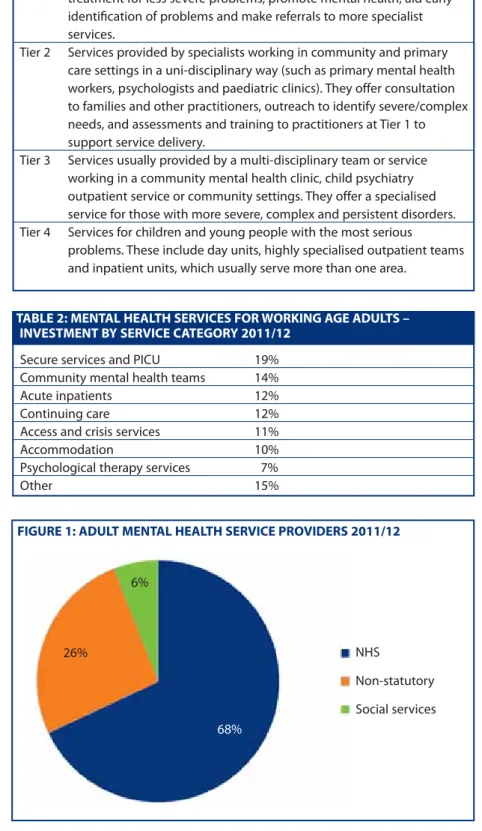
services for children and young people are planned and delivered using a four-tiered model (Table 1).
Mental health services for working age adults
A total of £6.6bn was spent on specialist mental health services for adults of working age by the NHS and local authorities in England in 2011/1212.
Some 83% of adult services were commissioned by the NHS and the remaining 17% by local authorities. The highest area of spend (Table 2) was secure services and psychiatric intensive care units (PICU). The majority of adult services were provided by the NHS, but just over a quarter were provided by non-statutory providers (Figure 1). Table 3 (overleaf) describes the traditional model of services based on the Department of Health’s 1999 framework, A national service framework for mental health. More recently, mental health trusts have been redesigning services to reduce the reliance on in-patient services, offer a single point of access to service users and provide a range of treatments, including recovery colleges that offer training in skills and techniques to empower service users, carers and staff to more effectively manage their mental health.
Mental health services for older people
A total of £2.8bn was spent on older people’s mental health services in 2011/12 in England by the NHS and local authorities in 2011/1213. Some 62% of
services were commissioned by the NHS and the remaining 38% by local authorities. The highest area of spend related to care homes (Table 4 overleaf). Slightly less than half of services were provided by
Tier 1 Services provided by practitioners working in universal services (such as GPs, health visitors, teachers and youth workers) who are not necessarily mental health specialists. They offer general advice and treatment for less severe problems, promote mental health, aid early identification of problems and make referrals to more specialist services.
Tier 2 Services provided by specialists working in community and primary care settings in a uni-disciplinary way (such as primary mental health workers, psychologists and paediatric clinics). They offer consultation to families and other practitioners, outreach to identify severe/complex needs, and assessments and training to practitioners at Tier 1 to support service delivery.
Tier 3 Services usually provided by a multi-disciplinary team or service working in a community mental health clinic, child psychiatry outpatient service or community settings. They offer a specialised service for those with more severe, complex and persistent disorders. Tier 4 Services for children and young people with the most serious
problems. These include day units, highly specialised outpatient teams and inpatient units, which usually serve more than one area.
Secure services and PICU 19%
Community mental health teams 14%
Acute inpatients 12%
Continuing care 12%
Access and crisis services 11%
Accommodation 10%
Psychological therapy services 7%
Other 15%
FIGURE 1: ADULT MENTAL HEALTH SERVICE PROVIDERS 2011/12
68%
6%
26% NHS
Non-statutory Social services
TABLE 2: MENTAL HEALTH SERVICES FOR WORKING AGE ADULTS – INVESTMENT BY SERVICE CATEGORY 2011/12
the NHS and 43% of services by the non-statutory sector (Figure 2). Table 5 describes some of the standard services found in an older people’s mental health service. Case study 2 describes the memory clinic services at Southern Health NHS Foundation Trust.
Forensic mental health services
Forensic mental health services work mainly with people who have a mental health problem and have been through the criminal justice system. They provide treatment in hospital (in particular, secure hospitals), prison and community settings. There are three different levels of secure hospitals: low, medium and high security. Low-secure services care for patients who demonstrate challenging or disturbed behaviour in the context of a serious mental health problem, usually with complex co-morbidities and who require the provision of security.
Medium-secure services provide inpatient treatment and care for adults with complex mental health problems who have been in contact with the criminal justice system and who present a serious risk to themselves or others, combined with the potential to abscond. There has been a significant increase in the level of investment in both low and medium secure services over the Acute adult inpatient ward Acute wards provide care with intensive medical and nursing support for users in periods of acute
psychiatric illness.
Psychiatric intensive care PICU are locked wards for compulsorily detained patients who are in an acutely disturbed phase of a unit (PICU) serious mental health problem. Staff ratios are higher than on acute inpatient wards.
Adult community mental Multi-disciplinary CMHTs provide treatment and support to service users in the community. Staff health team (CMHT) include psychiatrists, mental health social workers, community psychiatric nurses, psychologists
and occupational therapists. How teams operate varies across the country – some provide a generic service, while others focus on specific areas, for example, recovery, assessment, treatment. Some have fully integrated working arrangements with the local authority.
Assertive outreach team (AOT) AOTs provide intensive support in the community for people with severe mental health problems, who are difficult to engage in more traditional services. Many have been in contact with the criminal justice system and have a dual substance misuse and mental health problem. Services aim to maintain contact and increase engagement and compliance.
Early intervention in psychosis (EIP) EIP teams give treatment and support in the community for people who are having symptoms of psychosis for the first time.
Crisis resolution and home CRHTs aim to reduce both the number and length of hospital admissions. They act as a gatekeeper treatment team (CRHT) to acute mental health services, by assessing all those at risk of hospitalisation and deciding on their
care. They provide intensive support at home for people experiencing an acute mental health crisis. Rehabilitation services People who do not recover sufficiently after an acute mental health admission to be able to be
discharged home are referred to rehabilitation services. These services also provide ‘step-down’ for patients moving on from secure mental health services who have longer term and complex mental health needs. Rehabilitation services aim to work with people to help them acquire or regain the skills and confidence to live in the community. They include inpatients, community teams and supported accommodation services.
Care homes 43%
Acute inpatients 16%
Community mental health teams 14%
Continuing care 9%
Other 18%
FIGURE 2: OLDER PEOPLE’S MENTAL HEALTH SERVICE PROVIDERS 2011/12
Older adult acute These wards provide assessment, treatment and
inpatient wards rehabilitation of older people with mental health problems. Memory These services aid the early detection and diagnosis of assessment dementia. Investment in these services has increased from services £9m in 2006/07 to £35m in 2011/12.
Older adult CMHTs Multidisciplinary CMHTs provide specialist assessment, treatment and care in the community.
Care homes Care homes provide residential care for older people with mental health problems. Some also provide nursing care.
TABLE 4: MENTAL HEALTH SERVICES FOR OLDER PEOPLE INVESTMENT BY SERVICE CATEGORY 2011/12
48% 9% 43% NHS Non-statutory Social services
TABLE 3: MENTAL HEALTH SERVICES FOR WORKING AGE ADULTS – TYPES OF SERVICE
past decade14. In 2011/12 PCTs invested about £1bn
in low- and medium-secure services, with about a third of the investment in the non-statutory sector15.
High-secure services are designed for patients detained under the Mental Health Act 2007 who pose a grave and immediate danger to the public. All high-secure beds are provided by the NHS at Ashworth, Broadmoor and Rampton hospitals. Some 90% of all prisoners are estimated to have a diagnosable mental health problem (including personality disorder) and/or a substance misuse problem16. The mental health services across prisons
vary, but all prisons have a healthcare team and some have an in-reach team, similar to a CMHT. Prisons have access to a psychiatrist who can refer a prisoner to hospital if their mental health condition cannot be safely and effectively managed within the prison system.
Community forensic mental health services aim to help individuals who no longer require secure care make the transition back to the community.
Liaison psychiatry services
Liaison psychiatry services address the mental health needs of people who are being treated primarily for physical health problems or symptoms. The prevalence of mental and physical health co-morbidities is high among patients in general and acute hospitals. Older people account for 65% of all inpatients in general and acute hospitals at any one time and the overall prevalence of mental health conditions among this group is estimated at around 60%17.
Liaison psychiatry services can improve the detection rates of mental health problems by acute staff in emergency departments and on wards. They also improve access to mental health services in acute hospitals and train acute staff in the care of patients with mental health problems. The provision of liaison psychiatric services varies significantly across England18.
Drug and alcohol services
Drug and alcohol services are generally provided by NHS trusts or voluntary sector services. A large proportion of people with mental health problems have co-occurring problems with drug or alcohol misuse. The complexity of issues can make diagnosis, care and treatment more difficult, with
service users being at higher risk of relapse, readmission to hospital and suicide19. The
Department of Health’s guide on dual diagnosis20
states that integrated care should be the norm for this group of people. However, support for people with a dual diagnosis, including those with a range of multiple needs, is often inadequate21.
Mental health services for people with learning disabilities
Service models for mental health services for people with learning disabilities vary across England. These include jointly provided services where local mental health and learning disability services share facilities, teams and expertise; services where there is little joint working between mental health and learning disability services; poorly developed local services with a high reliance on out-of-area inpatient placements; or high reliance on mainstream mental health and older adult services, but sometimes without sufficient learning disability expertise to meet the mental health needs of the client group22.
NHS England has an objective to ensure that CCGs work with local authorities to ensure that vulnerable people, particularly those with learning disabilities and autism, receive safe, appropriate, high quality care.
Working with other agencies
The cross-government mental health strategy No health without mental healthreinforces the fact that
Associate specialist, Dr Jo Taylor, runs a memory clinic in Gosport:
There are different models of memory clinics across the country. We carry out the initial assessment of a patient with suspected dementia in their home, to see how they are coping in their usual environment. The assessment is normally carried out by a community mental health nurse, but it can be a psychiatrist.
Patients diagnosed as having Alzheimer’s are referred to our memory clinic. There they are seen by a psychiatrist who will confirm the diagnosis, check the results of blood tests and agree with the patient and carer whether medication should start. Medication cannot cure Alzheimer’s, but it can slow the progression of the disease in some people. If medication is prescribed, the patient is seen by the psychiatrist once a month for two more appointments, and then again after three months, when the memory test is repeated to measure any deterioration.
Patients are then seen for yearly follow-ups by a community mental health nurse at the memory clinic. We tell our patients that if they have any concerns between appointments, they can phone whenever they like. Patients and carers are also offered information and support and have access to memory courses and carer support groups.
CASE STUDY 2: FAREHAM AND GOSPORT MEMORY CLINIC, SOUTHERN HEALTH NHS FOUNDATION TRUST
“
“
FOOTNOTES
14
Mental Health Strategies (2012) Review of the provider market for mental health services
15
Mental Health Strategies (2012) 2011/12 National survey of investment in adult mental health services
16
Department of Health (2011)
No health without mental health
17
Centre for Mental Health (2012) Liaison psychiatry in the modern NHS
18
Centre for Mental Health (2012) Liaison psychiatry in the modern NHS
19
Joint Commissioning Panel for Mental Health (2013)
Guidance for commissioners of drug and alcohol services
20
Department of Health (2002)
Mental health policy and implementation guide – dual diagnosis good practice guide
21
Centre for Mental Health, DrugScope and UK Drug Policy Commission (2012)
Dual diagnosis: a challenge for the reformed NHS and for Public Health England
22
Joint Commissioning Panel for Mental Health (2013)
Guidance for commissioners of mental health services for people with learning disabilities
caring for and supporting people with mental health problems requires partnership working between many agencies.
Social services
Social services play a key role in the provision of mental health services. Adult and older people social services work closely with NHS mental health services and multi-disciplinary community teams include clinical staff and social workers. Children’s services’ responsibilities include working with vulnerable children and their parents, large proportions of whom need mental health support.
Employment
Employment or meaningful activity is regarded as an essential element of recovery from mental ill health. People who experience severe and enduring mental health problems have one of the lowest employment rates in the UK23. Individual placement
and support programmes work with people to secure paid competitive employment, as demonstrated in case study 3 below.
Housing
Good housing is critical for good mental health. People with mental health problems are less likely to be homeowners and far more likely to live in unstable environments24. Mental ill health is often
cited as a reason for tenancy breakdown25 and
housing problems are frequently given as a reason for a person being admitted to inpatient care26.
Around a third of adults with severe mental health problems (about 60,000 people) reside in supported accommodation provided by health and social services, voluntary organisations, housing associations and other independent providers27.
Police
The police are often the first point of contact for a person in a mental health crisis (Box C).
If someone is suspected of having a mental health problem and is in immediate need of care and control, the police can use Section 136 of the Mental Health Act 2007 to take the person from a ‘public place’ to a ‘place of safety’ for up to 72 hours. Where the person is not in a public place, the police may use Section 135 of the Act to gain access to a person’s home by force, following the granting of a court warrant.
Police and court diversion liaison services aim to ensure that individuals with a mental health problem are identified quickly when they come into contact with the police and the courts. Where appropriate, they are diverted to care and support, and if the individual is remanded or sentenced to prison, their mental health needs are communicated to the prison.
Raza Ahmed manages Vocational Services for North Essex Partnership University NHS FT:
The trust considers it has a key role to play in helping people who use their services to access and retain employment as part of the recovery process. These people’s needs fall into four groups:
● People who are currently ready to work and need support to gain access to competitive employment
● People who want to work now or in the near future but do not have the qualifications and skills required and therefore need access to vocational training or work placements
● People not currently considering paid employment who need extra longer term vocational support to develop their skills through social enterprise/firms, voluntary work, training or education
● People who are currently in employment and need help to retain their employment.
Our community mental health teams all include employment specialists, who are fully integrated members of the CMHT. In West Essex we work in partnership with the charity Employ-Ability, while
in Mid and North East Essex the employment specialists are employees of the trust. The employment specialists actively engage with local employers to create job opportunities and educate employers about the advantage of inclusive employment practices.
The employment specialists meet with service users to find out what kind of work they would like to do and what previous experience they have. They provide them with advice and support in looking for a job, completing application forms and interview techniques. Once the service user has found a job, the employment specialist continues to support them for as long as they need. We have helped people get a wide range of jobs – for example, in teaching, nursing, accountancy and catering.
As well as supporting people to find competitive employment, our employment specialists help people to access work placements, voluntary work and training. Work placements within our trust have led to several people getting permanent jobs with us. Sometimes people already in employment need support to retain their job. Our employer specialists are there to provide that support.
CASE STUDY 3: VOCATIONAL SERVICES - NORTH ESSEX PARTNERSHIP UNIVERSITY NHS FOUNDATION TRUST AND EMPLOY-ABILITY
FOOTNOTES
23
Centre for Mental health (2009) Individual placement and support into employment
24
Johnson R, Griffiths C, Nottingham T (2006) At home? Mental health issues arising in social housing
25
Social Exclusion Unit (2004),
Mental health and social exclusion
26
Johnson R, Griffiths C, Nottingham T (2006)At home? Mental health issues arising in social housing
27
Joint Commissioning Panel for Mental Health Cases for change – severe problems
“
Who is involved in providing mental
health services?
Most mental health services are based on specific community teams, as well as inpatient services. Each team will have several types of mental health workers with different knowledge and skills, so that they can support service users with the range of problems people with mental health problems face.
Psychiatrists
Psychiatrists are medically qualified doctors who specialise in the care of patients with mental health problems. They usually specialise in a particular branch of psychiatry and tend to work with people who have more severe disorders that may require some sort of medical treatment. This often, but not always, involves the prescription of medication. Most psychiatrists work in community-based teams, outpatients and hospital wards (Box D).
Clinical psychologists
Clinical psychologists have a degree in psychology and a doctorate in clinical psychology. Clinical psychology applies the scientific knowledge base of psychology to 'clinical' problems. The psychologists aim to reduce psychological distress and to enhance and promote psychological wellbeing. A wide range of psychological difficulties may be dealt with, including anxiety, depression, relationship problems, learning disabilities, child and family problems and serious mental illness.
To assess a client, a clinical psychologist may undertake a clinical assessment using a variety of methods – psychometric tests, interviews and direct observation of behaviour. Assessment may lead to therapy, counselling or advice. Therapies include cognitive and behavioural therapies, psychoanalytic/ psychodynamic therapy, humanistic therapies and systemic therapies.
There are different types of practitioner psychologists, including clinical psychologists, counselling psychologists and health psychologists. Psychologists are based in hospitals, outpatient clinics and work in community-based teams.
Mental health nurses
Mental health nurses specialise in mental health during their training. They work in community-based teams, psychiatric wards, day hospitals and
outpatient departments. When they work in community-based teams, they are called community psychiatric nurses (CPNs) or community mental
health nurses (CMHNs). Some nurses can prescribe medication. The role of a CPN can be wide and may include counselling or anxiety management, and working with people who have had severe mental health problems for years and need long-term support and psychiatric drugs.
Mental health social workers
Mental health social workers have a degree in social work and post-qualifying awards in mental health. They are usually employed by local authority social service departments, but often work within a community-based team run by a mental health trust. They are involved in the management and planning of care, and may help service users with practical issues such as benefits, housing, respite
BOX C: LEGAL FRAMEWORK
Under the Mental Health Act 2007 a person can be admitted, detained and treated in hospital against their wishes. There are strict legal guidelines to using the Mental Health Act in this way, usually involving the agreement of two doctors, an approved mental health professional (AMHP) and consultation with a family member. When someone is admitted to hospital under compulsion, this is commonly known as being ‘sectioned’. Supervised community treatment allows someone who has been detained under certain sections of the Mental Health Act to be discharged from hospital under a Community Treatment Order.
AMHPs are approved by a local authority social services department to carry out duties under the Mental Health Act. These duties involve assessing, in
collaboration with other mental health professionals, whether someone should be compulsorily treated under the Act. An AMHP can be a specially trained social worker, mental health nurse, occupational therapist or psychologist.
The Mental Health Act 2007 is not to be confused with the Mental Health Capacity Act 2005, a framework for acting and making decisions on behalf of individuals who lack the mental capacity to make decisions themselves. It contains provision for assessing whether people have the mental capacity to make decisions, procedures for making decisions on behalf of people who lack mental capacity and safeguards. The Act covers decisions relating to an individual’s property, financial affairs, and health and social care, and decisions on personal care.
BOX D: TRAINING TO BECOME A PSYCHIATRIST
● After gaining a medical degree, graduates enter a two-year Foundation Programme, which exposes them to a range of competencies across a broad range of specialities. It can include a placement in psychiatry.
● Specialist training in psychiatry is a minimum of six years – three years at core training level, and three years at higher training level.
● Core trainees undertake four- to six-month posts in various psychiatric specialities. They must obtain at least 12 months’ experience in general psychiatry. They also sit the MRCPsych exam.
● After completing core training, trainees can apply for higher training in one of six specialties: CAMHS, forensic psychiatry, general psychiatry, learning disability psychiatry, medical psychotherapy and old age psychiatry.
● Trainees in general psychiatry can undertake additional training in liaison, rehabilitation and substance misuse psychiatry. Higher training normally involves three 12-month posts.
care and personal budgets. They may also assess the needs of carers of people with serious mental health problems and plan packages that can help them.
Occupational therapists
Occupational therapists support people with mental health problems to get on with daily life, helping them to live independently and safely. They work in hospitals and community-based teams, and can support employment, social and leisure activities.
Other therapists
A range of other therapists also support people with mental health problems, such as art, music and drama therapists. Some community-based teams include a support, time and recovery worker (STR worker). Support may include promoting independent living, helping someone return to education or to travel independently. Some mental health trusts are starting to train and employ peer support workers with experience of
mental distress. They work alongside others with mental health problems to facilitate recovery by promoting hope and support based on common experience.
IAPT services employ high-intensity therapists trained in CBT and other therapies recommended by the National Institute for Health and Care Excellence (NICE). They also employ psychological wellbeing practitioners trained in cognitive behavioural approaches for people with mild to moderate anxiety and depression.
Graduate mental health workers also work in primary care settings to improve the capacity of primary care to manage common mental health problems. They are usually graduates in psychology and are offered postgraduate training as they work. Case study 4 describes the roles and functions of staff in a community mental health team.
Carol Adcock is team leader for the Andover community treatment team:
The trust reorganised adult community mental health services in 2012. Instead of traditional CMHTs, we now have a range of other services to support people in the community. Our access and assessment teams provide a single point of access, acting as the front door for all planned and unplanned mental health referrals. Where intervention of less than 12 weeks is required, it is provided by the access and assessment team. IAPT services support some people who used to be cared for by the CMHTs. Individuals who need support and treatment for periods of more than 12 weeks are allocated to the community treatment teams (CTTs).
Andover CTT is comprised of consultant psychiatrists, a junior doctor on rotation, clinical psychologists, a psychological advanced practitioner, social workers, nurses, support time recovery workers and administrative staff. We receive 16 to 25 new cases a month and have about 270 cases at a time. Most fit into one of three categories:
● People with psychotic disorders who may stay on our caseload for three to five years. If they require an anti-psychotic depot injection, they may stay longer on our caseload as many GPs do not undertake this treatment
● People with moderate to severe depression, or whose depression is treatment resistant, will stay on our caseload for about 12 months
● People with emotionally unstable personality disorder (previously known as borderline personality disorder) may be on our caseload for 12 to 18 months.
All service users are allocated to a member of my team, who
becomes that person’s care co-ordinator and is responsible for overseeing the person’s care and support. If the care co-ordinator feels someone on their caseload needs to be seen at least once a week (the individual is experiencing a psychotic relapse, say, or developing suicidal thoughts), we put the person on ‘shared care’ .
Shared care describes a team approach to care, with primary and secondary care practitioners working in a coordinated way to deliver care to ensure the patient’s care is as seamless as possible. Each day a member of the team is responsible for the shared care patients. If someone is discharged from hospital, they are assigned to shared care for three weeks, while they are at greater risk of relapse. Once a week we have a multi-disciplinary team meeting, where we discuss all patients on shared care and any other urgent cases.
I am a psychiatric nurse. As well as managing the team, I have a small caseload of complex cases. When someone is on my caseload, my activities could include care-coordination (liaising with other agencies including the family), carrying out an assessment of a patient over time, encouraging the person to engage with services, monitoring the effectiveness of medicine and its sides effects, CBT or emotional coping skills work, and providing carer support.
As well as working directly with service users, we spend a considerable amount of time working with other agencies:
● Andover MIND Wellbeing Centre provides one-to-one specialist support for some of our service users to prevent social exclusion and social isolation. For example, they might support someone to enrol at the local college or join a local gym. They attend our weekly multi-disciplinary team meetings.
CASE STUDY 4: ANDOVER COMMUNITY TREATMENT TEAM, SOUTHERN HEALTH NHS FOUNDATION TRUST
Models of care
The principles of the recovery approach in mental health are recognised as applying to all age groups and conditions. Recovery is about building a meaningful and satisfying life, as defined by the person themselves, whether or not there are ongoing or recurring symptoms or problems. 30
This approach emphasises the importance of good relationships, education, employment and purpose, alongside reductions in clinical symptoms. The care programme approach (CPA) is used to co-ordinate the care and support from secondary mental health services for people who have severe mental health problems and complex needs. A person eligible for CPA should get a full assessment of their health and social care needs, a care plan and regular reviews. A named care co-ordinator (usually a community psychiatric nurse or social worker) is responsible for overseeing that care and support.
Risk management is a core component of mental healthcare. The three main areas of risk are violence (including antisocial and offending behaviour), self-harm/suicide and self-neglect. Clinicians assess the likelihood of risk events, and then work with the service user to identify ways of reducing the likelihood of them happening.
People with a diagnosed mental health problem are among those at the highest risk of committing suicide. In 2010, about 4,200 people died by suicide. The suicide rate is highest among men aged 35-49 years and overall men are three times more likely than women to take their own life.31
The government launched a suicide prevention strategy in September 2012 with six areas for action:
● Reduce the risk of suicide in key high-risk groups
● Tailor approaches to improve mental health in specific groups
● The Princess Royal Trust for Carers provides a wide range of support services for carers. They also attend our weekly multi-disciplinary team meetings.
● Housing provider Stonham is a significant provider of mental health supported accommodation in the local area.
● We attend the monthly Hampshire County Council housing panel to discuss the housing needs of the most vulnerable people.
● We carry out joint visits with probation services.
● We work closely with local alcohol and drug services Hampshire Operational Model for Effective Recovery, creating joint care plans
● We attend Multi Agency Risk Assessment Conference28and
Multi Agency Public Protection Arrangements29 meetings.
Dr Mishra is one of the two consultant psychiatrists on the team:
The team aims to promote independence rather than dependence on mental health services, using a recovery model. My role is assessment and diagnosis. If a person requires a diagnosis, they are referred to one of the two consultants. We then formulate a management plan. Providing activity for a person is an important aspect of treatment, and some people are referred to Andover MIND Wellbeing Centre. If the person is prescribed medication, we will provide follow-up in the clinic. Once the person is stable, they are allocated a care co-ordinator with a recovery plan. If the co-ordinator is concerned the person’s condition is deteriorating, I will see them for a medical review.
Amanda Gunn is one of the senior social workers on the team: I am the care co-ordinator for about 30 service users with a range of disorders. I monitor the mental state of people with severe depression and liaise with the consultant about medication. I
provide therapeutic sessions for people with emotionally unstable personality disorders. I see people with long-term psychotic illnesses every three to four weeks to monitor their mental state, and ensure their social support network and housing status remain stable. I also monitor from a commissioning perspective a number of people in residential placements. I have a smaller caseload than some of the other care-coordinators, because half of my time is spent performing functions as an approved mental health professional under the Mental Health Act.
Clinical psychologist Laura Dannahy works with service users in both Andover and Winchester:
I tend to work with the most unwell. I have individual and group sessions. The type of therapy will depend on the person’s mental health problem. We provide CBT for people who have a psychotic illness, treatment-resistant depression or complex post-traumatic distress disorder. CBT focuses on how a person thinks about the things going on in their life, and how this impacts on how they behave and deal with emotional problems. It looks at how a person can change negative patterns of thinking or behaviour, which may then change the way the person feels. Dialectical behaviour therapy (DBT) is for people with emotionally unstable personality disorder, especially those with self-harming behaviour or suicidal thoughts. DBT aims to stop such behaviours and improve their quality of life. A DBT programme – individual weekly therapy, weekly group therapy and 24-hour telephone crisis coaching with the psychologist – lasts a year. Other therapies include acceptance and commitment therapy for people who have been stuck in services for a long time, and cognitive analytic therapy for people with a range of personality disorders.
FOOTNOTES
28
MARAC is a meeting where information is shared on the highest risk cases of domestic abuse between criminal justice, health, child protection, and other specialists. A safety plan for each victim is created.
29
MAPPA are the arrangements for the ‘responsible authorities’ tasked with the management of registered sex offenders, violent and other types of sexual offenders, and offenders who pose a serious risk of harm to the public.
30
Shepherd, Boardman and Slade, Sainsbury Centre for Mental Health (2008) Making recovery a reality
31
Department of Health (2012)
Suicide prevention strategy
“
“
“
“
“
“
“
Consultant psychiatrist, Dr Mo Zoha, works with the assessment and brief treatment team in Kensington and Chelsea:
A GP with concerns about possible psychotic symptoms in a patient can refer them to the local
assessment and brief treatment team. These teams work with service users who are new to mental health services. If the assessment diagnosis is schizophrenia and the service user is aged under 35, the person is then referred on to an early intervention in psychosis (EIP) Team. Early engagement with the person is recognised as being very important. The EIP team adopts an assertive outreach model – they don’t expect the person with schizophrenia to come to them, but rather they go out to see the person at home, or at a place they feel more at ease. This helps to build up engagement with the person and encourages them to accept treatment.
Normal treatment consists of developing a care plan drawn up under the care programme approach and covering a range of interventions, including pharmacological, psychological, social, occupational and educational. A person with a first episode or first presentation of schizophrenia usually remains under the care of the EIP team for three years.
About 10% of people with diagnosed schizophrenia have no further episodes of psychosis. The remaining 90% will continue to have episodes of psychosis. After three years with the EIP team, some patients can be discharged back to the care of their GP.
Patients who continue to have high levels of need are likely to move to the caseload of a community recovery team (previously known as
a community mental health team), where they will continue to receive a similar set of interventions.
The community recovery team is multi-disciplinary, with input from occupational therapy, social work, nursing, vocational workers, psychology and psychiatry. People in the team will often receive care from a number of different non-NHS agencies. This care will be coordinated by the recovery team. Social care will be a big aspect of the care received by this group. The team also works with the carer and may signpost the carer to support provided by other agencies such as the local authority or voluntary sector.
Some people with schizophrenia have co-morbidities – for example, substance misuse or depression. This is actively addressed by the community recovery team, as well as other appropriate services, such as substance misuse services. People who find it difficult to engage with services may be cared for by the assertive outreach team. Such people may be homeless, have drug and alcohol difficulties, have been involved with the criminal justice system or have complex difficulties. They usually have a history of admissions to hospital, possibly detained under the Mental Health Act and often encounter problems with medicinal treatments.
People with schizophrenia tend to experience periods when their symptoms become more intense and they need acute mental health services to help them to return to stability. These services consist of home treatment teams (HTT) and inpatient wards. HTTs help avoid admission by visiting people in their homes daily. They also help people who have been discharged from hospital make the transition back into the community. If the risk is too high, or the person is unwilling to engage, the person is admitted to an acute ward, as a voluntary patient or under the Mental Health Act.
CASE STUDY 5: TYPICAL CARE PATHWAY FOR SCHIZOPHRENIA AT CENTRAL AND NORTH WEST LONDON NHS FOUNDATION TRUST
“
Nature of intervention
Highly specialised treatment – medication, high-intensity
psychological interventions, combined treatments, multi-professional and inpatient care, crisis services, electroconvulsive therapy
Cognitive behavioural therapy (CBT), interpersonal psychotherapy, behavioural couples therapy, counselling, short-term psychodynamic psychotherapy, antidepressants, combined interventions,
collaborative care, self-help groups
Individual facilitated self-help, computerised CBT, structured physical activity, group-based peer support programmes, non-directive counselling delivered at home, antidepressants, self-help groups Identification, assessment, psychoeducation, active monitoring, referral for further assessments and interventions
Focus of intervention Step 4
Severe and complex depression; risk to life; severe self-neglect
Step 3
Persistent sub-threshold depressive symptoms or mild to moderate depression that has not responded to a
low-intensity intervention; initial presentation of moderate or severe depression
Step 2
Persistent sub-threshold depressive symptoms or mild to moderate depression
Step 1
Known and suspected presentations of common mental health problems
“
● Reduce access to the means of suicide
● Provide better information and support to those bereaved or affected by suicide
● Support the media in delivering sensitive approaches to suicide and suicidal behaviour
● Support research, data collection and monitoring. NICE has published guidelines for the treatment and care of people with mental health problems. This briefing describes typical care pathways for three conditions: depression, schizophrenia and dementia.
Care pathways for common mental health issues
There is no standardised model for primary mental health care services and current patterns of service provision vary greatly32. NICE recommends a
stepped-care model for common mental health problems (Table 6). In stepped care the least intensive intervention appropriate for a person is typically provided first, and people can step up or down the pathway according to changing needs and in response to treatment.
It states electroconvulsive therapy (ECT) should be considered for the acute treatment of severe depression that is life-threatening and when a rapid response is required or other treatments have failed. It is unlikely to help with mild to moderate
depression or most other psychiatric conditions. It has no role in the general treatment of
schizophrenia. Between 1985 and 2002 use of ECT in England more than halved, possibly because of better psychological and drug treatments33.
Care pathway for schizophrenia
NICE’s Clinical Guideline 82 (CG82) covers treating and managing schizophrenia in adults. Recommendations are listed for the phases of schizophrenia experienced: first episode (presentation of psychotic symptoms); promoting recovery (ongoing psychosis); and acute episode (psychotic crisis). Case study 5 sets out a care pathway for someone with schizophrenia at Central and North West London NHS Foundation Trust.
Care pathway for dementia
NICE’s Clinical guideline 42 (CG42)recommends how people with dementia and their carers should be supported and stresses the importance of integrated health and social care. As far as possible, dementia care services should be community-based, but psychiatric inpatient admission may be required. Case study 6 (overleaf) describes a typical care pathway for someone with dementia at Central and North West London NHS Foundation Trust.
Current service and financial issues
Improving the quality of mental health services
There have been several recent reports highlighting the need to improve the quality of mental health services. The national mental health strategy No health without mental healthfocuses on improving outcomes in mental health. The accompanying
Implementation frameworksets out what local organisations can do to implement the strategy and improve mental health outcomes (Box E).
The latest Care Quality Commission (CQC) Mental Health Act report34notes that while some providers
demonstrate excellent practice, this is not the case in all areas (Box F).
Following the Winterbourne View Hospital failings in 2012, the Department requires CCGs and local authorities to have a locally agreed joint plan by April 2014 to ensure high-quality care and support services for all children, young people and adults with learning disabilities or autism, as well as mental health problems or behaviour described as challenging. Services should be local, to let people remain in their communities. It is anticipated that there will be a substantial reduction in hospital placements for this group of people35.
BOX E: NO HEALTH WITHOUT MENTAL HEALTH IMPLEMENTATION FRAMEWORK
What mental health service providers can do: ● Ensure equality of access and outcomes
● Assess and improve service user and carer experience
● Ensure service design is based on humanity, dignity and respect ● Keep people safe
● Improve the physical health/wellbeing of people with mental health problems ● Improve the mental health/wellbeing of people with long-term physical conditions ● Consider the power of information to transform services
● Focus on choice, recovery and personalisation ● Develop protocols for sharing information with carers ● Tackle stigma and discrimination.
BOX F: MONITORING THE MENTAL HEALTH ACT IN 2011/12 – CARE QUALITY COMMISSION FINDINGS
● Services are under pressure, for example issues relating to the provision of AMHPs and transport to hospital, high bed occupancy, increased workloads and access to psychological therapies
● Most of the concerns highlighted in previous reports remain, particularly in respect of care planning, patient involvement and consent to treatment
● There is a significant gap between practice and the ambitions of the national mental health policy. The CQC observed that the No health without mental health
strategy was not being observed in many wards and trusts that were visited
● Cultures persist where control and containment are prioritised over treatment and support of individuals.
FOOTNOTES
32
Joint Commissioning Panel for Mental Health (2012)
Guidance for commissioners of primary mental health care services
33
Royal College of Psychiatrists website
34
Care Quality Commission (2013) Monitoring the Mental Health Act in 2011/12
35
Department of Health (2013)
Transforming care: a national response to Winterbourne View hospital