Iranian Rehabilitation Journal, Vol. 13, Issue 2, Summer 2015
Original Article
The Relation between Deterministic Thinking and Mental Health
among Substance Abusers Involved in a Rehabilitation Program
Seyed Jalal Younesi
*; Mohammad Ebrahimi; Hadi Gholam Mohammadi
University of Social Welfare and Rehabilitation Sciences, Tehran, IranObjective: The current research is to investigate the relation between deterministic thinking and mental
health among drug abusers, in which the role of cognitive distortions is considered and clarified by focusing on deterministic thinking.
Methods: The present study is descriptive and correlative. All individuals with experience of drug abuse
who had been referred to the Shafagh Rehabilitation center (Kahrizak) were considered as the statistical population. 110 individuals who were addicted to drugs (stimulants and Methamphetamine) were selected from this population by purposeful sampling to answer questionnaires about deterministic thinking and general health. For data analysis Pearson coefficient correlation and regression analysis was used.
Results: The results showed that there is a positive and significant relationship between deterministic
thinking and the lack of mental health at the statistical level [r=%22, P<0.05], which had the closest relation to deterministic thinking among the factors of mental health, such as anxiety and depression. It was found that the two factors of deterministic thinking which function as the strongest variables that predict the lack of mental health are: definitiveness in predicting tragic events and future anticipation.
Discussion: It seems that drug abusers suffer from deterministic thinking when they are confronted with
difficult situations, so they are more affected by depression and anxiety. This way of thinking may play a major role in impelling or restraining drug addiction.
Key words: Deterministic thinking, mental health, drug abuse, rehabilitation
Submitted: 10 March 2015 Accepted: 18 May 2015
Introduction
Currently, addiction rehabilitation is considered as the first-line rehabilitation against behavioral diseases such as AIDS and hepatitis, and one of the most essential public health problems worldwide. Substance abuse affects various biological, psychological and social dimensions of human life. Long-term use of drugs not only has a bad effect on the economic and social condition of addicted users, but also it plays a major role in the mental health of the individuals (1). Recent studies have concentrated on hazardous factors and multiple etiologies. However, the emphasis is mostly on social factors, while drug abuse is also related to biological and psychological processes (2). In recent approaches used in addiction psychology, cognitive approaches have played a considerable role. The viewpoints of mental health and lack of mental health are all connected to our modes of reception and interpretation of the world and, in particular, our
cognitive distortions are also involved (4). Cognitive distortions make the individuals vulnerable when faced with tragic events like losses and life difficulties. Confronted with mental irritation, their thinking can become more and more inflexible and distorted. Their judgments are often over-generalized and absolute, while core beliefs about the self and the world are deterministic and rigid (6). One of the most common and vulnerable cognitive distortions in the domain of mental health, one that can be seen as the mother of all distortions, is deterministic thinking. Other cognitive distortions begin from this point and, after being confirmed at this stage, cognitive distortions can move on to other steps in their minds. This type of thinking ignores any possibility or probability in coming to a conclusion about events, and results in many cognitive distortions because the issue of conclusion is common to them all. The distortion of deterministic thinking rules out any probability or possibility in making conclusions (7). The interpretation of events is affected by this distortion, so the events and their consequences may be thought of as: 2×2= 4. This sort of equation is a dominant factor among all conclusions of this kind of thinking, i.e. divorcing from wife = misery. The distortion brings about cognitive rigidity and may be the mother of all distortions (8). Cognitive rigidity is a major reason for depression, anxiety and other psychosocial maladjustments (9). From a religious perspective, which is sometimes essential to consider in cognitive therapy for some people (10), this distortion is seen as a destructive factor, ruining the balance of fear and hope (11); any exception for the consequences of bad or good events are ruled out by deterministic thinking.
There are strong recommendations by the most important religious leaders of Islam to keep the balance of fear and hope as a sign of faith and mental health (for example: Imam Ali, great sons of the great prophet Mohammad (12-14)). In the prediction of consequences of favored or undesirable events, any deterministic thinking about them has been rejected in the Holy Quran: "sometimes undesirable events may bring you good fortune and sometimes desired ones bring you bad luck" (Quran, 2, 216) So being too disappointed or too hopeful when confronted with events, either positively or negatively, is not accepted from the perspective of Quran. Since prediction of any event is certainly not possible from this viewpoint, there is an expression in Islamic discourse which is widely used by people
in western and eastern countries confronted with events: “Insha’Allah”, which means “If God Wills”. This expression is the opposite of deterministic thinking, because from a religious perspective any consequence of events comes back to the will of God, and it is only God who knows about it (8). Similarly, in a scientific approach, in spite of firm experimental reasons, accepting or rejecting a hypothesis with a P value of zero is avoided. The main reason for adopting such an approach is that some scientists believe in no absolute reality, because the sequence of events and realities is not stable from beginning to end. Creatures and events cannot be identified partially from their initiating or ending points (15): “You are not aware of what it is to be gradually creating in the world of creatures”. (Quran, 16, 8). "What is in the earth or sky requested from God and every day he is in the position of creating" (Quran, 55, 29). In Islamic philosophy, creation is not finished and new creation is expected, so in this ongoing job it is not possible to predict life’s events surely.
The studies conducted in this context show that deterministic thinking has a close relation with anxiety (16), depression and marital satisfaction (7), communication skills (17,18), life expectancy and obsession (19). An increase in deterministic thinking means that depression, anxiety and compulsion will be increased in the same way, whereas communication abilities, life expectancy and marital satisfaction will be reduced. Given that thinking, as the foundation of human behavior, has a special place, thus for strengthening and improving the etiology of behavior, the evaluating of thinking is very substantial. The present study intends to determine the role of cognitive distortions in behavioral pathology and addiction by seeking out the relations between deterministic thinking and mental health.
Methods
referral to the central social work unit over several successive days at the end of August 2012. After omitting the numbers of subjects who did not meet the criteria of the study, 110 subjects were selected as a sample.
Deterministic thinking questionnaire (DTQ): This is developed with the intention of measuring deterministic thinking based on the theories in relation with cognitive theories, Islamic viewpoints (11) and clinical experiences (7). This scale has 36 questions, which are graded with Likert’s 4-pointed method (1 meaning “I completely agree” and 4 meaning “I completely disagree”). Thus, the increase in the grade of an individual means the increase in the rate of deterministic thinking. For validating the questionnaire in two introductory and conclusive stages of the main project, exploratory, confirmative and convergent factorial analyses have been used. The results of analyzing the main constituents show that the questionnaire is constituted of 5 factors which explain 38 percent of variance, on the whole. Those are General determinism, Determinism in reaction to others, Philosophical absolutism, Determinism in future anticipation, and Determinism in tragic events. The results of the confirmative factorial analysis approved the accuracy of the collected data. The validity convergence of the deterministic thinking questionnaire is detected based on its correlation coefficient with the grade of Beck’s depression questionnaire. This amount which is obtained from the research sample by the calculation of the Pearson correlation coefficient in a group of 100 people was
equal to r=%33 and statistically is significant at a level lower than 0.01. The validity of the whole scale was equal to (0.821) via internal consistency coefficient and was equal to 0.78 by reassessing (for a week). General Health Questionnaire (GHQ): in this study, the 28-questioned form of GHQ was used which was made by Goldenberg and Heller in 1979 and surveys the general health of an individual under the sub-scales of physical health, anxiety, depression and disorders in social functions. This form is graded with a scale of 0 to 3. Tagavi has studied its validity for the whole scale on the Iranian population with the methods of reassessment, bisectional method, and Cronbach's Alpha, obtaining 0.70, 0.93, and 0.90 respectively. For studying the validity of the questionnaire, he used three methods of simultaneous validity, correlation of subtests of this questionnaire with the total score and the analysis of factors in which simultaneous validity has a correlation coefficient of 0.55 with the Middle Hospital Questionnaire (MHQ). The correlation coefficient between the subtests with the total score is reported as between 0.72 and 0.87. The results of the analyzed factors showed the presence of depression elements, anxiety, dysfunctions in social factors and physical symptoms. In total, the clarification of more than 0.50 of the total variance is reported (20).
Results
Descriptive statistics of the research data are presented in table (1).
Table1. Descriptive statistics
indexes variables
Mean SD minimum maximum
General Determined 28.10 2.92 17 36
philospphical determined 17.10 3.95 9 28
determined of tragic events 12.59 3.50 6 23
determined in future anticipation 13.29 3.44 7 20
Determ
inisti
c
thinking
determined interaction with others 21.07 3.67 11 32
Mental health 40.53 9.78 22 64
ph
ysical symptoms 10.08 4.36 2 21
anxiety disorder 10.50 4.13 3 21
disorder of social function 10.90 4.55 0 20
ment
al h
ea
lth
depression disorder 9.04 4.64 0 21
All participants were male, their age ranged from 19-52 years (M=34.43, SD=7.85). 42 (38.18%) were married, 45 (40.9%) were single, and 23 (20.9%) were divorced. In terms of education level 5 (4.5%) had Primary education. 82 (74.5%) had Secondary education. 23 (20.9%) had Diploma up to B.Sc education. In terms of employment, about half of them 45 (40.9%) were unemployed. Moreover,
among the addicts, 8 used heroin, 42 used crystal meth, 29 crack, 30 used opium and 2 used hashish substances.
Table 2. Correlation coefficients between deterministic thinking (DT) and mental health
variables
General DT inter
act
ion
with Others absolute Philosophical
DT
future
anticipation tragi
c ev
ents
Correlation 0.225* 0.021 0.133 0.29** 0.302**
mental healt
Sig 0.001 0.002 0.167 0.827 0.018
Correlation -0.06 - 0.091 - 0.036 0.135 0.125
physical symptom Sig 0.512 0.346 0.706 0.159 0.194
Correlation 0.191* - 0.042 0.109 0.209* 0.188*
anxiety Sig 0.046 0.665 0.255 0.029 0.049
Correlation 0.080 0.081 0.011 - 0.019 - 0.038
function disorder Sig 0.405 0.403 0.913 0.847 0.697
Correlation 0.236* 0.072 0.170 0.26** 0.319**
depression Sig .013 0.452 0.076 0.006 0.001
*P< 0.05, ** P< 0.01
It must be mentioned that the scoring of the general health questionnaire is designed in a way to display a subject’s high grade in parallel with his low level of mental health. As seen in table (2), there is a meaningful and positive relation between deterministic thinking and mental health among drug abusers at a statistical level of P<0.05. In other words, higher deterministic thinking means lower mental health. Also, the amount of calculated correlation with mental health for two of the other factors (determinism in future anticipation and determinism in tragic events), are (r = 0.30) and (r = 0.29). These numbers are meaningful at a statistical
level of P<0.01. Also, based on the findings of table (2), there is a significant and positive relation between deterministic thinking and two subscales of mental health, anxiety disorder (r = 0.19) and depression (r = 0.23), at the statistical level of P<0.05. There is a relation between determinism in future anticipation, anxiety disorder (r = 0.20) and depression (r = 0.26) at the statistical level of P<0.05 and P<0.01. Furthermore, there is a relation between determinism in tragic events, anxiety disorder (r = 0.18) and depression (r = 0.31) at the statistical level of P<0.05 and P<0.01.
Table 3. The analysis of Regression between predictor variables and criterion by the stepwise method.
Models R RS ARS SE F sig (1)
(2) 0.30 0.36 0.133 0.09 0.117 0.83 9.373 9.194 10.807 8.237 0.01 0.00
First model: negative determinism
Second model: negative determinism, determinism in future anticipation.
As shown in table (3), among all the deterministic thinking factors, only determinism in tragic events and determinism in future anticipation can explain the rate of mental health dependence on substance abuse (P<0.01, F= 8.23, r= 0.36). These variables
predict 0.133 percent of mental health variance on the whole. On the basis of this analysis, determinism in tragic events and then determinism in future anticipation are the most potent variables of prediction. Information related to the share of each of the predictor variables, and the exponent of their prediction is displayed in table (4).
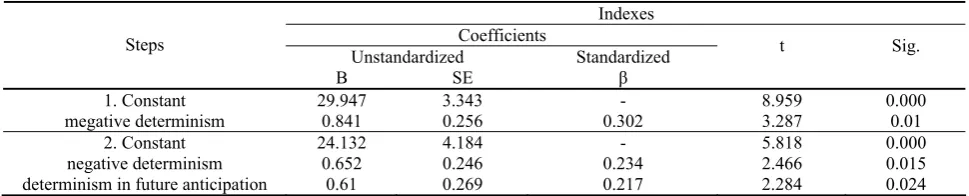
Table 4. Standard and non-standard coefficients for the prediction of mental health
Indexes Coefficients
Unstandardized Standardized t Sig.
Steps
B SE β
1. Constant 29.947 3.343 - 8.959 0.000
megative determinism 0.841 0.256 0.302 3.287 0.01
2. Constant 24.132 4.184 - 5.818 0.000
negative determinism 0.652 0.246 0.234 2.466 0.015
Predicted Variable: mental health
As shown in table (4), the standard coefficient in regression is 0.234 and 0.217 respectively for determinism in tragic events and determinism in future anticipation. So an increase of 1 unit in the grades of determinism in future anticipation is equal to a decrease of 0.234 units in mental health and an increase of 1 unit in the grades of determinism in tragic events is equal with a decrease of 0.217 units in mental health. The equation obtained for predicting mental health by means of deterministic thinking in stepwise regression is described below: (Determinism in future anticipation) 0.217+ (determinism in tragic events) 0.234+24.132= mental health.
Discussion
The objective of this research was to survey the relation between deterministic thinking and mental health among drug abusers. Considering the conducted surveys, it is proposed that deterministic thinking is related to a low level of mental health, so that a high level of deterministic thinking among drug abusers generates depression disorder and anxiety. Furthermore, among the various factors of deterministic thinking, determinism in future anticipation and determinism in tragic events have positive and significant relations with anxiety disorder and depression. Owing to the fact that the relations between addiction and some of the mental disorders have been detected (21), it can be asserted that determinism plays a major role in addiction and mental disorders. People who tend to see things and events in certain conditions without any degree of probability always experience more anxiety, because they sabotage the balance between hope and fear from an Islamic perspective (12,13,22). This refers to the nature of the world, in which all events cannot be precisely predicted without error, because creation is not finished (Quran, 16, 8; 55, 29; 15). Thus it is not possible to exactly predict the end of an unfinished job. In other words, both individuals who have either more hope than fear in predicting with optimism, or who have more fear than hope in foreseeing events with pessimism, can experience anxiety and depression. Considering DT (deterministic thinking) as a cognitive distortion, the results of the study are consistent with previous research findings of researchers who insist on the role cognitive distortions play in creating pathological contexts (23), especially anxiety and depression (24-29). Considering DT as a method of
predicting events without any probability, the findings of this study are compatible with researches which emphasize the role that negative prediction of events plays in producing anxiety or psychological disorders (30-33). For this reason, we also analyzed regression, and the findings show that deterministic thinking can predict a lack of mental health among drug abusers. Among the factors of deterministic thinking, determinism in tragic events and determinism in future anticipation are the most potent variables which predict a lack of mental health.
Conclusion
It is suggested that the role of DT in producing recurrence among drug abusers should be investigated. Moreover, it is necessary to conduct research concentrating on other variables of public health related to DT among drug abusers. Finally, it is proposed that a program of avoiding DT should be incorporated into the mental rehabilitation of drug abusers.
Acknowledgment
We would like to thank the committee of student researches of the University of Social welfare and rehabilitation Sciences for supporting this study. This article derived from a research project approved by the Committee of Student Researches of the University of Social Welfare and Rehabilitation Sciences.
References
1. Sneed CD, Morisky DE, Rotheram-Borus MJ, Ebin VJ,
Malotte CK. Patterns of adolescent alcohol, cigarette, and marijuana use over a 6-month period. Addictive Behaviors. 2001;26(3):415-23.
2. Glantz MD, Pickens RW. Vulnerability to drug abuse: American Psychological Association; 1992.
3. 3. Younesi SJ. Treatment of mental disorders in children, youths and families (Third edition). Tehran: Publications of University of social welfare and rehabilitation sciences; 2008. 4. Birch CD, Stewart SH, Zack M. Emotion and motive effects
on drug-related cognition. Handbook of implicit cognition and addiction. 2006:267-80.
5. Haji Alizade C, Bahrinian SA, Naziri G, Modarres GM. The comparison of dysfunctional attitudes between the drug abusers and ordinary individuals and its psychological outcomes. Journal of research on addiction. 2008;2(7): 81-90. [in Persian]. 6. Neenan M, Dryden W. Rational emotive behaviour therapy in
a nutshell: Sage publications; 2010.
7. Younesi J, Bahrami F. Prediction of rate of marital satisfaction among Tehranian couples by deterministic thinking. Journal of Iranian Psychologists. 2009;14:56-68.
8. Younesi J. The major role of cognitive Misconceptions" Equality in thinking" in psychological disorders. Journal of social sciences and humanities The Research institute of seminary & University (HAWZEH VA DANESHGAH). 2004;10:8-29.
9. Weishaar ME, Beck AT. Hopelessness and suicide.
International Review of Psychiatry. 1992; 4(2 ):177-84. 10. Sommers-Flanagan J, Sommers-Flanagan R. Counseling and
psychotherapy theories in context and practice: Skills, strategies, and techniques: John Wiley & Sons; 2012.
11. Younesi J, Mirafzal AA. Development of Deterministic Thinking Scale Based on Iranian Culture. Psychology (2152-7180). 2013;4(11).
12. Al tamimi AA. Ghorar Al hekam and dorar Al kalam. Beirut: Institute of Al ailami Press; 1979.
13. Faizol Al Islam A. Translation and explanation of Nahjo Al balagheh. Tehran: Islamieh Press; 1973.
14. Koleini SA. Osool Al Kaffi. Tehran: Mostafavi Press; 1980. 15. Jaafari MT. Scientific cognition in perspective of Quran.:
.Islamic culture Press; 1981.
16. Younesi SJ, Ravari MT, Esbati M. Relationship between Deterministic Thinking and General Health. Applied Psychology. 2014;2(6):38-47.
17. Maghsoudzade M. Prediction of marital satisfaction based on deterministic thinking and communication skills. Unpublished, Thesis for MA: University of social welfare and rehabilitation sciences; 2010
18. Navabi Nezhad S, Malek A. The effectiveness of opposition training with deterministic thinking on recovering the marital relationships of women. Journal of thought and behavior. 2010;4(16):7-16. [In Persian]
19. Rah Anjam S. Prediction of hope rate by deterministic thinking among in students. Unpublished, Thesis for MA: University of Islamic Azad; Tehran; 2010.
20. Tagavi SM. Study of Validity and Reliability General Health Questionnaire on students of Shiraz University. Journal of Psychology. 2001;3(4):1-18. [In Persian]
21. Sadock BJ. Kaplan and Sadock's synopsis of psychiatry [F. Razaei, trans]. Tehran: Arjmand Press; 2007.
22. Koleini SA-I. Osool Al Kaffi. Tehran: Mostafavi Press; 1980.
23. Younesi J, Manzari Tavakkoli V, Hashemzadeh VS.
Relationship between Deterministic Thinking and Defense Mechanisms Among students at University of Tehran. Journal of Behavioral Sciences in Asia. 2014;2(8):19-31.
24. Beck AT. The evolution of the cognitive model of depression and its neurobiological correlates. American Journal of Psychiatry. 2008;165(8):969-77.
25. Beck AT, Epstein N, Harrison R. Cognitions, attitudes and personality dimensions in depression. British Journal of Cognitive Psychotherapy. 1983.
26. Beck AT, Rush AJ, Show BF, Emery G. Cognitive therapy of depression. New York: Guilford Press; 1979.
27. Del Missier F, Ferrante D, Costantini E. Focusing effects in predecisional information acquisition. Acta psychologica. 2007;125(2):155-74.
28. Smits JA, Rosenfield D, McDonald R, Telch MJ. Cognitive mechanisms of social anxiety reduction: an examination of specificity and temporality. Journal of Consulting and Clinical Psychology. 2006;74(6):1203-12.
29. Teasdale JD. Emotion and two kinds of meaning: Cognitive therapy and applied cognitive science. Behaviour research and therapy. 1993;31(4):339-54.
30. Bentz BG, Williamson DA, Smith CF. The prediction of negative events associated with anxiety and dietary restraint: a test of the content specificity hypothesis. Journal of Psychopathology and Behavioral Assessment. 1999;21(2):97-108.
31. Kelly WE. Anxiety and the prediction of task duration: A preliminary analysis. The Journal of Psychology. 2002;136(1):53-8.
32. Society for Research in Child Development (2007 O. Female Anxiety: Females More Likely To Believe Negative Past Events Predict Future Science Daily Retrieved June 26, 2007,
from http://wwwsciencedailycom /releases/2007/09/070928092126htm.
33. Zvolensky MJ, Eifert GH, Lejuez C, Hopko DR, Forsyth JP. Assessing the perceived predictability of anxiety-related events: a report on the perceived predictability index. Journal of behavior therapy and experimental psychiatry. 2000;31(3):201-18.
35. Sahand B, Zarei H, Fata L. The Comparison of early maladaptive schema’s domains between successful and non-successful opiate addicts and non-clinical persons. Journal of Drug Abuse. 2009;3(11):65-82. [In Persian].
36. Soto RD. Criminogenic personality and behavioral
characteristics in substance abusers: An examination of the Lifestyle Model of Substance Abuse. 2007.
37. Borooghani M. Prediction of forgiveness by deterministic thinking among couples who are volunteers for divorce. Unpublished, Thesis for MA: University of social welfare and rehabilitation sciences; 2010.