!
Simulacra Studies And Composition With
Gesture
Solomiya Moroz
University of Huddersfield, Huddersfield, U.K. [email protected]!
Abstract
In this paper I discuss my process in composition with physical gesture while demonstrating examples from Simulacra Studies and from my recent work. In
Simulacra Studies, the pianist-performer is present on stage with touch sensors and accelerometers attached to his hands without a visible piano in front of him. In this piece, I explore the drama of a missing piano interface while embodying physically the act of playing. There is a video component to the piece which initially establishes real-time correlation with the performer, only to become amplified, disjointed and broken into other narratives as the piece progresses. Throughout the piece, the physical gestural behaviour becomes magnified with mediatized video experiences of the pianist as a person playing with images of himself on himself as one does with gender, sexuality, power, fragility, superficiality, banality, etc.
1. Introduction
In most of my pieces, when I’m working with instrumentalists and electronics, I am involved in working with musical gestures that produce sound and those that are secondary to sound production such as accompanying body movements which occur during the performance. Compositionally, I have been exploring control and theatricality as approaches for composition with gesture. I work with control when electronic processes such as triggering or continuous control take place through a gestural interface. In Simulacra Studies, I use Piano Hands as a gestural interface which allows for the control of the computer interface to make the invisible piano possible. The gestural interactions with the missing piano interface serve the theatricality of the situation which I then map to different video characters of the pianist. Further I developed the piece dramatically through the interactions between the physical and mediatized versions of the performer.
Recently, I became aware that having a performance background myself constantly pushes me to reexamine the role of the performer in contemporary concert music - the performers’ gestural input as well as collaborative feedback during the compositional process greatly contribute to the content of
Volume 1, 2019, Pages 31–41
the piece. Through close collaboration with performers, I became interested in narratives related to the image of the performer on stage and the physical embodiment of the performance practice. I explored this already in a couple of my pieces primarily in Immaculate Machine of Liveness and On Fragments. In Simulacra Studies, I deconstruct the role of the performer through various visual mappings that are developed non-linearly with instrumental gesture and character embodiment.
1.1 Initial Research Questions
Initially, I was drawn to the challenge of working on a piece for an invisible piano interface because part my research is concerned with the embodied instrumental behaviour of the performer. I was also interested in working with Marko Ivic, who is a pianist at ease with the theatrical as well as classical piano performance. Previously, I have collaborated with Marko on music theater and interdisciplinary pieces, like Short Wave Apocalypse or the Box*, which was presented in the selection of Amsterdam Fringe Festival 2016. Having worked with this performer before, I knew about the possibility of using various characters related to gender fluidity that were interesting to explore. To represent this fluidity I linked different hybrid piano sounds to different video characters, their copies and multiplicities. I decided to link three main characters to different hybrid sounds of the piano: the female character that became associated with prepared piano samples, the concert pianist with midi piano samples and his physical self present on stage with synthesised piano sounds.
When I started working on Simulacra Studies, I had a set of questions about the importance of a missing piano. I thought that such a piece would immediately draw attention to the person playing the gestures instead of just the musical material. It also became evident that the drama of a missing instrument could be treated theatrically and replaced by another surface such as the body of the performer. I imagined that there would be a hierarchy of roles between the theatrical and musical situations since the missing piano interface would draw attention to both the gestural and personal qualities of the pianist. The piece would be executed by gestures alone with the help of accelerometers and touch sensors attached to the pianist’s hands.
Thematically, I was interested in the idea of absence, absence of a piano interface and its relationship to neutral or visually absent character of a performer in a typical classical piano performance. Thus the pianistic gestures at the beginning of the piece are limited and generic - what one would expect from a caricature-like portrayal of a pianist. This portrayal translated to limited chord/pitch material and repetitive choreography of gestures of the opening sequence. In our collaborative sessions, when I was getting to know Marko’s pianistic preferences, I sent him a set of questions of how playing piano makes him feel. One interesting answer, which related to the idea of absence was “a complete absorption in the moment of focus during practice or performance where awareness of one’s body was blank or empty”. The absence of body awareness in the moment of † performance also contributed to my decisions about the repetitive choreography of gestures and limited pitch material in the opening chord sequence of the piece.
2. The Theory Behind Simulacra Studies
The theory of simulacra according to Jean Baudrillard cannot be fully applied to the piece as it only serves as an inspiration for the title and the process where I deconstruct the role of the pianist
Solomiya Moroz.dir. “Short Wave Apocalypse or the Box trailer” Youtube. 1 September, 2017. Web. https://
*
www.youtube.com/watch?v=XBQ2_yc4Tho&t=5s
Moroz, Solomiya. “some questions :)” Message to Marko Ivic. 7 November 2016. E-mail.
because I treat it as a simulacrum . By doing so, I suggest that there is a process of simulation in ‡ treating performers as generic copies of their roles as it is often the case in contemporary and classical music. One only has to think of numerous uncredited performances to performers that one comes across on music streaming websites. As an antithesis to this attitude, I embrace Jennifer Walshe's New Discipline Manifesto where she states: “Perhaps we are finally willing to accept that the bodies playing the music are part of the music, that they’re present, they’re valid and they inform our listening whether subconsciously or consciously. That it’s not too late for us to have bodies. that performers have bodies!” (Walshe 3)
In Simulacra Studies, I subvert the expectations for generic treatment of the role of the performer by mapping other characteristics that are not typically visible during a concert performance. The performance role subversion is related to gender performance which I use with variations of pianist’s gender in the video characters of the piece. Just as I deconstruct the role of the pianist, I also deconstruct the inherently masculine premise of his person when I use videos of female characteristic of the same performer in the piece. “If gender is a cultural meaning that sexed bodies assume, then a gender cannot be said to follow from the sex in any one way” (Butler 9). Butler sets a distinction between sex and gender interpretation in the first chapter of Gender Trouble: Feminism and Subversion of Identity, where she discusses problems in assuming that a determined sex can lead to a gender interpretation that is influenced by one’s cultural environment. She also opens questions as to the non-binary, fluid idea of gender: “When the constructed status of gender is theorised as radically independent, gender itself becomes a free floating artifice, with the consequences that man and masculine might just as well signify a female body as a male one, and woman and feminine as male body as easily as a female one” (Butler 9). In Simulacra Studies, I interpret gender as a constantly fluid construction between male and female, and take the approach of gender being independent from sex where both roles of the performer as a male pianist become deconstructed through embodied technique of piano playing and gender performance. The deconstruction of gender is further discussed in the Form and Mapping of the Narrative section.
3. Simulacra: Gesture and Control
3.1 Decisions About the Video Component
The visual component in Simulacra Studies is very important and is rooted in the idea of
hyperreality§ as manifested by multiple mediatized versions of the performer as a pianist and his ** effeminate versions. Before coming to my decision about performer’s placement in between two video screens, I thought of using a layering of three characters on a semi-transparent screen on top of him. This idea seemed relevant because it would blur the line between the real and the mediatized and would explore the absence/presence of different characters present when the pianist plays. This use of
Simulacrum - copy of the original that does not exist. Baudrillard, Jean. Simulacra and Simulation, (Ann Arbor:
‡
University of Michigan Press, 1994), p 1.
Hyperreality - generation by models of a real without origin or reality. Baudrillard, Jean. Simulacra and
§
Simulation, (Ann Arbor: University of Michigan Press, 1994), p 1.
Mediatization - Frederic James defines it as when traditional fine arts come to consciousness of themselves as
**
video staging could be found in the Study for String Instrument #3†† by Simon Steen-Andersen where he explores video mapping on top of a cellist with bowing and plucking gestures. The effect that he uses requires direct front body mapping, which looks ephemeral and not very clear for the viewer, influencing myself to rethink video mapping in Simulacra Studies. Thus placing the physical performer in between two video screens was important for clarity of image as well as narrative development while creating a discord between the real performer and his video versions.
In setting up the video of the piece I also thought of the works of Francis Bacon where the character of one person is explored in a triptych. Through his triptych paintings, Bacon was interested in physically breaking up the narrative away from linear interpretation. Like for Bacon, the ‡‡ characters of the pianist reveal themselves in series of images. It is particularly evident when the §§ female character makes its first appearances, later transforming into various dishevelled images of the same character, gravitating towards further gender fluidity of the original. Since I was working with a series of images of the same person and using live video manipulations on top of these images where narrative was mapped through sound to image, the idea of a triptych seemed suiting.
3.2 Choreography of the Physical Gestures
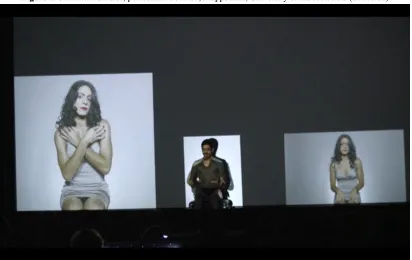
The piece opens with restraint chord gestures on the absent piano interface. In this section, I devised the sequence of choreography of gestures where the choreography of movements by the physical performer is replicated for two filmed characters: first for the pianist and later for the female character (see Figures 1 and 2). Besides the concern for the restrained look of the gestures, the limitations of the choreographed movements were set to the visible vicinity of the pianist’s body. The pianist starts with playing on the invisible piano interface gradually replacing his body as the interface. Thus, introduces the idea that this piece is also about his bodily presence where he is playing with images of himself on himself. In addition, I wanted the visual representation to be simple and direct at the beginning of the piece later becoming more variated, expanded and subverted. The space created through the repetitive sequence of gestures allows the viewer to understand the correlations between mediatized versions of the pianist and his physical self present on stage. The gestures emanating from the physical performer were mapped to the acceleration of arm movements thus sounding like they were produced from movement with intentionality of playing chord gestures, showing a believable one-to-one mapping of movement to sound.
!
Simon Steen Andersen, dir. “Study for String Instrument #3” Youtube. 14 August, 2017. Web. https://
††
www.youtube.com/watch?v=QvLI9bgAGw0
“Triptychs by Francis Bacon”. Wikipedia the Free Encyclopedia. Wikipedia the Free Encyclopedia, 3 Sep.
‡‡
2017. Web. 3 Sep. 2017. https://en.wikipedia.org/wiki/Triptychs_by_Francis_Bacon Ibid.
!
Figure 1. Simulacra Studies, performance Jan 25, Phipps Hall, University of Huddersfield (S. Moroz)
!
Figure 2. Simulacra Studies, performance Jan 25, Phipps Hall, University of Huddersfield (S. Moroz)
The repetitive simplicity of pitch in chord material relates to the theme of absences already discussed above where I was interested in the neutral or visually absent character of the performer. Visually, I was interested in both left and right arm movements so that the chosen pre-recorded piano chords were always broken up between treble and bass in the piano part (Figure 3):
Figure 3. Bars 1-3, Simulacra Studies (S.Moroz)
!
As the piece progresses, the initial choreography of gestures becomes absorbed in a slightly mocking manner by the female character of the pianist on the right video screen, this leads to a more open choreography which follows with prepared piano samples. This part is dependent on the video appearances of the right and left screens. The prepared piano samples replace the synthesized sound of the physical pianist, becoming the sound which he manipulates physically. As this part is open to improvised interactions where performer is reacting on the fly to the prepared piano sounds from the video on the left by initiating sampling manipulations such as sample speed, sample stutter, sample reversal and sample choice. These sort of manipulations remind one of the classic gestural controller interface performances from Michel Waisvisz and Laetitia Sonami where such reaction in the moment of improvisation could be observed (Dobrian and Koppelman, 2006:281). The performer’s response in this part of the piece, could be referred to as gestural interface virtuosity since the expressive response in a musical situation is controlled by reacting to timing, sampling process manipulations, sample variations in response to sound samples coming from the video projections on the left of the pianist (Dobrian and Koppelman, 2006:279). Thus expressive control of gestures rather than designated choreography become an important element of interaction and development in the middle section of the piece.
3.3 Mapping of the Narrative and the Form
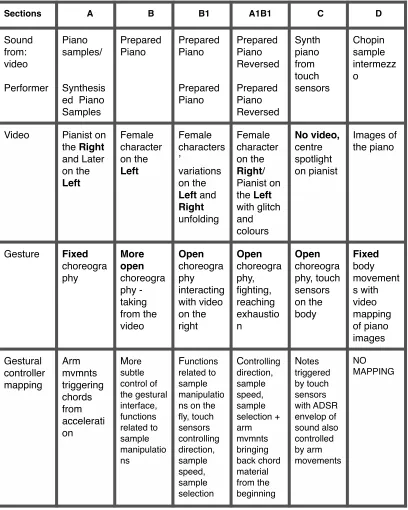
If one takes into account the musical material explored in each section, the form would be relatively simple: A B A1B1 C D, (Figure 4):
!
Figure 4. The form and structure of Simulacra Studies (S.Moroz)
Sections A B B1 A1B1 C D
Sound from:! video!
!
Performer Piano samples/!!!
Synthesis ed Piano SamplesPrepared Piano
Prepared Piano !
!!
Prepared Piano Prepared Piano Reversed!!
Prepared Piano Reversed Synth piano from touch sensors Chopin sample intermezz oVideo Pianist on
the Right
and Later on the Left Female character on the Left Female characters ’ variations on the
Left and
Right unfolding Female character on the Right/ Pianist on the Left
with glitch and colours
No video,!
!
Since the narrative of the piece is also mapped through video and gestural interactions, it becomes more complex and non-linear because one has to take into account many levels of interaction happening at the same time. The opening of the piece sets a controlled tone of interactions between the mediatized video versions of the pianist appearing on the right and the physical performer in the centre. This is done through fixed gesture of choreography and interactions with fixed mapping correlations between sound/gesture/image. However section B introduces an unexpected change in this relationship - copies or simulacra*** of the concert pianist character change into simulacra of the female character appearing on the left. Here gestures transform from choreographed to improvised, and are controlled by the performer as sound changes to prepared piano samples from synthesised. In B1 there is another twist - a sequence of appearances from the female character on the right. The gender variations of this character go from feminine to more masculine, as the wig and the make up disappear and the dress reveals parts of the male body behind it. The audience sees various disheveled images of this character and its gender variations, which is also in sync with the prepared piano samples that the performer is interacting with through the gestural controller. As this is happening the video on the left continuous its own slow transformation of gender from the original female character. This multiplicity of information and changes in interaction between sound and image creates a complex non-linear development for the viewer, which abstracts the clarity of the inherently simple form. In A1B1, interactions in sound and image between various copies of the pianist reach their peak when the pianist appears on the left of the performer, this time replacing the slow progression of gender variation from the previous images. At this point, we hear all the original samples in reverse both from the projected images on the left and the physical performer as the image on the right becomes glitchy. After this moment of reversibility, gestures come back to a clear point of one-to-one mapping of touch sensors to synthesised piano sounds in section C. The previous mappings of sound to image collapse as we are left with performer’s bare presence on stage.
Similar concerns with audio and visual elements and their subsequent mappings and development is found in the works of Simon Steen-Andersen. In Study for String Instrument #3, there are interactions between established visual correlations of audio to video as mapped onto a cellist or a guitar performer. The form and texture of the piece is composed of two layers of audio and visuals that are closely linked to each other: the pre-recorded video/audio score of the performer and the one performed live. The initial timbre of both parts is noisy and is not related to audibly recognisable pitch material thus making the blurring between the two parts more possible. The cellist in Study for String Instrument #3†††, starts in unison with the pre-recorded video and audio material progressively getting out of sync with it. In this piece specifically, Steen-Andersen uses the micro-motivic element of instrumental gestures such as bowing or pizzicato in relation to its video image and audio recording while going in and out of sync with the recorded version. Sometimes the visual element creates interesting merging between the performed action and the video, which makes for opposite bowing, guitar-like playing on a cello or other visual illusions. The material is developed by blurring the line of what is produced live or from the recording, leaving the recomposed visuals as the only believable source as to the possible origin of sound in this piece.
Unlike Steen-Andersen, in Simulacra Studies, I do not work with micro-motivic elements of instrumental gesture and I do not start with unison relationships in mapping. In Simulacra Studies, gestures start out of sync with the video image of the pianist eventually converging with the video but
Simulacra - copies of the original that does not exist. Baudrillard, Jean. Simulacra and Simulation, (Ann
***
Arbor: University of Michigan Press, 1994), p 1. Here I use simulacra in the similar sense to Jean Baudrillard where I attribute the image of a concert pianist to a symbol that no longer represents the real image of the pianist but is simulated for the purposes of the piece.
Simon Steen Andersen, dir. “Study for String Instrument #3” Youtube. 14 August, 2017. Web. †††
from the start there is no illusion as to what is real or what is not like in Steen-Andersen’s visual superpositions. In Simulacra Studies, the discord is created in the juxtaposition between the physical performer and the mediatized pianist where the initial gestures are choreographed and one is immediately aware of their caricature-like place of origin. Furthermore, I deconstruct the role of the pianist as well as his gender through character mappings beside and on top of the performer. The piece develops through mappings which constantly change from established correlation of gesture to sound and image thus developing a complex, non-linear narrative. The composition of this piece and its trans influences, in transmission of character, transgender of the original pianist, translation of gesture lead me to think about the mapping methods and how they can be used and translated across various subjects beyond a technique for measurements of sensors.
4.The Technology of Simulacra Studies
4.1 The Piano Hands
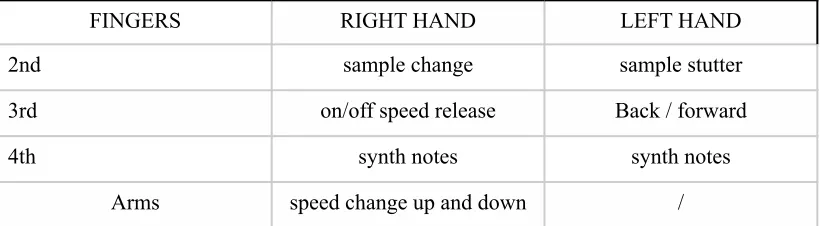
The Piano Hands corrnsist of two minibee accelerometers with three pressure sensors on each ‡‡‡ hand (figures 5 and 6). Each hand has two sensors with specific triggering functions that control sampling commands for the karma~ object in a Max/MSP patch used in section B of the piece (see §§§ figure 4). In addition, each sensor controls a set of possible notes that triggers synthesised piano sounds. The synth note choices are closely related to the pitches that are contained in the opening chords of the pianist at the beginning of Simulacra Studies. The triggering of synthesiser and prepared piano samples could be played separately or together, depending on the programming instance in the piece. The performer controls the sampling functions through touch sensors of the right and left hands (see figure 7). The sampling functions on the right hand are randomised sample selection, and sample speedselection, which is an ON/OFF trigger for the release of continuous control as controlled by the ‘y’ axis of the accelerometer on the right hand. The touch sensor on the left hand controls backward or forward direction, sample stutter (a programmed function of looping short instances of a sample). The accelerometers on the hands control the speed of sample playback as well as the envelopes of the synth sounding notes in the C section of the piece (see figure 5).
Figure 5. Sampling commands as controlled by the right and left hands of the pianist, Simulacra Studies. (S.Moroz)
FINGERS RIGHT HAND LEFT HAND 2nd sample change sample stutter 3rd on/off speed release Back / forward 4th synth notes synth notes
Arms speed change up and down /
MINIBEE accelerometers developed by Marije Baalman during her post-doctoral research at Concordia
‡‡‡
University, https://www.sensestage. eu
karma~ is a looper/sampler external for Max. It is a dynamic length, variable speed looper with some
§§§
!
The ‘xyz’ mapping of the accelerometer data was used differently depending on the required gesture in the piece. The arm movements at the beginning of the piece that trigger the synthesiser chord material are controlled by ‘xyz’ mapping of the accelerometers. Their combined data, with help from a programming situation which compared the old movement to the new. This comparative analysis ensured that only movements with a certain speed would trigger notes from the pitch bank containing the information about which chord would be chosen at random. The pitch material of the chords was also related to the original chord material from the sequence at the beginning of the piece (see figure 3).
!
! !
Figures 6-7. The Piano Hands - MINIBEE and touch sensors, front and palm view (S.Moroz)
4.2 Communication with Video
5. Conclusion
As the title suggests, Simulacra Studies, simulacra - copy of the original that was never there - suggests a level of hyperreality to the performance setting. I chose to treat the setting of the piece theatrically through a panel-like video frame. The piece subverts what is expected from a typical piano performance by introducing copies and versions of the mediatized pianist that is never truly there as one would expect. The premise of Simulacra Studies is complex because of the multiplicity of character mappings and fractured non-linearity of the narrative where each character develops through interactions with the performer. The mapping relationships while being set up, constantly change throughout the piece until they become reflected on the physical performer’s bare presence on stage. The physical body becomes the only real aspect to the piece with its skills of embodying the theatricality of gender performance and piano playing.
References
Auslander Paul. Liveness: Performance in a Mediatized Culture. Routledge, 1999.
Baudrillard, Jean. Simulacra and Simulation, Ann Arbor: University of Michigan Press, 1994, p 1. Butler, Judith. Gender Trouble: Feminism and Subversion of Identity. London: Routledge Classic,
2006.
Dobrian, Christopher and Daniel Kopelman, ‘The ‘E’ in NIME: Musical Expression in New Computer Interfaces’, in Proceedings of the 2006 conference on New Interfaces for musical expression. Paris, France, 2006. pp 277-282.
Concordia University Sensor Lab Research Centre. 2013. Accessed January 15, 2014 <http://slab.concordia.ca/sensor-lab-books/>.
Miranda R. Eduardo and Marcelo Wanderley. New Digital Musical Instruments: Control and Interaction Beyond the Keyboard. Wisconsin: A-R Editions Inc, 2006
Moroz, Solomiya. “Simulacra Studies” Vimeo. June 8, 2017 Web. https://vimeo.com/207141805 Moroz, Solomiya dir. “Short Wave Apocalypse or the Box trailer” Youtube. 1 September, 2017. Web.
https://www.youtube.com/watch?v=XBQ2_yc4Tho&t=5s
Spatz, Ben. What a Body Can Do: Technique as Knowledge, Practice as Research. London: Routledge, 2015.
Steen-Andersen, Simon. “Study for String Instrument #3”. Youtube. July 7. 2017. https://www.youtube.com/watch?v=jU4-a7h-vU4
Walshe, Jennifer. ‘Editorial and Statement’. The New Discipline. MusikText 149, May, 2016