NSW PUBLIC HEALTH
BULLETIN
Health impact assessment in urban settings
GUEST EDITORS
Patrick J. Harris
A,B, Ben F. Harris-Roxas
Aand Lynn Kemp
A ACentre for Health Equity Training, Research and Evaluation (CHETRE),part of the UNSW Research Centre for Primary Health Care and Equity, University of New South Wales BCorresponding author. Email: [email protected]
Our future is urban and the health impacts of that urbanisa-tion are a concern internaurbanisa-tionally, naurbanisa-tionally and locally within NSW. In 2008, for the first time in history, half the world’s population will live in cities.1Growth in urban areas
now accounts for the world’s entirenet population growth.1
Australia is already one of the most urbanised countries in the world, with more than three quarters of the population living in urban areas.2 The NSW population, over six
million, grew by almost 10% in the past decade.2
This issue of the NSW Public Health Bulletinbuilds on the growing interest in the impact of urbanisation in NSW and focuses on the contribution of health impact assessment (HIA) to sustainable urbanisation. The recently released
State Plan: a new direction for NSW3is a timely reminder
that health has an active role in the growth and sustainability of the state. The issue shows that our investment in HIA helps the health sector to better consider the health impacts of urbanisation.
The issue builds on the experience of the NSW HIA project over the past five years. Funded by NSW Health and led by the Centre for Health Equity Training Research and Evaluation, the project has developed the capacity of the health system to undertake HIA. The central element of the project has been ‘learning by doing’,4by undertaking HIAs
on policy, program and project proposals. As part of this work, HIAs have been conducted on proposals that directly influence sustainable urban planning; many of these have been described as case studies in this issue.
The NSW Health Impact Assessment Project has formed strong relationships between project participants and colleagues and experts in HIA and in the field of healthy
urban planning internationally, nationally and locally within NSW. Many of these colleagues have contributed to this special issue.
Four important messages concerning HIA, health and urbanisation are presented.
The first message reinforces the growing understanding that human well-being and the impacts of urbanisation are closely related.5Local and international authors with
expe-rience in HIA, health and urban planning provide similar arguments that:
• health and urban planning are inextricably linked • further action is required and
• HIA provides real opportunities to progress this action.
The second message is that HIA has been proven to be a mechanism by which health and other sectors involved in sustainable urbanisation can move beyond recognition of common concerns to concrete action. The HIA case studies included in this issue emphasise the value of con-structive engagement using the structured and stepwise approach of HIA.
The third message, highlighted by the case studies on the Bungendore, Lower Hunter and Illawarra impact assess-ments (see Gow et al.; Wells et al.; Furber et al.; this issue), is that HIA should not be limited to urbanisation in big cities. The proportional growth in regional centres and rural towns often dwarfs that occurring in large cities and the impact on existing resources, physical and social infrastruc-ture can be enormous. This situation is not unique to Australia. As noted in the State of the World Population 2007 report ‘contrary to general belief, the bulk of urban
w w w. p u b l i s h . c s i r o. a u / j o u r n a l s / p h b CONTENTS – See back page
Health impact assessment in urban settings
Vol. 18(9–10) • September–October2007
150 | Vol. 18(9–10) NSW Public Health Bulletin
population growth is likely to be in smaller cities and towns, whose capabilities for planning and implementa-tion can be exceedingly weak’.1
The fourth message is that successfully responding to the future challenges and opportunities of urbanisation will require a range of actions such as:
• a shift towards healthy public policy increasing the capacity of the health sector to engage intersectorally on urban planning
• understanding the regulatory framework that governs urban planning in NSW
• learning from past lessons concerning advocating for health as part of urbanisation and
• building on the strengths of, and meeting the challenges set by, HIA in NSW to date.
At all levels of the urbanisation debate – global, national and local, it is apparent that health must become actively
engaged in order to enhance the sustainability of planning activities. HIA is now established as one tool to facilitate that engagement. This issue of the Bulletin shows that NSW is now in a position, as a world leader on HIA, to support the pivotal future role that urbanisation will play in influencing the health of populations and communities.
References
1. UNFPA. State of the world population 2007: unleashing the potential of urban growth. United Nations Population Fund. At http://www.unfpa.org/swp/, accessed 13 August 2007.
2. Australian Bureau of Statistics. Year Book Australia 2007. Canberra: Australian Bureau of Statistics, 2007.
3. NSW Government State Plan: a new direction for NSW. Sydney: Premier’s Department of Health, 2007.
4. Harris-Roxas B, Simpson S. The NSW Health Impact Assessment Project.N S W Public Health Bull2005; 16(7–8): 120–3.
5. Capon AG, Dixon JM. Cities, sustainability and health (special edition).N S W Public Health Bull2007; 18(3–4): 37–72.
Influencing urban environments for health:
NSW Health’s response
EDITORIAL
Sarah V. Thackway
A,C, Andrew J. Milat
Band
Elizabeth Develin
BACentre for Epidemiology and Research, NSW Department of Health
BCentre for Chronic Disease Prevention and Health Advancement, NSW Department of Health
CCorresponding author. Email: [email protected]
The burden of preventable chronic disease is rapidly increasing in New South Wales.1If the potential for
pre-venting chronic diseases is not fully harnessed, it is pro-jected that treatment costs alone for people with diabetes, cardiovascular disease, cancers and musculoskeletal con-ditions in NSW will rise from approximately $3.3 billion in 2000–01 to $6.1 billion by 2020–21.2Addressing this
challenge will require a multifactorial approach and there is a growing body of evidence around the links between risk factors apportioned to increasing urbanisation and, more broadly, to the built environment.3–5 Creating
environments that promote health can play a significant role in reducing rates of death and disability from chronic disease.6Compounding the challenge of addressing
poten-tially avoidable chronic diseases is the sustainability of our urban communities, with increasing populations in and around Sydney and coastal NSW in particular. For example, over the next 20 years, population increases of over 50% are expected in several coastal townships.7
The importance of urban planning for health has been identified as a key priority for the NSW Government as described in the: NSW State Plan,8 NSW State Health
Plan,9 Healthy People NSW,10 and the NSW Population
Health Priority Taskforce. In particular, Healthy People NSWidentifies health impact assessment (HIA) as a key tool for affecting change and to strengthen health input into planning decisions.10
While in NSW it is local government planners and urban designers who have the ability to directly influence and shape the urban environment, NSW Health is increasing its engagement at both a state and regional level. This issue of
Influencing urban environments for health
the Bulletinreflects the increased level of activity and inno-vation by Health Services across NSW to influence the shape of the urban environment, through the use of HIA in projects from housing regeneration to population growth to capital works, in line with the growing body of evidence.
For a number of years, NSW Health has invested in and worked towards creating a more cohesive partnership approach to urban planning projects with state and regional planning bodies including the NSW Local Government and Shires Associations, through the NSW Health Impact Assessment Project, and health risk assess-ment work. The learning-by-doing approach to HIA out-lined in this issue highlights the practical impacts on planning that such a tool can have. HIA has emerged as a good mechanism through which to engage with the urban planning sector, as evidenced by the successful implemen-tation of several joint Area Health Services and local gov-ernment HIA projects in NSW in recent years. An acknowledged leader in this has been the Greater Southern Area Health Service, whose active engagement with the planning sector recently earned them an award from the University of NSW and the NSW HIA Steering Committee.
The coming year sees several activities being conducted in this domain including a statewide review of the activities being undertaken. This review will identify opportunities to build on the successes of recent years and to maximise NSW Health’s impact on urban planning and regeneration frameworks. Another highlight will be the 7–9 November 2007 South East Asia and Oceania Regional Health Impact Assessment Conference to be held in Sydney. This will be jointly hosted by NSW Health and the University of NSW Research Centre for Primary Health Care and
Equity. The conference will be an important vehicle to facilitate greater engagement between the health and plan-ning sectors, as well as academia, both in NSW and the South East Asia and Oceania regions.
References
1. Begg S, Vos T, Barker B, Stevenson C, Stanley L, Lopez A. The burden of disease and injury in Australia 2003. PHE 83. Canberra: AIHW, 2007.
2. Voss T, Goss J, Begg S, Mann N. Australian burden of disease and injury study: projected health care costs report. Brisbane: University of Queensland and Australian Institute of Health and Welfare, In press.
3. Saelens BE, Sallis JF, Frank LD. Environmental correlates of walking and cycling: findings from the transportation, urban design and planning literatures.Ann Behav Med2003; 25: 80–91. doi:10.1207/S15324796ABM2502_03
4. Ewing R, Schmid T, Killingsworth R, Zlot A, Raudenbush S. Relationship between urban sprawl and physical activity, obesity and morbidity.Am J Health Promot2003; 18: 47–57. 5. Lopez R. Urban sprawl and the risk for being overweight or
obese.Am J Public Health2004; 94: 1574–9.
6. World Health Organization. Food Agricultural Organization Joint Report. Diet, Nutrition and the Prevention of Chronic Disease. Geneva: WHO, 2002.
7. NSW Health Department. Chief Health Officer’s Report. At http://www.health.nsw.gov.au/publichealth/chorep/dem/dem _pop_percentmap.htm, accessed 30 July 2007.
8. NSW Government. State Plan: a new direction for NSW. Sydney: Premier’s Department, 2006.
9. NSW Department of Health. State Health Plan towards 2010: a new direction for NSW. North Sydney: NSW Department of Health, 2007.
10. NSW Department of Health. Healthy People NSW. North Sydney: NSW Department of Health, 2007.
South East Asia and Oceania Regional
Health Impact Assessment Conference
The Conference will be held in Sydney, Australia from Wednesday 7 to Friday 9 November 2007 at the Menzies.
This event will bring together health impact assessment (HIA) practitioners from South East Asia and Oceania for the first time. The conference will provide an opportunity for delegates to learn, meet other practitioners, network, share experiences, contribute ideas and to reflect on HIA.
HIA is a structured process for looking at the positive and negative, intended and unintended impacts that may eventuate from projects, programs or policies. It also considers the distribution of impacts across the population and within affected groups.
152 | Vol. 18(9–10) NSW Public Health Bulletin
HIA is a systematic approach to identifying the differen-tial health and wellbeing impacts of proposed plans and projects within a democratic, equitable, sustainable and ethical use of evidence framework. The goal is that posi-tive health impacts are maximised and negaposi-tive health impacts minimised within affected, or potentially affected, populations.1,2It uses a range of structured and evaluated
sources of qualitative and quantitative evidence that include public and other stakeholders’ perceptions and experiences as well as public health, epidemiological, tox-icological and medical knowledge. It aims to influence policy and decision-making by:
• providing a rigorous analysis of the potential impacts and options for enhancing positive impacts
• mitigating negative ones, and
• reducing any health inequalities that might arise from a proposed policy, plan, program or project.
Over the last three years, health impact assessment (HIA) has come of age and gone global. There are exciting devel-opments, at policy and project levels, in North America, Europe, Africa, Asia and Australasia. This article describes some examples of the innovative HIA work occurring in each of these continents.
International perspective on health impact
assessment in urban settings
Abstract:Health impact assessment is being used to support and deliver healthy and sustainable communities in major urban areas around the world. This article discusses some of the latest international developments in the use of health impact assessment in urban settings: in North America, Europe, Africa, Asia and Australasia. It outlines the implications of this work and describes some of the challenges facing practi-tioners in predicting health impacts and providing solutions to protecting and enhancing health and wellbeing in urban settings.
Salim Vohra
Centre for Health Impact Assessment, Institute of Occupational Medicine, UK Email: [email protected]
North America
Unlike the USA, Canada has a longstanding record in the field of HIA, healthy public policy and the consideration of the health impacts of policies, plans, programs and proj-ects.3,4 Only in the last few years has HIA gathered
momentum in the USA, with the growing recognition that health and wellbeing are critical issues for major urban areas.5 Leading institutions, notably the Centers for
Disease Control and Prevention (CDC) in Atlanta, have begun to carry out HIAs on urban development plans and projects.6–8
One example of the imaginative work happening in North America is the work of the Design for Health initiative. This collaboration between the Metropolitan Design Center at the University of Minnesota and Blue Cross and Blue Shield of Minnesota, two major health insurance associations, aims to bridge the gap between community design, healthy living and land development planning.9
The Design Center’s work is done by an interdisciplinary team with backgrounds in architecture, landscape archi-tecture, planning, public health and landscape ecology. They have created a HIA tool and a set of HIA materials and information for other agencies and organisations in Minnesota to use when developing new urban plans and projects.
Europe
HIA has been practised in Europe for almost a decade with the UK, Finland and the Netherlands among others being major proponents.10In Europe the major driving forces for
the way HIA is being used in urban settings have been the health inequalities, sustainability and climate change agendas.
One example of the leading edge HIA activity in Europe is the work of the London Healthy Urban Development Unit. This Unit is investigating the links between urban plan-ning and health and has developed a range of HIA tools to help improve health and wellbeing in London.11 Their
financial model is the first of its kind internationally to estimate the capital and revenue costs of health-care serv-ices for new housing developments and extensions to existing urban areas. It is also pioneering the use of Geographical Information Systems to map existing health, social, leisure and cultural facilities and plan the situation of new facilities to ensure that they are evenly distributed and accessible to all.
Africa
In Africa, HIA, as part of environmental health impact assessment, has been practised by major development agencies for over two decades and, similar to other south-ern regions and continents, has a strong history of doing social impact assessment alongside and within environ-mental impact assessment.12,13The major driving force for
HIA practice in Africa is the double burden of disease that many middle-income countries are facing from both infec-tious disease, such as HIV/AIDS and malaria, as well as the so-called developed country chronic diseases, such as obesity, heart disease and cancer. In addition, they need to ensure that economic development projects enhance the health and wellbeing of affected communities.
An example of a group undertaking groundbreaking HIA work is the Development Bank of Southern Africa in South Africa. It is currently working to mainstream HIA by embedding the consideration of health impacts within its existing environmental, social, economic, technical, financial and institutional appraisal processes for invest-ment funds and technical assistance.14The Bank is using
an organisational development model to raise awareness of HIA and is developing health impact guidance and training for the Bank’s in-house specialists, external clients and partners.
Asia
Similar to the African situation, development and the health burden from infectious and chronic diseases have been drivers for the use of HIA in Asia. HIA has been on the agenda since 2000, with Thailand and Laos leading the
way.15–17 Both Thailand and Laos are embedding HIA
within the environmental impact assessment framework; however, the HIA legislation in Thailand has gone beyond environmental impact assessment and taken a more holis-tic and far-reaching perspective on assessing the health and wellbeing implications of new plans and projects.
One example of the pioneering work in Asia is that of the Health Systems Research Unit in Thailand.18 This work
has highlighted the importance of history, culture and spir-ituality in enhancing individual and community wellbeing. In its HIA work on high-rise developments and urban planning in Chiang Mai, the Unit showed that unplanned development was changing the historical, cultural and spiritual significance that Chiang Mai, with its beautiful architecture and temples, has in the Lanna territory. This change, in turn, was affecting the health and wellbeing of the residents of Chiang Mai.
Australasia
Australia and New Zealand have a long history of HIA with both countries having had national drivers to incorporate health and wellbeing issues within the environmental impact assessment process and the sustainability agenda,
and as part of the healthy urban planning movement.19,20
The drivers for HIA have been health equity and the recog-nition that health and wellbeing are linked with where people live, work and play. Both countries have undertaken HIAs at national, regional and local levels. Examples of urban HIAs include the Shellharbour Foreshore Management Plan and the South East Queensland Regional Plan in Australia, and the Christchurch Urban Development Strategy and Greater Wellington Regional Land Transport Strategy in New Zealand.
An example of cutting edge HIA work in Australasia is that from the Centre for Health Equity Research, Training and Evaluation (CHETRE). They have developed a learn-ing-by-doing approach to embedding HIA in the health and non-health agencies working in NSW.21This approach
involves supporting and mentoring health and non-health professionals to identify, plan for, carry out and follow HIAs on new proposals on which these professionals are working. This approach has raised awareness of the value of HIA and built the capacity of agencies in NSW to undertake HIA.
The future of HIA in urban settings
These varied examples show the breadth and depth of HIA practice in urban settings around the world. At one end of the spectrum there is a discernable global movement to undertake separate HIAs on urban policies, plans, pro-grams and projects. At the other, there is a concerted push to integrate HIA into other forms of impact assessment, such as environmental impact assessment, social impact assessment and strategic environmental assessment, as well as to incorporate health into the wider sustainability agenda at national, regional and local levels.22 The 21st
Century is likely to see a blossoming of public health, in a similar way to sustainability, to once again become an integrated part of policy and practice. At policy level, poli-cies and plans from land use, transport and defence to edu-cation, crime and social welfare will integrate the assessment of potential health impacts within their policy and plan-making processes. Similarly, at project level, whether it is nuclear power stations and energy-from-waste facilities or housing and transport projects, all major projects will undergo some form of assessment of their potential health impacts whether as a separate HIA or as an integrated component within an environmental or social impact assessment.
However, there are three big challenges facing HIA in urban settings. First, the need to develop a robust and broad theoretical foundation that takes on board theoreti-cal understandings from fields as diverse as urban plan-ning and design; risk perception, communication and management; sociology and anthropology; environmental psychology and economics; as well as the more classical epidemiology, toxicology, health promotion and public
154 | Vol. 18(9–10) NSW Public Health Bulletin
health.23Second, to do more systematic follow-ups, plans
and projects to evaluate: their actual health impacts, the predictions made in any HIAs that were undertaken on them and the value HIA had in changing the final design and implementation.24And third, to learn more from each
other both within countries and internationally. The health issues we are facing, both North and South, East and West, have more similarities than differences. It is only by having a vibrant, international HIA community that HIA practitioners can play a full part in helping to create a more sustainable, equitable and healthy world.25,26
References
1. Quigley R, den Broeder L, Furu P, Bond A, Cave B, Bos R. Health impact assessment international best practice princi-ples. Special publication series no. 5. Fargo, USA:
International Association for Impact Assessment, 2006.
2. Health impact assessment: main concepts and suggested approach. Gothenburg Consensus Paper. Brussels: World Health Organization Regional Office for Europe, European Centre for Health Policy, 1999.
3. A Report of the Federal/Provincial/Territorial Committee on Environmental and Occupational Health. Canadian Handbook of Health Impact Assessment Volumes 1–4. Health Canada, 2004.
4. Mittelmark M. Promoting social responsibility for health: health impact assessment and healthy public policy at the community level.Health Promot Internation2001; 16(3): 269–74. doi:10.1093/heapro/16.3.269
5. Dannenberg A, Bhatia R, Cole PL, Dora C, Fielding JE, Kraft K et al.Growing the field of health impact assessment in the united states: an agenda for research and practice.Am J Public Health2006; 96(2): 262–70. doi:10.2105/AJPH.2005.069880 6. Centers for Disease Control and Prevention. Health impact
assessment. Available at http://www.cdc.gov/healthyplaces/ hia.htm, accessed 23 August 2007.
7. University of California. Los Angeles. Health impact assess-ment: information and insight for policy decisions. Available at http://www.ph.ucla.edu/hs/health-impact/, accessed 23 August 2007.
8. San Francisco Department of Health. Environmental Health Section. Eastern neighbourhoods community health impact assessment. Available at http://www.sfdph.org/phes/ ENCHIA.htm, accessed 23 August 2007.
9. University of Minnesota, Metropolitan Design Centre. Design for health. Available at http://www.designforhealth.net, accessed 23 August 2007.
10. Ståhl T, Wismar M, Ollila E, Lahtinen E, Leppo K. Health in all policies: prospects and potentials. Ministry of Social Affairs and Health, Finland and European Health Observatory on Health Systems and Policies 2006. Available from
http://ec.europa.eu/health/ph_information/documents/health_in _all_policies.pdf
11. NHS Healthy Urban Development Unit. Available at http://www.healthyurbandevelopment.nhs.uk/, accessed 23 August 2007.
12. World Bank. Environmental assessment sourcebook and updates. 1991 to present. Available at http://go.worldbank.org/ LLF3CMS1I0, accessed 23 August 2007.
13. African Development Bank. Integrated environmental and social impact assessment guidelines. 2003. Available at http://www.afdb.org/pls/portal/url/ITEM/F813B8C92C4393E8 E030C00A0C3D1B93, accessed 23 August 2007.
14. Gasa N. Mainstreaming health impact assessment at the Development Bank of Southern Africa. Personal communica-tion. 2007.
15.Towards a healthy society: healthy public policy and health impact assessment in Thailand. Health Systems Research Institute, Healthy Public Policy and Health Impact Assessment Program, 2005.
16. Phoolcharoen W, Sukkumnoed D, Kessomboon P.
Development of health impact assessment in Thailand: recent experiences and challenges.Bull World Health Organ2003; 81(6): 465–7.
17. Chanthaphone S. Health impact assessment development process in the Lao PDR. In 6th Global Conference on Health Promotion; 2005; Bangkok, Thailand.
18. Health Systems Research Unit. Thailand. Available at http://www.hsri.or.th/, accessed 23 August 2007.
19. Enhealth Council. Health impact assessment guidelines, 2001. Available from http://enhealth.nphp.gov.au/council/pubs/ pdf/hia_guidelines.pdf
20. Public Health Advisory Committee. An idea whose time has come new opportunities for health impact assessment in New Zealand public policy and planning. 2007. Available at http://www.phac.health.govt.nz/moh.nsf/indexcm/phac-idea-whose-time-has-come, accessed 23 August 2007.
21. University of New South Wales. Research Centre for Primary Health Care & Equity. HIA Connect: building capacity for health impact assessment. Available at
http://www.hiaconnect.edu.au/, accessed 23 August 2007.
22. Lock K, McKee M. Health impact assessment: assessing opportunities and barriers to intersectoral health improvement in an expanded European Union.J Epidemiol Community Health2005; 59: 356–60. doi:10.1136/jech.2004.024026 23. Mindell J, Boaz A, Joffe M, Curtis S, Birley M. Enhancing the
evidence base for health impact assessment.J Epidemiol Community Health2004; 58: 546–51.
doi:10.1136/jech.2003.012401
24. Krieger N, Northridge M, Gruskin S, Quinn M, Kriebel D, Davey Smith G et al. For the HIA “promise and pitfalls” conference group. Assessing health impact assessment: multidisciplinary and international perspectives.J Epidemiol Community Health2003; 57(9): 659–62.
doi:10.1136/jech.57.9.659
25. University of New South Wales, Research Centre for Primary Health Care and Equity. HIA Connect: International HIA Blog. Available at http://healthimpactassessment.blogspot.com/, accessed 23 August 2007.
Health impact assessment provides a framework to improve decision-making about plans, policies and pro-grams.1The framework has been used to assess impacts of
urban development, in both urban regeneration projects and new release areas (see Vohra in this issue). Currently, there is renewed interest in the health impacts of urban development because of an improved understanding of relationships between urban environments and contempo-rary epidemics of chronic disease (cardiovascular disease, diabetes, chronic respiratory disease and some cancers), injury and depression.2
Contemporary priorities
Our modern maladies are consequences of human–envi-ronment interactions.3There are three principal problems
with our current pattern of urban development: limited opportunities for incidental physical activity and associ-ated sedentarism; concentration of food retail in regional centres and associated local food insecurity; and physical separation of residential areas from employment. Three main urban planning responses are needed.
Health impacts of urban development:
key considerations
Abstract:The urban environment is an important determinant of health. Health impact assessment is a tool for systematic analysis of the health con-sequences of urban development and manage-ment. This paper identifies key considerations, including opportunities for physical activity, food access and local economic development. Time use by urban residents has health implications. The schedule for infrastructure development in new release areas (in particular transport, education and health infrastructure) also has health impli-cations. Health impacts should be considered a primary outcome of urban development and management.
Anthony G. Capon
Oxford Health Alliance Asia-Pacific Regional Centre, The University of Sydney
Urban Systems Program, CSIRO Sustainable Ecosystems Email: [email protected]
1. Improved opportunities for incidental physical activity
To improve conditions for walking and cycling in cities, it is necessary to ‘re-conquer’ the city, pushing back cars.4
Gehl argues that public space has always served as meeting place, marketplace and traffic space. In many cities, car traffic and parking have gradually usurped public space in streets, parks and squares. This resulting situation can make it unpleasant and unsafe to walk and cycle because of noise, air pollution and risk of injury. Gehl is currently advising the City of Sydney on a new direction for city spaces and ways to promote active transport (walking and cycling). Several tools to support design and planning for active living are available on the Internet.5,6
2. Planning for healthy food choices and sustainable food production
Some parts of our cities have a vibrant food culture with cafes, restaurants, farmers’ markets, supermarkets, bakers, greengrocers, butchers, fishmongers and delicatessens. In other parts of our cities, local food supply may be restricted to a retail store at a petrol station and some fast food restaurants. Healthy food choices may only be avail-able in a regional shopping centre. With the seeming inex-orable expansion of urban areas, a large amount of our fertile agricultural land is being covered with housing and opportunities to grow food locally are being lost. Urban plans consequently should address food supply by pro-moting sustainable food production and improving access to healthy food.7,8
3. Suburban economic development and a return to localism
In post-industrial societies like Australia, there is no longer a public health imperative to separate most employ-ment from residential areas.3 Planners now advocate
mixed-use development and more emphasis on suburban economic development.9 Public health workers should
support this advocacy because there are health benefits from living close to work (shorter travel times and improved prospects for walking or cycling to work). There is a strong case for a return to localism within cities,10
enabling people to meet their daily needs in their local area. This will have benefits for both the health of people and the health of the environment.
Time as a metric for health and sustainability Time use choices have health impacts.11 One important
156 | Vol. 18(9–10) NSW Public Health Bulletin
mode is active, such as walking and cycling, opportunities for incidental physical activity are provided. If the trans-port mode is sedentary, such as a car, and particularly if the travel times are long (more than 30 min), the time available for recreation, for family and for community participation is reduced. Time use is potentially an important metric for healthy and sustainable cities and warrants greater empha-sis in urban and transport planning.
Timetabling infrastructure in large-scale urban developments
Plans for large-scale urban development usually include plans for infrastructure, such as transport, schools, higher education institutions, health and other services. The timetable for delivery of infrastructure is an important issue in urban development as delays in construction of transport infrastructure, such as a railway line, will affect people’s transport choices. Transport patterns are difficult to change once they are established. If mass transit is pro-vided from the outset, it is likely to increase the proportion of no-car and one-car households, with benefits for the health of people and the health of the environment. Consequently, it is important that essential infrastructure is delivered early and on time.
Thinking ahead
A focus on healthy urban planning is important because once a development is built retrofit changes are difficult and costly. Health impact assessment has utility for large-scale urban development projects. Importantly, planners should also consider health impacts in everyday decision-making, because the cumulative impacts of small deci-sions can be as important as the decision on a large project.
Health is not just relevant to urban planning and develop-ment. Health should also be considered a key outcome of the ongoing management of cities. The ecological concept of ‘adaptive management’ is relevant.12The garden cities
paradigm of urban planning was a response to health con-cerns in the 19th Century. In the 21st Century, Australia has a population of more than 20 million. It is neither healthy nor sustainable for us all to live in garden cities. Certainly, alternate models of urban development, includ-ing aspects of ‘new urbanism’, may have unintended
health consequences. It is therefore essential to monitor outcomes and to adapt over time.
Our habitat (now increasingly urban) is a determinant of our habits (including health behaviours). Planners and public health workers should join together and advocate for due emphasis on human health impacts in urban decision-making.
References
1. Harris E. Contemporary debates in health impact assessment. What? Why? When?N S W Public Health Bull2005; 16: 107–8. doi:10.1071/NB05026
2. Frumkin H, Frank L, Jackson R. Urban sprawl and public health: designing, planning and building for healthy communi-ties. Washington DC: Island Press, 2004.
3. Capon AG, Blakely EJ. Checklist for healthy and sustainable communities.N S W Public Health Bull2007; 18: 51–4. doi:10.1071/NB07066
4. Gehl J, Gemzoe L. New city spaces. Copenhagen: The Danish Architectural Press, 2003.
5. Active living by design. Chapel Hill, North Carolina: active living by design. Available at http://www.activelivingbyde-sign.org/, accessed 29 May 2007.
6. Premier’s council for active living. Sydney: New South Wales Government. Available at http://www.pcal.nsw.gov.au/, accessed 6 August 2007.
7. Webb K, King L. Food, nutrition and the built environment. In: Johnson C, editor. Healthy environments. Sydney: Government Architect’s Publications, 2004. pp. 46–55.
8. Healthy and sustainable food for London: the Mayor’s food strategy. London: London Development Agency, 2006. Available at http://www.lda.gov.uk/, accessed 29 May 2007.
9. Blakely EJ, Bradshaw TK. Planning local economic develop-ment: theory and practice. 3rd ed. Thousand Oaks: Sage Publications, 2002.
10. Kunstler JH. McBurbia: our fervent love affair with suburbia is doomed – and dangerous.G Magazine2007; 2: 22.
11. Strazdins L, Loughrey B. Too busy: why time is a health and environmental problem.N S W Public Health Bull2007; in press
12. Walters CJ, Holling CS. Large-scale management experiments and learning by doing.Ecology1990; 71: 2060–8.
The links between town planning and health go back to the origins of town planning. The creation of zoning to sepa-rate dirty, polluting uses of land from the places where people lived was an important public health initiative. While it may not have been explicitly expressed as such, inherent in this approach was a clear connection between the health of communities, the environment and urban planning. And while planning has continued to address environmental issues that positively contribute to well-being, a specific focus on health has, until recently, taken a back seat.
Understanding exactly how different urban settings affect well-being is an important step in bringing planning and health closer together. Starting with planning’s historical links with public health reform, this paper provides an overview of how different urban settings affect physical and mental health – from the far-flung suburbs to the inner
A planner’s perspective on the health impacts
of urban settings
Abstract:The profession of town planning origi-nated out of concerns for the health and well-being of people. Progress was made as crowded and unsanitary inner city slums were replaced with suburban environments where individuals could access green open spaces and clean air. With significant increases in urban populations and the geographic spread of the city, over time these environments became increasingly unhealthy. This paper provides an overview of how modern urban environments impact on people’s physical and psychological health. This understanding will assist planners and health professionals to ensure that HIA and other related impact assessment tools are effective in identifying and ameliorating potential adverse well-being outcomes of different urban policies and proposals for varying scales of development.
Susan Thompson
Planning and Urban Development Program,
Faculty of the Built Environment, University of New South Wales Email: [email protected]
city. The situation is complex: indeed, both inner and outer urban environments have implications for health and well-being. These implications need to be better understood so that health impact assessment (HIA) and related processes, such as environmental and social impact assessments, are more effective. These tools, used alone or in combination, can enhance the identification of potential health impacts before a development approval is granted or a planning policy finalised making cities healthier places for all.
History of town planning’s origins in health
Early definitions of town planning reveal that the health of the community was a key objective of the fledgling pro-fession. Sir Patrick Abercrombie, an influential English planner in the early 20th Century, described the principles of planning quite simply as beauty, health and conven-ience. And while beauty came first in his list, it was ‘the quality which must run through the whole in order to lift sanitation and engineering to the level of civic design and the dignity of city life’.1Australian planners also saw the
achievement of a healthy community as central to their work. In practical terms, concerns for the health of city inhabitants – particularly those living in overcrowded inner-city slums – stimulated the development of two prin-ciples that have dominated planning ever since: the concept of zoning and that of the suburb.
Zoning plans focussed on separating dirty and polluting uses, such as factories, from clean uses, such as residential and recreational areas. Known as land-use zoning plans, these schemes assumed that planning activity could rationally order and control land use and development. The suburb was typified as the best place to bring up fam-ilies in wholesome and healthy circumstances away from the squalor and poverty of the densely packed inner city.2
Post World War II housing programs boosted suburban development and the availability of the motor car further stimulated suburban expansion.3
As cities grew, so did the geographical extent of the suburb, along with the separation between home and work. This situation has become increasingly problematic for human health; planning must now return to one of its orig-inal objectives – that of enhancing public health.
The impact of urban settings on health The suburban setting
158 | Vol. 18(9–10) NSW Public Health Bulletin
characterised by polluting industries. But as city popula-tions increased and cleaner industrial processes were introduced, the need for a large geographical separation between housing and places of employment diminished. Today, it is the very separation that is causing a problem for the physical and mental health of communities.4
The positioning of different land uses in a city, and the ways in which they are inter-connected, significantly influence how individuals travel from their homes to work, school, shops, recreational areas and other public facili-ties. In Australia, suburbs have generally been developed with low-density residential forms – typically a house on its own block of land – and poor public transport infra-structure. Street subdivisions are characterised by convo-luted cul-de-sacs rather than the traditional street grid.
While the former might make for a safer street – neigh-bours looking out for each other and little through traffic enabling children to play on the road – these subdivision patterns do not encourage walking. It takes longer to get between places because the convoluted road networks mean that the actual distance travelled is much greater.
The high level of car dependency in suburban localities has significant health and well-being implications. Retail facilities, particularly stand alone shopping centres, are designed with the car user in mind, are generally poorly connected to public transport and can be unfriendly to pedestrians. As parents worry more and more about their children’s safety, both from the real and perceived dangers of strangers and vehicles, youngsters do not walk to school or play games outdoors. People who commute long
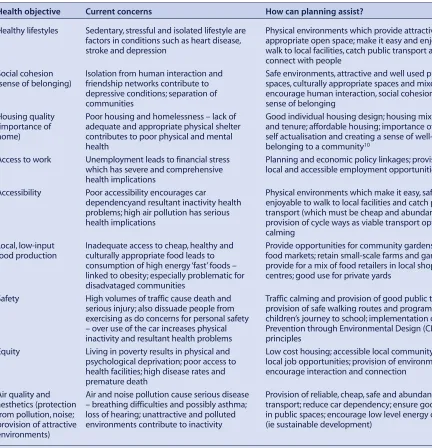
dis-Table 1. Connecting health and planning
Health objective Current concerns How can planning assist?
Healthy lifestyles Sedentary, stressful and isolated lifestyle are Physical environments which provide attractive and factors in conditions such as heart disease, appropriate open space; make it easy and enjoyable to stroke and depression walk to local facilities, catch public transport and
connect with people
Social cohesion Isolation from human interaction and Safe environments, attractive and well used public (sense of belonging) friendship networks contribute to spaces, culturally appropriate spaces and mixed uses
depressive conditions; separation of encourage human interaction, social cohesion and
communities sense of belonging
Housing quality Poor housing and homelessness – lack of Good individual housing design; housing mix – type (importance of adequate and appropriate physical shelter and tenure; affordable housing; importance of ‘home’ in home) contributes to poor physical and mental self actualisation and creating a sense of well-being and
health belonging to a community10
Access to work Unemployment leads to financial stress Planning and economic policy linkages; provision of which has severe and comprehensive local and accessible employment opportunities health implications
Accessibility Poor accessibility encourages car Physical environments which make it easy, safe and dependencyand resultant inactivity health enjoyable to walk to local facilities and catch public problems; high air pollution has serious transport (which must be cheap and abundant); health implications provision of cycle ways as viable transport options; traffic
calming
Local, low-input Inadequate access to cheap, healthy and Provide opportunities for community gardens and fresh food production culturally appropriate food leads to food markets; retain small-scale farms and gardens;
consumption of high energy ‘fast’ foods – provide for a mix of food retailers in local shopping linked to obesity; especially problematic for centres; good use for private yards
disadvataged communities
Safety High volumes of traffic cause death and Traffic calming and provision of good public transport; serious injury; also dissuade people from provision of safe walking routes and programs for exercising as do concerns for personal safety children’s journey to school; implementation of Crime – over use of the car increases physical Prevention through Environmental Design (CPTED) inactivity and resultant health problems principles
Equity Living in poverty results in physical and Low cost housing; accessible local community facilities; psychological deprivation; poor access to local job opportunities; provision of environments that health facilities; high disease rates and encourage interaction and connection
premature death
Air quality and Air and noise pollution cause serious disease Provision of reliable, cheap, safe and abundant public aesthetics (protection – breathing difficulties and possibly asthma; transport; reduce car dependency; ensure good design from pollution, noise; loss of hearing; unattractive and polluted in public spaces; encourage low level energy design provision of attractive environments contribute to inactivity (ie sustainable development)
environments)
tances from home to work often do not have the time or energy to form meaningful relationships with neighbours. Similarly, family relationships can suffer from long absences from home. Commuters also have less time to spend using local healthy planning innovations such as cycleways and walkable neighbourhoods. The net result is reduced community interaction and social capital.
But it is wrong to characterise the suburb as being all bad for health. In particular, the backyard is a healthy resource. It is safe for active children’s play and readily accessible on a daily basis. Private yards, where gardens grow, provide fresh fruit and vegetables which are both economical and culturally appropriate.5–7These spaces also provide
oppor-tunities for regular and enjoyable physical activity. Families can socialise there, and have pets, which bring many recognised health benefits to humans.8
Consolidated city settings
In contrast to the suburb, denser, inner residential areas increasingly characterise Australian cities. These environ-ments are rightly lauded for their walkable local destina-tions, proximity of living and working areas, plentiful and easily accessible recreational and cultural facilities, together with good public transport infrastructure. Consolidated inner localities epitomise the objectives of sustainable city planning with its focus on high residential densities and lower levels of car dependency. However, while these areas have significant health benefits, there are problems that need to be acknowledged. Heavily traf-ficked, polluted, unsafe and unpleasant environments do not promote walking. It is difficult to access local food production opportunities, and cheap, healthy and cultur-ally appropriate food can be hard to source. For disadvan-taged communities, this can lead to the consumption of high energy fast foods, which are in turn linked to obesity and other adverse health conditions.
Redevelopment of the inner city has increased housing costs,9 forcing those without the necessary financial
resources into poor or inadequate accommodation, and in extreme cases, homelessness. And for those able to afford to live in the inner city, body corporate rules and regula-tions can result in a reduction of personal autonomy and power at home.10Pets, for example, are often prohibited
from high rise apartments.
Less readily accessible open space for active children’s play is another adverse health consequence. A well-designed park may be part of a residential apartment complex, but if overly controlled it can dissuade some users and, for those living high above the ground, easy access for children is not an option. Increased energy use in high-density developments also raises health concerns. Air conditioning systems, clothes driers and lifts, com-monly installed in high rise buildings, can increase
green-house gases, in turn adversely affecting the climate and well-being of entire populations.11
Summary
Urban settings have different impacts on human well-being. A complex picture is revealed which necessitates a sophisticated understanding of the health implications of both low- and high-density urban forms. This understand-ing is particularly important for those undertakunderstand-ing HIA or related impact assessments on proposals for urban policy, as well as applications for specific developments – from single sites to entire neighbourhoods and regions. Table 1 summarises the relationship between health objectives and the ways in which good urban planning can contribute pos-itively to community well-being.12
Planning and the HIA process
With an understanding of how different urban environments affect well-being, planners are in a position to assess the health implications of proposed plans and developments before they are enacted or approved. The consideration of specific health impacts is becoming increasingly important as planners are reacquainted with the promotion of health as a core component of their work. Together with their existing knowledge of the environmental and social impact assess-ment processes, planners are in a good position to make positive contributions to the HIA process.13 Adverse
impacts of different proposals can be identified before implementation and changes made to the policy or develop-ment to ensure that the eventual outcome will support healthy behaviour of individuals and entire communities.
Conclusion
Health professionals and planners are beginning to see the benefits of working together. Many are realising that this is the only way forward to address the serious lifestyle-related health problems in contemporary communities. While working across professional and disciplinary boundaries is proving difficult, it is critical that we find pathways to connect planning and health. An understand-ing of how different urban settunderstand-ings impact on health is an important first step.
References
1. Abercrombie P. Town and country planning. 3rd ed. London: Oxford University Press, 1959.
2. Alexander I. The post-war city. In: Hamnett S, Freestone R, editors. The Australian metropolis: a planning history. St Leonards: Allen and Unwin, 2000.
3. Mumford L. Suburbia and beyond. Chapter 16 In: The city in history: its origins, its transformations, and its prospects. Harmondsworth: Penguin Books, 1961.
4. Frumkin H, Frank L, Jackson R. Urban sprawl and public health: designing, planning and building for healthy communi-ties. Washington DC: Island Press, 2004.
160 | Vol. 18(9–10) NSW Public Health Bulletin
5. Bartolomei L, Corkery L, Judd B, Thompson S. A bountiful harvest: community gardens and neighbourhood renewal in Waterloo, Sydney. Sydney: NSW Department of Housing and the University of NSW, 2003.
6. Gleeson J, Hamilton M. Marrickville backyards. Sydney: Marrickville Community History Group, 2001.
7. Thompson S, Corkery L, Judd B. The role of community gardens in sustaining healthy communities. Paper to be presented at the Third State of Australian Cities Conference, Adelaide, November 2007.
8. Jackson V. People, pets and planning. Australian Planner 2007; 44: 6–7.
9. Searle G. Sydney’s urban consolidation experience: power, politics and community. Research Paper 12. Brisbane: Griffith University, Urban Research Program, 2007. Available at www.griffith.edu.au/centre/urp, accessed 31 July 2007.
10. Thompson S. Meanings of home: developing a responsive and humane planning practice. Plan Canada 2002; 42: 13–15.
11. Randolph B, Troy P. Energy consumption and the built environment: a social and behavioural analysis. Research Paper 7. Sydney: University of NSW, City Futures Research Centre, 2007. Available at http://www.fbe.unsw.edu.au/ cityfutures/publications/researchpapers/researchpaper7.pdf, accessed 24 August 2007.
12. Barton H, Tsourou C. Healthy urban planning: a WHO guide to planning for people. London: Spon Press on behalf of the World Health Organisation Regional Office for Europe, 2000.
Much of what has been written on health impact assess-ment (HIA) has focussed on what health professionals and impact assessors ‘should do’. HIA ‘should’ be undertaken early enough in planning to allow changes to be made;1
HIA ‘should’ be thought of as a group of research activi-ties; HIA ‘should’ use a range of data;2and HIA ‘should’
involve robust methods and evaluation and monitoring.3
The nine case studies included in this issue represent a sig-nificant shift from ‘should do’ to ‘did’.
As cases based on the practice of HIA, the articles discuss the benefits of HIAs in urban settings and the impact they have on decision-making. They also challenge us to improve the ways we conduct HIA. In addition, the cases highlight the useful role that HIA can play as a tool for health systems seeking to respond to the potential health impacts of urbanisation and growth.
The case studies included in this issue of the Bulletinhave been conducted on a wide variety of proposals and across a wide range of settings, including local government, neighbourhood renewal, strategic development and popu-lation growth, land use planning, social planning and capital works projects. Despite their diversity, they offer common lessons. This article summarises some of those lessons.
Learning by doing: the value of case studies of
health impact assessment
Abstract: The nine health impact assessment (HIA) case studies in this issue represent a consid-erable contribution to the HIA literature and provide a number of lessons. These lessons include the value of using evidence in HIA to aid decision-making; the various forms that stakeholder and community involvement in HIA can take; and the fact that HIA can act as a catalyst for intersectoral engagement. They also highlight challenges faced by HIA practitioners, including time, methods of assessment, developing evidence summaries and considering equity.
Ben F. Harris-Roxas
A,Band Patrick J. Harris
A ACentre for Health Equity Training, Research and Evaluation(CHETRE), University of New South Wales
BCorresponding author. Email: [email protected]
1. Value of evidence to decision-making
Many of the case studies emphasise the positive role that evidence regarding potential health impacts played in influencing and assisting decision-making, resulting in issues being considered that otherwise might not have been. The case studies also support the notion that evi-dence can supplement the frameworks that are currently used to develop and implement proposals, such as best practice models.4,5
2. Community and stakeholder involvement
Stakeholder and community involvement in the HIA can take various forms and serve several purposes. Stakeholders’ views about potential impacts may be explicitly sought through the identification step6 or they
may be consulted to assist with the assessment and priori-tisation of impacts. Community and stakeholder comment may also be sought on the draft HIA report and its recom-mendations. As the case studies demonstrate, stakeholder engagement can enhance the acceptability of a HIA’s rec-ommendations and identify issues that may not have been considered in planning and decision-making.
3. Intersectoral engagement
HIA may act as a catalyst for intersectoral engagement. This can occur by going through the process of the HIA, as happened with the Christchurch HIA (see Stevenson et al. in this issue), or the HIA may spawn subsequent activities, as occurred with the Granville HIA (see Tennant and Newman in this issue). The case studies show that HIA can live up to the rhetoric about ensuring that poten-tial health impacts are considered in health and other sectors’ decision-making and in the development and implementation of new activities.
4. Range of impacts considered
The case studies also demonstrate that HIAs can success-fully examine a broad range of potential heath impacts (Table 1) that include both health protection and health promotion issues.
5. Evaluation
Internationally, it is acknowledged that there has been a lack of evaluation of completed HIAs.7This issue of the
162 | Vol. 18(9–10) NSW Public Health Bulletin
that examined the extent to which the recommendations of the HIAs were implemented and what related changes occurred as a result of the HIAs.
6. Challenges in conducting HIAs
Four major challenges are evident in the HIA case studies: • time constraints
• methods used in the assessments
• availability of synthesised and summarised evidence • equity.
Time
Time is a recurrent issue in the case studies. Often, there is only limited time available to undertake HIAs. This is partly due to the speed with which decisions are made once a proposal is detailed enough to assess. Compounding this, many of the HIAs in this issue repre-sent the first HIAs that were undertaken by their agencies, and the HIA practitioners had to learn ‘on the job’. However, this situation may have produced benefits – partner agencies engaged with the learning process and provided important insights into how decisions would be made regarding the proposal, emphasising the value of learning by doing.
Identifying potential impacts
The methods used to identify potential health impacts in the case studies include literature reviews, key informant interviews, stakeholder workshops and analysis of options and scenarios. Although these methods are appropriate, the challenge for HIA is to enhance the rigour of the methods used while still remaining timely and relevant to decision-making. This will not only improve the predictive accuracy of HIAs, but also ensure that assessments will be defensible when subjected to detailed scrutiny. This aspect will become more important as the use of HIAs becomes more widespread.
Summaries of evidence
Summaries of evidence assisted in several the case studies, enabling the assessors to reliably identify and predict potential impacts in a timely fashion. This highlights the
need for consolidated summaries of the health impacts of a range of activities. These summaries are not required on issues where numerous reviews of the evidence already exist, such as the impacts on health of the built environ-ment and urban form.8–10 Rather they are needed on
important and somewhat neglected issues such as water and social cohesion, both issues that were considered in several of the HIAs in this issue.
Health equity
Considering the distribution of impacts is a feature of many of the HIA case studies, though this largely takes the form of looking at the impacts on Indigenous groups. While essential, this fails to meet the minimum criteria for considering differential impacts within HIA in terms of:
• age • gender
• socioeconomic position • culture and ethnicity • locational disadvantage
• existing levels of health and disability.11
A meaningful consideration of health equity is a substan-tial challenge facing HIA. If HIAs fail to systematically assess the distribution of potential impacts not only will they be failing to realise one of their key principles,12but
they will also be undermining a key element of the utility and effectiveness of HIAs. For example, rates of diabetes in Australia are twice as high in the poorest areas com-pared with the wealthiest ones.13If we fail to adequately
assess how the impact of measures designed to curb or address diabetes will be distributed, we will undermine their effectiveness at a population level.
Addressing health equity in HIAs is therefore not simply a social justice issue but a central concern in ensuring the sustainability of urban environments, health systems and the long-term use of HIAs. The Equity Focused Health Impact Assessment Frameworkprovides clearly structured guidance for practitioners seeking to improve the consid-eration of equity within their HIAs.14
Table 1. Summary of the impacts considered in the health impact assessment case studies included in this issue of the NSW Public Health Bulletin
Air quality Physical activity
Asbestos exposure Safety and perceptions of safety
Buffering and exposure to toxins Social cohesion
Community and social services Street-level design and local urban form Economic development and business Suburban and regional urban form
Food and nutrition Traffic
Housing Transport
Injury Waste management
Conclusion
These case studies reflect the growing pool of experience of HIA in action and the considerable expertise in HIA that exists in Australia and New Zealand. They provide considerable insight into how HIA works in practice, the challenges faced and the benefits that can be derived from undertaking HIAs in urban settings.
References
1. Scott-Samuel A. Health impact assessment: theory into practice.JECH1998; 52(11): 704–5.
2. Lock K. Health impact assessment.BMJ2000; 320: 1395–8. doi:10.1136/bmj.320.7246.1395
3. Parry J, Stevens A. Prospective health impact assessment: pitfalls, problems, and possible ways forward.BMJ2001; 323: 1177–82. doi:10.1136/bmj.323.7322.1177
4. Menzies T. Reflections on the ways HIA can be made most useful to local government in NSW. Sydney: UNSW Research Centre for Primary Health Care and Equity, 2007.
5. Blau G, Mahoney M. The positioning of health impact assessment in local government in Victoria. Melbourne: Deakin University, 2005.
6. Simpson S, Harris E, Harris-Roxas B. Health impact assess-ment: an introduction to the what, why and how.Health Promot J Aust2004; 15: 162–7.
7. Quigley R, Taylor L. Evaluating health impact assessment. Public Health2004; 118: 544–52. doi:10.1016/j.puhe. 2003.10.012
8. Lavin T, Higgins C, Metcalfe O, Jordan A. Health impacts of the built environment: a review. Dublin: Institute of Public Health in Ireland, 2006.
9. Mead E, Dodson J, Ellway C. Urban environments & health: identifying key relationships & policy imperatives. Brisbane: Griffith University, 2006.
10. Gebel K, King L, Bauman A, Vita P, Gill T, Rigby A. et al. Creating healthy environments: a review of links between the physical environment, physical activity and obesity. Sydney: NSW Health Department and NSW Centre for Overweight and Obesity, 2005.
11. Harris-Roxas B, Simpson S, Harris E. Equity focused health impact assessment: a literature review. Newcastle:
Australasian Collaboration for Health Equity Impact Assessment, 2004.
12. ECHP. Gothenburg consensus paper on health impact assessment: main concepts and suggested approach. Brussels: European Centre for Health Policy, WHO Regional Office for Europe, 1999.
13. Comino E, Hermiz O, Flack J, Harris E, Powell Davies G, Harris M. Using population health surveys to provide information on access to and use of quality primary health care.Aust Health Rev2006; 30: 485–95.
14. Mahoney M, Simpson S, Harris E, Aldrich R, Stewart Williams J. Equity focused health impact assessment frame-work. Newcastle: Australasian Collaboration for Health Equity Impact Assessment, 2004.
164 | Vol. 18(9–10) NSW Public Health Bulletin
There is considerable evidence that health is a product of more than just biology and personal choices of lifestyle. A range of other factors including social determinants and the built environment are regarded as creating the context in which health is either enhanced or diminished.1,2The
challenge, however, lies in the fact that the majority of the determinants of health are outside the direct control of the health system. Health impact assessment (HIA) is one methodology that has been posited as having the potential to add concepts of health to the agenda of non-health agencies, particularly in the context of land-use planning.1,2
Process
Greater Southern Area Health Service has established relationships with various local government areas to address health promotion priorities, largely through social planning processes.3Collaboration using HIA was seen as
having the potential to extend such relationships. The Bungendore HIA was established as part of the NSW Health Impact Assessment Project. The project was one of five developmental sites established to further explore use of the HIA methodology.4
Bungendore is a small NSW town of approximately 2000 people 35 km east of Canberra within the Palerang Local Government Area. The Bungendore HIA examined the
Bungendore health impact assessment:
urban development in a rural setting
Abstract:As the majority of the determinants of health are controlled outside the health system, the challenge for promoting health is to find a way of influencing these determinants. Health impact assessment was used in Bungendore, NSW, in an attempt to influence decisions relating to scenarios for urban development. Twelve months after the project was completed, interim evaluation has revealed evidence that the health impact assess-ment has had a positive effect on preliminary land-use planning work.
Andrew J. Gow
A,Band Lorraine G. Dubois
AAHealth Development, Greater Southern Area Health Service BCorresponding author. Email:
potential health effects of two possible residential devel-opments for Bungendore. The first scenario considered Infill Development within the existing village boundaries of Bungendore, for the next 10 to 15 years, until available land supplies have been exhausted. The second scenario was a combination of Infill Development and Greenfield Development (where adjoining agricultural land is rezoned for residential purposes).5
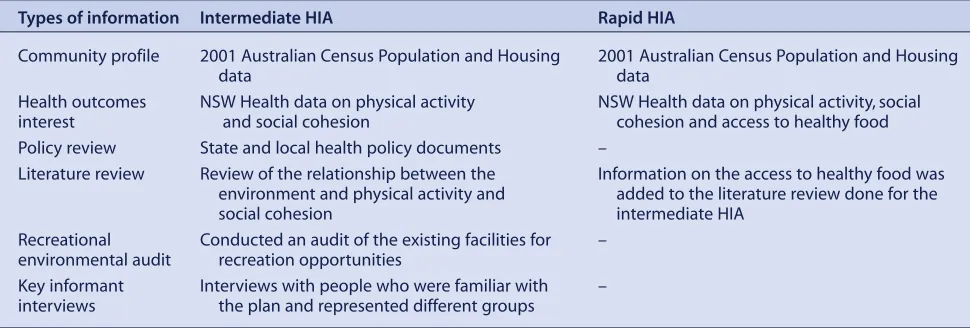
The HIA was conducted following the six steps described by Simpson.6The analysis considered the impact on
phys-ical activity, water and good neighbourliness. Neither development scenario was found to be preferable to the other in terms of potential health impacts. Instead, several health-promoting elements were identified for incorpora-tion into the Palerang Local Environmental and Social and Community Plans (Table 1).
Evaluation
Twelve months after completing the HIA, a process and interim impact evaluation was undertaken.7The evaluation
updated and reported on the outputs of the HIA with a view to a further evaluation in 2008. The process evaluation was a document analysis focussing on the processes involved in conducting the HIA, including comparison between initial project plan, screening report, scoping report and actual project progress. The evaluation was guided by the ques-tion: was the project implemented as intended?8–11
Overall, the document analysis confirmed that the project was implemented as intended, including the use of a rapid HIA methodology. It also identified that: (i) the use of a project agreement with identified responsibilities assisted in keeping the project on track; and (ii) earlier impressions that the steps of the HIA process are not necessarily dis-crete and linear were not supported by the documentation.
The interim impact evaluation aimed to determine if the proposed project outputs matched actual outputs. Project team members from Greater Southern Area Health Service and Palerang Council reviewed the document analysis and discussed the outputs. Proposed outputs of the project were that the HIA would: (i) be used in the development of a single Local Environmental Plan, Development Control Plans and Developer Contribution Plans for Palerang Council, (ii) be used in development of the Palerang Council Social Plan, and (iii) foster a new and productive relationship between Palerang Council and the Area Health Service.
CASE STUDY
Results
Interim results show a match between proposed and actual outputs. Nine broad recommendations covering the identi-fied health-promoting elements can be recognised in the Bungendore Discussion Paper July 2006, the preliminary document leading to the new Palerang Local Environ-mental Plan and accompanying Development Control and Developer Contribution Plans. Key recommendations were also incorporated into the draft Palerang Social and Community Development Plan 2006/07–2010/11.
Project team members commented that the HIA teamwork approach reinforced the value of cross-discipline planning and brought new knowledge, tools and skills to both organisations. The benefits of using the HIA methodology were noted and include: use of additional health-related evidence to support planning decisions verified by local consultation processes, a structured opportunity to consult with subject experts and the provision of additional tools to support decision-making.
Experience from Bungendore suggests that use of HIA can assist in inserting health-related concepts into broader planning processes.
References
1. Wilkinson R, Marmot M. Social determinants of health: the solid facts. 2nd ed. Copenhagen: World Health Organization, 2003.
2. Barton H, Mitcham C, Tsourou C. Healthy urban planning in practice: experience of European cities. Copenhagen: World Health Organization, 2003.
3. Greater Southern Area Health Service. Bungendore health impact assessment: progress report on outcomes, 2007. 4. University of NSW Research Centre for Primary Health Care
& Equity. NSW health impact assessment project phase 3. Sydney: CHETRE and NSW Health. Available at
http://www.hiaconnect.edu.au/nsw_hia_project.htm, accessed 12 December 2006.
5. Palerang Council, Greater Southern Area Health Service and Centre for Health Equity Training, Research and Evaluation. Bungendore health impact assessment: a rapid HIA of two development scenarios in Bungendore, NSW, 2006.
6. Simpson S. An introduction to health impact assessment.N S W Public Health Bull2005; 16(7–8): 106–7.
7. Greater Southern Area Health Service. Bungendore health impact assessment: progress report on outcomes, 2007. 8. Taylor L, Gowman N, Quigley R. Evaluating health impact
assessment. Health Development Agency, 2003. Available at www.hda.nhs.uk, accessed 12 December 2006.
9. Quigley R, Taylor L. Evaluation as a key part of health impact assessment: the English experience.Bull World Health Organ 2003; 81: 6.
10. Quigley R, Taylor L. Evaluating health impact assessment. Public Health2004; 118: 544–52.
doi:10.1016/j.puhe.2003.10.012
11. European policy health impact assessment – a guide. Available from http://ihia.org.uk/document/ephia.pdf.
Case study: Bugendore HIA
Table 1. Health-promoting elements to incorporate into the Palerang Local Environmental and Social and Community Plans
Physical activity Water Neighbourliness
• Mixed land use • Quantity of water available for residential, • Opportunities for incidental contact • High housing density recreational and commercial uses • Proactive conflict management
• Existence of footpaths, • Quality of water (fluoridation) • Increased participation in decision-making
cycle ways and facilities • Developing local identity
for physical activity • Supporting community groups / volunteering
• High street connectivity • Cultural and personal diversity
• Attractive and safe • Civic spaces, local businesses and local employment
street design
166 | Vol. 18(9–10) NSW Public Health Bulletin
Population growth and its distribution, along with the avail-ability of social and other services, have the potential to significantly affect the health and wellbeing of commu-nities, both existing and new.1,2A holistic approach to
plan-ning for population growth is required that incorporates an assessment of impacts on health and wellbeing, as well as on the environment and economy.3One process that
inves-tigates these impacts is social impact assessment.
The Lower Hunter Regional Strategy, prepared by the Hunter Department of Planning, identifies how develop-ment in the region will be managed on a sustainable basis over the next 25 years in 35 sites that were configured by geographic location. The Department released a draft strategy in November 2005 and invited agencies and com-munity members to comment by January 2006. The strat-egy, which projects a population increase of 125 000
An equity-focussed social impact assessment of
the Lower Hunter Regional Strategy
Abstract: The Lower Hunter Regional Strategy prepared by the Hunter Department of Planning identifies how development in the region will be managed on a sustainable basis over the next 25 years. In order to inform decision-makers about the potential social and health impacts arising from the proposed population incre