How Does Management Perceive Exporting? An Empirical Study of SMEs
Ruben Fernandez Ortiz
1, Jesus Arteaga Ortiz
2, Antonio Mihi Ramirez
31
University of La Rioja
26006 Logroño (La Rioja), Spain e-mail: [email protected]
2University of Las Palmas de Gran Canaria 35017 Las Palmas de Gran Canaria, Spain e-mail: [email protected]
3University of Granada
Campus Cartuja s/n, 18071, Granada, Spain e-mail:[email protected].
http://dx.doi.org/10.5755/j01.ee.23.2.1547
During the last two decades, the phenomenon of company internationalization has acquired remarkable attention (Saboniene, 2009). Different aspects such as globalization, the dilution of trade barriers, or the significant increase in economic-business transactions in the euro zone have prompted many SMEs to consider international development as a core component of their managerial strategy (Saboniene, 2009; Shamsuddoha et al., 2009; Singh et al., 2010).
According to Simpson and Kujawa (1974) “The decision to export is a combination of the right stimulus and the right perception of the factors involved in the export process itself”. That sentence demonstrates the importance of managerial perceptions of exports to the creation of the environment necessary for the stimuli to have the desired effect. The importance of entrepreneurs and international managers has been dealt with in many studies, which have found a relationship between a positive and intense international development and the entrepreneur’s international attitude, motivation, orientation, experience and network (Andersson & Wictor, 2003). The relevance of the perception of exports in the field of business management can have a key impact on the exporting behavior of SMEs. In particular, it can determine the decision to implement an export policy, as well as the policies applied to consolidate exports.
This paper covers two main aspects. First, the extents to which managerial perceptions of exports affect the decision to export, and second, for these SMEs which are already exporters, we study the managerial perceptions that can help to consolidate their commitment to exports. To this aim, some scales based on structural equations to measure the perception of the advantages and disadvantages of exporting are developed and validated. Both analyses are carried out considering whether the SMEs involved are family businesses or not, so that the results obtained can also explain the potential impact of this fact.
Keywords: exports, managerial perceptions, structural equations.
Introduction
One of the functions of top management is to establish the necessary conditions within the firm for it to create and maintain the factors of competitiveness. This will enable the firm to differentiate itself from competitors in its members’ knowledge, skills or innovation, all of which determine business success (Porter, 1991; Saboniene, 2009). Research into exporting often highlights the role of management characteristics in the exporting behavior of the firm (Leonidou et al, 1997; Da Silva, 2001; Arteaga, 2003). We can distinguish three aspects directly linked to the firm’s management that the literature has addressed as factors explaining the firm’s exporting behavior (Albaum, 1994): the importance attached to determined business objectives, the managerial perceptions, and the management characteristics.
This work aims to analyze the influence of managerial perceptions of exports since this is one of the main factors affecting firms’ export policies. As Chetty and Blankerburg
(2000) state, the manager, especially in small and medium enterprises, plays an important role in identifying the stimuli for the firm to internationalize. In fact, we can say that decisions regarding the internationalization process ultimately depend on the motivations and skills of the managers involved in the process (Duoba & Savaneviciene, 2004; Salavou & Halikias, 2009). Consequently, the decision to operate in multiple market increases the skill and knowledge requirement of top management.
work hypotheses, which address the differences in managerial perceptions depending on the firm’s organizational structure, ownership structure (family or non-family), the management’s experience-based knowledge, and whether the firm is initiating or consolidating exports. The fourth section addresses the empirical study of the hypotheses and the fifth and final section presents the most significant conclusions and implications of the research.
Research object is managerial perceptions of exports. Research method. The paper is built under theoretical review of scientific literature on SECI model and organizational learning, and structural equations modeling was performed to estimate direct and indirect effects of relations between constructs.
Theoretical framework and proposals
In our research we are going to distinguish two aspects for analysis: the advantages of barriers perceived to exports, as perceived by the management. If the perceived advantages of exports manifest themselves in determined business objectives, there is a greater possibility of using exports as a way to expand the business (Albaum, 1994; Lages, 2008; Tang & Liu, 2011). The advantages that the management team may perceive in exporting have traditionally fallen into three elements: profitability, risk and cost (Basche, 1971). The first aspect may be due to the higher margins to be obtained from international sales. Risk- or cost-related aspects diminish as the firm’s export experience increases. However, the way of analyzing that fact is counteracted by the relative importance that the decision-taker attaches to the export barriers. These perceived obstacles have three significant effects on business behavior (Singh et al., 2010):
- Many small firms perceive exporting with great skepticism and refuse to initiate or develop activities overseas.
- New exporters develop a negative attitude toward exporting.
- Consolidated exporters experience a fall in, or loss of, their performance, which may even entail a risk to their survival in international markets.
Without attempting to be exhaustive, and following a group of researchers (Yang, 1988; Ramaswami & Yang, 1990; Yang et al., 1992; Arteaga, 2003) who attempt to establish the theoretical bases for the possible dimensions explaining perceived export barriers, we distinguish four sources of export barriers:
Knowledge barriers: related to knowledge of exporting, such as knowledge of the competition, aid available for exports, etc. In that sense, export knowledge has been positively associated with the commitment of resources to exporting.
Resource barriers: The second type of barriers are resource barriers; the need for a minimum stock of resources to be able to export. This would mainly refer to financial and human resources. The former are necessary to conduct market research and to finance overseas sales. In other words, barriers resulting from the lack of financial resources (Ramaswami & Yang, 1990), productive resources (Leonidou, 1995) or external aid (Yang et al., 1992).
Procedural barriers: these appear during the export process and are related to language, culture, tariffs, the necessary documentation and permits, health and safety controls, import quotas, etc. It includes obstacles arising from the performance of their own export activities.
External barriers: The final group of barriers identified in our review of the literature are external barriers, which are those arising from the uncertainty existing in international markets and that cannot be controlled by firms since they are the result of the actions of other market players, such as governments, competitors or monetary and goods supply and demand (Yang, 1988; Shamsuddoha et al., 2009; Zhou et al., 2010).
The importance attached to those barriers probably depends on the level of uncertainty associated with each barrier and the perceived difficulty of overcoming them. The greater the managerial perceptions of barriers are, the more negative the effect on the export activity will be, and vice versa. It should also be borne in mind that the nature of the managers’ expectations and attitudes, including their perceptions of the success of the export venture, generally affects the export behavior and the export outcomes (Louter et al., 1991; Leonidou et al., 1997). Those firms whose management displays high but realistic expectations of the export activity will probably be less reluctant to allocate resources to such operations (Tang & Liu, 2011).
The perception of export barriers, taking into account the resources and capacities theory, also seems to vary according to the firm’s organizational characteristics and ownership structure, and the SME’s experience-based knowledge and export strategy. The organizational characteristics, represented by both the size and the experience, will promote the existence of the more open and proactive managerial team in relation to the exporting policies.
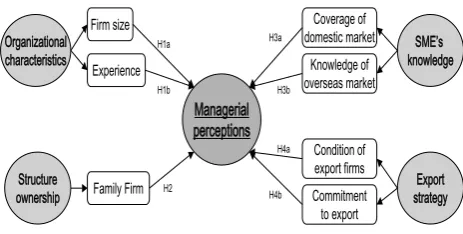
Together with the organizational aspects, we must also take into account the cognitive aspects of the organization that can be represented by the knowledge acquired by the company. We should frame these two aspects within the ownership structure which governs the company, as well as in the strategy used to reach out to the exterior (pre-exporter or (pre-exporter; and the degree of exporting commitment of the latter). The combination of these four aspects, widely analyzed in individual manner in literature, shows a joint analysis model, which synthesizes from the resources and capacities perspective, the determinants of perceiving the exportation methods by executives. This model can be seen in the following figure 1.
Figure 1. Analysis Model of Export Managerial Perceptions
Managerial perceptions Firm size
Experience
Family Firm
Knowledge of overseas market
Structure ownership Organizational characteristics
Export strategy SME’s knowledge Coverage of
domestic market
Condition of export firms Commitment to export H1a
H1b
H2
H3b H3a
H4a
The firm’s organizational characteristics
The two main organizational characteristics that determine the international character of the firm are: the business size and the experience or age of the firm. With regard to size, authors such as Arteaga (2003) or Andersson et al. (2004) conclude in their empirical research that the perceptions of barriers do not seem to differ with the size. Nevertheless, Barker & Kaynak (1992), Katsikeas & Morgan (1994) state that the smallest enterprises establish their development policies in the light of certain barriers linked to limited resources, operational difficulties and trade restrictions. Therefore, in this study, the first hypothesis can be set out as follows:
H1a: The importance attached by management to the different advantages of and barriers to exports varies according to the firm size.
The firm’s experience in the sector is an important aspect referred to in the literature (Katsikeas & Morgan, 1994; Leonidou, 2004; Andersson et al., 2004) as being decisive in the SME’s export process. This is due to the fact that this factor permits the combination of business resources that can be directed at obtaining deeper knowledge of the market and at reducing the intensity of the perception of export barriers. The above allows us to propose the following hypothesis:
H1b: The perception of the advantages of, and the barriers to, exports will vary according to the level of experience accumulated by the firm.
Ownership structure
The study of the behavior of those advantages and barriers according to the ownership structure has centered on whether the SME is a family firm or not. Despite the importance of family businesses in the economic growth of leading developed countries (Neubauer & Lank, 1998), there is a lack of unanimity within the scientific community regarding the definition of these types of companies. Most definitions of family businesses found in the literature consider one or several of the following aspects: management capacity or the capacity to take important decisions; capital ownership; level of family involvement in the business; and, finally, the desire to keep the business in the hands of future generations (Colli, 2003).
We considered that family business is one in which the members of the same family own part of the capital which allows them to substantially influence the management and strategic control of the business and one that wishes to keep the business in the hands of the next generation.
The theory in that respect (Zahra, 2003) shows that the perception of a certain inability to survive in international markets alone is more common among family firms, which leads their managers to adopt generally more conservative attitudinal patterns that tend to underestimate the efficacy with which they can operate in a competitive environment and to display less orientation toward exports (Bradley, 1995). The reason for that could be the lack of complete and appropriate information about the overseas market, which is more probable among family firms, as well as their smaller scale of operations. This would entail a higher
concentration of risk and a comparatively greater impact should a grave error occur on an international scale.
In light of the above, the following hypothesis is proposed:
H2: The perceptions of export barriers will be higher in family firms than in non-family firms.
Knowledge-based experience in the SME
The product life cycle theory places exporting in a second phase of the firm’s internationalization process once complete coverage of the national market has been achieved (Vernon, 1966; Singh et al., 2010). Similarly, the Scandinavian approach proposes that the firm will be interested in internationalization once it has fulfilled its potential in the national market (Johanson & Wiedersheim-Paul, 1975; Johanson & Valhne, 1977). Moreover, in the case of firms that operate in a local environment and decide to expand to other, more distant regions of their home countries, such decision leads them to become involved in greater difficulties and higher costs (Cavusgil, 1980). However, as those barriers are overcome, the aversion to the risks of distant markets diminishes and the firm develops overseas trade skills due to the learning experienced in national expansion (Root, 1994; Zhou et al., 2010). In that respect, the firm’s distribution of products/services in the domestic market may be an indicator of the firm’s capacity to embrace markets beyond its physical location. The results obtained by Arteaga (2003) for a sample of SMEs indicate the absence of any significant variation in the perception of export barriers that depend on the level of domestic coverage. Therefore, we can propose the following hypothesis:
H3a: As the firm expands its cover of the domestic market, its perception of export barriers diminishes.
Similarly, firms with high levels of experience in the export market tend to perceive lower levels of uncertainty in their export activities and have a greater understanding of export market forces (Katsikeas & Morgan, 1994; Da Silva, 2001), and so achieve higher levels of performance than other firms (Lages et al., 2008; Tang & Liu, 2011). Therefore, we propose that:
H3b: The more export experience the firm has, the less perception of EB.
Export strategy
A second strategy would be for firms already in the export process to increase their commitment to exports. The literature proposes that the increase in the SME’s commitment to overseas markets will be based on a positive perception of the advantages that that market offers the firm (Louter et al. 1991; Leonidou, 2004; Salavou & Halikias, 2009). Therefore,
H4b: Firms with a high commitment to export will perceive fewer export barriers and greater advantages of the overseas market.
Research design and methodology
In this section we briefly explain the main aspects of the information gathering and analysis processes.
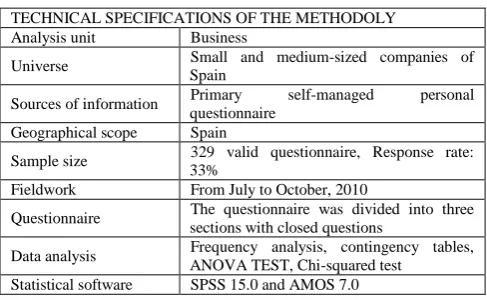
The data were obtained by means of the questionnaire, the specifications of which are shown in Table 1). For this research study, a small and medium-sized enterprise was defined on the basis of the criterion established by the European Commission (1996), Euro-Info 88/ES.
The industrial profile of Spain is notable for the predominance of small and medium-sized enterprises and for the high levels of specialization / in traditional manufacturing industries: footwear, furniture, food and agriculture industry and wine production sectors. These sectors are nowadays facing important challenges due to factors such as globalization, personalization of markets, changes to employment and labour market regulation. Asian countries and Eastern Europe have won an important part of these labour-intensive sectors. Competitiveness in the wine sector has also highly risen due to the commercial pressure of the so-called “New countries “(Chile, Australia, Argentina, etc). This combination of pressure in technological opportunities and new international competitors pushed firms to develop the managerial capacities of the companies and to adopt new routes, beyond exportation, to access the international market. A pre-test was carried out on 16 executives linked with the exporting world. Moreover, the design and the representation of the obtained sample were assessed too.
The statistical analysis (study of frequency distribution) of size, sector, ownership structure and legal structure between the population under consideration and the sample permit us to conclude that, based on the empirical study proposed, that the analyzed sample is representative of the population of the study.
Table 1
Technical specifications of the methodological process
TECHNICAL SPECIFICATIONS OF THE METHODOLY
Analysis unit Business
Universe Spain Small and medium-sized companies of
Sources of information Primary self-managed personal
questionnaire
Geographical scope Spain
Sample size 329 valid questionnaire, Response rate:
33%
Fieldwork From July to October, 2010
Questionnaire The questionnaire was divided into three
sections with closed questions
Data analysis Frequency analysis, contingency tables,
ANOVA TEST, Chi-squared test
Statistical software SPSS 15.0 and AMOS 7.0
Scale, Empirical Analysis and Results
Scale to measure “Managerial Perceptions”
The analysis of the relevant literature (Cavusgil, 1984) enabled us to identify three potential export advantages, the managerial perceptions of which could vary, depending on whether the firm is an exporter or not. Those three aspects are the perceptions of profitability, risk and cost. The indicators that we use are “Profit”, “Risk” and “Cost” respectively.
A further advantage was added since the family firm was under consideration. Authors such as Zhara (2003) state that: “internationalization boosts employment among family members… and can even be used to create employment opportunities for family members within the organization”. Therefore, the fourth advantage that we assess is the promotion of the youngest family members within the firm (“Young”).
We also studied the export obstacles or barriers perceived by the management team. Previous works addressing the issue have identified a set of attitudinal, structural and operational factors that inhibit both the development and the consolidation of many firms’ international operations. In line with Yang et al. (1992) we can mention a large group of empirical works that identify five different sets of barriers: external, cultural, informational, operational and internal. The latest empirical works to support those categories are those by Yang et al., (1992). Drawing on the review of the literature, we extracted eleven potential aspects that inhibit the firm’s export activity. Due to the expected negative relationship between the perceptions of advantages and barriers, the two were assessed in a single analysis.
After the process of refinement, the fit was notably higher (Chi-squared = 116.5; degrees of freedom = 52 and GFI = 0.9). In this case it was clear that the item “Stecnrss” was not sufficiently reliable; therefore in a final process of refinement (Table 2) it was eliminated from the scale, which then comprised three well-defined factors:
The first, which we labeled “Shortage”, comprises the items “Scomcap”, “Shumcap” and “Smagcap”. It encompasses the perceptions of barriers in terms of the managers’ opinions of the firm’s shortages.
The second, was called “Ignorance”, and like the first factor, aimed to synthesize the principal difficulties involved in the process of opening to overseas. In this case, the constituent variables are “Ichann”, “Ineed”, “Icom”, “Iaid” and “Iexp”, all of which have a sufficiently high factor load.
Table 2
Final process of refinement of the scale “Managerial Perceptions”
Indicators Loadson
F1
Loads on F2
Loads on F3
Reliability (R2)
Scomcap 1* - - 0.833
Shumcap 0.948 - - 0.720
Smagcap 0.905 - - 0.654
Stecrss 0.722 - - 0.412
Ichann - 1.092 - 0.779
Ineed - 1.052 - 0.729
Icomp - 1.068 - 0.741
Iaid - 0.931 - 0.595
Iexp - 1* - 0.641
Risk - - 1.156 0.687
Cost - - 1* 0.603
Profit - - 0.926 0.500
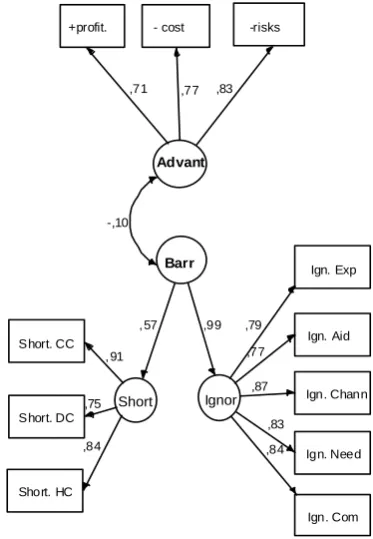
As we can see, the factors related to the second order latent variable “Barriers” have strong explanatory power on that variable. In turn, it is significant (95 %) and negatively related to the latent variable reflecting the advantages of exports “Adv”. That negative effect was to be expected since the two constructs represent clearly divergent aspects. Once the individual reliability of all the indicators had been established, the combined reliability was analyzed. More than 80% of variance in the multidimensional concept “Short” was explained and above 79 % of “Inf” and 72.3 % of “Adv” (See Figure 2). Those results are highly acceptable.
The reliability of the final scale displayed the following ratios (Table 3):
Table 3
Internal Consistency of the “Perceptions” scale
Reliability tests “Short” “Inf” “Adv”
Cronbach’s Alpha 0.78 0.88 0.82
Compound reliability of Construct 0.92 0.95 0.88
Analysis of extracted variance 0.81 0.79 0.72
The next step was to study the convergent validity of the measurement model. To that end we tested the measures of goodness of fit of the initial model (15 items) and of the definitive model (11 items (see table 4).
Table 4
Measures of fit of the scale “Managerial perceptions”
Absolute measures of fit
Measuring Scale (15 items)
Measuring Scale 11 items)
Chi-square statistic
229.47 (g.l:88; p: 0.000)
79.43
(g.l:42; p: 0.001)
GFI 0.91 0.93
RMSEA 0.07 0.053
ECVI 1 0.400
Measures of
incremental fit
AGFI 0.90 0.89
NFI 0.89 0.80
IFI 0.92 0.90
CFI 0.92 0.90
Measures of
parsimonies Standardized
Chi-square 2.68 1.9
PNFI 0.65 0.61
PCFI 0.68 0.68
AIC 323.4 127.9
With regard to the absolute measures of fit, the value of the p-statistic takes a value below the level of significance of 0.05. This does not necessarily mean that the proposed model does not faithfully reproduce the observed data since, as Hair et al. (1999) and other authors make clear, this statistic is sensitive to sample size, and it is necessary to use other indices to avoid this problem. The other indices determined an acceptable fit (GFI: 0.93).
Ign. Com
Ign. Chann
Ign. Aid
Ign. Need
Ign. Exp
Short. HC Short. CC
Short. DC Shorto
,75 , 91
Ignor
,79
,77
,87
,83 ,84 Advant
+profit. - cost - risks
,71 ,77 ,83
Barr
, 57
,99
-,10
,84
Figure 2. Path Diagram of the latent variable “Perceptions”
Empirical analysis and results
The validation of the scale was followed by the study of the different managerial perceptions of the advantages of, and barriers to, exports, divided into “Shortage of resources” and “Informative ignorance”. First of all, the behavior of those aspects depending on the firms’ characteristics (size and age) was studied. The empirical sections of the vast majority of studies have focused on small and medium firms, mainly because, as Miesenböck (1988) states, they are more susceptible to problems such as limited resources, organizational deficiencies and managerial limitations. Our study was conducted among SMEs and the differences would, predictably, have varied if the sample had included large firms. It was confirmed that there were significant differences of 95 %, depending on firm size, in the managerial perceptions of export barriers. This study, by means of the non-parametric Mann-Whitney test, revealed that managers of medium firms have lower perceptions of export barriers. No significant differences were found in the perceptions of advantages. Therefore Hypothesis 1a is partially accepted.
information resources (“informative ignorance”), and greater advantages of the export process. Only the informative barriers had a significant of above 99 % (Chi-squared 12.723 with 2 degrees of freedom and a significance of 0.002 in the Kruskal-Wallis test). This result is in line with those of authors such as Barker & Kaynak (1992), Katsikeas & Morgan (1994), who found that smaller firms establish their development policies considering certain barriers associated with limited resources, operational difficulties and trade restrictions. Therefore, we can accept Hypothesis 1b.
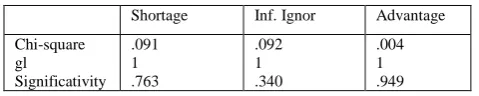
The study of managerial perceptions and ownership structures (family or non-family firm) reveals the absence of significant differences. In other words, the fact that the firm is family-owned is neither an obstacle nor an initial limitation in the managerial perceptions of advantages and barriers; hence Hypothesis 2 is rejected.
Table 6
Managerial perception of exports and family ownership; Contrast statistics a,b
Shortage Inf. Ignor Advantage
Chi-square gl Significativity .091 1 .763 .092 1 .340 .004 1 .949
a. Kruskal-Wallis one-way analysis of variance b. Group: Family Firms or not
The following analysis centers on the experience-based knowledge of the SME. With regard to the range of domestic cover, the non-parametric Kruskal-Wallis test (Table 7) shows that, as the sales area in the domestic market increases, there is a reduction in the managerial perception that shortage of resources and ignorance of overseas markets represent a significant barrier to exports (all the relationships are significant at 99 %). That fact permits us to accept Hypothesis 3a. We can state that, as the firm expands beyond its local environment, (1) the managers have less difficulty in interpreting the competitive variables correctly and thus the managerial skills to reduce export barriers are generated or strengthened, and (2) the potentials of the export market are seen more clearly.
Table 7
Range of cover of the domestic market and the perception of barriers and advantages
Ranges
EXNACI N Average range
Shortage 1.00 2.00 3.00 4.00 Total 43 64 76 138 321 198.66 179.95 178.28 130.96
Informative 1.00 Ignorance 2.00 3.00 4.00 Total 43 64 76 138 321 216.69 182.89 164.41 131.62
Advantages 1.00 2.00 3.00 4.00 Total 44 67 75 138 324 146.45 129.35 160.18 184.97
For the purpose of the study of the behavior of these managerial perceptions depending on the level of knowledge of overseas markets, the sample was segmented and we selected those firms that were already exporting (124 firms). The indicator used for the variable overseas knowledge has been used by Arteaga (2003) and others as a proxy of the firm’s international experience. The results (Table 8), which are grouped according to whether the firms had been exporting for less than 10 years (75 firms) or for more (49 firms), show that there are significant differences between the barriers perceived by one group of managers and those perceived by the other group. Therefore, Hypothesis 3b is partially supported. Thus, the managers of the firms with most experience in overseas markets have fewer perceptions of informative barriers and barriers associated with a shortage of resources to be allocated to exports. However, in the case of advantages, the results were similar for the two groups of managers.
Table 8
Export experience and managerial perceptions; Contrast statistics a,b
Shortage Inf. Ignor Advantage
Chi-square gl Significativity 4.344 1 .037 17.410 1 .000 .002 1 .963
a.Kruskal-Wallis one-way analysis of variance b.Group: Export experience
The next step in this research was to test empirically whether there were significant differences in the export strategy of SMEs or not. Since the analysis, which used non-parametric tests, could not guarantee the multivariate normality, it was applied to the two principal strategies related to exports: the initiation of the export activity (H4a) and, once that step had been taken to the consolidation of the export policy (H4b) by increasing commitment to exporting. The results referring to the initiation of exports are shown in the following Table 9:
Table 9
Perceived barriers and advantages and the export initiation strategy
Ranges
Firm’s Exportation N Average range
Shortage non yes Total 193 128 321 177.43 136.22
Informative non Ignorance yes Total 193 128 321 178.20 135.07
Advantages non yes Total 197 127 324 147.76 185.37
(Chi-square: 12730; degree of freedom.l:1; Sig. 0.00). Thus, Hypothesis 4a is confirmed.
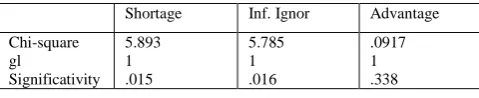
To analyze the managerial perceptions of the policies of consolidation and maintenance of commitment to export, we segmented the sample and used only those firms that were already exporters. The literature on export commitment contains numerous proxies as indicators of that commitment. In line with Atuahene-Gima (1995) we used the propensity to export (export sales as a percentage of the firm’s total sales). More specifically, in order to avoid possible distortion by the use of a single year, we created a new variable from the mean exporting propensity over a period of three years (2001-2003). Based on that variable, we grouped the SMEs according to whether their average export commitment over those three years was higher or lower than the average for all SMEs over the same period (indicator of propensity to export). The first group “low commitment exporter” comprised 83 firms, while the other group “high commitment exporter” comprised 40. The results of the statistical contrast are shown in the table below:
Table 10
Managerial perceptions and commitment to exports Contrast statistics a,b
Shortage Inf. Ignor Advantage
Chi-square gl
Significativity 5.893 1 .015
5.785 1 .016
.0917 1 .338
a. Kruskal-Wallis one-way analysis of variance b. Group: Export commitment
As Table 10 shows, the differences in the perceptions of export barriers are significant at 95%, and non-significant in the case of advantages. More specifically, on examining the levels of the Kruskal-Wallis test, we can say that the managers of firms that exceed the mean exporting propensity (high export commitment firms) have lower perceptions of barriers or obstacles to exporting. This seems to reflect the idea that, as the firm undertakes policies of higher commitment to overseas trade, those barriers cease to be decisive as factors inhibiting greater export commitment and are seen to a greater extent in firms that do not have high intensity of exports. The perception of the advantages offered by exporting is also greater, albeit not significantly, in the group of firms with high commitment to exports. Therefore, we can partially accept Hypothesis 4b.
Conclusions
In this final section, we present the most significant conclusions drawn from this work.
First of all, we should mention that the principal barriers or obstacles perceived by the firm’s management are mainly informative or internal barriers. The informative
barriers reflect a significant shortage of information in SMEs about both the act and the process of exporting. The internal barriers clearly demonstrate the fact that the lack of determined internal resources constitutes a significant brake on SME exports. Moreover, in line with the literature to date, the principal advantages of exporting are related to profitability, cost and risk diversification. The confirmatory factor analysis also enables us to confirm the validity and reliability of the proposed scale and overcome the limitations of traditional validation constructs.
Secondly, we should stress the presence of significant differences in the business management’s perceptions of the advantages of exporting. That fact is strongly confirmed in the different perceptions of export barriers, and in a more precise way in the perceptions of advantages. Thus, we can conclude that the perception of export barriers is inversely related to firm size.
Another result enables us to indicate that the managers of younger, less experienced SMEs perceive greater export barriers linked to the shortage of resources, and also greater advantages of the export process. The study of the behavior of those barriers and advantages reveals no significant differences between family and non-family firms. Another empirical conclusion is that, as the national coverage expands, the managers’ perceptions that a shortage of resources and ignorance of overseas markets represent a significant barrier to exports, while perceptions of the potential and advantages become more positive.
Thirdly, the principal results of this empirical work are related to the conclusions of the variance analysis, which show that the relevance of the resource shortage and the informative barriers is notable and significantly greater in firms that have not yet initiated an export policy. Furthermore, the perception of potential advantages offered by export entry is higher in continuing exporters than in as yet non-exporting firms. In addition, as the firm implements policies of greater international commitment, the barriers cease to be decisive as factors impeding exports. Consequently, those barriers are perceived more in firms that do not enjoy high export intensity.
Finally, we should highlight the fact that the perception of the management team constitutes a cornerstone of the export initiation process. That perception is based on a combination of factors (international experience, knowledge of the overseas market, language, age, risk aversion, etc.) that can be promoted by the design and development of specific programs to support internationalization. The entities that may develop those functions are many and varied, and range from the firm itself to Public Administrations, through National or Regional Export Promotion Agencies, Chambers of Commerce, Business Federations, Local Development Agencies, Sector Associations and others.
References
Albaum, G., Duerr, E., & Strandskov, J. (1994). International Marketing and Export Management. 2ª edition, Addison-Wesley, Cambridge.
Andersson, S., Gabrielsson, J., & Wictor, I. (2004). International Activities in Small Firms: Examining Factors Influencing the Internationalization and Export Growth of Small Firms. Revue Canadienne des Sciences de L´Administration, 21(1), 22-34.
Arteaga, J. (2003). La Actividad Exportadora y las Barreras a la ExportaciOn: una AplicaciOn Empirica a las Pequenas y Medianas Empresas EspaNolas. Doctoral Thesis. Las Palmas de Gran Canaria (Spain).
Atuahene-Gima, K. (1995). The Influence of New Product Factors on Export Propensity and Performance: an Empirical Analysis. Journal of International Marketing, 3(2), 11-28.
Barker, A. T., & Kaynar, E. (1992). An Empirical Investigation of the Differences Between Initiating and Continuing Exporters. European Journal of Marketing, 19(2), 279-302.
Basche, J. R. (1971). Export Marketing Services and Costs, Conference Board, New York.
Bollen, K. A. (1989). Structural Equations with Latent Variables. USA: Wiley-IntersciencePublication. Bradley, F. (1995). International Marketing Strategy, Prentice Hall: London.
Cavusgil, S. T. (1980). On the Internationalization Process of Firms. European Research, 8, 273-281.
Cavusgil, S. T. (1984). Organizational Characteristics Associated with Export Activity. Journal of Management Studies, 21(1), 3-22. http://dx.doi.org/10.1111/j.1467-6486.1984.tb00222.x
Chetty, S., & Blankenburg, D. (2000). Internationalization of Small to Medium-Sized Manufacturing Firms: A Network Approach. International Business Review, 9, 77-93. http://dx.doi.org/10.1016/S0969-5931(99)00030-X
Colli, A. (2003). The History of Family Business, 1850-2000. Cambridge: Cambridge University Press.
Da Silva, P. A, & Rocha, A. (2001). Perception of Export Barriers to Mercosur by Brazilian firms. International Marketing Review, 18(6), 589-610. http://dx.doi.org/10.1108/EUM0000000006296
Duoba, D., & Savaneviciene, A. (2004). Distinctions of a Learning Process in Virtual Organizations. Inzinerine Ekonomika-Engineering Economics(2), 63-69.
Hair, J. F., Anderson, R. E., Tatham, R. L., & Black, W. C. (1999). Analisis multivariante, Prentice-Hall, Madrid.
Johanson, J., & Vahlne, J.E. (1977). The Internationalization Process of the Firm: A Model of Knowledge Development and Increasing Foreign Market Commitments. Journal of International Business Studies, 8, 23-32. http://dx.doi.org/10.1057/palgrave.jibs.8490676
Johanson, J., & Wiedersheim-Paul, F. (1975). The Internationalization of Firm: Four Swedish Cases. Journal ofManagement Studies, October, 305-322. http://dx.doi.org/10.1111/j.1467-6486.1975.tb00514.x
Katsikeas, C. S., & Morgan, R. E. (1994). Differences in Perceptions of Exporting Problems Based on Firm Size and Export Market Experience. European Journal of Marketing, 28(5), 17-35. http://dx.doi.org/10.1108/03090569410062014 Lages, L. F., Jap, S. D., & Griffith, D. A. (2008). The Role of Past Performance in Export Ventures: a Short-Term Reactive
Approach. Journal of International Business Studies, 39, 304-325. http://dx.doi.org/10.1057/palgrave.jibs.8400339 Leonidou, L. C. (1995). Export Barriers: Non-Exporters Pperceptions. International Marketing Review, 2, 1.
Leonidou, L. C. (2004). An Analysis of the Barriers Hindering Small Business Export Development. Journal of Small Business Management, 42(3), 279-302. http://dx.doi.org/10.1111/j.1540-627X.2004.00112.x
Leonidou, L. C., Katsikeas, C. S., & Piercy, N. F. (1997). Identifying Managerial Influences on Exporting: Past Research and Future Directions. Journal of International Marketing, 6(2), 74-102.
Louter, P., Ouwerkerk, C., & Bakker, B. (1991). An Inquiry into Successful Exporting. European Journal of Marketing, 25 (6), 7-23. http://dx.doi.org/10.1108/03090569110001429
Miesenbock, K. J. (1988). Small Business and Exporting: A Literature Review. International Small Business Journal, 6(2), 42-61. http://dx.doi.org/10.1177/026624268800600204
Neubauer, F., & Lank, A. (1998). The Family Business. London: McMillan Business.
Porter, M. E. (1991). Towards a Dynamic Theory of Strategy. Strategic Management Journal, 12, 95-117. http://dx.doi.org/10.1002/smj.4250121008
Ramaswami, S. N., & Yang, Y. (1990). Perceived Barriers to Exporting and Export Assistance Requirements. In Cavusgil, S. T. Y Czinkota, M. R., International Perspectives on Trade Promotion and Assistance. Quorum Books. Westport, Connecticut.
Root, F. R. (1994). Entry Strategies for International Markets, Jossey-Bass, Reviewed and Expanded Edition, San Francisco. Saboniene, A. (2009). Lithuanian Export Competitiveness: Comparison with other Baltic States. Inzinerine
Ekonomika-Engineering Economics(2), 49-57.
Shamsuddoha, A. K., Ali, M.Y., & Ndubisi, N. O. (2009). Impact of Government Export Assistance on Internationalization of SMEs from Developing Nations. Journal of Enterprise Information Management, 22(4), 408-422. http://dx.doi.org/10.1108/17410390910975022
Simpson, C. L., & Kujawa, D. (1974). The Export Decisions Process: an Empirical Inquiry. Journal of International Business Studies, spring/summer, 107-117.
Singh, G., Pathak, R. D., & Naz, R. (2010). Issues Faced by SMEs in the Internationalization Process: Results from Fiji and Samoa. International Journal of Emerging Markets, 5(2), 153-182. http://dx.doi.org/10.1108/17468801011031801 Tang, J. & Liu, B. (2011). A Network Based Theory of Foreign Market Entry Mode and Post-Entry Performance.
International Journal of Business and Social Science, 2(23), 51-59.
Vernon, R. (1966). International Investment and International Trade in the Product Cycle. Quarterly Journal Economics, 80, 190-297. http://dx.doi.org/10.2307/1880689
Yang, Y. S. (1988). An Export Behavior Model of Small Firms: Identifying Potential and Latent Exporters Among Small and Medium Manufacturers, Thesis Doctoral, UMI, Michigan.
Yang, Y.S., Leone, R. P., & Alden, D. L. (1992). A Market Expansion Ability Approach to Identify Potential Exporters. Journal of Marketing, 56, 84-96. http://dx.doi.org/10.2307/1252134
Zahra, S. A (2003). International Expansion of U.S Manufacturing Family Businesses: the Effect of Ownership and Involvement. Journal of Business Venturing, 18, 495-512. http://dx.doi.org/10.1016/S0883-9026(03)00057-0
Zhou, T., Lin, G., & Li, Y. (2010). Determinants of Interest in the Acquisition of Export Skills for Chinese Exporters. Journal of Technology Management in China, 5(3), 196-212. http://dx.doi.org/10.1108/17468771011086229
Rubén Fernandez Ortiz, Jesus Arteaga Ortiz, Antonio Mihi Ramirez
Kaip vadovai suvokia eksportavimą? Empirinis MVĮ tyrimas
Santrauka
Suvokimas apie eksporto svarbą verslo valdymo srityje gali daryti didelę įtaką mažų ir vidutinių įmonių (MVĮ) eksportui. Jis gali nulemti sprendimą: diegti eksporto strategiją ir kitas strategijas, taikomas siekiant įtvirtinti eksportą ar ne.
Šiame darbe nagrinėjami du pagrindiniai aspektai. Pirmasis – tai laikas, per kurį vadovo supratimas apie eksportą daro įtaką sprendimui eksportuoti, o antrasis yra taikomas toms MVĮ, kurios jau yra eksportuotojos. Šiame straipsnyje nagrinėjamas vadovo supratimas, turintis reikšmę įsipareigojimui dėl eksporto. Šiam tikslui buvo patobulintos ir patvirtintos kai kurios pakopos, pagrįstos struktūrinėmis lygtimis, skirtomis įvertinti eksportavimo privalumų ir trūkūmų suvokimą. Abi analizės atliktos atsižvelgiant į tai, ar MVĮ yra privatus verslas ar ne, todėl gauti rezultatai gali paaiškinti galimą šio fakto įtaką. Šiame tyrime analizuojami du aspektai: eksporto privalumų ir barjerų suvokimas, taip pat siekiama išsiaiškinti kaip juos suvokia vadovas. Kuo geriau vadovybė suvokia kliūtis, tuo mažesnė bus neigiama įtaka eksporto veiklai ir atvirkščiai. Kartu su organizaciniais aspektais taip pat apžvelgti ir pažintiniai organizacijos aspektai, kurie įgyjami kompanijoje. Šie du aspektai bus analizuojami remiantis privačia nuosavybe, kuri valdo kompaniją, taip pat ir strategija, naudojama užmegzti ryšius su išoriniu pasauliu (būsena prieš tampant eksportuotoju ar esant eksportuotoju; ir eksportuotojo eksporto įsipareigojimų laipsnis).
Esminiai įmonės vadovybės suvokti barjerai ar kliūtys daugiausiai yra informatyvūs ir vidiniai barjerai. Informatyvūs barjerai atskleidžia nemažai informacijos apie trūkumus eksportuojant mažose ir vidutinėse įmonėse. Vidiniai barjerai aiškiai parodo faktą, kad nustatytas vidinių resursų trūkumas labai stabdo MVĮ eksportą. Egzistuoja didelis skirtumas tarp to, kaip verslo vadovai suvokia eksporto privalumus. Šį faktą patvirtina ne apskritai įvairus eksporto barjerų suvokimas, o labiau pačių privalumų suvokimas. Tokiu būdu galima daryti išvadą, kad eksporto barjerų suvokimas nepriklauso nuo įmonės dydžio.
Mažesnių, mažiau patyrusių MVĮ vadovai suvokia didesnius eksporto barjerus, susijusius su resursų trūkumu, kartu ir didesnius eksporto proceso privalumus. Tokių barjerų, taip pat privalumų tyrimas neatskleidė didesnių skirtumų tarp privačių ir neprivačių įmonių. Kita empirinė išvada yra ta, kad plečiantis nacionalinei veiklos sričiai, vadovai suvokia, kad trūkstant resursams ir ignoruojant užsienio rinkas, susidaro daug kliūčių eksportui, todėl potencialių privalumų suvokimas tuo metu tampa ypač pozityvus.
Eksporto siūlomus potencialius privalumus daugiau suvokia jau ilgesnį laiką eksportuojančios įmonės, nei tos, kurios dar neeksportavo. Be to, kai įmonė laikosi strategijoje numatytų tarptautinių įsipareigojimų, prieš tai paminėtos kliūtys nėra lemiamos, trukdančios eksportą. Nustatyta, kad šios kliūtys labiau suvokiamos įmonėse, kurių eksporto intensyvumas yra nedidelis.
Suvokimas kaip organizuoti eksportą ir valdyti patį jo procesą yra viena iš svarbiausių funkcijų kalbant apie eksportą. Šis suvokimas remiasi veiksnių, kurie gali paskatinti tam tikrų programų, skirtų internacionalizacijos paramai sukūrimas ir plėtra, deriniu. Tokias funkcijas galinčių atlikti organizacijų yra daug ir įvairių, pradedant nuo pačios įmonės iki Viešųjų administratorių, Nacionalinių ar regioninių eksporto rėmimo agentūrų, Komercijos rūmų, Verslo federacijų, vietinės plėtros agentūrų, Sektoriaus asociacijų ir kitų.
Raktažodžiai: eksportas, vadovo suvokimas, struktūrinės lygtys.
The article has been reviewed.