V
OLUMEN
O.
8
(2018),
I
SSUEN
O.
03
(M
ARCH)
ISSN 2231-5756
A Monthly Double-Blind Peer Reviewed (Refereed/Juried) Open Access International e-Journal - Included in the International Serial Directories Indexed & Listed at:
Ulrich's Periodicals Directory ©, ProQuest, U.S.A., EBSCO Publishing, U.S.A., Cabell’s Directories of Publishing Opportunities, U.S.A., Google Scholar, Indian Citation Index (ICI), J-Gage, India [link of the same is duly available at Inflibnet of University Grants Commission (U.G.C.)],
Index Copernicus Publishers Panel, Poland with IC Value of 5.09 (2012) & number of libraries all around the world.
V
OLUMEN
O.
8
(2018),
I
SSUEN
O.
03
(M
ARCH)
ISSN 2231-5756
INTERNATIONAL JOURNAL OF RESEARCH IN COMMERCE, IT & MANAGEMENT
CONTENTS
Sr.
No.
TITLE & NAME OF THE AUTHOR (S)
Page
No.
1
.
CUSTOMER INTENTION ANALYSIS OF USE OF FINPAY SERVICES USING UNIFIED THEORY
OF ACCEPTANCE AND USE OF TECHNOLOGY (UTAUT) MODEL (STUDY OF FINPAY SERVICE
USER IN JAKARTA)
DINEKE KUSUMAWATI & Dr. TEGUH WIDODO
1
2
.
HUMAN RESOURCE MANAGEMENT PRACTICES AS PREDICTORS OF EMPLOYEES’ JOB
SATISFACTION IN TOURISM INDUSTRY: A STUDY OF SELECTED HOTELS IN THE LAKE TANA
REGION OF ETHIOPIA
YIHEYIS AREGU & Dr. NAVJOT KAUR
7
3
.
POSITIVE AND NEGATIVE IMPACT OF GST ON INDIAN ECONOMY
RAJ KARAN & SHIKHA SHOKEEN
14
4
.
THE EFFECT OF SELECTED FINANCIAL RATIOS ON PROFITABILITY: AN EMPIRICAL ANALYSIS
OF LISTED FIRMS OF CEMENT SECTOR IN BANGLADESH
MD. FORHAD, MOHAMMAD SABBIR HOSSAIN & MAHBUBA SULTANA
17
5
.
A STUDY ON ‘THE ROLE OF DIC IN WOMEN ENTREPRENEURSHIP DEVELOPMENT’ WITH
SPECIAL REFERENCE TO PATHANAMTHITTA DISTRICT (KERALA)
BALA DEVI KUNJAMMA
22
6
.
EXTENDING BRANDS TO EMERGING MARKETS - IMPLICATIONS FOR BRAND
MANAGEMENT STRATEGY: A CASE OF LUXURY FOUR WHEELER IN INDIA
Dr. LALITA MISHRA
26
7
.
AN ANALYTICAL PERSPECTIVE ON ASEAN INDIA TRADE AND ASEAN INDIA FREE TRADE
AGREEMENT (AIFTA)
RENJU JOSEPH
34
8
.
TEXTILE FACTORIES AND THEIR PERFORMANCE IN USING AGOA OPPORTUNITY (THE CASE
OF MAA GARMENT AND ALMEDA TEXTILE AND GARMENT FACTORIES)
HAILAY GEBRETSADIK SHIFARE
40
9
.
THE FACTORS THAT AFFECTING STRUCTURE CAPITAL IN MANUFACTURING COMPANIES:
THE STUDY IN INDONESIA OF 2012-2014
PURWITO KESDU ASMORO CIPTO, ACHMAD CHOERUDIN & YULI SURYANTI
47
10
.
IMPACT OF GST ON THE UNORGANIZED RETAILERS IN PALAI MUNICIPALITY, KERALA
MATHEW ABRAHAM
50
V
OLUMEN
O.
8
(2018),
I
SSUEN
O.
03
(M
ARCH)
ISSN 2231-5756
INTERNATIONAL JOURNAL OF RESEARCH IN COMMERCE, IT & MANAGEMENT
CHIEF PATRON
Prof. (Dr.) K. K. AGGARWAL
Chairman, Malaviya National Institute of Technology, Jaipur
(An institute of National Importance & fully funded by Ministry of Human Resource Development, Government of India)
Chancellor, K. R. Mangalam University, Gurgaon
Chancellor, Lingaya’s University, Faridabad
Founder Vice-Chancellor (1998-2008), Guru Gobind Singh Indraprastha University, Delhi
Ex. Pro Vice-Chancellor, Guru Jambheshwar University, Hisar
FOUNDER PATRON
Late Sh. RAM BHAJAN AGGARWAL
Former State Minister for Home & Tourism, Government of Haryana
Former Vice-President, Dadri Education Society, Charkhi Dadri
Former President, Chinar Syntex Ltd. (Textile Mills), Bhiwani
FORMER CO-ORDINATOR
Dr. S. GARG
Faculty, Shree Ram Institute of Business & Management, Urjani
ADVISOR
Prof. S. L. MAHANDRU
Principal (Retd.), Maharaja Agrasen College, Jagadhri
EDITOR
Dr. A SAJEEVAN RAO
Professor & Director, Accurate Institute of Advanced Management, Greater Noida
CO-EDITOR
Dr. BHAVET
Former Faculty, Shree Ram Institute of Engineering & Technology, Urjani
EDITORIAL ADVISORY BOARD
Dr. S. P. TIWARI
Head, Department of Economics & Rural Development, Dr. Ram Manohar Lohia Avadh University, Faizabad
Dr. CHRISTIAN EHIOBUCHE
Professor of Global Business/Management, Larry L Luing School of Business, Berkeley College, USA
Dr. SIKANDER KUMAR
Chairman, Department of Economics, Himachal Pradesh University, Shimla, Himachal Pradesh
Dr. JOSÉ G. VARGAS-HERNÁNDEZ
Research Professor, University Center for Economic & Managerial Sciences, University of Guadalajara,
Guadala-jara, Mexico
Dr. M. N. SHARMA
Chairman, M.B.A., Haryana College of Technology & Management, Kaithal
Dr. TEGUH WIDODO
Dean, Faculty of Applied Science, Telkom University, Bandung Technoplex, Jl. Telekomunikasi, Indonesia
Dr. M. S. SENAM RAJU
Professor, School of Management Studies, I.G.N.O.U., New Delhi
Dr. D. S. CHAUBEY
Professor & Dean (Research & Studies), Uttaranchal University, Dehradun
Dr. CLIFFORD OBIYO OFURUM
Professor of Accounting & Finance, Faculty of Management Sciences, University of Port Harcourt, Nigeria
Dr. KAUP MOHAMED
V
OLUMEN
O.
8
(2018),
I
SSUEN
O.
03
(M
ARCH)
ISSN 2231-5756
INTERNATIONAL JOURNAL OF RESEARCH IN COMMERCE, IT & MANAGEMENT
Dr. VIRENDRA KUMAR SHRIVASTAVA
Director, Asia Pacific Institute of Information Technology, Panipat
SUNIL KUMAR KARWASRA
Principal, Aakash College of Education, ChanderKalan, Tohana, Fatehabad
Dr. MIKE AMUHAYA IRAVO
Principal, Jomo Kenyatta University of Agriculture & Tech., Westlands Campus, Nairobi-Kenya
Dr. SYED TABASSUM SULTANA
Principal, Matrusri Institute of Post Graduate Studies, Hyderabad
Dr. BOYINA RUPINI
Director, School of ITS, Indira Gandhi National Open University, New Delhi
Dr. NEPOMUCENO TIU
Chief Librarian & Professor, Lyceum of the Philippines University, Laguna, Philippines
Dr. SANJIV MITTAL
Professor & Dean, University School of Management Studies, GGS Indraprastha University, Delhi
Dr. ANA ŠTAMBUK
Head of Department of Statistics, Faculty of Economics, University of Rijeka, Rijeka, Croatia
Dr. RAJENDER GUPTA
Convener, Board of Studies in Economics, University of Jammu, Jammu
Dr. SHIB SHANKAR ROY
Professor, Department of Marketing, University of Rajshahi, Rajshahi, Bangladesh
Dr. ANIL K. SAINI
Professor, Guru Gobind Singh Indraprastha University, Delhi
Dr. SRINIVAS MADISHETTI
Professor, School of Business, Mzumbe University, Tanzania
Dr. NAWAB ALI KHAN
Professor & Dean, Faculty of Commerce, Aligarh Muslim University, Aligarh, U.P.
MUDENDA COLLINS
Head, Operations & Supply Chain, School of Business, The Copperbelt University, Zambia
Dr. EGWAKHE A. JOHNSON
Professor & Director, Babcock Centre for Executive Development, Babcock University, Nigeria
Dr. A. SURYANARAYANA
Professor, Department of Business Management, Osmania University, Hyderabad
P. SARVAHARANA
Asst. Registrar, Indian Institute of Technology (IIT), Madras
Dr. MURAT DARÇIN
Associate Dean, Gendarmerie and Coast Guard Academy, Ankara, Turkey
Dr. ABHAY BANSAL
Head, Department of Information Technology, Amity School of Engg. & Tech., Amity University, Noida
Dr. YOUNOS VAKIL ALROAIA
Head of International Center, DOS in Management, Semnan Branch, Islamic Azad University, Semnan, Iran
WILLIAM NKOMO
Asst. Head of the Department, Faculty of Computing, Botho University, Francistown, Botswana
Dr. JAYASHREE SHANTARAM PATIL (DAKE)
Faculty in Economics, KPB Hinduja College of Commerce, Mumbai
SHASHI KHURANA
Associate Professor, S. M. S. Khalsa Lubana Girls College, Barara, Ambala
Dr. SEOW TA WEEA
Associate Professor, Universiti Tun Hussein Onn Malaysia, Parit Raja, Malaysia
Dr. OKAN VELI ŞAFAKLI
Professor & Dean, European University of Lefke, Lefke, Cyprus
Dr. MOHENDER KUMAR GUPTA
V
OLUMEN
O.
8
(2018),
I
SSUEN
O.
03
(M
ARCH)
ISSN 2231-5756
INTERNATIONAL JOURNAL OF RESEARCH IN COMMERCE, IT & MANAGEMENT
Dr. BORIS MILOVIC
Associate Professor, Faculty of Sport, Union Nikola Tesla University, Belgrade, Serbia
Dr. LALIT KUMAR
Faculty, Haryana Institute of Public Administration, Gurugram
Dr. MOHAMMAD TALHA
Associate Professor, Department of Accounting & MIS, College of Industrial Management, King Fahd University
of Petroleum & Minerals, Dhahran, Saudi Arabia
Dr. V. SELVAM
Associate Professor, SSL, VIT University, Vellore
Dr. IQBAL THONSE HAWALDAR
Associate Professor, College of Business Administration, Kingdom University, Bahrain
Dr. PARDEEP AHLAWAT
Associate Professor, Institute of Management Studies & Research, Maharshi Dayanand University, Rohtak
Dr. ALEXANDER MOSESOV
Associate Professor, Kazakh-British Technical University (KBTU), Almaty, Kazakhstan
Dr. ASHOK KUMAR CHAUHAN
Reader, Department of Economics, Kurukshetra University, Kurukshetra
YU-BING WANG
Faculty, department of Marketing, Feng Chia University, Taichung, Taiwan
SURJEET SINGH
Faculty, Department of Computer Science, G. M. N. (P.G.) College, Ambala Cantt.
Dr. MELAKE TEWOLDE TECLEGHIORGIS
Faculty, College of Business & Economics, Department of Economics, Asmara, Eritrea
Dr. RAJESH MODI
Faculty, Yanbu Industrial College, Kingdom of Saudi Arabia
Dr. SAMBHAVNA
Faculty, I.I.T.M., Delhi
Dr. THAMPOE MANAGALESWARAN
Faculty, Vavuniya Campus, University of Jaffna, Sri Lanka
Dr. SHIVAKUMAR DEENE
Faculty, Dept. of Commerce, School of Business Studies, Central University of Karnataka, Gulbarga
SURAJ GAUDEL
BBA Program Coordinator, LA GRANDEE International College, Simalchaur - 8, Pokhara, Nepal
FORMER TECHNICAL ADVISOR
AMITA
FINANCIAL ADVISORS
DICKEN GOYAL
Advocate & Tax Adviser, Panchkula
NEENA
Investment Consultant, Chambaghat, Solan, Himachal Pradesh
LEGAL ADVISORS
JITENDER S. CHAHAL
Advocate, Punjab & Haryana High Court, Chandigarh U.T.
CHANDER BHUSHAN SHARMA
Advocate & Consultant, District Courts, Yamunanagar at Jagadhri
SUPERINTENDENT
V
OLUMEN
O.
8
(2018),
I
SSUEN
O.
03
(M
ARCH)
ISSN 2231-5756
INTERNATIONAL JOURNAL OF RESEARCH IN COMMERCE, IT & MANAGEMENT
CALL FOR MANUSCRIPTS
We invite unpublished novel, original, empirical and high quality research work pertaining to the recent developments & practices in the areas of Com-puter Science & Applications; Commerce; Business; Finance; Marketing; Human Resource Management; General Management; Banking; Economics; Tourism Administration & Management; Education; Law; Library & Information Science; Defence & Strategic Studies; Electronic Science; Corporate Gov-ernance; Industrial Relations; and emerging paradigms in allied subjects like Accounting; Accounting Information Systems; Accounting Theory & Practice; Auditing; Behavioral Accounting; Behavioral Economics; Corporate Finance; Cost Accounting; Econometrics; Economic Development; Economic History; Financial Institutions & Markets; Financial Services; Fiscal Policy; Government & Non Profit Accounting; Industrial Organization; International Economics & Trade; International Finance; Macro Economics; Micro Economics; Rural Economics; Co-operation; Demography: Development Planning; Development Studies; Applied Economics; Development Economics; Business Economics; Monetary Policy; Public Policy Economics; Real Estate; Regional Economics; Political Science; Continuing Education; Labour Welfare; Philosophy; Psychology; Sociology; Tax Accounting; Advertising & Promotion Management; Management Information Systems (MIS); Business Law; Public Responsibility & Ethics; Communication; Direct Marketing; E-Commerce; Global Business; Health Care Administration; Labour Relations & Human Resource Management; Marketing Research; Marketing Theory & Applications; Non-Profit Or-ganizations; Office Administration/Management; Operations Research/Statistics; Organizational Behavior & Theory; Organizational Development; Pro-duction/Operations; International Relations; Human Rights & Duties; Public Administration; Population Studies; Purchasing/Materials Management; Re-tailing; Sales/Selling; Services; Small Business Entrepreneurship; Strategic Management Policy; Technology/Innovation; Tourism & Hospitality; Transpor-tation Distribution; Algorithms; Artificial Intelligence; Compilers & Translation; Computer Aided Design (CAD); Computer Aided Manufacturing; Computer Graphics; Computer Organization & Architecture; Database Structures & Systems; Discrete Structures; Internet; Management Information Systems; Mod-eling & Simulation; Neural Systems/Neural Networks; Numerical Analysis/Scientific Computing; Object Oriented Programming; Operating Systems; Pro-gramming Languages; Robotics; Symbolic & Formal Logic; Web Design and emerging paradigms in allied subjects.
Anybody can submit the soft copy of unpublished novel; original; empirical and high quality research work/manuscriptanytime in M.S. Word format
after preparing the same as per our GUIDELINES FOR SUBMISSION; at our email address i.e. [email protected] or online by clicking the link online submission as given on our website (FOR ONLINE SUBMISSION, CLICK HERE).
GUIDELINES FOR SUBMISSION OF MANUSCRIPT
1. COVERING LETTER FOR SUBMISSION:
DATED: _____________
THE EDITOR
IJRCM
Subject: SUBMISSION OF MANUSCRIPT IN THE AREA OF______________________________________________________________.
(e.g. Finance/Mkt./HRM/General Mgt./Engineering/Economics/Computer/IT/ Education/Psychology/Law/Math/other, please specify)
DEAR SIR/MADAM
Please find my submission of manuscript titled ‘___________________________________________’ for likely publication in one of your journals.
I hereby affirm that the contents of this manuscript are original. Furthermore, it has neither been published anywhere in any language fully or partly, nor it is under review for publication elsewhere.
I affirm that all the co-authors of this manuscript have seen the submitted version of the manuscript and have agreed to inclusion of their names as co-authors.
Also, if my/our manuscript is accepted, I agree to comply with the formalities as given on the website of the journal. The Journal has discretion to publish our contribution in any of its journals.
NAME OF CORRESPONDING AUTHOR :
Designation/Post* : Institution/College/University with full address & Pin Code : Residential address with Pin Code : Mobile Number (s) with country ISD code : Is WhatsApp or Viber active on your above noted Mobile Number (Yes/No) : Landline Number (s) with country ISD code :
E-mail Address :
Alternate E-mail Address :
Nationality :
V
OLUMEN
O.
8
(2018),
I
SSUEN
O.
03
(M
ARCH)
ISSN 2231-5756
INTERNATIONAL JOURNAL OF RESEARCH IN COMMERCE, IT & MANAGEMENT
NOTES:
a) The whole manuscript has to be in ONE MS WORD FILE only, which will start from the covering letter, inside the manuscript. pdf. version is liable to be rejected without any consideration.
b) The sender is required to mention the following in the SUBJECT COLUMNof the mail:
New Manuscript for Review in the area of (e.g. Finance/Marketing/HRM/General Mgt./Engineering/Economics/Computer/IT/ Education/Psychology/Law/Math/other, please specify)
c) There is no need to give any text in the body of the mail, except the cases where the author wishes to give any specific message
w.r.t. to the manuscript.
d) The total size of the file containing the manuscript is expected to be below 1000 KB.
e) Only the Abstract will not be considered for review and the author is required to submit the complete manuscript in the first instance.
f) The journal gives acknowledgement w.r.t. the receipt of every email within twenty-four hours and in case of non-receipt of acknowledgment from the journal, w.r.t. the submission of the manuscript, within two days of its submission, the corresponding author is required to demand for the same by sending a separate mail to the journal.
g) The author (s) name or details should not appear anywhere on the body of the manuscript, except on the covering letter and the cover page of the manuscript, in the manner as mentioned in the guidelines.
2. MANUSCRIPT TITLE: The title of the paper should be typed in bold letters, centeredand fully capitalised.
3. AUTHOR NAME (S) & AFFILIATIONS: Author (s) name, designation, affiliation (s), address, mobile/landline number (s), and email/al-ternate email address should be given underneath the title.
4. ACKNOWLEDGMENTS: Acknowledgements can be given to reviewers, guides, funding institutions, etc., if any.
5. ABSTRACT: Abstract should be in fully Italic printing, ranging between 150 to 300 words. The abstract must be informative and eluci-dating the background, aims, methods, results & conclusion in a SINGLE PARA. Abbreviations must be mentioned in full.
6. KEYWORDS: Abstract must be followed by a list of keywords, subject to the maximum of five. These should be arranged in alphabetic order separated by commas and full stop at the end. All words of the keywords, including the first one should be in small letters, except special words e.g. name of the Countries, abbreviations etc.
7. JEL CODE: Provide the appropriate Journal of Economic Literature Classification System code (s). JEL codes are available at www.aea-web.org/econlit/jelCodes.php. However, mentioning of JEL Code is not mandatory.
8. MANUSCRIPT: Manuscript must be in BRITISH ENGLISH prepared on a standard A4 size PORTRAIT SETTING PAPER. It should be free
from any errors i.e. grammatical, spelling or punctuation. It must be thoroughly edited at your end.
9. HEADINGS: All the headings must be bold-faced, aligned left and fully capitalised. Leave a blank line before each heading. 10. SUB-HEADINGS: All the sub-headings must be bold-faced, aligned left and fully capitalised.
11. MAIN TEXT:
THE MAIN TEXT SHOULD FOLLOW THE FOLLOWING SEQUENCE:
INTRODUCTION REVIEW OF LITERATURE
NEED/IMPORTANCE OF THE STUDY STATEMENT OF THE PROBLEM OBJECTIVES
HYPOTHESIS (ES)
RESEARCH METHODOLOGY RESULTS & DISCUSSION
FINDINGS
RECOMMENDATIONS/SUGGESTIONS
CONCLUSIONS LIMITATIONS
SCOPE FOR FURTHER RESEARCH
REFERENCES
APPENDIX/ANNEXURE
V
OLUMEN
O.
8
(2018),
I
SSUEN
O.
03
(M
ARCH)
ISSN 2231-5756
INTERNATIONAL JOURNAL OF RESEARCH IN COMMERCE, IT & MANAGEMENT
12. FIGURES & TABLES: These should be simple, crystal CLEAR, centered, separately numbered & self-explained, and the titles must be above the table/figure. Sources of data should be mentioned below the table/figure. It should be ensured that the tables/figures are
referred to from the main text.
13. EQUATIONS/FORMULAE: These should be consecutively numbered in parenthesis, left aligned with equation/formulae number placed at the right. The equation editor provided with standard versions of Microsoft Word may be utilised. If any other equation editor is utilised, author must confirm that these equations may be viewed and edited in versions of Microsoft Office that does not have the editor.
14. ACRONYMS: These should not be used in the abstract. The use of acronyms is elsewhere is acceptable. Acronyms should be defined on its first use in each section e.g. Reserve Bank of India (RBI). Acronyms should be redefined on first use in subsequent sections. 15. REFERENCES: The list of all references should be alphabetically arranged. The author (s) should mention only the actually utilised
references in the preparation of manuscript and they may follow Harvard Style of Referencing. Also check to ensure that everything that you are including in the reference section is duly cited in the paper. The author (s) are supposed to follow the references as per the following:
•
All works cited in the text (including sources for tables and figures) should be listed alphabetically.•
Use (ed.) for one editor, and (ed.s) for multiple editors.•
When listing two or more works by one author, use --- (20xx), such as after Kohl (1997), use --- (2001), etc., in chronologically ascending order.•
Indicate (opening and closing) page numbers for articles in journals and for chapters in books.•
The title of books and journals should be in italic printing. Double quotation marks are used for titles of journal articles, book chapters, dissertations, reports, working papers, unpublished material, etc.•
For titles in a language other than English, provide an English translation in parenthesis.•
Headers, footers, endnotes and footnotes should not be used in the document. However, you can mention short notes to elucidate some specific point, which may be placed in number orders before the references.PLEASE USE THE FOLLOWING FOR STYLE AND PUNCTUATION IN REFERENCES:
BOOKS
•
Bowersox, Donald J., Closs, David J., (1996), "Logistical Management." Tata McGraw, Hill, New Delhi.•
Hunker, H.L. and A.J. Wright (1963), "Factors of Industrial Location in Ohio" Ohio State University, Nigeria.CONTRIBUTIONS TO BOOKS
•
Sharma T., Kwatra, G. (2008) Effectiveness of Social Advertising: A Study of Selected Campaigns, Corporate Social Responsibility, Edited by David Crowther & Nicholas Capaldi, Ashgate Research Companion to Corporate Social Responsibility, Chapter 15, pp 287-303.JOURNAL AND OTHER ARTICLES
•
Schemenner, R.W., Huber, J.C. and Cook, R.L. (1987), "Geographic Differences and the Location of New Manufacturing Facilities," Jour-nal of Urban Economics, Vol. 21, No. 1, pp. 83-104.CONFERENCE PAPERS
•
Garg, Sambhav (2011): "Business Ethics" Paper presented at the Annual International Conference for the All India Management Asso-ciation, New Delhi, India, 19–23UNPUBLISHED DISSERTATIONS
•
Kumar S. (2011): "Customer Value: A Comparative Study of Rural and Urban Customers," Thesis, Kurukshetra University, Kurukshetra.ONLINE RESOURCES
•
Always indicate the date that the source was accessed, as online resources are frequently updated or removed.WEBSITES
V
OLUMEN
O.
8
(2018),
I
SSUEN
O.
03
(M
ARCH)
ISSN 2231-5756
INTERNATIONAL JOURNAL OF RESEARCH IN COMMERCE, IT & MANAGEMENT
HUMAN RESOURCE MANAGEMENT PRACTICES AS PREDICTORS OF EMPLOYEES’ JOB SATISFACTION IN
TOURISM INDUSTRY: A STUDY OF SELECTED HOTELS IN THE LAKE TANA REGION OF ETHIOPIA
YIHEYIS AREGU
Ph. D. RESEARCH SCHOLAR
SCHOOL OF MANAGEMENT STUDIES
PUNJABI UNIVERSITY
PATIALA
Dr. NAVJOT KAUR
PROFESSOR
SCHOOL OF MANAGEMENT STUDIES
PUNJABI UNIVERSITY
PATIALA
ABSTRACT
In the contemporary era of aggressive business environment, the human resource factor of any organization is considered as a source of sustainable competitive strength, and job satisfaction of employees is regarded as important work place behavior to improve service quality and organizational performance. This research is an exploratory study sought to determine the extent to which human resource management practices can predict employees' job satisfaction in the tourism industry with special focus on selected hotels in the Lake Tana Region of Ethiopia. Six human resource management practices; namely recruitment and selection, employee involvement, training and development, performance appraisal, work condition and compensation practice were used as independent variables to predict job satisfaction of hotel employees. Data was obtained by using structured questionnaire from a total of 294 respondents who were selected from eleven hotels operating in Bahir Dar, an important tourist destination town in the southern shore of Lake Tana. Purposive, stratified and simple random sampling methods were used to select study hotels, departments and respondent employees respectively. Data were analyzed by using Pearson correlation and multiple regression methods. The result of the Pearson correlation indicate that all perceived human resource management practices considered in this study have positive and statistically significant association with job satisfaction. The regression analysis also shows that employee involvement, work condition, performance appraisal and compensa-tion practice have a positive and statistically significant effect on employees' job satisfaccompensa-tion.
KEYWORDS
HRM practices, Ethiopia, job satisfaction, tourism & hospitality industry.
JEL CODES
O15, L83, Z31.
1. INTRODUCTION
n the emerging era of turbulent business environment, the changing role of human resource management practices from the ordinary organizational duties to a more strategic function has been considered as one of the most important measure of helping organizations overcome the insistent pressure of globalization (Agwu and Ohaegbu, 2015; Dar et al., 2014; Ashkezari and Aneen, 2012;Wright andKehoe, 2007). Human resource management is concerned with the people dimension in organization. Since every organization is made up of people, acquiring their services, enhancing their skills, encouraging them to higher levels of performance and realizing that they are satisfied in their job and so that will continue to keep their commitment to the organization are essential factors to achieve organizational objectives (Decenzo and Robbis,2010; Dessler, 2007,). The basic aim of business organizations is customer satisfaction, and to maintain customer satisfaction it is very essential to sustain employee job satisfaction. Several empirical studies reveal that employee job satisfaction has become one of the significant indicators in measuring organizational commitment, organizational performance and meeting the challenges from competitors (Amare, 2015; Arokiasamy, 2013 Joseph, 2013;).
Boella (2013), Nikson (2007) and Hoque (2000) explained that in service delivery business organizations such as the tourism and hospitality industry, human resource management practices significantly contribute to employee job satisfaction, job commitment and organizational performance. Supporting this argument Onyema (2014) claims that human resources management practice such as recruitment and selection, training and development, performance appraisal and compensation jointly and separately affect job satisfaction. The hospitality industry refers to business institutions that provide accommodation and food services for people when they travel away from their permanent place of residence (Boela,2013). According to Yang (2010) the hospitality industry is sometimes considered as a “people oriented business”. Yang further elaborates that people in this circumstance refer to both employees who provide the products and services, and customers who consume products and services. Similar to other business institutions, hospitality organisations need employees with different levels and kinds of knowledge, skills, and experience to deliver a standard quality of products and services that are needed by customers. In other words, hospitality business operations depend on a capable and service-oriented labour force (Nickson, 2013; Hoque, 2000). This implies that it is imperative for the hospitality industry to ensure effective and efficient human resource management practices such as employee recruitment and selection, training and development, compensation management and motivational schemes that are linked with its strategic objectives in order to satisfy its workforce and so to improve organisational performance standards, deliver quality service to customers, and maintain its competitiveness in the quest for organisational success (Boella, 2013; Nikson, 2007).
In view of the vital role played by the human resource factor in running service industries, the study of human resource management practices in the tourism and hospitality industry in Ethiopia assumes a much greater significance. The available literature in the country, particularly in Addis Ababa University reveals that there is only few research works conducted pertinent to the subject under study. In so far as the researcher's effort to identify the existing literature is concerned, the contributions of (Itansa, 2016; Amare, 2015; Workineh, 2015; Tegegne, 2008; Wasbeek, 2004) regarding human resource management practices in Ethiopia are relatively works of better significance. However, none of them gives attention for the human resource management practices in the tourism and hospitality sector. Hence, this research endeavor mainly focuses on evaluating the perception of hotel employees on such human resource management practices as recruit-ment and selection, employees' involverecruit-ment, training and developrecruit-ment, performance appraisal, work condition and compensation practice; and measuring their joint and independent effect on employees' level of satisfaction in selected hotels in the Lake Tana Region of Ethiopia.
2. REVIEW OF RELATED LITERATURE
In order to examine the role of human resource management practices as determinants of employees' job satisfaction, researchers, academicians and policy makers have conducted several studies in different time periods at various places of the world. Hence, in this part of the paper an attempt has been made to
V
OLUMEN
O.
8
(2018),
I
SSUEN
O.
03
(M
ARCH)
ISSN 2231-5756
INTERNATIONAL JOURNAL OF RESEARCH IN COMMERCE, IT & MANAGEMENT
present the review of some relevant research work pertaining to those variables under study and their relationship in various organizations with particular em-phasis to those works on service industries. This enabled the researcher to identify key findings, inconsistencies and gaps in the existing literature
2.1. HUMAN RESOURCE MANAGEMENT PRACTICES
The dynamic nature of human resource management practices in the service industries has attracted a number of researchers belonging to different areas of specialization to study the various issues of the subject and its relations on employees job satisfaction, organizational commitment and organizational performance (Bratton and Gold, 2007). Human resource management practices refer to the policies and practices involved in carrying out the human resource aspects of a management position including human resource planning, job analysis, recruitment, selection, orientation, compensation, performance appraisal, training and development and labour relations. These bundles or packages of policies, practices and systems influence employees’ behaviour, attitude, and performance (Boela, 2013, Armstrong, 2010, Dessler, 2007). Delery and Doty (1996) described human resource management practices as organizational designs and implements re-garding the human resource factor with the purpose of achieving the overall objectives through consistent policies. Robbins & Judge (2013) precisely describe human resource management practices as organizational practices implemented to hire, train and motivate employees. Noe et al. (2011) prefer to define human resource management as it is composed of the policies, practices, and systems that influence employees’ behavior, attitude, and performance.
Tan and Nasurdin (2011) considered performance appraisal, career management, training, reward management and recruitment as human resource management practices while Ahmad and Schroeder (2003) used employment insecurity, selection hiring, use of team and decentralization, compensation/incentive contingent on performance, extensive training, status differences and sharing information as dimensions of human resource management practices. Tabouli et al (2016) and Demo et al. (2012) used to describe human resource management practices of organizations by considering recruitment and selection, employee involvement, training and development, work condition, performance appraisal and compensation practices. From the various definitions and conceptualizations of human resource management practice given above by different scholars, the Demo et al (2012) classification has been considered as a source of explanation and meas-urement scale of dimensions. Its comprehensive character including the most important and central components of human resource management practices is attributed to the researchers tendency towards the Demo et al conceptualization and classification of the human resource management factors.
2.2. JOB SATISFACTION
The term job satisfaction is an interdisciplinary and a multidimensional concept which attracted the attention of researchers and practitioners from different fields of study such as psychology,human resource management, organizational behavior and others. The extant literature witnesses that there are a large number of studies that analyze the term job satisfaction from many different point of view and its relationship with various organizational variables (Lund, 2003). However, there is no universal and agreed definition of job satisfaction that exposes all these dimensions at the same time(Joseph, 2013, Singh, 2013). The most referred characterization of job satisfaction was offered by Locke (1976) who defined job satisfaction as a pleasing or positive emotional state resulting from the evaluation of a person’s job(cited in Ray and Ray 2011). Job satisfaction is also defined as a person's universal tendency towards his or her job (Robbins and Judge, 2013). Mullins (1993) mentioned that job satisfaction is closely related to motivation. Various factors such as employee’ s needs and desires, social relationships, style and quality of management, job design, compensation, working conditions and perceived opportunities elsewhere are considered to be the determinants of job satisfaction (Moorhead and Griffin, 1999). Job satisfaction has a significant influence on employees’ organizational commitment, turnover and absenteeism (Moor-head and Griffin, 1999). According to Robbins and Judge (2013), a satisfied workforce can enhance organizational productivity through less distraction caused by absenteeism or turnover and few experiences of withering manners.
2.3. HUMAN RESOURCE MANAGEMENT PRACTICES AND JOB SATISFACTION
Human resource management practices and job satisfaction are the two management concepts on which a plethora of research has been produced, and the relationship of the two in different organizations is also widely studied in various parts of the world, particularly in the context of the developed nations (Onyema, 2014; Ray and Ray, 2011; Peccei, 2004; Steijn, 2004). However, the explanation on the nature of the relationship between human resource management practices and employee safety is still a matter of debate among scholars (DeHart-Davis et al, 2014; Ray and Ray, 2011; Peccei, 2004). Ray and Ray (2011) and Peccei (2004) are in the opinion that the adoption of progressive human resource management practices of the organization is associated with higher levels of job discretion and empowerment for employees. On the other side of the issue, DeHart-Davis et al (2014) consider progressive human resource management practices as essentially unfavorable for employees' well being.
However, for Ray and Ray, the provision of a generally more interesting, rewarding and supportive work situations by employers will result in a better quality of work life for employees. This will, therefore, provide an opportunity to have a relatively more satisfied and integrated workforce. Similarly, several other research-ers on the same line of argument empirically confirmed that human resource management practices that are adopted by organizations have a significant impact on the security of their employees, and this impact has a tendency to be more positive than negative (Bibi et al, 2012; Peccei, 2004). Onyema (2014) also upholds the idea that human resources management practice such as recruitment and selection, training and development, performance appraisal and compensation jointly and independently have significant positive effects on job satisfaction.
In an endeavor to examine the impact of human resource management practices on job satisfaction, Arzi and Farahbod (2014) have conducted an empirical study on the hospitality industry employees of Kualalampur, Malaysia. In the study five human resource management practices have been recognized including staffing, training, teamwork, performance appraisal and reward. The effect of each of these independent variables on employees' job satisfaction has been investigated separately. The results of the study demonstrated that there is significant and positive relation among all variables of the study, and the regression analysis found out that excluding training all of the human resource management practices have significant impact on job satisfaction and performance appraisal has been identified to have the maximum impact.
An influential empirical article by Joseph (2013) ventures to evaluate the level of satisfaction among the employees working in selected star hotels in the city of Kasaragod in Kerala State and Mangalore in Karnataka State of India. The study was chiefly based on primary data collected through oral interviews and distributing a structured questionnaire to randomly selected employees in the sample areas. As to the findings of the study, it is portrayed that the employee turnover is very high in the hotel industry. One of the major reasons for this has been suggested to be the low level of employee satisfaction in their organization and the major areas of their strong concern are salary package, training and development, performance appraisal, job security, promotion, employee recognition, grievance handling system and working hours. Another seminal study by Singh (2013) focuses on exploring the impact of human resource management practices on job satisfaction in the context of hotel industry.This study assesses the impact of selected human resource management practices (recruitment and selection, carrier growth and working condition) on job satisfaction in five hotels of Raipur division in India. The result of the analysis shows that recruitment & selection, carrier growth, working condition have positive significant impact among hotel employees.
Likewise,Arokiasamy (2013) has examined the relationship between career development, compensation and rewards, job security and working environment with employee satisfaction in the hotel industry in Malaysia. The results of the study indicate that there is a positive relationship between career development, compensation and rewards, job security and working environment and employee job satisfaction. The work of Islam, Bangish, Muhammad and Jenah (2016) ventured to investigate the effect of human resource management practices such as recruitment and selection, empowerment and working condition on job satisfaction in the prospects of hotel industry in Pakistan. The findings of the study revealed that there is a significant relationship between human resource management practices and job satisfaction. Moreover, the study found out that recruitment and selection, empowerment and work condition have positive effect on job satisfaction while compensation has a negative effect on job satisfaction.
In the context of Sub-Saharan Africa, Amare (2015)has tested the effect of selected human resource management practices (recruitment and selection, training and development, performance appraisal and compensation package) on employees' job satisfaction in Ethiopian public banks. The study confirmed that recruit-ment and selection has moderate but positive correlation with employees’ job satisfaction and the remaining factors like training and developrecruit-ment, performance appraisal and compensation package have a strong positive correlation with employees’ job satisfaction. Moreover, the regression result shows that recruitment and selection, training and development, performance appraisal and compensation package have a significant positive effect on job satisfaction.
V
OLUMEN
O.
8
(2018),
I
SSUEN
O.
03
(M
ARCH)
ISSN 2231-5756
INTERNATIONAL JOURNAL OF RESEARCH IN COMMERCE, IT & MANAGEMENT
management practices come increased watching and monitoring of employees' effort by both management and fellow employees (Barker,1993;). Based on the preceding reviews of the existing literature, the study would like to test which one of the two aforementioned perspectives actually exists taking the positive view as a position of reference.
3. THEORETICAL AND CONCEPTUAL FRAMEWORK
The relationship between human resource management practice and employees' work place behavior such as employee satisfaction, organizational commitment and productivity has been analyzed widely in different parts of the world (Jenah, 2016; Amare,2015; Arzi and Farahbod, 2014; Onyema, 2014; Joseph, 2013; Singh, 2013; Ray and Ray, 2011). In those studies it is generally suggested that treating employees as a valuable organizational asset enhances their satisfaction and commitment which in turn leads to better performance for their organization. Most of these studies mainly based their analysis on the popular conventional organizational behavior theories such as Hertzberg Two Factor Theory, Social Exchange Theory, Expectancy Theory, Equity Theory and the different models of human resource management practices. Of these, the current study adopted two fundamental theories to provide the hypothetical background in order to explain human resource management practices as determinant factors of employees' job satisfaction with a special focus on the hotel segment of the tourism industry. These are the Guest Model of human resource management and Herzberg’s Two Factor theory of motivation. As presented and discussed by Bratton and Gold (2007)), there are four major models of human resource management practices such as the Fombrun, Tichy and Devana Model of human resource management, the Harvard Model of human resource management, the Guest Model of human resource management, and the Warwick Model of human resource management (Bratton and Gold, 2007).
For this study, the Guest Model of human resource management is considered to be better relevant than others. The bearing of the Guest Model of human resource management for this study lies in its strength to show the close link between human resource management practices and their outcomes such as employee motivation and commitment, organizational flexibility and service quality (Aswthappa, 2008; Bratton and Gold, 2007). The essential argument of Guest’s model is that if an integrated set of human resource management practices is applied in a consistent manner, higher individual motivation, satisfaction, commitment and performance is expected to be achieved by training, appraisal, selection, rewards, job designs, involvement, and security(ibid).The present study selected the human resource management practices such as recruitment and selection, employee involvement, training and development, work condition, performance appraisal and compensation practices which were incorporated by the Guest Model of human resource management (Bratton and Gold, 2007) The second theory considered in this study to provide hypothetical background was Herzberg (1959) two factor theory. The Herzberg's motivation-hygiene theory also known as dual-factor theory states that there are some factors in the workplace that cause job satisfaction, while a separate group of factors cause dissatisfaction This theory determines factors in work content and context affecting employees' satisfaction and dissatisfaction (cited in Musa et al, 2014). Accord-ing to Herzberg hygiene and motivation are two features of employee satisfaction. The first category is external to the job and can only dissatisfy an employee if the factors are not present or if mismanaged by job owners. The dissatisfiers represent work condition, salary, interpersonal relations, and supervisory styles (Samuel and Chipunza, 2009). As cited in Amare (2015) and Samuel and Chipunza (2009), Herzberg is in the opinion that employees are motivated by internal values rather than values that are external to their job. This is to mean that motivation is internally driven and is shoved by factors that are intrinsic to the work which Herzberg called “motivators”. These intrinsic variables include achievement, recognition, the work itself, responsibility, advancement, and growth. On the other hand, certain factors which result from non-job related variables cause dissatisfying experiences to employees. These variables were referred to by Herzberg as “hygiene” factors which do not motivate employees. However, they must be present in the workplace to make employees happy. Removing the causes of dissatisfaction through hygiene factors would not result in a state of satisfaction; it rather would result in a neutral state. Satisfaction would only happen as an outcome of the use of internal factors. However, the existing empirical literature indicated that hygiene factors such as competitive salary, good interpersonal relationships, affable work conditions and supervisory styles were found to be key motivational variables that influence employees' satisfaction and commitment in the organizations (Amare, 2015; Musa et al, 2014 and Poulston, 2009). This implies that management should give emphasis to the integrated application of both internal and external factors as an effective mechanism to enhance employee satisfaction and commitment.
The findings of the reviewed literature led the researcher to formulate the conceptual framework presented below which shows the relation between the independent variables and the dependent variable where by the independent variables comprise six selected human resource management practices such as recruitment and selection, employee involvement, training and development, performance appraisal, work condition and compensation practice whereas employees' job satisfaction forms the dependant variable.The framework can thus be used to investigate the direct effect of the perceived human resource management practices on employees' job satisfaction in the hotel segment of the tourism industry.
FIGURE 1: CONCEPTUAL MODEL OF THE STUDY
The estimation process was based on Ordinary Least Squares (OLS),i.e.,y= a + bx. For this purpose, we consider the following model specifications and hence, the research model illustrated above can be mathematically expressed as follows:
JS = F(X1, X2, X3, X4, X5, X6)
JS = β0+ β1 X1+ β2 X2+ β3 X3+ β4 X4+ β5X5+ β6 X6 + Є, Where,
Y = Job Satisfaction X5= Performance Appraisal X1= Recruitment and Selection X6= Compensation Practice X2= Employee Involvement β0 = Intercept X3 = Training
and Development β1- β6 = Regression coefficients X4= Work Condition Є= Stochastic error term
4. RESEARCH OBJECTIVES
The main objective of the study was to examine the extent to which the perceived human resource management practices predict employees' job satisfaction in the hotel segment of the tourism industry. Therefore, the following are the specific objectives of the study.
To explore employees' perceptions of human resource management practices.
To determine the association between the perceived human resource management practices and employees' job satisfaction.
V
OLUMEN
O.
8
(2018),
I
SSUEN
O.
03
(M
ARCH)
ISSN 2231-5756
INTERNATIONAL JOURNAL OF RESEARCH IN COMMERCE, IT & MANAGEMENT
5. RESEARCH HYPOTHESIS
Based on the relationship between the perceived human resource management practices (recruitment and selection, employees' involvement, training and development, work conditions, performance appraisal and compensation practice) and employees' job satisfaction as depicted in the conceptual framework /model, the following hypotheses have been formulated.
H1: Recruitment and selection have significant effect on employees' job satisfaction.
H2: Employees' involvement has significant effect on employees' job satisfaction.
H3: Training and development have significant effect on employees' job satisfaction
H4: Performance appraisal has significant effect on employees' job satisfaction.
H5: Work condition has significant effect on employees' job satisfaction.
H6: Compensation practice has significant effect on employees' job satisfaction.
6. RESEARCH METHODOLOGY
The study characterizes quantitative approach in nature, and it maintained cross-sectional survey design as an appropriate research design to meet the research objectives, and it made use of both primary and secondary data sources. Primary data, the principal source of information, was collected through the use of structured questionnaire, and secondary sources were also considered for the study. The principal data gathering tool for the study constitutes two sets of scales. The first section was adapted from the scale developed by Demo et al (2012) that measure human resource management practices. The researcher's choice of the Demo et al (2012) HRMPS scale was based on different justifications. Firstly, as recommended by previous researchers the Demo et al (2012) HRMPS scale is comprehensive in character including the most important and central components of human resource management practices(Demo and Paschola, 2016; Joudi et al,2016 and Tabouli et al, 2016). Secondly, the scale has also been recently revalidated in the context of developing nations which are culturally and geographically close to Ethiopia (Tabouli et al, 2016). Thirdly, although it is a recently developed measurement scale of HRMPS, the Demo et al (2012) scale has been used by a reasonable number of previous researchers in the field and found to be reliable and good fit with a Cronbach’s alpha value ranging from.81 to.93.
The second section consists of the participant’s responses related to job satisfaction, and for this part the short version of Minnesota Satisfaction Questionnaire (MSQ) developed by Weiss et al. (1967) was adapted and used to assess the job satisfaction level of employees. The researcher's confidence to use MSQ was thus emanated from the fact that the instrument has been extensively used by previous researchers. Moreover, its established reliability and user-friendly character contributed to the preference of the researcher towards using MSQ in order to collect primary data for the current study. The items about socio-demographic qualifications such as gender, age, level of education and work experience were included to the instrument. A Five-Point Likert Scale was employed for the survey. All sets of questionnaires were translated into Amharic, the national working language of Ethiopia and back translated to English and the draft was then checked to ensure the consistency of the altered copy.
The sampling method was a combination of three techniques. Purposive, stratified and simple random sampling methods were used to select study hotels, de-partments and respondent employees respectively. According to the index of hotels in Bahir Dar compiled by the Amhara National Regional State Tourism and Parks Development Bureau (2016), there are a total of seventy four hotels including large, medium and small sized hotels. Of these, a total of eleven hotels which were groomed for star ranking project which was then underway in the country were purposively selected. The target population represents 1502 employees working within four operational departments (front office, housekeeping, food and beverage and food production) of the eleven hotels. Hence, based on the sample decision model developed by Krejce and Morgan (1970) cited in Uma Sekaram and Roger Bougie(2010),the exact sample size was 306. With a ten percent increase for uncertainties, 347 questionnaires were distributed for respondents, and of these 322 questionnaires were returned. From the total returned filled questionnaire, 28 papers were not usable with too much missing values and incorrect filling so that they were excluded from further analysis and interpretation.The analysis was thus made based on 294 properly filled questionnaires.
Once the required data was collected, the raw data gathered from primary sources was edited, classified, coded and introduced into the spreadsheet system on SPSS version 23 in order to make it ready for data analysis. Depending on the nature of the stated objectives and the proposed hypotheses, different statistical techniques such as descriptive statistics were used to summarize data, and Pearson correlation and multiple regression were employed to test the proposed hypotheses.
7.
RESULT AND DISCUSSION
After the necessary data for the study was collected using relevant tools and techniques, the next important step in the research process is the analysis, discussion and interpretation of data with the aim of arriving at empirical solution to the identified problem and so to draw conclusions. Data collected from the survey were thus analyzed using the Statistical Package for Social Sciences, SPSS (Version 23.0), and the data analysis techniques included Pearson correlation and multiple regression. However, prior to entering into the data analysis, statistical assumptions for multiple linear regressions such as linearity, normality, independence of errors, multicollinearity and homoscedasticity have been checked and the data met all the required assumption tests. The reliability of the scale was also tested before applying statistical tools using Cronbach's alpha method which is the most widely used technique of testing reliability (Kothari, 2014 and Malhotra and Birks, 2007,). It may be mentioned that its value varies from 0 to 1, but the satisfactory value is required to be greater than 0.6 for the scale to be reliable (ibid). In the present study, therefore, reliability of measurement has been tested on SPSS, and the testing result of variables which ranges from α = .770 to .930 as presented in the table -2 meets the required standard and indeed proved that the scales are highly reliable for data analysis.
V
OLUMEN
O.
8
(2018),
I
SSUEN
O.
03
(M
ARCH)
ISSN 2231-5756
INTERNATIONAL JOURNAL OF RESEARCH IN COMMERCE, IT & MANAGEMENT
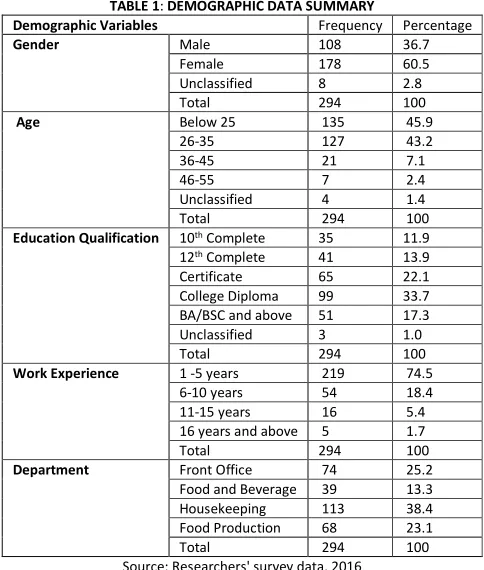
TABLE 1: DEMOGRAPHIC DATA SUMMARY
Demographic Variables Frequency Percentage
Gender Male 108 36.7
Female 178 60.5 Unclassified 8 2.8 Total 294 100
Age Below 25 135 45.9 26-35 127 43.2 36-45 21 7.1 46-55 7 2.4 Unclassified 4 1.4 Total 294 100
Education Qualification 10th Complete 35 11.9
12th Complete 41 13.9
Certificate 65 22.1 College Diploma 99 33.7 BA/BSC and above 51 17.3 Unclassified 3 1.0 Total 294 100
Work Experience 1 -5 years 219 74.5
6-10 years 54 18.4 11-15 years 16 5.4 16 years and above 5 1.7 Total 294 100
Department Front Office 74 25.2
Food and Beverage 39 13.3 Housekeeping 113 38.4 Food Production 68 23.1 Total 294 100 Source: Researchers' survey data, 2016
The demographic data summary as illustrated in table-1 above shows that majority of the respondents were females (60.5%). Age wise distribution of the data showed that the respondents of the age group below 25 years were 45.9%, age group 26-35 years were 43.2%, age group of 36 to 45 years were 7.1% while age group of 46 to 55 years were 2.4%. The distribution of respondents based on educational level depicts that 35(11.9%) of our sample are grade tenth completes or high school graduates,41(13.9%) are preparatory school completes and 65(22.1%) respondents have certificates, 99(33.7%) have college diploma and 51 (17.3%)of the study sample have bachelor degree or above. In terms of work experience among the participants of our research, 219 (74.5%) employees have a work experience of 1 to 5 years, 54 (18.5%) participants served their organization between 6 to 10 years, 16 (5.4%) participants have a working experience between 10 to 15 years, and 5 (1.7 %) participants have worked in hotel services for 16 years or beyond. The distribution of respondents based on their working department shows that 74(25.2%), 39(13.3%), 113(38.4%) and 68(23.1%) sample employees are working in front office, food and beverage, housekeeping and food production department respectively.
The summarized results of the descriptive statistics presented in table-2 below showed that employees in hotel industry have relatively average level satisfaction with employee involvement and work condition, whereas employees were found to appear least satisfied with the recruitment and selection process and training and development opportunities which is an indication of lack of fair recruitment and selection and unsatisfying training and development policies and practices. In so far as the correlation statistics between the distinct variables is concerned, the widely used Pearson product-moment correlation coefficient method was employed to analyze the correlation between the six predictor variables (recruitment and selection, employees' involvement, training and development, perfor-mance appraisal, work condition and compensation practice) and job satisfaction, the criterion variable. As table-2 below shows, the correlation value of variables ranges between .314 and .542, which indicates that all the factors are positively correlated with job satisfaction. It is also portrayed that there are moderate correlations between employees' involvement and job satisfaction(r =0.54, p = <0.01), and relatively lower correlation value is observed between training and development and job satisfaction(r =0.36, p <0.01). Hence, it should be necessary to give the highest emphasis on employees' involvement for superb job satisfac-tion of employees. The other four predictor variables are found to have a correlasatisfac-tion value between the two, 0.54 (the higher) and 0.31(the lower).
It is also clear from table -2 that the p-values of all variables are less than 0.01, which indicates the existence of statistically significant relationship between human resource management practices and job satisfaction. Hence, the results of the Pearson correlation statistics as presented in table-2 below shows that all the six human resource management practices have positive and significant correlation with job satisfaction among hotel employees of the Lake Tana Region.
TABLE 2: DESCRIPTIVE STATISTICS, RELIABILITY COEFFICIENTS AND CORRELATION MATRIX OF THE STUDY VARIABLES
Variables Mean Standard Deviation Reliability Coefficient Correlation Matrix with JS Rrecruitment and Selection 2.1752 .89566 0.806 .314 **
Employee Involvement 3.1608 1.01736 0.930 .542** Training and Development 2.5803 .92153 0.817 .364** Work Conditions 3.1219 .84239 0.770 .536** Performance Appraisal 2.9651 .98453 0.834 .394** Compensation Practice 2.8963 .95165 0.816 .402** Job Satisfaction 3.0600 .72476 0.906 1.00 Note: N=294; **p< 0.01 level (2-tailed).
Source: Researchers' survey data, 2016
V
OLUMEN
O.
8
(2018),
I
SSUEN
O.
03
(M
ARCH)
ISSN 2231-5756
INTERNATIONAL JOURNAL OF RESEARCH IN COMMERCE, IT & MANAGEMENT
Table-3 below shows that the constant value of t-statistics is 1.52 with p<.05. The coefficient of recruitment and selection (beta) is.028 at statistically insignificant level of 0.575 rejecting the research hypothesis H1 that says recruitment and selection have positive and significant effect on employees' job satisfaction. The
coefficient of employees involvement (beta) is.238 with p<.01 which shows that employees involvement has positive and significant effect on employees' job satisfaction, thus H2 is supported, where as the coefficient of training and development (beta) is 0.074 with p-value >0.05, i.e. 0.194 so that H3 which says training
and development have positive and significant effect on employees' job satisfaction is subjected to rejection. H4 was accepted indicating that work condition has
positive and significant effect on employees' job satisfaction (Beta=0.224, p<0.05). The coefficient of performance appraisal (beta) is 0.133 with p<0.05 which denotes positive and significant effect of performance appraisal on job satisfaction, and hence H5 is accepted. The coefficient of compensation practice (beta) is
0.119 with p-value <0.05, which highlights statistically significant effect of compensation on job satisfaction so that H6 is supported. Therefore, the overall model
underscores that H2, H4, H5 and H6 are accepted while H1 and H3 fall in the area of rejection. The result of this study is found to be in tandem with the findings of
Amare (2015), Farahbod (2014), Arokiasami (2013) and Joseph (2013) who concluded that human resource management practices have significant effect on job satisfaction. However, further investigations on the effect of human resource management practices including recruitment and selection and training and devel-opment on organizational commitment deemed necessary to better generalize the findings.
TABLE 3: MULTIPLE REGRESSION RESULTS
Model Estimated Coefficient Value Standard Error t-value Sig. 1 (Constant) 1.523 .157 9.714 .000
Rrecruitment and Selection .028 .051 .561 .575 Eemployee Involvement .238 .067 3.538 .000 Training and Development .074 .057 1.300 .194 Work Conditions .213 .065 3.295 .001 Performance Appraisal .133 .054 2.483 .014 Compensation Practice .119 .045 2.621 .009 a. Dependent Variable: Job Satisfaction
Source: Researchers' survey data, 2016
As it has been explained in the preceding discussions, the estimation process was based on Ordinary Least Squares (OLS), i.e., y= a + bx. Therefore, based on the outputs obtained from the multiple regression analysis as depicted in the coefficient statistics, the following mathematical relationship explains the result of the regression equation of the study.
Y = 2.169 + 0.028X1 + 0.238X2 + 0.074X3 + 0.213X4 + 0.133X5 + 0.119 X6 + Є
8. CONCLUSION
Over the last half century, the global market for the tourism and hospitality industry has become increasingly active and dynamic, and the human resource com-ponent in the sector is considered as a source of sustainable competitive advantage.This research paper examined the effect of selected human resource man-agement practices on job satisfaction among hotel employees of operational departments in the Lake Tana region of north central Ethiopia. The current study used six human resource management practices such as recruitment and relection, employees' participation, training and development, performance appraisal, work condition, compensation. On the basis of the findings of the research, it can be concluded that compensation practice, employees' involvement, work con-dition and performance appraisal have positive and significant effect on job satisfaction among hotel employees, while recruitment and selection and training and development have positive value in the regression output, but did not show statistically significant effect on job satisfaction among hotel employees. Employees' involvement is proved to be most important factor for creating satisfaction among employees in hotels under study.
The findings of the present study are consistent with the arguments of the optimist perspective regarding the relationship between human resource management practices and job satisfaction (Ray and Ray, 2011 and Peccei, 2004). The paper, thus, suggests that hotel managers should work to improve the recruitment and selection practices of hotel employees, and there should also be adequate training of employees through seminars and conferences.
9. RECOMMENDATION AND INDUSTRIAL IMPLICATION
Different from the doubters' outlook, which maintains the inverse relationship of human resource management practices and job satisfaction, the result of this research is consistent with the optimists' view, and it also meets the straight understanding that there is a positive relationship between human resource man-agement practices and job satisfaction. So, it is likely to say the higher the employee's rating of the human resource manman-agement practices, the more their perceived level of job satisfaction will be, and hence human resource management practices are considered as important tools for enhancing organizational performance through building a more satisfied workers. Therefore, based on the results of the empirical data analysis, the researcher would finally like to suggest that the following industrial and business actions should be adopted to enhance employees' job satisfaction in the hotel segment of the tourism industry in particular and the entire service industry in general.
Recruitment and selection process should be carried out very carefully in order to identify the best competence of the candidates for employment and so to realize person organization fit in the sector.
Management should promote employees' involvement and participation in decision making, problem solving and policy designing tasks.
Human resource management of the organizations should offer extensive employee training and development programs for better enrichment of the em-ployees.
Organizations should provide better work condition as a prerequisite to encourage employees to do their work effectively.
Organizations should initiate competency based performance appraisal systems, which result in pay rise, promotion and training of the employees that will enhance employees’ job satisfaction.
Organizations should manage to pay at least even handed compensation to the employees for overtime duties or in the form of bonus for their earnest effort devoted to make attractive profit for the business.
10. LIMITATION AND DIRECTIONS FOR FUTURE RESEARCH
As it is natural for any research to have certain limitations, the current study has inevitable deficiencies, which simultaneously show gaps and open up opportunities for future studies. The results may not thus be generalized because the data were collected only from lower level hotel employees, which might create the potential for common method bias. Hence, for the issue of generalizing, for future studies data should be collected from different sources including employees' supervisors or managers. The replication of this study in other institutions and regions of Ethiopia is also recommended.Tourism and hospitality industry still needs much more information and investigation on what factors do really satisfy the employees of the sector, therefore other variables should be included into the research model and empirically tested to validate the authenticity of the findings and for universality.
REFERENCES
1. Ahmad, S. and Schroeder, Roger G. (2003.) The impact of human resource management practices on operational performance: recognizing country and industry differences. Journal of Operations Management 2,119–43.
2. Agwu, E and Ohaegbu, V.A. (2015). Strategic Management of the Benefits and Challenges of HR Outsourcing in Effective Organizational Management, Journal of Business Studies Quarterly, 7(2).