91
This work is licensed under Creative Commons Attribution 4.0 International License.
Design and Development of Prosthetic Legs
Mahajan S.M1, Patil Sneha V.2, Mahajan Pratiksha N.3 and Bankar Abhijit K.4
1Professor, Department of Mechanical Engineering, Sandip Institute of Engineering and Management, Nashik, Maharashtra, INDIA
2,Student, Department of Mechanical Engineering, Sandip Institute of Engineering and Management, Nashik, Maharashtra, INDIA
3
Student, Department of Mechanical Engineering, Sandip Institute of Engineering and Management, Nashik, Maharashtra, INDIA
4Student, Department of Mechanical Engineering, Sandip Institute of Engineering and Management, Nashik, Maharashtra,
INDIA
2Corresponding Author: [email protected]
ABSTRACT
The purpose of this article is to describe the development in prosthetic legs. Artificial limbs may be needed for a variety of reasons including diseases, accidents and congenital defects. As the human body changes over time due to growth or change in body weight, the artificial limbs have to be changed and adjusted periodically. This constant need for change or adjustment may become costly if the material used is expensive. This study will emphasis the prosthetic legs by focusing on the socket part as it is often changed and replaced with natural-based bio composites. The results of this study are based on the compatibility of the properties of existing and proposed materials which contribute towards providing alternative materials that are more cost efficient, eco-friendly and yet maintaining the features required for artificial limbs. The findings are expected to help patients or wearers to live independently when they are young, who cannot afford to have this essentially.
Keywords— Artificial Limb, Prosthetic Leg, Lamination Method, Natural Fiber-Based Bio Composites
I.
INTRODUCTION
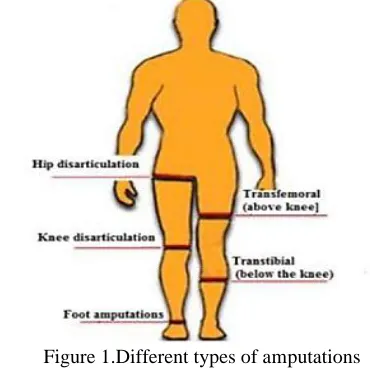
The number of limb amputations is increased due to various reason, e. g, vascular diseases and trauma, in the whole world. These patients need to use prostheses in the daily life activities. Figure 1 shows different types of amputations.
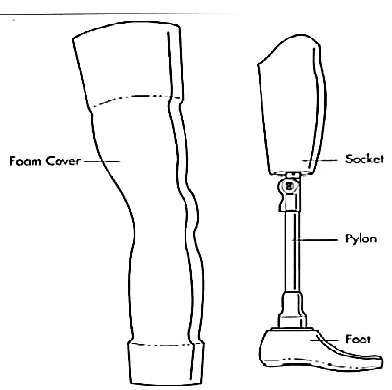
An amputee patient is generally fitted with a prosthesis in order to help the patient return to the state of life prior to amputation. A prosthesis, in medicine, is an artificial device that replaces a missing part. Figure 2 shows the parts of a prosthesis for an above-knee amputation. The liner component of the prosthesis contacts with the residual limb directly. The main functions of which are load distribution, friction reduction and cushioning around the residual limb. Prosthesis is a mechanism designed to substitute the function or appearance of a missing limb or
body part. Therefore, ideally, prosthesis must be comfortable to wear, easy to put on and remove, light weight, durable, cosmetically pleasing, functioning well mechanically and requires reasonable maintenance, mention that at present, to have all these qualities in a prosthetic leg is possible but the expensive cost of manufacturing will result in financially burdened wearers having the difficulty to afford these prosthetic legs. Because of this, a solution for more affordable and less expensive parts and components should be sought after to enable many wearers to have the opportunity to enjoy ambulation with less expensive and high quality prosthetic legs..An artificial limb is type of prosthesis that replaces a missing limb or part of the body, such as the arm or leg. The type of artificial limb used is determined largely by the extent of the extent of the amputation or loss and the location of the missing limb. Cancer, infection and circulatory diseases are the leading ailments that may lead to amputation. In most developed countries, such as the North America and Europe, diseases are the leading cause of amputation. Thus, the demand for prosthetic legs is high for many amputees around the world at present.
92
This work is licensed under Creative Commons Attribution 4.0 International License.
Figure 2.The parts of prosthesis
II.
HISTORY
Between World War 1 and World War 2 very little research in limb prosthetics was carried out. World War 2 inspired a number of countries to establish research programs in prosthetics and theses program continues twenty-five years later. The thalidomide tragedy increased the interest in artificial limbs especially in those countries most affected. The United Nations from its beginning has regarded rehabilitations as an important part of this program. Under Public law 480, the United States has been able to support research in artificial limbs and braces in foreign countries with money received from the sale of excess agricultural commodities.
III.
CAUSES AND NEEDS OF LOWER
LIMB
In developed countries, the main cause of lower limb amputation is due to circulatory dysfunction. The prime reason for this is arthrosclerosis; although up to a third patient have concomitant diabetes. In the United Kingdom, there are about 5000 major new amputation cases a year. This is in sharp contrast with other developing countries where a most amputations are caused by traumas related to either industrial conflict or traffic injuries. Global extrapolation are problematic, but in the recent US study, it is states that the amputation rate among combatants in the US military conflict remains 14-19% and the devastations caused by land mines continues, particularly, when displaced civilians return to mine areas and resume agricultural activities.
The national limb loss information centre reports that the main cause of acquired limb loss is poor circulation in the limb due to arterial disease, with more than half of all amputations occurring among people with diabetes mellitus. The amputation of a limb may also occur after a
traumatic event or for the treatment of bone cancer. Congenital limb difference is the complete or partial absence of a limb at birth. The risk of limb loss increases with age, in which persons aged 65 years or older have the greatest risk of amputation. As with diabetes and heart diseases, smoking, lack of exercise and proper nutrition may also increase the risk of limb loss. The cause limb loss vary from one region to another. At present, the cost of prosthetic legs is expensive. Hence, an alternative way to produce cheaper prosthetic legs is crucially needed to ensure that low-income wearers get to enjoy cheap and comfortable prosthetic legs. Thus, in this case, cutting down the cost of manufacturing by offering a cheaper material will be one of solution.
IV.
COMPONENTS
Components of prosthetic legs are socket, suspension system, knee joint, shank pylon, foot assembly are as follows. Figure 3 shows components of prosthetic legs -
Socket- It is a most important part and the connection between the stumps and the prosthesis. It protects the stumps and transmits the forces. If socket feel uncomfortable to patient then it is rejected. Contoured sockets fit closer to bone, muscle, soft tissues. Socket provides support and relief.
Suspension system- Suspension devices should keep the prosthesis firmly in place during use and allow comfortable sitting. Several types of suspension exist, both for the transtibial and transfemoral amputation. Common transtibial suspensions include sleeve, supracondylar, cuff, belt and strap, thigh-lacer, and suction styles. Sleeves are made of neoprene, urethane, or latex and are used over the shank, socket and thigh. Supracondylar and cuff suspensions are used to capture the femoral condyles and hold the prosthesis on the residual limb. The belt and strap method uses a waist belt with an anterior elastic strap to suspend the prosthesis, while the thigh-lacer method uses a snug-fitting corset around thigh. The suction method consists of a silicone sleeve with a short pin at the end.
Knee joint-Knee joint consist of three parameters as follows-
a) Axis system- Axis of prosthetic knee is same as that of weighty bearing axis Flexion easier, but stance phase control difficult. Permits momentary axis of knee flexion to change through the arc of motion à increase knee stability.
93
This work is licensed under Creative Commons Attribution 4.0 International License.
and Changes knee swing by modifying the speed of knee motion. Adjust knee swing accordingly.
c) Stabilizer- Most unit do not have special device to increase stability. Patient control knee actions through hip motions by manual locking and friction brake.
Shank/pylon- The shank corresponds to the anatomical lower leg, and is used to connect the socket to the ankle-foot assembly. In an endoskeletal shank, a central pylon, which is a narrow vertical support, rests inside a foam cosmetic cover. End skeletal systems allow for adjustment and realignment of prosthetic components. In an exoskeletal shank, the strength of the shank is provided by a hard outer shell that is either hollow or filled with lightweight material. Exoskeletal systems are more durable than exoskeletal systems; however, they may be heavier and have a fixed alignment, making adjustments difficult.
Foot assembly- The foot-ankle assembly is designed to provide a base of support during standing and walking, in addition to providing shock absorption and push-off during walking on even and uneven terrain. Four general categories of foot-ankle assemblies are non-articulated, articulated, elastic keel, and dynamic-response. One of the most widely prescribed feet is the solid-ankle-cushion-heel (SACH) foot, due to its simplicity, low cost, and durability. It may be inappropriate, however, for active community ambulators and sports participants.
Figure 3.Components of prosthetic legs
V.
MATERIALS USED
A prosthetic device should be light weight; hence much of it is made from plastic. The socket is usually made
from polypropylene-resistant to many chemical solvents, bases and acids Lightweight metals, such as titanium and aluminum, have replaced much of the steel in the pylon. Furthermore, alloys of these materials are most frequently used. The newest development in prosthesis manufacturing has been the use of carbon fiber to form a lightweight pylon. Prosthetic sockets were fabricated from materials, which among others included leather, wood, latex, and metal. For centuries, certain types of wood or leather were carved, soaked, stretched and stitched into prosthetic forms. Foot of the prosthesis traditionally been made of wood and rubber. Even the foot of prosthesis is made from urethane foam with a wooden inner keel construction, but due to uneconomical and hazardous effects on the environment, the use of leather or wood, for instance, has been replaced by polypropylene-based materials, such as polyethylene, polypropylene, acrylics, and polyurethane.
Material selection plays an important role in meeting the requirements of the prosthesis parts in order to make them effectively functional. The cost of the material chosen has to be relevant (i.e. economical and affordable to low-income amputees, for instance) to be manufactured in mass productions. Since the material cost itself does contribute a lot in total manufacturing cost for each part. Therefore, based on the related review as preceded above, this research tries to propose more studies on material engineering in providing alternative materials for the same purpose.
VI.
MANUFACTURING PROCESSES
AND DESIGN
Prosthetic limbs are not mass produced to be sold in stores. Similar to the way dentures or eyeglasses are produced, prosthetic limbs are first prescribed by a medical doctor, usually after consultations with the amputee, a prosthetist, and a physical therapist. The patients then visit the prosthetist to be fitted with a limb. Although some parts-the socket, for instance-are custom-made, many parts (feet, pylon) are manufactured in a factory, sent to the prosthetist, and assembled at the prosthetist’s facility in accordance with the patient’s needs. At a few facilities, the limbs are custom made from start to finish.
Measuring and casting-The prosthetist then measure the lengths of relevant body segments and determines the location of bones and tendons in the remaining part of the limb using the impression and the measurements, the prosthetist then makes of plaster cast of the stump this is most commonly made of plaster of pairs because it dries fast and yields a detailed impressions from the plaster cast, a positive model-an exact duplicate-of the stump is created.
94
This work is licensed under Creative Commons Attribution 4.0 International License.
the positive mold. In this process, the heated sheet is simply laid over the top of the mold in a vacuum chamber. If necessary, the sheet is heated again. Then, the air between the sheet and the mold is sucked out of the chamber, collapsing the sheet around the mould and forcing it into the exact shape of the mold. This thermoplastic sheet is now the test socket; it is transparent so that the prosthetist can check the fit .Before the permanent socket is made, the prosthetics’ works with the patient to ensure that the test socket fits properly. In the case of a missing leg, the patient walks while wearing the test socket and the prosthetist studies the gait. The test socket is then adjusted according to patient input and retired. The permanent socket is then formed. Since it is usually made of polypropylene, it can be vacuum- formed over mold in the same way as the test socket. Figure 4 shows making of socket.
Figure 4.Making of socket
Fabrication of the prosthesis- There are many ways to manufacture the parts of a prosthetic limb. Plastic pieces-including soft-foam pieces used as liners or padding-are made in the usual plastic forming methods. These include vacuum-forming, injecting molding-forcing molten plastic into a mold and letting it cool-and extruding, in which the plastic is pulled through a shaped die. Pylons that are made of titanium or aluminum can be die-cast; in this process, liquid metal is forced into a steel die of the proper shape. The wooden pieces can be planed, sawed, and drilled. The various components are put together in variety of ways, using bolts, adhesives, and laminating, to name a few.
The entire limb is assembled by the prosthetist’s technician using such tools such as a torque wrench and screwdriver to bolt the prosthetic device together. After this, the prosthetist again fits the permanent socket to the patient, this time with the completed custom-made limb attached. Final adjustments are then made. Figure 5 shows artificial limb with foam cover.
Figure 5.Artificial limb with foam cover
VII. ADVANTAGES
Energy-When the prosthetic legs are well fitted and the patients have satisfactory gaits, patients expend less energy walking without prosthetic legs than when walking without prosthetic legs and using crutches.
Mobility-Prosthetic legs provide greater sense of independence.
Psychological-People can gain a better psychological outlook on life by mastering the use of prosthetic legs.
VIII. FUTURE SCOPE
Engineers are trying to match nature by engineering some device that will have to fulfil the same function as natural part of the body or coordinate with natural processes is about as difficult as it gets. Designing the mechanical limb with increasing miniaturization of electric motors and advances in computing powers. The most advanced prostheses available today, do have some mental control, but no sensory feedback. Engineers are trying for sensory feedback also. Prosthetic legs are expensive, scientist are trying to make them cheap.
IX.
CONCLUSION
95
This work is licensed under Creative Commons Attribution 4.0 International License.
Prosthetic legs consume less energy of patients, provides independence and also psychological to patient. Using bio-composite material it is degradable and economical in case of materials
REFERENCES
[1] S.A. Abbood, Zan wu, & Bengt sunden. (2017). Thermal assement for prostheses. International Journal of Computational Methods and Experimental Measurements, 5(1), 1-12.
[2] Ghoseiri, K. & Safari, M.R. (2014). Prevalence of heat and perspiration discomfort inside prostheses: Literature
review. Journal of Rehabilitation Research and
Development, 51, 855–868.
[3] Rosalam Che Me, Rahinah Ibrahim, & Paridah Md. Tahir. (2012). Natural based bio-composite material for prosthetic socket fabrication. Alam Cipta, 5(1), 27-34. [4] Mirza AML. (2016). Lower limb prosthesis. Available at: https://www.slideshare.net/nawan_junior/lower-limbs-prosthesis.
[5] Future prosthetic. (2018). Available at:
www.theengineer.co.uk.
[6] Hewitt D. (2018). Advantages of prosthetic legs. Available at: www.livestrong.com.