The Thirty-Third AAAI Conference on Artificial Intelligence (AAAI-19)
Words Can Shift: Dynamically Adjusting
Word Representations Using Nonverbal Behaviors
Yansen Wang,
1Ying Shen,
2Zhun Liu,
2Paul Pu Liang,
2Amir Zadeh,
2Louis-Philippe Morency
2 1Department of Computer Science, Tsinghua University2School of Computer Science, Carnegie Mellon University
[email protected];{yshen2,zhunl,pliang,abagherz,morency}@cs.cmu.edu
Abstract
Humans convey their intentions through the usage of both ver-bal and nonverver-bal behaviors during face-to-face communica-tion. Speaker intentions often vary dynamically depending on different nonverbal contexts, such as vocal patterns and facial expressions. As a result, when modeling human language, it is essential to not only consider the literal meaning of the words but also the nonverbal contexts in which these words appear. To better model human language, we first model expressive nonverbal representations by analyzing the fine-grained visual and acoustic patterns that occur during word segments. In addition, we seek to capture the dynamic nature of nonverbal intents by shifting word representations based on the accom-panying nonverbal behaviors. To this end, we propose the Recurrent Attended Variation Embedding Network (RAVEN) that models the fine-grained structure of nonverbal subword sequences and dynamically shifts word representations based on nonverbal cues. Our proposed model achieves competitive performance on two publicly available datasets for multimodal sentiment analysis and emotion recognition. We also visualize the shifted word representations in different nonverbal con-texts and summarize common patterns regarding multimodal variations of word representations.
Introduction
Multimodal language communication happens through both verbal and nonverbal channels. The verbal channel of com-munication conveys intentions through words and sentences while the nonverbal aspect uses gestures and vocal intona-tions. However, the meaning of words and sentences uttered by the speaker often varies dynamically in different non-verbal contexts. These dynamic behaviors can arise from different sources such as cultural shift or different political backgrounds (Bamler and Mandt 2017). In human multi-modal language, these dynamic behaviors are often inter-twined with their nonverbal contexts (Burgoon, Guerrero, and Floyd 2016). Intentions conveyed through uttering a sentence can display drastic shifts in intensity and direction, leading to the phenomena that the uttered words exhibit dynamic meanings depending on different nonverbal contexts.
Previous work in modeling human language often utilizes word embeddings pretrained on a large textual corpus to rep-resent the meaning of language. However, these methods
Copyright © 2019, Association for the Advancement of Artificial Intelligence (www.aaai.org). All rights reserved.
4“T*WX”RST*.*&C 4“T*WX”SZ*U*K3[
4“T*WX”KCU3.*&C
Negative-shifted word representation Original word representation
Positive-shifted word representation
V
is
u
al
A
cou
st
ic
⋯
excited voice
raised eyebrows
V
is
u
al
A
cou
st
ic
⋯
soft voice
shock
Word Representation Space
t = 1 t = 2 t = m
t = 1 t = 2 t = n
Figure 1: Conceptual figure demonstrating that the word rep-resentation of the same underlying word “sick” can vary con-ditioned on different co-occurring nonverbal behaviors. The nonverbal context during a word segment is depicted by the sequence of facial expressions and intonations. The speaker who has a relatively soft voice and frowning behaviors at the second time step displays negative sentiment.
Modeling the nonverbal contexts concurrent to an uttered word requires fine-grained analysis. This is because the visual and acoustic behaviors often have a much higher temporal frequency than words, leading to a sequence of accompany-ing visual and acoustic “subword” units for each uttered word. The structure of these subword sequences is especially im-portant towards the representation of nonverbal dynamics. In addition, modeling subword information has become essen-tial for various tasks in natural language processing (Faruqui et al. 2017), including language modeling (Labeau and Al-lauzen 2017; Kim et al. 2016), learning word representations for different languages (Peters et al. 2018; Oh et al. 2018; Bojanowski et al. 2016), and machine translation (Kudo 2018; Sennrich, Haddow, and Birch 2015). However, many of these previous works in understanding and modeling multimodal language has ignored the role of subword analysis. Instead, they summarize the subword information during each word span using the simple averaging strategies (Liang et al. 2018; Liu et al. 2018; Zadeh et al. 2018b). While average behav-iors may be helpful in modeling global characteristics, it is lacking in its representation capacity to accurately model the structure of nonverbal behaviors at the subword level. This motivates the design of a more expressive model that can ac-curately capture the fine-grained visual and acoustic patterns that occur in the duration of each word.
To this end, we propose the Recurrent Attended Variation Embedding Network (RAVEN), a model for human mul-timodal language that considers the fine-grained structure of nonverbal subword sequences and dynamically shifts the word representations based on these nonverbal cues. In order to verify our hypotheses on the importance of subword anal-ysis as well as the dynamic behaviors of word meanings, we conduct experiments on multimodal sentiment analysis and emotion recognition. Our model shows excellent performance on both tasks. We present visualizations of the shifted word representations to better understand the impact of subword modeling and dynamic shifts on modeling word meaning. Finally, we present ablation studies to analyze the effects of subword modeling and dynamic shifting. We discover that the shifted embeddings learned by RAVEN exhibit mean-ingful distributional patterns with respect to the sentiment expressed by the speaker.
Related Works
Previously, much effort has been devoted to building machine learning models that learn from multiple modalities (Ngiam et al. 2011; Srivastava and Salakhutdinov 2014). However, there has been limited research into modeling the variations of word representations using nonverbal behaviors. To place our work in the context of prior research, we categorize pre-vious works as follows: (1) subword word representations, (2) modeling variations in word representations, and (3) mul-timodal sentiment and emotion recognition.
Modeling subword informationhas become crucial for vari-ous tasks in natural language processing (Faruqui et al. 2017). Learning the compositional representations from subwords to words allows models to infer representations for words not in the training vocabulary. This has proved especially useful for machine translation (Sennrich, Haddow, and Birch 2015),
language modeling (Kim et al. 2016) and word representation learning (Bojanowski et al. 2016). In addition, deep word representations learned via neural models with character con-volutions (Zhang, Zhao, and LeCun 2015) have been found to contain highly transferable language information for down-stream tasks such as question answering, textual entailment, sentiment analysis, and natural language inference (Peters et al. 2018).
Modeling variations in word representationsis an impor-tant research area since many words have different mean-ings when they appear in different contexts. Li and Juraf-sky (2015) propose a probabilistic method based on Bayesian Nonparametric models to learn different word representa-tions for each sense of a word, Nguyen et al. (2017) use a Gaussian Mixture Model (Reynolds 2009) and Athiwaratkun, Wilson, and Anandkumar (2018) extend FastText word repre-sentations (Bojanowski et al. 2016) with a Gaussian Mixture Model representation for each word.
movie !"($) !&($) !'($)()
+,-./ +,-./ ⋯ +,-./
A
cou
st
ic
V
is
u
al
ℎ2($)
ℎ/($) 3($)
Visual Embedding
Acoustic Embedding
Word Embedding
Nonverbal Shift
Attention
Gating Shifting
34($)
sick
t = 2.3 t = 2.8
…
time Gated Modality-mixing
Network
3($)
sick’
34($)
sick ℎ4($)
Shifting
ℎ4($)
Multimodal Shifting
+,-.2 +,-.2
5"($)
+,-.2
⋯
5&($) 5'($)6) Nonverbal Sub-networks
Multimodal-shifted word representation
last night.
⋯
⋯
⋯ ⋯
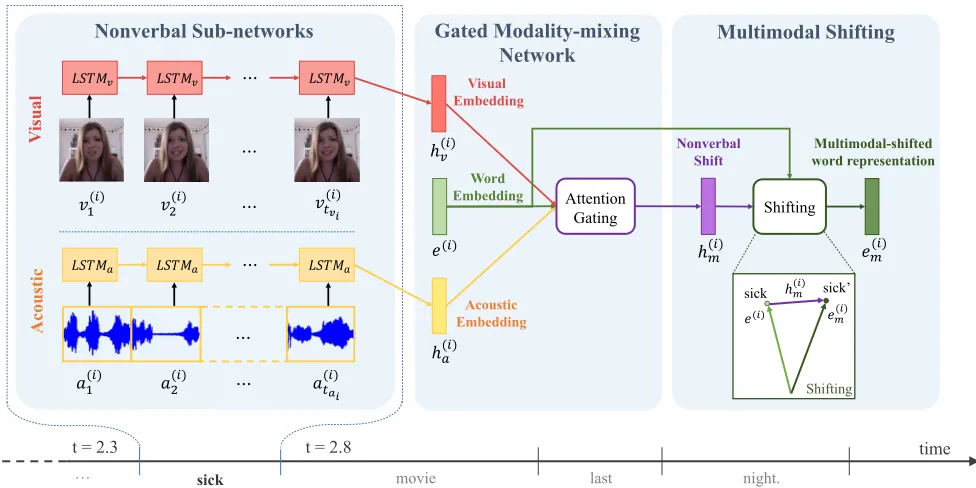
Figure 2: An illustrative example for Recurrent Attended Variation Embedding Network (RAVEN) model: The RAVEN model has three components: (1) Nonverbal Sub-networks, (2) Gated Modality-mixing Network, and (3) Multimodal Shifting. For the given word “sick” in the utterance, the Nonverbal Sub-networks first computes the visual and acoustic embedding through modeling the sequence of visual and acoustic features lying in a word-long segment with separate LSTM network. The Gated Modality-mixing Network module then infers the nonverbal shift vector as the weighted average over the visual and acoustic embedding based on the original word embedding. The Multimodal Shifting finally generates the multimodal-shifted word representation by integrating the nonverbal shift vector to the original word embedding. The multimodal-shifted word representation can be then used in the high-level hierarchy to predict sentiments or emotions expressed in the sentence.
Recurrent Attended Variation Embedding
Network (RAVEN)
The goal of our work is to better model multimodal human language by (1) considering subword structure of nonverbal behaviors and (2) learning multimodal-shifted word repre-sentations conditioned on the occurring nonverbal behaviors. To achieve this goal, we propose the Recurrent Attended Variation Embedding Network (RAVEN).
An overview of the proposed RAVEN model is given in Figure 2. Our model consists of three major components: (1)Nonverbal Sub-networksmodel the fine-grained structure of nonverbal behaviors at the subword level by using two separate recurrent neural networks to encode a sequence of visual and acoustic patterns within a word-long segment, and outputs the nonverbal embeddings. (2)Gated Modality-mixing Networktakes as input the original word embedding as well as the visual and acoustic embedding, and uses an attention gating mechanism to yield the nonverbal shift vector which characterizes how far and in which direction has the meaning of the word changed due to nonverbal context. (3)
Multimodal Shiftingcomputes the multimodal-shifted word representation by integrating the nonverbal shift vector to the original word embedding. The following subsections discuss the details of these three components of our RAVEN model.
Nonverbal Sub-networks
To better model the subword structure of nonverbal behaviors, the proposed Nonverbal Sub-networks operate on the visual and acoustic subword units carried alongside each word. This yields the visual and acoustic embeddings. These output embeddings are illustrated in Figure 2.
Formally, we begin with a segment of multimodal lan-guage L denoting the sequence of uttered words. For the span of theith word denoted asL(i), we have two accom-panying sequences from the visual and acoustic modali-ties:V(i)
= [v(1i), v2(i),⋯, v(ti)
vi],A
(i)
= [a(1i), a2(i),⋯, a(ti)
ai].
These are temporal sequences of visual and acoustic frames, to which we refer as the visual and acoustic subword units. To model the temporal sequences of sub-word information com-ing from each modality and compute the nonverbal embed-dings, we use Long-short Term Memory (LSTM) (Hochreiter and Schmidhuber 1997) networks. LSTMs have been suc-cessfully used in modeling temporal data in both computer vision (Ullah et al. 2018) and acoustic signal processing (Hughes and Mierle 2013).
The modality-specific LSTMs are applied to the sub-word sequences for each wordL(i), i
=1,⋯, n. For thei-th word
sepa-rately for its underlying visual and acoustic sequences:
h(i)
v =LSTMv(V
(i)
) (1)
h(i)
a =LSTMa(A
(i)
) (2)
whereh(i)
v andh
(i)
a refer to the final states of the visual and
acoustic LSTMs. We call these final states visual and acoustic embedding, respectively.
Gated Modality-mixing Network
Our Gated Modality-mixing Network component computes the nonverbal shift vector by learning a non-linear combi-nation between the visual and acoustic embedding using an attention gating mechanism. Our key insight is that depend-ing on the information in visual and acoustic modalities as well as the word that is being uttered, the relative importance of the visual and acoustic embedding may differ. For exam-ple, the visual modality may demonstrate a high activation of facial muscles showing shock while the tone in speech may be uninformative. To handle these dynamic dependencies, we propose a gating mechanism that controls the importance of each visual and acoustic embedding.
In order for the model to control how strong a modal-ity’s influence is, we use modality-specific influence gates to model the intensity of the influence. To be more concrete, for wordL(i), given the original word representatione(i), we concatenatee(i)with the visual and acoustic embeddingh(i)
v
andh(i)
a respectively and then use the concatenated vectors
as the inputs of the visual and acoustic gatew(i)
v andw
(i)
a :
w(i)
v =σ(Whv[hv(i);e(i)] +bv) (3) w(i)
a =σ(Wha[h
(i)
a ;e
(i)
] +ba) (4)
where [;] denotes the operation of vector concatenation.
WhvandWhaare weight vectors for the visual and acoustic gates andbvandbaare scalar biases. The sigmoid function
σ(x)is defined asσ(x) =1 1
+e−x, x∈R.
Then a nonverbal shift vector is calculated by fusing the visual and acoustic embeddings multiplied by the visual and acoustic gates. Specifically, for a wordL(i), the nonverbal shift vectorh(i)
m is calculated as follows:
h(i)
m =w
(i)
v ⋅ (Wvh
(i)
v ) +w
(i)
a ⋅ (Wah
(i)
a ) +b
(i)
h (5)
whereWvandWa are weight matrices for the visual and
acoustic embedding andb(i)
h is the bias vector.
Multimodal Shifting
The Multimodal Shifting component learns to dynamically shift the word representations by integrating the nonverbal shift vector h(i)
m into the original word embedding.
Con-cretely, the multimodal-shifted word representation for word
L(i)is given by:
e(i)
m =e
(i)
+αh(mi) (6)
α=min(
∣∣e(i)∣∣2
∣∣h(mi)∣∣2
β,1) (7)
whereβis a threshold hyper-parameter which can be deter-mined by cross-validation on a validation set.
In order to ensure the magnitude of the nonverbal shift vectorh(i)
m is not too large as compared to the original word
embeddinge(i), we apply a scaling factorαto constrain the magnitude of the nonverbal shift vector to be within a desirable range. At the same time, the scaling factor maintains the direction of the shift vector.
By applying the same method for every word inL, we can transform the original sequence triplet(L,V,A)into
one sequence of multimodal-shifted representations E =
[e(m1),e
(2)
m ,⋯,e(mn)]. The new sequenceEnow corresponds
to a shifted version of the original sequence of word repre-sentationsLfused with information from its accompanying nonverbal contexts.
This sequence of multimodal-shifted word representations is then used in the high-level hierarchy to predict sentiments or emotions expressed in the utterance. We can use a simple word-level LSTM to encode a sequence of the multimodal-shifted word representations into an utterance-level multi-modal representationh. This multimodal representation can then be used for downstream tasks:
h=LSTMe(E) (8)
For concrete tasks, the representationhis passed into a fully-connected layer to produce an output that fits the task. The various components of RAVEN are trained end-to-end together using gradient descent.
Experiments
In this section, we describe the experiments designed to evalu-ate our RAVEN model. We start by introducing the tasks and datasets and then move on to the feature extraction scheme.1
Datasets
To evaluate our approach, we use two multimodal datasets involving tri-modal human communications: CMU-MOSI (Zadeh et al. 2016) and IEMOCAP (Busso et al. 2008), for multimodal sentiment analysis and emotion recognition tasks, respectively.
Multimodal Sentiment Analysis: we first evaluate our ap-proach for multimodal sentiment analysis. For this task, we choose the CMU-MOSI dataset. It comprises 2199 short video segments excerpted from 93 Youtube movie review videos and has real-valued sentiment intensity annotations from[−3,+3]. Negative values indicate negative sentiments
and vice versa.
Multimodal Emotion Recognition: we investigate the per-formance of our model under a different, dyadic conversa-tional environment for emotion recognition. The IEMOCAP dataset we use for this task contains 151 videos about dyadic interactions, where professional actors are required to per-form scripted scenes that elicit specific emotions. Annota-tions for 9 different emoAnnota-tions are present (angry, excited, fear, sad, surprised, frustrated, happy, disappointed and neutral).
1
Evaluation Metrics: since the multimodal sentiment anal-ysis task can be formulated as a regression problem, we evaluate the performance in terms of Mean-absolute Error (MAE) as well as the correlation of model predictions with true labels. On top of that, we also follow the convention of the CMU-MOSI dataset, and threshold the regression values to obtain a categorical output and evaluate the performance in terms of classification accuracy. As for the multimodal emotion recognition, the labels for every emotion are binary so we evaluate it in terms of accuracy and F1 score.
Unimodal Feature Representations
Following prior practice (Liu et al. 2018; Liang et al. 2018; Gu et al. 2018), we adopted the same feature extraction scheme for language, visual and acoustic modalities.
Language Features: we use the GloVe vectors from (Pen-nington, Socher, and Manning 2014). In our experiments, we used the 300-dimensional version trained on 840B tokens2.
Visual Features: given that the two multimodal tasks all include a video clip with the speakers’ facial expressions, we employ the facial expression analysis toolkit FACET3as our visual feature extractor. It extracts features including facial landmarks, action units, gaze tracking, head pose and HOG features at the frequency of 30Hz.
Acoustic Features: we use the COVAREP (Degottex et al. 2014) acoustic analysis framework for feature extraction. It includes 74 features for pitch tracking, speech polarity, glottal closure instants, spectral envelope. These features are extracted at the frequency of 100Hz.
Baseline Models
Our proposed Recurrent Attended Variation Embedding Net-work (RAVEN) is compared to the following baselines and state-of-the-art models in multimodal sentiment analysis and emotion recognition.
Support Vector Machines (SVMs) (Cortes and Vapnik 1995) are widely used non-neural classifiers. This baseline is trained on the concatenated multimodal features for clas-sification or regression tasks (P´erez-Rosas, Mihalcea, and Morency 2013; Park et al. 2014; Zadeh et al. 2016).
Deep Fusion(DF) (Nojavanasghari et al. 2016) performs late fusion by training one deep neural model for each modal-ity and then combining the output of each modalmodal-ity network with a joint neural network.
Bidirectional Contextual LSTM(BC-LSTM) (Poria et al. 2017) performs context-dependent fusion of multimodal data.
Multi-View LSTM(MV-LSTM) (Rajagopalan et al. 2016) partitions the memory cell and the gates inside an LSTM corresponding to multiple modalities in order to capture both modality-specific and cross-modal interactions.
Multi-attention Recurrent Network(MARN) (Zadeh et al. 2018b) explicitly models interactions between modalities through time using a neural component called the Multi-attention Block (MAB) and storing them in the hybrid mem-ory called the Long-short Term Hybrid Memmem-ory (LSTHM).
2
https://nlp.stanford.edu/projects/glove/ 3
https://imotions.com/
Dataset CMU-MOSI
Metric MAE Corr Acc-2
SVM 1.864 0.057 50.2
DF 1.143 0.518 72.3
BC-LSTM 1.079 0.581 73.9
MV-LSTM 1.019 0.601 73.9
MARN 0.968 0.625 77.1
MFN 0.965 0.632 77.4‡
RMFN 0.922‡ 0.681† 78.4⋆
LMF 0.912⋆
0.668‡ 76.4
RAVEN 0.915† 0.691⋆
78.0†
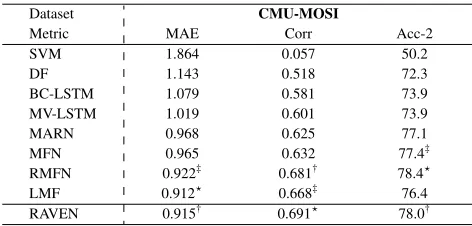
Table 1: Sentiment prediction results on the CMU-MOSI test set using multimodal methods. The best three results are noted with⋆,†and‡successively.
Memory Fusion Network(MFN) (Zadeh et al. 2018a) con-tinuously models the view-specific and cross-view interac-tions through time with a special attention mechanism and summarized through time with a Multi-view Gated Memory.
Recurrent Multistage Fusion Network(RMFN) (Liang et al. 2018) decomposes the fusion problem into multiple stages to model temporal, intra-modal and cross-modal interactions.
Low-rank Multimodal Fusion (LMF) model (Liu et al. 2018) learns both modality-specific and cross-modal in-teractions by performing efficient multimodal fusion with modality-specific low-rank factors.
Results and Discussion
In this section, we present results for the aforementioned ex-periments and compare our performance with state-of-the-art models. We also visualize the multimodal-shifted representa-tions and show that they form interpretable patterns. Finally, to gain a better understanding of the importance of subword analysis and multimodal shift, we perform ablation studies on our model by progressively removing Nonverbal Sub-networks and Multimodal Shifting from our model, and find that the presence of both is critical for good performance.
Comparison with the State of the Art
We present our results on the multimodal datasets in Tables 1 and 2. Our model shows competitive performance when com-pared with state-of-the-art models across multiple metrics and tasks. Note that our model uses only a simple LSTM for making predictions. This model can easily be enhanced with more advanced modules such as temporal attention.
Multimodal Sentiment Analysis: On the multimodal sen-timent prediction task, RAVEN achieves comparable per-formance to previous state-of-the-art models as shown in Table 1. Note the multiclass accuracyAcc-7is calculated by mapping the range of continuous sentiment values into a set of intervals that are used as discrete classes.
Words with their inherent polarity
Nouns that appear in both positive and negative contexts
Words not critical for expressing sentiment
Don’t
Great
Expectations
Guy
That
The
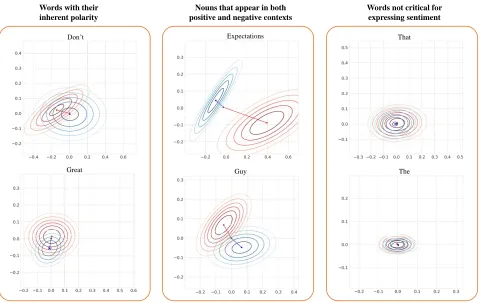
Figure 3: The Gaussian contours of shifted embeddings in 2-dimensional space. Three types of patterns observed in the distribution of all instances of the same word type: words with their inherent polarity will need a drastic variation to convey opposite sentiment; nouns that can appear in both positive and negative contexts will have large variations in both cases; words not critical for expressing sentiment minimal variations in both positive and negative contexts and the distribution of positive/negative instances significantly overlap.
Dataset IEMOCAP Emotions
Task Happy Sad Angry Neutral
Metric Acc-2 F1 Acc-2 F1 Acc-2 F1 Acc-2 F1
SVM 86.1 81.5 81.1 78.8 82.5 82.4 65.2 64.9
DF 86.0 81.0 81.8 81.2 75.8 65.4 59.1 44.0
BC-LSTM 84.9 81.7 83.2 81.7 83.5 84.2 67.5 64.1
MV-LSTM 85.9 81.3 80.4 74.0 85.1‡ 84.3‡ 67.0 66.7
MARN 86.7 83.6 82.0 81.2 84.6 84.2 66.8 65.9
MFN 86.5 84.0 83.5† 82.1 85.0 83.7 69.6‡ 69.2‡
RMFN 87.5⋆
85.8⋆
82.9 85.1† 84.6 84.2 69.5 69.1
LMF 87.3† 85.8⋆
86.2⋆
85.9⋆
89.0⋆
89.0⋆
72.4⋆
71.7⋆
RAVEN 87.3† 85.8⋆
83.4‡ 83.1‡ 87.3† 86.7† 69.7† 69.3†
Table 2: Emotion recognition results on IEMOCAP test set using multimodal methods. The best three results are noted with⋆,†and‡successively.
Multimodal Representations in Different
Nonverbal Contexts
As our model learns shifted representations by integrating each word with its accompanying nonverbal contexts, every instance of the same word will have a different
multimodal-shifted representation. We observe that the shifts across all instances of the same word often exhibit consistent patterns. Using the CMU-MOSI dataset, we visualize the distribution of shifted word representations that belong to the same word. These visualizations are shown in Figure 3. We begin by pro-jecting each word representation into 2-dimensional space using PCA (Jolliffe 2011). For each word, we plot Gaussian contours for the occurrences in positive-sentiment contexts and the occurrences in negative-sentiment contexts individu-ally. Finally, we plot the centroid of all occurrences as well as the centroids of the subset in positive/negative contexts. To highlight the relative positions of these centroids, we add blue and red arrows starting from that overall centroid and pointing towards the positive and negative centroids. We dis-cover that the variations of different words can be categorized into the following three different patterns depending on their roles in expressing sentiment in a multimodal context:
centroid. In Figure 3, the word “great” has an overall centroid that is very close to its positive centroid, while its negative centroid is quite far from both overall and positive centroids. (2) Fornouns that appear in both positive and negative contexts, both of their positive and negative centroids are quite far away from the overall centroid, and their positive and negative instances usually occupy different half-planes. While such nouns often refer to entities without obvious polarity in sentiment, our model learns to “polarize” these representations based on the accompanying multimodal con-text. For example, the noun “guy” is frequently used for addressing both good and bad actors, and RAVEN is able to shift them accordingly in the word embedding space towards two different directions (Figure 3).
(3) Forwords that are not critical in conveying sentiment
(e.g. stop words), their average variations under both positive and negative contexts are minimal. This results in their pos-itive, negative, and overall centroids all lying close to each other. Two example words that fall under this category are “that” and “the” with their centroids shown in Figure 3.
These patterns show that RAVEN is able to learn meaning-ful and consistent shifts for word representations to capture their dynamically changing meanings.
Ablation studies
RAVEN consists of three main components for perform-ing multimodal fusion: Nonverbal Sub-networks, Gated Modality-mixing Network and Multimodal Shifting. Among these modules, Nonverbal Sub-networks and Multimodal Shifting are explicitly designed to model the subtle structures in non-verbal behaviors and to introduce dynamic variations to the underlying word representations. In order to demon-strate the necessity of these components in modeling mul-timodal language, we conducted several ablation studies to examine the impact of each component. We start with our full model and progressively remove different components. The different versions of the model are explained as follows:
RAVEN: our proposed model that models subword dynam-ics and dynamically shifts word embeddings.
RAVEN w/o SUB: our model without the Nonverbal Sub-networks. In this case, the visual and acoustic sequences are averaged into a vector representation, hence the capability of subword modeling is disabled.
RAVEN w/o SHIFT: our model without Multimodal Shift-ing. Visual and acoustic representations are concatenated with the word embedding before being fed to downstream networks. While this also generates a representation associ-ated with the underlying word, it is closer to a multimodal representation projected into a different space. This does not guarantee that the new representation is a dynamically-varied embedding in the original word embedding space.
RAVEN w/o SUB&SHIFT: our model with both Nonverbal Sub-networks and Multimodal Shifting removed. This leads to a simple early-fusion model where the visual and acoustic sequences are averaged into word-level representations and concatenated with the word embeddings. It loses both the capabilities of modeling subword structures and creating dynamically-adjusted word embeddings.
Dataset CMU-MOSI
Metric MAE Corr Acc-2
RAVEN 0.915 0.691 78.0
RAVEN w/o SHIFT 0.954 0.666 77.7
RAVEN w/o SUB 0.934 0.652 73.9
RAVEN w/o SUB&SHIFT 1.423 0.116 50.6
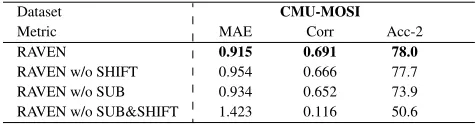
Table 3: Ablation studies on CMU-MOSI dataset. The com-plete RAVEN that models subword dynamics and word shifts works best.
Table 3 shows the results of ablation studies using sev-eral different variants of our model. The results show that both Nonverbal Sub-networks and Multimodal Shifting com-ponents are necessary for achieving state-of-the-art perfor-mance. This further implies that in scenarios where the visual and acoustic modalities are sequences extracted at a higher frequency, the crude averaging method for sub-sampling them to the same frequency of words does hurt performance. Another observation is that given neural networks are uni-versal function approximators (Cs´aji 2001), the early-fusion model, in theory, is the most flexible model. Yet in practice, our model improves upon the early-fusion model. This im-plies that our model does successfully capture underlying structures of human multimodal language.
Conclusion
In this paper, we presented the Recurrent Attended Varia-tion Embedding Network (RAVEN). RAVEN models the fine-grained structure of nonverbal behaviors at the subword level and builds multimodal-shifted word representations that dynamically captures the variations in different nonver-bal contexts. RAVEN achieves competitive results on well-established tasks in multimodal language including sentiment analysis and emotion recognition. Furthermore, we demon-strate the importance of both subword analysis and dynamic shifts in achieving improved performance via ablation stud-ies on different components of our model. Finally, we also visualize the shifted word representations in different non-verbal contexts and summarize several common patterns re-garding multimodal variations of word representations. This illustrates that our model successfully captures meaningful dynamic shifts in the word representation space given non-verbal contexts. For future work, we will explore the effect of dynamic word representations towards other multimodal tasks involving language and speech (prosody), videos with multiple speakers (diarization), and combinations of static and temporal data (i.e. image captioning).
Acknowledgments
References
Athiwaratkun, B.; Wilson, A.; and Anandkumar, A. 2018. Proba-bilistic fasttext for multi-sense word embeddings. InACL. Bamler, R., and Mandt, S. 2017. Dynamic word embeddings.arXiv preprint arXiv:1702.08359.
Bojanowski, P.; Grave, E.; Joulin, A.; and Mikolov, T. 2016. Enrich-ing word vectors with subword information.CoRRabs/1607.04606. Burgoon, J. K.; Guerrero, L. K.; and Floyd, K. 2016. Nonverbal communication. Routledge.
Busso, C.; Bulut, M.; Lee, C.-C.; Kazemzadeh, A.; Mower, E.; Kim, S.; Chang, J.; Lee, S.; and Narayanan, S. S. 2008. Iemocap: Interactive emotional dyadic motion capture database.Journal of Language Resources and Evaluation42(4):335–359.
Cortes, C., and Vapnik, V. 1995. Support-vector networks.Machine learning20(3):273–297.
Cs´aji, B. C. 2001. Approximation with artificial neural networks.
Faculty of Sciences, Etvs Lornd University, Hungary24:48. Degottex, G.; Kane, J.; Drugman, T.; Raitio, T.; and Scherer, S. 2014. Covarep–a collaborative voice analysis repository for speech technologies. InIEEE ICASSP, 960–964. IEEE.
Faruqui, M.; Schuetze, H.; Trancoso, I.; and Yaghoobzadeh, Y., eds. 2017.Proceedings of the First Workshop on Subword and Character Level Models in NLP. ACL.
Gu, Y.; Yang, K.; Fu, S.; Chen, S.; Li, X.; and Marsic, I. 2018. Multimodal affective analysis using hierarchical attention strategy with word-level alignment. InACL, 2225–2235. Association for Computational Linguistics.
Hochreiter, S., and Schmidhuber, J. 1997. Long short-term memory.
Neural computation9(8):1735–1780.
Hughes, T., and Mierle, K. 2013. Recurrent neural networks for voice activity detection. InIEEE ICASSP, 7378–7382. IEEE. Jolliffe, I. 2011. Principal component analysis. InInternational Encyclopedia of Statistical Science. Springer. 1094–1096. Kim, Y.; Jernite, Y.; Sontag, D.; and Rush, A. M. 2016. Character-aware neural language models. InAAAI’16, 2741–2749.
Kudo, T. 2018. Subword regularization: Improving neural net-work translation models with multiple subword candidates.CoRR
abs/1804.10959.
Labeau, M., and Allauzen, A. 2017. Character and subword-based word representation for neural language modeling prediction. In
Proceedings of the First Workshop on Subword and Character Level Models in NLP. Association for Computational Linguistics. Li, J., and Jurafsky, D. 2015. Do multi-sense embeddings improve natural language understanding?CoRRabs/1506.01070.
Liang, P. P.; Liu, Z.; Zadeh, A.; and Morency, L.-P. 2018. Mul-timodal language analysis with recurrent multistage fusion. In
EMNLP.
Liang, P. P.; Zadeh, A.; and Morency, L.-P. 2018. Multimodal local-global ranking fusion for emotion recognition. InICMI. ACM.
Liu, Z.; Shen, Y.; Lakshminarasimhan, V. B.; Liang, P. P.; Bagher Zadeh, A.; and Morency, L.-P. 2018. Efficient low-rank multimodal fusion with modality-specific factors. InACL.
Ngiam, J.; Khosla, A.; Kim, M.; Nam, J.; Lee, H.; and Ng, A. Y. 2011. Multimodal deep learning. InICML.
Nguyen, D. Q.; Nguyen, D. Q.; Modi, A.; Thater, S.; and Pinkal, M. 2017. A mixture model for learning multi-sense word embeddings.
CoRRabs/1706.05111.
Nojavanasghari, B.; Gopinath, D.; Koushik, J.; Baltruˇsaitis, T.; and Morency, L.-P. 2016. Deep multimodal fusion for persuasiveness prediction. InICMI, 284–288. ACM.
Oh, A.; Park, S.; Byun, J.; Baek, S.; and Cho, Y. 2018. Subword-level word vector representations for korean. InACL, 2429–2438. Park, S.; Shim, H. S.; Chatterjee, M.; Sagae, K.; and Morency, L.-P. 2014. Computational analysis of persuasiveness in social multimedia: A novel dataset and multimodal prediction approach. InICMI. ACM.
Pennington, J.; Socher, R.; and Manning, C. 2014. Glove: Global vectors for word representation. InEMNLP, 1532–1543. Associa-tion for ComputaAssocia-tional Linguistics.
P´erez-Rosas, V.; Mihalcea, R.; and Morency, L.-P. 2013. Utterance-level multimodal sentiment analysis. InACL, volume 1, 973–982. Peters, M. E.; Neumann, M.; Iyyer, M.; Gardner, M.; Clark, C.; Lee, K.; and Zettlemoyer, L. 2018. Deep contextualized word representations.CoRRabs/1802.05365.
Pham, H.; Manzini, T.; Liang, P. P.; and Poczos, B. 2018. Seq2seq2sentiment: Multimodal sequence to sequence models for sentiment analysis. InProceedings of Grand Challenge and Work-shop on Human Multimodal Language. ACL.
Poria, S.; Cambria, E.; Hazarika, D.; Majumder, N.; Zadeh, A.; and Morency, L.-P. 2017. Context-dependent sentiment analysis in user-generated videos. InACL, 873–883.
Rajagopalan, S. S.; Morency, L.-P.; Baltrusaitis, T.; and Goecke, R. 2016. Extending long short-term memory for multi-view structured learning. InECCV, 338–353.
Reynolds, D. A. 2009. Gaussian mixture models. In Li, S. Z., and Jain, A. K., eds.,Encyclopedia of Biometrics.
Sennrich, R.; Haddow, B.; and Birch, A. 2015. Neural machine translation of rare words with subword units.CoRRabs/1508.07909. Srivastava, N., and Salakhutdinov, R. 2014. Multimodal learning with deep boltzmann machines.JMLR15.
Tsai, Y.-H. H.; Liang, P. P.; Zadeh, A.; Morency, L.-P.; and Salakhut-dinov, R. 2018. Learning factorized multimodal representations.
arXiv preprint arXiv:1806.06176.
Ullah, A.; Ahmad, J.; Muhammad, K.; Sajjad, M.; and Baik, S. W. 2018. Action recognition in video sequences using deep bi-directional lstm with cnn features.IEEE Access6:1155–1166. Wang, H.; Meghawat, A.; Morency, L.-P.; and Xing, E. P. 2016. Select-additive learning: Improving generalization in multimodal sentiment analysis.arXiv preprint arXiv:1609.05244.
Xu, C.; Tao, D.; and Xu, C. 2013. A survey on multi-view learning.
arXiv preprint arXiv:1304.5634.
Zadeh, A.; Zellers, R.; Pincus, E.; and Morency, L.-P. 2016. Mul-timodal sentiment intensity analysis in videos: Facial gestures and verbal messages.IEEE Intelligent Systems31(6):82–88.
Zadeh, A.; Liang, P. P.; Mazumder, N.; Poria, S.; Cambria, E.; and Morency, L. 2018a. Memory fusion network for multi-view sequential learning. InAAAI. AAAI Press.
Zadeh, A.; Liang, P. P.; Poria, S.; Vij, P.; Cambria, E.; and Morency, L. 2018b. Multi-attention recurrent network for human communica-tion comprehension. InAAAI. AAAI Press.