The Thirty-Third AAAI Conference on Artificial Intelligence (AAAI-19)
Data Augmentation for Spoken Language
Understanding via Joint Variational Generation
Kang Min Yoo, Youhyun Shin, Sang-goo Lee
Seoul National University, Seoul 08826, Korea {kangminyoo, shinu89, sglee}@europa.snu.ac.krAbstract
Data scarcity is one of the main obstacles of domain adap-tation in spoken language understanding (SLU) due to the high cost of creating manually tagged SLU datasets. Recent works in neural text generative models, particularly latent variable models such as variational autoencoder (VAE), have shown promising results in regards to generating plausible and natural sentences. In this paper, we propose a novel gen-erative architecture which leverages the gengen-erative power of latent variable models to jointly synthesize fully annotated utterances. Our experiments show that existing SLU mod-els trained on the additional synthetic examples achieve per-formance gains. Our approach not only helps alleviate the data scarcity issue in the SLU task for many datasets but also indiscriminately improves language understanding per-formances for various SLU models, supported by extensive experiments and rigorous statistical testing.
Introduction
Spoken language understanding (SLU) in current literature refers to the study of models that parse spoken queries into semantic frames. Semantic frames contain pieces of seman-tic units that best represent the speaker’s intentions and are essential for the development of human-machine interfaces, such as virtual assistants.
Scarcity of linguistic resources has been a recurring is-sue in many NLP tasks such as representation learning (Al-Rfou, Perozzi, and Skiena 2013), neural machine translation (NMT) (Zoph et al. 2016), and SLU (Kurata, Xiang, and Zhou 2016a). The issue is especially true for SLU, because creating manually annotated SLU datasets is costly but the domain space that might require new labeled datasets is near infinite.
Even for domains with existing datasets, they might suffer from the data sparsity issue, which have long been plaguing many NLP tasks that require annotated linguistic datasets (Lai et al. 2015). For example, most SLU datasets are not large enough cover all possible data label pairs. Further-more, biased data collection methods could exacerbate the issue (Torralba and Efros 2011).
Recent years, there have been significant advances in vari-ational autoencoders (VAE) (Kingma and Welling 2013) and
Copyright © 2019, Association for the Advancement of Artificial Intelligence (www.aaai.org). All rights reserved.
other latent variable models for textual generation (Serban et al. 2017; Yu et al. 2017; Hu et al. 2017; Li et al. 2017), prompting investigations into the possibility of improving model performances through generative data augmentation (Kafle, Yousefhussien, and Kanan 2017; Kurata, Xiang, and Zhou 2016a; Hou et al. 2018).
In order to alleviate the data issues, data augmentation (DA) techniques that simply perform class-preserving trans-formation on data samples have been extensively used ex-tensively (Simard, Steinkraus, and Platt 2003; Krizhevsky, Sutskever, and Hinton 2012; Fadaee, Bisazza, and Monz 2017). However, such DA methods require full supervision and generated datasets lack variety and robustness. To re-duce reliance on handcrafted transformation functions, there has been growing interest in leveraging the generative power of latent variable models to facilitate DA. These line of works deserve a category of its own, to which we refer as generative data augmentation (GDA). Recent works have explored the idea for the SLU task (Kurata, Xiang, and Zhou 2016a; Hou et al. 2018).
In this paper, we formalize the notion of GDA by devel-oping a general framework for the class of DA techniques in the SLU domain. Upon the framework, we propose a gen-erative model specialized in the generation of SLU datasets. Finally, we wish to demonstrate the effectiveness of our ap-proach through various experiments. In essence, our main contributions are three folds:
1. The Generative DA Framework: We develop a general framework of generative data augmentation specifically for the SLU task. During formulation, we posit the im-portance of prior approximation in generation sampling and propose a Monte Carlo-based method. Experiments show that the Monte Carlo-based estimation is superior compared to other approximation methods.
3. Substantiation with Extensive Experimentation: We substantiate the general benefits of generative data aug-mentation with experiments and statistical testing on var-ious SLU models and datasets. Results show that our ap-proach produces extremely competitive performances for existing SLU models in the ATIS dataset. Our ablation studies also bring some important insights such as the op-timal synthetic dataset size to light.
Related Work
Deep Generative Models and Text Generation Vari-ational autoencoders (VAE) (Kingma and Welling 2013; Rezende, Mohamed, and Wierstra 2014) are deep latent Gaussian models applied with stochastic variational infer-ence, a method which makes the models scalable to large datasets. Since its inception, many variations of the VAE model have been explored in the language domain. Notably, variational recurrent auto-encoders (VRAE) were first pro-posed by (Fabius and van Amersfoort 2014). Generative ad-versarial networks (GAN) are another class of latent vari-able models with implicit latent distribution (Goodfellow et al. 2014). Advances have been made in applying the GAN model to text generation (Yu et al. 2017; Fedus, Goodfellow, and Dai 2018). Recently, much attention has been drawn to the tasks of controllable generation and style transfer, which have been successfully explored in (Hu et al. 2017; Shen et al. 2017) using variational models.
Data Augmentation and Regularization For data-hungry models, appropriate regularization is necessary to achieve high performance for many tasks. Model regulariz-ers such as dropout (Srivastava et al. 2014) and batch nor-malization (Ioffe and Szegedy 2015) are widely accepted techniques to prevent model overfitting and promote noise robustness. Transfer learning is another regularization tech-nique to enhance the generalization power of models that has achieved success across numerous domains and tasks (Pan and Yang 2010).
Data augmentation (DA) is a separate class of regular-ization methods that create artificial training data to ob-tain better resulting models. Most DA techniques proposed in the literature can be categorized into either transforma-tive or generative methods. Transformative data augmen-tation relies on unparameterized data-transforming func-tions embued with external knowledge to synthesize new class-preserving data points (Dao et al. 2018). Transforma-tive DA is widely used in the vision domain. For exam-ple, images are randomly perturbed with linear transforma-tions (rotation, shifting etc.) to boost performances in many vision-related tasks (Simard, Steinkraus, and Platt 2003; Krizhevsky, Sutskever, and Hinton 2012).
On the other hand, Generative DA (GDA) exploits the generative power of latent variable models to artificially cre-ate convincing data samples. With advances in powerful generative models such as VAEs and GANs, the potential to leverage them for data augmentation has gained much at-tention recently. Particularly, performance gains from gener-ated datasets have been studied and documented in the VQA task (Kafle, Yousefhussien, and Kanan 2017), general image
w
s
y
D
p(x)
p?(x)
ωb
ˆ
p(x) ˆ
p?(x)
ωd
ˆ
w
ˆ
s
ˆ
y
ˆ
D
w0
s0
y0
D0
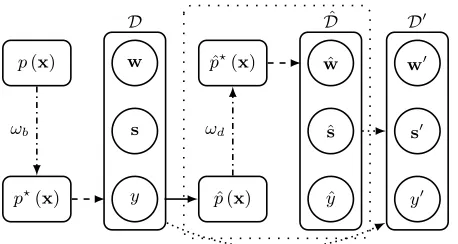
Figure 1: The general framework for generative language understanding data augmentation. Solid arrows ( ) denote training, dashed arrows ( ) denote generation, dot-dashed arrows ( ) denote distortion, and dotted arrows ( ) de-note data duplication.D0 is the final augmented dataset for
training SLU models. The goal of GDA (enclosed in loosely dotted lines) is to recover the true data distributionpthrough sampling, as if the samples are drawn from the corrected model distribution.
classification (Ratner et al. 2017), and selected SLU tasks (Kurata, Xiang, and Zhou 2016a; Hou et al. 2018). However, relevant researches are hurdled by the architectural and ex-perimental complexities. Nevertheless, our work is the first to explore idea of using variational generative models for DA.
Spoken Language Understanding The SLU task is one of more mature research areas in NLP. Many works have focused on exploring neural architectures for the SLU task. Plain RNNs and LSTMs were first explored in (Mesnil et al. 2015; Yao et al. 2014). (Kurata et al. 2016b) proposed sequence-to-sequence (Seq2Seq) models. Hybrid models between RNNs and CRFs were explored in (Huang, Xu, and Yu 2015). Joint language understanding models that jointly predict slot labels and intents gained significant trac-tion since they had been first proposed in (Guo et al. 2014; Goo et al. 2018). Some works focused on translating ad-vances in other NLP areas to the SLU task (Liu and Lane 2016).
Model Description
In this section, we describe our generative data augmenta-tion model and the underlying framework in detail.
Framework Formulation
We begin with some notations, then we formulate the over-all generative data augmentation framework for the spoken language understanding task.
Notations An utterance w is a sequence of words
w1, . . . , wTi
, where T is the length of the utterance. For each utterance in a labeled dataset, an equally-long seman-tic slot sequence s = (s1, . . . , sT) exists such that si
utterance is denoted byy. A fully labeled language under-standing datasetDis a collection of utterances and their re-spective annotations{(w1,s1, y1), . . . ,(wn,sn, yn)}, where
nis the size of the dataset. A data sample in Dis denoted byx= (w,s, y). The set of all utterances present inDis de-noted byDw={w1, . . . ,wn}. Similarly, the set of slot label
sequences and intent classes are denoted byDsandDy.
Spoken Language Understanding A spoken language understanding model is a discriminative modelSfitted on la-beled SLU datasets. Specifically, letψto denote parameters of the prediction model. Given a training sample (w,s, y), the training objective is as follows:
LLU(ψ;w,s, y) =−logpψ(s, y|w). (1)
Given an utterance w, predictions are made by finding the slot label sequence ˆs and the intent class yˆthat max-imize the loglikelihood:(ˆs,yˆ) = arg maxs,ylogpψ(s, y|w).
For non-joint SLU models,pφis factorizable:pφ(s, y|w) =
pφ(s|w)pφ(y|w). In recent years, joint language
under-standing has become a popular approach, as studies show a synergetic effect of jointly training slot filling and intent identification (Guo et al. 2014; Chen et al. 2016).
Generative Data Augmentation A general framework of generative data augmentation (GDA) is depicted in Fig-ure 1. Suppose that IID samples x ∈ D were intended to be sampled from a true but unknown language distribution
p(x) ∈ P, whereP is the probability function space forx. However, in real world cases, the actual distribution repre-sented by theDwcould be distorted due to biases introduced
during erroneous data collection process or due to under-sampling variance (Torralba and Efros 2011). Let such dis-tortion be a functionωb ∈ Ω :P → P. The distorted data
distributionp?=ω
b(p)diverges from the true distributionp,
i.e.d(p?, p)>0wheredis some statistical distance measure such as KL-divergence.
An ideal GDA counteracts the bias-introducing function
ωb and unearths the true distribution p through
unsuper-vised explorative sampling. Suppose that a joint language understanding modelpˆ(x)is trained onx∼p?(x). Without the loss of generality, suppose that the model is expressive enough to perfectly capture the underlying distribution, i.e.
ˆ
p=p?. We collectmsamplesDˆ={xˆ1, . . . ,ˆxm}drawn from ˆ
p(x)and combine them with the original datasetDto form an augmented datasetD0of size
n+m. Na¨ıve DA will not yield better SLU results as synthetic data samplesxˆfollow the distorted data distributionp?in the best case. However, an ideal explorative sampling method could distort the sam-pling distribution, as ifxˆwere sampled from another distri-butionpˆ?, such that the new distribution is closer to the true
distribution (i.e. d(ˆp?, p) < d(ˆp, p)). There exists a distor-tion funcdistor-tionωd such thatpˆ? =ωd(ˆp). The ideal sampling
method can be seen as a corrective functionωd that undos
the effect of ωb. In this paper, we propose and investigate
different sampling methodsωd for the maximal DA effect.
These methods are described in model description sections. The implementation details are covered in the experiments sections.
Algorithm 1:Monte Carlo posterior sampling.
input :a sufficiently large numberm
given :Dw,θ,φ
output:synthetic utterance listU initializeUas an empty list; whileUhas less thanmsamplesdo
sample a real utterancewfromDw;
estimate the mean¯zof the posteriorqφ(z|w);
samplewˆ from the likelihoodpθ(w|¯z);
appendwˆ toU; end
returnU
Joint Generative Model
In this subsection, we describe our generative model in de-tail. We begin with a standard VAE (Kingma and Welling 2013) applied to utterances, then we extend the model by allowing it to generate other labels in a joint fashion.
Standard VAE VAEs are latent variable models applied with amortized variational inference. Let θ be the param-eters of the generator network (i.e. the decoder network), and letφbe the parameters of the recognition network (i.e. the encoder network). Specifically in the case of utterance learning, the goal is to maximize the log likelihood of sam-ple utteranceswin the datasetlogp(w) = logR
p(w,z)dz. However, since the marginalization is computationally in-tractable, we introduce a proxy network qφ(z|w)and
sub-sequently minimize a training objective based on evidence lower bound (ELBO):
LV AE(θ, φ;w) = DKL(qφ(z|w) kp(z)) −Ez∼qφ(z|w)[logpθ(w|z)]
(2)
In Equation 2, the proxy distributionqφis kept close to the
priorp(z), which we assume to be the standard multivari-ate Gaussian. Since the KL-divergence term is always pos-itive,LV AE is the upper bound for the reconstruction error
under the particular choice of a proxy distributionqφ. The
proposed generative model is based on VRAEs, in which the posterior of a sequence factorizes over sequence ele-ments (i.e. words) based on the Markov Chain assumption:
pθ(w|z) =QTi=1pθ(wi|w1, . . . , wi−1,z). VAEs can be
opti-mized using gradient-descent methods with the reparameter-ization trick (Kingma and Welling 2013).
6
The Sampling Problem Given the parametersθDandφD
that are optimized for all w ∈ Dw, our goal is to sample
plausible utteranceswˆ from the distribution ofw believed by the model:
ˆ
w∼pθD,φD(w) =
Z
pθD(w|z)pθD,φD(z)dz (3)
w1 w2 w3 w4 w5
Encoder µ
σ z
ˆ
w1 wˆ2 wˆ3 wˆ4 wˆ5
ˆ
s1 ˆs2 sˆ3 ˆs4 sˆ5
ˆ
y
Decoders
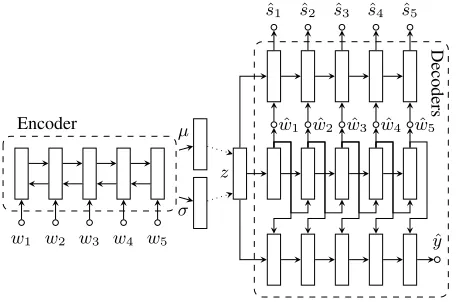
Figure 2: Joint language understanding variational autoen-coder (JLUVA). The VAE model consists of a BiLSTM-Max encoder and three uni-directional decoders. Note that the fully connected layers and embedding layers are omitted for clarity.
variablepθD,φD(z), which can be estimated by
marginaliz-ing the joint probability from the recognition network.
pθD,φD(z) =Ew∼p(w)
qφD(z|w) (4)
However, Equation 4 cannot be solved analytically, as the true distribution of w is unknown. Hence, some form of approximation is required to sample utterances from the latent variable model. The approximation approach will likely have an impact on the quality of generated utterances, thereby determine the effect of data augmentation. Here, we describe two options.
The first is to approximate the marginal probability of the latent variable with the priorp(z), the standard multivari-ate Gaussian. However, this na¨ıve approximation will likely yield homogeneous and uninteresting utterances due to over-simplication of the latent variable space. In real world sce-narios, the KLD loss term in Equation 2 is still large after convergence.
Alternatively, the other option is to approximate using the Monte Carlo method. Under the Monte Carlo approach (Al-gorithm 1), the marginal likelihood is calculated determin-istically for each utterancewsampled from the dataset D. According to the law of large numbers, the marginal likeli-hoodpθD,φD(w) converges to the empirical mean, thereby
providing an unbiased distribution for samplingw.
Exploratory Sampling In our general framework for GDA, remind that the sampling method is required to be exploratory, such that the biases in datasets are counter-acted. translating to better performances in resulting mod-els. Hence, an ideal exploratory sampling approach is unbi-ased but has increunbi-ased sampling variance. Intuitively, we can sample the latent variablezfrom the Gaussian encoded by the recognizer in place of analytically estimating the mean in Algorithm 1. Suppose thatµandσ are mean and stan-dard deviation vectors encoded by the recognizer. Then we samplezfromN(µ(w), λs·σ(w)), where the scaling
hy-perparameterλs controls the level of exploration exhibited
Dataset #Splits Train Val Test ATIS-small 35 127 - 128 500 893 ATIS-medium 9 497 - 498 500 893
ATIS 1 4,478 500 893
Snips 1 13,084 700 700
MIT Movie Eng 1 8,798 977 2,443 MIT Movie Trivia 1 7,035 781 1,953 MIT Restaurant 1 6,894 766 1,521
Table 1: Dataset statistics. Training sets of ATIS (Small) and ATIS (Medium) have been chunked from the training set of ATIS (Full).
by the generator. This unbiased empirical estimation of the posterior helps generate realistic but more varied utterances.
Joint Language Understanding VAE Starting from a VAE for encoding and decoding utterances, Joint Language Understanding VAE (JLUVA) extends the model by predict-ing slot labels and intent classes. The generation of slot la-bels and intents are conditioned on the latent variablezand the generated utterancewˆ (Figure 2). The benefits of having conditional dependence onzduring labeling is documented in (Kurata et al. 2016b). The modified training objective for the language understanding task is as follows.
LLU(φ, ψ;w,s, y) =−Ez∼qφ[logpψ(s, y|wˆ,z)] (5)
The joint training objective of the entire model is speci-fied in terms of the training objective of the VAE component (Equation 2) and the negative log-likelihood of the discrim-inatory component (Equation 5):
L(θ, φ, ψ;w,s, y) = DKL(qφ(z|w) kpθ(z|w)) −Ez∼qφ[logpθ(w|z)] −Ez∼qφ[logpψ(s, y|wˆ,z)]
(6)
We obtain the optimal parametersθ∗, φ∗, ψ∗by minimiz-ing Equation 6 (i.e. arg minθ,φ,ψL) with respect to a real
dataset D. During the data generation process, we sample
z?from an approximated priorp?(z)which depends on the approximation strategy (e.g. posterior sampling). Then we perform inference on the posterior networkpθ(w|z?)to
es-timate the language distribution. A synthetic utterancewˆ is sampled from said distribution and is used to infer the slot label and intent distribution from the relevant networks, i.e.
p(s, y|z,wˆ). The most probableˆsandyˆare combined with
ˆ
wto form a generated sample set( ˆw,ˆs,yˆ). This generation process is repeated until sufficient synthetic data samples are collected.
Experiments
Slot Filling (F1) Intent (F1) Semantic (Acc.) Model + Sampling Approach Small Med. Full Small Med. Full Small Med. Full
Baseline (No Augmentation) 72.57‡ 88.28‡ 95.34 82.65 90.59† 97.21 35.09‡ 65.18‡ 85.95 Encoder-Decoder + Additive* 74.79† 89.13‡ 95.20 - - - - - -JLUVA + Additive (Ours) 74.14‡ 89.13‡ 95.40 83.46 90.97 97.04 38.58 66.75 85.81 JLUVA + Standard Gaussian (Ours) 70.72‡ 86.90‡ 94.91‡ 78.67‡ 86.90‡ 96.90 32.46‡ 61.12‡ 84.62‡ JLUVA + Posterior (Ours) 74.92 89.27 95.55 83.65 90.95 97.24 39.43 67.05 86.33 *(Kurata, Xiang, and Zhou 2016a) †p <0.1 ‡p <0.01
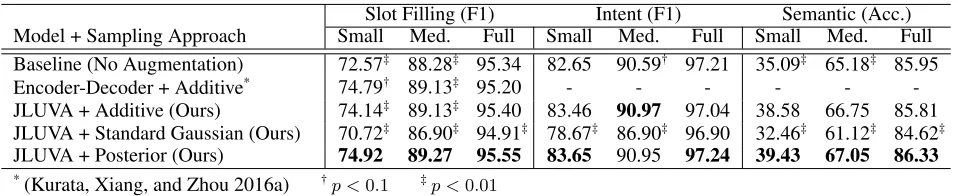
Table 2: Data scarcity results for the ATIS dataset. We use the baseline BiLSTM model as the control SLU model. Results are averaged over multiple runs and compared to the best of our approaches (JLUVA + Posterior). The differences are tested for statistical significance.
Datasets
In this paper, we carry out experiments on the following lan-guage understanding datasets.
• ATIS: Airline Travel Information System (ATIS) (Hemphill, Godfrey, and Doddington 1990) is a represen-tative dataset in the SLU task, providing well-founded comparative environment for our experiments.
• Snips: The snips dataset is an open source virtual-assistant corpus. The dataset contains user queries from various domains such as manipulating playlists or book-ing restaurants.
• MIT Restaurant (MR): This single-domain dataset spe-cializes in spoken queries related to booking restaurants.
• MIT Movie: The MIT movie corpus consists of two single-domain datasets: the movie eng (ME) and movie trivia (MT) datasets. While both datasets contain queries about film information, the trivia queries are more com-plex and specific.
All of the datasets are annotated with slot labels and in-tent classes except the MIT datasets. The detailed statistics of each dataset are shown in Table 1. In order to simulate a data scarce environment (similar to the experimental de-sign proposed in (Chen et al. 2016)), we randomly chunk the ATIS training set into equal-sized smaller splits. For the small dataset the training set is chunked into 35 pieces, and for the medium dataset it is chunked into 9 pieces. The sizes of the small and medium training splits approximately cor-respond those mentioned in the previous work (Chen et al. 2016).
Experimental Settings
Here, we describe the methodological and implementation details for testing the GDA approach under the framework.
General Experimental Flow Since we observe a high variance in performance gains among different runs of the same generative model (e.g. Figure 3), we need to approach the experimental designs with a more conservative stance. The general experimental methodology is as follows.
• NGidentical generative models are trained with different
initial seeds on the same training split.
• mutterance samples are drawn from each model to create
NGaugmented datasetsD10, . . . ,D 0
NG.
• NL identical SLU models are train for eachaugmented
datasetD0. All models are validated against the evaluation
results on the same validation split. Best model from each SLU model is evaluated on the test set.
• We collect the statistics of allNG×NLresults and perform
comparative analyses.
Implementation Details For both models, the word (Ww),
slot label (Ws), and intent (Wy) embeddings have
dimen-sions of 300, 200, and 100 respectively and were trained jointly with the network. Ww had been initialized with the
GloVe vectors (Pennington, Socher, and Manning 2014).
Generative Model The encoder network, a single-layer BiLSTM-Max model (Conneau et al. 2017), encodes the word embeddings of word tokens wi ∈ w in both
di-rections and produces the final hidden state by applying max-pooling-over-time on combined encoder hidden out-putsh(1e), . . . ,h
(e)
T (1024 hidden dimensions). The decoders
are uni-directional single-layer LSTMs with the same hid-den dimensions (1024). Leth(tw),h
(s)
t , andh
(y)
t be the
hid-den outputs of word, slot label, and intent decoders at time steptrespectively. We perform dot products between respec-tive embeddings and the hidden outputs to obtain logits (e.g. o(tw) =Wwh(tw) etc.). The likelihood of each token at each
time steptis obtained by applying the softmax on the logits:
p(wt|w<t,z) =
eo
(w)
t,wt
P
w0∈Vwe o(w)
t,w0
.
WhereVwis the vocabulary set of utterance words. During
generation, the beam search algorithm is used to search for the most likely sequence candidates using the conditional token distributions. The beam search size was set to 15 and the utterances were sampled from top-1 (kb) candidate(s) to
reduce variance. Exploratory hyperparameterλswas 0.18.
To feasibly train the model, we employ the teacher-forcing strategy, in which the LU network is trained on the ground truth utterancewinstead of the predicted sequence
ˆ
w. We applied KLD annealing and the decoder word dropout (Bowman et al. 2016). KLD annealing rate (kd) was 0.03 and
Slot-Gated (Full) Slot-Gated (Intent) Dataset Slot Intent SF Slot Intent SF
ATIS 95.3‡ 94.9‡ 84.3‡ 95.4‡ 94.7‡ 83.5‡ ATIS+ 95.7 95.6 85.4 95.6 95.6 84.8 Snips 88.2‡ 97.0 74.9‡ 88.2 96.9 74.6 Snips+ 89.3 97.3 76.4 88.3 96.7 74.6 ME 82.2‡ - 63.6‡ 81.8‡ - 62.1‡
ME+ 82.9 - 64.5 82.8 - 63.3
MT 63.5‡ - 24.0‡ 62.8‡ - 24.4‡
MT+ 65.7 - 27.4 65.0 - 27.5
MR 72.6† - 52.8† 72.1‡ - 51.8‡
MR+ 73.0 - 53.4 73.0 - 52.9
†p <0.1 ‡p <0.01
Table 3: Mean data augmentation results on various SLU tasks tested using the slot-gated (Goo et al. 2018) SLU mod-els. Datasets are augmented (prefixed by +) using our pro-posed generative model. The results have been aggregated and are tested for statistical significance.
Ba 2014) optimizer with 0.001 initial learning rate. The code is available on github (kaniblu/ludus-jluva).
SLU Models For the baseline SLU model, we imple-mented a simple BiLSTM model. A bidirectional LSTM cell encodes an utterance into a fixed size representation h. A fully connected layer translates the hidden outputshtof the
BiLSTM to slot scores for all time stept. The softmax func-tion is applied to the logits to producep(st|w≤t). The final
hidden representationhof the input utterance is obtained by applying max-pooling-over-time on all hidden outputs. An-other fully connected layer and a softmax function mapsht
to the intent distributionp(y|w). This simple baseline was able to achieve 95.32 in the slot filling f1-score.
For other SLU models, we consider the slot-gated SLU model (Goo et al. 2018), which incorporates the attention and the gating mechanism into the LU network. We found the model suitable for our task, as the model is reasonably complex and distinctive from our simple baseline. Further-more, the code for running the model is publicly available and the results are readily reproducible. We were able to ob-tain similar or even better results on our environment (Table 4). This difference might be due to differing data preprocess-ing methods. SLU performance is measure by (1) slot fillpreprocess-ing f1-score (evaluated using the conlleval perl script), (2) intent identification f1-sore, and (3) semantic frame formulation. f1-score measures the correctness of predicted slot labels.
Generative Data Augmentation Results
In this section, we describe and present two experiments that test the GDA approach under variety of experimental set-tings: data scarce scenarios, varied SLU models, and varied datasets.
Data Scarce Scenario For the first experiment, we test whether our GDA approach performs better than the pre-vious work 1) under the regular condition (full datasets) 2) and data scarce scenarios. We compare our model to a
de-Dataset Model Slot (F1) Intent (F1)
ATIS JLUVA 94.44 97.09
ATIS BiLSTM (Baseline) 95.34 97.21
ATIS Deep LSTMa 95.66
-ATIS Slot-Gated (Full)b,d 95.66 96.08 ATIS Att. Encoder-Decoderc 95.87 98.43
ATIS Att. BiRNNc 95.98 98.21
ATIS+ BiLSTM (Baseline) 95.75 97.54 ATIS+ Slot-Gated (Full)b,d 96.04 96.75
a(Kurata et al. 2016b) b(Goo et al. 2018) c(Liu and Lane 2016) drun on our environment
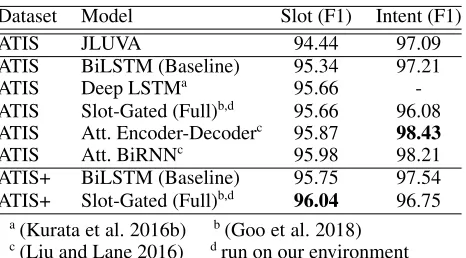
Table 4: Comparisons of the best slot filling and intent de-tection results for the ATIS dataset.
terministic encoder-decoder model (Seq2Seq) proposed in (Kurata, Xiang, and Zhou 2016a). The two decoders of the model learn to decode utterances and slot labels from an en-coded representation of the utterance.
For the full dataset, we conduct the standard experiments withNG= 3, NL= 3andm= 10000, synthetic dataset size.
For small and medium datasets, each experiment is repeated
NL = 3 times forallNT training splits. The final result is
aggregated fromNT×NLruns (i.e. 105 runs for ATIS-small
and 27 runs for ATIS-medium). Results are presented in 2. According to the results, our approach performed better than all other baselines at the statistically significant level for small and medium datasets. The performance gain of our approach diminishes for the full dataset. This is likely due to the homogeneous nature of the ATIS dataset, leav-ing little room for the GDA to explore. Although we could not achieve statistically significant improvement on the full dataset, we note that our approach never experiences perfor-mance degradation for any dataset size and evaluation mea-sure.
GDA on Other SLU Models and Datasets We test GDA with various combinations of SLU models and datasets (Ta-ble 3). There were statistically significant improvements in language understanding performances across most datasets and SLU models. Comparing these results with the data scarcity results in Table 2, we observe two trends: (1) the more difficult the dataset is to model (e.g. MIT Movie Trivia) and (2) the more expressive the SLU model, the more drastic the improvements are. For example, the improvement rate between ATIS and ATIS+ for full attention-based Slot-Gated model was only 0.39%, whereas the improvement rate increased nearly ten-fold (3.54%) between MIT Movie Eng and MIT Movie Eng+ for the same model.
0.1 1 10 100 0
2 4 6
Synthetic to Real Data Ratio (r)
(a) Slot Filling
0.1 1 10 100 0
2 4
Synthetic to Real Data Ratio (r)
(b) Intent Classification
Figure 3: The impact of synthetic data to real data ratio on the relative improvements in SLU performance. The vertical axis shows the relative performance gains, compared to the non-augmented baseline (dashed horizontal lines). For each box plot, the height of the box depicts the variance and outer whiskers mark the minimum and the maximum.
Comparison to Other State-of-the-art Results
In this study, we compare the best LU performance achieved by our generative approach on the ATIS task to other state-of-the-art results in literature (Table 4). We chose the best performing run out of all runs carried out from the previ-ous experiments (NG = 3, NL = 3, m = 10000) and
re-port its results in Table 4. In the best case, our approach was able to boost the slot filling performance for the slot-gated (full) model by 0.38. Remarkably, our best results out-peformed more complex models, further supporting the idea of data-centric regularization. We also evaluate the SLU per-formance of JLUVA by performing deterministic inference (i.e.z=µ). We find that the LU performance by itself is not competitive. This eliminates the possibility that the perfor-mance gains in our approach are attributed to JLUVA being a more expressive model and therefore acting as a teacher network.
Ablation Studies
In the ablation studies, we carry out two separate compara-tive experiments on variations of our generacompara-tive model.
Sampling Methods The following sampling approaches are considered.
• Monte-Carlo Posterior Sampling (Ours):zis sampled from the empirical expectation of the model, which is esti-mated by inferring posteriors from random utterance sam-ples. (Algorithm 1)
• Standard Gaussian: z is sampled from the assumed prior, the standard multivariate Gaussian.
• Additive Sampling: First, the latent representationzwof
a random utterancewis sampled. Thenzwis disturbed by
a perturbation vectorα∼ U(−0.2,0.2). It was proposed for the deterministic model in (Kurata, Xiang, and Zhou 2016a).
The results in Table 2 confirm that exploratory Monte-Carlo sampling based on scaled posterior distribution (λs=
0.18) provides the greatest benefit to the language under-standing models for the ATIS and the data-scarce datasets. We note that the additive perturbation, despite its simplic-ity in nature, performs reasonably well compared to our ap-proach. This suggests the exploratory sampling approaches are not only limited to Gaussian distributions. On the other hand, over-simplified and biased approximation of the prior such as standard multivariate Gaussian, could rather cause performance degradation. This also highlights the fact that the choice of sampling approach has a significant impact on the generative quality and thereby the resulting perfor-mances.
Synthetic Data Ratio To gain further insights into genera-tive DA, we conduct regressional experiments to expose the underlying relationship between the relative synthetic data size and the performance improvements.
Letmbe the size of the synthetic dataset used to augment the original dataset of sizen. Thesynthetic to real data ra-tiorism/n. For each run, we conduct the standard experi-ment procedure (NG= 10, NL= 5) on a ATIS-small dataset
with JLUVA as the generative model and the simple BiL-STM as the SLU model. We repeat the experiments for all
r ∈ {0.08,0.78,1.56,3.90,7.81,15.6,39.06,78.13}. From the box plots of our results (Figure 3), we make two observa-tions. First, the maximum marginal improvement is achieved around 10≤ r ≤ 20for all evaluation measures. Also, the improvements appear to plateau around r = 50. Second, The variance starts off relatively small when r < 1, but it quickly grows asrincreases and peaks around5≤r≤20. The variance appears to shrink again afterr >20. A plausi-ble explanation for the apparent trend of the variance is that increasingr enhances the chance to generate performance-boosting key utterances, until no novel instances of such ut-terances are samplable from the generator, at which point further increasingronly increases the chance to generate al-ready known utterances, thereby reducing the variance. This also explains the plateauing phenomenon.
Conclusion
References
Al-Rfou, R.; Perozzi, B.; and Skiena, S. 2013. Polyglot: Distributed word representations for multilingual nlp. In CoNLL, 183–192.
Bowman, S. R.; Vilnis, L.; Vinyals, O.; Dai, A.; Jozefow-icz, R.; and Bengio, S. 2016. Generating sentences from a continuous space. InCoNLL, 10–21.
Chen, Y.-N.; Hakanni-T¨ur, D.; Tur, G.; Celikyilmaz, A.; Guo, J.; and Deng, L. 2016. Syntax or semantics? knowledge-guided joint semantic frame parsing. In SLT Workshop, 348–355.
Conneau, A.; Kiela, D.; Schwenk, H.; Barrault, L.; and Bor-des, A. 2017. Supervised learning of universal sentence representations from natural language inference data. In EMNLP, 670–680.
Dao, T.; Gu, A.; Ratner, A. J.; Smith, V.; De Sa, C.; and R´e, C. 2018. A kernel theory of modern data augmentation. arXiv preprint arXiv:1803.06084.
Fabius, O., and van Amersfoort, J. R. 2014. Variational recurrent auto-encoders. arXiv preprint arXiv:1412.6581. Fadaee, M.; Bisazza, A.; and Monz, C. 2017. Data augmen-tation for low-resource neural machine translation. InACL, volume 2, 567–573.
Fedus, W.; Goodfellow, I.; and Dai, A. M. 2018. Maskgan: Better text generation via filling in the . arXiv preprint arXiv:1801.07736.
Goo, C.-W.; Gao, G.; Hsu, Y.-K.; Huo, C.-L.; Chen, T.-C.; Hsu, K.-W.; and Chen, Y.-N. 2018. Slot-gated modeling for joint slot filling and intent prediction. InNAACL, volume 2, 753–757.
Goodfellow, I.; Pouget-Abadie, J.; Mirza, M.; Xu, B.; Warde-Farley, D.; Ozair, S.; Courville, A.; and Bengio, Y. 2014. Generative adversarial nets. InNIPS, 2672–2680. Guo, D.; Tur, G.; Yih, W.-t.; and Zweig, G. 2014. Joint se-mantic utterance classification and slot filling with recursive neural networks. InSLT Workshop, 554–559.
Hemphill, C. T.; Godfrey, J. J.; and Doddington, G. R. 1990. The atis spoken language systems pilot corpus. InThe Work-shop on Speech and Natural Language, 96–101.
Hou, Y.; Liu, Y.; Che, W.; and Liu, T. 2018. Sequence-to-sequence data augmentation for dialogue language under-standing. InICCL, 1234–1245.
Hu, Z.; Yang, Z.; Liang, X.; Salakhutdinov, R.; and Xing, E. P. 2017. Toward controlled generation of text. InICML, 1587–1596.
Huang, Z.; Xu, W.; and Yu, K. 2015. Bidirectional lstm-crf models for sequence tagging. arXiv preprint arXiv:1508.01991.
Ioffe, S., and Szegedy, C. 2015. Batch normalization: Accel-erating deep network training by reducing internal covariate shift. InICML, 448–456.
Kafle, K.; Yousefhussien, M.; and Kanan, C. 2017. Data augmentation for visual question answering. InINLG, 198– 202.
Kingma, D. P., and Ba, J. 2014. Adam: A method for stochastic optimization.arXiv preprint arXiv:1412.6980. Kingma, D. P., and Welling, M. 2013. Auto-encoding vari-ational bayes. arXiv preprint arXiv:1312.6114.
Krizhevsky, A.; Sutskever, I.; and Hinton, G. E. 2012. Imagenet classification with deep convolutional neural net-works. InNIPS, 1097–1105.
Kurata, G.; Xiang, B.; Zhou, B.; and Yu, M. 2016b. Lever-aging sentence-level information with encoder lstm for se-mantic slot filling. InEMNLP, 2077–2083.
Kurata, G.; Xiang, B.; and Zhou, B. 2016a. Labeled data generation with encoder-decoder lstm for semantic slot fill-ing. InINTERSPEECH, 725–729.
Lai, S.; Xu, L.; Liu, K.; and Zhao, J. 2015. Recurrent con-volutional neural networks for text classification. InAAAI, volume 333, 2267–2273.
Li, J.; Monroe, W.; Shi, T.; Jean, S.; Ritter, A.; and Jurafsky, D. 2017. Adversarial learning for neural dialogue genera-tion. InEMNLP, 2157–2169.
Liu, B., and Lane, I. 2016. Attention-based recurrent neural network models for joint intent detection and slot filling. In INTERSPEECH, 685–689.
Mesnil, G.; Dauphin, Y.; Yao, K.; Bengio, Y.; Deng, L.; Hakkani-Tur, D.; He, X.; Heck, L.; Tur, G.; Yu, D.; and Zweig, G. 2015. Using recurrent neural networks for slot filling in spoken language understanding. IEEE/ACM TASLP23:530–539.
Pan, S. J., and Yang, Q. 2010. A Survey on Transfer Learn-ing.IEEE TKDE22:1345–1359.
Pennington, J.; Socher, R.; and Manning, C. 2014. Glove: Global vectors for word representation. InEMNLP, 1532– 1543.
Ratner, A. J.; Ehrenberg, H.; Hussain, Z.; Dunnmon, J.; and R´e, C. 2017. Learning to compose domain-specific trans-formations for data augmentation. InNIPS, 3236–3246. Rezende, D. J.; Mohamed, S.; and Wierstra, D. 2014. Stochastic backpropagation and approximate inference in deep generative models. InICML, II–1278.
Serban, I. V.; Sordoni, A.; Lowe, R.; Charlin, L.; Pineau, J.; Courville, A. C.; and Bengio, Y. 2017. A hierarchical latent variable encoder-decoder model for generating dialogues. In AAAI, 3295–3301.
Shen, T.; Lei, T.; Barzilay, R.; and Jaakkola, T. 2017. Style transfer from non-parallel text by cross-alignment. InNIPS, 6830–6841.
Simard, P.; Steinkraus, D.; and Platt, J. 2003. Best practices for convolutional neural networks applied to visual docu-ment analysis. InICDAR, 958.
Srivastava, N.; Hinton, G.; Krizhevsky, A.; Sutskever, I.; and Salakhutdinov, R. 2014. Dropout: a simple way to prevent neural networks from overfitting.JMLR15(1):1929–1958. Torralba, A., and Efros, A. A. 2011. Unbiased look at dataset bias. InCVPR, 1521–1528.
Yao, K.; Peng, B.; Zhang, Y.; Yu, D.; Zweig, G.; and Shi, Y. 2014. Spoken language understanding using long short-term memory neural networks. InSLT Workshop, 189–194. Yu, L.; Zhang, W.; Wang, J.; and Yu, Y. 2017. Seqgan: Sequence generative adversarial nets with policy gradient. InAAAI, 2852–2858.