* Corresponding author.Tel.: (+98)9132835865; E-mail address:[email protected], (S. Salehi).
Journal Homepage: ijmge.ut.ac.ir
IJMGE 51-1 (2017) 91–96 DOI: 10.22059/ijmge.2017.218671.594635
The role of catalyst in chalcopyrite passivation during leaching
Soghra Salehi
a,*, Mohammad Noaparast
b, Seied Ziaeddin Shafaie
b.
a Department of Mining Engineering, Science and Research Branch, Islamic Azad University, Tehran, Iran.
bSchool of Mining Engineering, College of Engineering, University of Tehran, Iran.
ABSTRACT
This work presents an investigation on the chalcopyrite leaching under different conditions, and studies the surficial characteristics of chalcopyrite using Scanning Electron Microscope (SEM) to determine the composition of the passivation layer on the surface of chalcopyrite. The study of chalcopyrite dissolution was carried out in H2SO4 solution systems at pH of 1.2, with a chalcopyrite concentrate 5% in the redox potential of 460 mV at 90°C. The tests were meant to study the leaching of chalcopyrite in ferric sulfate solution to extract copper by adding pyrite, silver and silver coated pyrite. Using these approaches, the achieved recoveries were different. The results showed that in presence of pyrite, an elemental sulfur layer formed around chalcopyrite particles which hindered the complete dissolution of copper in chalcopyrite. No commercial process has been so far developed using silver as a catalyst to recover copper from chalcopyrite due to precipitation of argentojarosite which forms during the leaching process and limits the availability of silver ion as a catalyst. But, silver and pyrite assemblage to form silver coated pyrite caused an increase in dissolution. However, in presence of the pyrite coated silver, the leaching rate was very fast, and complete copper extraction was achieved within 10 hours.
Keywords : Chalcopyrite, passivation, pyrite, silver, SEM.
1.
Introduction
Copper has an increasing importance worldwide due to its use in construction and appliance industries [1]. Hydrometallurgical processes have been expanding in recent years for treatment of chalcopyrite concentrates [2]. These processes can be categorized based on the type of used lixiviant for extraction of copper from chalcopyrite. These processes are grouped as sulfate, chloride, sulfate - chloride, ammonia, and nitrogen processes. As described in literature, sulfate processes have the most established technology, due to the simplicity of their leaching reactions, low capital and operating costs, and the conventional SX/EW
[3, 4].
The chalcopyrite leaching reaction in this media is initially very rapid, but it decreases afterwards. It has been generally accepted that the main cause of low leaching efficiency of chalcopyrite in leaching process is formation of passivation layer which can inhibit the further dissolution of chalcopyrite [5, 6, 22]. The nature of these passivation layers has long been an argument. However, there are three different hypotheses to explain the structure of this impermeable layer. One theory suggests the formation of the sulfur layer which limits the oxidation reaction. Another hypothesis suggests the formation of a copper-rich polysulfide layer which develops on the surface, as a result of solid state changes to the mineral during leaching [7]. A third theory suggests that the passivation layer consists of iron salts [8]. Recently, it was found that in ferric sulfate media, adding pyrite to the system had performed as a catalyst and increased copper recovery. This process is Galvanox™[9]. It is strictly chemical and therefore requires no microbe. Fine grinding is not required in this process. Also, the operating temperature is low, and the chemical conditions are mild. When pyrite is present in the leach slurry, ferric reduction increases and this allows the system to maintain the solution potential within the active region of the mineral [10-13].
Chalcopyrite can be chemically activated by silver ions to improve its leaching ability under acid oxidizing conditions. Several authors have demonstrated the ability of silver to catalyze copper dissolution from chalcopyrite in chemical leaching systems [14-16]. Initially it was shown by Snell and Fords (1976), that copper extraction from chalcopyrite increased in ferric sulfate solution by addition of a soluble silver salt. In their study, it was claimed that the solid residue contained over 90% of the silver. The reaction occurred at temperatures between 95 and 110°C
[17].
Miller and Portillo (1979), proposed the first model to explain the catalytic effect of silver. Based on this model, the enhanced rate of leaching can be explained through formation of intermediate Ag2S film on chalcopyrite surface by an exchange reaction. They suggested that under these conditions, the elemental sulfur forms a non-protective reaction product on the Ag2S crystallites, in contrast to uncatalyzed ferric sulfate leaching in which a dense elemental sulfur layer forms on the mineral surface and acts as a diffusion barrier; thus delaying the oxidation of chalcopyrite by ferric ions [15]. The following reaction (equation 1) has been proposed for the silver catalyzed leaching of chalcopyrite:
CuFeS2 + 4Ag+ 2Ag2S (chalcopyrite surface) +Cu2++Fe2+ (1) In the presence of Fe3+, the silver sulfide film is oxidized to Ag+ and S0
(Equ. 2):
Ag2S+2Fe3+2Ag++2 Fe2+ + S0 (2) Nazari et al. (2012), investigated the addition of pyrite coated by silver, to enhance the catalytic properties of pyrite and to increase chalcopyrite leaching [17, 18]. Fe (ΙΙ) and Fe (ΙΙΙ) are often present in acidic ferric sulfate leaching solution of chalcopyrite. The immediate result of ferric precipitation is the reduction of available ferric oxidants in the obtained solution. However, iron and jarosite compounds are also connected to
Article History:
sulfur layer, based on the leaching conditions. There is still no direct evidence to show the consequential decrease in leaching rates [6, 19-22]. Despite the multiple researches on chalcopyrite leaching, the composition of passivation layer is not obvious [23].
In this paper, the morphology of chalcopyrite oxidized in the ferric sulfate leach solution is presented. The objective of this study was to acquire further understanding on chalcopyrite passivation, and to show the state of leaching process. Some polished sections of residue samples were prepared and were then examined by Scanning Electron Microscopy/Energy Dispersive X-Ray Spectroscopy (SEM/EDX) to determine the composition of the passive layer on the surface of chalcopyrite, under different CuFeS2 leach conditions. In the first step, the leaching of chalcopyrite was investigated in presence of pyrite and silver ions; then, in the second one, the leaching of chalcopyrite was examined in presence of pyrite coated by silver.
2.
Materials and methods
2.1.Pyrite and Chalcopyrite samples and their characterizations
The pyrite ore samples were collected from Meydook copper mine located in Kerman Province, Iran, and the samples were then crushed and ground down to -75 μm. A sample of copper concentrate was
obtained from the Sarcheshmeh copper flotation circuit (Kerman, Iran). The concentrate contained approximately 63% chalcopyrite with fewer amounts of pyrite (14%), iron oxides (7%) and siliceous gangue (5%). Of the particle size distribution of concentrate samples 90% was passing the 38 μm sieve. In Table 1, the results of chemical analysis of copper concentrate and pyrite samples are presented.
2.2.Preparation of silver-coated pyrite
In order to prepare pyrite particles coated by silver, 50 g of pyrite crystals were ground down to -75 μm which were then immersed into a 500ml solution containing the desired amount of silver nitrate solution. The pulp was then mixed using a magnetic stirrer at 500 rpm and 25 °C [17], for 4 hours. After treating the pyrite with silver ions, the solid residue was filtered and rinsed several times with water, to wash unreacted silver from the pyrite surfaces. The silver content in the solution was determined by atomic absorption spectroscopy.
2.3.Leach tests
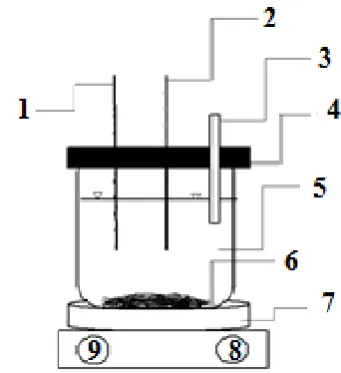
The leaching experiments were carried out in a stirring tank reactor containing 500 mL suspension at 5% pulp density (w/v) and initial pH of 1.2, using sulfuric acid with a purity of approximately 98%. After setting the pH, the solution was prepared with amounts of ferrous and ferric sulfate solutions, and H2O2 were added for reaching the desired redox potential (controlled in 460 mV vs Ag/AgCl at 25°C or 0.46 V vs SHE). The desired temperature was obtained by an electrical heater fixed at 80°C. Then, the concentrate and pyrite or pyrite coated by silver in ratio (Cp/Py or Py+Ag) of 1:2, were added to the reactor, and the stirring speed was maintained at 950 rpm. Afterwards, 5 ml pulp samples were taken periodically from the reactor and centrifuged for 3 min at 5000 rpm, to remove the solids. Samples were then assayed for copper
content by AAS. The leaching system is shown in Fig. 1.
Fig. 1. Schematic view of the leaching reactor: 1-termometer, 2- Eh probe, 3- Sampling system, 4- Blind, 5- Pulp, 6- Copper concentrate and pyrite samples, 7- Magnetic impeller, .8- Temp controller, 9- Impeller controller
In order to estimate the leaching efficiency of copper, a volume correction formula (Eq. 3) was used, which included correction factors in itself to account for the volume losses due to sampling [25].
1 1
( ) , ,
1 1
,
100
i i
V vi CM i v Ci M i
i i
X m i
C M m
(3)Where,
XM,i: Cu extraction corresponding to sample i
V: the initial volume of the leaching solution in the reactor (mL)
νi: the volume of sample i withdrawn from the reactor (mL) CM,i: the Cu concentration in sample i (mg/L)
m: the initial mass of the chalcopyrite in grams added into the reactor CM: the initial Cu percentage in the chalcopyrite.
2.4.Sample characterization
Also, the copper concentrate (feed) and the residues of leaching experiments were scrubbed, dried in an oven at 50°C for 7 hours, and analysed by X ray diffraction (XRD, Model?). The surface of materials were studied by a Scanning Electron Microscope (SEM, CamScan MW 2300) using a field emission electron gun operating at 20 keV. Prior to sample analysis, they were mounted and coated with a thin film of gold to ensure conductivity for imaging. The Energy Dispersive X-Ray Spectroscopy (EDX) was performedusing the CamScan software. The secondary electron images revealing morphological contrasts were also obtained. This technique allows resolution of surface features to a practical limit of about 1μm, facilitating the identification of pores, precipitates and areas of preferential reaction on the surface of particles.
Table 1. Chemical analyses of the representative sample of copper concentrate and pyrite.
Elements
(wt.%) Cu Fe S Si Zn Mg
Ag (ppm) copper
concentrate 25.21 29.58 25.51 2.75 0.93 0.54 36.6
Pyrite 0.13 45.43 50.62 1.28 - 0.04 21
3.
Results and discussion
3.1.Leaching analysis
S. Salehi et al. / Int. J. Min. & Geo-Eng. (IJMGE), 51-1 (2017) 91-96 93
In presence of pyrite, as a catalyst, after a few hours of reaction, dissolution occurs with a lower speed. Probably, formation of an elemental sulfur layer around chalcopyrite particles hindered the complete dissolution of copper from chalcopyrite. It is possible that the type of pyrite can be another reason for the decline of chalcopyrite dissolution. Nazari et al. (2012), indicated that pyrite samples from various sources influenced the rate of chalcopyrite leaching differently. While some of pyrite samples increased leaching, others had only a minor effect on the leaching rate [13, 27-29].
Also, no successful commercial process has been developed in presence of silver as a catalyst to recover copper from chalcopyrite. A fundamental problem is that the leaching reaction conditions limit the availability of silver ion in the leaching solution. The catalytic effect of silver increases by increasing the ferric concentration in the leaching solution; however, higher ferric concentrations favour the precipitation of argentojarosite.This reaction limits the availability of silver ion in solution which may act as a catalyst. Furthermore, once formed, it is difficult and expensive to re-dissolve this precipitate to recover the contained silver [26]. Hence, argentojarosite forming during the leaching process typically represents an irreversible loss of silver from the process. In the tests with pyrite and silver, complete copper extraction was not achieved.
However, in the presence of pyrite particles coated by silver the leaching process was very fast, and a relatively complete copper extraction was achieved within about 10 hours. The results of chalcopyrite sample leached in presence of pyrite coated by silver indicate the probable formation of a thin porous sulfur layer around chalcopyrite particles. In presence of pyrite coated by silver, the increase of the chalcopyrite dissolution is possibly due to the formation of silver sulfide film formed during chalcopyrite leaching in presence of pyrite coated by silver and indicates that there was no passivation.
Fig. 2. Leaching of chalcopyrite in ferric sulfate solution with pyrite ( ), silver ( ) and pyrite coated by silver ( ) in 460mV.
The test shown in Fig. 2 was repeated at 480 mV, and the results are shown in Fig. 3. In presence of pyrite coated by silver, faster leaching was observed at a redox potential of 460 mV than 480 mV. These results confirm the beneficial effect of lower solution potential, and also confirm the dramatic increase in both the rate and the extent of copper extraction in presence of pyrite coated by silver. An important reason to explain the faster kinetics of silver catalysed leaching at lower redox potential is decreasing or inhibiting jarosite formation. At lower redox potential, ferric concentration is lower which decreases jarosite and argentojarosite formation. As discussed earlier, once argentojarosite is formed, silver loses its catalytic properties[26].
Fig. 3. Leaching of chalcopyrite in ferric sulfate solution with pyrite ( ), silver ( ) and pyrite coated by silver ( ) in 480mV.
3.2.SEM/EDX analysis
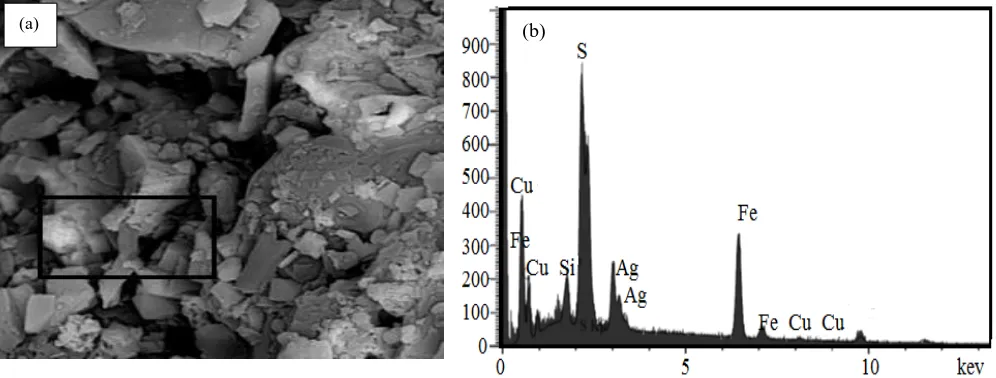
To investigate the different phases formed on the surface of chalcopyrite, SEM and EDX analyses were performed. The SEM images of leaching residues are shown in Fig. 4. Fig. 4a shows the SEM photomicrograph of chalcopyrite residue leached in presence of pyrite. This Figure clearly shows the presence of an elemental sulfur layer formed around the chalcopyrite particles that hindered the complete dissolution of copper in chalcopyrite. As shown, the surface of pyrite is also covered by sulfur layer. It seems that the decrease in chalcopyrite dissolution is not only the reason of elemental sulfur formation, but also is the reason of pyrite oxidation and the decline in amount of cathodic surface area, as well. The EDX data obtained from the diagram is given
in Fig. 4b. These results show that the sulfur peak is very high.
Fig. 5 (a, b), shows the SEM/EDX analysis on chalcopyrite residue
leached in presence of silver. This figure also shows the presence of an elemental sulfur layer formed around the chalcopyrite particles. Silver availability is affected by formation of precipitates during leaching. The catalytic effect of silver is increased as the ferric concentration increases. However, as ferric concentration increases, hydrolysis of ferric sulfate leads to formation of argentojarosite which limits the availability of silver.
Fig. 6 shows the SEM micrograph and the results of chalcopyrite
sample leached for 10 h in presence of pyrite coated by silver. Fig. 6a shows the porous sulfur layer formed around chalcopyrite particles. Therefore, the porous layer causes reagent to easily react with the surface of chalcopyrite, and the chalcopyrite dissolution is increased. EDX analysis is presented in Figure 6b that shows the residual copper content to be very low. The results confirm the presence of silver sulfide formed during chalcopyrite leaching in presence of pyrite coated by silver. Due to the formation of Ag2S film on chalcopyrite surface (Eq. 4), chalcopyrite leaching is enhanced. According to Eq.5, Ag2S in presence of Fe3+ is oxidized to Ag+ and S0[23]. The EDX analysis is shown in
Table 2.
CuFeS2 + 4 Ag+ = 2 Ag2S (chalcopyrite surface) + Cu2+ + Fe2+ (4)
Ag2S + 2 Fe3+ = 2 Ag+ + 2 Fe2+ + S0 (5)
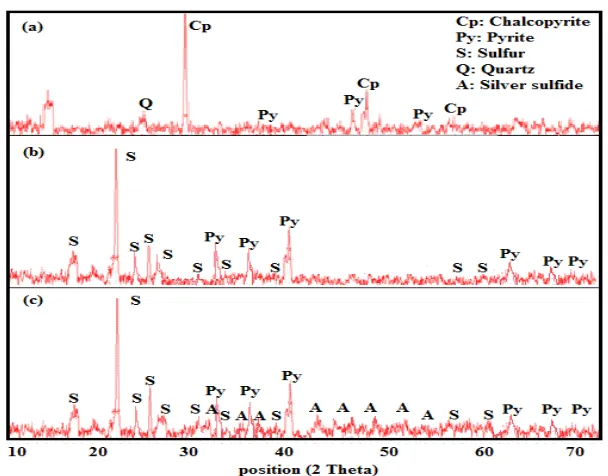
These analyses also provide further evidence regarding the presence of silver in sulfur layer. Also, XRD patterns of chalcopyrite concentrate, leaching residues from chalcopyrite in present of pyrite, and leaching residues from chalcopyrite in presence of pyrite coated by silver are shown in Fig. 7.
0 10 20 30 40 50 60 70 80 90 100
0 1 2 3 4 5 6 7 8 9 10
C u r ec o v er y ( % ) time (h) Py/Cp=0, Ag/Py=200 ppm Py/Cp=6, Ag/Py=0 0 10 20 30 40 50 60 70 80 90 100
0 2 4 6 8 10
Fig. 4. SEM micrograph (a) and EDX analyses (b) of leaching residues from chalcopyrite in presence of pyrite.
Fig. 5. SEM micrograph (a) and EDX analyses (b) of leaching residues from chalcopyrite in presence of silver.
Fig. 6. SEM micrograph (a) and EDX analyses (b) of leaching residues from chalcopyrite in presence of pyrite coated by silver.
(a) (b)
(a
)
(b)
S. Salehi et al. / Int. J. Min. & Geo-Eng. (IJMGE), 51-1 (2017) 91-96 95
Fig. 7. XRD patterns of (a) chalcopyrite concentrate (b) of leaching residues from chalcopyrite in present of pyrite, (c) of leaching residues from chalcopyrite in presence of pyrite coated by silver.
Table 2. Elemental analyses on selected area of chalcopyrite residue of silver coated pyrite leaching.
Elements Cu Fe S Al O2 Ag
(wt.%) 0.86 8.59 58.03 1.01 27.21 0.98
4.
Conclusion
In this research, silver, pyrite and silver coated pyrite leaching processes were compared. The catalytic ability of silver and pyrite to accelerate the kinetics of chalcopyrite leaching in ferric sulfate media is well known. Hence, it was necessary to evaluate the role of silver, pyrite and silver coated pyrite in this process. Under identical conditions, the same amount of silver was introduced to the leaching process in absence and presence of pyrite. It was observed that the rate of copper extraction in presence of pyrite was significantly higher. In addition, due to the high price of silver, evaluation of recycling silver is very important. Using silver coated pyrite, the addition is sufficient to ensure rapid and complete leaching of chalcopyrite.
SEM/EDX results showed that when pyrite was employed as catalyst, chalcopyrite leaching was low. This was due to sulfur formation around chalcopyrite particles which prevents enhancing the leaching rate. Albeit, using silver as catalyst, silver was lost through forming argentojarosite or silver sulfide, and it was not recoverable unless an additional series of inconvenient processes waere followed. In both two states, the formed passivation layers prevented the reaction of catalysts with chalcopyrite particles, and accordingly, decreased chalcopyrite extraction. However, in presence of silver coated pyrite as catalyst, the results indicated that silver reacted with sulfur, Ag2S was formed on the surface of chalcopyrite particles, and therefore, the chalcopyrite leaching rate was increased.
Acknowledgment
This research was performed with the help of Sarcheshmeh Copper Complex and the authors are grateful for their supports.
References
[1] Zhao, H.B., Wang, J., Qin, W.Q., Zheng, X.,Tao, L., Gan X.W. and Qiu, G.Z. (2015).Surface species of chalcopyrite during bioleaching by moderately thermophilic bacteria Trans. Nonferrous Met. Soc. China 25: 2725−2733.
[2] Roman, R.J. and Benner, B.R. (1973). The dissolution of copper concentrates. Miner. Sci. Eng., 5: 3-24
[3] Padilla, R., Pavez, P. and Ruiz, M.C. (2008). Kinetics of copper dissolution from sulfidized chalcopyrite at high pressures in H2SO4–O2. Hydrometallurgy, 91: 113-120.
[4] Qing You, L., Heping, L. and Li, Z. (2007). Study of galvanic interactions between pyrite and chalcopyrite in a flowing system: implications for the environment. Environmental Geology, (52): 11-8.
[5] Hackl, R.P.(1995). The leaching and passivation of chalcopyrite in acid sulfate media, PhD Thesis, University of British Columbia, Vancouver, BC, Canada.
[6] Hackl, R.P., Dreisinger, D.B., Peters, E. and King, J.A.(1995). Passivation of chalcopyrite during oxidative leaching in sulfate media. Hydrometallurgy. 39: 25–48.
[7] McMillan, R.S., MacKinnon, D.J. and Dutrizac, J.E. (1982). Anodic dissolution of n-type and p-type chalcopyrite. J. Appl. Electro. chem. 12: 743–757.
[8] Pinches, A., Al- Jaid, F.O. and Williams, D.J.A. (1976). Leaching of chalcopyrite concentrates with thiobacillus ferro oxidans in batch culture. Hydrometallurgy. 2: 87–103.
[9] Dixon et al., (2008), Enhancing the kinetics of chalcopyrite leaching in the Galvanox™ process
[10] Koleini, S.M.J., Aghazadeh, V. and Sandstrom, A. (2011). Acidic sulphate leaching of chalcopyrite concentrates in presence of pyrite. Minerals Engineering, 24: 381-386.
[12] Nazari, G., Dixon, D.G. and Dreisinger, D.B. (2011). Enhancing the kinetics of chalcopyrite leaching in the Galvanox™ process. Hydrometallurgy. 105: pp. 251-258.
[13] Nazari, G., Dixon, D.G. and Dreisinger, D.B. (2012). The role of silver-enhanced pyrite in enhancing the electrical conductivity of sulfur product layer during chalcopyrite leaching in the Galvanox™ process. Hydrometallurgy. 113-114: 177-184.
[14] Banerjee, P.C., Chakrabarti, B.K., Bhattacharyya, S. and Das, A. (1990).Silver catalyzed hydrometallurgical extraction of copper from sulfide ores from Indian Mines. Hydrometallurgy. 25: 349– 355.
[15] Miller, J.D., McDonough, P.J. and Portillo, H.Q. (1981). Electrochemistry in silver catalyzed ferric sulfate leaching of chalcopyrite. In: Process and Fundamental Considerations of Selected Hydrometallurgical Systems (Editor: Kuhn, M.C.), SME-AIME, New York, 327–338.
[16] Price, D.W. and Warren, G.W. (1986). The influence of silver ion on the electrochemical response of chalcopyrite and other mineral sulfide electrodes in sulfuric acid. Hydrometallurgy 15: 303–324. [17] Cooney, C.L. Kplov, H.M. and Haeggstroem, M. (1981). Transient
Phenomena in Continuous Culture, In Continuous Cultures of Cells. P.H. Calcott (Ed.), CRC Press Inc. Boca Raton (Florida), 1: 143-168.
[18] Ghahremanizadeh, A., Rebecca Radzinski, R., Gheorghiu, T., Dixon, DG. and Asselin, E. (2015). A model for silver ion catalysis of chalcopyrite (CuFeS2) dissolution. Hydrometallurgy. 155: 95– 104.
[19] Braithwaite, J.W. and Wadsworth, M.E. (1976). Oxidation of chalcopyrite under simulated conditions of deep solution mining. In Extractive Metallurgy of Copper, vol II. J.C. Yannopoulos and J.C. Agarwal (Eds.), TMS-AIME: New York, pp. 725-775. [20]Tuovien, O.H.(1990). Biological fundamentals of mineral leaching
process, In microbial mineral recovery. H.L. Ehrlich and C.L. Brierley (Eds.), McGraw-Hill Publishing company: New York., pp. 55-77.
[21] Yen Lai, J.C. (1997). Fundamental study of the controlled-potential leaching of chalcopyrite., B.Sc. (Hon.) Thesis, University of British Columbia, Vancouver, BC, Canada.
[22]Klauber, C., Parker, A., van Bronswijk, W. and Watling, H., (2001). Sulphur speciation of leached chalcopyrite surfaces as determined by X-ray photoelectron spectroscopy. Int. J. Miner. Process. 62: 65– 94.
[23]Miller, J.D. and Portillo, H.Q. (1979). Silver catalysis in ferric sulfate leaching ofchalcopyrite. Mineral Processing. Editor: J. Laskowski. XIII InternationalMin. Proc. Conf. Elsevier, Amsterdam, 851–901. [24]Zhao H.B., Wang J., Qin, W.Q., Hu, M.H., Zhu S. and Qiu, G.Z.
(2015). Electrochemical dissolution process of chalcopyrite in the presenceof mesophilic microorganisms [J]. Minerals Engineering, 71: 159−169.
[25]Georgiou, D. and Papangelakis, V.G.(1998). Sulfuric Acid Pressure Leachingof a Limonitic Laterite: Chemistry and Kinetics. Hydrometallurgy. 49, 23.
[26]Cordoba, E.M., Munoz, J.A., Blázquez, M.L., González, F., Ballester, A., 2008b. Leaching of chalcopyrite with ferric ion. Part II: Effect of redox potential. Hydrometallurgy 93, 88–96.
[27]Tshilombo, A. F. 2004. Mechanism and kinetics of chalcopyrite passivation and depassivation during ferric and microbial leaching solutions. PhD Thesis, The University of British Columbia, Vancouver, BC, Canada.
[28]Eghbalnia, M., Dixon, D.G. 2011. Electrochemical study of leached chalcopyrite using solid paraffin-based carbon paste electrodes. Hydrometallurgy 110, 1–12.