Available Online At www.ijpret.com
INTERNATIONAL JOURNAL OF PURE AND
APPLIED RESEARCH IN ENGINEERING AND
TECHNOLOGY
A PATH FOR HORIZING YOUR INNOVATIVE WORK
REALISTIC SIMULATION FOR COMPARISON OF NETWORK ROUTING
PROTOCOL IN VANET
KAPIL S. ZADE1, PROF. BEERTHI SAHADEV2, SAKEEB H. SHEIKH3
1. M-tech, Department of Computer Science & Engineering, Vivekanand Institute of
Technology & Science.
2. M-tech, Department of Computer Science & Engineering, Vivekanand Institute of
Technology & Science.
3. B.E., Department of Computer Science & Engineering, Chandrapur Polytechnic Chandrapur.
I.INTRODUCTION
Accepted Date:
27/02/2013
Publish Date:
01/04/2013
Keywords
VANETs, AODV, DSR, DSDV, NS2, ITS
Corresponding Author Mr. Kapil S. Zade
Abstract
Available Online At www.ijpret.com In the recent years, vehicular networking
has gained a lot of popularity among the
industry and academic research community
and is seen to be the most valuable concept
for improving efficiency and safety for
future transportations. A Vehicular Ad-Hoc
network is a form of Mobile ad-hoc
Networks, to provide communication
among nearby vehicles and between
vehicles and nearby fixed equipment i.e.
roadside equipment. The main goal of
VANET is providing safety and comfort for
passengers. The important factors that
would influence the adoption of VANET
architecture for future vehicular
applications would be - Low latency
requirements for safety applications
Extensive growth of interactive and
multimedia applications Increasing
concerns about privacy and security Each
vehicle equipped with VANET device will be
a node in the Ad-hoc network and can
receive & relay other messages through the
wireless network. Collision warning, Road
signal arms and in place traffic view will give
the driver essential tool to decide the best
path along the way. The V2V
communication infrastructure assumes the
presence of high bandwidth with low
latency. VANET or Intelligent Vehicular
Ad-Hoc Networking provides an intelligent way
of using vehicular Networking. A VANET
overview can be seen in Fig. 1.[1]
Fig. 1. VANET Scenario [1]
In this paper, we are trying to analyze the
performance of two highly adopted ad-hoc
routing protocols AODV, DSR and DSDV
using the various parameters such as
throughput, packets dropped and
simulation time by taking the different node
densities of 10 to 30 nodes. The
performance of the proposed protocol has
been studied using simulation tools mainly
Network Simulator (NS) and MOVE
(MObility model generator for VEhicular
networks) over SUMO (Simulation of Urban
Available Online At www.ijpret.com II. RELETED WORK
Vijaya et. al [1] compares the performance
of two prominent on- demand reactive
protocols for mobile ad-hoc networks: DSR
and AODV with traditional proactive DSDV
protocol. The network performance such as
throughput delivery ratio and end-to-end
delay carried out using NS2 simulator. Anuj
K. Gupta et. al. [2] is subjected to the
on-demand routing protocols with identical
loads and environment conditions and
evaluates their relative performance with
respect to the two performance metrics:
average End-to-End delay and packet
delivery ratio and investigates various
simulation scenarios with varying pause
times. Using the latest simulation
environment NS 2, it evaluates the
performance of three widely used ad-hoc
network routing protocols using
packet-level simulation. Singh Annapurna et. al. [3]
compares the performance of three
on-demand routing protocol i.e. DSR, DSDV and
TORA for MANET by varying the size of the
networks. The performance metrics used
are Total traffic received, Traffic Load,
Throughput, Number of Hops per route and
Route Discovery time. The simula- tor used
is OPNET simulator. Mohd. Izuan Mohd
Saad et. al.[4] studied the effect of the
different mobile node movement pattern in
random-based mobility model group
(Random Waypoint Mobility Model,
Random Walk Mobility Model and Random
Direction Mobil- ity Model)on the
performance of Ad-hoc On-demand
Distance Vector (AODV). To evaluate the
performance, a detail simulation was
conducted using the discrete-event
simulator OMNeT++. Azizol Abdullah et. al.
[6] compares three ad-hoc routing
protocols named DSDV, DSR and AODV
using NS2 simulator. Simulation results
show that when number of nodes
participating in the net- work is increased,
packet delivery fraction of data packet
delivered by all the protocols will become
lesser. M.Sulleman Memon et. al. [5]
contributes an effort towards anthology of
one of the major segment of routing
protocols i.e. unicast, their categories and
the main type of unicast routing protocols
such as DSDV from proac- tive plus DSR
from reactive. Muazzam Ali Khan Khattak
et. al. [6] analyze different performance
Available Online At www.ijpret.com network routing protocols (AODV, DSDV,
DSR) with varying node density and velocity,
under reliable TCP and unreliable UDP
transport layer protocols. From simulation
results it is observed that each protocol
perform in different way with different
node density and velocity. Comparing result
for both UDP and TCP, it concludes that all
the protocols perform well under TCP as far
as packets received are concerned.
III. ROUTING PROTOCOLS
In VANET, the routing protocols are
classified into two categories: Topology
based and Position based Routing
Protocols. Topology based routing protocols
use links information that exist in the
network to perform packet forwarding.
They are further divided into Proactive and
Reactive. The proactive routing means that
the routing information such as next
forwarding hope is maintained in the
background irrespective of communication
requests. Reactive Routing Protocols
implement route determination on a
demand or need basis and maintain only
the routes that are currently in use, thereby
reducing the burden on the network when
only a subset of available routes is in use at
any time [7]. Position based routing
Protocols share the property of using
geographic positioning information in order
to select the next forwarding hops. In our
simulation, we have used two Reactive
Routing Protocols, namely AODV, DSR and
one Proactive Protocols, namely DSDV.
A. AODV
The Ad hoc On-Demand Distance Vector
(AODV) [8] is an on-demand routing
protocol which does not maintain routes
from every node to every other node in the
network rather they are discovered as and
when needed & are maintained only as long
as they are required. AODV algorithm
enables dynamic, self-starting, multi-hop
routing between participating mobile nodes
wishing to establish and maintain an ad hoc
network. AODV maintains and uses an
efficient method of routing that reduces
network load by broadcasting route
discovery mechanism and by dynamically
updating routing information at each
intermediate node. AODV initiates a route
discovery process using Route Request
Available Online At www.ijpret.com node will create a RREQ packet containing
its IP address, its current sequence number,
the destination’s IP address, the
destination’s last sequence number and
broadcast ID. To process the RREQ, the
node sets up a reverse route entry for the
source node in its route table. This helps to
know how to forward a RREP to the source.
When the destination node or an
intermediate node with a route to the
destination receives the RREQ, it creates
the RREP and unicast the same towards the
source node using the node from which it
received the RREQ as the next hop. When
the RREP reaches the source node, it means
a route from source to the destination has
been established and the source node can
begin the data transmission. If the RREQ is
lost during transmission, the source node is
allowed to broadcast again using route
discovery mechanism. It favours the least
congested route instead of the shortest
route and it also supports both unicast and
multicast packet transmissions even for
nodes in constant movement.
B. DSR
Dynamic source routing (DSR) [9] protocol is
one of the example of an on-demand
routing protocol that is based on the
concept of source routing. The DSR network
is totally self organizing and self configuring.
DSR uses no periodic routing messages like
AODV, thereby reduces network bandwidth
overhead, conserves battery power and
avoids large routing updates. The DSR
routing protocol discovers routes and
maintains information regarding the routes
from one node to other by using two main
mechanisms: route discovery and route
maintenance. The DSR regularly updates its
route cache for the sake of new available
easy routes. Route Discovery is the
mechanism by which a node S wishing to
send a packet to a destination node D
obtains a source route to D. Route
Discovery is used only when S attempts to
send a packet to D and does not already
know a route to D. Route Maintenance is
the mechanism by which node S is able to
detect, with the help of a source route to D,
if the network topology has changed such
that it can no longer use its route to D
because a link along the route no longer
Available Online At www.ijpret.com source and destination, the source node
tries to find another route to the
destination or invokes Route Discovery DSR
has a unique advantage of source routing.
As the route is part of the packet itself,
routing loops, either short – lived or long –
lived, cannot be formed as they can be
immediately detected and eliminated. The
packet in DSR carries all information
pertaining to route in its preamble (header)
thus permitting the intermediate nodes to
cache the routing information in their route
tables for their future use.
III. RESEARCH METHODOLOGY USED
The scenarios used for analysis, simulation
setup, performance metrics used for
making various comparisons are discussed
in this section. A. Simulation Tools To carry
out the experiments in this paper, MOVE
along with SUMO and NS2 is used. 1) Move:
A tool MOVE (Mobility model generator for
Vehicular networks) [11], [12] to facilitate
users to rapidly generate realistic mobility
models for VANET simulations. MOVE is
currently implemented in java and is built
on top of an open source micro-traffic
simulator SUMO. By providing a set of
Graphical User Interfaces that automate the
simulation script generation, MOVE allows
the user to quickly generate realistic
simulation scenarios without the hassle of
writing simulation scripts as well as learning
about the internal details of the simulator.
The output of MOVE is a mobility trace file
that contains information about realistic
vehicle movements which can be
immediately used by popular simulation
tools such as ns-2. The architecture of
MOVE is shown in Fig. 2. The two main
function of MOVE are: MAP Editor Vehicle
Movement Editor the Map Editor is used to
create the road topology. Currently our
implementation provides three different
ways to create the road map – the map can
be manually created by the user, generated
automatically, or imported from existing
real world maps such as publicly available
TIGER [13]. We have also integrated Google
Earth into MOVE to facilitate the creation of
nodes in a realistic setting. The Vehicle
Movement Editor allows the user to specify
the trips of vehicles and the route that each
vehicle will take for one particular trip.
2) Sumo: “Simulation of Urban MObility"
Available Online At www.ijpret.com
portable, microscopic road traffic
simulation package designed to handle
large road networks. It allows the user to
build a customized road topology, in
addition to the import of different
readymade map formats of many cities and
towns of the world.
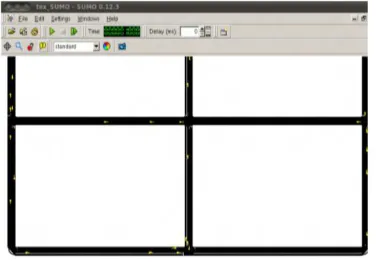
Fig. 2. shows SUMO visualization.
3) NS2: The Network Simulator (ns2) [15] is
a discrete event driven simulator developed
at UC Berkeley. We are using Network
Simulator NS2 for simulations of protocols.
It provides substantial support for
simulation of TCP, routing and multicast
protocols over wired and wireless networks.
Ns- 2 code is written either in C++ and OTCL
and is kept in a separate file that is
executed by OTCL interpreter, thus
generating an output file for NAM (Network
animator) [16]. It then plots the nodes in a
position defined by the code script and
exhibits the output of the nodes
communicating with each other. It consists
of two simulation tools. The network
simulator (ns) contains all commonly used
IP protocols. The network animator (NAM)
is use to visualize the simulations. It is
packaged with a bundle of rich libraries for
simulating wireless networks. All the mobile
nodes in NS-2 quickly assume that they are
the part of Ad-hoc network and the
simulation mobile nodes connected with
infrastructure networks are not really
possible. For this study three performance
metrics are selected namely:-
1)Throughput: Throughput describes as the
total number of received packets at the
destination out of total transmitted
packets. It is the average rate of successful
message delivery over a communication
channel. It is the number of received
packets per TIL (Time Interval Length). This
data may be delivered over a physical or
logical link, or pass through a certain
network node. The throughput is usually
measured in bits per second (bit/s or bps),
and sometimes in data packets per second
Available Online At www.ijpret.com (TIL). Total no. of received packets at
destination *
Packet size
T = ---
Total simulation time
2) Packets Dropped: The number of
packets dropped at a given instance of
time in the simulation run determines
the efficiency of the protocol. The reason
for packet drop may arise due to
congestion, faulty hardware and queue
overflow etc.
3) Simulation Time: It describes the total
time taken by the simulator NS-2 to
simulate the individual routing protocol.
IV. NS2 SIMULATON RESULT FOR VANET
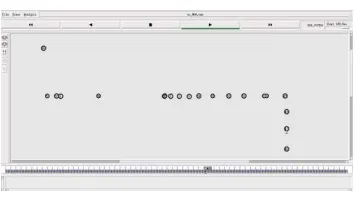
Fig. 3. shows NS2 visualization.
V CONCLUSION
This work mainly consists of two studies,
one is analytical study and other is
simulation study. From analytical study it is
concluded that routing protocols in new
modern arena of telecommunications,
internet systems and in seamless
communication play prominent role to
develop better communication between
end users. The selection of suitable
protocol according to the network
definitely increases the reliability of that
network. The simulation study consisted
of three routing protocols AODV, DSR and
DSDV, analyzing their behavior with
respect to three parameters, Throughput,
Packets Drop rate and Simulation Time.
The motive was to check the performance
of these three routing protocols in VANET
in the above mentioned parameters.
REFERENCES
1. Vijaya, Amiya kumar Rath, Pinak Bhusan
Mishra, Amulya Ratna Dash (2011) 2nd
international conference on Emerging
Applications of Information technology,
IEEE.
2. Anuj K. Gupta, Anil K. Verma, Harsh
Sadawarti (2010) IACSIT International
Available Online At www.ijpret.com
3. Singh Annapurna and Mishra Shailendra
(2010) International journal of Computer
Science and Network Security, 10(8).
4. Md. Izuan Mohd Saad, Zuriati Ahmad
Zukarnain (2009) Eu- ropea Journal of
Scientific Research, 32(4), 444-454.
5. Md. Sulleman Memon Manzoor
Hashmani (2008) A Review For
Uniqueness And Variations In Throughput
Of MANET Routing Protocol Due To
Performance Metrics, Characteristics And
Simulation Environments, 7(5).
6. Kapang Lego, Pranav Kumar Singh,
Depankar Sutradhar, (2004) Indian Journal
of Computer Science and Engineering, 1(4),
364-371.
7. Kevin C. Lee, Uichin Lee, Mario
Gerla,“Survey of Routing Protocols in
Vehicular Ad Hoc Networks”,
RoutingBookChapterKLULMario.pdf.
8. Perkins Charles E., Royer Elizabeth M.,
“Ad-hoc on-demand distance vector
routing”, the proceedings of Second IEEE
Workshop on Mobile Computing Systems
and Applications, WMCSA '99, pp. 90-100,
25-26 Feb. 1999.
9. Johnson, D. B. and Maltz, D. A. (1996),
“Dynamic Source Routing in Ad Hoc
Wireless Networks,” Mobile Computing, T.
Imielinski and H. Korth, Eds., Ch. 5, Kluwer,
1996, pp. 153–81.
10. Md. Izuan Mohd Saad, Zuriati
Ahmad Zukarnain (2009) Eu- ropea Journal
of Scientific Research, 32(4), 444-454.
11. MOVE
http://www.cs.unsw.edu.au/klan/move/.
12. Rapid Generation of Realistic
Simulation for VANET Manual Updated 11
November 2009. Available at:
http://www.lens1.csie.ncku.edu.tw/MOVE/
Example%20for% 20step-by-step.pdf.
13. U.S. Census Bureau – Topologically
Integrated Geographic Encoding and
Referencing (TIGER) system,
http://www.census.gov/geo/www/tiger.
14.SUMO http://sumo.sourceforge.net/
15.The Network Simulator ns-2.
http://www.isi.edu/nsnam/ns/index.html.
16.NAM Network Animator.
![Fig. 1. VANET Scenario [1]](https://thumb-us.123doks.com/thumbv2/123dok_us/8757689.1750382/2.595.318.502.232.393/fig-vanet-scenario.webp)