4191 METHOD DEVELOPMENT AND VALIDATION OF ANASTROZOLE IN TABLET
DOSAGE FORM BY RP-HPLC METHOD
Divya T1*, Pavani B1 and Lakshmi Keerthi P2
1Assistant Professor, Department of Pharmaceutical Analysis, Vasavi Institute of Pharmaceutical Sciences, Kadapa, A.P.,India
2Assistant Professor, Dept. of Pharmaceutical Analysis, Bhaskar College of Pharmacy, Moinabad, Vikarabad, Hyderabad
*Corresponding author E-mail: [email protected]
ARTICLE INFO ABSTRACT
Key Words
Anastrazole , RP-HPLC, Validation
A new, simple, accurate and precise reversed phase high performance liquid chromatographic method was for method development and validation of Anastrazole. The method was based on reversed phase liquid chromatography and separation was achieved on a Water’s Inertsil ODS C18 150×4.6 mm 5µ column. The Eluent was monitored by measuring the absorbance at wavelength 215 nm using a mixture of water and acetonitrile in the ratio of 60:40 (v/v) at pH 4 with a flow rate of 1.0 mL min-1. The Calibration curves were found to be linear in the concentration range of 16-60 μg mL-1 for Anastrazole. The proposed method was validated by testing for its linearity, recovery, precision and it was successfully employed for the rapid, specific and sensitive estimation of Anastrazole
INTRODUCTION:
Many breast cancers have estrogen receptors and growth of these tumors can be stimulated by estrogens. In post-menopausal women, the principal source of circulating estrogen (primarily estradiol) is conversion of adrenally-generated androstenedione to estrone by aromatase in peripheral tissues, such as adipose tissue, with further
conversion of estrone to estradiol.
Anastrozole is a potent and selective non-steroidal aromatase inhibitor [1-3]. It
significantly lowers serum estradiol
concentrations. As less estrogen reaches the cancer cells, they grow more slowly or stop growing altogether. It is used in the treatment of breast cancer after surgery, as well as for metastasis in both pre and post-menopausal women. It is also used as
Adjuvant treatment (After surgery) of postmenopausal women with hormone receptor-positive early breast cancer (cancer that has not spread), to reduce the chance of the cancer coming back. It is used in first line treatment of postmenopausal women with hormone receptor-positive or hormone receptor unknown locally advanced or metastatic breast cancer. Anastrozole offers no clinical benefit to premenopausal women with breast cancer. Anastrazole is well absorbed into the systemic circulation with 83 to 85% of the radiolabel recovered in urine and feces [4]. Food does not affect the extent of absorption. Elimination of Anastrazole is primarily via hepatic metabolism (approximately 85%) and to a lesser extent, renal excretion (approximately
An Elsevier Indexed Journal ISSN-2230-7346
4192 11%), and Anastrazole has a mean terminal
elimination half-life of approximately 50 hours in postmenopausal women. A group of scientists employed different optical spectroscopic techniques viz., fluorescence, FTIR, circular dichroism (CD) and UV-vis absorption spectroscopy to investigate the mechanism of interaction of an anticancer drug, Anastrozole (AZ) with transport proteins viz., bovine serum albumin (BSA) and human serum albumin (HAS) [5,6]. The drug, AZ quenched the intrinsic fluorescence of protein and the analysis of results revealed the presence of dynamic quenching mechanism [7]. A simple and sensitive
analytical method for simultaneous
determination of anastrozole, bicalutamide, and tamoxifen as well as their synthetic
impurities, anastrozole pentamethyl,
bicalutamide 3-fluoro-isomer, and tamoxifen e-isomer, was developed and validated by
using high performance liquid
chromatography (HPLC) [8]. A rapid, simple and specific method for estimation of anastrazole in human plasma was validated using Letrozole as internal standard.
Fig 1: Structure of anastrozole
MATERIALS AND METHODS:
EXPERIMENTAL INSTRUMENTATION:
The HPLC system consisted of a LC Waters (Waters, Milford, MA, USA) using a Water’s Inertsil ODS C18 150×4.6 mm 5µ column. The system was equipped with a photodiode array detector (Water, 2965 model) and auto sampler (Waters, model 717 plus). Data was processed using Empower Pro software (Waters, Milford, MA, USA). The mobile phase was pumped at a flow rate of 0.000 to 1.500ml/min. RT’s were observed for Anisatrazole
CHEMICALS AND REAGENTS
Acetonitrile grade and Milli Q water
supplied by Merck and Reference standards of Anastrozole were kindly supplied by Celon laboratories, Hyderabad, India with purity of 90-110%. Sample i.e., Armilon were kindly supplied by Celon laboratories, Hyderabad, India
PREPARATION OF MOBILE PHASE (60:40) V/V
Measure and transfer separately 600ml of Water and 400ml of Acetonitrile to a reagent bottle. Mix well, Sonicate for about 10mins and filter through a 0.45µ membrane filter.
PREPARATION OF NEEDLE WASHES SOLUTION
Measure and transfer separately 500ml of Acetonitrile and 500ml of Water to an appropriately sized reagent bottle. Mix well, Sonicate for about 10 mins.
METHOD DEVELOPMENT AND OPTIMISATION OF
CHROMATOGRAPHIC CONDITIONS:
SELECTION OF WAVELENGTH
Selection of wavelength (λmax)
should be performed in order to determine
the wavelength at which maximum
absorbance is observed. The drug solution was scanned at 190 to 700nm [9].The maximum absorbance (λmax) was found at
215nm, which is used for the present study.
MOBILE PHASE:
Mobile Phase was prepared by taking Water and Acetonitrile in the ratio 60:40. Then it was filtered and degassed.
METHOD DEVELOPMENT:
Mobile Phase: Water: Acetonitrile (60:40)
Flow rate: 1.5ml/min
Wavelength: 215nm
Column: Inertsil ODS C18 150×4.6 mm 5µ
Injection volume: 20µl
Mode : Isocratic
4193 PREPARATION OF STANDARD
SOLUTION
Transfer accurately about 40mg of standard into a 100ml volumetric flask. Add 50ml of diluent and dissolve. Then make upto the mark with the diluent.Take 5ml of the resulting solution and make upto 50 ml with the diluent to obtain a concentration of 40µg/ml.
PREPARATION OF SAMPLE SOLUTION
Take 20 tablets and crush them. Transfer an amount equivalent to 4 tablets into a 100ml volumetric flask.To it add about 50ml of diluent and sonicate for about 15minutes.Then dilute it upto the mark with the diluent to obtain a concentration of 40µg/ml.
PREPARATION OF PLACEBO
Weigh and transfer accurately
placebo equivalent to 4mg of Anastrozole into a 100ml volumetric flask. Add about 50ml of diluent and sonicate for about 15minutes with occasional stirring. Make the solution upto the mark with the diluent.
PREPARATION OF STOCK SOLUTION
Weigh and transfer accurately 40mg of Anastrozole standard into a 100ml volumetric flask. To it add about 70ml of diluent to dissolve and make upto the mark with the diluent and sonicate well.
QUANTITATIVE DETERMINATION OF THE DRUG BY USING THE
DEVELOPED METHOD
SAMPLE: ANASTROZOLE
VALIDATION
Typical validation characteristics which
should be considered are Linearity,
Accuracy, Precision, and Robustness. After method development, the validation of the current method has been performed in accordance with USP requirements for assay determination which include accuracy, precision, selectivity, linearity, range, robustness and ruggedness.[10,11]
Accuracy Formula:
Percentage recovery = amount recovered /actual amount added X 100 Acceptance criteria
Percentage recovery in all the cases should be between 98.0 and 102.0 %. Precision:
System Precision
Method Precision
Intermediate Precision % RSD Formula: (σ /μ) × 100
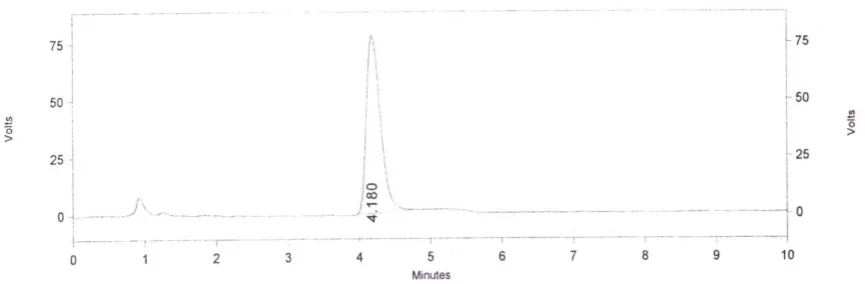
Specificity: Blank, placebo solution, standard and sample solutions were injected into the HPLC system. Anastrazole was homogenous and there was no interference at the retention time.
RESULTS
ACCURACY: The accuracy of a method is the closeness of the measured value to the true value for the sample. Accuracy is usually determined by recovery studies.
ROBUSTNESS
To establish the robustness of the HPLC method employed for analysis of Anastrozole tablets, the method was challenged for various parameters like effect of mobile phase flow, effect of wavelength change and effect of mobile phase
composition change [12-14]. The
observations in different conditions.
PRECISION
Repeatability: Six preparations of sample were prepared and injected into HPLC system.
SUMMARY AND DISCUSSION
4194
Peak shape was good. The peak is sharply resolved with less tailing and hence the trial-4 method is optimized for analysis.
Fig 2: Linearity plot of Anastrozole
Table 1: Accuracy of Anastrozole
Spiked Level Peak Area Amount
added (µg/ml)
Amount found (µg/ml)
% Mean recovery
80% Sample-1 854915 33.17 32.63 98.4
80% Sample-2 852592 33.17 32.54 98.1
80% Sample-3 851810 33.17 32.51 98.0
100%Sample-1 1065996 41.46 40.69 98.1
100% Sample-2 1099117 41.46 41.95 101.2
100%Sample-3 1091662 41.46 41.67 100.5
120%Sample-1 1323962 49.75 50.53 101.6
120%Sample-2 1274932 49.75 48.66 97.8
120%Sample-3 1278943 49.75 48.81 98.1
Mean 99.1
Std deviation 0.89
4195
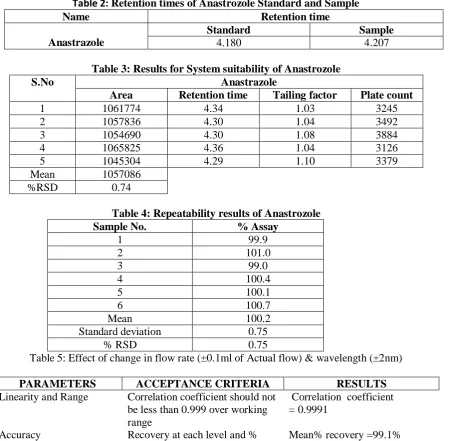
Table 2: Retention times of Anastrozole Standard and Sample
Name Retention time
Anastrazole
Standard Sample
4.180 4.207
Table 3: Results for System suitability of Anastrozole
S.No Anastrazole
Area Retention time Tailing factor Plate count
1 1061774 4.34 1.03 3245
2 1057836 4.30 1.04 3492
3 1054690 4.30 1.08 3884
4 1065825 4.36 1.04 3126
5 1045304 4.29 1.10 3379
Mean 1057086
%RSD 0.74
Table 4: Repeatability results of Anastrozole Sample No. % Assay
1 99.9
2 101.0
3 99.0
4 100.4
5 100.1
6 100.7
Mean 100.2
Standard deviation 0.75
% RSD 0.75
Table 5: Effect of change in flow rate (±0.1ml of Actual flow) & wavelength (±2nm)
PARAMETERS ACCEPTANCE CRITERIA RESULTS
Linearity and Range Correlation coefficient should not be less than 0.999 over working range
Correlation coefficient = 0.9991
Accuracy Recovery at each level and % mean recovery should be between 100% to 150% with % RSD should not be more than 2.0%
Mean% recovery =99.1% %RSD=0.89
Specificity There shouldn’t be interference from blank and main peak. (Active)
There is no interference from blank and sample peak
Precision (Repeatability) system & method precision
% RSD should not be more than 2.0%
Mean=100.2 %RSD=0.75
4196 In the method development of Anastrazole
project work carried out by incorporating the Reverse phase High Performance Liquid
Chromatography (HPLC). Finally the
method was developed & validated according to ICH guidelines for its various parameters.
CONCLUSION
The method was validated for system suitability, linearity, precision, accuracy, specificity, ruggedness, robustness and stability in analytical solution. The system suitability parameters were within limit, hence it was concluded that the system was suitable to perform the assay. The method shows linearity between the concentration ranges of 16-60 μg/ml for Anastrazole. The % Recovery of Anastrazole was found to be 98.2%, 99.9% and 99.2% for accuracy 80%, 100% and 120% samples respectively. As there was no interference due to excipients and mobile phase and good resolution peaks of Anastrazole was found, the method was found to be specific. The method was robust and rugged as observed from insignificant variation in the results of analysis by changes in Flow rate, organic composition in mobile phase. Good agreement was seen in
the assay results of pharmaceutical
formulation by developed method & it can be concluded that the proposed method was a good approach for obtaining reliable results and found to be suitable for the routine analysis of Anastrazole in Bulk & Pharmaceutical formulations.
REFERENCES:
1. BOCK MJ, Validated assay for the
quantification of Anastrozole in Human
plasma by Capillary Gas
Chromatography-63Ni Electron Capture Detection, J.Chromatoqr B., Biomed Sci
Appl. 700 (1-2):131-8 (1997).
2. Punith R, Spectral characterization of the binding and conformational changes of Serum albumins upon interaction with an
Anticancer drug, Anastrozole,
Spectrochim Acta A Mol Biomol
Spectrosc. 92:37-41 (2012).
3. Gomes FP, Development and validation
of a simple and sensitive High
performance liquid chromatographic
method for the simultaneous
determination of Anastrozole,
Bicalutamide, Tamoxifen and their
synthetic impurities, Talanta, 101:495-503 (2012).
4. Arvind, A simple, selective and rapid validated method for estimation of Anastrazole in Human plasma by Liquid
chromatography-Tandem mass
spectrometry and its application to
Bioequivalence study, Biomedical
Chromatography, Volume 24, Issue 7,
727-731 (2010).
5. Liang Meng, Determination of
Anastrozole in compound feed using HPLC, Journal of Agricultural Science
and Technology 2008-S2 (2008).
6. Reddy, LC and LC-MS/MS study of
forced decomposition behavior of
Anastrozole and establishment of
validated stability-indicating analytical method for impurities estimation in low dose Anastrozole tablets, Journal of
Pharmaceutical and Biomedical Analysis,
50(3):397-404 (2009).
7. Sitaram C, Determination and
characterization of degradation products of Anastrozole by LC-MS/MS and NMR Spectroscopy, Journal of Pharmaceutical
and biomedical analysis, 56:5, 962-8
(2011).
8. YuJ, Ultra performance liquid
chromatography - Tandem mass
spectrometry method for determination of Anastrozole in Human plasma and its application to a pharmacokinetic study,
Biomed Chromatoqr, 25 (4):511-6
(2011).
9. Daphal.V.N., Development and
validation of Simultaneous determination of Anastrozole and Temozolomide in
pharmaceutical dosage forms,
International Journal of Theoretical and
Applied sciences, 4(2):48-55(2012).
10.Sathis Kumar.D., Development and
validation of a HPLC method for determination of Anastrozole in tablet dosage form, E-Journals of Chemistry, 8(2), 794-797 (2011).
11.Sathis Kumar.D., Development and
4197 determination of Anastrozole in tablet
dosage form, E-Journals of Chemistry, 8(2), 794-797 (2011).
12.Satyannarayana P.V.V., Development and validation method for quantification of Anastrozole in formulation analysis by using RP-HPLC, International Journal of Research And Reviews In Pharmacy And
Applied Sciences, 1(2), 72-77 (2011).
13.Vinayak Daphal., Method validation and quantitative determination of Anastrozole in Human plasma by an CMS/MS,
Biological Forum-An International
Journal, 4(1):55-60(2012).
14.Srinivasulu.D, Reverse phase HPLC
method for the analysis of Anastrozole in
pharmaceutical dosage forms,
International Journal of Pharmacy and
Pharmaceutical Sciences, Vol 2, Suppl 2,
75-76 (2010).
15.Sathis Kumar.D., Development and
validation of spectrophotometric method for estimation of anastrozole bulk and
pharmaceutical dosage formulation,
International Journal of Advances in
Pharmaceutical Sciences, 1329-333
(2010).
16.Smita Sharma, UV spectrophotometric methods for estimation of Anastrozole bulk and tablet dosage form by derivative spectroscopy, Journal of Optoelectronics
and Biomedical Materials, Vol 2, Issue 4,
October-December 217-221 (2010).