Jianyong Zheng
1, C, D, F, Yanyan Xiao
1, E, F, Mei Chong
1, E, F, Yan Chen
1, E, F, Yong Yao
2, C, F,
Mei Jin
1, Yinglong Liu
1, E, F, Ling Han
1, A, E, FThe Effect of Cardiopulmonary Bypass Duration on
Renal Injury after Congenital Heart Surgery in Infants
and Young Children
Wpływ czasu trwania krążenia pozaustrojowego na uszkodzenie
nerek po leczeniu chirurgicznym wrodzonych wad serca u niemowląt
i małych dzieci
1 Department of Pediatric Cardiology and Cardiac Surgery, Beijing Anzhen Hospital, Capital Medical University,
Beijing, China
2 Department of Pediatric Nephrology, Peking University First Hospital, Beijing, China
A – research concept and design; B – collection and/or assembly of data; C – data analysis and interpretation;
D – writing the article; E – critical revision of the article; F – final approval of article; G – other
Abstract
Background. Improvements in surgical techniques and perioperative management mean that more complex car-diac procedures are being performed on very young patients.
Objectives. The aim of this study is to evaluate the effects of the duration of cardiopulmonary bypass (CPB) on renal injury after congenital heart surgery in infants and young children.
Material and Methods. 58 children with ages ≤ 3 years undergoing CPB surgery were divided into three groups according to the duration of their CPB: Group I was < 90 min, n = 15; Group II, 90–149 min, n = 25; and Group III was ≥ 150 min, n = 18. Urinary neutrophil gelatinase-associated lipocalin, interleukin-18, microalbumin and α1-microglobulin were measured at baseline and 4 h, 6 h, 12 h and 24 h after surgery.
Results. No significant differences were noted among the groups in terms of gender, age, weight and baseline serum creatinine. The incidence of acute kidney injury (based on serum creatinine increase) after surgery were 13.3% (2/15) in Group I, 52.0% (13/25) in Group II and 77.8% (14/18) in Group III. 4 children developed acute renal failure (ARF) requiring peritoneal dialysis; all of them were in Group III. The levels of urinary biomarkers increased significantly, peaked at 4 h and remained elevated up to 24 h after surgery. Group III had significantly higher levels of urinary biomarkers than Groups I and II at 4–12 h after surgery, while the levels were not signifi-cantly different at 24 h.
Conclusions. Prolonged CPB duration was related to more severe renal tubular injury and acute renal failure. Measurements of urinary kidney specific biomarkers in infants and children with a CPB duration of more than
150 min might help identify those at high risk for ARF (Adv Clin Exp Med 2013, 22, 5, 693–698).
Key words: renal injury, cardiopulmonary bypass, congenital heart surgery, infants and young children.
Słowa kluczowe: uszkodzenie nerek, krążenie pozaustrojowe, leczenie chirurgiczne wrodzonych wad serca, niemowlęta i małe dzieci.
Adv Clin Exp Med 2013, 22, 5, 693–698 ISSN 1899–5276
oRIGINAL PAPERS
© Copyright by Wroclaw Medical University
Renal injury is a well recognized potential com-plication in infants and young children with con-genital heart disease (CHD) following cardiopul-monary bypass (CPB) surgery [1, 2]. The spectrum varies from subclinical injury to acute renal failure
the risk of ARF and to initiate early interventional or precautionary measures [4, 5]. With improve-ments in surgical techniques and perioperative management, more complex procedures are be-ing performed on very young patients, with a pro-longed CPB duration [6]. However, the effects of the duration of CPB on renal injury has not been extensively studied in this very young population.
one method of quantifying renal injury is measurement of kidney-specific biomarkers. Tra-ditional markers such as serum creatinine are not sensitive enough to detect discrete and subclinical renal injury. Recent studies have revealed several novel and promising urinary biomarkers for the early diagnosis of acute kidney injury (AKI). Neu-trophil gelatinase-associated lipocalin (NGAL) is a 25-kDa protein normally expressed at very low levels in kidneys [7]; interleukin-18 (IL-18) is a proinflammatory cytokine and biologically in-active precursor [8]. Expressions of both of these are markedly induced and activated in injured tu-bular cells in response to acute insults, and they excrete to a notable extent into the urine [7–9]. Another marker is α1-microglobulin (α1-MG), a low-molecular-weight protein that freely filters through the glomerulus and is reabsorbed mostly by proximal tubular cells. In the case of renal jury, urinary α1-MG excretion increases as an in-dex of renal tubular dysfunction. Elevated urinary microalbumin (MA) reflects increased permeabil-ity of the basal membrane as a consequence of glo-merular injury.
The aim of the present study is to use urinary biomarkers to evaluate the effect of CPB duration on renal injury after congenital heart surgery in in-fants and young children.
Material and Methods
Subjects
From November 2010 to April 2011, the au-thors prospectively enrolled all CHD children aged ≤ 3 years undergoing CPB surgery at Bei-jing Anzhen Hospital. Patients with congenital ab-normalities of the urological system, known kid-ney disease, preoperative renal failure, malignant tumors, perioperative use of nephrotoxic drugs or recent radiocontrast exposure were excluded. 58 children (39 males and 19 females) fulfilled the inclusion criteria and constituted the study pop-ulation. Written informed consent was obtained from the parents or legal guardian of each child.
The study population was divided into three graded groups according to their CPB duration: Group I was < 90 min, n = 15; Group II, 90–149 min,
n = 25; and Group III was ≥ 150 min, n = 18. Dur-ing cardiac procedures, the mean systemic arteri-al pressure was maintained at 50–70 mmHg. After surgery, intravenous vasoactive drugs (e.g. dopa-mine) were used to maintain blood pressure for adequate perfusion of vital organs. Milrinone was indicated on a short-term basis for impaired cardi-ac function, and diuretics for reduced urine output despite adequate volume state.
Sample Collection
and Biomarker Measurement
Urine samples were collected at baseline and at 4 h, 6 h, 12 h and 24 h from the initiation of CBP. The samples were centrifuged at 2000 g for 10 min and stored the supernatants in two vol-umes at –4°C and –80°C respectively. Within 48 h of sampling urinary MA and α1-MG were mea-sured using immunoturbidimetry at the clini-cal laboratory of Peking University First Hospi-tal. Urinary NGAL and IL-18 were also measured, using commercially available ELISA kits for hu-man NGAL (Quantikine, R&D Systems, Minneap-olis, MN, USA) and IL-18 (MBL, Nagoya, Japan) at the central laboratory of Peking University Peo-ple’s Hospital. All the measurements were carried out in duplicates and averaged. Concentrations of biomarkers were expressed as ratios to urinary cre-atinine, in order to correct for urine volume vari-ation. The medical staff was blind to the study de-sign and laboratory results. Serum creatinine was measured routinely at baseline, then twice a day in the first 3 days after surgery and daily thereafter.Statistical Analysis
The statistical analysis was performed using SPSS software, version 13.0 (Chicago, IL, USA). Normally distributed variables were expressed as mean ± standard deviation (SD), while non-nor-mally distributed variables were expressed as me-dian (interquartile range). Continuous variables were compared using a one-way ANoVA test or rank sum test. Categorical variables were displayed as percentages and compared using the χ2 or Fisher exact test. A two-tailed P value of < 0.05 was con-sidered to be statistically significant.
Results
Clinical Information
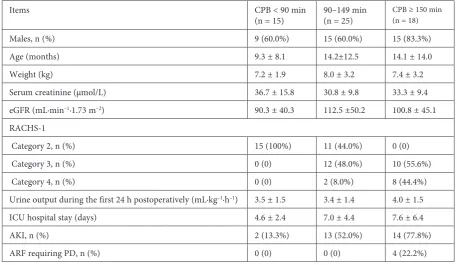
gender, age, weight and baseline serum creatinine. Children with longer CPB duration had more complex cardiac surgical procedures as evaluated by Risk Adjustment for Congenital Heart Surgery 1 (RACHS-1) [10]. Patients with CPB < 90 min were all in RACHS-1 Category 2, while those with CPB ≥ 150 min were all in Categories 3–4. Urine output during the first 24 h after surgery was not significantly different among the groups. The in-cidences of AKI after surgery (defined as an ab-solute increase in serum creatinine ≥ 0.3 mg/dl [26.4 µmol/l], or a percentage increase ≥ 50% with-in a 72-hour period after surgery) were 13.3% (2/15) in Group I, 52.0% (13/25) in Group II, and 77.8% (14/18) in Group III. 4 children developed ARF requiring peritoneal dialysis, and were all in Group III. The procedures associated with ARF in-cluded repair of a coarctation and ventricular sep-tal defect closure in a one-month-old infant, tosep-tal repair of a tetralogy of Fallot with pulmonary atre-sia in two cases, and an arterial switch operation with ventricular septal defect closure in one.
Serial Measurements
of Urinary Biomarkers
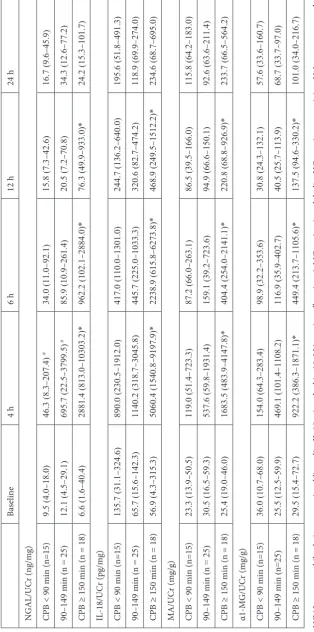
Table 2 shows the urinary biomarker measure-ments at baseline and various points in time after CPB surgery. The baseline levels of the urinary biomarkers were low and did not show significant
differences among the groups. They increased markedly and peaked at 4 h, and remained elevated up to 24 h after surgery. The 4 h concentrations of urinary NGAL were significantly different among groups (Group I < Group II < Group III, P < 0.05). The 4 h concentrations of urinary IL-18, MA and α1-MG were significantly higher in Group III than in Groups I and II (P < 0.05). Group III also had significantly higher levels of urinary biomarkers than Groups I and II at 6–12h after surgery, while the levels were not significantly different at 24 h af-ter surgery.
Discussion
CPB surgery is often complicated by renal in-jury. The pathophysiology is multifactorial, and related to perioperative renal hypoperfusion and the formation of endogenous and exogenous nephrotoxins and microembolisms [11, 12]. Clini-cal studies have proved that off-pump cardiac sur-gery is superior to on-pump procedures in adults with respect to postoperative renal injury [13, 14]. Compared with older patients, infants and young children are more susceptible to postoperative kid-ney damage and ARF [3, 15]. Young children are unique because they rarely have co-morbid condi-tions such as hypertension and diabetes, which are commonly present in adult patients and may have
Table 1. The patients’ clinical characteristics in different groups
Items CPB < 90 min
(n = 15) 90–149 min (n = 25) CPB ≥ 150 min (n = 18)
Males, n (%) 9 (60.0%) 15 (60.0%) 15 (83.3%)
Age (months) 9.3 ± 8.1 14.2±12.5 14.1 ± 14.0
Weight (kg) 7.2 ± 1.9 8.0 ± 3.2 7.4 ± 3.2
Serum creatinine (µmol/L) 36.7 ± 15.8 30.8 ± 9.8 33.3 ± 9.4
eGFR (mL·min–1·1.73 m–2) 90.3 ± 40.3 112.5 ±50.2 100.8 ± 45.1
RACHS-1
Category 2, n (%) 15 (100%) 11 (44.0%) 0 (0)
Category 3, n (%) 0 (0) 12 (48.0%) 10 (55.6%)
Category 4, n (%) 0 (0) 2 (8.0%) 8 (44.4%)
Urine output during the first 24 h postoperatively (mL·kg–1·h–1) 3.5 ± 1.5 3.4 ± 1.4 4.0 ± 1.5
ICU hospital stay (days) 4.6 ± 2.4 7.0 ± 4.4 7.6 ± 6.4
AKI, n (%) 2 (13.3%) 13 (52.0%) 14 (77.8%)
ARF requiring PD, n (%) 0 (0) 0 (0) 4 (22.2%)
Table 2. Urinary biomarker measurements at baseline and various times after CPB surgery Baseline 4 h 6 h 12 h 24 h NGAL/UCr (ng/mg) CPB < 90 min (n=15) 9.5 (4.0 – 18.0) 46.3 (8.3 – 207.4) # 34.0 (11.0 – 92.1) 15.8 (7.3 – 42.6) 16.7 (9.6 – 45.9) 90 – 149 min (n = 25) 12.1 (4.5 – 29.1) 695.7 (22.5 – 3799.5) # 85.9 (10.9 – 261.4) 20.5 (7.2 – 70.8) 34.3 (12.6 – 77.2) CPB ≥ 150 min (n = 18) 6.6 (1.6 – 40.4) 2881.4 (813.0 – 10303.2)* 962.2 (102.1 – 2884.0)* 76.3 (49.9 – 933.0)* 24.2 (15.3 – 101.7) IL-18/UCr (pg/mg) CPB < 90 min (n=15) 135.7 (31.1 – 324.6) 890.0 (230.5 – 1912.0) 417.0 (110.0 – 1301.0) 244.7 (136.2 – 640.0) 195.6 (51.8 – 491.3) 90 – 149 min (n = 25) 65.7 (15.6 – 142.3) 1140.2 (318.7 – 3045.8) 445.7 (225.0 – 1033.3) 320.6 (82.7 – 474.2) 118.9 (69.9 – 274.0) CPB ≥ 150 min (n = 18) 56.9 (4.3 – 315.3) 5060.4 (1540.8 – 9197.9)* 2238.9 (615.8 – 6273.8)* 468.9 (249.5 – 1512.2)* 234.6 (68.7 – 695.0) MA/UCr (mg/g) CPB < 90 min (n=15) 23.3 (13.9 – 50.5) 119.0 (51.4 – 723.3) 87.2 (66.0 – 263.1) 86.5 (39.5 – 166.0) 115.8 (64.2 – 183.0) 90 – 149 min (n = 25) 30.5 (16.5 – 59.3) 537.6 (59.8 – 1931.4) 159.1 (39.2 – 723.6) 94.9 (66.6 – 150.1) 92.6 (63.6 – 211.4) CPB ≥ 150 min (n = 18) 25.4 (19.0 – 46.0) 1683.5 (483.9 – 4147.8)* 404.4 (254.0 – 2141.1)* 220.8 (68.8 – 926.9)* 233.7 (66.5 – 564.2) α1-MG/UCr (mg/g) CPB < 90 min (n=15) 36.0 (10.7 – 68.0) 154.0 (64.3 – 283.4) 98.9 (32.2 – 353.6) 30.8 (24.3 – 132.1) 57.6 (33.6 – 160.7) 90 – 149 min (n=25) 25.5 (12.5 – 59.9) 469.1 (101.4 – 1108.2) 116.9 (35.9 – 402.7) 40.5 (25.7 – 113.9) 68.7 (33.7 – 97.0) CPB ≥ 150 min (n = 18) 29.5 (15.4 – 72.7) 922.2 (386.3 – 1871.1)* 449.4 (213.7 – 1105.6)* 137.5 (94.6 – 330.2)* 101.0 (34.0 – 216.7) NGAL – neutrophil gelatinase-associated lipocalin, IL-18 – interleukin-18, MA – microalbumin, α1-MG – α1-microglobulin, UCr – urinary creatinine. Values are expressed as medians with the interquartile range. * indicates a significant difference ( p < 0.05) from the other groups, and
# indicates
detrimental effects on postoperative renal func-tion. Therefore, young children constitute an ideal population to study the effects of CPB duration on renal injury after cardiac surgery.
To quantitatively assess renal injury, the authors measured urinary biomarkers that have been found to be sensitive and reliable indicators for that pur-pose. Urinary diagnostics have the additional ad-vantage of being non-invasive in nature. The current study showed significant alteration in kidney-specif-ic biomarkers early after surgery. The increase of urinary NGAL, IL-18 and α1-MG levels clearly sug-gested tubular injury after CPB surgery. As tubular dysfunction can also cause microalbuminuria owing to decreased reabsorption of filtered albumin [16], urinary MA levels must be at least 5–6 times of α1-MG to indicate glomerular injury [17, 18]. There-fore, the increase of urinary MA found in this study did not actually suggest glomerular damage because of the similar levels of the two markers.
The authors divided the study population in-to 3 graded categories based on CPB duration. As shown in Table 1, longer CPB durations were pos-itively correlated with higher RACHS-1 catego-ries. The study showed that prolonged CPB dura-tion was related to more severe renal injury and ARF. These results were in agreement with studies on adults, which showed that patients with CPB times over 90 min had more pronounced kid-ney damage than patients with CPB times under 70 min [19]. Previous retrospective studies also identified longer CPB duration as a potential clin-ical risk factor for ARF after congenital heart sur-gery [3]. The current study supplemented the re-sults of these studies and demonstrated that CPB duration was positively correlated with the de-gree of renal injury after surgery even without the
development of ARF, as shown in urinary bio-marker levels at 4 h after surgery. This positive re-lationship might be due to longer renal ischemic time and more severe ischemia-reperfusion inju-ry. Additionally, a more intense systemic inflam-matory response might also play a prominent role, as demonstrated by higher IL-18 levels with longer CPB duration [12].
In the present study, 4 patients developed postoperative ARF requiring PD, and all 4 of them had CPB durations over 150 min. As children with postoperative ARF have a high mortality rate [3], early and accurate prediction immediately after surgery is essential for early treatment and good clinical outcomes. Recent studies have revealed several novel urinary biomarkers which alone or in combination might be promising candidates in the early diagnosis of ARF [7, 8]. Measurements of these urinary biomarkers in patients with CPB du-ration ≥ 150 min might be cost-effective and con-firmative in the early prediction of ARF. However, the authors cannot compare their predictive ca-pacities or establish the optimal predictive panel of biomarkers for ARF in this study due to the small sample size and very few children with ARF. Fu-ture large-scale studies are needed to address this issue.
Conclusions
In summary, prolonged CPB duration was re-lated to more severe renal injury and ARF. Mea-surements of urinary kidney specific biomarkers in infants and children with CPB duration over 150 min might help identify those at high risk for ARF.
Acknowledgements. The authors sincerely thank the medical staff of the intensive care unit at Bei-jing Anzhen Hospital for urine sample collection, as well as the children participating in this study and their guardians. We also appreciate the help of Guobin Xu and Haixia Li at Beijing University First Hospi-tal and Chunying Li and Qi Zhang at Beijing University People’s HospiHospi-tal for the measurements of urinary biomarkers.
References
[1] Baskin E, Saygili A, Harmanci K, Agras PI, Ozdemir FN, Mercan S, Tokel K, Saatci U: Acute renal failure and mortality after open-heart surgery in infants. Ren Fail 2005, 27, 557–560.
[2] Chan KL, Ip P, Chiu CS, Cheung YF: Peritoneal dialysis after surgery for congenital heart disease in infants and young children. Ann Thorac Surg 2003, 76, 1443–1449.
[3] Pedersen KR, Povlsen JV, Christensen S, Pedersen J, Hjortholm K, Larsen SH, Hjortdal VE: Risk factors for acute renal failure requiring dialysis after surgery for congenital heart disease in children. Acta Anaesthesiologica Scandinavica 2007, 51, 1344–1349.
[4] Dittrich S, Dahnert I, Vogel M, Stiller B, Haas NA, Alexi-Meskishvili V, Lange PE: Peritoneal dialysis after infant open heart surgery: observations in 27 patients. Ann Thorac Surg 1999, 68, 160–163.
[5] Sorof JM, Stromberg D, Brewer ED, Feltes TF, Fraser CD Jr.: Early initiation of peritoneal dialysis after surgical repair of congenital heart disease. Pediatr Nephrol 1999, 13, 641–645.
[7] Devarajan P: Neutrophil gelatinase-associated lipocalin (NGAL): a new marker of kidney disease. Scand J Clin Lab Invest Suppl 2008, 241, 89–94.
[8] Leslie JA, Meldrum KK: The role of interleukin-18 in renal injury. J Surg Res 2008, 145, 170–175.
[9] Tuladhar SM, Puntmann VO, Soni M, Punjabi PP, Bogle RG: Rapid detection of acute kidney injury by plasma and urinary neutrophil gelatinase-associated lipocalin after cardiopulmonary bypass. J Cardiovasc Pharmacol 2009, 53, 261–266.
[10] Jenkins KJ, Gauvreau K, Newburger JW, Spray TL, Moller JH, Iezzoni LI: Consensus-based method for risk adjustment for surgery for congenital heart disease. J Thorac Cardiovasc Surg 2002, 123, 110–118.
[11] Abu-Omar Y, Ratnatunga C: Cardiopulmonary bypass and renal injury. Perfusion 2006, 21, 209–213.
[12] Kinsey GR, Li L, Okusa MD: Inflammation in acute kidney injury. Nephron Exp Nephrol 2008, 109, 102–107.
[13] Ascione R, Lloyd CT, Underwood MJ, Gomes WJ, Angelini GD: on-pump versus off-pump coronary revascu-larization: evaluation of renal function. Ann Thorac Surg 1999, 68, 493–498.
[14] Loef BG, Epema AH, Navis G, Ebels T, van Oeveren W, Henning RH: off-pump coronary revascularization atten-uates transient renal damage compared with on-pump coronary revascularization. Chest 2002, 121, 1190–1194. [15] Zheng JY, Xiao YY, Yao Y, Han L: Is serum cystatin C an early predictor for acute kidney injury following
car-diopulmonary bypass surgery in infants and young children? Kaohsiung J Med Sci 2013, 29, 494–499.
[16] Birn H, Christensen EI: Renal albumin absorption in physiology and pathology. Kidney Int 2006, 69, 440–449.
[17] Lun A, Suslovych M, Drube J, Ziebig R, Pavicic L, Ehrich JH: Reliability of different expert systems for profiling proteinuria in children with kidney diseases. Pediatr Nephrol 2008, 23, 285–290.
[18] Seeman T, Dusek J, Vondrak K, Spatenka J, Feber J: Profiling proteinuria in children after renal transplantation. Pediatr Nephrol 2009, 24, 2439–2444.
[19] Boldt J, Brenner T, Lehmann A, Suttner SW, Kumle B, Isgro F: Is kidney function altered by the duration of cardiopulmonary bypass? Ann Thorac Surg 2003, 75, 906–912.
Address for correspondence:
Ling Han
Department of Pediatric Cardiology and Cardiac Surgery Beijing Anzhen Hospital, Capital Medical University No. 2 Anzhen Road
Beijing 100029
People’s Republic of China E-mail: [email protected]
Conflict of interest: None declared