This is an open access journal, and articles are distributed under the terms of the Creative Commons Attribution-Non Commercial-ShareAlike 4.0 License, which allows others to remix, tweak, and build upon the work non-commercially, as long as appropriate credit is given and the new creations are licensed under the identical terms.
Malocclusion & occlusal traits among Iranian female
elementary students: an epidemiologic study
Roya Hamedi
1, Fatemeh Niaghiha
2, Alireza Ebrahimi Bazzaz
3, Zohreh Yazdi
4, Hashem
Ahmadzadeh
5, Fatemeh Pachenari
6*
1Assistant Professor, Department of Orthodontics, Dental Caries Prevention Research Center, Qazvin University of Medical Sciences, Qazvin, Iran. 2General Dentist, Student Research Committee, Qazvin University of Medical Sciences, Qazvin, Iran. 3Pediatrics Resident, Shahid Beheshti University of Medical Sciences, Tehran, Iran. 4Social determinants of health research center, Qazvin University of Medical Sciences, Qazvin, Iran. 5General Dentist, Private Practice, Tehran, Iran. 6Postgraduate Student, Department of Pediatric Dentistry, Faculty of Dentistry, Qazvin University of Medical Sciences, Qazvin, Iran.
Correspondence: Fatemeh Pachenari, Department of Pediatric Dentistry, Faculty of Dentistry, Qazvin University of Medical Sciences, Qazvin, Iran. Email: [email protected].
ABSTRACT
background: Malocclusion detection is straightforward in the mixed dentition and is enabling more efficient provision of orthodontic treatment. This study aimed to assess the frequency of malocclusion in female elementary students in Qazvin, Iran. Materials and Methods: This descriptive, cross-sectional study, randomly evaluated 450 female elementary students in Qazvin, Iran. Type of malocclusion, overjet, overbite, anterior and posterior open bite, lingual posterior crossbite, crowding, spacing, midline deviation, facial asymmetry, facial profile, and vertical facial height were evaluated and recorded. The data were analyzed using SPSS version 21 via descriptive statistics. Results: The results showed that 9.6% of the study population had normal occlusion. The commonest malocclusions were class II division I (41.5%) followed by class I (33.3%), class II division II (12%) and class III (3.6%). Overjet
between 0 to 3.5 mm (52%) and overbite ≤1/3 (54.2%) had the highest frequency. The most common facial profile was convex in
55.3%. The highest vertical facial height was normal in 70.4%. The other occlusal traits did not present, in most of the subjects. The occlusal traits distribution of subjects, according to occlusion type were evaluated. Conclusions: Contrary to the results of the most epidemiologic studies in Iranian population that have shown most subjects had normal occlusion or class I malocclusion; in female elementary students in Qazvin, Class II division 1 malocclusion and convex profile were the most prevalent, whereas class III malocclusion and concave profile were the least. It was noticeable in treatment programs.
Keywords:female, Iran, Malocclusion, Students.
Introduction
Maxillofacial deformities have a high prevalence worldwide [1].
According to [2], around 75% of 6-11 year-olds had maxillofacial
deformities. These deformities can have consequences such as temporomandibular joint [3, 4] and psychological problems [5, 6].
The variation in craniofacial growth and/or development with
esthetic influence, and following psychosocial implication in children and adults is named malocclusion [7].
The first classification of malocclusion is Angle’s that was based on the relationship between the first molars in the anterior-posterior dimension and their inclination relative to the occlusal plane [2, 8, 9]. However, this classification has shortcomings as
well. It cannot differentiate between malocclusions with an anterior-posterior discrepancy of dental arch and disharmony of facial structures. It does not include vertical and transverse discrepancies either (Overbite, as an index for assessment of vertical occlusal relationship and Cross bites in the transverse plane). It does not evaluate dental malalignments such as rotation, crowding, and spacing. The missing or impacted teeth are not taken into account in the Angle’s classification either. Therefore, a classification was presented by [2, 10] to overcome
the limitations of Angle’s classification and was named as “orthodontic analysis”, that included the assessment of facial ratios and esthetics, alignment and symmetry of teeth in dental arch and dental and skeletal relationships in transverse dimension, anterior-posterior dimension, and vertical dimension [2].
Access this article online
Website: www.japer.in E-ISSN: 2249-3379
How to cite this article: Roya Hamedi, Fatemeh Niaghiha, Alireza Ebrahimi Bazzaz, Zohreh Yazdi, Hashem Ahmadzadeh, Fatemeh Pachenari. Malocclusion & occlusal traits among Iranian female elementary students: an epidemiologic study. J Adv Pharm Edu Res 2019;9(2):24-35.
Numerous other methods have been available for the assessment of malocclusion in communities, such as epidemiological assessment method by Bjork, Krebs, and Slow, the method invented by the Federation Dentaire International, dental esthetic index and malocclusion severity index [11]. Considering
the lack of a consensus on a comprehensive classification for malocclusion types, it seemed that a combination of these classifications should be used for such assessments. Epidemiological data regarding malocclusion have been imperative for the assessment of the quality and quantity of orthodontic services. Not only detection and prediction of malocclusion in the mixed dentition are easier, enabling more efficient provision of orthodontic treatment, but also management of maxillofacial discrepancies in this stage may eliminate the need for complex high-cost corrective surgeries and more invasive procedures in the future [2, 12].
Epidemiological investigations on the prevalence of malocclusion in a certain region have provided important data to enable outlining of the measures necessary for a reduction in the incidence of unfavorable factors, in addition to the stopping of the skeletal problems at a suitable age [13].
To the best of authors’ knowledge, no comprehensive study on the prevalence of different types of malocclusions has been available among a large group of female elementary students in Qazvin, Iran. Considering the need for epidemiological studies on dentofacial deformities, this study aimed to assess the frequency of malocclusion in female elementary students in Qazvin, Iran in 2017.
Materials and Methods
Permission to undertake the records was obtained from the Ministry of Health and Education. Ethical approval was given by the Research Ethics Committee and Faculty of Community Dentistry, School of Dentistry, Qazvin University of Medical Sciences (IR.QUMS.REC.1396.108).
This descriptive cross-sectional study evaluated randomly chosen 450 female elementary students (7-12 years) in Qazvin, Iran in 2017. The sample size (n= 390) was calculated assuming P=0.1 and d=0.03. To increase the accuracy of results, 450 subjects were enrolled. Subjects were selected using stratified random cluster sampling.
The exclusion criteria:
• Craniofacial anomalies
• Congenital anomalies (clefts, syndromes)
• History of trauma to the head or face
• Orthognathic surgery
• Orthodontic treatment
• Non-Iranian ethnicity
Written informed consent was obtained from parents or legal guardians of children.
The selected subjects received a comprehensive oral and dental examination under adequate lighting in a seated position with
teeth in centric occlusion and head in natural head position. All examinations were performed by a calibrated dental student as an examiner using a dental mirror and a wooden stick.
The following variables were evaluated (see table 1 including definitions and criterions of malocclusions and occlusal traits):
• Type of occlusion
This variable was determined according to the Angle’s classification.
• Overjet, Reverse overjet (anterior crossbite), Overbite, Deep bite
The amounts of overjet and overbite were marked on a wooden stick using 0.5 mm tip of a red pencil and the distances were measured by a metal ruler.
• Anterior open bite, Posterior open bite, Lingual posterior crossbite, Crowding, Spacing, Midline deviation, Facial asymmetry
To assess facial symmetry, three anatomical points (gnathion, subnasale, and nasion) should have been in line; otherwise, the face would be considered asymmetric.
• Facial profile, Vertical facial height
After clinical examination, the subjects were provided with oral hygiene instructions.
The data were analyzed using SPSS version 21 via descriptive statistics.
Results
A total of 450 students, being 7, 8, 9, 10, 11 and 12 year olds accounted for 17%, 17.8%, 16.2%, 16.4%, 16.4% and 16.2%; respectively, were the study population.
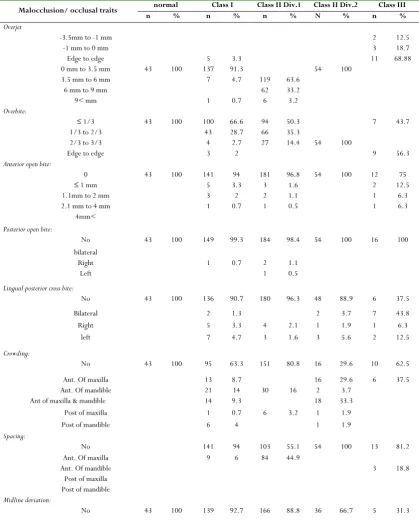
The frequency of malocclusions among the subjects was, 9.6% normal occlusion, 33.3% class I, 41.5% class II division I, 12% class II division II and 3.6% class III malocclusion (Table 2 shows the prevalence of each malocclusion.). The highest overjet was noted 0 mm to 3.5 mm in 52% (table 2). The
highest overbite was ≤ 1/3 in 54.2% (Table 2).
respectively (Table 3). The highest frequency of midline deviation was 68.7% in class III patients (table 3). The frequency of asymmetry was the highest in class III (25%) and the lowest in normal occlusion (0.0%) (Table 3).
Regarding facial profile, convex profile was the most common type in class II patients (98.4% in div.1 & 100% in div.2), concave profile was the most common type in class III (87.5%) and straight profile was the most common type in normal occlusion (93%) and class I malocclusion (93.3%) (table 3). The highest frequency of long face was in class III (37.5%), and the highest frequency of short face was in class II division II (100%) (Table 3).
Discussion
This study aimed to comprehensively assess the frequency of different types of malocclusion and occlusal traits in female elementary students in Qazvin, Iran.
Types of malocclusion and occlusal traits
frequency in this study and reviewed
literature in Iran and other countries (notice
Table 2 and 4)
• Type of occlusion:
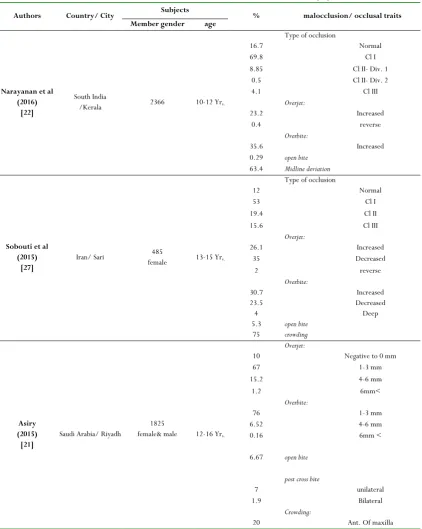
The frequency of class II division I malocclusion in this study was found to be 41.5%, which had the highest frequency among different types of malocclusion, that was not similar to other studies. This value on the literature in Iran was recorded 24.1% in the study by Borzabadi-Farahani et al [9], 17.6% in a study by
Atashi [14], 26.3% in a study by Khaneh et al [15], 16.4% in the
study by Ramezanzadeh and Hosseini [16] and 4.78% in a study
by Arabiun [17] (Tables 2,4).
In the studies evaluating malocclusion in similar population of this study, by Hanna et al [18], the largest population had Class I
(normal) occlusion and Moaris et al [19] reported a similar
percentage of Class I and II.
Class I malocclusion had a frequency of 33.3% in this study, which ranked the second in terms of frequency. Previous studies have reported that class I malocclusion had the highest frequency in Iran, unlike this study’s population in Qazvin (table 4). However, similar to other reports, class III had the lowest frequency in this study (Table 4).
• Overjet:
Based on this study, the normal overjet was the commonest in 52%. Similarly, this value was the highest in normal criterion in reported frequency in Iranian population as follow: 52% by Oshagh et al [20], 71% by Ramezanzadeh and Hosseini [16], 67.7%
by Borzabadi-Farahani et al [9] (Tables 2,4). Increased overjet in
this study had a higher frequency (43.3%), compared to the previous ones (Tables 2,4). The frequency of edge to edge and reverse overjet in this study was 3.6% and 1.1%; respectively (Table 2).
• Overbite:
The frequency of normal and increased overbite were 54.2% and 43.1%; respectively in this study, and 2.7% had edge to edge overbite (Table 2). The findings indicated that the normal overbite had the highest frequency in different populations, however, in the study by Oshagh et al, deep bite had the highest frequency (53%) [20] (Table 4).
• Other occlusal traits:
The commonest subjects of this study had shown no other occlusal traits, such as anterior and posterior open bite, lingual posterior crossbite, crowding, spacing, midline deviation, and facial asymmetry. These results approximately were similar to the other studies in different populations (Tables 2,4).
However, in the study by Borzabadi-Farahani et al [9] and Atashi [14], more than 70% of the subjects had crowding. Also, in the
study by Asiry, 59.5% of the subjects had spacing [21]. In the
study by Narayanan and Kumar, most of the subjects had, midline deviation (63.4%) [22] (Table 4).
The following data have been shown in the evaluation of the result details:
The frequency of unilateral posterior crossbite (5.54%) was higher than bilateral, in the subjects of this study. This result was similar to the other studies (Tables 2,4).
In this study, the frequency of anterior crowding (19.6%) was higher than that of posterior crowding (3.3%) (Table 2). The frequency of spacing was higher in the anterior of the maxilla (20.7%), compared to the anterior of the mandible, in this study. In the study by Asiry [21], 17.6% had spacing in the
anterior of the maxilla, and 9.3% had spacing in the anterior of the mandible, which was in agreement with the findings of this study. In contrast to Borzabadi-Farahani et al, [9], the frequency
of spacing was higher in the maxilla (Tables 2,4).
• Facial profile:
Regarding facial profile, 41.1% had a straight, 55.3% had a convex and 3.6% had a concave profile. Similar to that, in the study by Ramezanzadeh and Hosseini [16], the convex profile had
the highest frequency (Tables 2,4).
• Vertical facial height:
The frequency of normal vertical facial height was the commonest (70.4%) in this study (Table 2).
Prevalence of occlusal traits based on the
type of occlusion in the subjects (Table 3)
• Normal occlusion & Class I malocclusion:
• Class II division 1 malocclusion:
In this group, the majority of the subjects had 3.5mm to 6 mm overjet (63.6%) and normal overbite (50.3%). Results showed that the subjects in the highest frequency did not have an anterior and posterior open bite, lingual posterior crossbite, crowding, spacing, midline deviation and facial asymmetry (Table 3). Regarding facial profile, convex was the commonest (98.4%). The vertical facial height was normal in the highest frequency (79.1%) (Table 3). Increased overjet in class II division 1 patients was probably due to the retruded position of the mandible and subsequent incompetency of the lower lip to cover the maxillary incisors. In such cases, the lower lip was positioned behind the maxillary incisors, and applied pressure to their palatal surface causing their protrusion. At the same time, it applied pressure to the labial surface of the lower incisors causing their retrusion. Thus, it increased the overjet over time [2, 23].
• Class II division 2 malocclusion:
In this group, all of the subjects had normal overjet and 2/3 to 3/3 overbite. Results showed that subjects in the highest
frequency did not have an anterior and posterior open bite, lingual posterior crossbite, spacing, midline deviation and facial asymmetry (Table 3). In the highest frequency, subjects had crowding in anterior of maxilla & mandible (33.3%) (Table 3). In almost all of the subjects, the profile was convex, and the vertical facial height was short, due to anti-clockwise rotation of the mandible [2] (Table 3).
Crowding in the mandibular arch of class II division II patients can be attributed to the smaller size of the mandibular arch, while crowding of the maxillary arch can be due to the palatal inclination of the maxillary incisors and decreased overjet, causing overlapping of lateral and central incisors [2, 23].
• Class III malocclusion:
In this group, all of the subjects had edge to edge overjet (68.88%) and overbite (56.3%). Results showed that subjects in the highest frequency did not have an anterior and posterior open bite, spacing and facial asymmetry (Table 3). In the highest frequency, the subjects had lingual bilateral posterior
crossbite (43.8%) and had 1/2 to ¼ width of lower incisor
midline deviation (37.4%) (Table 3).
Regarding facial profile, concave was the commonest (87.5%). The vertical facial height was normal in the highest frequency (62.5%) (Table 3). Posterior cross bite had the highest frequency in class III patients in this study (62.5%), which was in agreement with the results of Borzabadi-Farahani et al, [9] and
can be due to the smaller size of the maxillary arch in class III patients [2] (Table 3).
In general, the comparison of the findings of epidemiological studies was difficult because the variations in many factors might affect the results. Thus, the interpretation of the findings should be done with care. Age, sample size, the method of sampling, race, ethnicity, assessment tools and expertise of the examiners have been among the main factors that can affect the results [9]. Patients in primary, mixed and permanent dentition
period can have different patterns of occlusion [11]. Also, the
definition of normal occlusion and classifications varied in different stages of development of the masticatory system [11].
The age range of patients in some of the studies was different from that in this study (7-12 years).
Regarding the race, despite the fact that the present study, as well as some others, were conducted on the Iranian population, differences existed in the reported frequency of malocclusions, which can be due to the conduction of studies in different geographical locations and on different ethnic populations with variable age ranges, methods of examination and sample sizes [16, 23, 24].
The available definitions and classifications for different types of malocclusion can also be responsible for the controversy in results. The difference in the prevalence of normal occlusion and class I malocclusion can be due to the overlapping of these two entities, and the fact that normal occlusion may be mistaken for class I malocclusion or vice versa. The accuracy of tools used for the assessments is also important, and last but not the least, the experience and expertise of the examiners also play a role in the accuracy of findings, and special attention should be paid to intra- and inter-examiner reliability.
Based on the descriptive data of this study, there was a high prevalence of malocclusion among female elementary student in Qazvin, Iran, that would be valuable in planning the best preventive and treatment program. Also, contrary to the results of the most epidemiologic studies in Iranian population, it was shown that most subjects had normal occlusion or class I malocclusion, Considering the high prevalence of class II malocclusion in this study’s population, it can be suggested that the undergraduate dental students, general dentists, pediatric dentists and orthodontists should obtain further training to management of class II malocclusion to improve the quality of care provided to the patients in Qazvin, Iran. Focus on prevention may be more efficient in the initial phases. Interceptive orthodontic treatment in US Medicaid patients has been useful in lessening malocclusion severity; some problems might not require additional comprehensive orthodontic treatment at later stages [25, 26].
Further studies with larger sample size are required on the larger population and other ethnic groups in Iran.
Table 1- malocclusion/ occlusal traits definitions and criterions
Malocclusion/ occlusal
traits Definition criterions
Type of occlusion
Class I malocclusion the mesiobuccal cusp of the maxillary first molar was in the buccal groove of the mandibular first molar and the teeth were not in a correct position relative to the occlusal plane.[2]
Class II malocclusion
the mesiobuccal cusp of the maxillary first molar was more mesially than buccal groove of the mandibular first molar and the teeth were not in a correct position relative to the occlusal plane. [2]
• Class II division 1:
a disto-occlusion where the maxillary incisors are significantly protruded. • Class II division 2:
a disto-occlusion where the maxillary central incisors have a natural or palatal inclination, maxillary lateral incisors have flaring or overlap the central incisors.
Class III
malocclusion mandibular first molar and the teeth were not in a correct position relative to the occlusal plane.the mesiobuccal cusp of the maxillary first molar was more distally than buccal groove of the [2]
Overjet
Horizontal overlapping of mandibular incisors by the maxillary incisors
The incisal edge of the maxillary incisors should be placed ahead of the incisal edge of the mandibular incisors. [14]
• Reverse overjet (anterior crossbite):
Mandibular incisors are placed ahead of the maxillary incisors.[2]
Normal:
0 mm to 3.5 mm
Increased:
3.5 mm to 6 mm 6 mm to 9 mm
9< mm
Edge to edge
Reversed:
-3.5mm to -1 mm -1 mm to 0 mm
Overbite Vertical overlapping of mandibular incisors by the maxillary incisors [14]
• Deep bite:
Increased vertical overlapping [27]
Normal:
≤ 1/3
Edge to edge
Deep bite:
1/3 to 2/3 2/3 to 3/3
Anterior open bite No overlapping of mandibular incisors by the maxillary incisors [28]
0
≤ 1 mm
1.1 mm to 2 mm 2.1 mm to 4 mm
4mm<
Posterior open bite No contact of the occlusal surface of the posterior teeth in centric occlusion[28]
No Right unilateral
Left unilateral bilateral
Lingual posterior cross bite
The palatal cusps of the maxillary teeth are positioned more palatally relative to the central groove of
the mandibular teeth [2] Right unilateral No
Left unilateral Bilateral
Crowding: A smaller periphery of the dental arch from the sum of mesiodistal widths of teeth leads to crowding, overlapping or rotation of teeth [20]
No Ant. Of maxilla Ant. Of mandible Ant of maxilla & mandible
Post of maxilla Post of mandible
Spacing: A larger size of the dental arch than the sum of mesiodistal widths of teeth leads to spacing [20]
No Ant. Of maxilla Ant. Of mandible
Post of maxilla Post of mandible
Midline deviation: The maxillary and mandibular dental midline do not inline. [10] ½ to ¼ width of lower No
Facial asymmetry: Deviation of the hypothetical line passing through the gnathion, subnasale and nasion [29] No
Yes
Facial profile: The relationship between the connecting line of the nasal bridge to the base of the upper lip and the connecting line of the base of the upper lip and chin [2]
Straight Concave convex
Vertical facial height: hypothetically three segments of the face in the frontal view: from the hairline to the nasion from the nasion to the anterior nasal spine from the anterior nasal spine to menton [30]
Normal Long face Short face
Table 2-Prevalence of malocclusion/ occlusal traits in the subjects (450 girls).
Malocclusion/occlusal traits n %
Type of occlusion
Normal 43 9.6
Cl I 150 33.3
Cl II- Div. 1 187 41.6
Cl II- Div. 2 54 12
Cl III 16 3.6
Overjet
-3.5mm to -1 mm 2 0.4
-1 mm to 0 mm 3 0.7
Edge to edge 16 3.6
0 mm to 3.5 mm 234 52
3.5 mm to 6 mm 126 28
6 mm to 9 mm 62 13.7
9< mm 7 1.6
Overbite:
≤ 1/3 244 54.2
1/3 to 2/3 109 24.2
2/3 to 3/3 85 18.9
Edge to edge 12 2.7
Anterior open bite:
0 431 95.8
≤ 1 mm 10 2.2
1.1mm to 2 mm 6 1.3
2.1 mm to 4 mm 3 0.7
4mm<
Posterior open bite:
No 446 99.1
bilateral
Right 3 0.7
left 1 0.2
Lingual posterior cross bite:
No 413 91.8
Bilateral 11 2.4
Right 11 2.4
left 15 3.4
Crowding:
No 315 70
Ant. Of maxilla 35 7.8
Ant. Of mandible 53 11.8
Ant of maxilla & mandible 32 7.1
Post of maxilla 2 0.4
Post of mandible 13 2.9
Spacing:
No 354 78.7
Ant. Of maxilla 93 20.7
Ant. Of mandible 3 0.6
Post of maxilla Post of mandible
Midline deviation:
No 389 86.4
½ to ¼ width of lower incisor 39 8.7
½< width of lower incisor 22 4.9
Facial asymmetry:
Yes 23 5.1
Facial profile:
Straight 185 41.1
Concave 16 3.6
convex 249 55.3
Vertical facial height:
Normal 317 70.4
Long face 63 14
Short face 70 15.6
Table 3-Prevalence of malocclusion/ occlusal traits based on the type of occlusion in the subjects (450 girls).
Malocclusion/ occlusal traits normal Class I Class II Div.1 Class II Div.2 Class III
n % n % n % N % n %
Overjet
-3.5mm to -1 mm 2 12.5
-1 mm to 0 mm 3 18.7
Edge to edge 5 3.3 11 68.88
0 mm to 3.5 mm 43 100 137 91.3 54 100
3.5 mm to 6 mm 7 4.7 119 63.6
6 mm to 9 mm 62 33.2
9< mm 1 0.7 6 3.2
Overbite:
≤ 1/3 43 100 100 66.6 94 50.3 7 43.7
1/3 to 2/3 43 28.7 66 35.3
2/3 to 3/3 4 2.7 27 14.4 54 100
Edge to edge 3 2 9 56.3
Anterior open bite:
0 43 100 141 94 181 96.8 54 100 12 75
≤ 1 mm 5 3.3 3 1.6 2 12.5
1.1mm to 2 mm 3 2 2 1.1 1 6.3
2.1 mm to 4 mm 1 0.7 1 0.5 1 6.3
4mm<
Posterior open bite:
No 43 100 149 99.3 184 98.4 54 100 16 100 bilateral
Right 1 0.7 2 1.1
Left 1 0.5
Lingual posterior cross bite:
No 43 100 136 90.7 180 96.3 48 88.9 6 37.5
Bilateral 2 1.3 2 3.7 7 43.8
Right 5 3.3 4 2.1 1 1.9 1 6.3
left 7 4.7 3 1.6 3 5.6 2 12.5
Crowding:
No 43 100 95 63.3 151 80.8 16 29.6 10 62.5
Ant. Of maxilla 13 8.7 16 29.6 6 37.5
Ant. Of mandible 21 14 30 16 2 3.7
Ant of maxilla & mandible 14 9.3 18 33.3
Post of maxilla 1 0.7 6 3.2 1 1.9
Post of mandible 6 4 1 1.9
Spacing:
No 141 94 103 55.1 54 100 13 81.2
Ant. Of maxilla 9 6 84 44.9
Ant. Of mandible 3 18.8
Post of maxilla Post of mandible
Midline deviation:
Table 4-Prevalence of malocclusion/ occlusal traits based in different populations.
Authors Country/ City Subjects % malocclusion/ occlusal traits
Member gender age
Narayanan et al (2016)
[22]
South India
/Kerala 2366 10-12 Yrs.
16.7
Type of occlusion
Normal
69.8 Cl I
8.85 Cl II- Div. 1
0.5 Cl II- Div. 2
4.1 Cl III
23.2
Overjet:
Increased
0.4 reverse
35.6
Overbite:
Increased 0.29 open bite
63.4 Midline deviation
Sobouti et al (2015)
[27] Iran/ Sari
485
female 13-15 Yrs.
12
Type of occlusion
Normal
53 Cl I
19.4 Cl II
15.6 Cl III
26.1
Overjet:
Increased
35 Decreased
2 reverse
30.7
Overbite:
Increased 23.5
4
Decreased Deep 5.3 open bite
75 crowding
Asiry (2015) [21]
Saudi Arabia/ Riyadh female& male 1825 12-16 Yrs.
10
Overjet:
Negative to 0 mm
67 1-3 mm
15.2 4-6 mm
1.2 6mm<
76
Overbite:
1-3 mm
6.52 4-6 mm
0.16 6mm <
6.67 open bite
7
post cross bite
unilateral
1.9 Bilateral
20
Crowding:
Ant. Of maxilla
½ to ¼ width of lower incisor 8 5.3 14 7.5 11 20.3 6 37.4
½< width of lower incisor 3 2 7 3.7 7 13 5 31.3
Facial asymmetry:
No 43 100 143 95.3 178 95.2 51 94.4 12 75
Yes 7 4.7 9 4.8 3 5.6 4 25
Facial profile:
Straight 40 93 140 93.3 3 1.6 2 12.5
Concave 2 1.3 14 87.5
convex 3 7 8 5.5 184 98.4 54 100
Vertical facial height:
Normal 35 81.3 124 82.7 148 79.1 10 62.5
Long face 2 4.7 16 10.6 39 20.9 6 37.5
18 Ant. Of mandible
3.5 Post of maxilla
4 Post of mandible
17.6
Spacing:
Ant. Of maxilla
9.3 Ant. Of mandible
Arabiun et al (2014)
[17] Iran/ Shiraz 1338 14-18 Yr
s.
76.3
Type of occlusion
Normal
12.78 Cl I
4.78 Cl II- Div. 1
5.16 Cl II- Div. 2
0.97 Cl III
0.82 Ant open bite
0.37 Post open bite
0.37
posterior cross bite:
Bilateral
1.56 Unilateral
Bourzgui et al (2012)
[28]
Morocco/ Casablanca 1000 8-12 Yrs.
61.4 24 10
Type of occlusion
Cl I Cl II Cl III
2
Overjet:
Negative to 0 mm
5.9 Edge to edge
63.9 1-4 mm
17.2 4-6 mm
10 6mm<
7.1
Overbite:
Edge to edge
65.4 1-4 mm
16.6 4-6 mm
7 6mm<
3.1 open bite
2.9
post cross bite
right
2.6 left
1.6 Bilateral
49.2 Crowding
42.2 Midline deviation
Oshagh et al (2010)
[20]
Iran/ Shiraz
700
female& male 6-14 Yrs.
18
Type of occlusion
Normal
70 Cl I
12 Cl II
Cl III
52
Overjet:
Normal
30 Large
18 negative
36
Overbite:
Normal
53 deep
11 open bite
36 cross bite
Borzabadi-Farahani et al.
(2009) [9]
Iran/Isfahan female& male 502 11-14 Yrs.
22.9
Type of occlusion
Normal
41.8 Cl I
24.1 Cl II- Div. 1
3.4 Cl II- Div. 2
7.8 Cl III
1
Overjet:
3.2 -1 mm to 0 mm Edge to edge
67.7 0 mm to 3.5 mm
24.5 3.5 mm to 6 mm
3.4 6 mm to 9 mm
0.2 9< mm
60.4
Overbite:
≤ 1/3
23.5 1/3 to 2/3
8.8 2/3 to 3/3
3.6 Edge to edge
1.6 Anterior open bite
2
posterior cross bite:
Bilateral
4.6 Right
3.8 Left
75.2
Crowding:
maxilla
73.7 mandible
18.9
Spacing:
maxilla
20.7 mandible
76.3
Midline deviation:
No
17.9 ½ to ¼ width of lower incisor
5.8 ½< width of lower incisor
Atashi (2007) [14]
Iran/ Tabriz 398 13-15 Yr
s.
4 Type of occlusion Normal
57 Cl I
17.6 Cl II- Div. 1
4.3 Cl II- Div. 2
17.1 Cl III
30.7
Overjet:
Increased (3mm<) 33.9 Decreased (2mm>)
2 Reverse
40.2
Overbite:
Increased (2mm<) 3.3
19.3
Deep Decreased (1mm>) 3.3 open bite
77.4 Crowding
54.8
Facial profile:
Straight
3 Concave
42.2 Convex
Ramezanzadeh and Hosseini
(2005) [16]
Iran/ Neishabour female& male 469 12-15 Yrs.
13.7 Type of occlusion Normal
54 Cl I
16.4 Cl II- Div. 1
6.8 Cl II- Div. 2
9.2 Cl III
71
Overjet:
1-3 mm
16.2 4-6 mm
4.1 7mm<
6.4 Edge to edge
2.3 Reverse
8.3
Overbite:
52.2 1-3 mm
30.1 4-6 mm
2.1 7mm <
7.3 Anterior open bite
19.4
Facial profile:
Straight
3.6 Concave
77 Convex
Khaneh et al (2004)
[15]
Iran/ Ahwaz male 744 11-14 Yrs.
2.8
Type of occlusion
Normal
69.9 Cl I
26.3 Cl II- Div. 1
2.8 Cl II- Div. 2
5.1 Cl III
Conclusions:
Contrary to the results of the most epidemiologic studies in Iranian population which showed that most subjects had normal occlusion or class I malocclusion, in female elementary students aged 7-12 in Qazvin, Iran:
1. Class II division 1 malocclusion and convex profile were the most prevalent, whereas class III malocclusion and concave profile were the least.
2. Normal overjet, overbite, and vertical facial height were the most prevalent.
These conclusions are noticeable because they can affect on the preventive and treatment programs in this region.
References
1. Silva LF, Thomaz EB, Freitas HV, Pereira AL, Ribeiro CC, Alves CM. Impact of malocclusion on the quality of life of Brazilian adolescents: A population-based study. PloS one. 2016 Sep 30; 11(9): e0162715.
2. Siécola GS, Filho LC, Lorenzoni DC, Janson G, JFC. Subjective facial analysis and its correlation with dental relationships. Dental Press J Orthod. 2017; 22(2): 87– 94.
3. Bilgiç F, Gelgör İE. Prevalence of temporomandibular dysfunction and its association with malocclusion in children: an epidemiologic study. Journal of Clinical Pediatric Dentistry. 2017; 41(2):161-5.
4. Farronato G, Rosso G, Giannini L, Galbiati G, Maspero C. Correlation between skeletal Class II and temporomandibular joint disorders: a literature review. Minerva stomatologica. 2016 Aug; 65(4):239-47. 5. Bittencourt JM, Martins LP, Bendo CB, Vale MP, Paiva
SM. Negative effect of malocclusion on the emotional and social well-being of Brazilian adolescents: a population-based study. European journal of orthodontics. 2017 Mar 25; 39(6):628-33.
6. Pithon MM, dos Santos CR, Lima Santos ND, Aguiar Sales Lima SO, da Silva Coqueiro R, dos Santos RL.
Impact of malocclusion on affective/romantic
relationships among young adults. The Angle Orthodontist. 2015 Sep 14; 86(4):638-43.
7. Almeida MR, Pereira ALP, Almeida RR, Almeida-Pedrin RR, Silva Filho OG. Prevalence of malocclusion in children aged 7 to 12 years. Dental Press J Orthod. 2011; 16(4):123-31.
8. Akbari M, Lankarani KB, Honarvar B, Tabrizi R, Mirhadi H, Moosazadeh M. Prevalence of malocclusion among Iranian children: A systematic review and meta-analysis. Dental research journal. 2016 Sep; 13(5):387.
9. Borzabadi-Farahani A, Borzabadi-Farahani A, Eslamipour F. Malocclusion and occlusal traits in an urban Iranian population. An epidemiological study of 11-to 14-year-old children. The European Journal of Orthodontics. 2009 May 28; 31(5):477-84.
10. Baeshen H. The Prevalence of Major Types of Occlusal Anomalies among Saudi Middle School Students. The journal of contemporary dental practice. 2017 Feb 1; 18(2):142-6.
11. Hassan R, Rahimah AK. Occlusion, malocclusion and method of measurements - an overview. Archives of Orofacial Sciences. 2007; 2:3-9.
12. Amat P. The search for balance in the therapeutic decision-making process: the example of Class II malocclusion treatments in children and adolescents. L'Orthodontie francaise. 2016 Dec; 87(4):375-92. 13. Bittencourt MA, Machado AW. An overview of the
prevalence of malocclusion in 6 to 10-year-old children in Brazil. Dental Press J Orthod. 2010; 15(6):113-22. 14. Atashi MH. Prevalence of malocclusion in 13-15 year-old
adolescents in Tabriz. Journal of dental research, dental clinics, dental prospects. 2007; 1(1):13-8.
15. Khaneh MM, Basir L. A study on prevalence of dentofacial anomalies according to angle’s classification in 11-14 year old boy students in ahwaz 2002.Jundishapur Scientific Medical Journal. 2004; 42:20-25.
2002-2003. Journal of Dentistry Mashhad University of Medical Sciences. 2005; 29:57-66.
17. Arabiun H, Mirzaye M, Dehghani-Nazhvani A, Ajami S, Faridi S, Bahrpeima F. The prevalence of malocclusion among 14-18 years old students in Shiraz. Journal of Oral Health and Oral Epidemiology. 2014 Jun 3; 3(3):8-11. 18. Hanna A, Chaaya M, Moukarzel C, Asmar K, Jaffa M,
Ghafari J.G. Malocclusion in Elementary School Children
in Beirut: Severity and Related Social/Behavioral Factors.
International Journal of Dentistry. 2015: 351231. doi:
10.1155/2015/351231
19. Moaris CHD, Zanin L, Degan VV, Valdrighi HC, Venezian GC, Vedovello SAS. Malocclusion in schoolhildren aged 7-12 years old in Minas Gerais, Brazil, RGO, Rev Gaúch Odontol, Porto Alegre,2016;64(2):164-170.
20. Oshagh M, Ghaderi F, Pakshir HR, Baghmollai AM. Prevalence of malocclusions in school-age children attending the orthodontics department of Shiraz University of Medical Sciences. Eastern Mediterranean Health Journal. 2010 Dec 1; 16(12):1245.
21. Asiry MA. Occlusal status among 12-16 year-old school children in Riyadh, Saudi Arabia. Journal of international oral health: JIOH. 2015 May; 7(5):20-3.
22. Retna Kumari Narayanan MT, Kumar TA. Prevalence of malocclusion among 10-12-year-old schoolchildren in Kozhikode District, Kerala: An epidemiological study. International journal of clinical pediatric dentistry. 2016 Jan; 9(1):50-5.
23. Buschang PH. The development, phenotypic characteristics, and etiology of Class II malocclusion. Recognizing and correcting developing malocclusions A problem‐oriented approach to orthodontics. 2016 Jan 25:90-107.
24. Danaie SM, Asadi Z. Distribution of malocclusion types, hereditary crowding and the need of 7 9 year old children to serial extraction in Shiraz, 2000-2001. Journal of Dentistry, Shiraz University of Medical Sciences. 2003; 4(2):44-51.
25. Patrick DL, Lee RSY, Nucci M, Grembowski D, Jolles CZ, Milgrom P. Reducing oral health disparities: a focus on social and cultural determinants. BMC Oral
Health.2006; 6 (Suppl 1): S4.
https://doi.org/10.1186/1472-6831-6-S1-S4
26. King G, Spiekerman C, Greenlee G, Huang G. Randomized clinical trial of interceptive and comprehensive orthodontics. Journal of Dental Research. 2012; 91(7), supplement, 59S–64S.
27. Sobouti F, Namadar P, Behzadi Y, Motevalli S, Armin M. Prevalence of Dental Malocclusion among 13-15 year Old Girls. Journal of Mazandaran University of Medical Sciences. 2016 Jan 15; 25 (132):300-3.
28. Bourzgui F, Sebbar M, Hamza M, Lazrak L, Abidine Z, El Quars F. Prevalence of malocclusions and orthodontic treatment need in 8-to 12-year-old schoolchildren in Casablanca, Morocco. Progress in orthodontics. 2012 Sep 1; 13(2):164-72.
29. Al Taki A, Ahmed MH, Ghani HA, Al Kaddah F. Impact of different malocclusion types on the vertical mandibular asymmetry in young adult sample. European journal of dentistry. 2015 Jul; 9(3):373-7.