Copyright © 2016 IJECCE, All right reserved
Comparative Analysis of Power Control Algorithms in
CDMA System using Optimization Techniques
Dr. Manish Rai, Chandra Prakash
Abstract – However, the power control in CDMA systems,
allows multiple users to share resources of the system equally between themselves, leading to increased capacity. With appropriate power control, capacity of CDMA system is high in comparison to frequency division multiple access (FDMA) and time division multiple access (TDMA). For power control in CDMA system optimization algorithms i.e. genetic algorithm & particle swarm algorithm can be used which determines a suitable power vector [1], [2]. These power vector or power levels are determined at the base station and told to mobile units to adjust their transmitting power in accordance to these levels. The performances of the algorithms are investigated through both analysis and computer simulations, and compared with well-known algorithms from the literature.
Keywords – CDMA, Power Control, GAME,
PSO, QoS etc.
I.
I
NTRODUCTIONIn wireless communication systems, multiple-access techniques introduce multiple access interference and which is one of the major factors that limit the system capacity. For CDMA systems, power is the main resource that is shared by multiple access schemes and thus the performance relies greatly on fast and accurate adaptive power control for both mobile and base stations. To function effectively, there is a need to control the power. If power control is not implemented many problems such as the near-far effect, co-channel interference will start to dominate and consequently will lower the capacity of the CDMA system. Power control in cellular communications is a challenging task since the system is complex and mobiles randomly move all the time. Thus the channel is time varying and the various channel parameters affect the system performance considerably. Power control is proved to be a potential technique for resource allocation, which balances the power levels of all the transmitters and receivers in the system. It also shows promising results in the capacity enhancements meeting the QoS requirements irrespective of the multiple access techniques. In addition to this, power control also has an important role in reducing the battery power consumption, which is an essential factor for the next generation mobile phones. The previous research in power control [3-9] was on different power control algorithms proposed for various generations and situations. But there are quite few works done in [6-9] on the comparison of these algorithms, which could bring some useful conclusions and contributions in the Cellular Communications. In this context, this paper deals with the performance comparison of different power control algorithms to gain a better understanding of the different approaches in the field of Cellular Radio Mobile Communications.
II.
P
OWERC
ONTROLThe CDMA offers high capacity in comparison to FDMA and TDMA. Since CDMA systems do not explicitly schedule time or frequency slots among users, the central mechanism for resource allocation and interference management is power control. Each use changes its access to the resources by adapting its transmitting power to the changing channel and interference conditions. Therefore power control also known as Transmit Power Control (TPC) is a significant design problem in CDMA systems. Power control encompasses the techniques and algorithms used to manage the transmitted power of base stations and mobiles. Power control helps to reduce co-channel interference, increasing the cell capacity by decreasing interference and prolonging the battery life by using a minimum transmitter power.
CDMA Reverse Link
The objective of the power control is to limit the transmitting power on forward link & reverse link. Due to non-coherent detection at the base station reverse link power control is more important as compared to forward link power control. Reverse link power control is essential for CDMA system. Main objectives are:
To minimize the transmitting power from the mobile units in order to increase the battery life time. And Minimize the near-far effect. This is done by trying to make the received signal levels from mobile units very close to each other.
Copyright © 2016 IJECCE, All right reserved Fig. 1. Uplink CDMA channels
If the received power levels at the base station are not equal, the correlating receiver may not be able to detect the weak user’s signal due to high interference from other users with higher power levels. Clearly, if a user is received with a weak power, it will suffer from the interference generated by stronger users’ signals. Therefore power control in the uplink is very important to keep the interference acceptable to all users and to obtain a considerable channel-capacity improvement.
Reverse Link Power Control
Power control on the reverse link is an important issue in achieving high capacity for the DS-CDMA wireless system. Conventional power control uses an open-loop algorithm, or a closed-loop algorithm, or some combination of the two. Reverse link closed-loop power control for a packetized DS-CDMA network has been examined in [10-11] for a system accommodating voice and data users. A closed-loop algorithm based on equal signal strength for data users and on equal error probability for voice users is proposed. The closed-loop power control algorithm in [12-13] is designed to update the transmitted power of a mobile at a rate faster than that of multipath fading.
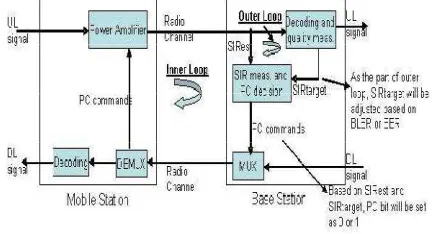
The received power at the base station is compared to a threshold value and the result is hard quantized to a power command which informs the user whether to increase or decrease its transmitted power. Block diagram of Reverse Link receiver system is shown in Figure-2.
Fig. 2. Reverse Link receiver system
III.
O
PTIMIZATIONA
LGORITHMSIn a CDMA network, resource allocation is critical in order to provide suitable Quality of Service (QoS) for each user and achieve channel efficiency. Many QoS measures, including bit error rate, depend on the Eb/No given by
=
/
(∑η)/ (1)
Where W is the total spread spectrum bandwidth occupied by the CDMA signals. Gbi denotes the link gain on the path between mobile i and its base b. n denotes background noise due to thermal noise contained in W and
M is the number of mobile users. The transmitted power of
mobile i is pi which is usually limited by a maximum
power level as
0 ≤ pi≤ pimax for 0 ≤ i ≤ M (2)
Ri is the information bit rate transmitted by mobile i. This rate is bounded by the value, Ric, designated in the traffic contract once this user has been admitted into the system.
0 ≤ Ri≤ Ric , for 1 ≤ i ≤ M (3)
An increase in the transmission power of a user increases its Eb/No, but increases the interference to other users, causing a decrease in their Eb/No. On the other hand, an increase in the transmission rate of a user deteriorates its own Eb/No. Controlling powers and rates of the users therefore amounts to directly controlling the QoS that is usually specified as a pre-specified target Eb/No value (θ). It can also be specified in terms of the probability that the
Eb/No falls below (θ).
Thus, the objective here is to find a nonnegative power P=[P1, P2,, ..., Pm]and rate R=[R1, R2,... Rm] vectors which
satisfy the maximum power and rate constraints (2,3) and maximize the function F proposed as
= 1
+ ""# + $$+ %% − (4)
where F is a threshold function defined for user i as
= (1 ()*/+, ) ≥ θi
0 otherwise )7 (5)
A. GAME ENGINE
Genetic algorithms (GAS), as described in [14], are search algorithms based on mechanics of natural selection and natural genetics. In every generation, a new set of artificial creatures (chromosomes) is created using bits and pieces of the fittest of the old. GAS use random choice as a tool to guide a search toward regions of the search space with likely improvement. They efficiently exploit historical information to speculate on new search points with expected improved performance.
Copyright © 2016 IJECCE, All right reserved
θ, the maximum possible power p the rate granted on
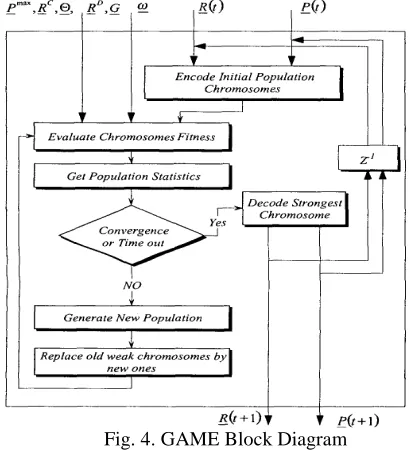
admission Rc and the links gains G. The GAME starts by encoding R(t) and p(t) into chromosomes to form the initial population.
The chromosome is a binary string of N digits. It encodes the (power, rate) values of all M mobiles as depicted in Figure-3. Each mobile occupies 32 bits for its power and 32 bits for its rate.
Fig. 3. Chromosome Format, N bits, where A4 is the total number of mobiles controlled by the base station
F, defined in (4), is the fitness function used to evaluate
chromosomes. The evolving cycle of reproduction evaluation works until the stopping criterion is met. The base station forwards the new R(t+l) and p(t+l) vectors to the users. In the mean time, the new solution is being used to initialize the input vectors at the next control period. This feedback is done for the sake of superiority assurance of the new solution.
B. Particle Swarm Optimization Approach
Particle Swarm Optimization (PSO) is a method for global optimization [15] and it is different from other well-known Evolutionary Algorithms. As in Evolutionary Algorithms, a population of potential solutions is used to probe the search space, but no operators are applied on the population to generate new solutions. In PSO, each individual particle, of the population, called swarm, adjusts its trajectory toward its own previous best position, and toward the previous best position attained by any member of its topological neighborhood. In the global variant of PSO, the whole swarm is considered as the neighborhood.
Fig. 4. GAME Block Diagram
Thus, global sharing of information takes place and the particles profit from the discoveries and previous experience of all other companions during the search for
promising regions of the landscape. For example, in the single-objective minimization case, such regions possess lower function values than others, visited previously. In the local variant of PSO, the neighborhood of each particle in the swarm is restricted to a certain number of other particles but the movement rules for each particle are the same in the two variants. The basic algorithm of PSO has two different versions. The first version is the one where the particles are represented by binary strings and the other is the one where the particles are represented by real numbers in n dimensional space where n is the dimension of the optimization problem under consideration. First, the author describes the basic algorithm of PSO in real number problems. The Pseudo-code for this algorithm is: For i=1 to number of individuals
If G(8i) G(9i) then do // G() evaluates fitness For d=1 to dimensions
9id=8id // 9idis best so far Next d
End do
g=i // arbitrary For j=indices of neighbors
If G(8i) >G( 9g ) then g=j // g is index of best performer Next j
For d= 1 to dimensions
<id(t)= <id(t-1)+ ø1(9id - 8id(t-1))+ ø2( 9gd - 8id(t-1))
<id∈ (−>min, +>max)
8id(t)= 8id(t-1)+ <id(t) Next d
Next i
Here 8C is the position of particle i, <C is the velocity of particle i, ø1 is a random number that gives the size of the
step towards personal best, ø2 is a random number that
gives the size of the step towards global best (the best particle in the neighborhood) and G is the fitness function which we are trying to minimize.
For the binary PSO, the component value of , 9C and 9D are restricted to the set {0, 1}. The velocity <C is interpreted as a probability to change a bit from 0 to 1, or from 1 to 0 when updating the position of particles. Therefore, the velocity vector remains continuous-valued but the value of the velocity needs to be mapped from any real value to a probability in the range [0, 1]. This is done by using a sigmoid function to squash velocities into a [0, 1] range. Finally, the equation for updating positions is replaced by the probabilistic update equation:
8CE = F0 if ρid (t − 1) ≥ sig(vid t )
1 ρid t – 1# ≤ sig(vid t )7 (6)
(K) is a vector representing random numbers, drawn from a uniform distribution between 0 and 1.
PSO Algorithm
Copyright © 2016 IJECCE, All right reserved 1995]. The PSO principle is the movement of a group of
particles, randomly distributed in the search space, each one with its own position and velocity. The position of each particle is modified by the application of velocity in order to reach a better performance [Kennedy and Eberhart 1995]. The interaction among particles is inserted in the calculation of particle velocity. The problem described in (16) indicated an optimization developed in the R set. Hence, in the PSO strategy, each power candidate-vector defined as pi[n], of size4 K, is used for the velocity calculation of next iteration:
vi[n+1] = w[n] .vi[n]+ø1.Ui1 [n]( LMNOP[n]-pi[n])
+ ø2 Ui2 [n](LQMNOP[n]-pi [n]) (7)
Where ω[n] is the inertia weight of the previous velocity in the present speed calculation; Ui1 [n] and Ui2 [n] are diagonal matrices with dimension K, and elements are random variables with uniform distribution ~ U ϵ[0; 1], generated for the ith particle at iteration n = 1; 2; :: ;N;
LQMNOP[n] and LMNOP[n] are the best global position and the best local positions found until the nth iteration, respectively; ø1 and ø2 are acceleration coefficients
regarding the best particles and the best global positions influences in the velocity update, respectively.
The particle(s) selection for evolving under power-multirate adaptation strategy is based on the lowest fitness values satisfying the constraints in [16]. The ith particle’s position at iteration n is a power candidate-vector pi[n] of size K × 1. The position of each particle is updated using
the new velocity vector (7) for that particle:
pi [n + 1] = pi[n] + vi[n + 1]; i = 1; :: : ;M (8) The PSO algorithm consists of repeated application of the update velocity and position update equations. A pseudo-code for the single-objective PSO power-multirate allocation problem is presented in Algorithm 1[SOO PSO Power multirate allocation].
In order to reduce the likelihood that the particle might leave the search universe, maximum velocity Vm factor is
added to the PSO model (7), which will be responsible for limiting the velocity in the range [±Vm]. The adjustment of
velocity allows the particle to move in a continuous but constrained subspace, been simply accomplished by:
vi[n] = min {Vm; max{-Vm; vi[n]}} (9)
From (9) it’s clear that if |vi[n]| exceeds a positive constant value Vm specified by the user, the ith particle’
velocity is assigned to be sign(vi[n])Vm, i.e. particles
velocity on each of K¡dimension is clamped to a maximum magnitude Vm. If we could define the search
space by the bounds [Pmin; Pmax], then the value of Vm will
be typically set so that Vm = τ (Pmax - Pmin), where 0.1 ≤ τ
≤ 1.0, please refer to Chapter 1 within the definition of
reference [Nedjah and Mourelle 2006].
Hence, in order to achieve a balance between global and local search abilities, a linear inertia weight decreasing with the algorithm evolving, having good global search
capability at beginning and good local search capability latter, was adopted herein:
w[n] = (w
initial- w
Final) + w
Final (10)where winitial and wfinal is the initial and final weight inertia,
respectively, winitial > wfinal , N is the maximum number of iterations, and m ϵ [0.6; 1.4] is the nonlinear modulation
index [Chatterjee and Siarry 2006].
IV.
R
ESULTA
NALYSIS• Simulation for showing GAME behavior is done for a single cell, where the base is situated at its center. The cell radius is 1 distance unit. Mobile users are distributed uniformly over the cell space. We adopt the distance loss model in [l6]. The link gain, Gij is modeled as a product of
two variables
Gij = Aij x Dij (11)
Aij is the variation in the received signal due to shadow fading, and assumed to be independent and log normally distributed with a mean of 0 dB and astandard deviation of 8 dB. The variable Dij is the large-scale propagation loss, which depends on the transmitter and the receiver location, and on the type of geographical environments. Let dij be the distance between transmitter j and receiver
i,we assume, in decibels
10 log UV = W
−127.0 − 25\,DEV EV < 1
−127.0 − 35\,DEV 1 ≤ EV < 3
−135.5 − 80\,DEV 3 ≤ EV
7 EV
The above propagation model includes three different path loss slopes and assumes -127.0dB for the 1 unit distance interception point [17]. In a typical 3G CDMA environment, the system bandwidth W can increase up to 20MHz and the background thermal noise density is - 174 dbm/Hz.
• In PSO it was assumed a retangular multicell geometry with a number of base station (BS) equal to 4 and mobile terminals (mt) uniformly distributed over 25Km2 area. Besides, the initial rate assignment for all multirate users was admitted discretely and uniformly distributed over three chip rate submultiple,
Rmin = [
`a
;
c`
;
d
]
Rc[bps] (12)A number of mobile terminals ranging from K = 5 to 250 was considered, which experiment slow fading channels, i.e., the following relation is always satisfied:
Tslot < (∆t)c (13)
where Tslot = kOlmPn is the time slot duration, Rslot is the
Copyright © 2016 IJECCE, All right reserved SINR estimation process, and it implies that each power
updating accomplished by the DPCA happens with rate of
Rslot, assumed here equal to 1500 updates per second.
• Regarding the average transmitting power for the mobile units, PSO algorithm reached solutions with much smaller values of transmitting power to serve the same number of users. The author says that the resulting values of PSO algorithm are about 65% on average from those of GA algorithm [1]. This means that PSO algorithm was much better in searching the search space when we fixed the maximum number of iterations.
• Regarding the average received )*/+, the author found that the results obtained by GA algorithm are slightly better than those obtained by PSO algorithm [2]. This was an expected result because the solutions of GA algorithm used greater values for transmitting power and thus they probably will achieve better average received )*/+,. In spite of the fact that GA results are better than PSO results, the results for both algorithms are too close to each other.
V.
C
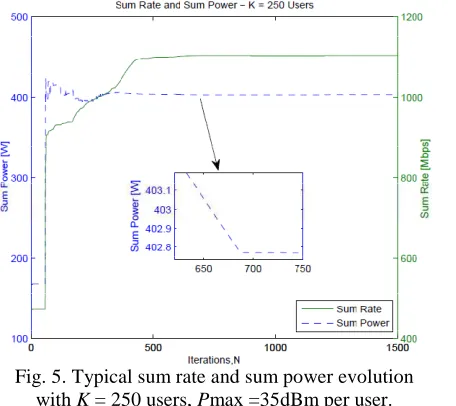
ONCLUSIONSThe simulations results revealed that the proposed PSO approach can be easily applied to the throughput maximization problem under power consumption constraint in a large multirate system loading and realistic fading channel conditions. The algorithm has been found robust under a high number of active users in the systems, e.g. K ≥ 200, while held the efficient searching feature and quality solutions (Fig.5). Those features make the PSO resource allocation algorithm a strong candidate to be implemented in real multiple access networks.
Fig. 5. Typical sum rate and sum power evolution with K = 250 users, Pmax =35dBm per user.
In GAME, the proposed scheme performed acceptably during the experiments done to test it. The enhancements over the uncontrolled case are substantial. The received signal quality )*/+, on the average has seen an increase of
up to 7.5 dB and the probability of having )*/+, below
required level is decreased from 0.3 to 0.01(Fig.6). In the same time, the average power consumption is decreased by at least 20%. These improvements help enhancing the
current users QoS and extend the base station coverage to serve more mobiles.
Fig. 6. Average Probability that received
)
*/
+
,,is less than θ Vs. Number of Users.
The only drawback is that the GAME is seen to be aggressive somewhat on bit rate cuts. We have seen rate decrease of up to 50% of the asked traffic. Also, the processing time to solve the optimization problem is seen to be proportional with the number of users.
Regarding the outage probability, both algorithms achieved zero outage for small number of users. As the number of users increases, the outage probability appears. In general, the solutions of GA algorithm had outage probability greater than the solutions of PSO algorithm.
R
EFERENCES[1] M. Moustafa, I. Habib and M. Naghshineh, Genetic Algorithm for mobiles equilibriumǁ, in Proceedings of MILCOM 2000: 21st Century Military Communications Conference, vol. 1, pp. 70– 74, Oct. 2000.
[2] Hassan M. Elkamchouchi, Hassan M. Elragal ,Mina A. Makar power control in cdma system using Particle swarm optimizationǁ 24th national radio science conference (NRSC 2007).
[3] S.A. Grandhi, R.Vijayan, D.J. Goodman and J. Zander, .Centralized power control in cellular radio systems., IEEE Trans. Veh. Technology, vol.42, pp.466-468, Nov.1993. [4] G.J. Foschini and Z. Miljanic, .A simple distributed autonomous
power control and its convergence., IEEE Trans. on Veh. Technology, vol.42, pp.641-646, Nov.1993.
[5] S.A. Grandhi, R.Vijayan and D.J. Goodman. Distributed power control in cellular radio systems, IEEE Trans. on Comm., vol. 42, No.2/3/4, Feb/Mar/April 1994.
[6] T.H. Lee and J.C. Lin, .A fully distributed power control algorithm for cellular mobile systems., IEEE Journal on selected areas in comm., vol.14, issue 4, pp.692-697, May 1996. [7] H. Wang, A.Huang, R.Hu and W.Gu, .Balanced distributed
power control. The 11th IEEE Intl. Sysmp. on Personal, Indoor and Mobile Radio Comm., vol.2, pp.1415-1419, Sep. 2000. [8] C.W.Sung and W.S Wong, .A distributed fixed step power
control algorithm with quantization and active link quality protection., IEEE Trans. on Veh. Technology, vol. 48, pp.553-562, March 1999.
[9] A. Chockalingam, P. Dietrich, L. B. Milstein, and R. R. Rao, “Performance of closed-loop power control in DS-CDMA cellular systems,” IEEE Transactions on Vehicular Technology, vol. 47, no. 3, pp. 774-778, August 1998.
Copyright © 2016 IJECCE, All right reserved
[11] J. T.-H. Wu and E. Geraniotis, Power control in multi-media CDMA networks, in Proc. VTC, pp. 789–793, 1995.
[12] Salim Manji and Weihua Zhuang, Power control and capacity analysis for a packetized indoor multimedia DS-CDMA network, IEEE Trans. Vehicular Technology, 49, 2000, 911-935. [13] S. Ariyavisitakul and L. F. Chang, Signal and interference
statistics of a CDMA system with feedback power control, IEEE Trans. Commun., 41, 1993, 1626–1634.
[14] D.Goldberg, Genetic Algorithms in Search, Optimization and Machine Learning, Addison-Wesley, 1989.
[15] Abdurazak Mudesir ―Power Control Algorithm in CDMA systemsǁ International University Bremen.
[16] D. Kim, “Rate-Regulated Power Control for Supporting Flexible Transmission in Future CDMA Mobile Networks”, IEEE Journal on Selected Areas in Communications, vol. 17, no. 5, pp. 968-977, 1999.
[17] W. Lee, Mobile Communications Design Fundamentals. Wiley,
2nd Edition, New York, 1993.
A
UTHOR’
SP
ROFILEDr. Manish Rai
He received the B.Tech. and M.Tech. degrees In Electronics and Telecommunications from University of Allahabad, and the Ph.D. degree from Motilal Nehru Regional Engg. College (University of Allahabad, a central university), Allahabad. His current area of research is Wireless Adoc Network and fiber optics. He is presently working as a Professor in the Department of Electronics & Communication Engineering Faculty of Engg. & Tech. MJP Rohilkhand University. Email: [email protected]
Chandra Praksh
He received the M.Tech. degree in Digital Systems from Motilal Nehru National Institute of Technology, Allahabad. Presently working as Research Scholar in the Department of Electronics and Communication Engineering of B.U. India. His current area of research is Wireless Communication and CDMA system.