Int. J. Adv. Res. Sci. Technol. Volume 5, Issue 2, 2016, pp.583-587.
International Journal of Advanced Research in
Science and Technology
journal homepage: www.ijarst.com
ISSN 2319 – 1783 (Print)
ISSN 2320 – 1126 (Online)
Worldwide Interoperability for Microwave Access.
Kamal Saran Rangavajhula*
Department of Electronics and communication, School of Engineering, G.V.P. College for Degree and PG Courses, Visakhapatnam-530045, India.
*Corresponding Author’s Email: [email protected]
A R T I C L E I N F O A B S T R A C T
Article history: Received Accepted Available online
: 23 May 2016 : 30 June 2016 : 02 Aug. 2016
WiMax (Worldwide Interoperability for Microwave Access) is the next step on the path to a wireless world, extending broadband wireless access to new areas and over farther distances, as well as considerably reducing the expenditure of deploying broadband to new locations. WiMax is a wireless digital communications system, also known as IEEE 802.16 that is intended for wireless "metropolitan area networks". WiMax can provide broadband wireless access (BWA) up to 30 miles (50 km) for fixed stations, and 3- 10 miles (5 -15 km) for mobile stations. In contrast, the Wi-Fi/802.11 wireless local area network standard is limited in most cases to only 100 -300 feet (30 - 100m). WiMax is the industry term for a long-range networking standard. WiMax technology has potential to deliver the high-speed Internet access to rural areas and other locations not serviced by cable or DSL technology. WiMax offers an alternative to satellite Internet services.
© 2016 International Journal of Advanced Research in Science and Technology (IJARST). All rights reserved. Keywords:
WiMax, broadband, wireless access,
Communications system.
PAPER-QR CODE
Citation: Kamal Saran Rangavajhula., Worldwide Interoperability for Microwave Access, Int. J. Adv. Res. Sci. Technol. Volume 5, Issue 2, 2016, pp.583-587.
Introduction:
WiMax is a new standard being developed by the IEEE that focuses on solving the problems of point-to-multipoint broadband outdoor wireless networks. It has several possible applications, including last mile connectivity for homes and businesses and backhaul for wireless hot spots.
While WiMax has historically lacked the grassroots popularity of its cousin, Wi-Fi (i.e. 802.11), the standard is gaining significant traction from the high profile support it has received from the likes of Intel and other big name corporations. Supporters of the standard have some very lofty expectations for its potential. Intel, for example, stated that 802.16 is, "as important has the Internet itself" -- a technology that will enable up to 5 billion people to be connected over time.
Only time will tell if WiMax will live up to the expectations of its supporters. For the time being, it is important to understand how Wi Max works and to
examine the role that it might play in environments looking to benefit from wireless mobility.
WiMax Forum:
In April of 2001, the WiMax forum is set up. This forum participates in authenticating the standardization and interoperability of the broadband radio access products based on IEEE 802.16 and ETSI Hiper MAN.
This forum is organized by many radio communication equipment suppliers, component suppliers, operators, which is a nonprofit organization In November of 2004, the Network Working Group (NWG) is set up, which participates in setting downing the network standards for the IEEE 802.16d and IEEE 802.16e.
802.16 Standards:
1.802.16.1 : (10-66 GHz, line-of-sight upto 134Mbit/s).
Int. J. Adv. Res. Sci. Technol. Volume 5, Issue 2, 2016, pp.583-587. 3.802.16a : (2-11 Ghz, Mesh, non-line-of- sight).
4.802.16b : (5-6 Ghz).
5.802.16c : (detailed system profiles). 6.P802.16e : (Mobile Wireless)
WiMax Features:
Use microwave for the wireless transfer of data. Specifies a frequency band in the range between 2 GHz to 66 GHz, For high speed wireless networking. Basically, Wimax is a wireless internet service that is capable of covering a wide geographical area by serving hundreds of users at a very low cost. Uses OFDM, good for multipath environments. It includes TDD and FDD duplexing support. Flexible channel sizes (3.5 MHz, 5 MHz, 10MHz).
An easy and fast system to install. Leading to low installation cost, when compared to fiber ,cable or DSL deployments.
Architecture:
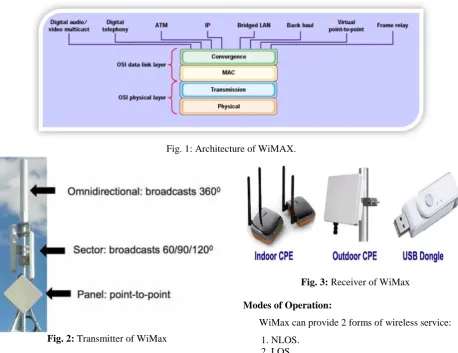
IEEE 802.16 Protocol Architecture has 4 layers: Convergence, MAC, Transmission and physical, which can be mapped to two OSI lowest layers: physical and data link
Physical and transmission layer functions:
Encoding/decoding of signals
Preamble generation/removal
Bit transmission/reception
The PHY converts MAC layer frames into signals to be transmitted across the air interface.
Traditional narrow band radio is used with conventional modulation schemes. 1. QPSK: (longer distance) 2. QAM-16: (medium distance) 3. QAM-64: (short distance).
The MAC and Convergence layers which are present in other communication networks behave as they behave in other networks. Which are used to combine every application of WIMAX and forward them to physical layer.
WiMax system consists of:
WiMax Tower:
Similar in concept to a cell-phone tower - A single WiMAX tower can provide coverage to a very large area as big as 3,000 square miles (~8,000 square km).
WiMax Receiver:
The receiver and antenna could be a small box or Personal Computer Memory card, or they could be built into a laptop the way WiFi access is today.
Fig. 1: Architecture of WiMAX.
Fig. 2: Transmitter of WiMax
Fig. 3: Receiver of WiMax
Modes of Operation:
WiMax can provide 2 forms of wireless service:
Int. J. Adv. Res. Sci. Technol. Volume 5, Issue 2, 2016, pp.583-587. NLOS:
Wi-Fi sort of service, where a small antenna on a computer connects to the tower. Uses lower frequency range (2 to 11 GHz).
Non-line-of-sight (NLOS) is a condition where a signal from a wireless transmitter passes several obstructions before arriving at a wireless receiver. The signal may be reflected, refracted, diffracted, absorbed or scattered.
These create multiple signals that will arrive at a receiver at different times, from different paths, and with different strength.
Wireless systems developed for NLOS environment have to incorporate a number of techniques to overcome this problem and that make the systems more complex than those for LOS
LOS:
Where a fixed antenna points straight at the WiMax tower from a rooftop or pole. The LOS connection is stronger and more stable. Higher throughput. Uses higher frequencies: reaching a possible 66 GHz.
Through stronger LOS antennas, higher range can be achieved: up to 50km radius. Line-of-sight (LOS) is a condition where a signal travels over the air directly from a wireless transmitter to a wireless receiver without passing an obstruction. LOS is an ideal condition for a wireless transmission because the
propagation challenge only comes from weather or atmospheric parameters and the characteristic of its operating frequency.
Fig. 4: (LOS) and (NLOS) in Transmission and Receiver in WiMax.
How WiMax Works?
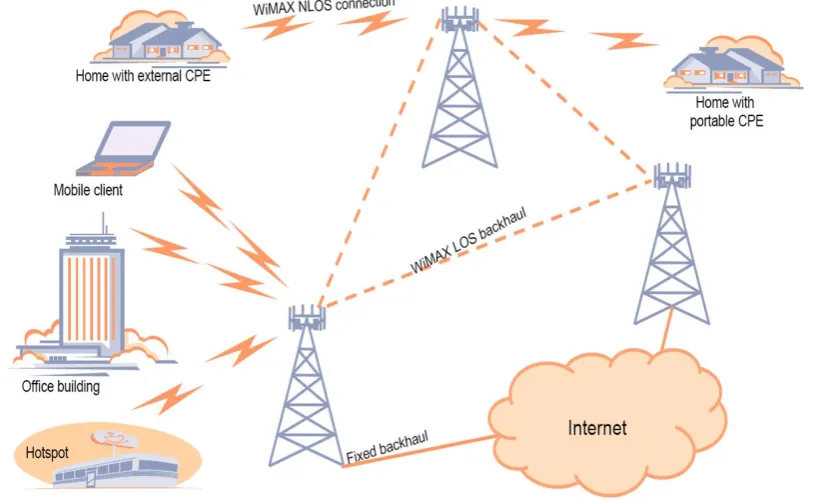
Working procedure of Wimax is as follows .A WiMAX tower station can connect directly to the internet using a high-bandwidth, wired connection.
It can also connect to another WiMAX tower using a line-of-sight, microwave link and the way towers communicate with each other is by LOS backhaul ay. From those towers to homes , offices, mobile clients by LOS or NLOS connection.
This connection to a second tower, along with the ability of a single tower to cover up to 3,000 square miles, is what allows WiMAX to provide coverage to remote rural areas.
Fig. 5: Pictorial Representation of WiMax working procedure.
Connectivity:
Devices that provide connectivity to a WiMax network are known as the “subscriber stations”.
Some of the portable units are:
Mobile Phones
Int. J. Adv. Res. Sci. Technol. Volume 5, Issue 2, 2016, pp.583-587.
Laptops
Gaming consoles
MP3 Players.
WiMax - Security Functions:
Security is handled by a privacy sub layer within the WiMAX MAC. The key aspects Of WiMAX security are as follow:
Support for privacy:
User data is encrypted using cryptographic schemes.
WiMAX uses the Advanced Encryption Standard (AES) to produce cipher text. The cipher text is then transmitted over the wireless network and cannot be understood by an eavesdropper.
Device/user authentication:
WiMAX provides a flexible means for authenticating users to prevent unauthorized use. Support for fast handover.
A three-way handshake scheme is supported to optimize the re-authentication mechanisms for supporting fast handovers.
Advantages of WiMAX:
Multi - functionality within WiMax Technology:
WiMax Technology perform a variety of task at a time such as offering high speed internet, providing telephone service, transformation of data, video streaming, voice application etc.
WiMax Coverage:
The single station of Wimax can operate and provide coverage for hundreds of users at a time and manage sending and receiving of data at very high speed with full of network security.
WiMax infrastructure:
WiMax infrastructure is very easy and flexible
Disadvantages:
WiMAX is basically a power sensitive technology, meaning that it heavily relies on strong electrical support
A Line of sight is required in order to make a wireless data communication connection extending over 6 miles or more. Means it is needed for more distant connections.
Bandwidth is shared among users in a given radio sector. If there are many users in one sector, they will have lower speed.
Bad weather conditions such as rain could interrupt the signal. Other wireless equipment could cause interference.
WiMAX is a very power-consuming process.
Applications:
Broadband Internet access real time applications:
Video streaming VoIP, Video on Demand
Surveillance and monitoring (forests, volcano, etc.)
General applications and services based on IP connectivity.
Media content downloads, E-learning Multi-player interactive gaming
Web browsing and instant messaging. Other possible real time complex applications.
Advanced Features of WiMAX Technology:
Adaptive Modulation and Coding (AMC):-Support for QPSK, 16QAM & 64QAM are mandatory in the DL with Mobile WiMAX.
Hybrid Automatic Repeat Request (HARQ):- supported by Mobile WiMAX. HARQ is enabled using “Stop and Wait” protocol which provides fast response to packet errors and improves cell edge coverage. A dedicated ACK channel is provided in the uplink for HARQ ACK/NACK signaling.
Int. J. Adv. Res. Sci. Technol. Volume 5, Issue 2, 2016, pp.583-587. IEEE802.16d stands for fixed WIMAX and
IEEE802.16e stands for mobile WIMAX. Table: 1 comparison between different IEEE standards.
Present research work on WiMAX:
WiMAX2 is the present ongoing development in the WiMAX versions. That is to increase the speed of existing WiMAX network. Currently existing WiMAX versions provides minimum of 30 to 40 megabits per second of speed. But the goal of the WiMAX2 is to get 100 Mbit/s for mobile devices and 1 Giga bits per second fixed type of WiMAX devices and 4G for next generation mobile network.
References:
1. www.it.iitb.ac.in
2. http://en.wikipedia.org/wiki/WiMax 3. IEEE 802.16-2005 (802.16e)
4. “IEEE Standard 802.16: A Technical Overview of the Wireless MAN Air Interface for Broadband Wireless Access,” C. Eklund et al., IEEE Communication Magazine.om
5. http://en.wikipedia.org/wiki/WiMax