Please cite this article as: I. F. Edem, V. A. Balogun, Energy Efficiency Analyses of Toolpaths in a Pocket Milling Process, International Journal of Engineering (IJE), IJE TRANSACTIONS B: Applications Vol. 31, No. 5, (May 2018) 847-855
International Journal of Engineering
J o u r n a l H o m e p a g e : w w w . i j e . i rEnergy Efficiency Analyses of Toolpaths in a Pocket Milling Process
I. F. Edema, V. A. Balogun*b
a Faculty of Engineering, Department of Mechanical Engineering, Akwa Ibom State University, Mkpat Enin, Akwa Ibom State, Nigeria. b Faculty of Engineering, Department of Mechanical Engineering, Edo University Iyamho, Iyamho-Uzairue, Edo State, Nigeria
P A P E R I N F O
Paper history: Received 27 July 2017
Received in revised form 15 September 2017 Accepted 06 January 2018
Keywords: Energy Efficiency Modelling Machining Toolpath Strategies NC Codes Feed Axes
A B S T R A C T
This paper presents an approach to analytically determine the most energy efficient toolpath strategy in mechanical machining. This was achieved by evaluating the electrical energy requirement of the NC codes generated for the zag, zigzag, and rectangular contour toolpath strategies. The analytical method was validated by performing pocket milling on AISI 1018 steel with the considered toolpaths using a 3-axis Takisawa Mac-V3 milling machine. The rectangular contour toolpath was the most efficient in terms of the electrical energy demand of the feed axes and cycle time. Pocket milling with the zigzag toolpath strategy resulted in higher electrical energy demand of the feed axes and cycle time by 2% due to acceleration and deceleration characteristics of the machine tool feed axes execution at corners of the toolpath strategy adopted. Also, the electrical energy demand of the feed axes and cycle time for the zag toolpath were higher by 14% and 8%, respectively, due to the number of tool retracts as a result of the executed toolpath strategy. The experimental validation results showed good agreement with the analytical approach presented in this study. It can be deduced that for sustainable machining, the rectangular contour toolpath should be adopted since it has less tool retractions irrespective of the toolpath strategy adopted for machining. This could further enhance the selection of optimum green parameters by shop floor process engineers for sustainable manufacture of products.
doi: 10.5829/ije.2018.31.05b.22
1. INTRODUCTION1
The International Energy Outlook (IEO2013) projected the global industrial energy demand to increase between 2010 and 2040 from 0.06 quadrillion kWh to 0.09 quadrillion kWh, which indicates an average increase of 1.4 % per annum [1]. In 2011, the United States Energy Information Agency (EIA) reported that the industrial sector consumed 0.08 quadrillion kWh [2], being 51% of the total global energy demand (0.16 quadrillion kWh) [3], while the value decreased to 0.0003 quadrillion kWh in UK [4]. The energy consumed accounted for 457.5 million tonnes (Mt) of CO2
equivalent emission for 2011 in UK. This further affirms the contributions of the manufacturing sector to increase the carbon footprint and the environmental impacts of such processes. Therefore, the use of sustainable technologies and best available practices
*Corresponding Author’s Email:
[email protected] (V.A. Balogun)
(BAP) could provide significant energy saving and CO2
reduction in the manufacturing sector [5].
Mechanical machining is one of the widely used technologies in the manufacturing sector due to its versatility and accuracy in the fabrication of products. Machine tools possess high intensity of electrical energy demand [6, 7]. This electrical power demand fluctuates based on operating states of the machine tool. For example, Edem and Mativenga [8] proposed a power-time profile for the power consumed when undertaking peripheral milling of AISI 1018 steel on a 3-axis Takisawa Mac-V3 milling machine.
of machine tool components, and proposed: 1) switching off the machines during long idle periods; 2) attaining of energy saving mode during idle periods through constant time breaks; and 3) the provision of the Human Machine Interface (HMI) device to trigger manual operations on the machines for energy reduction strategies. Mori et al. [11] developed a new acceleration and deceleration control method for reducing energy consumption by synchronising spindle acceleration with feed system. Kroll et al. [12] reported that weight reduction of machine components tends to decrease the acceleration time and hence reduces the processing time. This is because lower gravitational and inertia forces are created and the overall energy for moving masses is reduced. Edem and Mativenga [13] suggested that the design and material choice of the vice to be mounted on the machine table with regards to its weight should be considered in order to reduce energy consumption.
Other researchers also proposed methods of minimising the electrical energy demand in machining processes. Rangarajan and Dornfeld [14] developed a method for reducing feedrate losses due to abrupt toolpath changes as well as determining the best feedrate for machining a segment. They reported that 2 – 4% reduction in cycle time may be achieved which could result in more than 10 – 20% of energy savings. Balogun et al. [15] used the relationship between the cutter swept angle and specific ploughing energy to develop an optimised model for determining minimum ploughing effect in a milling process. The authors reported that minimum ploughing effect could be achieved at a cutter swept angle value of 39.74o when
machining with a tool that has an edge radius of 60 µm. Yan and Li [16] utilised the grey relational analysis and the response surface methodology to determine the optimal cutting parameters (including feedrate, spindle speed, depth of cut, and width of cut) that would enhance the identification of the most efficient cutting parameter for reduced cutting energy demand, improved surface finish, and increased material removal rate for a milling process. It was observed that machining at low spindle speeds results in minimal energy demand. Al-Ghamdi and Iqbal [17] investigated the impacts of feedrates, cutting speeds, minimum quantity lubrication on tool life, machining forces, productivity, process costs, and specific energy consumption. The authors reported that energy efficiency can be correlated with the high speed machine tool. Camposeco-Negrete [18] studied the effects of the depth of cut, feedrate, and cutting speed on the energy required in turning AISI 1018 steel and reported that higher feedrate, minimum depth of cut, and minimum cutting speed combination results in lower energy demand. Balogun and Edem [19] investigated the impact of swept angle optimization and their influence on the specific cutting energy in milling
AISI 1045 steel alloy by varying the step over at different feedrate values, in order to determine the optimization criterion for machining. It was observed that an optimum swept angle of 31.8° was appropriate in the elimination of ploughing effect and reducing the specific cutting energy to an optimised minimum value. Edem and Mativenga [20] reported that the energy intensity in mechanical machining could be significantly reduced by selecting toolpaths with longer linear path segments as a result of the minimal constraints imposed by acceleration and deceleration of the feed drive which enables the maximum feedrate to be reached.
1. 1. Toolpath Strategies Toolpaths guide the cutter through the machined region and enable the removal of material to a fixed depth from some arbitrary closed boundary on a flat workpiece surface. This process is called pocketing and the shape produced is called pocket [21]. In milling, two types of toolpath strategies are commonly utilised namely the direction-parallel toolpaths (zag, zigzag) and the contour direction-parallel toolpaths (rectangular contour spiral and true spiral).The zag toolpath strategy requires the tool to move in a parallel direction while machining the pocket, then retracts at the end of the path, steps over in a fixed distance, and returns to the start point to continue with the machining process. However, the tool movement during the zigzag strategy is in the to-and-fro directions with regards to the x-y plane of the machine table, resulting in up and down milling processes due to the change in direction of the tool movement. The contour-parallel toolpath consists of a series of contours that are parallel to the boundary or geometry on the flat workpiece [22]. Mechanical machining of parts with efficient toolpath strategies could lead to minimum processing time, improved surface finish [23, 24], higher tool life [25], and minimum energy demand [8].
zigzag, and zag toolpath strategies on machining time without due consideration on the electrical energy demand of toolpaths. El-Midany et al. [22] proposed a feedrate machining time model for normal zig-zag, smooth zig-zag, normal spiral, smooth spiral and fishtail toolpaths. It was concluded that the most efficient toolpath strategy depends on the part geometry, the CNC machine characteristics, and the cutting conditions. Analytical estimation method was also adopted to determine the power demand of two axes feed motors based on NC codes by evaluating the actual feedrate for each axes [28]. The power demand of the feed axes was estimated from the angle of orientation and their corresponding axis feedrates. However, the study did not investigate optimum toolpath strategies for energy consumption reduction. Moreover, the effects of the weights of the feed axes, workpiece and machine vice were not considered in the analytical power estimation. Edem and Mativenga [8] undertook a systematic study of work holding device and toolpath orientation, as well as toolpath strategies for milling operations. They concluded that machining toolpaths aligned to the lighter axis reduced the electrical energy demand and surface roughness by 29 and 50%, respectively. Nevertheless, this work did not utilise the power demand model of the feed axes to estimate the feed axes’ power demand of toolpaths.
Altintas et al. [29] investigated the effect of toolpath strategies on the electrical energy demand and total processing time. Six toolpath strategies (i.e. follow path, follow periphery, profile, zig, zigzag, and zig with contour) were engaged to mill a rectangular open pocket standard for exchange of product (STEP) feature. It was reported that the zigzag toolpath strategy resulted in minimum energy demand while the zig with contour toolpath resulted in high energy demand. Li et al. [30] theoretically analysed the optimal machining toolpath strategies in order to improve energy efficiency of CNC machining. End milling was performed on a CNC machining centre HAAS-VF5 with the zigzag in x-axis direction, zigzag in y-axis direction, zigzag in 45o,
contour offset and spiral toolpath strategies. Results showed that air cutting time was higher when utilising the spiral toolpath due to the number of tool retracts; thereby, resulting in higher energy demand. The air cutting time was minimal for zigzag in x-axis direction. Nevertheless, the importance of weights moved by the feed drive was not highlighted in their theoretical analyses. Recently, Edem et al. [31] investigated the impacts of toolpath strategies and machine tool axes configurations on electrical energy demand in
mechanical machining. This was achieved by
performing pocket milling of AISI 1018 steel with the zag, zigzag, and rectangular contour toolpaths on two 3-axis CNC milling machines. Results showed that the electrical energy efficiency of toolpaths machining
strategy varied from one CNC milling machine to another one due to their structural configurations.
The literature has provided insight into few analytical approaches for determining efficient toolpath strategies based on the machining time. However, the proposed models did not determine the optimal toolpath strategy in terms of electrical energy demand and processing time and at the same time did not consider the feed axes energy demand model which incorporates the weights of the feed axes, workpiece and machine vice. Since numerical control (NC) codes (i.e. G, M, S, and F-codes) control the functional performance of NC machines, it is therefore important to determine the optimal toolpath strategy that incorporates the generic feed axes energy demand model found in literature to evaluate the feed energy demand of toolpaths from the generated NC codes.
1. 2. Research Aim The aim of this work is to investigate the energy demand of machining toolpath strategies in a milling process. This was to determine the green and the most efficient toolpath strategy. In lieu of this, pocket milling on AISI 1018 steel with the zag, zigzag, and rectangular contour toolpaths were conducted on a 3-axis CNC milling machine in order to validate the proposed analytical approach for optimal toolpath prediction. The knowledge obtained in this study would aid process planners in selecting optimum toolpath strategy for improved energy efficiency in mechanical machining.
2. ELECTRICAL ENERGY DEMAND ESTIMATION OF TOOLPATH STRATEGIES WITH REGARDS TO FEED AXES DIRECTIONS
Energy saving measures in toolpath strategies could be achieved by using appropriate models to predict the energy required to machine a product based on numerical control (NC) codes. The energy efficiency of toolpaths may be affected by the structural configuration of the feed axes due to the difference in weights moved by each axis [32]. This would be ascertained by adopting the power demand model for feed axes proposed by Edem and Mativenga [13] and presented in Equation 1 to estimate the feed axes’ power demand of toolpaths.
Pf−feed= P0+ (aiWivfi+ biWi) + Ffvf (1)
The machining toolpath’s cutting length and direction influence the material removal cycle time. The cycle time and direction of the cutting tool relative to the workpiece can be evaluated by taking into account the acceleration and deceleration time of the feed axes movement [33]. The time required to accelerate and decelerate the feed drives depends on the maximum feedrate and axis acceleration to be attained by the drive and the controller parameters of the machine tool.
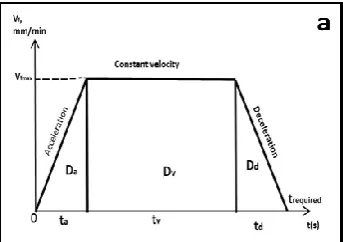
Two types of feed profiles are normally used for the feed axes movement. These include the trapezoidal feed profile and the triangular feed profile presented in Figures 1(a) and 1(b).
The trapezoidal feed profile in Figure 1a shows that the distance travelled by the feed axes or cutter is long enough to allow acceleration, stabilisation and deceleration of the feed axes, thereby making it possible for the required feedrate to be reached at any instance of the machining operation. In the case of the triangular axis movement in Figure 1b, the specified feedrate cannot be reached due to the fact that the feed axis or cutter travel distance is shorter than the time required for the drive to accelerate, stabilise and decelerate [32]. Therefore, based on Figures 1a and 1b, the time required to run an NC block can be estimated for trapezoidal feed profile as shown in Equation 2; while Equation 3 can be adopted for the triangular feed profile depending on the length of the toolpath segment.
Figure 1(a). Acceleration and deceleration phase of the feed
drive as it undergoes trapezoidal movements
Figure 1(b). Acceleration and deceleration phase of the feed
drive as it undergoes triangular axes movements
𝒕𝒓𝒆𝒒𝒖𝒊𝒓𝒆𝒅= 𝟐𝒕𝒂+𝑫−𝟐𝑫𝒗 𝒂
𝒇 (𝑫 ≥ 𝟐𝑫𝒂) (2)
𝒕𝒓𝒆𝒒𝒖𝒊𝒓𝒆𝒅= √𝟐𝒕𝒗𝒂𝑫
𝒇 (𝑫 < 2𝑫𝒂) (3)
where ta is the acceleration time in s, D is the total travel distance in mm, Da is the distance moved by the tool or axis at the acceleration time ta, and vf is the feedrate in mm/min
The electrical energy demand of the feed axes could be estimated from Equation 1 (i.e. feed axes power) and from either Equation 2 or 3 (cycle time) depending on the activated program feedrate or rapid feedrate. Therefore, modifying Equation 1 and incorporating the cycle time based on the feed profile, Equations 4 and 5 can be deduced as proposed by Edem and Mativenga [13].
Ef= Ef−feed+ Er−feed (approach)+ Er−feed (retract) (4)
Ef= (P0+ (aiWivfi+ biWi) + Ffvfi)tcy+
(6502vfa+ 2838.3 + Ffvfa)tcy+ (8540vfa+ 2852 + Ffvfi)tcy
(5)
where Ef is the total electrical energy demand of the feed axes in J, Ef-feed is the energy demand of the feed
axes in specified axes directions and feedrates in J,
Er-feed(approach) is the energy demand of the feed axes during tool approach at rapid or specified feedrate in J,
Er-feed(retract)is the energy demand of the feed axes during tool retract at rapid or specified feedrate in J, vfa is the specified or rapid feedrate for tool approach or tool retract in z-axis direction, tcy is the cycle time in s while P0, Wi, ai and bi, vfi and Ff still retain their usual meanings. It should be noted that during rapid traversing mode or tool retract, Ff = 0.
For the purpose of evaluating the theoretical total energy demand of the feed axes Ef, NC codes from different toolpath strategies (zag, zigzag, and rectangular contour) were generated with the hyper mill CAM software. Figure 2 shows the sample workpiece with different toolpath strategies. The pocket length for zag, zigzag, and rectangular contour offset was 122 mm while the width was 54 mm.
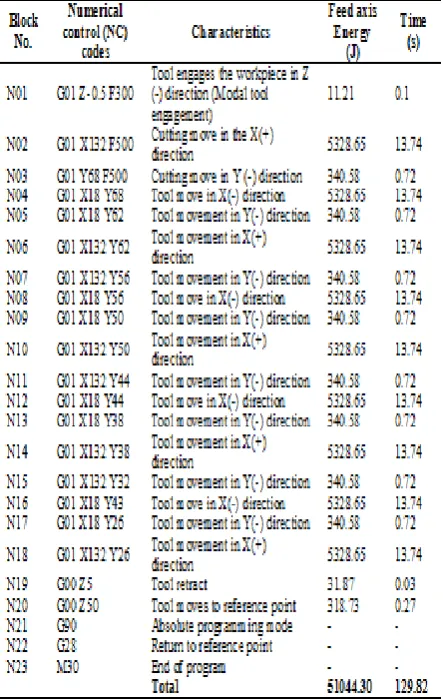
Table 1 presents the NC codes for one of the toolpath strategies (zigzag in x-direction), as well as the feed axis energy and cycle time evaluated using Equations 4 and 5, respectively. The basic machine power demand for Takisawa was measured as 2763.18 W. This value was incorporated into Equation 5 as P0 while the vector coordinates of the corresponding NC codes were evaluated and presented in Table 1.
Figure 2. CAM toolpath showing different toolpath strategies
TABLE 1. NC code sequences for zigzag toolpath in x-axis
direction
From Table 2, it can be observed that the zag toolpath strategy had the longest cycle time due to the number of tool retracts that the toolpath strategy underwent. This means that 10% of the total cycle time was attributable to the non-cutting tool movements (i.e. time required by the tool to rapidly move to the next cutting start point, tool retract and tool approach); thereby, increasing the cycle time. However, the other toolpath strategies (zigzag and rectangular contour) had assumed zero tool retracts. Figure 3 shows variation of predicted theoretical feed axes energy demand based on different toolpath strategies.
From Figure 3, it is observed that the theoretical feed axis energy demand in the y-axis direction is higher than the x-axis by 29, 19, and 11% for the zag, zigzag, and rectangular contour toolpaths, respectively. This is because the x-axis weighs less than the y-axis; thereby resulting in more weights being moved in the y-axis direction. Figure 3 also shows that the rectangular contour toolpath is the most efficient in terms of energy demand and processing time. The reason may be due to longer cutting length of the toolpath before the next cutting pass.
Considering the zigzag toolpath, the short links between one cutting pass and the next increased the processing time and feed energy demand by 2% due to acceleration and deceleration of the machine tool at corners. The feed energy and the processing time for the zag toolpath were higher by 14 and 8%, respectively than that of the rectangular contour toolpath. This was as a result of the number of tool retracts. These results show that the feed axes energy demand model in Equation 5 could be used in determining the most energy efficient toolpath strategy. Thus, energy efficiency of toolpaths could be improved by selecting toolpaths with zero tool retracts and longer cutting length with machining being executed along an axis carrying minimum weights.
3. CASE STUDY
3. 1. Experimental Validation for Electrical Energy Demand of Toolpaths with Regards to
Feed Axes Studies were conducted to determine
Figure 3. Predicted feed axes energy for different toolpath strategies from analytical method
TABLE 2. Results for cutting time, non-cutting time, and feed
axes energy demand of toolpaths
AISI 1018 steel workpiece material with dimensions of 150 × 100 × 20 mm and average mass of 3 kg each was cut for the pocket milling tests, and were machined along the x- and y- axes of the Takisawa Mac-V3 milling machine. The density and average hardness of the workpiece are 7.85 g/cm3 and 233 HV, respectively. The mass of the vice was 57 kg. The sample pockets with the considered toolpaths were previously presented in Figure 2. The cutting tests were conducted under dry cutting environment so as to prevent the power of the coolant pump from masking the feed axis power, as well as to promote sustainable manufacture. An 8 mm diameter short carbide endmill with 4 flutes was used to perform the pocket milling. The cutting speed was 100 m/min. Spindle speed was maintained at 4000 rev/min. The depth of cut was kept at 0.5 mm. The feedrate was also maintained at 500 mm/min to prevent the dominance of feedrates on the feed axes power. The ratio of width of cut to tool diameter was set at 0.75D. The NC codes used in analytically predicting the feed axes energy demand of toolpaths was fed as input to the Takisawa Mac-V3 milling machine for the milling test. The tests were repeated three times for repeatability and accuracy of results. The current and voltage drawn by the CNC machine were directly measured using the 3-phase FLUKE 434 power quality analyser which was
clamped by an electrical technician to the three wires supplying current to the machine tool from the power grid as shown in Figure 4. This enabled the calculation of power requirements during the operation of the machine.
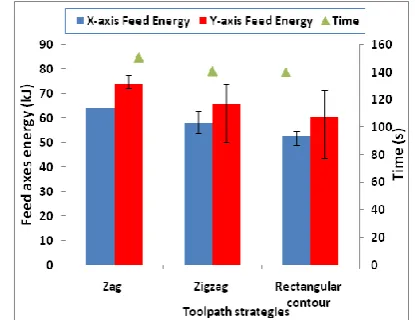
The feed axes power was obtained by subtracting the spindle power and the baseline power from the total cutting power [34]. The feed axes power value and the processing time were then used to estimate the electrical energy of the feed axes required for each toolpath strategy. Figure 5 shows the variation of the electrical energy demand for feed axes during milling with different toolpath strategies and axes movements. From Figure 5, it is observed that the y-axis consumes 15, 14, and 15% more electrical energy of the feed axes than the x-axis of the Takisawa Mac-V3 milling machine for zag, zigzag, and rectangular contour, respectvely. This is because the x-axis is mounted directly on the y-axis. It can be deduced that energy efficiency of toolpaths can be improved by machining along the axis with minimal toolpaths.
Figure 4. Fluke 434 power quality analyser clamped on three
live wires at the back of the Takisawa Mac-V3 milling machine.
Figure 5. Experimental feed axes energy for different moving
It is also observed from Figure 5 that the rectangular contour toolpath is the most efficient toolpath strategy in terms of electrical energy demand of the feed axes and cycle time due to zero tool retracts and longer cutting length of the pocket. These values are in agreement with the theoretical value deduced and presented in Table 2 where the energy demand of the rectangular contour toolpath strategy is lower along the y-axis.
4. CONCLUSIONS
This paper proposed an approach to analytically determine the most energy efficient toolpath strategy in mechanical machining using the generated NC codes from hyper mill CAM software. This was achieved by evaluating the feed energy requirement of the generated NC codes for each toolpath strategy with a proposed feed axes energy demand model in literature. The analytical method was validated by performing pocket milling on AISI 1018 steel with the zag, zigzag, and rectangular contour toolpaths on a 3-axis Takisawa Mac-V3 milling machine. The following conclusions were obtained from this study:
Predictions from the analytical method showed that the feed axis energy demand in the y-axis direction was higher than the x-axis by 29, 19, and 11% for the zag, zigzag, and rectangular contour toolpaths, respectively. This is because more weights are moved on the y-axis than on the x-axis.
Minimum power and electrical energy demand of the feed axes could be achieved by reducing the weights of the table, workpiece, and material billet moved by the feed drive. This is critical since heavier weights increase the friction and inertia exerted on the drive; thereby resulting in a rise in power requirement of the feed axes, and hence the constant power demand of the machine tool.
The rectangular contour toolpath was the most efficient in terms of energy demand and processing time due to longer cutting length of the toolpath before linking the next cutting pass.
In case of the zigzag toolpath, the short links between one cutting pass and the next increased the processing time and the feed energy demand by 2%, due to acceleration and deceleration of the machine tool at corners. The feed energy and the processing time for the zagtoolpath were higher by 14 and 8%, respectively than that of the rectangular contour toolpath. This was as a result of the higher number of tool retracts.
The experimental values show strong correlation with the analytical approach in that the rectangular contour toolpath was identified as the most efficient
in terms of feed axes energy and processing time. It is therefore recommended for process planners to select toolpaths with less tool retractions in order to improve the energy efficiency of the machining process.
5. REFERENCES
1. Sieminski, A., "International energy outlook", Energy
Information Administration (EIA), Deloitte Oil and Gas
Conference, Houston, TX, Nov. Vol. 18, No., (2014).
2. Agency, E.U.S.E.I., "Energy consumption by sector", AEO2013 Reference Case (Full Report) (2017).
3. Conti, J., Holtberg, P., Diefenderfer, J., LaRose, A., Turnure, J.T. and Westfall, L., International energy outlook 2016 with projections to 2040. No. DOE/EIA--048 (2016), USDOE Energy
Information Administration (EIA), Washington, DC (United States). Office of Energy Analysis.
4. Chitnis, M., L. C. Hunt, "What drives the change in UK household energy expenditure and associated CO2 emissions?
Implication and forecast to 2020." Applied Energy, Vol. 94, (2012), 202-214.
5. Kianinejad, K., Uhlmann, E. and Peukert, B., "Investigation into energy efficiency of outdated cutting machine tools and identification of improvement potentials to promote sustainability", Procedia CIRP, Vol. 26, (2015), 533-538. 6. Balogun, V.A., Edem, I.F. and Mativenga, P.T., "E-smart
toolpath machining strategy for process planning", The
International Journal of Advanced Manufacturing
Technology, Vol. 86, No. 5-8, (2016), 1499-1508.
7. Dahmus, J.B. and Gutowski, T.G., "An environmental analysis of machining", in ASME 2004 international mechanical engineering congress and exposition, American Society of
Mechanical Engineers, (2004), 643-652.
8. Edem, I.F. and Mativenga, P.T., "Energy demand reduction in milling based on component and toolpath orientations",
Procedia Manufacturing, Vol. 7, (2017), 253-261.
9. Diaz, N., Helu, M., Jarvis, A., Tonissen, S., Dornfeld, D. and Schlosser, R., "Strategies for minimum energy operation for precision machining", (2009).
https://escholarship.org/uc/item/794866g5
10. Li, W., Zein, A., Kara, S. and Herrmann, C., An investigation into fixed energy consumption of machine tools", Glocalized solutions for sustainability in manufacturing. (2011), Springer, Berlin, Heidelberg. 268-273.
11. Mori, M., Fujishima, M., Inamasu, Y. and Oda, Y., "A study on energy efficiency improvement for machine tools", CIRP
Annals-Manufacturing Technology, Vol. 60, No. 1, (2011),
145-148.
12. Kroll, L., Blau, P., Wabner, M., Frieß, U., Eulitz, J. and Klärner, M., "Lightweight components for energy-efficient machine tools", CIRP Journal of Manufacturing Science and
Technology, Vol. 4, No. 2, (2011), 148-160.
13. Edem, I.F. and Mativenga, P.T., "Impact of feed axis on electrical energy demand in mechanical machining processes",
Journal of Cleaner Production, Vol. 137, No., (2016), 230-240.
14. Rangarajan, A. and Dornfeld, D., "Efficient tool paths and part orientation for face milling", CIRP Annals-Manufacturing
15. Balogun, V.A., Edem, I.F., Adekunle, A.A. and Mativenga, P.T., "Specific energy based evaluation of machining efficiency",
Journal of Cleaner Production, Vol. 116, (2016), 187-197.
16. Yan, J. and Li, L., "Multi-objective optimization of milling parameters–the trade-offs between energy, production rate and cutting quality", Journal of Cleaner Production, Vol. 52, (2013), 462-471.
17. Al-Ghamdi, K.A. and Iqbal, A., "A sustainability comparison between conventional and high-speed machining", Journal of
Cleaner Production, Vol. 108, (2015), 192-206.
18. Camposeco-Negrete, C., Nájera, J.d.D.C. and Miranda-Valenzuela, J.C., "Optimization of cutting parameters to minimize energy consumption during turning of aisi 1018 steel at constant material removal rate using robust design", The
International Journal of Advanced Manufacturing
Technology, Vol. 83, No. 5-8, (2016), 1341-1347.
19. Balogun, V.A. and Edem, I.F., "Optimum swept angle estimation based on the specific cutting energy in milling aisi 1045 steel alloy", International Journal of Engineering-
Transactions A: Basics, Vol. 30, No. 4, (2017), 591-596.
20. Edem, I.F. and Mativenga, P.T., "Modelling of energy demand from computer numerical control (cnc) toolpaths", Journal of
Cleaner Production, Vol. 157, (2017), 310-321.
21. Kramer, T.R., "Pocket milling with tool engagement detection",
Journal of Manufacturing Systems, Vol. 11, No. 2, (1992), 114-123.
22. El-Midany, T.T., Elkeran, A. and Tawfik, H., "Toolpath pattern comparison: Contour-parallel with direction-parallel", in Geometric Modeling and Imaging-New Trends, 2006, IEEE., (1993), 77-82.
23. Balogun, V.A., Gu, H. and Mativenga, P.T., "Improving the integrity of specific cutting energy coefficients for energy demand modelling", Proceedings of the Institution of Mechanical Engineers, Part B: Journal of Engineering
Manufacture, Vol. 229, No. 12, (2015), 2109-2117.
24. Chan, Y.L. and Xu, X., "Evaluation and comparison of lubrication methods in finish machining of hardened steel mould inserts", Proceedings of the Institution of Mechanical
Engineers, Part B: Journal of Engineering Manufacture, Vol.
231, No. 14, (2017), 2458-2467.
25. Toh, C., "A study of the effects of cutter path strategies and orientations in milling", Journal of Materials Processing
Technology, Vol. 152, No. 3, (2004), 346-356.
26. Park, S.C. and Choi, B.K., "Tool-path planning for direction-parallel area milling", Computer-Aided Design, Vol. 32, No. 1, (2000), 17-25.
27. Kim, B.H. and Choi, B.K., "Machining efficiency comparison direction-parallel tool path with contour-parallel tool path",
Computer-Aided Design, Vol. 34, No. 2, (2002), 89-95.
28. He, Y., Liu, F., Wu, T., Zhong, F. and Peng, B., "Analysis and estimation of energy consumption for numerical control machining", Proceedings of the Institution of Mechanical
Engineers, Part B: Journal of Engineering Manufacture, Vol.
226, No. 2, (2012), 255-266.
29. Altıntaş, R.S., Kahya, M. and Ünver, H.Ö., "Modelling and optimization of energy consumption for feature based milling",
The International Journal of Advanced Manufacturing
Technology, Vol. 86, No. 9-12, (2016), 3345-3363.
30. Li, C., Li, L., Tang, Y., Yi, Q. and Zhu, Y., "Operational strategies for energy efficiency improvement of cnc machining", in Automation Science and Engineering (CASE), 2016 IEEE International Conference on, IEEE., (2016), 1270-1275. 31. Edem, I.F., Balogun, V.A. and Mativenga, P.T., "An
investigation on the impact of toolpath strategies and machine tool axes configurations on electrical energy demand in mechanical machining", The International Journal of
Advanced Manufacturing Technology, Vol. 92, No. 5-8,
(2017), 2503-2509.
32. Kong, D., Choi, S., Yasui, Y., Pavanaskar, S., Dornfeld, D. and Wright, P., "Software-based tool path evaluation for environmental sustainability", Journal of Manufacturing
Systems, Vol. 30, No. 4, (2011), 241-247.
33. Tounsi, N., Bailey, T. and Elbestawi, M., "Identification of acceleration deceleration profile of feed drive systems in cnc machines", International Journal of machine tools and
manufacture, Vol. 43, No. 5, (2003), 441-451.
34. Balogun, V.A., Kirkwood, N.D. and Mativenga, P.T., "Direct electrical energy demand in fused deposition modelling",
Energy Efficiency Analyses of Toolpaths in a Pocket Milling Process
I. F. Edema, V. A. Balogunb
a Faculty of Engineering, Department of Mechanical Engineering, Akwa Ibom State University, Mkpat Enin, Akwa Ibom State, Nigeria. b Faculty of Engineering, Department of Mechanical Engineering, Edo University Iyamho, Iyamho-Uzairue, Edo State, Nigeria
P A P E R I N F O
Paper history: Received 27 July 2017
Received in revised form 15 September 2017 Accepted 06 January 2018
Keywords: Energy Efficiency Modelling Machining Toolpath Strategies NC Codes Feed Axes
هديكچ
هلاقم نیا رد زیلانآ کی
یلیلحت نییعت یارب رازبا نیرتدمآراک یکیناکم یراکنیشام رد یژتارتسا
ارا تسا هدش هئ رما نیا .
ب ا
یکیرتکلا یژرنا یبایزرا دروم
زاین یاهدک NC ریسم یاه لح هار یارب هدش دیلوت یاه
یژتارتسا ،گاز ز طوطخ و گاگیا
دلاوف یور رب شوج لحارم ماجنا اب یلیلحت شور .تسا هدش هتخاس یلیطتسم AISI 1018
اب زا هدافتسا د هاگتس
یراکشارت 3 روحم Takisawa Mac-V3 .تفرگ رارق دییات دروم
نیا رظن زا رتشیب لیطتسم یطخ شک طخ یاضاقت
دمآراک هخرچ نامز و روحم قرب یژرنا نیرت
دوب یازفا بجوم گازگیز شخرچ یژتارتسا اب یبیج یراکزرف . اقت ش
یاض
نازیم هب هخرچ نامز و هیذغت یاهروحم رد یکیرتکلا یژرنا 2
دش دنک یاه یگژیو و باتش تلع هب دصرد یاهدنیارف ن
یژتارتسا یاه هشوگ رد رازبا نیشام شخرچ روحم ToolPath
هدش یکیرتکلا یژرنا یاضاقت نینچمه .تسا ب
م یار روح
بیترت هب گاز رازبا ریسم یارب هخرچ نامز و هیذغت 14
٪
و 8
٪
رتشیب دنا هدوب ، رطاخب دروم نیا دعت
هار یژتارتسا رازبا دا
.تسا هدش ارجا زادنا رد
یبرجت یجنس رابتعا جیاتن هعلاطم نیا هدش لصاح
قفاوت ، ولطم اب یب زیلانآ ت د یلیلح تشا دنا ه . م ی
نیا اریز ،دوش ذاختا دیاب لکش لیطتسم یطخ شک طخ ،رادیاپ یراکنیشام یارب هک تفرگ هجیتن ناوت شور
نودب رظن رد
یژتارتسا نتفرگ toolpath
هب رازبا نیرتمک هتشاد زاین
، هک ذاختا یراکنیشام یارب دیدرگ
. لوت یارب یاپ لوصحم دی راد
،
یسدنهم طسوت هنیهب زبس یاهرتماراپ باختنا هناخراک دنیارف ن
.تسا تیمها زئاح doi: 10.5829/ije.2018.31.05b.22