85 |
P a g e
International Journal of Pharmaceutical
Development & Technology
e ISSN - 2248 - 910X
www.ijpdt.com
Print ISSN - 2248 - 9096FORMULATION AND IN VITRO EVALUATION OF MOUTH
DISSOLVING TABLETS OF MIRTAZAPINE USING SUBLIMATION
METHOD
K.Shailaja
1*, K. Rajeswar Dutt
1, K.N.VRao
1, K.Raghupathi
1, Ramya Sri Sura
21Nalanda College of Pharmacy, Charlapally, Nalgonda, Telangana, India. 2Research Scholar, Department of Pharmaceutics, Osmania University, Hyderabad, India.
ABSTRACT
The present investigation was carried out on Mitrazapam mouth dissolving tablets by sublimation method. The estimation of Mitrazapam by UV spectrophotometric method at 288nm in pH 6.8 phosphate buffer had good reproducibility and this method was used in the study. Camphor concentration was optimised as 10mg. The pre and post formulation studies were found to be within limits. Invitro dissolution studies revealed that, Formulations prepared different concentrations of Vivasol along with camphor (F1 – F3) was shown maximum drug release at 30 min in the concentration of 10 mg. If increase the concentration of Vivasol retards drug release. Formulations prepared with different concentrations of Explotab along with camphor (F4-F6) were shown good drug release at the concentration of 10mg of Explotab. Increase the concentration above 10 mg retards the drug release. Formulations prepared with Combination of superdisintegrants along with camphor (F7-F9) were shown as increase in the concentration, increase the drug release. Among all formulations F6 formulation was considered as optimised formulations. Drug and Excipient compatibility was good which were found by FTIR.
Keywords: Mitrazapam, Vivasol, Explotab, Camphor, Sublimation method and Mouth dissolving tablets.
INTRODUCTION
The oral route of administration is considered as the most widely accepted route because of its convenience of self administration, compactness and easy manufacturing. But the most evident drawback of the commonly used oral dosage forms like tablets and capsules is difficulty in swallowing, leading to patients incompliance particularly in case of paediatric and geriatric patients, but it also applies to people who are ill in bed and to those active working patients who are busy or travelling, especially those who have no access to water.
For these reasons, tablets that can rapidly dissolve or disintegrate in the oral cavity have attracted a great deal of attention. Oral dispersible tablets are not only indicated for people who have swallowing difficulties, but also are ideal for active people [1]. An orally disintegrating tablet (MDT) is a solid dosage form that contains medicinal substances and disintegrates rapidly (within seconds) without water when placed on the tongue. The drug is released, dissolved, or dispersed in the saliva, and then swallowed and absorbed across the GIT [2]. US FDA defined MDT tablets as “A solid dosage form containing medicinal substances which disintegrates rapidly usually within a matter of seconds,
when placed upon the tongue”. Recently European Pharmacopoeia used the term ‘Orodispersible tablet’ as a tablet that is to be placed in the mouth where it disperses rapidly before swallowing. Orally disintegrating tablets are also called as mouth-dissolving tablets, fast disintegrating tablets, fast dissolving tablets, orodispersible tablets, rapimelts, porous tablets, quick dissolving tablet. . The US
Food and Drug Administration responded to this challenge with the 2008 publication of Guidance for Industry: Orally Disintegrating Tablets. Three main points stand out in the final guidance: MDTs should have an in vitro disintegration time of approximately 30sec or less.
Generally, the MDT tablet weight should not exceed 500 mg, although the combined influence of tablet weight, size, and component solubility all factor into the acceptability of an MDT for both patients and regulators.
The guidance serves to define the upper limits of the MDT category, but it does not supersede or replace the original regulatory definition mentioned. In other words, disintegration within a matter of seconds remains the target for an MDT.
86 |
P a g e
Need to develop MDT
The need for one of the non-invasive delivery system i.e., orally disintegrating tablets persists due to patients’ poor acceptance of, and compliance with, existing delivery regimes, limited market size for drug companies and drug uses, coupled with high cost of disease management.
Patient factors
Orally disintegrating dosage forms are particularly suitable for patients, who for one reason or the other; find it inconvenient to swallow tablets and capsules with an 8-oz glass of water. These include the following:
• Paediatric and geriatric patients who have difficulty in swallowing or chewing solid dosage forms.
• Patients who are unwilling to take solid preparation due to fear of choking.
• Very elderly patients who may not be able to swallow a daily dose of antidepressant.
• An eight-year old with allergies who desires a more convenient dosage form than antihistamine syrup
• A middle-aged woman undergoing radiation therapy for breast cancer may be too nauseous to swallow her H2- blocker.
• A schizophrenic patient in an institutional setting who may try to hide a conventional tablet under his or her tongue to avoid their daily dose of an atypical antipsychotic.
• A patient with persistent nausea, who may be journey, or has little or no access to water
Effectiveness Factors
• Increased bioavailability and faster onset of action 0are a major claim of these formulations.
• Dispersion in saliva in oral cavity causes pregastric absorption from some formulations in those cases where drug dissolves quickly.
• Buccal, pharyngeal and gastric regions are all areas of absorption for many drugs.
• Any pregastric absorption avoids first pass metabolism and can be a great advantage in drugs that undergo a great deal of hepatic metabolism.
• Furthermore, safety profiles may be improved for drugs that produce significant amounts of toxic metabolites mediated by first-pass liver metabolism and gastric metabolism, and for drugs that have a substantial fraction of absorption in the oral cavity and pregastric segments of GIT.
Manufacturing and Marketing Factors
• Developing new drug delivery technologies and utilizing them in product development is critical for pharmaceutical industries to survive, regardless of their size.
• As a drug nears the end of its patent life, it is common for pharmaceutical manufacturers to develop a given drug entity in a new and improved dosage form.
• A new dosage form allows a manufacturer to extend market exclusivity, unique product differentiation, value-added product line extension, and extend patent protection, while offering its patient population a more convenient dosage form.
• This leads to increased revenue, while also targeting underserved and under-treated patient populations.
MECHANISM OF ACTION OF MDT IN ORAL MUCOSA
Mechanism of Action
The MDT is placed upon patient’s tongue or any oromucosal tissue. It instantly get wet by saliva due to presence of hydrophilic polymer and other excipients, then the tablet rapidly hydrates and dissolves to release the medication for oromucosal absorption.
Advantages of MDTS
Advantages of MDTs include:
• Ease of administration to geriatric, paediatric, mentally disabled, and bed-ridden patients, who have difficulty in swallowing the tablet.
• The MDTs do not need water for swallowing unlike conventional dosage forms. This is very convenient for patients who are travelling or do not have immediate access to water, and thus, provide improved patient compliance.
• Being unit solid dosage forms, provide luxury of accurate dosing, easy portability and manufacturing, good physical and chemical stability and an ideal alternative for paediatric and geriatric patients.
• Bioavailability of drugs is enhanced due to absorption from mouth, pharynx, and oesophagus.
• Pregastric absorption can result in improved bioavailability and because of reduced dosage, improved clinical performance through a reduction of unwanted effects.
• Rapid onset of therapeutic action as tablet is disintegrated rapidly along with quick dissolution and absorption in oral cavity.
• Good mouth feels, especially for paediatric patients as taste-masking technique is used to avoid the bitter taste of drugs.
• Minimum risk of suffocation in airways due to physical obstruction, when MDTs are swallowed, thus they provide improved safety and compliance with their administrations.
• Rapid drug therapy intervention is possible.
• Conventional processing and packaging equipments pleat disintegration in the mouth [3]
Aim
The aim of the present study was to formulate and characterization of mouth dissolving tablets of Mitrazepine using sublimation method
87 |
P a g e
Oral administration is the most popular route while compared to other dosage forms due to ease of ingestion, pain avoidance, versatility and most importantly patient compliance but one important drawback of solid dosage forms is the difficulty in swallowing (dysphasia) or chewing in patients particularly pediatric and geriatric patients.The patient acceptability and compliance are important in design of the novel drug delivery system, one such drug delivery system is Fast dissolving tablets (FDTs) which has gained acceptance and popularity in the recent times. The prime factor for the commercial success of Fast dissolving tablets is, because of its significant impact on patient compliance of all age groups. These dosage forms are designed in such a way that they disintegrate or dissolve in patient’s Fast upon contact with saliva, within seconds without aid of water leading to faster onset of action. The main objective of this study is to enhance the solubility of Mitrazepine by forming mouth dissolving tablets using sublimation techniques.
Plan of work
1. Literature review 2. Selection of drug
3. Analytical method development a. λ max determination
b. Calibration curve (standard graph)
4. Preparation of mouth dissolving Mitrazepine tablets formulations
5. Characterization of micrometric properties
• Angle of repose
• Bulk Density
• Tapped Density
• Carr’s Index (CI) (%)
• Hausner’s ratio
6. Characterization of tablets for the following parameters
• Weight variation
• Thickness
• Hardness
• Friability
• Disintegration time
• Content uniformity 7. In vitro dissolution studies 8. Drug- excipients interactions [4].
• FT-IR
DRUG PROFILE
Drug : Mirtazapine
Synonym : 6-Azamianserin, Mirtazapin
Drug category : Histamine H1 Antagonists, Adrenergic alpha-Antagonists,Antidepressive Agents, Tricyclic
Structure
Chemical name/ Nomenclature / IUPAC Name : 5-methyl-2,5,19-
triazatetracyclo[13.4.0.0²,⁷.0⁸ ,¹³]nonadeca-1(15),8,10,12,16,18-hexaene
VIVASOL
Nonproprietary Name: BP: Croscarmellose Sodium,
JP: Croscarmellose Sodium,
PhEur: Croscarmellose Sodium,
USP-NF: Croscarmellose Sodium.
Synonyms
Ac-Di-Sol; carmellosum natricum conexum; crosslinked
carboxymethylcellulose sodium; Explocel; modified cellulose gum; Nymcel ZSX; Pharmacel XL; Primellose; Solutab; Vivasol [5].
Chemical Name : Cellulose, carboxymethyl ether, sodium salt, cross linked
Structural Formula :
Functional Category : Tablet and capsule disintegrant.
Applications in Pharmaceutical Formulation or
Technology
Croscarmellose sodium is used in oral pharmaceutical formulations as a disintegrant for capsules, tablets and granules. In tablet formulations, croscarmellose sodium may be used in both direct-compression and wet-granulation processes. When used in wet wet-granulations, the croscarmellose sodium should be added in both the wet and dry stages of the process (intra and extra-granularly) so that the wicking and swelling ability of the disintegrant is best utilized. Croscarmellose sodium at concentrations up to 5% w/w may be used as a tablet disintegrant, although normally 2% w/w is used in tablets prepared by direct compression and 3% w/w in tablets prepared by a wet-granulation process [6-9].
Description
Croscarmellose sodium occurs as an odorless,
white or
grayish white powder.
Stability and Storage Conditions
88 |
P a g e
disintegrant, showed no significant difference in drug dissolution after storage at 300C for 14 months.
Croscarmellose sodium should be stored in a well-closed container in a cool, dry place [10-13].
Incompatibilities
The efficacy of disintegrants, such as croscarmellose sodium, may be slightly reduced in tablet formulations prepared by either the wet-granulation or direct-compression process that contain hygroscopic excipients such as sorbitol. Croscarmellose sodium is not compatible with strong acids or with soluble salts of iron and some other metals such as aluminum, mercury, and zinc [14].
Safety
Croscarmellose sodium is mainly used as a disintegrant in oral pharmaceutical formulations and is generally regarded as an essentially nontoxic and nonirritant material. However, oral consumption of large amounts of croscarmellose sodium may have a laxative effect, although the quantities used in solid dosage formulations are unlikely to cause such problems. In the UK, croscarmellose sodium is accepted for use in dietary supplements. The WHO has not specified an acceptable daily intake for the related substance carboxymethylcellulose sodium, used as a food additive, since the levels necessary to achieve a desired effect were not considered sufficient to be a hazard to health [15].
Handling Precautions
Observe normal precautions appropriate to the circumstances and quantity of material handled. Croscarmellose sodium may be irritant to the eyes; eye protection is recommended.
METHODOLOGY
Determination of UV Absorption maxima
10mg of Mirtazepine was dissolved in 10 ml of methanol (Primary stock). From this primary stock solution 1ml was taken in a 10 ml volumetric flask and volume made up to 10 ml with pH 6.8 phosphate buffer (100µg/ml – Secondary stock). From secondary stock solution 1 ml was taken and volume made up to 10ml with pH 6.8 phosphate buffer (10µg/ml). Final concentration was taken for determining the wavelength of drug.
Preparation of Standard Calibration Curve of
Mirtazepine
10mg of Mirtazepine was dissolved in 10 ml of methanol (Primary stock). From this primary stock solution 1ml was taken in a 10 ml volumetric flask and volume made up to 10 ml with pH 6.8 phosphate buffer (100µg/ml – Secondary stock). From this secondary stock solution 0.5, 1, 1.5, 2 and 2.5 ml was taken and diluted up to 10 ml with pH 6.8 Phosphate buffer to get the concentrations as 5, 10, 15, 20 and 25µg/ml. After preparing these concentrations were
taken for UV Sphectrophotometric study at respective wavelength by keeping pH 6.8 phosphate buffer as blank.
Evaluation parameters
Formulation Development for Sublimation method Optimization of camphor concentration
Concentration of camphor should be optimized initially by keeping all the ingredients constant. Camphor was used in the concentration of 5, 10 and 15 mg. After preparation of tablets kept in hot air oven at 40-60oC
then observed pores forming on tablets. Whenever increase the concentration of sublimating agent increase the pores on tablets. Among 3 formulations O1 formulation was showed more pores on tablets.
Preparation of Mirtazepine Mouth dissolving tablets by sublimation method
Drug different concentrations of super disintegrate and optimized concentration of camphor were accurately weighed and passed through a 20-mesh screen to get uniform size particles and mixed in a glass mortar for 15 minutes. The obtained blend was lubricated with magnisium stearate and Talc was added and mixing was continued for further 5 minutes. The resultant mixture was directly compressed into tablets by using 5mm round flat faced punch of rotary tablet compression machine.
Pre compression parameters Bulk Density (Db)
It is the ratio of total mass of powder to the bulk volume of powder. It was measured by pouring the weight powder (passed through standard sieve # 20) into a measuring cylinder and initial weight was noted. This initial volume is called the bulk volume. From this the bulk density is calculated according to the formula mentioned below. It is expressed in g/ml and is given by,
Tapped Density (Dt)
It is the ratio of total mass of the powder to the tapped volume of the powder. Volume was measured by tapping the powder for 750 times and the tapped volume was noted if the difference between these two volumes is less than 2%. If it is more than 2%, tapping is continued for 1250 times and tapped volume was noted. Tapping was continued until the difference between successive volumes is less than 2 % (in a bulk density apparatus). It is expressed in g/ml and is given by,
Angle of Repose (Ө)
The friction forces in a loose powder can be measured by the angle of repose (q). It is an indicative of the flow properties of the powder. It is defined as maximum angle possible between the surface of the pile of powder and the horizontal plane r is the radius in cm
89 |
P a g e
that the powder particles slip and roll over each other through the sides of the funnel. Relationship between angle of repose and powder flow property.
Carr’s index (or) % compressibility:
It indicates powder flow properties. It is expressed in percentage and is give by,
Hausners ratio
Hausner ratio is an indirect index of ease of powder flow. It is calculated by the following formula. Lower Hausners ratio (<1.25) indicates better flow properties than higher ones (>1.25).
Post compression parameters Weight variation
20 tablets were selected randomly from the lot and weighted individually to check for weight variation. Weight variation specification as per I.P. is shown in table No. 4.11
Hardness
Hardness or tablet crushing strength (fc), the force required to break a tablet in a diametric compression was measured using Monsanto tablet hardness tester. It is expressed in kg/cm2.
Thickness
Three tablets were selected randomly from each batch and thickness was measured by using digital micrometer.
Friability (F)
Friability of the tablet determined using Roche friabilator. This device subjects the tablet to the combined effect of abrasion and shock in a plastic chamber revolving at 25 rpm and dropping a tablet at the height of 6 inches in each revolution. Pre weighed sample of tablets was placed in the friabilator and were subjected to the 100 revolutions. Tablets were dusted using a soft muslin cloth and reweighed. The friability (F) is given by the formula.
DRUG CONTENT Method
3 tablets were randomly selected, weighed and finely powdered and quantity of powder equivalent to one tablet was added to 100 ml of pH 6.8 phosphate buffer in a conical flask. A conical flask was then placed on a rotary shaker. An aliquot of solution was centrifuged and supernatant was filtered through a 0.22µ filter. Absorbance of the resulted supernatant solution was measured using U.V Visible double beam spectrophotometer at respective wavelength against pH 6.8 phosphate buffer as blank. Concentrations and amount of drug present in one tablet were calculated with the help of calibration curves.
WETTING TIME Method
A piece of tissue paper folded twice was placed in a small petridish containing 6ml of water. A water-soluble dye phenolphthalein was added to the petridish. The dye solution was used to identify the complete wetting of the tablet surface (Abdelbary et al, 2009). A tablet was carefully placed on the surface of tissue paper in the petridish at room temperature. The time required for water to reach the upper surface of the tablets and completely wet them was noted as the wetting time. To check for reproducibility, the measurements were carried out in triplicates (n=3). The wetting time was recorded using a stopwatch.
WATER ABSORPTION RATIO (R) Method
The weight of the tablet before keeping in the petridish was noted (Wb) using digital balance. The wetted
tablet from the petridish was taken and reweighed (Wa`)
using the same. The Water absorption ratio, R, was determined according to the following equation:
IN- VITRO DISPERSION TIME
Method
IN- VITRO dispersion time was determined by placing one tablet in a beaker containing 10 ml of pH 6.8 phosphate buffer at 37±0.5°c and the time required for complete dispersion was determined. To check for reproducibility, the measurements were carried out in triplicates (n=3). The dispersion time was recorded using a stopwatch.
IN- VITRO DRUG RELEASE
Method
Dissolution test was carried out by using USP type II apparatus. The paddle was rotated at 50 rpm. pH 6.8 phosphate buffer was used as dissolution medium (900ml) and was maintained at 37 ± 10C. Samples of 5ml were
withdrawn at predetermined intervals (5, 10, 15, 20 and 30), filtered and replaced with 5ml of fresh dissolution medium. The collected samples were suitably diluted with dissolution fluid, where ever necessary and were analyzed for the drug at respective wavelength by using UV spectrophotometer [15].
Drug- Excipient compatibility studies by FT-IR
The compatibility between the pure drug and excipients was detected by FTIR spectra obtained on Bruker FTIR Germany (Alpha T). The spectra were recorded over the wave number of 4000 to 550cm-1.
RESULTS & DISCUSSION
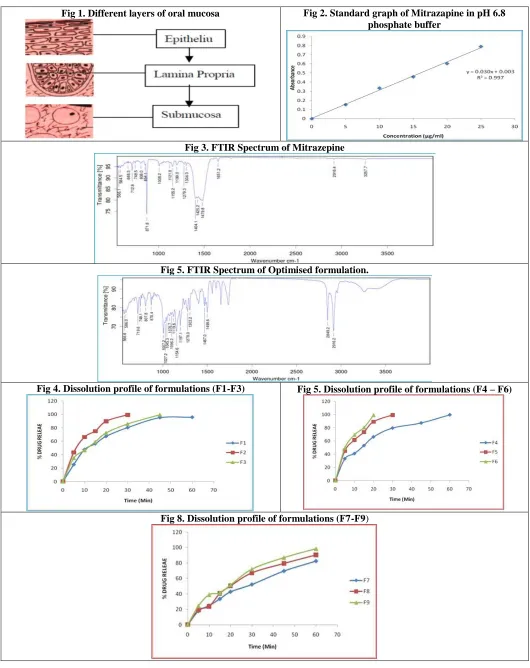
Standard Calibration curve of Mitrazapine
90 |
P a g e
FTIR
From the FTIR data it was evident that the drug and excipients doses not have any interactions. Hence they were compatible.
Evaluation Parameters for Fast dissolving Tablets of Mitrazapine
Pre-compression parameters
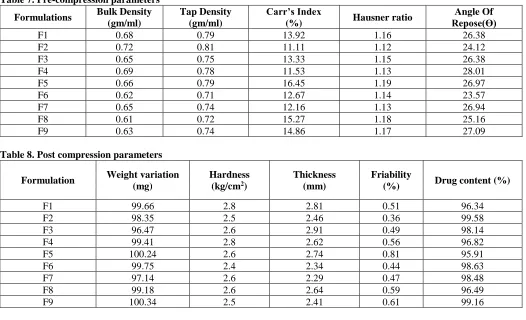
The data were shown in Table 7. The values for angle of repose were found below 28°. Bulk density and tapped density of various formulations were found to be in the range of 0.61 to 0.72 (gm/ml) and 0.71 to 0.81 (gm/ml) respectively. Carr’s index of the prepared blends was less than 18% and Hausners ratio was less than 1.25. From the result it was concluded that the powder blends had good flow properties and these can be used for tablet manufacture.
Post compression studies Weight variation test
Tablets of each batch were subjected to weight variation test, difference in weight and percent deviation was calculated for each tablet and was shown in the Table 8. The average weight of the tablet is approximately in range of 96.47 to 100.34 mg. The permissible limit is ±10%. The results of the test showed that, the tablet weights were within the pharmacopoeia limit.
Hardness test
Hardness of the three tablets of each batch was checked by using Monsanto hardness tester and the data were shown in Table 8. The results showed that the hardness of the tablets is in range of 2.4 to 2.8 kg/cm2,which was
within IP limits.
Thickness
Thickness of three tablets of each batch was checked by using digital micrometer and data shown in Table-8. The result showed that thickness of the tablet is raging from 2.34 to 2.81.
Friability
Tablets of each batch were evaluated for percentage friability and the data were shown in the Table 8. The average friability of all the formulations lies in the range of 0.36 to 0.81 % which was less than 1% as per official requirement of IP indicating a good mechanical resistance of tablets.
Drug content
Drug content studies were performed for the prepared formulations. From these studies, it was concluded that all the formulations were showing the % drug content
values within 95.91 - 99.58 %.
In- vitro disintegration time
Tablets of each batch were evaluated for In- vitro
disintegration timeand the data were shown in the Table 9. The results showed that the disintegration time of prepared tablets were in the range 11.28 to 26.18 seconds.
Wetting time
Wetting time to the time required to wet completely when kept motionless on the tissue paper in a petridish.
• All the FDT formulations were evaluated for their wetting time as per the procedure described in the methodology section, and the results are shown in table 9.
• The average wetting time for all the formulations was in the range of 8.49 to 26.14 seconds.
In- vitro dispersion time
The In- vitro dispersion time for all formulation was found to be in a range of 13.46 to 32.19 seconds
Water Absorption ratio
All the formulations were evaluated for water absorption ratio according to the procedure described in methodology section and the results are shown in table 9.
• The maximum water absorption ratio was shown by formulation F6 and F9 i.e., 99%.
• Water absorption ratio is directly proportional to dissolution rate profile as higher the water absorption ratio faster the dissolution.
In- vitro Dissolution studies
In- vitro dissolution studies were carried out by using 900ml of pH 6.8 phosphate buffer in USP dissolution apparatus by using paddle method. The dissolution studies were carried out for about 60 min. The dissolution data for all the formulations were given in the Table 10.
From the tabular column 9 it was evident that the formulations prepared different concentrations of Vivasol along with camphor (F1 – F3) was shown maximum drug release at 30 min in the concentration of 10mg. if increase the concentration of Vivasol retards drug release. Formulations prepared with different concentrations of Explotab along with camphor (F4-F6) were shown good drug release at the concentration of 10mg of Explotab. Increase the concentration above 10 mg retards the drug release. Formulations prepared with Combination of superdisintegrants along with camphor (F7-F9) were shown as increase in the concentration, increase the drug release. Among all formulations F6 formulation was considered as optimised formulations.
Table 1. Optimisation of camphor concentration
Ingredients O1 O2 O3
91 |
P a g e
Vivasol 5 5 5
Camphor 5 10 15
Mg.stearate 2 2 2
Talc 2 2 2
MCC Q.S Q.S Q.S
Total weight 100 100 100 * All quantities were taken in mg
Table 2. Formulation of Sublimation mouth dissolving tablets
Ingredients F1 F2 F3 F4 F5 F6 F7 F8 F9 Mirtazepine 15 15 15 15 15 15 15 15 15
Vivasol 5 10 15 -- -- -- 2.5 5 7.5 Explotab -- -- -- 5 10 15 2.5 5 7.5 Camphor 10 10 10 10 10 10 10 10 10 Mg.stearate 2 2 2 2 2 2 2 2 2
Talc 2 2 2 2 2 2 2 2 2 MCC QS QS QS QS QS QS QS QS QS Total weight 100 100 100 100 100 100 100 100 100 * all quantities were taken in mg.
Table 3. Angle of Repose as an Indication of Powder Flow Properties
Sr. No. Angle of Repose(Ѳ) Type of Flow
1 <20 Excellent
2 20-30 Good
3 30-34 Passable
4 >34 Very Poor
Table 4. Relationship between % compressibility and flow ability
Sr no. % Compressibility Flow ability
1 5-12 Excellent
2 12-16 Good
3 18-21 Fair Passable
4 23-35 Poor
5 33-38 Very Poor
6 <40 Very Very Poor
Table 5. Weight Variation Specification as per IP
Average Weight of Tablets %Deviation
80 mg or less ±10
More than 80 mg but less than 250 mg ±7.5
250 mg or more ±5
Table 6. Linearity Data
Concentration [µg/ml] Abs
0 0
5 0.154
10 0.335
15 0.458
20 0.603
92 |
P a g e
Table 7. Pre-compression parameters
Formulations Bulk Density
(gm/ml)
Tap Density (gm/ml)
Carr’s Index
(%) Hausner ratio
Angle Of Repose(Ɵ)
F1 0.68 0.79 13.92 1.16 26.38 F2 0.72 0.81 11.11 1.12 24.12 F3 0.65 0.75 13.33 1.15 26.38 F4 0.69 0.78 11.53 1.13 28.01 F5 0.66 0.79 16.45 1.19 26.97 F6 0.62 0.71 12.67 1.14 23.57 F7 0.65 0.74 12.16 1.13 26.94 F8 0.61 0.72 15.27 1.18 25.16 F9 0.63 0.74 14.86 1.17 27.09
Table 8. Post compression parameters
Formulation Weight variation
(mg)
Hardness (kg/cm2)
Thickness (mm)
Friability
(%) Drug content (%)
F1 99.66 2.8 2.81 0.51 96.34 F2 98.35 2.5 2.46 0.36 99.58 F3 96.47 2.6 2.91 0.49 98.14 F4 99.41 2.8 2.62 0.56 96.82 F5 100.24 2.6 2.74 0.81 95.91 F6 99.75 2.4 2.34 0.44 98.63 F7 97.14 2.6 2.29 0.47 98.48 F8 99.18 2.6 2.64 0.59 96.49 F9 100.34 2.5 2.41 0.61 99.16
Table 9. In- vitro disintegration time, Wetting time, dispersion time, % water absorption ratio
Formulation Disintegration Time
(sec)
Wetting time (sec)
In- vitro dispersion
time*(sec)
%Water absorption ratio*
F1 29.22 26.14 32.19 94
F2 26.18 23.14 28.21 97
F3 21.24 18.16 23.18 98
F4 18.13 16.49 20.14 96
F5 16.24 14.22 19.36 95
F6 12.41 10.14 14.18 99
F7 16.49 13.28 19.14 96
F8 14.19 11.46 16.21 98
F9 11.28 8.49 13.46 99
Table 10. In- vitro dissolution data Time
F1 F2 F3 F4 F5 F6 F7 F8 F9
(Min)
0 0 0 0 0 0 0 0 0 0
93 |
P a g e
Fig 1. Different layers of oral mucosa Fig 2. Standard graph of Mitrazapine in pH 6.8
phosphate buffer
Fig 3. FTIR Spectrum of Mitrazepine
Fig 5. FTIR Spectrum of Optimised formulation.
Fig 4. Dissolution profile of formulations (F1-F3) Fig 5. Dissolution profile of formulations (F4 – F6)
94 |
P a g e
SUMMARY AND CONCLUSION
The present study was done on Mitrrazapam by employing sublimation technique. It was found that the estimation of Mitrrazapam by UV spectrophotometric method at 288nm in pH 6.8 phosphate buffer had good reproducibility and this method was used in the study. The correlation coefficient for the standard curve was found to be closer to 1, at the concentration range,5-25μg/ml.
The values for angle of repose were found below 28°. Bulk density and tapped density of various formulations were found to be in the range of 0.61 to 0.72 (gm/ml) and 0.71 to 0.81 (gm/ml) respectively. Carr’s index of the prepared blends was less than 18% and Hausners ratio was less than 1.25. From the result it was concluded that the powder blends had good flow properties and these can be used for tablet manufacture.
Concentration of camphor should be optimized initially by keeping all the ingredients constant. Camphor was used in the concentration of 5, 10 and 15 mg. Among 3 formulations O2 formulation was showed more pores on tablets. The post compression parameters such as weight variation, thickness, hardness, friability, drug content, disintegration time, wetting time and dispersion time were
found to be within limits. Invitro dissolution studies revealed that, it was evident that the formulations prepared different concentrations of Vivasol along with camphor (F1 – F3) was shown maximum drug release at 30 min in the concentration of 10mg. if increase the concentration of Vivasol retards drug release. Formulations prepared with different concentrations of Explotab along with camphor (F4-F6) were shown good drug release at the concentration of 10mg of Explotab. Increase the concentration above 10 mg retards the drug release. Formulations prepared with Combination of superdisintegrants along with camphor (F7-F9) were shown as increase in the concentration, increase the drug release. Among all formulations F6 formulation was considered as optimised formulations. Drug and Excipient compatibility was good which were found by FTIR.
ACKNOWLEDGEMENT
Nil
CONFLICT OF INTEREST
Authors declare no conflict of interest.
REFERENCES
1. Jaysweh JH, Dhaval AR, Kantilal RV. Orally disintegrating tablets, a review. Tropial Journal of Pharm.Sciences, 8(2), 2009, 161-172.
2. Yadav VB, Yadav AV. Liquisolid granulation technique for tablet manufacturing, an overview, Journal of Pharmacy Research, 2(4), 2009, 670-674.
3. Spireas S, Bolton M. Liquisolid systems and methods of preparing same, U.S. Patent, 5, 1999, 968, 550. 4. Ellsworth AJ, Witt DM, Dugdale DC. Medical Drug Reference, Elsevier science, Missouri, 2003, 610‐612.
5. Subrahmanyam CVS. Dissolution. In Textbook of Physical Pharmaceutics, 2nd ed.; Jain, M. K., Ed.; VallabhPrakashan: Delhi, India, 1, 2000, 92.
6. Ahmad Z, et al. Solubility enhancement of poorly water soluble drugs, a review. IJPT, 3(1), 2011, 807-82.
7. Brahamankar D. M; Jaiswal S. B; Bioavailability and Bioequivalence, In Biopharmaceutics and Pharmacokinetics, A Treatise, 1st edition,Vallabh Prakashan: Delhi, India, 1995, 298-299.
8. Sekiguchi K, Obi N. Studies on absorption of eutectic mixtures, I. A comparison of the behavior of eutectic mixtures of sulphathiazole and that of ordinary sulphathiazole in man. Chem. Pharm. Bull, 9, 1991, 866–872.
9. Fahmy RH, Kassem MA. Enhancement of famotidine dissolution rate through liquisolid tablet formulation: In vitro and In vivo evaluation. Eur. J. Pharm. Biopharm, 69, 2008, 993-1003.
10. Spiras S. Liquisolid systems and methods for preparing same, United States patent, 2002, 6, 423, 339 B1.
11. Ajit S. Kulkarni, Nagesh H, et al. Liquisolid Systems: A Review. International Journal of Pharmaceutical Sciences and Nanotechnology, 3(1), 2010, 795-802.
12. Spireas SS, Jarowski CI, Rohera BD. Powder Solution technology, Principles and Mechanism. Pharma Research, 9, 1992, 1351 – 1358.
13. Liao CC. Physicochemical properties of selected powdered drug solutions, Ph.D. thesis, St.John’s university, Jamaica, NY, 1983.
14. Martin AN, Swarbrick J, Cammarata A. Physical Pharmacy, Lea & Febiger, Philadelphia, 1983, 445-468.