© Author(s) 2008. This work is distributed under the Creative Commons Attribution 3.0 License.
Radio Science
Physical IC debug – backside approach and nanoscale challenge
C. Boit1, R. Schlangen1, A. Glowacki1, U. Kindereit1, T. Kiyan1, U. Kerst1, T. Lundquist*, S. Kasapi**, and H. Suzuki***
1TUB Berlin University of Technology, Berlin, Germany *DCG Systems, Fremont, CA, USA
**NVIDIA, Santa Clara, CA, USA ***Hamamatsu Photonics KK, Japan
Abstract. Physical analysis for IC functionality in
sub-micron technologies requires access through chip backside. Based upon typical global backside preparation with 50– 100µm moderate silicon thickness remaining, a state of the art of the analysis techniques available for this purpose is presented and evaluated for functional analysis and layout pattern resolution potential. A circuit edit technique valid for nano technology ICs, is also presented that is based upon the formation of local trenches using the bottom of Shallow Trench Isolation (STI) as endpoint for Focused Ion Beam (FIB) milling. As a derivative from this process, a locally ultra thin silicon device can be processed, creating a back surface as work bench for breakthrough applications of nanoscale analysis techniques to a fully functional circuit through chip backside. Several applications demonstrate the power and potential of this new approach.
1 Introduction
It has become common practice with recent IC technolo-gies that the physical techniques to support functional cir-cuit analysis have to access the active information through chip backside (see Fig. 1) (Barton et al., 2004). For this pur-pose, the device receives typically a global polishing prepa-ration. In most cases, mechanical stability and / or heat sink requirements limit the minimum remaining silicon substrate thickness to 550–100µm, which will be categorized here as moderate silicon thickness.
The penetration depth of particle beams is orders of mag-nitude smaller, so the previously very successful electron or ion beam microscopy derivatives using voltage contrast like E Beam Probing are not applicable under these circum-stances. But bulk silicon is transparent to light of photon energies smaller than the Si band gap of 1.1eV, i.e. the near infrared (IR) regime. A survey of the analysis techniques
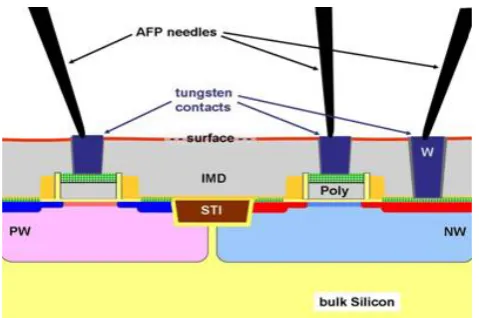
Correspondence to: C. Boit ([email protected])
Fig. 1. Flip chip package. Structured side of IC (die) is turned to
substrate (image from [1]).
available for backside access of moderate silicon thickness is presented in chapter 2.
Circuit edit also needs to be performed through chip back-side. The creation and optimization of FIB-based processes for this purpose is subject of the following chapter 3. The key of backside circuit edit is the milling of local trenches to the bottom level of the STI, leaving an SOI (Silicon on In-sulator) – like ultra thin layer of silicon (ca. 300 nm) for ac-tive device function. This preparation technique, expanded to planes of up to 0.03 mm2, offers a new breakthrough ap-proach of physical functional analysis techniques: While the circuit will be remaining fully functional, the active volume then is small enough to interact with high energy photons or particle beams applied through chip backside. The 4th chapter will discuss the opportunities of such a concept for nanoscale resolution of functional analysis techniques and demonstrate how powerful it is in use.
2 Backside access functional analysis on devices of
mod-erate bulk silicon thickness
266 C. Boit et al.: Physical IC debug
Fig. 2. Optical probing and stimulation techniques.
Fig. 3. TRE and signal pattern (from [24]).
stimulation (LS) techniques (Fig. 2). Time resolution and signal pattern response characteristics of these techniques will be discussed shortly in this chapter, before the critical resolution potential of the general approach using moderate silicon thickness will be assessed.
2.1 Time resolved photon emission (TRE)
Photon Emission is the standard functional analysis tech-nique of semiconductor devices as it occurs in a MOS Tran-sistor without any further stimulus when a considerable num-ber of carriers gain kinetic energy high enough to relax by emitting photons (Boit, 2004). This is happening in CMOS digital circuits mainly during rise and fall time of the signal pattern (Fig. 3). Although this dynamic light signal is faint, TRE is a very powerful, reliable and easy to interpret tech-nique with low risk of artifacts and time resolution in 10 ps regime (Vallett, 2004). Due to the low signal level, sampling of the signal is necessary. As the waveform is not repro-duced in full but the signal only represents the short
switch-Well SCR Diffu
s
io
n
WSCR = f(VD)
required parameters:
NDiffusion
NWell NSCR
simplified diode structure:
Well SCR Diffu
s
io
n
WSCR = f(VD)
required parameters:
NDiffusion
NWell NSCR
simplified diode structure:
Fig. 4. Simplified diode structure for simulation (from [8])
-1.2
-0.8
-0.4
0
0
10
20
30
40
50
Vd [V]
|d
elta R
| / R
o
[p
p
m
]
simulation
measurement
Fig. 5. Comparison of simulation results from model in Fig. 4 with
measurement on PFET drain area.
ing pulses, trigger stability and jitter are critical (Kasapi and Woods, 2006). TRE emission intensity decreases nonlin-early with supply voltage (Rowlette and Eiles, 2003). The resulting SNR challenge of recent IC technologies may not be overly severe as recent studies indicate (Tosi et al., 2006). Spectral information of the emission has so far only marginally been used in analysis. Detailed understanding of device physics and the mechanisms of photon emission may change this in the future.
2.2 Laser Voltage Probing (LVP)
Fig. 6. Illustration of SEI and OBIRCH influence on I/V
character-istic (from[10]).
Fig. 7. p-n junction IV characteristic at TLS (from[10]).
of the effect (see Fig. 4 and 5). In this example, a qualita-tive and even a quantitaqualita-tive fit has been successful using well doping level of 1017cm−3 and a diffusion doping level of 1021cm−3.
Time resolution is in the same range as TRE. Due to the waveform reproduction, the signal pattern information can still be obtained when trigger stability is problematic.
Probe placement may not be trivial when local interference is affecting the signal level.
Although available for a long time, in recent past LVP stood in the shadow of TRE. But the power of this technique has been improved by the mentioned in depth investigation of the interaction mechanisms, and a new product generation using polarized light, and seems to become increasingly at-tractive again, especially as it offers some robustness to IC clock instabilities.
Fig. 8. p-n junction IV characteristic at PLS (from[10]).
Fig. 9. Delay variation with laser stimulation.
2.3 Laser stimulation
Scanning IR lasers with several hundred mW can stimu-late electrical signal alteration either by local heat conver-sion of the absorbed light modulating electrical parameters (TLS = Thermal LS, Beaudoin, 2004), or by photocurrent induced into the signal path if photon energies reach silicon band gap level and electron hole (e-h) pairs are generated (PLS=Photoelectric LS).
As the electrical circuit behavior can be altered in a wide variety, many techniques have been invented that are based on the LS principle. Table 1 gives an overview of the most common abbreviations used in LS of statically and dynami-cally driven circuits.
268 C. Boit et al.: Physical IC debug
Table 1. Laser Stimulation techniques.
Stim. Effect Technique Device Analysis
OBIRCH
Optical Beam Induced
Resitivity Change Identify areas of
TIVA high local resistance
Thermally Induced Voltage Alteration
TLS
Thermal Laser Stim. 1300
nm
RIL Test vectors:
Resisitive Interconnect Identify area
Localization of highest pass-fail
SDL sensitivity (ShmooVariation)
Soft Defect Localization
SEI
Seebeck
(Thermoelectric) Effect
Imaging Identify sensitive
material interfaces
1064 nm
PLS OBIC
Photo Optical Beam Induced
-electric Current
Laser Stim.,
parasitic TLS Localize p-n
junctions – Space Charge Region (SCR)
LIVA Read out signals
Light Induced Voltage sensitive to logical
Alteration state
LADA
Laser Assisted Device Alteration,
Dynamic LS Signal Pattern in IC: Delay Variation
OBIRCH, SEI As parasitic effect
Fig. 10. Principle of Solid Immersion Lens (from [23]).
of the stimulation on equivalent device i-v characteristics is presented. All static and dynamic properties of devices and circuits can be derived from these models. In case of TLS in an FET, typically the channel conductivity will be modulated like OBIRCH, but in two competitive mechanisms, change of
Fig. 11. Principle of Nanoscale Atomic Force Probing (AFP) on
parallel polished sample.
Fig. 12. FIB preparation for backside circuit edit.
mobility and threshold voltage. But to understand the readout properly, several side effects like local conversion efficien-cies, heat or carrier diffusions and distant Seebeck voltages may contribute to the final signal. A detailed description of all those effects is given in (Glowacki, 2007).
In a dynamically driven IC, LS will influence the timing. The results of dynamic LS can be read out either by pass/fail condition of the tester under stimulation (Shmoo variation) or direct evaluation of the signal pattern variation (Fig. 9). A systematic overview on the LS at dynamic circuit operation like in (Bruce et al., 2002) for static techniques is nor yet available, so in Table 1 some of the techniques seem to be overlapping and some possible options have not been pub-lished yet.
Fig. 13. Variety of FIB contacts using UTS.
Fig. 14. Image of FIB trench location (left: IR-optics, middle: FIB
n-well end point, right: FIB STI opening).
(Bruce et al., 2002), when active devices are affected. PLS causes similar effects.
The other group of techniques read out the signal pat-tern directly like LADA or Delay Variation (Sanchez et al., 2006a,b). In a transistor, the effects of PLS and TLS on the output current must be studied in detail for correct evalua-tion (Glowaki et al., 2007). In general, if PLS is enabled by selection of the proper laser wavelength, it usually prevails over TLS.
Time resolution and required trigger quality of LS is very much a question of the signal extraction procedure.
As in LS a large variety of stimulation and readout oppor-tunities can be applied, the overall potential of this approach is by far not exhausted yet.
2.4 Nanoscale potential of IR analysis techniques
Maximum microscopic resolution is the light wavelength re-ferring to the length of a repeating structure, the so called pitch. A pitch consists of minimum 2 features, so the min-imum resolved feature is 2×smaller. Realistic pitch reso-lution is ca. 800 nm, respectively 400 nm feature size. But feature sizes are rapidly shrinking with technology innova-tion. Solid Immersion Lenses (SIL, Fig. 10) have been in-troduced, making bulk silicon a part of the microscope and increasing resolution theoretically by the refraction index of silicon nSi=3,5. A resolution of of 200 nm has been achieved.
As technologies progress further into the nanometer range, IR techniques even with SIL can localize only the area of
in-Fig. 15. Probing on Ultra Thin Silicon.
Fig. 16. Nanoprobing on FIB edited contacts to Silicide.
terest but not anymore the exact device. In addition, scanning probe techniques and derivatives are increasingly inevitable to identify the critical node in nanoscale regime. Nanoprob-ing makes use of the contacts to the active structures un-der investigation (Fig. 11) (Lin et al., 2006; Mulun-der et al., 2006). Planar polishing techniques need to be applied from chip frontside, finally removing all interconnect
layers to reveal the tungsten contacts of multiple devices in the suspected fail area.
This process is time consuming and full of risks: If the fail-ing transistor cannot be found in the final measurement the problem might have been removed with the backend, leaving no second chance for other FA techniques.
3 Circuit edit through chip backside
270 C. Boit et al.: Physical IC debug
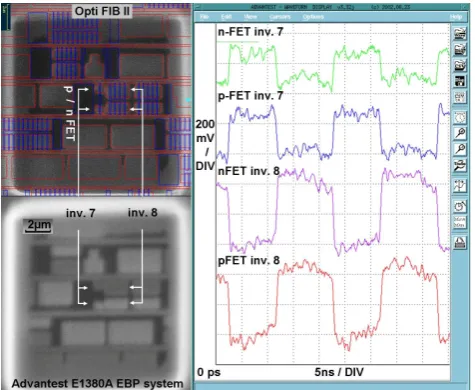
Fig. 17. Backside E-Beam Probing targeting M1 or directly
mea-suring on the FET floating body.
Fig. 18. EBP results measured directly of FET body of 90 nm bulk
CMOS after FIB backside prep down to STI level.
polishing technique as applied in chapter 2, the region of in-terest is identified by the IR microscope. Then, after a spe-cial FIB cleaning procedure, a 200×200µm2wide trench is milled until the operator stops on n-well level. The endpoint becomes visible because of a voltage contrast between the n-wells and the substrate due to the built-in potential of the pn-junction (Boit et al., 2003). Next, a smaller local trench will be milled until the STI becomes visible as imaging con-trast - lower secondary electron emission of SiO2– and the preparation is ended.
By this approach, the active device material is reduced to 300 to 400 nm (the depth of the STI trenches) and the chip is ready for the actual edit process, the milling of narrow trenches for the cuts and contact holes (Boit et al., 2005).
This backside FIB process is offering several more oppor-tunities to edit the circuit than the frontside process: The technique to endpoint the contact trenches on the Silicide
interface, which is only 300 nm below the trench to STI, is meanwhile established (Schlangen et al., 2006a), allowing to contact any source/drain area on the chip, even those that hove not been contacted on IC interconnect level. All the functional nodes are represented on the active device level. A typical backside CE is illustrated in Fig. 13. Any CE contact can be performed using the contact to silicide (CtS) process, only cut operations still have to be performed by trenching deeper into metal interconnects. The lower aspect ratio for CtS compared to contacts to metal lines (right part of Fig. 13) is very fortunate for the contact resistance, be-ing the critical parameter for nanoscale application. With current platinum deposition, contacts on silicide have resis-tivities below 60/µm2. Typical contact sizes of 1×0.2µm2 end up with 300resistance per contact, considerably lower than FET- channel resistances of several k(Schlangen et al., 2007a) and acceptable for most CE and probing tasks. When SOI technologies are considered, the contact height will be reduced by a factor of 3, reducing resistance further. The utilization of advanced conductor deposition materials as Molybdenum may offer further improvement potential.
Taking into account state of the art FIB resolution perfor-mance, this backside CE technique can be rated as fully suit-able for technologies scaling well into the nanometer regime. An invasiveness study of backside CE processing using in-tentionally enlarged trench sizes down to STI level (Fig. 14), resulted in almost unchanged single device- and circuitry-performance at regular processing (Boit et al., 2005).
This study showed also that a wide FIB trench to n-well level can be performed with remarkable co-planarity to the chip levels. In Fig. 14, the coaxial IR microscope image of the trench shows Newton rings indicating the slope of silicon thickness. A planarity mismatch less than 200 nm on 250µm trench expansion or 0.08% deviation is state of the art. With such a process, a new base plane can be created for the ap-plication of analysis techniques through the backside of ultra thin silicon.
4 Functional IC analysis through the backside of Ultra
Thin Silicon (UTS)
The FIB preparation routines developed for circuit edit through chip backside (chapter 3) produce a back surface of an ultra thin active device volume maintaining full IC func-tionality. The back surface of the remaining ultra thin ac-tive volume can now be regarded as a completely new work bench for physical techniques to access fully functional cir-cuits. This innovative concept opens a very short path to de-vice interaction for analysis techniques with improved reso-lution potential (Fig. 15), which is summarized in Table 2.
of an electron microscope, can be reconsidered for IC analy-sis on a higher technical level again. Optical techniques may be shifted to much smaller wavelengths with the respective resolution improvement as no bulk silicon has to be passed anymore.
In case of substantial power consumption in the IC’s area of interest, solutions for proper heat dissipation paths need to be developed.
4.1 Nanoprobing on UTS
Nanoprobing on UTS can be done on edited contacts because of their low resistance, taking advantage of the full circuit function (Fig. 16). For characterization of single devices, some cuts might be necessary to separate the transistors from their environment (Schlangen et al., 2007a), but full circuit functionality can be reestablished easily afterwards by sim-ple conductor deposition.
4.2 E-Beam Probing on UTS
The interaction opportunities through UTS are expanded to particle beams as well. Then, high resolution probing or stimulation with electron beams return to the IC debug toolkit. In (Schlangen etal., 2006b) it is demonstrated, that switching information on lower metal lines is transferred to the back surface (capacitive coupled voltage contrast, CCVC). Additionally, the full active device area can be used to pick up node waveforms (Fig. 17), based on the modula-tion of the floating body potential. In this way, the spot size of the pulsed e-beam can be as big as the full transistor body (always by a factor of 3–5 bigger than the smallest metal lines) and the resolution requirements become more relaxed. Furthermore, this method offers all advantages frontside EBP did: fast signal acquisition, linear Vdd signal scaling and su-perior signal to noise ratio (Jain et al., 2007).
Figure 18 shows first results measured with a 10 year old EBP, clearly resolving 90 nm technology (Schlangen et al., 2007b). Regarding latest improvements in low keV SEM de-velopment, this technique should be suitable for scaling fur-ther into nanometer regime.
4.3 Optical Techniques on UTS
On UTS, visible and even UV light may be used to stimulate the devices. This way, optical resolution would be instantly improved even without SIL. In addition, short wavelength SIL solutions are within reach. Efficient PLS in small active volumes like SOI devices requires light of short absorption ranges. Only UTS provides the condition for such a stimula-tion.
Another problem is the stimulation character in multi-material active volumes as it is used more and more in strain technologies. Stimulation as performed today with photon energies near the Si band gap, has hardly predictable absorp-tion properties for Ge compounds used for straining and
mo-Table 2. Comparison of Feature resolution potential of Functional
Analysis Techniques though moderate and ultra thin silicon.
Technique Resolution Potential Status
(IR) Optical
bulk Si 400 nm 200 nm (SIL) standard technique
(IR) Optical
UTS 200 nm 100 nm (SIL) future concept
UV
UTS 100 nm <50 nm (SIL) future concept
E Beam UTS 100 nm 10–20 nm demonstrated
Nanoprobing UTS 50 nm 10 nm demonstrated
bility enhancement. With shorter wavelengths, absorption properties are clearly defined independent of the semicon-ductor material. If laser stimulation can be blanked over ac-tives and only performed over STI, it may be possible to sup-press photocurrent generation and thermal stimulation could then be accomplished with high resolution.
To gain resolution beyond all optical limits though, back-side E-Beam Probing and E-Beam stimulation seem to be most promising.
5 Summary
The IR analysis techniques for IC debug are very powerful and offer a huge potential to localize circuit problems which is not fully exhausted yet. The only drastic disadvantage is the increasing optical resolution mismatch in nanoscale tech-nologies.
For circuit edit (CE), a process for access through chip backside is established as well with a FIB preparation tech-nique processing towards STI level.
The back surface of the ultra thin silicon (UTS) produced for backside CE is full of opportunities for functional anal-ysis of nanoscale devices because this preparation technique offers for analysis techniques with nanoscale resolution the unique option to keep the Integrated Circuit fully functional. UTS analysis potential matches the requirements for several technology generations to come. The utilization has just be-gun.
Acknowledgements. The authors thank S. Sch¨omann and P. Egger
272 C. Boit et al.: Physical IC debug
References
Barton, D., Cole, Jr. E., and Bernhard-H¨ofer, K.: Flip Chip and “Backside” Sample Preparation Techniques, Microelectronics Failure Analysis Desk Reference, ASM International, 5th Edi-tion, 42–48, Ohio, USA, 2004.
Boit, C.: Fundamentals of Photon Emission (PEM) in Silicon-Electroluminescence for, Analysis of Electronic Circuit and De-vice Functionality, Microelectronics Failure Analysis Desk Ref-erence, ASM International, 5th Edition, 356–368, Ohio, USA, 2004.
Vallett, D.: Picosecond Imaging Circuit Analysis – PICA, Micro-electronics Failure Analysis Desk Reference, ASM International, 5th Edition, 369–377, Ohio, USA, 2004.
Kasapi, S. and Woods, G.: Voltage Noise and Jitter Measurement Using Time Resolved Emission, Proc. 32nd EDFAS ISTFA In-ternational Symposium for Testing and Failure Analysis, Austin, TX, USA, 438–443, 2006.
Rowlette, J. A. and Eiles, T.: Critical Timing Analysis in Mi-croprocessors Using Near-IR Laser Assisted Device Alteration (LADA), Proc. IEEE ITC International Test Conference, Char-lotte NC, USA, 264–273, 2003.
Tosi, A., Stellari, F., Pigozzi, A., Marchesi, G., and Zappa, F.: Hot Carrier Photon Emission in Scaled CMOS Technologies – A Callenge for Emission Based Testing and Diagnosis, Proc. 44th IEEE IRPS International Reliability Physics Symposium San Jose 2006, 595–601, 2006.
Paniccia, M., Eiles, T., Rao, V. R. M., et al.: Novel optical probing technique for flip-chip packaged microprocessors, Proc. IEEE ITC International Test Conference, Paper 30.2, 740–747, 1998. Kindereit, U., Woods, G., Tian, J., Kerst, U., Leihkauf, R., and
Boit, C.: Quantitative Investigation of Laser Beam Modulation in Electrically Active Devices as used in Laser Voltage Probing, IEEE TDMR Transactions on Device and Materials Reliability, 7, 1, 19–30, 2007.
Beaudoin, F., Desplats, R., Perdu, P., and Boit, C.: Principles of Thermal Laser Stimulation Techniques, (), Microelectronics Failure Analysis Desk Reference, ASM International, 5th Edi-tion, 417–425, Ohio, USA, 2004.
Glowacki, A. S., Brahma, H., Suzuki, C., and Boit, C.: Systematic Characterization of Integrated Circuit Standard Components as Stimulated by Scanning Laser Beam, IEEE TDMR Transactions on Device and Materials Reliability, 7, 1, 31–49, 2007.
Bruce, M., Bruce, V., Eppes, D., Wilcox, J., Cole, Jr. E., Tangyun-yong, P., and Hawkins, C. F.: Soft Defect Localization (SDL) on ICs , Proc. 28th EDFAS ISTFA International Symposium for Testing and Failure Analysis, Phoenix, AZ, USA, 21–28, 2002. Sanchez, K., Desplats, R., Beaudoin, F., Perdu, P., Lewis, D.,
Veda-garbha, P., and Woods, G.: Delay Variation Mapping Induced by Dynamic Laser Stimulation, Proc. 43th IEEE IRPS International Reliability Physics Symposium San Jose 2005, 305–311, 2006a. Sanchez, K., Desplats, R., Beaudoin, F., Perdu, P., Dudit, S., and Vallet, M.: Dynamic Thermal Laser Stimulation Theory and Applications, Proc. 44th IEEE IRPS International Reliability Physics Symposium San Jose 2006, 574–584, 2006b.
Lin, K., Zhang, H., and Lu, S.-S.: Conductive Atomic Force Mi-croscopy Application for Semiconductor Failure Analysis in Ad-vanced Nanometer Process, Proc. 32nd EDFAS ISTFA Interna-tional Symposium for Testing and Failure Analysis, Austin TX, USA, 178–181, 2006.
Mulder, R., Subramanian, S., and Chrastecky, T.: Case Studies in Atomic Force Probe Analysis, Proc. 32nd EDFAS ISTFA In-ternational Symposium for Testing and Failure Analysis, Austin TX, USA, 153–162, 2006.
Boit, C., Wirth, K., and LeRoy, E.: Voltage Contrast like N-Well Imaging, Proc. 29th EDFAS ISTFA International Symposium for Testing and Failure Analysis, Santa Clara, CA, USA, 331 pp., 2003.
Boit, C., Kerst, U., Schlangen, R., Kabakow, A., Le Roy, E., Lundquist, T., and Pauthner, S.: Impact of Back Side Circuit Edit on Active Device Performance in Bulk Silicon ICs, Proc. IEEE ITC International Test Conference, Austin TX, paper 48.2, 1–9, 2005.
Schlangen, R., Sadewater, P., Kerst, U., and Boit, C.: Contact to Contacts or Silicide by Use of Backside FIB Circuit Edit Allow-ing to Approach Every Active Circuit Node,Proc. 17th ESREF European Symposium on Reliability of Electron Devices, Failure Physics and Analysis, Wuppertal, Germany, 1498–1503, 2006a. Schlangen, R., Kerst, U., Boit, C., Sch¨omann, S., Kr¨uger, B., Jain,
R., Malik, T., and Lundquist, T.: FIB Backside Circuit Modifi-cation on Device Level Allowing to Access Every Circuit Node with Minimum Impact on Device Performance by Use of Atomic Force Probing, accepted at 33rd EDFAS ISTFA International Symposium for Testing and Failure Analysis, San Jose, USA, 2007a.
Schlangen, R., Leihkauf, R., Kerst, U., and Boit, C.: Functional IC Analysis through Chip Backside with Nano Scale Resolution – E-Beam Probing in FIB Trenches to STI Level, Proc. 32nd EDFAS ISTFA International Symposium for Testing and Failure Analysis, Austin TX, USA, 376–381, 2006b.
Jain, R., Malik, T., Lundquist, T., Schlangen, R., Leihkauf, R., Kerst, U., and Boit, C.: Novel Flip-Chip Probing Methodology Using Electron Beam Probing, Proc. 14th IEEE IPFA Interna-tional Symposium on the Physical and Failure Analysis of Inte-grated Circuits, Bangalore, India 39–42, 2007.
Schlangen, R., Leihkauf, R., Kerst, U., Boit, C., Jain, R., Malik, T., Wilsher, K., Lundquist, T., and Kr¨uger, B.: Backside E-Beam Probing on Nano Scale Devices, accepted at IEEE ITC Interna-tional Test Conference, Santa Clara, CA, USA, 2007b.
Vickers, J. S., Ispasoiu, R., Cotton, D., Frank, J., Lee, B., and Kasapi, S.: Time-Resolved Photon Counting System Based on a Geiger-Mode InGaAs/InP APD and a Solid Immersion Lens, Proc. 16th Annual Meeting of the IEEE LEOS, 2, 600–601, 2003.
![Fig. 1. Flip chip package. Structured side of IC (die) is turned tosubstrate (image from [1]).](https://thumb-us.123doks.com/thumbv2/123dok_us/9654384.1947741/1.595.340.510.230.300/fig-flip-chip-package-structured-turned-tosubstrate-image.webp)
![Fig. 4. Simplified diode structure for simulation (from [8])](https://thumb-us.123doks.com/thumbv2/123dok_us/9654384.1947741/2.595.54.279.270.436/fig-simplied-diode-structure-simulation.webp)
![Fig. 8. p-n junction IV characteristic at PLS (from[10]).](https://thumb-us.123doks.com/thumbv2/123dok_us/9654384.1947741/3.595.84.251.305.455/fig-p-n-junction-iv-characteristic-pls.webp)