The Thirty-Third AAAI Conference on Artificial Intelligence (AAAI-19)
Private Model Compression via Knowledge Distillation
Ji Wang,
1Weidong Bao,
1Lichao Sun,
2Xiaomin Zhu,
1,3Bokai Cao,
4Philip S. Yu
2,5 1College of Systems Engineering, National University of Defense Technology, Changsha, China2Department of Computer Science, University of Illinois at Chicago, Chicago, USA
3State Key Laboratory of High Performance Computing, National University of Defense Technology, Changsha, China 4Facebook Inc., Menlo Park, USA
5Institute for Data Science, Tsinghua University, Beijing, China
{wangji,wdbao,xmzhu}@nudt.edu.cn, [email protected], [email protected], [email protected]
Abstract
The soaring demand for intelligent mobile applications calls for deploying powerful deep neural networks (DNNs) on mo-bile devices. However, the outstanding performance of DNNs notoriously relies on increasingly complex models, which in turn is associated with an increase in computational expense far surpassing mobile devices’ capacity. What is worse, app service providers need to collect and utilize a large volume of users’ data, which contain sensitive information, to build the sophisticated DNN models. Directly deploying these models on public mobile devices presents prohibitive privacy risk. To benefit from the on-device deep learning without the capacity and privacy concerns, we design a private model compres-sion framework RONA. Following the knowledge distillation paradigm, we jointly use hint learning, distillation learning, and self learning to train a compact and fast neural network. The knowledge distilled from the cumbersome model is adap-tively bounded and carefully perturbed to enforce differen-tial privacy. We further propose an elegant query sample se-lection method to reduce the number of queries and control the privacy loss. A series of empirical evaluations as well as the implementation on an Android mobile device show that RONAcan not only compress cumbersome models efficiently but also provide a strong privacy guarantee. For example, on SVHN, when a meaningful(9.83,10−6)-differential privacy is guaranteed, the compact model trained by RONAcan ob-tain 20×compression ratio and 19×speed-up with merely 0.97% accuracy loss.
Introduction
Recent years have witnessed impressive breakthroughs of deep learning in various areas. Thanks to the large volume of data and the easy availability of computational resources, customized deep learning models attain unprecedented per-formance that beats many records of traditional machine learning algorithms.
The significant progress in deep learning, on the other hand, is notorious for its dependence on cumbersome mod-els which require massive data to learn their millions of pa-rameters. This major drawback restricts the large-scale ployment of deep learning applications, especially the de-ployability of deep neural network on mobile devices such as smartphones, wearable devices, and medical monitors (Cao
Copyright c⃝2019, Association for the Advancement of Artificial Intelligence (www.aaai.org). All rights reserved.
et al. 2017; Sun et al. 2017). Mobile application service providers are facing a series of challenges to widely adopt DNNs in their mobile apps.
Capacity bottleneck. In spite of the great advances of mobile chips and mobile batteries, the limited-capacity na-ture of mobile devices still imposes the intrinsic bottleneck making resource-demanding applications remain off bounds (Wang et al. 2018). The modern DNNs with millions of parameters often require prohibitive runtime to execute on computationally limited devices. What is worse, the massive floating point operations during the execution aggravate the burden of processing chips and easily dominate the whole system energy consumption, which widens the chasm be-tween DNNs and their deployability on mobile devices. It is difficult to directly adopt powerful DNNs on mobile systems so far (Lee 2017).
Data privacy and intellectual piracy concerns. Devel-oping a strong predictive DNN needs abundant data. The more data accessible, the more effective and powerful a DNN will be. In practice, app service providers usually col-lect and utilize a large volume of data from users, which often contains sensitive information, to build their sophisti-cated DNN models. Directly releasing these models trained by users’ data presents potential privacy issues because the adversary can recover sensitive information encoded in the public models (Abadi et al. 2016). It is illegal to share in-dividuals’ data or models directly in many domains like medicine (Claerhout and DeMoor 2005). Apart from data privacy, releasing DNN models may invade app service providers’ right due to intellectual piracy. It is sometimes not appealing for app service providers to share their valu-able and highly tuned models (Osia et al. 2017).
Howard et al. 2017) are complementary to knowledge dis-tillation and can also be used to further reduce the size of student models, which is beyond the scope of this paper. De-spite the encouraging compression rate, the privacy concern has not been fully resolved by the current knowledge distil-lation methods yet.
In this paper, we introduce the rigorous standard of differ-ential privacy (Dwork 2011) and design a pRivate mOdel compressioN frAmework, named RONA, to overcome the aforementioned challenges and promote the adoption of deep learning in mobile applications.
Both model compression and data privacy are considered in the proposed framework. We assume that the app service provider has trained a powerful cumbersome model based on the sensitive data and the public data. Following the knowl-edge distillation paradigm, RONAuses only the public data to train the small student model whose feature representa-tions are encouraged to be similar to those of the cumber-some model. Then the small student model is released to mo-bile application users while the cumbersome model as well as the sensitive data are retained by the app service provider. Intuitively, the privacy is preserved because the training of the student model does not depend on the sensitive data; nei-ther the cumbersome model nor the sensitive data is exposed to the public or accessible to the adversary. Mere intuition, however, is not sufficient. To provide provable privacy guar-antee, we carefully perturb the knowledge distilled from the cumbersome model to satisfy the standard of differential pri-vacy.
It is a nontrivial problem to jointly compress large DNNs, preserve privacy, and control model performance loss. A set of novel methods are presented to solve this problem. Our main contributions are four-fold:
• A framework promoting deep learning in mobile ap-plications. We take the key constraints of adopting DNNs in mobile applications,i.e., privacy, performance, and overhead, into consideration, and design a privacy-preserving framework for training compact neural net-works via knowledge distillation1. To the best of our knowledge, the proposed RONAis the first framework that applies the knowledge distillation to model compression with meaningful privacy guarantee.
• A differentially private knowledge distillation. To the-oretically guarantee privacy, we propose a new mecha-nism to perturb the knowledge distillation from the sense of differential privacy. Different from the existing sample-by-sample query mode, our proposed mechanism makes queries in batch mode to reduce the number of queries. The batch loss responded by the teacher model is clipped by the adaptive norm bound and then carefully perturbed to preserve privacy.
• A query sample selection method for knowledge dis-tillation. The privacy loss depends on the number of queries. To control the student model’s access to the teacher model, the number of samples used during knowl-edge distillation should be reduced. Hence, we present a
1
This paper uses the multi-class image recognition as the appli-cation scenario due to its wide usage in mobile apps.
query sample selection method to select a subset of sam-ples such that the knowledge distilled over the subset is competitive over the whole samples.
• Thorough empirical evaluation. We evaluate the pro-posed RONA by using three standard benchmarks that are widely used in knowledge distillation works. The re-sults demonstrate the effectiveness of the above novel methods, bringing significant improvement in training small models with rigorous privacy guarantee. Our code is open-sourced at https://github.com/jwanglearn/Private Compress.
Preliminary and Related Work
Deep neural network compression. To squeeze DNNs into mobile devices, DNN compression attracts intense attention. The compression methods can be broadly classified into four categories: parameter sharing, network pruning, low-rank factorization, and knowledge distillation (Han, Mao, and Dally 2016; Howard et al. 2017; Chen et al. 2017). The former three methods mainly attempt to reduce the size of a given model, without significantly changing the architecture of the model. The last one, knowledge distillation, uses the knowledge captured by the cumbersome model to guide the training of a smaller model in a teacher-student paradigm (Bucilua, Caruana, and Niculescu-Mizil 2006). Hinton et al. (Hinton, Vinyals, and Dean 2014) used the class probabili-ties generated by the teacher as a soft target to train the stu-dent model. Romero et al. (Romero et al. 2015) extended this work by training the student to mimic the teacher’s interme-diate representation. Based on these two works, a framework for compressing object detection models was designed by Chen et al. (Chen et al. 2017), trying to solve the class im-balance problem. Few existing model compression methods took the privacy issue into consideration. The teacher model can be queried as many times as necessary during training, which is infeasible if we want to preserve privacy.
Differentially private deep learning. Due to the critical need of respecting privacy, privacy-preserving data analy-sis has become an emerging topic of interests. One state-of-the-art privacy standard is differential privacy (Dwork 2011) which provides provable privacy guarantee.
Definition 1 (Dwork 2011) A randomized mechanismMis (ϵ, δ)-differentially private, iff for any adjacent inputdand
d′, and any outputSofM,
Pr[M(d) =S]≤eϵ·Pr[M(d′) =S] +δ. (1) Typically,dandd′are adjacent inputs when they are iden-tical except for only one data item. The parameterϵdenotes the privacy budget (Dwork 2011), controlling the privacy loss ofM. A smaller value ofϵenforces a stronger privacy guarantee.
For a deterministic function f, the (ϵ, δ)-differential privacy is generally enforced by injecting ran-dom noise calibrated to the f’s sensitivity ∆f, ∆f = maxd,d′∥f(d)−f(d′)∥. For example, the Gaussian mechanism is given by,
Theorem 1 (Dwork and Roth 2014) Suppose function f
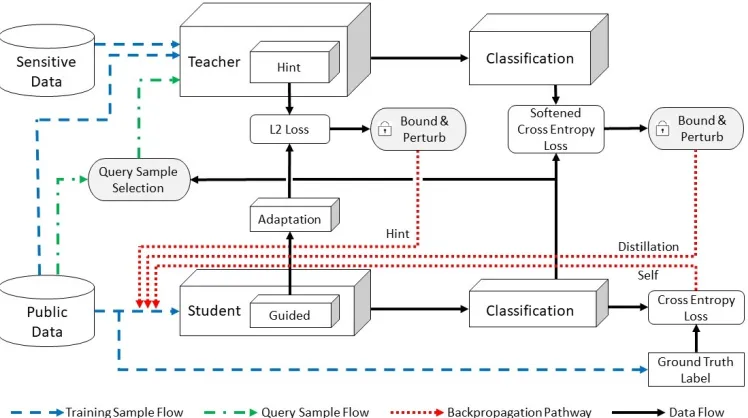
Figure 1: The overview of RONA. RONAis implemented by the mobile app service providers. Only the student model is released to the public while the sensitive data and the teacher model are retained by the mobile app service provider.
Mf(d):
Mf(d) =f(d) +N(0,∆2f2σ2), (2)
where N(0,∆2f2σ2)is a random variable sampled from
the Gaussian distribution with mean 0 and standard devi-ation∆2f σ. Mf(d) is(ϵ, δ)-differentially private ifσ ≥ √
2 ln(1.25/δ)/ϵandϵ <1.
Differential privacy provides guaranteed privacy which cannot be compromised by any algorithm (Dwork 2011). It is increasingly adopted as the standard notion of pri-vacy (Beimel et al. 2014). Abadi et al. (Abadi et al. 2016) presented a differentially private SGD and designed a new technique to track the privacy loss. Papernot et al. (Paper-not et al. 2017; Paper(Paper-not et al. 2018) proposed a general framework for private knowledge transfer in the sample-by-sample mode where the student was trained to predict an output generated by noisy voting among the teachers. This framework only used the output label to train the student and cannot be used to compress DNNs efficiently. Apart from private training, Triastcyn et al. (Triastcyn and Falt-ings 2018) added a Gaussian noise layer in the discrimina-tor of GAN to generate differentially private data. Recently, Wang et al. (Wang et al. 2018) designed a private inference framework across mobile devices and cloud servers to free mobile devices from complex inference tasks. However, this framework heavily depended on the network accessibility. Few current works applied differential privacy and model compression to enabling on-device deep learning as well as preserving privacy.
The Proposed Framework
The framework RONAis presented in this section. We first give the overview of RONA. Then we detail three key mod-ules: (1) the model compression based on knowledge
distil-lation, (2) the differentially private knowledge perturbation, and (3) the query sample selection.
Overall Structure
The overview of RONAis given in Fig. 1. To better capture the knowledge embedded in the cumbersome teacher model, we jointly use the hint learning (Romero et al. 2015), the dis-tillation learning (Hinton, Vinyals, and Dean 2014), and the self learning to train a small student model. Meanwhile, both the hint loss and the distillation loss are carefully bounded and perturbed by random noises that are consistent with dif-ferential privacy. Since more queries to the teacher model incur higher privacy loss, an elegant query sample selection method is designed in RONA to select a subset of samples from the entire public samples.
The sensitive data is only used to train the complex teacher model which is not released to the public. It is ob-vious that the sensitive data are insulated from the explicit invasion of privacy as the student model has no access to it. Further, the information generated by the teacher model, i.e., the hint loss and the distillation loss, are perturbed by additional noises. All the information relating to the sensi-tive data and the teacher model are isolated or well protected before releasing.
Model Compression
In order to learn a compact and fast DNN model that can be adopted in mobile applications, we propose a stage-wise knowledge distillation method. This method enables the small student model to capture not only the information in ground truth labels but also the information distilled from the cumbersome teacher model.
Algorithm 1:Compact Student Model Training Parameter :Hint learning epochsTh; Distillation learning
epochsTd; Self learning epochsTs; Iterations
R; Hint and distillation learning batch sizeS; Self learning batch sizeS′.
1 fort←0toTh−1do
2 xq←random select(xp);
3 fori←0to|xq|/Sdo
4 Sample a batchx(qi)of sizeSfromxq; 5 Compute hint lossL(hinti) overx(qi)by Eq. (3);
6 L˜
(i)
hint←privacy sanitize(L
(i)
hint); 7 Backpropagate byL˜
(i)
hintto updateΘgandΘa;
8 forr←0toR−1do 9 fort←0toTs−1do 10 fori←0to|xp|/S′do
11 Sample a batchx(pi)of sizeS′fromxp; 12 Compute self lossL(selfi) overx(pi)by Eq. (5);
13 Backpropagate byL(selfi) to updateΘs;
14 fort←0toTd−1do
15 xq←query select(xp,Θs); 16 fori←0to|xq|/Sdo
17 Sample a batchx(qi)of sizeSfromxq;
18 Compute distill lossL(distilli) overx(qi)by Eq. (4);
19 L˜
(i)
distill←privacy sanitize(L
(i)
distill); 20 Backpropagate byL˜
(i)
distillto updateΘs;
hint to guide the training of the student model. Analogously, a hidden layer of the student model is chosen as the guided layer that learns from the teacher’s guidance. We train the student model from the first hidden layer up to the guided layer by minimizing the L2 loss function:
Lhint(xq,zh; Θg,Θa) =
1
2∥r(g(xq; Θg); Θa)−zh∥
2
, (3)
whereg(·; Θg)represents the student model up to the guided
layer with parameterΘg,xqdenotes the query samples, and zh is the output of the teacher’s hint layer over the query
samples. As the scale of the guided layer is usually differ-ent from that of the hint layer, we introduce an adaptation layer on the top of the guided layer to match the scale of the guided and hint layers. The adaptation layer is represented byr(·; Θa)with parameterΘalearned during the hint
learn-ing. If both guided and hint layers are fully connected lay-ers, we add a fully connected layer as the adaptation layer. If both guided and hint layers are convolutional, we add1×1 convolutions instead to reduce the number of parameters.
Hint learning is introduced to teach the student how to ex-tract general features. It makes the student model lack flex-ibility to choose a higher hidden layer as the guided layer. So, we select the student’s middle layer as the guided layer in our case.
Distillation and self learning stage: We train the whole student model by using the distillation and self learning in this stage. Letztbe the output of the teacher’s final hidden
layer, also called logits, over the query samples, we use the soften probability (Hinton, Vinyals, and Dean 2014)Pτt as the knowledge:Pτt =sof tmax(zt/τ), whereτ is the
tem-perature parameter that is normally set as 1. A higherτcan make the teacher model generate soften probabilities such that the classes whose normal probabilities are near zero will not be ignored. The soften probability contains the knowl-edge about the latent relationship between different classes. The student model is trained to learn this knowledge by min-imizing the distillation loss over the query samples:
Ldistill(xq,Pτt; Θs) =H(Pτs,P τ
t; Θs), (4)
whereHis the cross-entropy, andΘsis the parameters of the
student model. Here, Pτs is the student’s soften probability over the query samplesxq,Pτs=sof tmax(zs/τ), wherezs
is the student’s logits.
Different from the classical use of knowledge distillation, we introduce the self learning process where the ground truth labels of all public samples are used to train the stu-dent model by minimizing the self loss:
Lself(xp,yp; Θs) =H(Ps,yp; Θs), (5)
wherexpandypare the public samples and the ground truth labels, respectively, andPsis the normal probability gener-ated by the student model withτ= 1.
For the privacy-preserving reason, the number of distillation-learning epochs should be controlled (detailed in the next section). Nonetheless, the self learning does not use any information relating to the sensitive data, and hence it does not aggregate the privacy loss. The number of self-learning epochs can be arbitrarily large. It is inappropriate to combine the distillation loss and the self loss together as a general loss for training. To jointly apply the two learning methods, we mimic the way how a real student learns from her teacher. The student model first learns by itself to min-imize the self loss. Then, it selects some samples to query the teacher model, and learns from the teacher by minimiz-ing the distillation loss. This procedure repeats until the con-vergence or exceeding the privacy budget. Our experimental results show that the self learning can not only accelerate the training of the student model but also allow the distillation learning to avoid local minima.
Algorithm 1 presents the two-stage knowledge distilla-tion. The student model queries the teacher model in a batch-by-batch mode. During the hint learning, the student model learns to extract general features. Hence, we select the query samples from the public samples randomly rather than using the proposed sample selection method.
Privacy Protection
To enforce theoretical privacy guarantee, we inject random perturbation into the information that is related with the sen-sitive data and is used by the student model,i.e., the hint loss and the distillation loss. Algorithm 2 outlines the privacy-preserving functionprivacy sanitize. For each batch lossL(i), we first bound the batch loss by a thresholdB,
Algorithm 2:Function Privacy Sanitize
Input:Batch lossL(i)
.
Parameter :Noise scaleσ; Bound thresholdB.
1 L¯(i)← L(i)/max (1,∥ L(i)∥
2 B ); 2 L˜(i)←L¯(i)+N(0, σ2B2I);
Output:Sanitized batch lossL˜(i).
It is hard to estimate the sensitivity of the batch loss over the sensitive data. Therefore, we clip the max value of
L(i)
2within a given bound as shown in Line 1 of
Algo-rithm 2. The value ofL(i)
2is preserved if L(i)
2 ≤B,
whereas it is scaled down toBifL(i)
2 > B. After
clip-ping, the sensitivity ofL¯(i)isB.
An overly largeB will incur excessive noise, while too smallB will lead to over truncation of the batch loss, both causing low utility of the sanitized batch loss. To solve this problem, we propose to use an adaptive norm bound. Spe-cially, we train an auxiliary teacher model based on the pub-lic data. We constantly monitor the auxiliary batch loss be-tween the auxiliary teacher model and the student model during training and set the average value of the auxiliary batch loss as the norm bound. In this manner, the norm bound B changes adaptively during training. The empir-ical study shows considerable performance improvement brought by such an adaptive norm bound. As the norm bound is independent with the sensitive data, no privacy bud-get would be consumed by clipping the batch loss.
Gaussian noise is then added into the bounded batch loss to preserve privacy. According to Theorem 1, this ran-domized mechanism enforces(ϵ, δ)-differential privacy per query if we setσas√2 ln(1.25/δ)/ϵ. During the training of the student model, the teacher model is queried T = (Th+RTd)|xq|/Stimes. Using moments accountant (Abadi
et al. 2016), we have the following theorem:
Theorem 2 Givenϵ < c1T,δ >0, wherec1is a constant.
Algorithm 1 can achieve(ϵ, δ)-differential privacy by setting
σas:
σ≥c2 √
Tln(1/δ)
ϵ , (6)
wherec2is a constant.
Due to the page limitation, we omit the proof here. The-orem 2 indicates that a larger value ofTincurs a larger pri-vacy budgetϵ, namely more privacy loss, whenσis fixed. To provide stronger protection, the value ofT should be con-trolled. Therefore, instead of querying the teacher over all public samples, we select the subsetxqas the query samples.
Nonetheless, it is obvious that the downsampling of public samples has an adverse impact on knowledge distillation. To alleviate this impact, we design a novel query sample selec-tion method to select the critical samples in the next secselec-tion.
Query Sample Selection
The sample selection problem can be categorized as the ac-tive learning problem. Different from the traditional setting
Algorithm 3:Function Query Select
Input:Public samplesxp; Student parametersΘs. Parameter :Number of query samplesNq. 1 Initializexqwith a sample randomly chosen fromxp; 2 forn←0toNq−2do
3 xsel← arg max xi∈xp−xq
min xj∈xq
Λ(xi, xj|Θs);
4 xq←xq∪ {xsel}; Output:Query samplesxq.
where the samples are chosen one-by-one to query, our pro-posed student-teacher query works in a batch mode. We at-tempt to select a set of query samples such that the distilled knowledge over the query samples and that over the whole public samples are as close as possible. Formally, we try to minimize the difference between the distillation loss over the query samples and that over the whole public samples:
min
xq:xq⊂xp
|Ldistill(xp,Pτt)− Ldistill(xq,Pτt)|. (7)
Because we have no prior knowledge of Pτt, the above optimization objective is not tractable. Instead, we try to op-timize the upper bound of this objective as given below.
Theorem 3 Given the public samplesxpand the query
sam-plesxq. Ifxqisλcover ofxp,Ldistill(xp,Pτt) =A, we have,
|Ldistill(xp,Pτt)− Ldistill(xq,Pτt)|
≤ O(λ) +O(
√
1
|xp|
) +O(A). (8)
The proof is omitted here due to the page limitation. In Theorem 3, “xq isλcover ofxp” indicates that the whole
xpcan be covered by a group of spheres2 centered at each
sample inxq with radiusλ. In the right-hand side (RHS) of Eq. (8),O(√1/|xp|)+O(A)is independent withxq. Hence,
we can minimizeλto control the RHS of Eq. (8). Now the optimization of (7) is converted into: minxq:xq⊂xpλ. This
problem is equivalent to the minimax location problem (Ko-rupolu, Plaxton, and Rajaraman 1998),
min xq:xq⊂xp
max
xi∈xq
min
xj∈xq,xj̸=xi
D(xi, xj|Θs), (9)
whereD(xi, xj|Θs)denotes the distance between two
sam-ples. The KL-divergence between the output probabilities is used as the distance. We use a 2-OP T greedy algorithm to solve this problem (Korupolu, Plaxton, and Rajaraman 1998). Algorithm 3 outlines the function for selecting query samples.
Experimental Evaluation
The framework RONA is evaluated based on three popu-lar image datasets: MNIST (LeCun et al. 1998), SVHN (Netzer et al. 2011), and CIFAR-10 (Krizhevsky and Hin-ton 2009). We first use CIFAR-10 to examine the perfor-mance impact of different parameters and the effectiveness
2
(a) Hint Learning Epochs (b) Iterations (c) Batch Size
(d) Noise Scale (e) # of Query Samples (f) Testing Accuracy
Figure 2: Performance impact of parameters.
of proposed techniques in RONA. Then we verify privacy protection and compression performance based on MNIST, SVHN, and CIFAR-10. The experiment details are reported in the GitHub repository together with the codes.
Effect of Parameters
We use CIFAR-10 in this group of experiments. CIFAR-10 contains 50K training samples belonging to 10 classes. We randomly choose 80% training samples as the public data while the reset 20% as the sensitive data. We preprocess the dataset by normalizing each sample. The widely used con-volutional deep neural network, Conv-Large (Laine 2017; Park et al. 2017), is pretrained as the cumbersome teacher model on both public data and sensitive data. A modified Conv-Small network is used as the compact student model that will be trained based on RONA. The performance of the compact student model is affected by multiple parameters. We examine them individually, keeping the others constant, to show their effects.
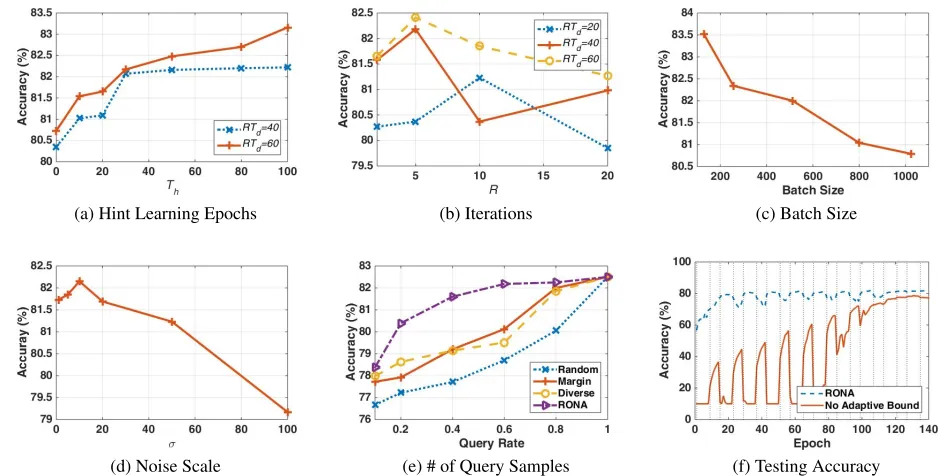
Hint learning epochs. It can be observed from Fig. 2(a) that the accuracy of the student model increases when the hint learning epoch ascends. But the increase diminishes as the hint learning epoch becomes large, especially whenRTd,
i.e., the total epochs of distillation learning, is small. As the hint learning consumes the privacy budget, it is not appro-priate to set an overly large value of hint learning epoch.
Iterations for distillation learning. The total epochs of distillation learning are determined by the rounds of itera-tionsRand the epochs per iterationTd. Generally, as shown
in Fig. 2(b), a larger value ofRTd brings a more effective
student model because the student model can learn more knowledge from the teacher. WhenRTdis fixed,Rshould
be set as a moderate value.
Batch size. Fig. 2(c) shows that the student’s perfor-mance descends with the increase of batch size. In RONA, the student queries the teacher in a batch-by-batch mode. A small value of batch size indicates that the teacher would be queried more times, and thus the privacy loss would be high. To achieve a balance between performance and privacy, we set the batch size as 512 in our experiments.
Noise scale. The student model benefits from the addi-tional noise when the noise scale is moderate as shown in Fig. 2(d). As a DNN usually suffers from the overfitting problem, the norm bound and additional noise act as reg-ularization roles during training. Even when the noise scale is relatively large (σ= 20), the accuracy degradation is less than 1%. This property is encouraging as more noise can be injected to provide a stronger privacy guarantee per query.
Number of query samples. The experimental results in Fig. 2(e) show that the student’s performance rises when more query samples are available. Nonetheless, more query samples mean a higher privacy loss. The query sample selec-tion method proposed in our work can achieve decent per-formance by only using 20% public samples as the query samples. We compare it with three other selection methods: random, margin (Wang et al. 2017), and diverse (Wang and Ye 2013). Fig. 2(e) demonstrates the superiority of our pro-posed query sample selection method.
(a) MNIST (b) SVHN (c) CIFAR
Figure 3: Accuracy vs. privacy budgetϵ. Base denotes the student model trained without querying the teacher model.
Table 1: Performance of Masking Specific Samples
Base RONA
ϵ= 5.2 ϵ= 8.7 ϵ= 29.8
Overall 79.87 80.93 88.48 90.35 Unseen Classes 0.00 9.59 46.75 53.43
(i.e., less privacy loss). Besides, we can find that the self learning contributes to the training acceleration as well. At the beginning of this stage, the accuracy is quickly improved by the self learning without consuming privacy budget.
Privacy Protection
We verify the privacy protection on MNIST, SVHN, and CIFAR-10. MNIST and SVHN are digit image datasets con-sisting of 60K and 73K training samples, respectively. We randomly choose 40% SVHN training samples and MNIST training samples as the public data. For MNIST, we use a modified Conv-Small network as the teacher. For SVHN, we use the Conv-Middle network as the teacher.
RONA achieves accuracies of 98.64% and 92.90% on MNIST and SVHN with(7.68,10−5)and(7.03,10−6) dif-ferential privacy. It outperforms the results in (Papernot et al. 2017) which achieved 98.10% and 90.66% accuracy on (8.03,10−5)guaranteed MNIST and (8.19,10−6) guaran-teed SVHN. It is comparable with the latest results in (Pa-pernot et al. 2018), achieving 98.5% and 91.6% accuracy on (1.97,10−5)guaranteed MNIST and (4.96,10−6) guaran-teed SVHN, which however used better and larger baseline networks. On CIFAR-10, we obtain 81.69% accuracy with (8.87,10−5)privacy, which outperforms 73% accuracy with (8.00,10−5)privacy in (Abadi et al. 2016). RONA’s perfor-mance is even better than the latest cloud-based solution that achieved 79.52% accuracy on CIFAR-10 (Wang et al. 2018). We verify the performance with different privacy budgets on three datasets. Fig. 3 demonstrates that the accuracies on three datasets generally rise with the increase of privacy bud-get. Thanks to the techniques proposed in this work, the stu-dent can still benefit from the knowledge distillation even when the knowledge is protected by a strong privacy.
In the above experiments, we select the public data ran-domly from the original training samples. We further test RONA in a much tougher condition on MNIST where we
Table 2: Compression Performance
# Params Time(s) Acc(%)
MNIST
T 155.21K 0.76 99.48
S1 4.97K 0.03 98.94
S2 9.88K 0.07 99.28
SVHN
T 1.41M 7.34 96.36
S1 0.04M 0.29 94.49
S2 0.07M 0.39 95.39
CIFAR-10
T 3.12M 13.92 86.35
S1 0.15M 0.93 82.14
S2 0.52M 3.10 84.57
regard all training samples of the digits 6 and 9 as sensitive data. This data masking mimics a possible contingency in re-ality when some specific kinds of samples are highly sensi-tive. For the student model, 6 and 9 are mythical digits it has never seen. As listed in Table 1, without the teacher’s knowl-edge, the student cannot recognize 6 and 9, getting accuracy of 0. RONAcan significantly improve the student’s accuracy on 6 and 9 with a reasonable privacy loss even though the student has never seen 6 and 9 during training.
Compression Performance
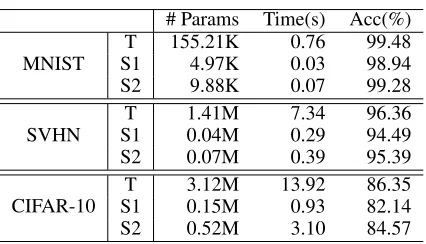
We randomly choose 80% training samples as the public data to validate the compression performance on the three datasets. For MNIST, SVHN, and CIFAR-10, we enforce (9.60,10−5), (9.83,10−6), and (9.59,10−5) differential privacy, respectively. In order to examine the runtime on mo-bile devices, we deploy these DNNs on HUAWEI HONOR 8 equipped with ARM [email protected] and [email protected] to process 100 images consecutively.
less than 2% while the model size is 6 times smaller. The above results argue that RONAcan privately compress large models with acceptable accuracy loss.
Acknowledgments
This work is supported by the Scientific Research Project of National University of Defense Technology through grant ZK17-03-48, Science Fund for Distinguished Young Scholars in Hunan Province through grant 2018JJ1032, NSFC through grants 61872378, 61572511, 91648204, and 71702186, as well as NSF through grants 1526499, IIS-1763325, and CNS-1626432.
References
Abadi, M.; Chu, A.; Goodfellow, I.; McMahan, H. B.; Mironov, I.; Talwar, K.; and Zhang, L. 2016. Deep learning with differential privacy. InProceedings of the 2016 ACM SIGSAC Conference on Computer and Communications Se-curity, CCS ’16, 308–318.
Beimel, A.; Brenner, H.; Kasiviswanathan, S. P.; and Nis-sim, K. 2014. Bounds on the sample complexity for pri-vate learning and pripri-vate data release. Machine Learning 94(3):401–437.
Bucilua, C.; Caruana, R.; and Niculescu-Mizil, A. 2006. Model compression. In Proceedings of the 12th ACM SIGKDD International Conference on Knowledge Discov-ery and Data Mining, KDD ’06, 535–541.
Cao, B.; Zheng, L.; Zhang, C.; Yu, P. S.; Piscitello, A.; Zu-lueta, J.; Ajilore, O.; Ryan, K.; and Leow, A. D. 2017. Deep-mood: modeling mobile phone typing dynamics for mood detection. InProceedings of the 23rd ACM SIGKDD In-ternational Conference on Knowledge Discovery and Data Mining, KDD ’17, 747–755.
Chen, G.; Choi, W.; Yu, X.; Han, T.; and Chandraker, M. 2017. Learning efficient object detection models with knowledge distillation. InAdvances in Neural Information Processing Systems 30, NIPS ’17. 742–751.
Claerhout, B., and DeMoor, G. 2005. Privacy protection for clinical and genomic data: The use of privacy-enhancing techniques in medicine. International Journal of Medical Informatics74(2):257 – 265.
Dwork, C., and Roth, A. 2014. The algorithmic foundations of differential privacy. Foundations and Trends in Theoreti-cal Computer Science9(3-4):211–407.
Dwork, C. 2011. Differential Privacy. Boston, MA: Springer US. 338–340.
Han, S.; Mao, H.; and Dally, W. J. 2016. Deep compression: Compressing deep neural networks with pruning, trained quantization and huffman coding. In4th International Con-ference on Learning Representations, ICLR ’16.
Hinton, G.; Vinyals, O.; and Dean, J. 2014. Distilling the knowledge in a neural network. InAdvances in Neural Infor-mation Processing Systems Deep Learning Workshop, NIPS ’14.
Howard, A. G.; Zhu, M.; Chen, B.; Kalenichenko, D.; Wang, W.; Weyand, T.; Andreetto, M.; and Adam, H. 2017. Mo-bilenets: Efficient convolutional neural networks for mobile vision applications. arXiv:1704.04861.
Korupolu, M. R.; Plaxton, C. G.; and Rajaraman, R. 1998. Analysis of a local search heuristic for facility location prob-lems. InProceedings of the Ninth Annual ACM-SIAM Sym-posium on Discrete Algorithms, SODA ’98, 1–10.
Krizhevsky, A., and Hinton, G. 2009. Learning multiple layers of features from tiny images.
Laine, S. 2017. Temporal ensembling for semi-supervised learning. In5th International Conference on Learning Rep-resentations, ICLR ’17.
LeCun, Y.; Bottou, L.; Bengio, Y.; and Hinton, G. 1998. Gradient-based learning applied to document recognition. Proceedings of the IEEE86(11):2278–2324.
Lee, P. 2017. Technology, media and telecommunications predictions. Delloitte Touche Tohmatsu Limited.
Netzer, Y.; Wang, T.; Coates, A.; Bissacco, A.; and Ng, B. W. A. Y. 2011. Reading digits in natural images with un-supervised feature learning. InProceedings of the 24th In-ternational Conference on Neural Information Processing Systems, NIPS ’11. 1–9.
Osia, S. A.; Shamsabadi, A. S.; Taheri, A.; Rabiee, H. R.; Lane, N. D.; and Haddadi, H. 2017. A hybrid deep learning architecture for privacy-preserving mobile analyt-ics. arXiv:1703.02952.
Papernot, N.; Abadi, M.; Erlingsson, U.; Goodfellow, I.; and Talwar, K. 2017. Semi-supervised knowledge transfer for deep learning from private training data. In5th International Conference on Learning Representations, ICLR ’17. Papernot, N.; Song, S.; Mironov, I.; Raghunathan, A.; Tal-war, K.; and Erlingsson, U. 2018. Scalable private learning with pate. In6th International Conference on Learning Rep-resentations, ICLR ’18.
Park, S.; Park, J.-K.; Shin, S.-J.; and Moon, I.-C. 2017. Ad-versarial dropout for supervised and semi-supervised learn-ing.arXiv:1707.03631.
Romero, A.; Ballas, N.; Kahou, S. E.; Chassang, A.; Gatta, C.; and Bengio, Y. 2015. Fitnets: Hints for thin deep nets. In 3th International Conference on Learning Representations, ICLR ’15.
Sun, L.; Wei, X.; Zhang, J.; He, L.; Philip, S. Y.; and Srisa-an, W. 2017. Contaminant removal for android malware detection systems. InIEEE International Conference on Big Data (Big Data), 1053–1062.
Triastcyn, A., and Faltings, B. 2018. Generating artificial data for private deep learning. arXiv:1803.03148.
Wang, Z., and Ye, J. 2013. Querying discriminative and representative samples for batch mode active learning. In Proceedings of the 19th ACM SIGKDD International Con-ference on Knowledge Discovery and Data Mining, KDD ’13, 158–166.
IEEE Transactions on Circuits and Systems for Video Tech-nology27(12):2591–2600.