Location Optimization of Wireless Sensor Network in
Intelligent Workshop Based on the Three-Dimensional
Adaptive Fruit Fly Optimization Algorithm
https://doi.org/10.3991/ijoe.v14i11.9544Shaobo Li, Chenglong Zhang(*) Guizhou University, Guiyang, China
Jinglei Qu
Henan Institute of Technology, Xinxiang, China
Abstract—The production process of modern manufacturing industry is com-plex and changeable, manufacturing resources have extensive dynamic charac-teristics. For effectively managing and controlling manufacturing resources, re-alizing real-time location data collection of intelligent workshop, a manufactur-ing resource location sensmanufactur-ing architecture based on the wireless sensor network is proposed. For ensuring real-time accuracy of manufacturing resource location data in the intelligent workshop, a three-dimensional adaptive fruit fly optimiza-tion algorithm is designed to estimate the locaoptimiza-tion coordinates, the new algorithm introduced the adaptive inertial weight coefficient, retained the advantage of strong local search ability of fruit fly optimization algorithm, improved the ability of global optimization, effectively solved the problem of three-dimensional loca-tion in intelligent workshop. The simulaloca-tion results show that, the algorithm in this paper is applied to the location calculation of triangulation, which has smaller location error and shorter operation time, it improves the accuracy of the location data and meets the real-time location requirements of manufacturing resources such as intelligent workshop staff, materials, logistics vehicles etc. facilitate re-source sensing and scheduling management, thereby improving management standards and product quality.
Keywords—intelligent manufacturing, wireless sensor network, node location, fruit fly optimization, location error
1
Introduction
production process is complex and changeable. The manufacturing resources such as raw material, equipment, tooling mold, site and operator have extensive dynamic char-acteristics, for effectively management and control manufacturing resources, to ensure the safety of the enterprises, improve the production efficiency, promote the intelligent development of the manufacturing industry, real-time and effective production data lo-cation collection becomes very necessary.
The traditional location application GPS cannot solve the problem of manufacturing workshop location effectively because of the limitation of manufacturing workshop scene, installation cost and other factors. As a new information sensing technology, wireless sensor network (WSN) is composed of a large number of static or mobile sens-ing nodes, with the characteristics of low cost, low power consumption, self-organiza-tion, large coverage area, etc., which have been widely used and popularized in military, industry, agriculture, medical and other fields to complete things detection, event de-tection and target tracking in the network deployment area.
In the current engineering application field, range-based localization algorithm with higher accuracy is often adopted. However, under the effects of electromagnetic inter-ference and manufacturing resources in manufacturing workshop, it exists low location accuracy, poor real-time and high location failure rate and other problems. Therefore, it is necessary to optimize the localization algorithm to improve the location accuracy and ensure the accuracy of location data. In recent years, particle swarm optimization (PSO), ant colony algorithm (ACO), artificial bee colony algorithm (ABC), fruit fly optimization algorithm (FOA) and other swarm intelligence optimization algorithms have been widely used in WSN node location optimization, achieved significant results. However, in the manufacturing workshop environment, three-dimensional (3D) loca-tion data collecloca-tion of manufacturing resources can better reflect the integrity of the data, but only few researches on the optimization of 3D spatial location of WSN nodes. Accordingly, in order to meet the need of high-precision 3D location of manufactur-ing resources in intelligent workshop, introduces an adaptive inertial weight coefficient to the FOA and proposes a 3D adaptive fruit fly optimization algorithm (3D-AFOA) to the calculation of triangulation to optimize node location in WSN. On the basis of pre-serving the local search ability of FOA, the design algorithm improves the running ef-ficiency and enhances the ability of global optimization. The simulation results show that the design algorithm has strong local optimization ability and high efficiency of operation, can effectively find the minimum estimated coordinates of location error, efficiently locate 3D nodes and is conducive to achieving high precision location in the workshop to promote the realization of intelligent manufacturing.
2
Location sensing architecture for intelligent workshop
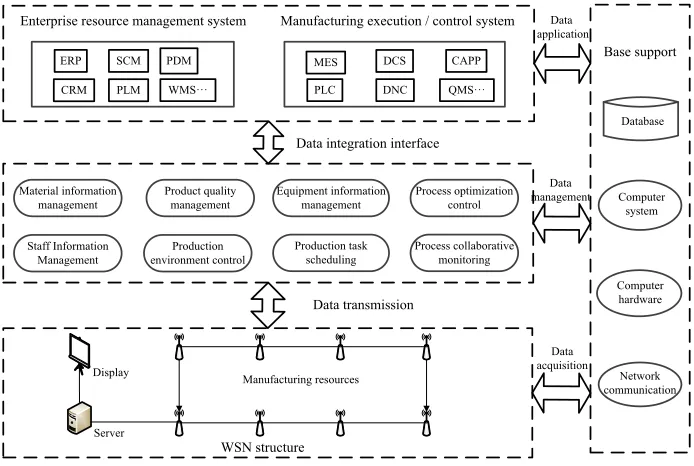
of production workshop automatic control equipment and manufacturing execution sys-tem, the data such as production plan and task execution and quality information of in-process products are collected in real-time and interacted with the enterprise manage-ment information system to realize the cooperative application of information data.
Therefore, this paper proposes a location sensing architecture for intelligent work-shop as shown in Figure 1, which can effectively match the manufacturing resources of the intelligent workshop, the real-time location data of manufacturing resources are collected and analyzed and integrated with enterprise resource management system and workshop manufacturing execution / control system. Through collecting effective real-time location information to consummate the integrality of manufacturing data, strengthen the management and business application of manufacturing data thus can forecast, monitor and analyze the events in manufacturing process and provide decision basis for production managers.
Fig. 1. Location sensing architecture for intelligent workshop
3
The optimization of location method based on the 3D-AFOA
3.1 The 3D-AFOA
FOA is a new swarm intelligence optimization algorithm, which was proposed by Taiwanese scholar Pan Wenchao in 2011, he studies the complex foraging relationship of fruit fly. Compared with other traditional swarm intelligence optimization algo-rithms, this algorithm has the advantages of easy to understand, less parameter setting, small computing space and strong global optimization ability. It is widely used in
Material information management
Staff Information Management
Product quality
management Equipment information management
Production task scheduling Process optimization control Process collaborative monitoring Data integration interface
Enterprise resource management system Manufacturing execution / control system
ERP
CRM WMS···
SCM
PLM
PDM MES CAPP
solving various practical problems of optimization.
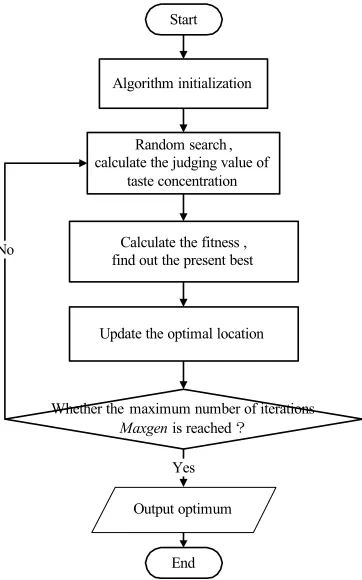
In order to overcome the disadvantages of FOA which is easy to fall into local opti-mum, combined with the strong global optimization ability of PSO, aiming at the need of 3D location of manufacturing resources in intelligent workshop. By introducing adaptive inertia weight coefficient from PSO, a 3D-AFOA is proposed, in which the specific flow of the algorithm is as follows:
Step 1: Algorithm initialization. Setting the population size of fruit fly Size pop, it-eration times of algorithm Maxgen, and initializing the population position of fruit fly (Xaxis, Yaxis, Zaxis), introducing adaptive inertial weight coefficient ω where is shown in
formula (1), g is the current iteration number;
𝜔𝜔 = 𝑐𝑐𝑐𝑐𝑐𝑐 &*×+,-'./'×) 0 (1)
Step 2: Random search. The initialized fruit fly individuals (Xi, Yi, Zi) use olfactory
to carry out random search for food sources, where Xi, Yi, Zi are shown in formula (2),
(3), (4);
𝑋𝑋2= 𝜔𝜔 × 𝑋𝑋,-23+ 2 × 𝑅𝑅𝑅𝑅𝑅𝑅𝑅𝑅 − 1 (2)
𝑌𝑌2= 𝜔𝜔 × 𝑌𝑌,-23+ 2 × 𝑅𝑅𝑅𝑅𝑅𝑅𝑅𝑅 − 1 (3)
𝑍𝑍2= 𝜔𝜔 × 𝑍𝑍,-23+ 2 × 𝑅𝑅𝑅𝑅𝑅𝑅𝑅𝑅 − 1 (4)
Step 3: Calculate the judging value of taste concentration. By calculating the euclid-ean distance Di from the individual to the origin of fruit fly melanogaster, the judging
value of taste concentration Si was calculated, where Di, Si are shown in formula (5),
(6);
𝐷𝐷2= ?𝑋𝑋2@+ 𝑌𝑌2@+𝑍𝑍2@ (5)
𝑆𝑆2=CBD (6)
Step 4: Calculate the fitness. According to step 3, the taste concentration of fruit fly melanogaster Smelli was calculated, where is shown in formula (7);
𝑆𝑆𝑆𝑆𝑆𝑆𝑆𝑆𝑆𝑆2= 𝐹𝐹𝐹𝐹𝑅𝑅𝑐𝑐𝐹𝐹𝐹𝐹𝑐𝑐𝑅𝑅(𝑆𝑆2) (7)
Step 5: Find out the present best. According to the calculating results of the taste concentration of fruit fly melanogaster population in step 4, the fruit fly with the highest taste concentration was selected as the contemporary optimum. By greedy selection method to find the fruit fly with the highest taste concentration;
[𝑏𝑏𝑆𝑆𝑐𝑐𝐹𝐹𝑆𝑆𝑆𝑆𝑆𝑆𝑆𝑆𝑆𝑆 𝑏𝑏𝑆𝑆𝑐𝑐𝐹𝐹𝑏𝑏𝑅𝑅𝑅𝑅𝑆𝑆𝑏𝑏 ] = 𝑆𝑆𝐹𝐹𝑅𝑅(𝑆𝑆𝑆𝑆𝑆𝑆𝑆𝑆𝑆𝑆) (8)
𝑆𝑆𝑆𝑆𝑆𝑆𝑆𝑆𝑆𝑆𝑏𝑏𝑆𝑆𝑐𝑐𝐹𝐹(𝑔𝑔) = 𝑏𝑏𝑆𝑆𝑐𝑐𝐹𝐹𝑆𝑆𝑆𝑆𝑆𝑆𝑆𝑆𝑆𝑆 (9)
𝑋𝑋,-23= 𝑋𝑋(𝑏𝑏𝑆𝑆𝑐𝑐𝐹𝐹𝑏𝑏𝑅𝑅𝑅𝑅𝑆𝑆𝑏𝑏) (10)
𝑌𝑌,-23= 𝑌𝑌(𝑏𝑏𝑆𝑆𝑐𝑐𝐹𝐹𝑏𝑏𝑅𝑅𝑅𝑅𝑆𝑆𝑏𝑏) (11)
𝑍𝑍,-23= 𝑍𝑍(𝑏𝑏𝑆𝑆𝑐𝑐𝐹𝐹𝑏𝑏𝑅𝑅𝑅𝑅𝑆𝑆𝑏𝑏) (12)
Step 7: If the maximum number of iterations Maxgen is reached, the algorithm ends with the optimal output value, otherwise, we will continue the algorithm to search for optimization iterations.
The flow chart of the optimization algorithm described above is as shown in Figure 2:
Fig. 2. The flow chart of the 3D-AFOA
3.2 Design and implementation of location method
The triangulation is a location method based on the anchor node and the distance between the unknown node and the anchor node to estimate and the location of the unknown node. In this article, 3D-AFOA is applied to solve the triangulation, and the location error is iteratively optimized thus to improve the location accuracy.
Start
Algorithm initialization
Random search, calculate the judging value of
taste concentration
Calculate the fitness , find out the present best
Update the optimal location
Whether the maximum number of iterations Maxgen is reached?
Output optimum Yes No
Based on the 3D-AFOA, the reciprocal distance is taken as the judging value of taste concentration, then the fitness function is put in to find the optimal taste concentration. Set Di as the location error of the unknown node to the anchor node i, where is shown
in formula (13);
𝐷𝐷2= U?(𝑏𝑏V − 𝑏𝑏2)@+ (𝑦𝑦V − 𝑦𝑦2)@− 𝑟𝑟2U (13)
(𝑏𝑏V, 𝑦𝑦V) is the estimated coordinates of unknown nodes, (xi, yi)is the coordinates of
anchor nodes i, ri is the distance from unknown nodes to anchor nodes i.
Take the node location error as the judging value of the taste concentration Si, add
the fitness function to solve the Smelli concentration so that the node location error will
be minimized that can find the precise location coordinate. To carry out iterative opti-mization to find the minimum location error and obtain the estimated coordinates of unknown nodes with the highest location accuracy.
4
Experimental simulation and analysis
4.1 Experimental environment
In order to verify the performance of the 3D-AFOA designed in this article, based on the experimental platform Win10/MATLAB(R2016a), computer configuration:
In-tel(R)Core(TM)i3-[email protected], 4.00GB RAM, 64-bit operating system, a
simulation program based on MATLAB is designed. By comparing and analyzing the positioning accuracy and performance of different algorithms to verify the superiority and efficiency of the algorithm.
4.2 Algorithm analysis
Because the FOA is mainly used in the two-dimensional location optimization of WSN nodes and has limited reference value, this article compares the 3D-AFOA with the three-dimensional fruit fly optimization algorithm (3D-FOA)to evaluate the superi-ority of the design algorithm.
The parameters of the experimental environment are set as follows: to simulate the layout of the intelligent workshop, the experimental space is set at 80m × 30m × 6m, the coordinates of the three anchor nodes are assumed to be the same, using the node location method in this article to simulate the manufacturing resource of the node P (5,
10, 2). Among them, the population Size pop of 3D-AFOA and 3D-FOA are both set to
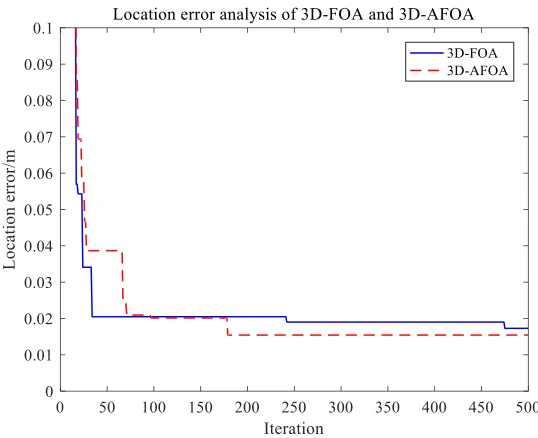
Fig. 3. Location error analysis of 3D-FOA and 3D-AFOA
As shown in Figure 3, the red dotted line is the simulation curve using the 3D-AFOA to solve the minimum location error, and the blue solid line is the simulation curve of the 3D-FOA. From the diagram, we can get the minimum location error of 1.54 cm for 179 iterations of the 3D-AFOA, and 1.73 cm for 475 iterations of the 3D FOA. It can be seen that the former's ability to jump out of the local optimum is greatly enhanced, the location error is reduced, and the coordinates of unknown nodes can be obtained more accurately. Therefore, in the WSN node location optimization, the 3D-AFOA is more accurate than the 3D-FOA.
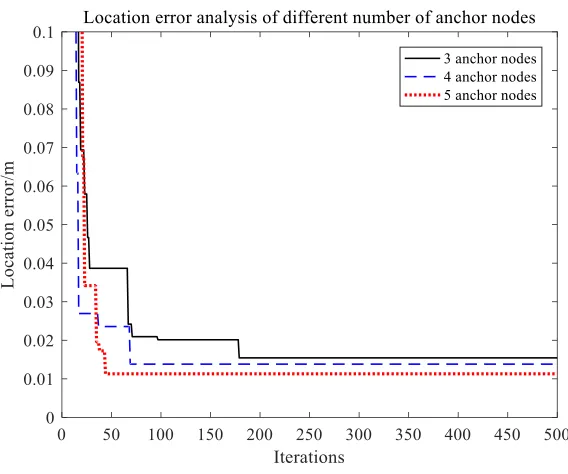
To further verify the effectiveness of the algorithm, three anchor nodes A(0, 0, 6), B(80, 0, 6), C(80, 30, 6), four anchor nodes A(0, 0, 6), B(80, 0, 6), C(80, 30, 6), D(20, 0, 6) and five anchor nodes A(0, 0, 6), B(80, 0, 6), C(80, 30, 6), D(20, 0, 6), E(40, 0, 6) are used to locate the manufacturing resources of the node P (5, 10, 2), to compare with the minimum positioning error, analyze the superiority of the optimization method that obtains the contrast curve as shown in Figure 4.
Fig. 4. Location error analysis of different number of anchor nodes
Table 1. The table of location error analysis
Number of anchor nodes Minimum location error Generation of convergence
3 1.54cm 179
4 1.38cm 73
5 1.13cm 44
5
Conclusion
6
Acknowledgment
This work was supported by national Natural Science Foundation of China (51475097 and 61540066), Science and Technology Foundation of Guizhou Province (JZ[2014]2001), and National Key Technology Support Program of China (2012BAH62F00).
7
References
[1]Chen Weixing, Li Shaobo, Huang Haisong. (2016). Active perception and manage-ment model for manufacturing data in discrete IoMT-based process. Computer Inte-grated Man-ufacturing Systems, 22(1): 166-176
[2]Yao Xifan, Yu Miao, Chen Yong. (2014). Connotation, architecture and key technolo-gies of Internet of manufacturing things. Computer Integrated Manufacturing Systems, 20(1): 1-10
[3]Zhong Ray Y, Xu Chen, Chen Chao, et al. (2017). Big Data Analytics for Physical In-ternet-based intelligent manufacturing shop floors. International Journal of Produc-tion Research, 55(9): 2610-2621 https://doi.org/10.1080/00207543.2015.1086037
[4]Li Shaobo, Qu Jinglei, Zhang Chenglong. (2017). Real-time resource positioning sys-tem based on wireless sensor network in manufacturing workshop. International Journal of Online Engineering, 13(6): 96-104 https://doi.org/10.3991/ijoe.v13i06.6933
[5]Afraimovich E L. (2016). GPS global detection of the ionospheric response to solar flares. Radio Science, 35(6): 1417-1424 https://doi.org/10.1029/2000RS002340
[6]Benbadis F, Friedman T, De Amorim M D, et al. (2017). GPS-free-free positioning sys-tem for wireless sensor networks// Ifip International Conference on Wireless and Op-tical Com-munications Networks. IEEE Xplore, 2017: 541-545
[7]Nellore K, Hancke G P. (2016). A Survey on Urban Traffic Management System Using Wireless Sensor Networks. Sensors, 16(2): 157-181 https://doi.org/10.3390/s16020157
[8]Han Guangjie, Liu Li, Jiang Jinfang, et al. (2017). Analysis of Energy-Efficient Con-nected Target Coverage Algorithms for Industrial Wireless Sensor Networks. IEEE Transactions on Industrial Informatics, 13(1): 135-143 https://doi.org/10.1109/TII.2015.2513767
[9]Hu Yanling, Dong Mianxiong, Ota K, et al. (2016). Mobile Target Detection in Wire-less Sensor Networks With Adjustable Sensing Frequency. IEEE Systems Journal, 10(3): 1160-1171 https://doi.org/10.1109/JSYST.2014.2308391
[10]Liu Jilong, Wang Zhe, Yao Mingwu, et al. (2016). VN-APIT: virtual nodes-based range-free APIT localization scheme for WSN. Wireless Networks, 22(3): 867-878
https://doi.org/10.1007/s11276-015-1007-z
[11]Liu Silin. (2017). Optimization analysis of WSN location process based on hybrid PSO al-gorithm// IEEE International Conference on Unmanned Systems. IEEE, 2017: 78-80 [12]Bao Peiming, Zhu Qingbao. (2009). A Multi-objective Ant Algorithm for Multi-base Station
Placement in Wireless Sensor Networks. Journal of Shanghai Jiaotong Uni-versity, 43(3): 449-454
[14] Xu Tongwei, He Qing, Wu Yile, et al. (2017). Research on the Localization Algorithm Based on Adaptive ABC/FOA Fusion. Chinese Journal of Sensors and Actuators, 30(2): 278-283
[15] Wang Kai, Ma Baoshan, Liu Ming, et al. (2013). A WSN-based system for environ-ment monitoring and energy saving control in hull workshop. Sensors and Transduc-ers, 158(11): 135-140
[16] Pan Wenchao. (2011). Using Fruit Fly Optimization Algorithm Optimized General Regres-sion Neural Network to Construct the Operating Performance of Enterprises Mode. Journal of Taiyuan University of Technology(Social Sciences Edition), 29(4): 1-5
[17] Pan Wenchao. (2011). Fruit Fly Optimization Algorithm. Taipei: Tsang Hai Publish-ing [18] Pan Wenchao. (2012). A new Fruit Fly Optimization Algorithm: Taking the financial
dis-tress model as an example. Knowledge-Based Systems, 26: 69-74 https://doi.org/10.1016/ j.knosys.2011.07.001
[19] Safa H. (2014). A novel localization algorithm for large scale wireless sensor net-works. Computer Communications, 45(3): 32-46 https://doi.org/10.1016/j.comcom.2014.03.020
[20] Rashid H, Turuk A K. (2013). Localization of Wireless Sensor Networks Using a Sin-gle Anchor Node. Wireless Personal Communications, 72(2): 975-986 https://doi.org/10.1007/ s11277-013-1050-y
8
Authors
Shaobo Li is currently a professor of School of Mechanical Engineering at Guizhou Unversity, Guiyang, China, 550025. His research interests include computational intel-ligence, manufacturing information system and internet things of technology. He is a member of the IEEE, CMES and CCF ([email protected]).
Chenglong Zhang is now pursuing his master degree in college of big data and information engineering at Guizhou University, Guiyang, China, 550025. His research interests include manufacturing information system and internet things of technology, wireless sensor network ([email protected]).
Jinglei Qu is currently a lecturer of Department of Mechanical Engineering at He-nan Institute of Technology, Xinxiang, China, 453000. His research interests include computational intelligence, manufacturing information system and data mining ([email protected]).