73
INTERNATIONAL JOURNAL OF ADVANCES IN ENGINEERING RESEARCH
PERFORMANCE AND COMPARISON OF LINEAR
MULTIUSER DETECTORS IN DS-CDMA USING
CHAOTIC SEQUENCE
D.Swathi1 B.Alekhya2 J.Ravindra Babu3
ABSTRACT
Digital communication offers so many advantages over analog communication, that today majority of communication systems are digital only. In that CDMA system is well known wireless technology. DS-CDMA system suffers from Multiple Access Interference (MAI) caused by the users. Multi-User Detection schemes were introduced to detect the users data in presence of MAI. M-sequences, gold sequences etc., has been traditionally used as spreading codes in DS-CDMA. This paper introduces a new type of sequences called chaotic sequences for DS-CDMA system. Simulation results gives the performance of three detectors known as conventional detector, Decorrelating detector and MMSE (Minimum Mean Square Error) detector with chaotic sequence as spreading sequence. Comparison shows that chaotic sequence is better than the gold sequence, and also MMSE gives the better performance than the decorrelator.analysis is to be carried out.
Index Terms—DS-CDMA, gold sequence, chaotic sequence, decorrelator, MMSE, conventional detector
I. INTRODUCTION
74
INTERNATIONAL JOURNAL OF ADVANCES IN ENGINEERING RESEARCH well-known, even though completely deterministic and initial sensitive, have characteristics similar to those of random noise. Surprisingly, the maps can generate large numbers of these noise-like sequences having low cross-correlations. The evaluated performance of the systems will be compared in the presence of additive white Gaussian noise (AWGN) for difference number of users. The noise-like feature of the chaotic spreading code is very desirable in a communication system. This feature greatly enhances the LPI (low probability of intercept) performance of the system.[1-2] The conventional systems used either frequency spectrum sharing or timesharing and hence there was the limitation on the capacity. With the advent of spread spectrum and hence CDMA, fixed bandwidth was used to accommodate many users by making use of certain coding properties over the bandwidth. But this system suffers from MAI (Multiple Access Interference)\ caused by direct sequence users. Multi-User Detection Technique is going to be the key to this problem. These detection schemes were introduced to detect the users’ data in the presence of Multiple Access Interference (MAI), Inter Symbol Interference and noise.
The DS/CDMA receivers are divided into Single-User and Multi-User detectors. A single user receiver detects the data of one user at a time whereas a multi-user receiver jointly detects several users’ information. At the receiver, the aim is to restore the signal, which is corrupted by the channel back to its original form. In its simplest form, the Single-User detector is a matched filter to the desired signal. Other users’ signals are treated as noise (self noise). These self-noise limit the system’s capacity and can jam out all communications in the presence of a strong nearby signal (Near-Far Problem)
This problem has been solved subsequently and resulted in less complex suboptimal multi-user detection algorithms such as the decorrelating detector, minimum mean square error detector (linear detectors) and other sub-optimal detectors. Because of the significant advantages which multi-user detection offers CDMA based wireless systems, in terms of capacity improvements and near-far resistance.[3-6]
The following sections of this paper, overview of multiuser detection problem, conventional detector, and linear multiuser detectors are presented. The simulation model applied for this work is described. The BER performance results are presented. Finally, we conclude.
II. CONVENTIONAL MATCHED FILTER
The DS-CDMA receivers using are based on conventional detector, also known as matched filter [7], and we consider BPSK transmission through a common AWGN channel. Figure1 shows the conventional single user matched filter to generate sufficient statistics for signal detection matched filter is used.
75
INTERNATIONAL JOURNAL OF ADVANCES IN ENGINEERING RESEARCH Figure:1 Matched filter bank
Each user is demodulated separately without taking into account to the existence of other (K-1) active users in the system. In other words, other users are considered as interference or noise [8].
1
( ) ( ) ( ) (1)
K
k k k
k
Y t A b S t n t
For K direct sequence users in the synchronous single path BPSK real channel, the baseband received signal is
given by
0
( ) ( ) (2)
T
k k
y
Y t s t dt 1 0
( ) ( ) ( ) (3)
T K
K j j j K
j
y A b S t n t S t dt
1 (4) kK K K j j jk k
j j k
y A b A b n
where 0 ( ) ( ) T k kn
n t s t dt0
( ) ( )
T
kj S t S t dtk j
ƿkj is the cross correlation of the spreading sequence between the kth and jth user. The decision is made by
^
sgn( k) (5)
76
INTERNATIONAL JOURNAL OF ADVANCES IN ENGINEERING RESEARCH
The single user matched filter receiver takes the MAI as noise and cannot suppress it. In matrix form, the outputs of the matched filter as
yRAb n (6)
Where R is the normalized cross correlation matrix whose diagonal elements are equal to 1 and whose (i,j)elements is equal to the cross correlation, ƿij, A= diag {A1,……, Ak },
y =[y1,……..yk]T , b= [b1,……..bk]T and n is a Gaussian random vector with zero mean [9].
Algorithm for conventional matched filter
Advantage of matched filter is each branch detects one user without regard to the existence of the other users (single user strategy), but the performance of this detector gives the limited capacity and causes the near far problems
III LINEAR MULTIUSER DETECTORS
a) Decorrelating detector
An optimal receiver must be capable of decoding the bits error-free when the noise power is zero.
77
INTERNATIONAL JOURNAL OF ADVANCES IN ENGINEERING RESEARCH
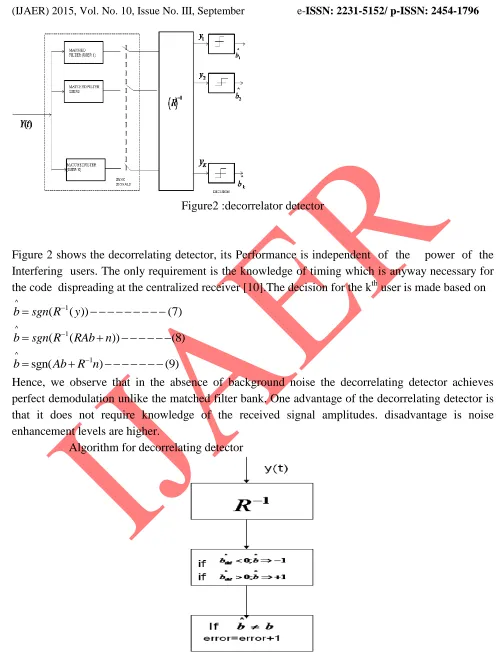
Figure2 :decorrelator detector
Figure 2 shows the decorrelating detector, its Performance is independent of the power of the Interfering users. The only requirement is the knowledge of timing which is anyway necessary for the code dispreading at the centralized receiver [10].The decision for the kth user is made based on
^
1
( ( )) (7)
bsgn R y
^
1
( ( )) (8)
bsgn R RAb n
^
1
sgn( ) (9)
b Ab R n
Hence, we observe that in the absence of background noise the decorrelating detector achieves perfect demodulation unlike the matched filter bank. One advantage of the decorrelating detector is that it does not require knowledge of the received signal amplitudes. disadvantage is noise enhancement levels are higher.
Algorithm for decorrelating detector
78
INTERNATIONAL JOURNAL OF ADVANCES IN ENGINEERING RESEARCH b) Minimum mean square error detector
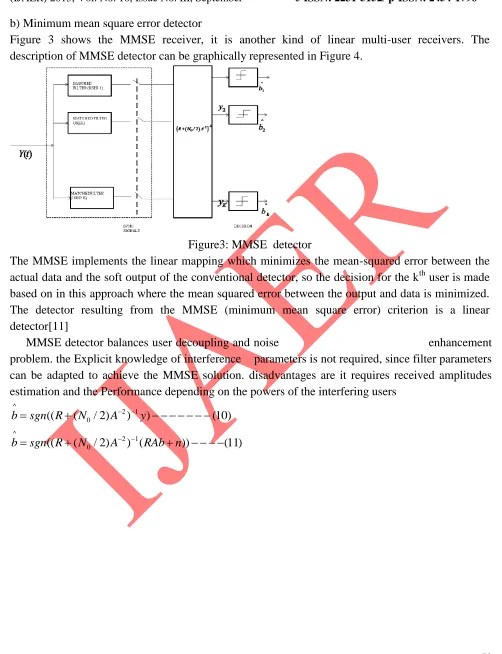
Figure 3 shows the MMSE receiver, it is another kind of linear multi-user receivers. The description of MMSE detector can be graphically represented in Figure 4.
Figure3: MMSE detector
The MMSE implements the linear mapping which minimizes the mean-squared error between the actual data and the soft output of the conventional detector, so the decision for the kth user is made based on in this approach where the mean squared error between the output and data is minimized. The detector resulting from the MMSE (minimum mean square error) criterion is a linear detector[11]
MMSE detector balances user decoupling and noise enhancement problem. the Explicit knowledge of interference parameters is not required, since filter parameters can be adapted to achieve the MMSE solution. disadvantages are it requires received amplitudes estimation and the Performance depending on the powers of the interfering users
^
2 1
0
(( ( / 2) ) ) (10)
bsgn R N A y
^
2 1
0
(( ( / 2) ) ( )) (11)
79
INTERNATIONAL JOURNAL OF ADVANCES IN ENGINEERING RESEARCH Algorithm for MMSE detector
IV SPREADING CODES
a) Gold sequence
The autocorrelation properties of a m-sequence cannot be better and doesn’t exhibit god correlation properties for code division multiple access. For this reason a particular class of PN sequences is used, these are called as gold sequence.
Figure4:. Diagram of a simple Gold code generator.
Gold code can be generated by a modulo two addition of two maximum-length sequence with same length as shown in fig4. One of the advantages of gold code is to generate the large no of codes. Gold codes have bounded small cross-correlations within a set, which is useful when multiple devices are broadcasting in the same range.
80
INTERNATIONAL JOURNAL OF ADVANCES IN ENGINEERING RESEARCH m-sequence 1 : 1000010101110110001111100110100
m-sequence 2 : 1000011001001111101110001010110 modulo-2 adder.: 0000001100111001100001101100010
The result of the modulo-2 addition is a code sequence that is also 31 bits long, i.e., a code sequence of maximum length.[12]
b) Chaotic sequence
Chaotic sequences are Noise like waveform and possess Wideband spectrum chaotic sequence have very low values of the cross correlation function among them. This is an important issue with regard to security, because the receiver cannot be figured out from a few points of the chaotic sequence. Consequentially, the chaotic sequences also permit more users in the communication system and the system obtains a greater security, since the difficulty they present to be reconstructed for Multiple-user systems. The main usage is increased security of the data transmission and ease of generation of a great number of chaotic sequences [13].
One of the simplest and most widely studied nonlinear dynamical systems capable of exhibiting chaos is the logistic map.
F(x,r) = rx(1-x) ---(12) or written in its recursive form,
x=rx
n(1-xn) , 0≤xn≤1, 0≤r≤4---(!3)
here , F is the transformation mapping function, and r is called the bifurcation parameter. Depending on the value of r, the dynamics of this system can change attractively, exhibiting periodicity or chaos.[14]
Figure 5.:Block diagram for chaotic sequence generator
V SIMULATION RESULTS
81
INTERNATIONAL JOURNAL OF ADVANCES IN ENGINEERING RESEARCH MATLAB. Basic synchronous CDMA model has been used. AWGN channel is considered and with the assumption all active users have equal power. BPSK modulation is assumed, with the bits +1 and -1 being equiprobable and spreading sequence length 31 random
Sequences were used.
0 1 2 3 4 5 6 7 8 9 10
10-4 10-3 10-2 10-1 100 Eb/No, dB B it E r r o r R a t e
BER performence of matched filter using gold code
2 users 5 users 10 users
Figure6: BER performance of matched filter using gold sequence
From Figure 6 to Figure 8 shows the Bit Error Rate performance of the matched filter, Decorrelating detector and MMSE using gold sequence. The bit error rate plots have been obtained for the 2 users, 5 users and 10 users. It is observed that as multiple access interference increases as the number of user increases the performance becomes poor. This is because the detector ignores the cross-talk between users (the MAI) as white noise.
0 1 2 3 4 5 6 7 8 9 10
10-3 10-2 10-1 100 Eb/No, dB B it E r r o r R a t e
BER performence of decorrelating detector using gold sequence
2 users 5 users 10 users
Figure7: BER performance of decorrelator using gold sequence
82
INTERNATIONAL JOURNAL OF ADVANCES IN ENGINEERING RESEARCH
0 1 2 3 4 5 6 7 8 9 10
10-3 10-2 10-1 100
Eb/No, dB
B
it
E
r
r
o
r
R
a
t
e
BER performence of MMSE using gold sequence
2 users 5 users 10 users
Figure8: BER performance of MMSE using gold sequence
0 1 2 3 4 5 6 7 8 9 10
10-3 10-2 10-1 100
Eb/No, dB
B
it
E
r
r
o
r
R
a
t
e
matched filter detector for chaos sequence
2 users 5 users 10 users
83
INTERNATIONAL JOURNAL OF ADVANCES IN ENGINEERING RESEARCH
0 1 2 3 4 5 6 7 8 9 10
10-3 10-2 10-1 100
Eb/No, dB
B
i
t
E
r
r
o
r
R
a
t
e
BER performence of decorrelating detector using gold sequence
2 users 5 users 10 users
Figure10: BER performance of decorrelator using chaotic sequence
0 1 2 3 4 5 6 7 8 9 10
10-4 10-3 10-2 10-1 100
Eb/No, dB
B
it
E
r
r
o
r
R
a
t
e
MMSE detector using chaos sequence
2 users 5 users 10 users
84
INTERNATIONAL JOURNAL OF ADVANCES IN ENGINEERING RESEARCH
0 1 2 3 4 5 6 7 8 9 10
10-3 10-2 10-1 100
Eb/No, dB
B
it
E
r
r
o
r
R
a
t
e
comparision of matched filter with gold and choas sequence
gold 10 users choas 10 users choas 5 users gold 5 users
Figure12: comparision of matched filter with gold and chaotic sequence
0 1 2 3 4 5 6 7 8 9 10
10-3 10-2 10-1 100
Eb/No, dB
B
i
t
E
r
r
o
r
R
a
t
e
comparision of decorrelating detector using gold and choas sequence
gold 10 users choas 10 users gold 5 users choas 5 users
85
INTERNATIONAL JOURNAL OF ADVANCES IN ENGINEERING RESEARCH
0 1 2 3 4 5 6 7 8 9 10
10-3 10-2 10-1 100
Eb/No, dB
B
i
t
E
r
r
o
r
R
a
t
e
comparision of MMSE detector for gold and choas sequence
gold 5 users choas 5 users gold 10 users choas 10 users
Figure14: comparison of MMSE detector using gold and chaotic sequence
From figure 12 to 14 shows the comparison of Bit Error Rate performance of the matched filter, Decorrelating detector and MMSE using different sequences like gold and chaotic sequences. The bit error rate plots have been obtained for the 2 users, 5 users and 10 users.
CONCLUSION
The chaotic sequence is well performed compared to the Gold sequence in the linear multi-user detectors. The linear multiuser detectors perform better than the conventional matched filter. MMSE detector generally performs better than the decorrelating detector and matched filter because it takes the background noise into account. Number of users increases the performance of all detectors will degrade. This is because as the number of interfering users increases, the amount of MAl becomes greater as well.
REFERENCES
[1]P. G. Flikkema, “Spread Spectrum Techniques for Wireless Communications,” IEEE Signal Processing Magazine, vol. 1, pp. 26–36, May 1997.
[2]Mario Martello, “Introduction to Discrete Dynamical systems and chaos,” Wiley, Inter-science, 1999.
[3] S. Verdu “Minimum Probability of Error for Asynchronous Gaussian
86
INTERNATIONAL JOURNAL OF ADVANCES IN ENGINEERING RESEARCH
[4] A. J. Viterbi, CDMA: Principles of Spread Spectrum Communication, Addision-Wesely.1995.
[5] J.Ravindrababu, P.Venumadhav, E.V.Krishna Rao. Low complexity multi user detection using Decision feedback equalizer in DS-CDMA i-manager’s Journalon Electronics Engineering, Vol. 1 l No. 3 l March - May
2011. pp. 10-13
[6] J.Ravindrababu, P.Venumadhav, E.V.Krishna Rao. Performance Analysis of Coherent and Noncoherent MMSE Interference Suppression For DS–CDMA International Journal of Advanced Engineering Sciences And Technologies. Vol No. 8, Issue No. 2, pp. 238 -242
.
[7]Shimon Moshavi (1996), Multiuser Detection for DS-CDMA Communications, IEEE Communication Magazine.
[8]A Duel-Hallen, J. Holtzman, and Z. Zvonar (1995), Multiuser Detection for CDMA Systems, IEEE Personal Communications, vol. 2, pp. 46-58
.
[9] J.G. Proakis (1995), Digital Communications, 3 Edition, New York: McGraw-Hill.
[10]S.Verdu,Multiuser Detection Cambridge University Press, 1998
[11]D.Swathi, J.Raveendrababu,B.Alekya ,BER Performance of Linear Multi-user Detectors in DS-CDMA, International Journal of Scientific & Engineering Research, Volume 3, Issue 4, April-2012
[12] J.Ravindrababu, E.V.Krishna Rao Performance Analysis and Comparison of Linear Multi-User Detectors in DS-CDMA System International Journal of Electronics and Communication Engineering & Technology (IJECET) vol-3, issue 1, January –June 2012. pp. 229-243
[13] S.V.Sartvate and M.B.Pursly M.“Cross-Correlation Properties of Pseudorandom and Related Sequences,” Proc.IEEE.vol.68, pp.593-619, May, 1980.
87
INTERNATIONAL JOURNAL OF ADVANCES IN ENGINEERING RESEARCH D.Swathi received her B.Tech. Degree in Electronics and Communication from K.L.University, Guntur, Andhra Pradesh, India. in 2009. M.Tech degree in microwave and communication engineering from PVPsiddhartha institute of technology ,Vijayawada, J.N.T.University, Kakinada, Andhra Pradesh, India. Her research interests include Communications, digital signal processing, and microwaves. At present she is working as a assistant professor at PVP Siddhartha institute of technology, Vijayawada, India .She is a life member of ISTE.
B. Alekya received her B.Tech. Degree in Electronics and Communications Engineering from K. L. University, Guntur, Andhra Pradesh, India. in 2008. She was a lecturer in Department of Electronics and Communication Engineering Courses at Nimra College of Engineering J.N.T.University, Kakinada in 2010. She is doing her M.Tech Degree in Microwave and Communications Engineering in P.V.P.Siddhartha Institute of Technology, Vijayawada, under J.N.T.University, Kakinada, Andhra Pradesh, India. She is also very much interests in research area include Communications, digital signal processing, and microwaves. At present she is working as a assistant professor at V.R. college of engineering, Vijayawada, India.