24 INTERNATIONAL JOURNAL OF ADVANCES IN ENGINEERING RESEARCH
MOBILE COMPUTING USES OPTIMIZATION
TECHNIQUE FOR QUALITY OF SERVICE (QOS)
THROUGH GREY PREDICTION APPROACH
Dr. Dharmendra Mishra1
Department of Computer Science and Applications
______________________________________________________________________________
ABSTRACT
Today computing has rapidly grown from being confined to a single location. With the rapid advances & development in mobile computing technologies and mobile devices, it is an important issue to maximize the number of served tasks for quality of service (QoS) provisioning in a mobile computing environment. One of many potential approaches is based on radio resource management (RRM). However, RRM suffers a problem that the task arrival rate, the task duration and the communication overhead between mobile nodes are uncertain under a mobile environment. To alleviate the obstacle, this paper proposes a Gray-RRM method to predict the load status of mobile nodes. Our approach is on the application-level of mobile computing, and can directly support existing facility. The Grey-RRM scheme exhibits better adaptability, and outperforms other recent algorithms. The simulation results show that the proposed algorithm can yield lower task blocking rate, lower task dropping rate, less load information updated overhead, and shorter radio resource carrier acquisition delays.
Keywords: mobile computing, quality of service, radio resource management, grey prediction, carrier
allocation.
INTRODUCTION
Mobile computing technologies—wireless or ubiquitous computing technologies. A mobile computing environment generally consists of a central switching office, namely mobile switching center, and a set of mobile nodes (MN), each with a fixed base station (MN). Although the concept also applies to radio network controller in mobile computing, a mobile node directly communicates with all mobile stations (MSs) within its wireless transmission radius [1, 2, 6, 14, 17] [The radio resource management by carrier assignment (allocation) problem is an important topic in mobile nodes [3, 5]. The objective of the radio resource assignment of existing results mainly exploits the carrier reuse factor under the constraint of co-carrier reuse distance. The schemes for the carrier assignment can be classified into Fixed Carrier Assignment (FCA) [3, 4, 7], and Dynamic Carrier Assignment (DCA) [6, 8, 12, 17]. FCA is simple to realize but it does not adapt to an environment where load may fluctuate and vary from mobile nodes to mobile nodes.
25 INTERNATIONAL JOURNAL OF ADVANCES IN ENGINEERING RESEARCH
Figure 1: Block diagram of our Grey-RRM
DCA schemes can dynamically assign/reassign tasks according to load change, and thus are more flexible. A centralized DCA scheme places all carriers in a pool, and assigns them to new tasks as required. All allocated mobile nodes are done by a mobile switching center. For distributed DCA schemes, mobile nodes are needed to be involved [8]. To be more specific, load balancing is the process of redistributing the carriers to a network of mobile nodes to avoid the situation where some mobile nodes are idle while others are congested. One method to alleviate the congestion caused by the load imbalance is to enlarge the bandwidth of mobile nodes but such method is inefficient. A more efficient approach tries to allocate carriers from lightly loaded mobile nodes to heavily loaded ones. Conventional strategies for the carrier allocation usually use fixed thresholds to distinguish the status of each mobile node.
26 INTERNATIONAL JOURNAL OF ADVANCES IN ENGINEERING RESEARCH can not only estimate the time-varying traffic load about the mobile nodes networks, but also provide useful information for making the carriers reallocation decisions. This work uses grey prediction to forecast the one step-ahead predicted load of mobile nodes, and then identifies a mobile node to be heavily loaded, moderate, or lightly loaded. A good load information gathering could be able to reflect our qualitative estimates of the current load on a mobile node, predict the mobile nodes load in the near future, relatively stable, and have a simple relationship with the resource indices. For a mobile node, the arrival time of the tasks may vary significantly. Traditional carrier allocation approaches can be classified into update and search A mobile node is marked as ― heavily loaded‖, if the ratio of the available carriers to the total carriers allocated to that mobile node is less than or equal to a threshold value. Otherwise it is ―lightly loaded‖. Since the load state may exhibit sharp distinction state level, sequential fluctuation like ping-pong effect may occur when the loads are around the threshold [6, 9, 11]. This phenomenon results in a significant amount of efforts in transferring carriers back and forth; however, the load imbalance exists still. To alleviate this problem, the load information collection can not only estimate the time-varying traffic load about the mobile nodes networks, but also provide useful information for making the carriers reallocation decisions. This work uses grey prediction to forecast the one step-ahead predicted load of mobile nodes, and then identifies a mobile node to be heavily loaded, moderate, or lightly loaded. A good load information gathering could be able to reflect our qualitative estimates of the current load on a mobile node, predict the mobile nodes load in the near future, relatively stable, and have a simple relationship with the resource indices. For a mobile node, the arrival time of the tasks may vary significantly. Traditional carrier allocation approaches can be classified into update and search and the message passing overhead among the mobile nodes are vague and uncertain. The idea of control of grey predictions is used to predict future behaviors of a system based on a collection of data regarding the system in order to uncover the development law, if any, of the system, and to perform pre-controls on relevant controlling decisions, by using the predicted future development tendency of the system. In this way, it becomes possible for load balancing to prevent a predicted disaster before it actually occurs, and to impose controls in a timely fashion. Using grey prediction can prevent receiving or migrating tasks when mobile nodes load is moderate in the early future and avoid the system is busy in transferring tasks In simple allocation strategy [17], this variant of the fixed assignment scheme proposes to transfer a carrier from neighboring mobile nodes provided it does not interfere with the existing carriers and locked in those co-carrier mobile nodes of the transferring one. In the directed retry with load sharing scheme [16], it is assumed that the neighboring mobile nodes and the users overlap region and the main drawback of this scheme include increased number of hand-offs and co carrier interference, and also the load sharing is dependent on the number of users in the overlap region. The carrier borrowing without locking scheme [10] propose carrier transfer when the set of carriers in a mobile node gets exhausted, but to use the transferred carriers under reduced transmission power to avoid co-carrier interference. In the load balancing with selective borrowing [6], a mobile nodes is classified as ― heavily loaded‖, if it s degrees of lightly loaded defined as the ratio of the number of available carrier to the total
27 INTERNATIONAL JOURNAL OF ADVANCES IN ENGINEERING RESEARCH
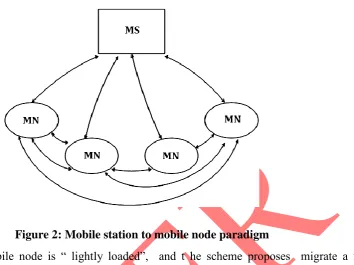
Figure 2: Mobile station to mobile node paradigm
Otherwise the mobile node is ― lightly loaded‖, and t he scheme proposes migrate a fixed number of carriers to from lightly loaded node to heavily loaded one through a centralized carrier allocation algorithm by an mobile switching center server in charge of a group of mobile nodes. Aided by a radio resource of carrier allocation strategy within each mobile nodes, it has been presented in that the centralized scheme achieves almost perfect load balancing and lead to a significant improvement over FCA, simple borrowing, directories and carrier borrowing without locking schemes in case of an over loaded mobile nodes. However, the disadvantage of hence, too much depends on the central server in the mobile switch center. Maintenance of continuous status information of the mobile nodes in an environment where the number of the user request tasks changes dynamically, lead to enormous amount of updating task traffic, consumption of carrier and message delay.
MOBILE NODE LOAD DECISION-MAKING AND GREY PREDICTION
MODULE
28 INTERNATIONAL JOURNAL OF ADVANCES IN ENGINEERING RESEARCH behavior data. The radio resources carrier with task assignment schemes has received considerable attention because of their reliability and solvability. The decision making indicates the significance of various loading that regards with the mobile nodes [13, 15]. Although number of available carrier is the obvious factor impacting on the system load, also there are certain other factors influencing the system load, such as tasks arrival rate and tasks duration, etc. For the accuracy of evaluating the load state of a mobile node, we employ the used available carrier and traffic load as the input variables for the grey prediction. The grey predictor forecasts the one-step-ahead value from data series. The Grey-RRM has the effect of transforming crisp measured data into suitable linguistic values. If all the information of a system is known, we define the system ―white system‖. On the other hand, if we don’t have any information about a system, the system "black system". Thus a grey system is a system which we have only a little information about it. The grey system theory include the following fields: (a) grey generating, (b) grey relational analysis, (c) grey forecasting, (d) grey decision making, and (e) grey control. The grey prediction has been widely used in many domains. It uses only a few data through the accumulated generating operation (AGO) technique to approach the system behavior. The raw data output from the system may not possess any regularity. However, the original data may become more regular after a repeatedly accumulated generating operation. Therefore, we can utilize grey model (GM) which describes a system behavior via a first-order differential equation to approximate such a regularity and hopefully to predict the next output from the system. This is why it is applicable to the time-varying nonlinear system prediction problem. Grey Prediction is summarized as follows:
Step 1: Given the original data sequence X(0) =(X(0)(1), X(0)(2),…………, X(0)(n)) (3.1), Where X(0)corresponds to the system output at time i, . The work try to predict the
next X(n + k) .
Step 2: Before constructing the GM (1, 1) model, the original data need to be ratio tested.
Meanwhile = (3.2), where k = 2, 3… n and is
tasks class ratio. When the value of class ratio falls within 0.145-7.573, it means that the original data sequence X(0) satisfy the grey model.
Step 3: From the original data sequence X(0) a new sequence X(1) is generated by the accumulated generating operation (AGO) X(1) =(X(1)(1), X(1)(2),…………, X(1)(n)) (3.3),
Where X(1) =X(0) , X(1)(k)= (0)(m), k = 2, 3,…, n.
Step 4: According to GM (1, 1), we can define the source model
X(0)(k)+ aZ(1)(k) =b, k = 2, 3,…, n. (3.4), By mean value generating operation we obtain the background value is z(1)(k)= x(1)(k) + x(1)(k-1). is the adjusting factor, on
general situation and a is the development coefficient of GM and b is the grey
controlled variable. The normally differential equation is to replace the source
29 INTERNATIONAL JOURNAL OF ADVANCES IN ENGINEERING RESEARCH Step 5: Parameters a and b can be obtained by the minimum least square estimation. According to the source model X(0)(k)+ aZ(1)(k) =b, for allk = 2, 3,…, n, we can get
X(0)(2)+ aZ(1)(2) =b X(0)(3)+ aZ(1)(3) =b
….. ….. …… (3.5)
….. ….. …… X(0)(n)+ aZ(1)(n) =b
Transferring the terms of the source model, it can be rewritten as
X(0)(k)= - aZ(1)(k) +b (3.6)
Set , equation(3.6) Can be rewritten as
. Resolving the matrix relation, we get (3.7)
Step 6: By solving the whitening equation, we can get the prediction function for the grey system
(3.8)
Step 7: Taking inverse accumulated generating operation (IAGO) on . The corresponding
IAGO sequence . It can get , where
the predicted value of . The number of available carriers is the indicator
used as an example of the calculation procedures for the prediction formula, and the predicted calculations for other variables follow the same way. It will adopt four-data series from T1 to T4 as original data to forecast the number of available carriers at T5. Before we start the procedure, we must check the data by ratio tested whether it can be used or not. If the data is accepted, we can use it. The example of estimation will involve the following steps:
1. The original data of the number of available carriers between T1 and T4 .
2. Do the ratio test 5/10=0.5, 10/8=1.25, 8/3=2.67. The data satisfies the class ratio test.
3. Applying AGO on the original data yields the data sequence
4. From grey differential equation Z(k),
5. Matrix Band fixed vector Yare accumulated as follows:
6.Solve the development coefficients aand bin Equation (3.7) by the least-square method a=0.4572, b=15.1540.
7. From the grey shadow equation,
8. Restore the predicted value by IAGO,
30 INTERNATIONAL JOURNAL OF ADVANCES IN ENGINEERING RESEARCH newer model is established, and a series of new predicted values will appear accordingly. This end guarantees a strong adaptability of the system .If the data sequence don’t pass through the class ratio test, we don’t adopt the predicted value, but we take the original value instead.
MULTI-CARRIERS MIGRATING
The new tasks with carrier migrating with multitasks transferring can reallocate tasks well especially in an unpredictable variation of mobile nodes load. The design mechanism for multi-tasks transfer calculates the amount of transferred carriers by the number of available carriers and the number of task. The Grey-RRM, when requesting mobile nodes and a probed mobile nodes are decided, the number of reallocated tasks is just one task in iteration between nodes to one. It is very inefficient if the mobile nodes load of two mobile nodes differ with a large value. The proposed idea is to transfer several tasks once instead of only one between two mobile nodes. For example, in the next generation multi-media mobile network, tasks may need multiple carriers at a time. In this idea, we could make the mobile nodes load between two mobile nodes more balanced. The carrier requesting messages transmitted between heavily loaded mobile nodes i and lightly loaded mobile nodes j are classified into four categories as follows.
(1) Request message, request (i): Message sent by the heavily loaded mobile nodes i to cluster mobile nodes to request the free carriers.
(2) Reply message, reply (j, Vj, Uj): Message from lightly loaded mobile nodes j,
mobile nodes responding to transfer mobile nodes i. The message also includes the information on the reserved carriers in mobile nodesj.
(3) Inform message, inform (i, Bij): Message sent by transfer mobile nodes i to the transferring and the other mobile nodes to inform them about its carrier acquisition decision, where Bij is set of carriers transfer by heavily loaded mobile nodes i from lightly loaded mobile nodes j .The message also includes the requests of the reserved carriers if any.
31 INTERNATIONAL JOURNAL OF ADVANCES IN ENGINEERING RESEARCH transfer a quantity control number of the carrier range [-CR, +CR] of the function output. The function is defined on the interval [0, +CR] for receive action, and on the interval [0, - CR] for migrate action. We have used center of area method because it supports software real time controls to differentiate the difference of load on two mobile nodes. This value is calculated by
the formula Where Greyoutput
represent the number of migrate carriers with tasks, Xi = the degree ofith load level and yi = the load level center value of ith control rule. Consequently, the function value Greyoutputobtained by formula can be interpreted as an expected value of variable. Finally, we obtain the number of carriers with tasks transfer restrict CTR as follow: CTR= [receive mobile nodes (Greyoutput)
migrate mobile nodes (Greyoutput)].
EXPERIMENTAL RESULTS
This paper proposes a mobile computing based dynamic load balancing method. We choose the Java as the design language, since it’s port to implement the simulation system with other platforms and will introduce the system architecture of java load balancing system. The Java has provided some useful features that can be used in distributed computing. The most important feature is the Java Remote Method Invocation (RMI). It allows programmer to implement distributed object using Java. It provides a simple and direct model for distributed computation with Java objects. These objects can be new Java objects, or simple Java wrappers around an existing API. Use RMI to be the daemon process that locates on each host. In the simulation environment seven workstations are chosen to build the virtual machine. The communication network connects those workstations. Also they are located on different NIS (Network Information Service) and NFS (Network File System) domains. To perform the collected action those use the Java Native Interface (JNI). By using t he JNI we call each platform’s of the API for getting its system information.
Besides the hardware and OS level environment, the use of JDK with JIT and native thread support to construct simulation platform. The problem domain naturally lends itself to simulate using multiple threads since there is a lot of concurrence and global resource management issues in the system.
The problem domain naturally transfers itself to simulate using multiple threads since there is a lot of concurrence and global resource management issues in the system. The simulated model consists of 7 clusters. Each cluster consists of 7 homogeneous mobile nodes. This experiment has used the number of radio resource by carriers CR =50 in a mobile nodes, total of N = 49 mobile nodes in the system. The amount of requested carrier specified of minimum basic carrier units
(CU) is 30Kbps of multi-carriers migration. We assume tasks/per hour are the
carriers with tasks originating rate per mobile nodes and be the hand-off traffic density per mobile
nodes. We assume that traffic density pattern for performance
analysis as and the d=1 sec communication delay between mobile nodes, and each handoff and
32 INTERNATIONAL JOURNAL OF ADVANCES IN ENGINEERING RESEARCH load is chosen randomly and non-linearly. The maximum numbers of handoff tasks are queued 15 for the high class priority and new tasks 15 for the low class priority, respectively. Let the density of simulation be 300 peoples per mobile nodes and the velocity is from 0 km/h to 100 km/h. We define that the time of the sample interval is 5 minutes and the sampling time does influence previous one. In order to represent various multi-media services, three different types are assumed based on the radio resource by carrier requirement with QoS. The duration of tasks are distributed by different means for different multimedia traffic types. In our simulation three types of traffic services are assumed: voice service, video phone and video on demand. These types are defined on the radio resource by carrier requirement 10Kbps, 64Kbps and interval 128Kbps- 1Mbps, respectively. The assumptions of three performance metrics for our simulation study are as follows:
1. Blocking task with carrier: If all the servers are busy, and the mobile nodes do not succeed to transfer a carrier from its cluster mobile nodes, then hand-over and new tasks, generated at this particular mobile node are stored in the queue, otherwise they get service. If new and handoff tasks do not get service of neither free carriers nor receive carriers, then the handoff and new tasks are requested. When its delay constraint is over, the tasks must be blocked.
2. Dropping task with carrier: When MS moves into neighboring mobile nodes, the task must be transferred to the neighboring mobile nodes. This procedure is a hand-over. If a carriers wit tasks cannot be assigned at the new mobile node and the particular mobile node does not to transfer a carriers from its cluster carriers, then the task generated at this particular mobile node are stored in the queue, and its delay constraint is over then the calls must be dropped, otherwise they get service.
3. Load information update message complexity: Each mobile nodes needs to communicate with co-carrier in order to exchange the set of load state information.
4. Radio resource by carrier acquisition delays: The values it acquires before the selected carriers, the mobile nodes must ensure that the selected carriers will not be acquired by any of its cluster mobile nodes and interference mobile nodes, simultaneously. When a mobile node receives a carrier request from an MS, it assigns a free carrier, if any, to the request. Otherwise, the mobile nodes will need to acquire a new carrier from its cluster mobile nodes and then assign carriers to the request.
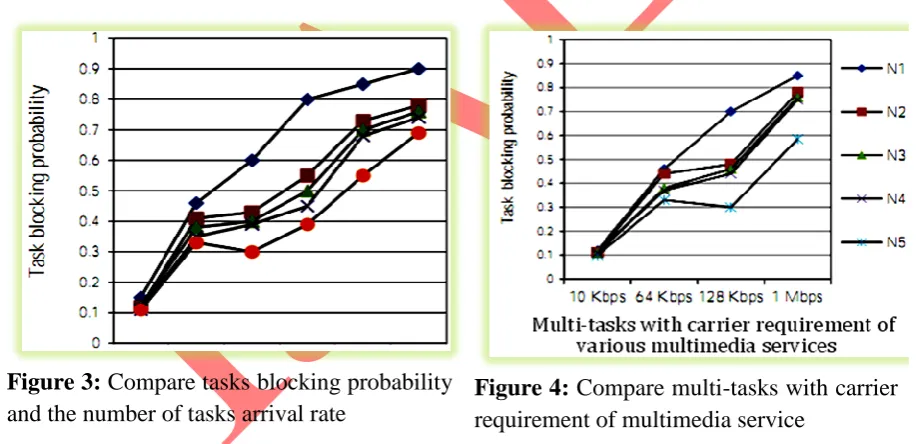
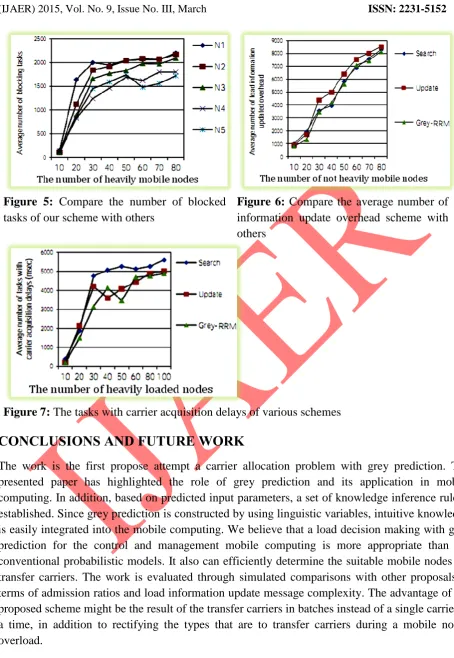
33 INTERNATIONAL JOURNAL OF ADVANCES IN ENGINEERING RESEARCH number of blocked carrier request also increases. For fixed carrier assignment, it increases at faster blocking rate than by using other methods. The reason for this is that a mobile node can only use its nominal carriers. When tasks traffic load becomes heavily loaded, nominal carriers are used up in many mobile nodes. In mobile nodes cluster, while fixed carrier assignment algorithms reject all the new carrier requests, the other schemes can handle the imbalance and satisfy new carrier requests by transferring carrier from mobile nodes with lightly loaded the number of tasks traffic. Figure 4 compares the carrier assignment algorithms according to the tasks blocking probability of carrier request for multimedia services. When the traffic load increases tasks blocking rate of carrier requests increases at a slower rate than the other schemes. Figure 5 shows the blocked tasks of the six carrier assignment algorithms with the number of heavily loaded mobile nodes. It is mobile nodes with a few heavily loaded mobile nodes in the system; we find that our proposed scheme has the best performance. In our Grey-RRM, when traffic load is heavily loaded there will be a lot of carrier allocation at a time for multi-media services, although not as severely carrier allocation scheme. In Figure 6 depicts the messages of different carrier borrowing schemes, and we found that our proposed DCA scheme has the shortest updated messages. Especially, our proposed scheme performs well when the numbers of heavily loaded mobile nodes are large. The carrier acquisition delays are also discussed in our experiment. Figure 7 show that our proposed scheme has the shortest carrier acquisition delays. This result is used in all traffic conditions in a carrier allocation scheme with efficient carrier.
Figure 3: Compare tasks blocking probability and the number of tasks arrival rate
34 INTERNATIONAL JOURNAL OF ADVANCES IN ENGINEERING RESEARCH Figure 5: Compare the number of blocked
tasks of our scheme with others
Figure 6: Compare the average number of information update overhead scheme with others
Figure 7: The tasks with carrier acquisition delays of various schemes
CONCLUSIONS AND FUTURE WORK
The work is the first propose attempt a carrier allocation problem with grey prediction. The presented paper has highlighted the role of grey prediction and its application in mobile computing. In addition, based on predicted input parameters, a set of knowledge inference rule is established. Since grey prediction is constructed by using linguistic variables, intuitive knowledge is easily integrated into the mobile computing. We believe that a load decision making with grey prediction for the control and management mobile computing is more appropriate than the conventional probabilistic models. It also can efficiently determine the suitable mobile nodes for transfer carriers. The work is evaluated through simulated comparisons with other proposals in terms of admission ratios and load information update message complexity. The advantage of the proposed scheme might be the result of the transfer carriers in batches instead of a single carrier at a time, in addition to rectifying the types that are to transfer carriers during a mobile nodes overload.
35 INTERNATIONAL JOURNAL OF ADVANCES IN ENGINEERING RESEARCH [1] Y.-T. Wang. Hierarchical Genetic Algorithm for dynamic time slot allocation in TD-CDMA TDD systems. Expert Systems with Applications, Vol. 38, No. 8, (2011), 90849095.
[2] Y.-T. Wang. A Dynamic Resource Management in Mobile Agent by Artificial Neural Network. Journal of Network and Computer Application, Vol. 35,No. 6, (2010), 672-681. [3] S. K. Das, S. K. Sen and R. Jayaram. A structured channel borrowing scheme for dynamic load balancing in cellular networks, IEEE Distributed Computing Systems Conference, (1997), 116-123.
[4] J. Kim, T. Lee, and C. S. Hwang. A dynamic channel assignment scheme with two thresholds for load balancing in cellular networks. IEEE Radio and Wireless Conference, (1999), 141-145. [5] X. Dong and T. H. Lai. Distributed dynamic carrier allocations in wireless cellular networks: search vs. update. IEEE Distributed Computing Systems Conference, (1997), 108– 115.
[6] T. Lee, J. Kim, and C. S. Hwang. A dynamic channel assignment scheme with two thresholds for load balancing in cellular networks. IEEE Radio and Wireless Conference, (1999), 141– 145. [7] H. Jiang and S. S. Rappaport. CBWL: a new channel assignment and sharing method for cellular communication systems. IEEE Transactions on Vehicular Technology, Vol. 43, No. 2, (1994), 313 – 322.
[8] S. Kim and P. K. Varshney. Adaptive Load Balancing with Preemption for Multimedia Cellular Network. IEEE Wireless Communications and Networking Conference, (2003), 1680– 1684.
[9] T. S. Yum and M. Zhang. Comparisons of channel assignment strategies in mobile telephone systems. IEEE Transactions on Vehicular Technology, Vol. 38, No. 4, (1989), 211–215.
[10] Y. -T. Wang and J.-P. Sheu. A Dynamic Channel Borrowing Approach with Fuzzy Logic Control in Distributed Wireless Cellular Networks. Simulation Modeling Practice and Theory, Vol. 12, No. 3, (2004), 287 – 303.
[11] Y. T. Wang. A Fuzzy-Based Dynamic Carrier Borrowing Scheme for Wireless Cellular Networks. IEEE Vehicular Technology Conference, (2003), 1517– 1521.
[12] L. A. Zadeh. Fuzzy Algorithm. Information and Control, (1968), 94– 102.
[13] Y. Zhang. A new adaptive channel assignment algorithm in cellular mobile systems. IEEE Systems Sciences Conference, (1999), 1– 7.
[14] H.-F. Yu, H.-C. Yang, Y.-T. Wang and P.-L. Fan. Broadcasting scheme with low client buffers and bandwidths for video-on-demand applications. International Journal of Multimedia Tools and Applications, Vol. 42, No.3, (2009), 295-316.
[15] H. Haas and S. McLaughlin. A novel decentralized DCA concept for a TDD network applicable for UMTS. IEEE Transactions on Vehicular Technology Conference, (2001), 881-885.
[16] J. Karlsson and B. Eklundh. A cellular mobile telephone system with load sharing an enhancement of directed retry. IEEE Transactions on Communications, Vol. 37, No. 5, (1989), 530-535.
36 INTERNATIONAL JOURNAL OF ADVANCES IN ENGINEERING RESEARCH