Communication Tool
SOH PEA LING
A thesis submitted in fulfilment of the requirements for the award of the degree of Master of Education (Educational Technology)
UNIVERSITI TEKNOLOGI MALAYSIA
ACKNOWLEDGEMENT
First and foremost, I would like to thank God for giving me a healthy body and mind to complete this research. I would also like to express my gratitude to my supervisor, PM. Dr Jamalludin Harun, who is abundantly helpful, offer invaluable assistance, mental support and full guidance to me.
Besides that, I would like to thank Universiti Teknologi Malaysia (UTM) for providing me a good environment and facilities to complete this project. Special thanks to Perpustakaan Sultanah Zanariah (PSZ) for providing many useful references.
I would also like to express my gratitude to the people who have been supporting me in the completion of this project, especially my mother, Madam Lim Sew Huang who inspired, encouraged and fully supported me. My brothers and sister who not only gave me moral support, but spiritually too.
I am grateful to all my best friends Miss Ida and Miss Foo, who helped and wish me for the successful completion of this project. Special thanks to Mr. Yong for his encouragement, understanding and mental support.
ABSTRACT
ABSTRAK
Pembelajaran mobile merupakan teknologi terkini yang semakin popular. Kecanggihan alat pemudah alih dan kemudahan internet telah membolehkan pembelajaran berlaku dimana-mana dan sebarangan waktu sahaja. Tujuan kajian ini adalah untuk mengumpul data daripada pelajar tentang pembelajaran mobile dan membangunkan satu sistem untuk kegunaan pembelajaran mobile . Kajian ini mengandungi dua peringkat. Peringkat pertama bertujuan mengumpulkan data tentang kesediaan dan persepsi pelajar terhadap pembelajaran mobile. Satu set soal selidik telah digunakan dalam kajian ini. Seramai 63 pasca siswazah dari fakulti pendidikan yang mengikuti kursus Teknologi Pendidikan telah dipilih secara rawak untuk menjawab soal selidik. Analisis menunjukkan kebanyakan pasca siswazah bersedia dalam menggunakan alat pemudah alih dalam mencari informasi menerusi internet (nilai min= 4.43). Data juga menunjukkan bahawa pasca siswazah mempunyai persepsi yang positif terhadap pembelajaran mobile (nilai min= 4.44). Satu laman web yang bemama Mobile Moodle
CONTENTS
CHAPTER TITLE PAGE
DECLARATION ii
DEDICATION iii
ACKNOWLEDGEMENT iv
ABSTRACT v
ABSTRAK vi
CONTENTS vii
LIST OF TABLES xiv
LIST OF FIGURES xix
LIST OF ABBREVIATIONS xxi
LIST OF APPENDICES xxii
CHAPTER I INTRODUCTION
1.1 Introduction 1
1.2 Background of Problems 2
1.3 Statements of Problems 7
1.4 Objectives of Research 8
1.5 Research Questions 9
1.6 Theoretical Framework 9
1.7 Rationale of the Research 12
1.8 Significance of the Research 13
1.8.1 Campus Learner 13
1.8.2 Lecturer 14
1.8.3 University 14
1.9 Scope and Limitation of the Research 14
1.10 Definition 15
1.10.1 Information and Communication Technologies
1.10.2 Mobile Learning (M-Leaming) 15 1.10.3 Electronic Learning (E-learning) 16 1.10.4 Learning Management System (LMS) 16
1.10.5 Moodle 16
1.10.6 Mobile Learning Engine (MLE) 16
1.10.7 Mobile Interactive Learning Objects (MILOs) 17 1.10.8 Technology Acceptance Model (TAM) 17
1.11 Conclusion 17
CHAPTER II LITERATURE REVIEW
2.1 Introduction 19
2.2 From E-learning to M-leaming 19
2.3 Mobile Learning (ML) 21
2.3.1 Mobile Learning Tool 22
2.3.2 Mobile Learning Characteristics 23
2.3.3 Mobile Learning Environment 24
2.3.4 Advantages of Mobile Learning 25
2.4 Research about Students’ Readiness, Perception
towards Mobile Learning 26
2.5 Research about Students’ Acceptance towards
Mobile Learning 28
2.6 Mobile Learning as an Additional Tool and
Communication Tool 28
2.7 Learning Management System (LMS) 30
2.7.1 Moodle: Open Source Learning
Management System (LMS) 30
2.7.2 E-learning with Moodle 32
2.7.3 M-Leaming with Moodle 33
2.8 Mobile Interactive Learning Object (MILO) 35
2.9 Technology Acceptance Model (TAM) 36
2.10 Educational Learning Theory 3 7
2.11.1 Constructivist Learning 3 8
2.11.2 Socio Constructionist Learning 38
2.11 Instructional Design Model 39
2.11.1 Analysis Phase 40
2.11.2 Design Phase 41
2.11.3 Development Phase 41
2.11.4 Implementation Phase 41
2.11.5 Evaluation Phase 42
2.12 Conclusion 42
CHAPTER HI RESEARCH METHODOLOGY
3.1 Introduction 44
3.2 Research Design 44
3.3 Stage One Survey - Survey on the Readiness and
Perceptions of Postgraduates towards Mobile Learning 46
3.3.1 Research procedure 47
3.3.2 Quantitative Research Sampling 48
3.3.3 Research Instrument 48
3.3.4 Pilot Study/ Validity of the Instrument 52 3.3.5 Data Analysis (Quantitative Data Analysis) 54 3.4 Second Stage Survey - Survey on Postgraduates’
Acceptance in Adopting Mobile Learning and their
intention to use Mobile Learning. 57
3.4.1 Research Procedur 58
3.4.2 Mixed-Method Research Sampling 58
3.4.3.1 Quantitative Part (Questionnaire) 59
3.4.3.2Qualitative (Interview) 64
3.4.4 Data Analysis 65
3.4.4.1 Data Analysis for Quantitative Part 65 3.4.4.2 Data Analysis for Qualitative Part 68 3.5 Instructional Design Model for Mobile Learning Project 68
3.5.1 Analyse Phase 69
3.5.2 Design Phase 71
3.5.3 Development Phase 72
3.5.4 Implementation Phase 73
3.5.5 Evaluation Phase 74
3.6 Project Flowchart 75
3.7 Conclusion 76
CHAPTER IV RESULTS AND DATA ANALYSIS
4.1 Introduction 77
4.2 Results of the Study (First Stage Survey) 78 4.3 Demographic Information of the Respondents 78
4.3.1 Respondents’ Gender 78
4.3.2 Respondents’ Mobile Phone 79
4.3.3 Respondents’ Previous Knowledge about
Mobile Learning 79
4.3.4 Respondents’ Opinion in Accessing Internet
Using Mobile Phone 79
4.3.5 Result of the Respondents’ Readiness towards the Usage of Mobile Learning based on their
Activities on Mobile Device. 80
Readiness and Perceptions 88 4.4 Results of the Study (Second Stage Survey) 88 4.5 Demographic Information of the Respondents 89
4.5.1 Respondents’ Gender 89
4.5.2 Mobile Learning Interaction 89
4.5.3 Result of the Respondents’ Acceptance in Adopting Mobile Learning as an Additional
Learning Tool 90
4.5.4 Result of the Respondents’ Acceptance in Adopting Mobile Learning as Communication
Tool 93
4.5.5 Result of the Respondents’ Intention to use Mobile Learning Environment Based on its
Usefulness 97
4.5.6 Result of the Respondents’ Intention to use Mobile Learning Environment Based on its
Ease of Use 98
4.6 Interview Analysis 100
4.7 System Design of Mobile Learning Environment 106
4.7.1 Main Menu 107
4.7.2 Mobile Interactive learning Object (MILO) 110 4.7.3 Mobile Learning Activities
(Social Constructionist Pedagogy) 114
4.8 Conclusion 120
CHAPTER V DISCUSSIONS, CONCLUSIONS
AND RECOMMENDATIONS 5.1 Introduction
5.2 Discussion and Analysis of the Demographic
Information of the Respondents (First Stage Survey) 122 5.3 Discussion about Postgraduates’ Readiness towards
the Usage of Mobile Learning based on their
Preference Activities on Mobile Device (Section B) 123 5.3.1 Access Online Information through
Mobile Device 124
5.3.2 Communication and Collaboration among
Friends 124
5.3.3 Entertainment and Multimedia 125
5.3.4 Educational Purposes 126
5.4 Discussion about Postgraduates’ Perceptions from the Aspect of their Concepts about Mobile Learning
(Section C) 126
5.4.1 General about Mobile Learning 127 5.4.2 Mobile Learning as New Opportunity
in Learning 129
5.5 Discussion and Analysis of the Demographic
Information of the Respondents (Second Stage Survey) 130 5.6 Discussion about Postgraduates’ Acceptance in
Adopting Mobile Learning as an Additional Learning
Tool for Learning Purpose (Section B) 131 5.6.1 Benefits of Self-learning tool 131 5.6.2 Environment of Self-learning tool 133 5.7 Discussion about Postgraduates’ Acceptance in
Adopting Mobile Learning as a Communication Tool
for Learning Purpose (Section C) 135
5.7.1 Communicate with Lecturer 136
5.7.2 Communicate with Friends 137
5.7.3 Communication for Learning Purposes 139 5.8 Discussion about Postgraduates’ Intention to use
Usefulness in Technology Acceptance Model (TAM)
(Section D) 139
5.9 Discussion about Postgraduates’ Intention to use Mobile Learning Environment based on the Perceived
Ease of Use in Technology Acceptance Model (TAM)
(Section E) 141
5.10 Problems during Development and Implementation 142
5.11 Conclusion 142
5.12 Limitation and Suggestion for Further Research 143
5.12.1 Research Sample 143
5.12.2 Research Field 143
5.12.3 Mobile Learning Content Development 144 5.12.4 Implementation of Mobile Learning Proj ect 144
5.13 Summary 145
TABLE LIST
NO. TABLE TITLE PAGES
3.1 Proj ect Research Design 45
3.2 The division of the research design based
on the data collection for objectives 46 3.3 The example questions for section B
(respondents’ activities on mobile device) 50 3.4 The example questions for section C
(respondents’ concept on Mobile Learning) 51
3.5 Example of closed-ended question 52
3.6 Scale for the questionnaire 52
3.7 The Cronbach’s coefficients Alpha and its
scale value 53
3.8 The Cronbach ’ s coefficients Alpha value 54 3.9 Obj ectives of Research and Data Analysis used 54 3.10 The numbers of male and female respondents 55 3.11 The numbers of respondents own mobile phone 55 3.12 The numbers of respondents know about
Mobile Learning 55
3.13 The numbers of respondents will use mobile
learning for learning purpose 55
3.14 Percentages, means and standard deviations of
3.16 3.17 3.18 3.19 3.20 3.21 3.22 3.23 3.24 3.25 3.26 3.27 3.28
the students’ concept on mobile learning 56 Overall percentages, means and standard deviations
of the postgraduates’ activities on mobile device
for each criterion 56
Overall percentages, means and standard deviations of the postgraduates’ concept on Mobile Learning
for each criterion 57
The overall results 57
The example questions for section B
(respondents’ acceptance in adopting Mobile Learning
as an additional learning tool) 60
The example questions for section C
(respondents’ acceptance in adopting Mobile
learning as communication tool) 61
The example questions for section D
(respondents’ intention to use Mobile Learning Environment for Mobile Learning based on its
Perceived Usefulness) 62
The example questions for section E
(respondents’ intention to use Mobile Learning platform for Mobile Learning based on its
Perceived Ease of Use) 63
Scale for the questionnaire 63
The deviation of criteria for interview 64 The number of male and female respondents 65 The numbers of respondents who have interaction
with Mobile Learning 65
Percentages, means and standard deviations of the respondents’ acceptance in adopting Mobile
3.29 3.30 3.31 3.32 3.33 3.34 3.35 4.1 4.2 4.3 4.4
of the respondents’ in adopting Mobile
Learning as communication tool 66
Overall percentages, means and standard deviations of the respondents’ acceptance in adopting Mobile
learning as an additional learning tool 66 Overall percentages, means and standard deviations
of the respondents’ acceptance in adopting Mobile
learning as communication tool 66
Percentages, means and standard deviations of the respondents’ intention to use mobile
learning environment based on its Usefulness 67 Overall percentages, means and standard deviations
of the respondents’ intention to use mobile
learning environment based on its Ease of use 67 Overall percentages, means and standard deviations
of the respondents’ intention to use mobile
Learning environment based on its Usefulness 68 Overall percentages, means and standard deviations
of the respondents’ intention to use mobile
Learning environment based on its Ease of use 68 Types of learning material and their designing tools 72 Percentages, Means and Standard Deviations of the
Respondents’ readiness in accessing online information
through mobile device. 80
Percentages, Means and Standard Deviations of the
respondents’ readiness in communication and collaboration
among friends 81
Percentages, Means and Standard Deviations of the respondents’ readiness for entertaining and multimedia
purpose 82
4.5 4.6 4.7 4.8 4.9 4.10 4.11 4.12 4.13 4.14
respondents’ readiness for education purpose 83 Overall Means and Standard Deviations of the
respondents’ readiness towards the usage of mobile learning based on their preference activities on
mobile device 84
Percentages, Means and Standard Deviations of the
postgraduates’ general perceptions about Mobile Learning 85 Percentages, Means and Standard Deviations of the
postgraduates’ perceptions on Mobile Learning as new
opportunity in learning 86
Overall Percentages, Means and Standard Deviations of postgraduates’ perceptions from the aspect of their
concepts about Mobile Learning 87
Percentages, Means and Standard Deviations of the respondents’ acceptance in adopting mobile learning as an additional learning tool based on the
benefits of self-learning tool 90
Percentages, Means and Standard Deviations of the respondents’ acceptance in adopting mobile learning as an additional learning tool based
on the environment of learning tool 91
Overall Means and Standard Deviation for each criteria (respondents’ acceptance in adopting Mobile Learning
as an additional learning tool) 92
Percentages, Means and Standard Deviations of the respondents’ acceptance in adopting Mobile Learning as communication tool (communicate with lecturer) 93 Percentages, Means and Standard Deviations of the
4.15
4.16
4.17
4.18
4.19
4.20
4.21 5.1
5.2
respondents’ acceptance in adopting Mobile Learning as
communication tool (communicate for education purpose 95 Overall Means and Standard Deviations for each
criteria (respondents’ acceptance in adopting
Mobile Learning as communication tool) 96 Percentages, Means and Standard Deviations of the
respondents’ intention to use Mobile Learning environment
based on its Perceived Usefulness 97
Percentages, Means and Standard Deviations of the
respondents’ intention to use Mobile Learning environment
based on its Perceived Ease of Use 99
Respondents’ opinion towards the usage of Mobile Moodle Short Course
(Question 1 to 3 based on criterion [a]) 100 Respondents’ opinion towards the usage of
Mobile Moodle Short Course
(Question 4 to 5 based on criterion [b]) 102 Respondents’ opinion towards the usage of
Mobile Moodle Short Course
(Question 6 to 7 based on criterion [c]) 104
A List of Usemame and Password 106
The Strengths and weaknesses collected from
respondents’ comments 134
The Strengths and weaknesses collected from
FIGURES LIST
NO. FIGURE TITLE PAGES
1.1 Theoretical Framework 11
2.1 The transition of technology devices from 20 E-learning to M-Leaming
2.2 The place ofM-Leaming as part of E-learning 21 and D-leaming
2.3 Original Technology Acceptance Model (TAM) 36
2.4 ADDIE Instruction Design 40
3.1 The characteristics of Mobile Learning Environment
(Mobile Moodle) 70
3.2 Mobile Moodle is the combination of Moodle and
Mobile Learning Engine (MLE) 71
3.3 General view of Mobile Learning architecture 74
3.4 The scenario of Mobile Learning in Moodle 75
4.1 Number and percentage of respondents’ gender 78 4.2 Number and percentage of respondents who know
about Mobile Learning 79
4.3 Number and percentage of respondents who will
access internet via mobile phone 80
4.4 Number and percentage of respondents’ gender 89 4.5 Number and Percentage of respondents’ who ever
Interact with Mobile Learning 90
4.6 The main interfaces of Mobile Moodle Short Course
Computer view 108 4.7 The main interfaces of Mobile Moodle Short Course
and MLR Moodle mobile access quick link for mobile
phone view 108
4.8 The main interfaces in MLE-Moodle 109
4.9 The learning topics in MLE-Moodle 110
4.10 The online learning modules 111
4.11 The learning materials provided for learner in PDF
and graphic forms 112
4.12 The Java based learning materials in Moodle and
run on phone 113
4.13 The flash based learning materials 114
4.14 The discussion forum in Mobile Moodle 115
4.15 The Quizzes and the responses provided for learner 116
4.16 The Assignment provided for learner 117
A CMS ICT ID LMS M MILO MLE MSC D PC PDA PHD PDF SA SD Sd SLA SMS SPSS TAM UteM WAP
LIST OF ABBREVIATIONS
Agree
Course Management System
Information and Communication Technologies Instructional Design
Learning Management System Mean
Mobile Interactive Learning Object Mobile Learning Engine
Multimedia Super Corridor Disagree
Personal Computer
Personal Digital Assistance Philosophy of Doctoral Portable Document Format Strongly Agree
Stomgly Disagree Standard Deviation Slightly Agree
Short Message Service
LIST OF APPENDICES
APPENDIX TITLE PAGE
A Questionnaire (First Stage Survey) 153
B Questionnaire (Second Stage Survey) 156
INTRODUCTION
1.1 Introduction
The rapid development of information and communication technologies (ICT) during the past two decades has placed new demands on expertise, and also leading to increase the use of information technology (IT) especially for instruction and learning process. The development of technology enables our country growing approach the flexibility in education field and hence meets the country’s drive to fulfil Vision 2020.
Our education curriculum had transformed and enhanced by the use of new media as tools. E-learning was introduced in Malaysia higher institutions since year 1998. The rapid growth of web-based technologies and the high usage of the internet had made teaching and learning via the internet more viable (Chai and Poh, 2009). E- leaming provides the learning opportunities anytime and anywhere by using the interactive network technology and computers in computer lab to deliver the learning materials to learner. E-learning actually integrates all forms of online instructions using electronic devices.
provided an E-leaming portal for a teaching medium purposely for long distance education and off-campus programs (Khalid, 2006; Chai and Poh, 2009).
The E-leaming environment also provides students a place for interaction electronically with each other or with instructor in some activities like forum, discussion board, email and chat rooms. This way of learning enable learner to express their idea or their new finding information from internet (Brandi, 2005; Bajahzer et al., 2008). Moodle (Modular Object Oriented Dynamic Learning Envoronment) is an open source Learning Management System (LMS) which is the number four famous product for E-leaming. Moodle is confirmed able to increase student confidence before exam by connecting individual course together and sharing materials with each other. Besides that, it allows teacher to provide and share document, graded assignment, quizzes within this quality online course.
The earlier E-leaming is restricted to computer lab’s computer and cabled internet services. However, since 2000, the advance in information technology and computing had provided another learning concept by using the portable PCs like notebook with wireless LANs. But now, education is being transformed by the use of wireless mobile technologies into Mobile Learning where this flexible method is unbounded by space and time.
1.2 Background of Problems
The rapid development of mobile devices in the information age matches with the trend where the information can be achieved at fingertips and independency of time and location. Mobile Learning (M-Leaming) is emerging to be the next generation of E-leaming.
“State o f the internet...Mobile will be bigger than Desktop Internet in 5 years ”
Morgan (2010) believes that more users will be likely to connect to internet via mobile devices than desktop devices within 5 years. Hence, researcher should start to explore the potential in mobile device and using the advantages of mobile device in creating a portable and affordable learning for all learners.
Actually, Mobile Learning is a part of learning technologies which combine mobile technologies and E-leaming, it delivers E-leaming materials and provide learning environment on mobile devices such as mobile phone, PDA (Personal Digital Assistant) and other devices (Mariam and John, 2008). Mobile Learning can offer small and consumable learning contents which can be delivered through wireless network to all mobile devices (Saipunidzam et al., 2010).
Nowadays, the use of mobile phones and handheld device among students in western country has dramatically increased. Mobile technologies offer capabilities that can support SMS based system and some advance mobile wireless device can support web based system. There have been a number of systems developed by western country where the mobile device is used in supporting the classroom interaction between teacher and learner. One example is the computer science program at the University of Minnesota, Duluth where it had already picked the pocket PC platform to support two functions: reference materials and exercises for students. Students can use the device as portable textbooks and easily offering information usually contained within bulkier, more expensive book forms (Alexander, 2004).
The Mobile Learning in Malaysia is still consider new trend and not yet widely used in higher education. In Malaysia, LTT Global Communication which is a private company at Petaling Jaya establishes its own business product which is based on mobile E-leaming English language. LTT Global Communication has built up a case for using mobile phone in education where they applied it in teaching and learning English language. This product’s name is SMS-ME-ENGLISH, which work over SMS and students will receive text messages that can help them in learning the language. This application can be classified as a learning application for adult learners (Kashminder, 2007; Poon and Koo, 2008).
Another mobile application produced by Universiti Teknikal Malaysia Melaka (UTeM) is Mobile Learning Notes for SPM Sejarah “Islam Di Asia Tenggara”. This learning application needs to be installed in mobile device and it enables learning everywhere because mobile phones are carried by anyone everywhere (Abd Wahab, 2008). Besides that, UTeM also produced another Mobile Learning application which enables 8-10 years old children learn mathematics using mobile phone. The content of the project is to teach the student on how to memorise the times table using accelerated learning techniques (Hashim, 2008).
Meisenberger and Nischelwitzer (2004) stated that traditional E-leaming with their Personal Computer (PC), notebook or laptop cannot give a real independency of time and space because it is hard for everyone to bring their notebook or their Personal Computer (PC) with them all the time. The real independency in time and location according to Sharpies et al. (2005) is that the process of learning is regardless of time (whenever) and place (wherever) where a learner can access to his learning materials.
Besides the independency problem, nowadays many universities are implementing some technologies that allow students to access learning course materials on wireless devices. But most of the learning materials or lectures note can be accessed by using E-leaming methods. Mode of delivery should shift to M- leaming (Georgieva and Trifonova, 2006). He also stated that students’ usage of E- leaming will increase their interest to M-leaming. Hence, Mobile Learning applications together with learning platforms are required so that student has a chance to access learning course by using mobile device.
Although learner can access for their own necessary information or interact with their lecturer by using laptop computer or desktop computer; a small, handy, always with the user and able to connect to internet mobile device will replace those immobile devices. For now, not all the activities and teaching materials used in E- leaming system are suitable for mobile delivery. There still lack of some online learning platforms for mobile device user since the percentages of mobile device holder become higher and higher.
some lecturers do not encourage interaction between students and lecturer. Besides that, some students feel shy to ask question in front of a large audience and cause the communication fail to occur.
There are many advantages of applying Mobile Learning in higher education and more and more universities start to implement the new technology. A research was done by Jacob and Issac (2007) on students’ perception on Mobile Learning in higher education campus. The finding shows that majority of student support that wireless networks increase the flexibility of accessing to resources in learning by using palmtop, mobile phones and PDAs.
Besides that, another advantage of Mobile Learning is it can be a new educational tool. Douglas et al. (2008) carried out a survey about the effectiveness of
HotLava Software’s Learning Mobile Author in improving learning outcome. The finding shows that this mobile phone application can make a significant in students learning outcome and hence can be used as one new learning tool in education.
Because of the advantages of Mobile Learning, more and more research has been carried out on the effectiveness and acceptance level of Mobile Learning among students. Research done by Joseph and Maria (2007) is a survey on the students and faculty’s readiness for Mobile Learning. A total of 94% of students indicated their readiness for Mobile Learning because all of them own a cell phone or smart phone. About 60% of faculty also affirmed their readiness for Mobile Learning. Researchers also stated that faculty can implement Mobile Learning in their online course by adding or making more learning content and information in the form of easily accessible by using mobile phones.
students toward Mobile Learning? Are they ready to use their mobile devices for a space and time unbounded learning? Mobile Learning is a unique and special approach and hence a movement toward mobile age is a need.
1.3 Statement of Problems
The emergence of Mobile Learning is not to replace the E-leaming method, but act as another learning method which is used to improve learners’ learning experience. The Mobile Learning scenario is still ‘young’ especially in the developing country like Malaysia. Learners still carry out their learning when there is a computer or laptop and internet service. They fail to learn at any time and everywhere they are. Mobile Learning can bring many benefits and thus there is a need to develop a Mobile Learning environment with Mobile Learning materials. Mobile Learning situation can firstly be implemented in local university and hence provides a higher level of support for learner to adopt the usage o f mobile device as an additional learning tool and communication tool.
E-leaming system can integrate into regular curriculum by using LMS and provide a communication platform between instructor and learner. Now, mobile can access to LMS like Moodle and provide extra special such as portability, social interactivity, context sensitivity and individuality. But the adoption of LMS by using mobile devices is still new and not much developed by instructor for learning purpose. Hence, there is a need to expand the capabilities of Moodle so that it can be served as Mobile Learning platform which can support online interactive learning and various activities.
carryout to survey the acceptance level among postgraduates in adopting Mobile Learning as an additional learning tool and communication tool for educational purpose. Technology Acceptance Model (TAM) will be used to collect data about the perceived usefulness and perceived ease of use towards mobile Moodle.
1.4 Objectives of the Research The objectives of this research are:
(i) To study the postgraduates’ readiness towards the usage of Mobile Learning based on their preferred activities on mobile device.
(ii) To study the postgraduates’ perceptions from the aspect of their concepts about Mobile Learning.
(iii) To develop Mobile Learning environment (Mobile Moodle) which connect to a Learning Management System (LMS) based on postgraduates preferred activities.
(iv) To develop Mobile Interactive Learning Object (MILO) for Mobile Moodle.
(v) To evaluate postgraduates’ acceptance in adopting Mobile Learning as
a. an additional learning tool
b. a communication tool for learning purposes.
(vi) To examine the postgraduates’ intention to use Mobile Learning environment (Mobile Moodle) based on the main constructs of Technology Acceptance Model (TAM):
1.5 Research Questions
The research questions of this research are:
(i) Are the postgraduates ready towards the usage of Mobile Learning based on their preferred activities on mobile device?
(ii) What are the postgraduates’ perceptions in term of their concepts towards the Mobile Learning?
(iii) What is the postgraduates’ acceptance in adopting Mobile Learning as an additional learning tool for learning purpose?
(iv) What is the postgraduates’ acceptance in adopting Mobile Learning as a communication tool for learning purpose?
(vii) Are the postgraduate’s intent to use Mobile Learning environment based on Perceived Usefulness and Perceived Ease of Use according to Technology Acceptance Model (TAM)?
1.6 Theoretical Framework
Theoretical framework for this research is about the readiness and perceptions of postgraduates toward the usage of Mobile Learning. This study is started with the analysis of postgraduates’ readiness based on their daily activities on mobile device and their perceptions about the concepts of Mobile Learning towards the usage of Mobile Learning in education field. This survey is carried out by using questionnaire.
i. Must contain less information than traditional learning object (LO) ii. Allow user to stop learning abruptly
iii. Provide discovery learning environment iv. Small and simple information
v. Fix on mobile device’s screen
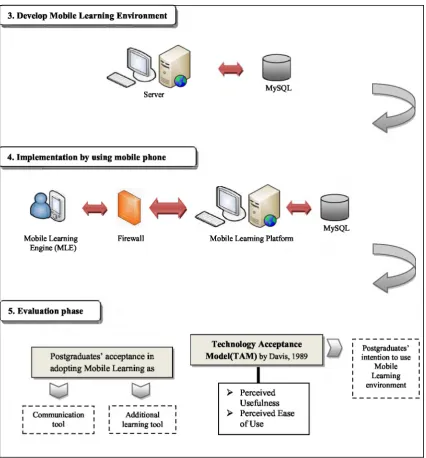
The Mobile Learning environment which contains all learning materials is build by connecting Mobile Learning environment with Learning Management System (LMS). The Mobile Learning Engine (MLE) is an open source plugin and used together with Learning Management System especially Moodle platform to enable the broad variety of mobile devices can run on it.
The Mobile Learning environment is designed to meet the Social Constructivism learning pedagogy which is fully supported by Moodle platform. Besides that, the Mobile Learning users are encouraged to involve in this interactive and experiential learning where the users can build new knowledge upon the foundation of previous knowledge after interact with the learning materials provided there. The learning materials provided are support the constructivist learning philosophy.
During the implementation process, Mobile Learning environment is tested by using mobile device. Lastly, an evaluation process is carried out to collect data about the postgraduates’ acceptance in adopting Mobile Learning as an additional learning tool and communication tool. Besides that, Technology Acceptance Model (TAM) by Davis (1989) is adopted to determine the factors that influence postgraduates’ intention to use Mobile Learning. The TAM has two main beliefs:
i. Perceived Usefulness ii. Perceived Ease of Use
individual perceives the system to be easy to use, he or she is more likely to perceive the system to be useful also (Morris and Dillion, 1997; Sek et al., 2010).
The whole research use the ADDIE instructional design model (Molenda et al., 2003) as a guide. The 5 phases of development in ADDIE model are Analyse, Design, Development, Implementation and Evaluation. The whole theoretical framework is shown at Figure 1 below:
1. Pre survey on postgraduates
Readiness Perceptions
2. Select and design Mobile Learning environment
Mobile Learning Environment
(Moodle)
£
Mobile Learning Activities
I Social Constructivism
| (Martin Dougiamas, 2003)
| S Student- centered environment v' Learner works independently
I v' Reflective on own works and others work
\1
Mobile Learning Engine (MLE)
(Meisenberger et al., 2006)
S Enables varies mobile accessible
S Support texts, hyperlinks and video v' Provides applications like multimedia,
forum
Mobile Learning Materials
Mobile Interactive Learning Object (MILO)
(Holzinger et al., 2005)
S Less words
^L earning take place anytime and anywhere ’''D iscovery learning
•f Small and simple information v'Fix mobile device’s screen
Constructivist Learning
(Bruner,1966)
S Discover the learning knowledge independently
S Construction o f knowledge ’''Experiential learning
3. Develop Mobile Learning Environment
Server MySQL
4. Implementation by using mobile phone
Mobile Learning Engine (MLE)
5. Evaluation phase
Firewall Mobile Learning Platform
MySQL
Postgraduates’ intention to use
Mobile Learning environment
Figure 1.1: Theoretical Framework
1.7 Rationale of the Research
E-leaming cannot give a real independency in term of time and place to users. The limitations in E-leaming are now can be enhanced by using Mobile Learning. Mobile Learning or called as M-Leaming is the one step advance learning style than E-leaming in Malaysia and it offers another way to deliver small and consumable byte learning materials for learner and hence enable learning anywhere and anytime (Liang, 2005; Saipunidzam, 2010).
Besides that, Mobile Learning can increase the interactivity and communication between lecturer and students. M-Leaming is the current technology that used to resolve the challenges from traditional learning (Sahilu et al., 2010). Hence, the purpose of this project is to provide another learning environment for local Higher Public Learning Institution (IPTA) students. They can access the learning platform with the aid of mobile devices like smart phones, PDAs and iPhones which are able to connect to wireless networks.
1.8 Significance of the Research This project will bring benefit to:
1.8.1 Campus learner
1.8.2 Lecturer
The communication between lecturer and students is very important but the conventional learning style provides a unilateral communication between them (E Costa et al., 2008). Mobile device with online learning environment is able to solve the communication problem and enhance teaching and learning process because this platform enables lecturers to get feedbacks instantly from their student.
1.8.3 University
The use of Mobile Learning in University is a good starter and it is better than the traditional face to face instruction learning, paper based distance education learning or traditional E-leaming. It is possible that most of the universities in the world applying the anytime, anywhere concept in their education due to its ability to support ubiquitous learning via mobile technologies (Abas et al., 2009). Mobile Learning also a powerful method for engaging learner especially for distance learning learner which face-to-face meeting is very limited.
1.9 Scope and Limitation of the Research
This research is about the development of online Mobile Learning environment and Mobile Learning materials. This Mobile Learning environment can be accessed by using mobile devices such as smart phone, PDA and iPhone. In this survey, the use of mobile devices limited to internet-enabled mobile phones only.
Before the development of Mobile Learning environment, the perceptions and readiness of postgraduates towards Mobile Learning will be collected. In this study, a set of questionnaire will be used to collect data from them. The respondents are those Educational Technology’s postgraduates who are studying in Universiti Teknologi Malaysia.
After the development of Mobile Learning environment, a survey will be carried out to collect data about the acceptance level of Mobile Learning among campus postgraduates. The scope of contents for learning materials in mobile phones study is focused on a subject in Educational Technology Course (MPP) - Video and Animation Technology Production (MPT1383).
1.10 Definition
The definitions of some terms that are used in this project are as follows:
1.10.1 Information and Communication Technologies (ICT)
Information and communications technologies (ICT) are a diverse set of technological tools and resources used to communicate, and to create, disseminate, store and manage information (Blurton, 2002).
1.10.2 Mobile Learning (M-Learning)
1.10.3 Electronic Learning (E-learning)
E-leaming is commonly referred to the intentional use of networked information and communications technology in teaching and learning. A number of other terms are also used to describe this mode of teaching and learning. They include online learning, virtual learning, distributed learning network and web based learning (Som Naidu, 2006).
1.10.4 Learning Management System (LMS)
Learning Management System (LMS) is a software application that automates the administration, tracking and reporting of training events, classroom events, e-leaming programs and some training content (Ellis, 2009). LMS can be used as a tool to provide students with external access to various resources like handouts, links and software.
1.10.5 Moodle
Moodle is an open source Learning Management System (LMS). The word Moodle was originally from an acronym for Modular Object-Oriented Dynamic Learning Environment. Moodle is open to register users and offers the possibility to develop forum, wikis, quizzes, surveys and other interactive in built activities. The design of Moodle is based on Social Constructivism pedagogy (Martin Dougiamas, 2003).
1.10.6 Mobile Learning Engine (MLE)
1.10.7 Mobile Interactive Learning Objects (MILOs)
Mobile Interactive Learning Objects (MILOs) is a practical approach to Mobile Learning which can be used within a Mobile Learning Engine (MLE) that runs on mobile phone as learning information. The mobile interactive learning objects are interactive, adaptable and used to achieve educational objectives (Holzinger et al., 2005).
1.10.8 Technology Acceptance Model (TAM)
TAM is a specific model developed to explain and predict user’s computer usage behaviour. TAM specifies the causal relationships between system design features, perceived usefulness, perceived ease of use, attitude toward using and actual usage behaviour (Davis, 1993).
1.11 Conclusion
The rapid development of information and communication technologies together with the increasing number of learning tools in education field had change the conventional teaching and learning process to a new educational platform. The traditional E-leaming world provides online learning opportunities by delivering the learning materials to learner where the learners can access them using personal computer, laptop or notebook. This learning style cannot give a real independency for learner to obtain information anytime and anywhere.
BIBIOGRAPHY
Abas, Z.W., Lim, T., Harvinder, K.D.S., Shyang, W.W. (2009). Design and Implementation of Mobile Learning at Open University Malaysia. The 9th SEAAIR Annual Conference: 13-15 October 2009. Pulau Pinang, Malaysia, pp. 439-445.
Abas, Z.W., Cling, L.P. and Mansor, N. (2009). A Study on Learner Readiness for Mobile Learning at Open University Malaysia. In Proceedings o f IADIS International Conference Mobile Learning. 26-28 Febuary 2009. Barcelona,
Spain, pp. 151-157.
Abd Wahab, S. (2008). Mobile Learning Notes for SPM Sejarah “Islam Di Asia Tenggara”. Faculty of Information and Communication Technology, Universiti Teknikal Malaysia Melaka (UTeM).
Alexander, B. (2004). M-Leaming: Emergent Pedagogical and Campus Issues in the Mobile Learning Environment. EDUCAUSE Center fo r Applied Research (ECAR) Bulletin, Vol. 2004(16). pp 1-10.
Alfredo, M. Ronchi. (2009). eCulture: Cultural Content in the Digital Age: Educational Market. Springer Dordrecht Heidelberg London New York, 2009. [E-Book] Available: Google books.
Al-Fahad, F. N. (2009). Students’ Attitudes and Perceptions towards the Effectiveness of Mobile Learning in King Saud University, Saudi Arabia. The Turkish Online Journal o f Educational technology-TOJET. Vol. 8(2), pp. I l l -1 1 9 .
Ariffin, S.A., (2011). Mobile Learning in the Institution of Higher Learning for Malaysia Students: Culture Perspectives. Proceeding o f the International Conference on Advanced Science, Engineering and Information Technology 2011. 14-15 January 2011. Putrajaya, Malaysia, pp. 283-288.
Arrigo, M., Novara, G., and Cipri, G. (2008). M-Leaming Accessibility Design: A Case Study. K. Miesenbergereat. (Eds): ICCHP 2008, LNCS 5105, Springer- Verlag Berlin Heidelberg, pp. 226-233.
Bajahzer, A., Al-Ajlan, A., Zedan, H. (2008). Exercise Services for E-learning in Higher Education with Open Source Software (MOODLE). IADIS International Conference, 9-11 April 2008. Algarve, Portugal, pp 51-58. Bhaskar, N.U. and Govindarajulu, P. (2008). A Design Methodology for
Acceptability Analyzer in Context Aware Adaptive Mobile Learning System Development. International Journal o f Computer Science and Network Security 8(3), pp. 130-138.
Blurton, C. (2002). New Directions o f ICT-Use in Education. UNESCO’s World Communication and Information Report.
Brandi, K. (2005). Are You Ready to “MOODLE” ? Language Learning & Technology. Vol. 9(2), pp. 1 6 -2 3 . Available on :
http ://llt.msu.edu/vol9num2/review 1 /
Chai, L.G. and Poh, Y.N. (2009). E-learning in Malaysia: Success Factors in Implementing E-learning Program. International Journal o f Teaching and Learning in Higher Education Vol.20(2), pp. 237-246.
Chaiprasurt, C., Esichaikul, V. and Wishart, J. (2011). Designing Mobile Communication Tools: A Framework to Enhance Motivation in Online Learning Environment. 10th World Conference on Mobile and Contextual Learning. 16-21 October 2011. Beijing, China.
Chaka, C. (2009). From Classical Mobile Learning to Mobile Web2.0 Learning. Guy, R. (Ed.). The Evolution o f Mobile teaching and Learning. Santa Rosa, California: Informing Science Press (pp. 79-102).
Cole, J. & Foster, H. (2008). Using Moodle, 2nd Edition. Published by O ’Reilly Media, Inc., 1005 Gravenstein Highway North, Sebastopol, CA 95472.
Davis, F.D. (1989). Perceived Usefulness, perceived ease o f use, and user acceptance o f information technology. MIS Quarterly, 13(3), pp. 319-339. Davis, F.D. (1993). User Acceptance of Information Technology: System
Characteristics, User Perceptions and Behavioural Impacts. International Journal o f Man-Machine Studies (1993) 38, pp. 475-487.
Dougiamas, M. & Taylor, P. (2003). Moodle: Using Learning Communities to Create an Open Source Course Management System. In D. Lassner & C. McNaught (Eds.), Proceedings o f World Conference on Educational Multimedia, Hypermedia and Telecommunications 2003 Chesapeake, VA: AACE. pp. 171-178.
E Costa, J.C., Ojala T., and Korhonen, J. (2008). Mobile Lecture Interaction: Making Technology and Learning Click. IADIS International Conference Mobile Learning 2008. 11-13 April, 2008. Algarve, Portugal, pp. 119-124.
Ellis, Ryann K. (2009). Field Guide to Learning Management Systems, ASTD Learning Circuits.
Georgiev, T., Georgieva, E., and Smrikarov, A. (2004). M-Leaming - a New Stage o f E-leaming. International Conference on Computer Systems and
Technologies. 17-18 June 2004. Rousse, Bulgaria, pp. 281-285.
Georgieva, E., and Trifonova, A. (2006). The Influence of the Usage of e-leaming on the Students' Expectations about m-Leaming. Proceedings o f International
Workshop in Learning Networks fo r Lifelong Competence Development, TENCompetence Conference. 30-31 March 2006. Sofia, Bulgaria.
Georgieva, E., and Trifonova, A. (2006). Determining Student’s Readiness for Mobile Learning. 5th WSEAS International Conference on E-ACTIVITIES,
20-22 November 2006.Venice, Italy, pp.84-89.
Gliem, J.A. & Gliem, R. R. (2003). Calculating, Interpreting, and Reporting Cronbach’s Alpha Reliability Coefficient for Likert-Type Scales. Midwest Research-to-Practice Conference in Adult, Continuing, and Community Education.Columbus, Ohio : Ohio State University.
Goggin, G. (2009). Mobile Learning: The Significance o f New Mobile and Wireless Communications Technologies fo r Education. J. Zajda and D. Gibbs (eds.),
Comparative Information Technology. Springer Science, pp. 65-77.
Hashim, N.N. (2008). Learning Multiplication Table in Mobile. Faculty of Information and Communication Technology, Universiti Teknikal Malaysia Melaka (UTeM).
Herrington, A., and Herrington, J. (2007). Authentic mobile learning in higher education. AARE 2007 International Educational Research Conference. 26 29 November. University of Notre Dame.
Holzinger, A., Nischelwitzer, A., and Meisenberger, M. (2005). Mobile Phones as a Challenge fo r m-learning: Examples fo r Mobile Interactive Learning Objects (MILOs). Proceedings o f the 3r International Conference Pervasive Computing and Communications Workshops. 8 - 1 2 March. Koloa, Hawaii: IEEE, pp. 3 0 7 -3 1 1 .
Houser, C., and Kinjo, T.P. (2005). Poodle: a course-management system for mobile phones./EE1# International Workshop on Wireless and Mobile Technologies in Education (WMTE’05).pp 211-215.
Jacob, S. M., and Issac, B. (2007). Mobile Learning Culture and Effects in Higher Education. IEEE Multi disciplinary Engineering Education Magazine. Vol. 2(2), pp.19 — 21.
Jacob, S. M., and Issac, B. (2008).The Mobile Devices and its Mobile Learning Usage Analysis .Proceedings o f the International Multi Conference o f Engineers and Computer Scientists (IMECS) 2008.19-21 March 2008. Hong Kong.
Jairak, K., Praneetpolgrang, P., and Mekhabunchakij, K. (2009). An Acceptance of Mobile Learning for Higher Education Students in Thailand. The Sixth International Conference on eLearning fo r Knowledge-Based Society. 17-18 December 2009. Thailand.
Joseph, Rene Corbeil and Maria Elena Valdes-Corbeil (2007). Are You Ready fo r Mobile Learning1? EDUCASE Quarterly. 2:2007. pp 51-58.
Krejcie, R.V. (1970). Determining Sample Size fo r Research Activities. Educational and Psychological Measurement, 1970, 30, pp. 607-610.
Lodico, M.G., Spaulding, D.T. and Voegtle, K.L. (2006). Methods in Educational Research: From Theory to Practice. United States of America: A Wiley Imprint.
Laouris, Y., and Eteokleous, N. (2005). We need an educationally relevant definition o f mobile learning. Available on:
www.mleam.org.za/CD/papers/Laouris%20&%20Eteokleous.pdf
Lu, X. and Viehland, D. (2008). Factors Influencing the Adoption of Mobile Learning. 19th Australasian Conference on Information Systems. 3-5 December 2008. Christchurch, New Zealand: ACIS, pp. 597 - 606.
Mahendra, G., and Ela, G. (2011). Applicability of Mobile Learning Engine - Moodle in Computer Application Course. Journal o f Information Technology Management, volume XXII (3). ISSN#1042-1319.
Marguerite, L.K. (2009). A Model fo r Framing Mobile Learning. Mohamed Ally (Ed.). Mobile Learning Transforming the Delivery o f Education and Training.
pp 45-67. Canada: AU Press.
Mariam. M and John. W (2008). Why Does Malaysia Need to Consider Mobile Technology? A Review of Current Practices to Support Teaching and Learning with School-age Children. 2nd Asia Pacific Mobile learning & Edutainment Conference 2008 (APAC). 20-21 Nov 2008. Putra World Trade Centre, KL.
Matthee, M.C., and Liebenberg, J. (2008).Teaching Systems Architecture by Using Mobile Learning Engine (MLE) As a Platform for a Mobile Learning Project.
Mayorga, T.M.C. (2006). Learning Object fo r Mobile Learning: A Case Study in the Actuarial Science Degree. Current Developments in Technology-Assisted Education, 2006. pp 2095-2099.
Meisenberger, M., and Nischelwitzer, A. K., (2004).The mobile learning engine (MLE) - a mobile, computer-aided, multimedia- based learning application.
Multimedia Applications in Education Conference Mapec, 13-15 September 2004. Austria, pp. 52-58.
McGriff, S. J., (2000). Instructional System Design (ISD): Using theADDIE Model. Instruction Systems, College of Education, Penn State University. Available on:
www.iacmeonline.org/svstem/files/meeting/IACME Fall.../5.+ADDIE-1 .pdf
Michelle, P., and Davide, D. (2009/ From E-leaming to Mobile Learning: New Oppunities. Mohamed Ally (Ed) Mobile learning: Transforming the Delivery o f Education and Training (pp 183-194). Canada: AU Press.
Minovic, M., Stavljanin, V., Milovanovic, M., Starcevic, D. (2010). User-Centered Design of M-Leaming System: Moodle on the Go. Journal o f Computing Science and Engineering, Vol.4(l), March 2010, pp 80-85.
Molenda, M. (2003). In search of elusive ADDIE model. Performance Improvement, 42(5), 1-4.
Morgan, S. (2010). Internet Trends. Available on:
http ://www.morganstanlev. com/institutional/techresearch/pdfs/Intemet Tren ds 041210.pd
Morrison, G. R., Ross, S. M., Kemp, J. E., and Kalman, H. K. (2007). Designing Effective Instruction. (5th Ed). Hoboken, NJ: John Wiley & Sons, Inc.
Naismith, L., Lonsdale, P., Vavoula, G., and Sharpies, M. (2006). Literature Review in Mobile Technologies and Learning. Future lab Series. Report 11.
Available on: www.fliturelab.org.uk/research/lit reviews.htm
Nedeva, V. (2005). The Possibilities of E-leaming, based on Moodle Software Platform. Trakia Journal o f Sciences, Vol. 3(7), pp 12-19.
Park, S.Y. (2009). An Analysis of the Technology Acceptance Model in Understanding Students’ Behavioral Intention to Use e-Leaming.
Educational Technology & Society, 12(3), pp.150-162.
Paulus, I.S. (2009). Usability of E-Learning Portal and How It affects Students’ Attitude and Satisfaction, An Exploratory Study. Pacific Asia Conference on Information Systems (PACIS).\0 -\2 Judy 2009. Hyderabad, India.
Poon, W.C., Low, L.T., and Yong, G. F. (2004). A Study of Web-based Learning (WBL) Environment in Malaysia The International Journal o f Educational Management, 18(6), pp. 374-385.
Poon, W.C., and Koo, A.C. (2008). Emerging Issues & Developments in Mobile Learning. 2nd Asia Pacific Mobile learning & Edutainment Conference 2008.
2 0 - 2 1 November 2008. Kuala Lumpur, Malaysia.
Sahilu, W., Wan Admad, W.F., and Haron, N.S. (2010). University Students Awareness on M-Leaming. World Academy o f Science, Engineering and Technology Issue 62. 24 - 26 February 2010. Penang, Malaysia, pp. 787 - 791.
Saipunidzam, M., Noor Ibrahim, M., Abd Malek Foad, M.D., and Mohd Taib, S. (2008). Open Source Implementation of M-Leaming for Primary School in Malaysia. International Journal o f Social Sciences.V ol. 3(4), pp. 309 - 313. Saipunidzam, M., Noor Ibrahim, M., and Mohd Taib, S. (2010). M-leaming: A New
Paradigm of Learning Mathematics in Malaysia. International Journal o f Computer science and Information technology (IJCSIT). Vol.2(4), pp. 76 -
86.
Sek, Y.W., Lau, S.H., Teoh, K.K., Law, C.Y., and Shahril Parumo (2010). Prediction o f User Acceptance and Adoption of Smart Phone for Learning with Technology Acceptance Model. Journal o f Applied Sciences. 10(20), pp. 2395 - 2402.
Selim, Hassan M. (2003). An Empirical Investigation of Student Acceptance of Course Websites.
Sharpies, M., Taylor, J., and Vavoula, G. (2005). Towards a Theory of Mobile Learning. Proceedings o f mLeam 2005 Conference. 25-28 October 2005. Cape Town, South Africa.
Singh, D., and Zaitun, A.B. (2006).Mobile Learning in Wireless
C\assrooms.Malaysian Online Journal o f Instructional Technology (MOJIT),
3(2), pp. 26-42.
Som Naidu (2006). E-Learning: A Guidebook o f Principles, Procedures and Practices. Common wealth Educational Media Center for Asia, New Delhi. Tamimuddin, M. (2007). Mengenal Mobile Learning (M-Leaming).
Available on: http://mtamim.files.wordpress.com/20Q8/12/mleam tamim.pdf
William H. Rice IV (2006). Moodle E-Learning Course Development. A complteguide to successful learning using Moodle. Packet Publishing Birmingham-Mumbai.
Woodill, G. (2011). The Mobile Learning Edge: Tools and Technologies fo r Developing your Team. The McGraw-Hill Companies, Inc.
Wong, H.C. (2008). A Study on the learner readiness toward mobile learning and the effectiveness o f mobile learning application in motivating learning and enhances understanding. Universiti Teknologi Malaysia.
Xhafa, F., Caballe, S., Rustarazo, I., and Barolli, L., (2010). Implementing a Mobile Campus Using MLE Moodle. 2010 International Conference on P2P, Parallel, Grid, Cloud and Internet Computing. 4-6 Nov 2010. Fukuoka, Japan, pp 207-214.
Yordanova, K. (2007). Mobile Learning and integration of advanced technologies in education .International Conference on Computer Systems and Technologies - CompSysTech ’07.14-15 June 2007, University of Rousse, Bulgaria.pp 231 236.