ABSTRACT
CHANDRU, VISHWANATHAN. Analysis of Memory Performance and Execution Models for Large-Scale Manycores. (Under the direction of Dr. Frank Mueller.)
Platforms consisting of many computing cores have become mainstream in scientific comput-ing/high performance computing, but present a technological challenge to others like real-time
embedded systems. While they provide increased processing power and system availability, they
can impose latencies and contention for memory accesses as multiple cores try to reference data at the same time. This becomes critical for hard real-time systems where predictability and
per-formance isolation are important. On a multiprocessor board with 50 or more processing cores,
the NoC (Network on Chip) adds to that unpredictability. This work makes two contributions:
• It develops a bank-aware and controller-aware allocator and it evaluates the impact of targeted allocation on performance isolation and contention. Experiments for bank-aware
and controller-aware allocation show that such targeted allocation significantly improves
performance isolation, results in less contention and reduces worst case and average exe-cution times.
• It utilizes an MPI-like abstraction designed over the NoC and the vendor’s OpenMP support for the assessment various programming models. The experiments are primarily
designed to assess the impact of NoC contention and load distribution on application
performance. The results demonstrate that MPI and OpenMP abstractions are most scal-able given the right data decomposition but they are also highly susceptible to NoC
contention. The hybrid model, which utilizes a mix of both paradigms, performs inferior to MPI and OpenMP in most of the cases but is most resilient to NoC contention. Results
further indicate that NoC contention can significantly affect the variance of performance,
especially if the number of utilized cores is high. We further conclude that compared to small multicores, optimization on a large manycore platform is governed by a different
parameters, such that one model sometimes performs better than others depending on
© Copyright 2015 by Vishwanathan Chandru
Analysis of Memory Performance and Execution Models for Large-Scale Manycores
by
Vishwanathan Chandru
A thesis submitted to the Graduate Faculty of North Carolina State University
in partial fulfillment of the requirements for the Degree of
Master of Science
Computer Science
Raleigh, North Carolina
2015
APPROVED BY:
Dr. Xipeng Shen Dr. Guoliang Jin
DEDICATION
BIOGRAPHY
The author was born and brought up in Indore, a city popular for street food in Madhya Pradesh, India. He pursued his Bachelor’s degree in Information Technology at Vellore Institute
of Technology University at Vellore, India. After the undergraduate degree, he worked at GE Healthcare on Medical Diagnostic Imaging software for 3 years till 2013. Then he began his
Masters at NC State University from Fall 2013 in the field of Computer Science. He started
ACKNOWLEDGEMENTS
I would like to thank my advisor Dr. Frank Mueller for his help, guidance, patience and en-couragement. I would also like to thank Dr. Xipeng Shen and Dr. Guoliang Jin for agreeing to
TABLE OF CONTENTS
LIST OF TABLES . . . vi
LIST OF FIGURES . . . vii
Chapter 1 Introduction . . . 1
1.1 Hypothesis . . . 3
1.2 Contributions . . . 6
Chapter 2 Targeted Allocation . . . 7
2.1 Background . . . 7
2.2 Design . . . 9
2.3 Evaluation . . . 12
2.3.1 Hardware Platform . . . 12
2.3.2 Address Mapping . . . 13
2.3.3 Overhead . . . 14
2.3.4 Key Ideas . . . 15
2.3.5 Benchmarks . . . 15
2.4 Results . . . 16
2.5 Related Work . . . 22
Chapter 3 Programming Model Assessment . . . 25
3.1 Background . . . 25
3.1.1 NoC Architectures . . . 25
3.1.2 Tilera Architecture . . . 26
3.1.3 Architectural Implications . . . 26
3.2 Design . . . 29
3.3 Implementation . . . 31
3.3.1 NoCMsg . . . 31
3.3.2 Benchmarks . . . 32
3.4 Evaluation . . . 33
3.4.1 Hardware Platform . . . 33
3.4.2 Key Ideas . . . 33
3.4.3 Benchmarks . . . 36
3.5 Results . . . 38
3.6 Related Work . . . 56
Chapter 4 Conclusion . . . 58
LIST OF TABLES
LIST OF FIGURES
Figure 1.1 Best Case Scenario . . . 4
Figure 1.2 Worst Case Scenario . . . 5
Figure 2.1 Queue(s) used in allocator . . . 11
Figure 2.2 Bank split up in a 64 kB page(with no address hashing) . . . 11
Figure 2.3 Allocator performance in SPLIT mode as we increase the request size . . . . 14
Figure 2.4 Modified NPB IS OMP (Class A) Execution . . . 16
Figure 2.5 Modified STREAM Add Sustainable Bandwidth . . . 17
Figure 2.6 Composite Benchmark (32 Threads, 2 Pages per Thread) . . . 18
Figure 2.7 Composite Benchmark (32 Threads, 10 Pages per Thread) . . . 19
Figure 2.8 Composite Benchmark (48 Threads, 10 Pages per Thread) . . . 20
Figure 2.9 Composite Benchmark (8 Threads, 10 Pages per Thread) . . . 20
Figure 3.1 Local data homing . . . 28
Figure 3.2 Remote data homing . . . 28
Figure 3.3 NoCMsg API design . . . 30
Figure 3.4 OperaMPI API design . . . 31
Figure 3.5 CPU Affinity used for Hybrid execution (8 MPI tasks) . . . 35
Figure 3.6 SP-MZ Input Specifications . . . 37
Figure 3.7 LU-MZ Input Specifications . . . 37
Figure 3.8 Average runtimes of LU-MZ Weak Scaling . . . 38
Figure 3.9 Average runtimes of SP-MZ Weak Scaling . . . 39
Figure 3.10 Average runtimes of CoMD Weak Scaling . . . 40
Figure 3.11 LU-MZ Standard Deviation corresponding to weak scaling . . . 41
Figure 3.12 SP-MZ Standard Deviation corresponding to weak scaling . . . 42
Figure 3.13 CoMD Standard Deviation corresponding to weak scaling . . . 43
Figure 3.14 Average runtimes of LU-MZ Hashing for 56 cores . . . 47
Figure 3.15 Average runtimes of SP-MZ Hashing for 56 cores . . . 48
Figure 3.16 Average runtimes of CoMD Hashing for 56 cores . . . 49
Figure 3.17 Average runtimes of LU-MZ Strong Scaling . . . 50
Figure 3.18 Average runtimes of SP-MZ Strong Scaling . . . 51
Figure 3.19 Average runtimes of CoMD Strong Scaling . . . 52
Figure 3.20 LU-MZ Standard Deviation corresponding to strong scaling . . . 53
Figure 3.21 SP-MZ Standard Deviation corresponding to strong scaling . . . 54
Chapter 1
Introduction
Mainstream HPC systems commonly consist of multiple nodes, where each node features one
or more multi-core CPU. A node commonly features a NUMA architecture, a high speed data
bus, multi-level cache hierarchies and other advanced features along with optional co-processors like GPUs (Graphical Processing Units) to speed up computation and communication. These
nodes communicate via a high-speed interconnect. Two methods of parallelization are generally
supported:
• shared memory parallelization and
• distributed memory parallelization.
Shared memory parallelism, MIMD (Multiple Instruction Multiple Data and SIMD (Single
instruction multiple data), rely on sharing memory or distributed shared memory for data ex-changes. This approach predominantly uses threads for parallelization. OpenCL, CUDA and
OpenACC for GPU-based parallelization, OpenMP or Pthreads (in a Linux environment) for
CPU based parallelization are examples of this category. But this kind of parallelization cannot take advantage of multiple nodes in a HPC cluster. Distributed memory parallelization
gen-erally follows the SPMD (Single Program, Multiple Data) model of separate processes, which
allows multiple nodes within a cluster to be utilized. It requires explicit communication over the high-speed interconnect, subject to latencies of the memory hierarchy within each node. The
solution to the limitations of both parallelization approaches is to use them in combination,
i.e., leveraging the shared memory infrastructure within a node and high speed node inter-connects to perform processing across nodes. This is also known as the hybrid MPI/OpenMP
programming model. The goal of all three programming models is to minimize the
CHAPTER 1. INTRODUCTION
of an application, inter- and intra-MPI task data distribution is critical.
Determining data distribution (and therefore the work distribution) is the key for an efficient
parallel application, but it is not trivial to achieve. Often, depending on the topology of the
interconnect, the communication pattern, memory footprint, intra-node bandwidth, inter-node bandwidth and load distribution, a coarse domain decomposition at the process level and a
coarse or fine sub-domain decomposition within a process are required. One also needs to
consider the characteristics of individual nodes, e.g., NUMA hierarchy, cache design, number of cores and sockets, etc. For example, if we consider the pure MPI model for a
communication-bound application and treat each core within a node as a CPU, processes running within a node
have a higher communication bandwidth than the inter-node bandwidth, taking advantage of shared memory within the node. If an application is parallelized in a topology-aware manner,
we can obtain higher bandwidth and lower latencies resulting in superior performance. The
hybrid model of parallelization can lead to reduced communication and superior performance if domain and sub-domain decomposition are performed properly. For example, if we consider
a CPU-bound application, we can use a co-processor, like a GPU or Intel Xeon-Phi, to speed up the computation using the hybrid programming model.
With multicore/manycore platforms with up to 100’s of cores and proposals to scale the
num-ber of cores even further combined with an evolution from bus-based architectures to ring/mesh based Network on Chip architectures [Tili],[Ada],[Sccb],[Scca],[Bor07],[Wen07b], manycores
re-semble a distributed system with optional shared memory. The challenge becomes to determine
the best partition scope and size for OpenMP sub-tiles, and to identify techniques that limit shared memory contention. In such architectures, a hybrid programming model can be
benefi-cial. The key aspects are to reduce communication overhead, to improve load balance and to
reduce computational overhead.
On many-core platform(s), memory (DRAM) is a resource critical to performance. As
ap-plications share cores and become more and more memory intensive, DRAM tends to become
a performance bottleneck that critically affects system performance [WM95].
Performance problems usually arise due to serialization of memory accesses. This can be
avoided using bank-aware and controller-aware allocation. The DRAM in many-core platform(s)
is divided among multiple memory controllers and, within a controller, ranks and banks. Con-trollers and banks can be accessed in parallel. Therefore, performance of an application varies
significantly depending on how data is placed and how many cores/processors access a given
bank at same time. In the best case, each core/processor accesses a different controller/bank. This ensures that contention of accesses does not occur and that accesses are resolved in
1.1. HYPOTHESIS CHAPTER 1. INTRODUCTION
threaded applications it improves performance. But if multiple programs or multiple threads are running simultaneously, it can cause cross-interference. The higher the degree of parallelism,
the higher is the probability of bank sharing resulting in more cross-interference.
Linux on the Tilera platform can be configured to allocate memory on the closest NUMA node (physical memory controller). But since Linux on the Tilera platform handles DRAM as
a single resource following a NUMA allocation policy (unless and until disabled), banks are not
considered during allocation and it is not possible to predict the exact location of allocated memory over the banks [Tild; Tila].
Multiple works both at the software and hardware level are being pursued to improve
pre-dictability and performance isolation. Some approaches like Paolieri et al. [Pao09] and Akesson et al. [Ake07] focus on scheduling of requests to improve performance and predictability.
An-other technique improves performance via assigning cores private banks [Wu13] [Rei11]. All
of them require hardware modifications. There are software-based approaches like PALLOC [Yun14] and Liu et al. [Liu12], which propose modifications at the OS level to implement bank
coloring. But when it comes to manycore architectures like Tilera, contention due to the NoC also becomes critical.
Unlike a bus connecting cores to other cores and components, the Tilera architecture features
a mesh NoC instead of a bus. The Intel Xeon Phi co-processor [Mic] is another example of a many-core architecture co-processor that utilizes an Inter-processor Network ring instead of
a bus. All data accesses and data exchanges go through the NoC. Given the large number
of cores, traffic over the network can lead to high latencies. Therefore, NoC contention also becomes very important for predictability and performance isolation. Due to the large number
of cores, controller contention also becomes a critical factor.
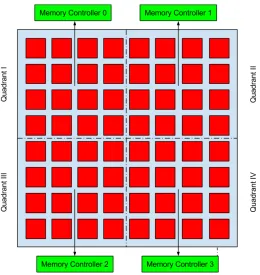
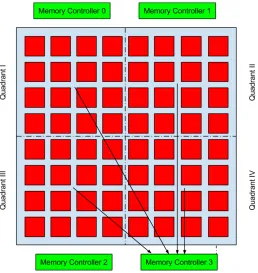
Figures 1.1 and 1.2 show the best-case and worst-case scenarios considered in this work. The worst case does not arise due to bank-level contention but due to NoC contention and a
specific memory access pattern. If all accesses are directed via a particular memory controller
as shown in Fig. 1.2, then the latencies increase since requests get queued at controller(s) and core(s) stall. Furthermore, cores in each quadrant may access all controllers, which leads to a
high volume of traffic. Even though all controllers are being utilized, the latency is high.
1.1
Hypothesis
We hypothesize that a mesh-based network-on-chip (NoC) interconnects of a modern manycore
1.1. HYPOTHESIS CHAPTER 1. INTRODUCTION
1.1. HYPOTHESIS CHAPTER 1. INTRODUCTION
1.2. CONTRIBUTIONS CHAPTER 1. INTRODUCTION
• controller- and bank-aware memory allocation and
• a hybrid MPI+OpenMP programming model due to reduced NoC contention and more balance and localized utilization of shared resources
1.2
Contributions
The work makes the following main contributions:
• It introduces a user space bank-aware and controller-aware allocator that keeps track of bank(s) and controller(s) of allocated memory, i.e., it returns memory addresses
re-quested on a particular bank/controller. This allows users to bind a core/processor to a
specific bank and controller reducing the contention and serialization, thus improving per-formance isolation. Using the allocator, an extensive experimental study was performed
to evaluate the impact of bank-aware and controller-aware allocation on performance
iso-lation. Various benchmarks, including STREAM, NPB’s IS (OpenMP version) along with a composite benchmark generated using the M¨alardalen benchmark suite, were used.
• It assesses the hybrid programming model in comparison to pure shared and pure dis-tributed memory parallelization on the Tilera architecture [Tili] . The assessment is
per-formed using an extension of the NoCMsg library [ZM14], an MPI-like abstraction over the Tilera NoC. This abstraction treats the Tilera manycore architecture as a distributed
memory system. It relies solely on low latency software-defined message passing via the
NoC instead of architecture-defined shared memory for data communication. Weak scaling [Gus88] and strong scaling [Amd67] is performed on various benchmarks under multiple
Chapter 2
Targeted Allocation
2.1
Background
The Tilera [Tili] architecture differs from most modern systems due to presence of a mesh NoC
instead of a bus. Other platforms with large core count now use a mesh or ring NoC as well
(Intel Xeon Phi [Mic], Intel SCC [Sccb], Adapteva [Ada] etc.). Like modern DRAM systems, the memory system is composed of a controller that handles the arbitration, scheduling and
conversion of packets to external memory commands. Memory is organized into ranks (4 in our
setup) and each rank has multiple banks (8 in our case), which can be accessed in parallel. Each bank is composed of a row buffer and an array of storage cells organized into rows and
columns. The systems may or may not have multiple independent memory channels. The Tilera architecture supports four channels capable of independent operation [Tile]. Data is accessed
by issuing an ACT command to get data into a row-buffer. Then, the column can be accessed.
If another row has to be accessed, the data in the row buffer has to be written back with a PRE command before activating another row. Since DRAM storage is composed of capacitors,
a periodic refresh is necessary. Due to timing constraints and operational methodology we can
observe:
• a high access latency for closed rows exists.
• operations on different banks may proceed in parallel.
Tiles (similar to cores) do not have direct access to controllers as the architecture implements a DSM (Distributed Shared Memory) protocol to ensure coherence at the L2 level cache. Tilera
utilizes a mesh interconnect for data exchange [Tilf]. Dimension ordered routing is used in
2.1. BACKGROUND CHAPTER 2. TARGETED ALLOCATION
They are the interface between memory controllers and other I/O devices [Tilf]. The memory controller has multiple MDN ports [Tile] where requests arrive and are fulfilled. To optimize
memory bandwidth and latency, reordering is performed based on the following considerations:
• the overhead of the memory accesses and DRAM page policy on memory side;
• load balancing and starvation avoidance on the tile side.
Due to these architectural considerations, the NUMA allocation policy is the default. If,
however, the STRIPE mode [Tile; Tild; Tilc] is enabled, a page (64 kB size) is striped across
all controllers in an interleaved way at 8 kB granularity to balance load and improve memory parallelism. Another strategy to load balance is hash homing [Tilb], where a page is striped at
cache line granularity and distributed among the available tiles. However, NUMA and STRIPE
allocations might not be able to ensure performance isolation as the accesses to the data struc-ture will be resolved by different memory controllers with different latencies (hops) over the
NoC.
First, none of the policies are bank aware, i.e., they cannot restrict accesses of a task running on a tile to a particular bank or even controller if memory striping is enabled. And even with
a controller-aware NUMA policy, contention may not necessarily be reduced: Allocation will always be performed on the closest controller, but if all tasks are placed close by, contention
may actually increase.
The second reason is bank sharing. Even if memory is striped across the controller(s) to improve load balancing and throughput, the probability of bank sharing is still high. Thus, bank
contention may decrease throughput for memory intensive tasks. NoC contention is another
overhead in case of memory striping. Since a memory page is effectively distributed across controllers, the probability of NoC contention increases significantly due to longer NoC data
paths when we increase the number of tasks and the size of the memory footprint.
To limit the impact of bank sharing, bank address hashing [Tile] is performed at the hard-ware level to randomize the banks within a page based on the physical address of a page. This
increases the bank availability but that becomes less significant as we increase the memory
footprint of the tasks and the number of tasks.
In the worst case, both issues simultaneously manifest. In this paper, we present a user space
allocator utilizing non-striped mode and using controller-interleaved page allocation instead of
2.2. DESIGN CHAPTER 2. TARGETED ALLOCATION
2.2
Design
In this paper, we propose the design and implementation of a user space bank-aware and
controller-aware allocator. It exploits the virtual to physical address translation. After deter-mining the bank and controller from bits within the physical address, the address is added to
a specific list corresponding to the relevant controller and bank. When a user requests memory
from a certain bank and controller, the corresponding list is searched and if memory is available, its address is returned.
Our allocator requires pre-allocation of a large pool of memory, which is then traversed at a
granularity of 8 kB and chunks are added to the corresponding free list(s). The default behavior of the allocator is to try to find a memory chunk fitting the requested size, bank and controller.
But if the exact request cannot be full-filled, the allocator supports multiple modes as a fallback from the default behavior, namely:
• CONTROLLER RESTRICTED: If a requested bank is not found within the controller, the allocator defaults to the bank that has the most free memory.
• CONTROLLER UNRESTRICTED: If a requested bank and the controller cannot be used to satisfy the request, the allocator defaults to the bank and controller that have the
most free memory.
• SPLIT: If the requested size is greater than 8 kB and this mode is enabled, then standard allocation is performed (i.e., find the first fitting contiguous chunk available) and its
address is returned.
Algorithm 1 shows the implementation. Multiple modes can be configured via a bit-mask for
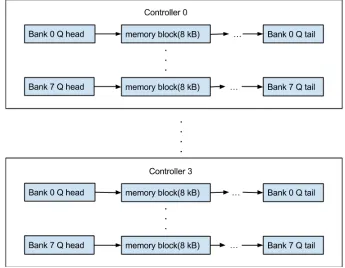
finer control of the allocator. Multiple lists are used to improve the performance of the allocator (see Fig. 2.1). Multiple doubly linked list(s) are maintained, one for each bank within a
con-troller. The head of the list is indexed using the controller number/bank number. For SPLIT
allocation, a separate list is maintained for quicker allocation. Each free memory chunk is part of both lists. Each memory chunk has four pointers, two pointers that are used to traverse the
corresponding bank list and two pointers for the list used for SPLIT allocation.
As we can see from the allocation modes and the algorithm, we perform book-keeping on memory available per bank/controller. For this purpose, a queue is maintained in which
elements are sorted according to memory availability and its doubly linked list implementation,
2.2. DESIGN CHAPTER 2. TARGETED ALLOCATION
Input: Request Size, Memory Controller, Bank, modes mask block ←−NULL;
block ←−Memory from requested controller and bank; if block != NULLthen
return block; end
if CONTROLLER RESTRICTED in modes mask then
Q←− Banks corresponding to requested Memory Controller with banks in descending order of memory availability;
foreach bank in Q do
block←− allocate memory from current bank if chunk of size greater than or equal to requested size is available;
if block != NULL then return block;
end end end
if CONTROLLER UNRESTRICTED in modes mask then
ControllerQ←− Get controllers in descending order of memory availability; foreach controller in ControllerQ do
BankQ←− Get banks from current controller (ordered in descending order of memory availability);
for each bank in BankQ do
block←− allocate memory from current bank if chunk of size greater than or equal to requested size is available;
if block != NULL then return block;
end end end end
block ←−NULL;
if SPLIT MODE in modes mask then
block←− Allocate contiguous block of memory (may span across banks and controllers);
end
return block;
2.2. DESIGN CHAPTER 2. TARGETED ALLOCATION
Figure 2.1 Queue(s) used in allocator
Figure 2.2 Bank split up in a 64 kB page(with no address hashing)
controller. Queues are array based for fast operation as the number of banks and controllers is
fixed.
Even though multiple levels of design abstractions are introduced, they primarily accelerate
2.3. EVALUATION CHAPTER 2. TARGETED ALLOCATION
multiple data structures and free lists need to be updated. For this reason, all our experiments exclude the allocation time and focus on real-time applications after they pre-allocate data
during the initialization.
One shortcoming of our approach is that the allocator works best for shared memory tasks. For non-shared memory tasks, it will lead to wasted memory as a separate pool will be needed
for each task.
In contrast to PALLOC [Yun14], a kernel-level allocator, and other software partitioning approaches [Jeo12] [Liu12], our allocator works in user space. It is more restrictive in terms
of usage due to multiple reasons. Due to Tilera’s design of a 64 kB page size and utilization
of controller-interleaved page placement, we cannot allocate more than 64 kB of contiguous memory within a controller. As the bank varies every 13 bits (explained in the address mapping
section), a contiguous allocation within a bank cannot be more than 8 kB (see Fig. 2.2). Also,
due to allocator design restriction(s), the allocator cannot perform contiguous allocation within a controller greater than 8 kB (see Fig. 2.1). Unlike PALLOC, this allocator is not seamlessly
integrated, i.e., explicit modifications are required to utilize this allocator in accordance with the previously mentioned restrictions.
2.3
Evaluation
2.3.1 Hardware Platform
The evaluation platform used is a Tilera TILEPro-64 with 64 tiles [Tilg]. Each tile has 16+8
kB private L1I+D cache(s), a 64 kB private L2 cache and a soft L3 cache of 5 MB, which is
created by combining the private L2 caches of all tiles. There are 4 memory controllers, each capable of independent operation. Each controller can support up to 32 banks (4 ranks and 8
banks per rank). The configuration we utilize has 8 GB of DDR2 RAM, 2 GB per controller.
Address hashing [Tile] is enabled to enhance the number of available banks.
Memory striping is disabled in the test configuration to obtain a more predictable worst
case execution time. When memory striping is enabled, Linux sees only one controller and a page is striped across all four controllers. To determine which 8 kB chunk belongs to which
physical controller, we would need to write an additional wrapper function over Tilera’s API.
In contrast to this, if memory striping is disabled, all four physical memory controllers are visible to Linux, i.e., just by appropriately setting the affinity of a task and by using the default
NUMA policy, we can restrict allocations to a controller. This also makes the simulation of the
2.3. EVALUATION CHAPTER 2. TARGETED ALLOCATION
memory controller using Tilera’s API.
2.3.2 Address Mapping
Address translation is straight forward. The physical address has 36 bits [Tile]. Per the
doc-umentation and configuration register values, address hashing is performed to increase bank
availability. Bits 13, 14, 15 are used to determine banks and bits 34 and 35 are used to deter-mine the controller.
The implication of the position of bank-determining bits is that a bank changes every 8 kB. Since the Tilera architecture dictates pages to be 64 kB in size, one page is spread across 8
banks. The configuration was determined by reading from a SPR (Special Purpose Register)
[Tile] using the Tilera Board Test Kit [Tilh].
We also need to consider bank address hashing while determining the banks. Algorithm 2
shows the bank determination functions.
if hash[0] = 0 then
bank[bankbits-1:0] = addr[bankbits+colbits+2:colbits+3]; end
if bankbits+colbits+2>= 15 and bankbits=3 then high[bankbits-1:0] = 1’b0, addr[17:16];
end
if hash[0] = 1 then
bank[bankbits-1:0] = addr[bankbits+colbits+2:colbits+3]∧high[bankbits-1:0]; end
Algorithm 2:Bank Address Hashing
After querying the SPR controller configuration, we determined that colbits is 10 and bank
bits is 3.addr in Algorithm 2 is the physical address. As we can see from the functions described in Algorithm 2, we take bits 16 and 17 from the physical address and XOR them with the
identified bank bits. This results in a randomization of banks based on the physical address.
Based on the previously mentioned function, we assume that the first 8 kB of a page is bank 0. However, after hashing, it can be any bank from 0-3.
Apart from the default configuration of 8 banks, we also experimented with 2 and 4 bank
2.3. EVALUATION CHAPTER 2. TARGETED ALLOCATION
Figure 2.3 Allocator performance in SPLIT mode as we increase the request size
every 4th bank, i.e., after banks 0-3. All this is done during bank identification for building the
free list so no configuration changes on the platform are required.
2.3.3 Overhead
As discussed in the previous section, the allocator is fast for requests of size less than or
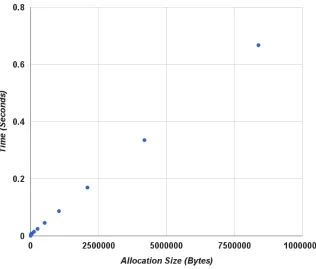
equal to 8 kB. But if we allocate contiguous memory greater than 8 kB, we need to use the SPLIT mode, where the performance varies depending on the size of allocation. Fig. 2.3 shows
the timing plot for varying allocations in SPLIT mode. As we increase the size of allocations
the difference between allocations keeps increasing. An allocation of 8 MB requires close to 0.7 seconds but an allocation of an 8 kB chunk takes only about 0.007 seconds. As real-time
systems tend to allocate memory ahead of time, a detailed analysis on allocator performance
2.3. EVALUATION CHAPTER 2. TARGETED ALLOCATION
2.3.4 Key Ideas
The experimentation mainly focuses onsame bank allocation vs. varied bank allocations. Same
bank allocation is not possible due to bank address hashing. So even when we access the first
8 kB of each page, it is randomized to any bank between 0-3 (not necessarily 0). Thus, when we try to perform same bank allocation via Tilera’s API and default allocation policy, there
is some bank parallelism. One way to avoid this is to write a wrapper around Tilera’s API to
identify the chunk belonging to bank 0 and return it for accesses. But we did not implement this as we want to see the effectiveness of bank address hashing in reducing bank contention.
Second, consider data dependencies (RAW, WAW and WAR). These dependencies lead to a stall as re-ordering cannot take place. If we can define the access pattern that violates temporal
and spatial locality, we will always encounter a cache miss and one outstanding memory request
at a time. On Tilera, this can be achieved by disabling caching at all levels while performing allocations using Tilera’s API. To compile, the O3 flag is used for all experiments to optimize
the code.
To measure bank-level contention, we use OpenMP benchmarks and a composite benchmark. The entire processor is divided into 4 quadrants with 16 tiles each, except quadrants 3 and 4
with only 12 tiles each as the bottom-most 8 tiles cannot be used for execution in our setup.
The primary aim of dividing tiles into quadrants is to restrict the access to memory via the closest memory controller. This allows us to remove controller contention and to minimize NoC
contention so that we can focus on measuring bank level contention. This also helps if we
want to create pathological worst case scenarios, i.e., tiles from each quadrant accessing all the controllers to generate excessive memory contention in all quadrants accessing controller 0 and
1. The execution time is indicative of contention. Colored allocation results in lower execution
time compared to non-colored allocation, and we get better memory bandwidth with colored allocation.
During the entire experiment, threads were pinned to the respective tiles to prevent them
from migrating and causing unintended interference.
2.3.5 Benchmarks
A multi-threaded composite benchmark was designed. Each thread is assigned one kernel and
the number of times threads execute the associated kernels can be specified (also termed as iterations). Once launched, threads execute each iteration in a lock-step manner. This is ensured
using two barriers. Minimum, maximum and average execution times are reported per thread
2.4. RESULTS CHAPTER 2. TARGETED ALLOCATION
4 5 6 7 8 9
0 2 4 6 8 10 12 14 16
Execution (Seconds)
Experiment Instance
Bank Aware Allocation (4 Colors) Bank Aware Allocation (8 Colors) Bank Non-Aware Allocation
Figure 2.4 Modified NPB IS OMP (Class A) Execution
stats from the M¨alardalen Benchmark Suite [Gus10]. The modifications are limited to changing key arrays from 1D to 2D.
We have also utilized the NAS IS OMP [Bai91] and STREAM [McC95] benchmark(s) for our
experiments. The modifications in these codes are also limited to changing key arrays from 1D to 2D and then performing dynamic allocation either using our allocator or using the Tilera’s
API. OpenMP parallel sections, if present, are modified to set affinity of individual threads as well.
2.4
Results
Let us assess the impact of bank-aware allocation on performance. We use execution time to measure the worst-case performance impacted by latency, bandwidth and contention. By
running the same benchmark in multiple tile(s) and using an OpenMP enabled benchmark, the
impact of bank-aware and controller-aware allocation is shown. Thex-axis of the plots denotes the ith experiment/execution (experiment instance) and the y-axis shows memory bandwidth
2.4. RESULTS CHAPTER 2. TARGETED ALLOCATION
0 100 200 300 400 500
0 2 4 6 8 10 12 14 16
Sustainable Bandwidth ( MB/s )
Experiment Instance
Bank Aware Allocation (4 Colors) Bank Aware Allocation (8 Colors) Bank Non-Aware Allocation
Figure 2.5 Modified STREAM Add Sustainable Bandwidth
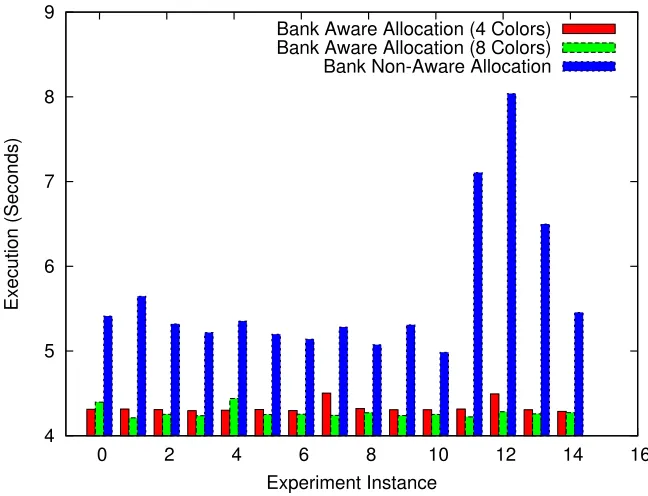
Fig. 2.4 depicts the execution time of the NAS IS OMP benchmark for 32 threads (8 threads per quadrant). We obtain close to a 20% performance benefit with colored allocation.
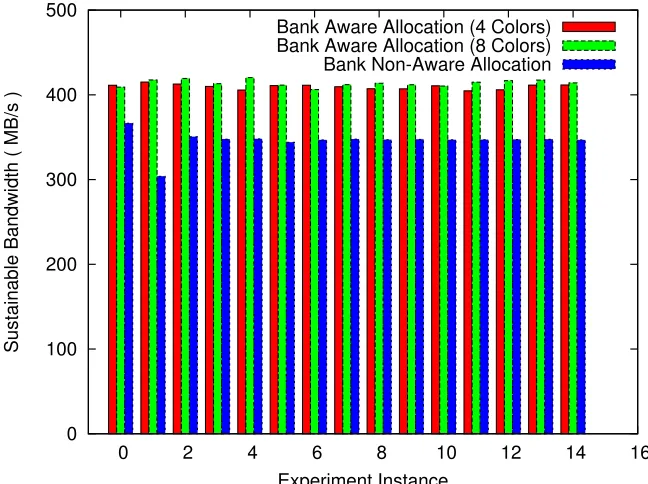
Fig. 2.5 (bandwidth reported by modified STREAM benchmark with 32 threads and 8 threads
per quadrant) shows a significant increase in sustainable bandwidth for the ADD kernel from the modified STREAM benchmark.
To further understand NoC contention and bank contention, composite benchmark execu-tions (for the modified bubble-sort from the M¨alardalen benchmark suite) with varied number
of threads and memory footprints were performed. Bubble-sort is used as it is the most memory
bound of all integrated benchmarks. As mentioned in the benchmark section, composite bench-mark runs are reported in terms of iterations. To get reliable data and account for outliers,
multiple iterations are performed per execution and multiple rounds of executions are run per
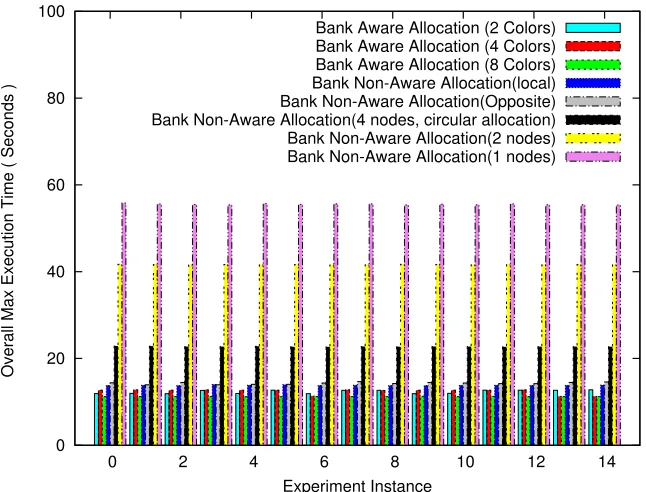
experiment. Fig. 8 shows the plot of overall maximum execution time per experiment of the composite benchmark for 32 threads and 2 pages per thread. We observe that colored
alloca-tion always results in the best performance isolaalloca-tion. The two pathological worst case scenarios,
2.4. RESULTS CHAPTER 2. TARGETED ALLOCATION 0 20 40 60 80 100
0 2 4 6 8 10 12 14
Overall Max Execution Time ( Seconds )
Experiment Instance
Bank Aware Allocation (2 Colors) Bank Aware Allocation (4 Colors) Bank Aware Allocation (8 Colors) Bank Non-Aware Allocation(local) Bank Non-Aware Allocation(Opposite) Bank Non-Aware Allocation(4 nodes, circular allocation) Bank Non-Aware Allocation(2 nodes) Bank Non-Aware Allocation(1 nodes)
Figure 2.6 Composite Benchmark (32 Threads, 2 Pages per Thread)
criticality of NoC contention and controller contention. Controller-local allocation is slightly slower than bank-aware allocation within a controller (colored allocation) as the latter reduces
serializations of accesses.
The difference between 2, 4 and 8 color allocations is noticeable. This is due the fact that even though we are simulating two and four bank configuration(s) by wrapping around bank
indices when populating free lists at user level, at hardware level we still have 8 banks, which is a higher bank level parallelism than expected for a four or two color scheme.
To further analyze the impact of colored allocation, the following two sets of experiments
were performed:
1. Constant memory footprint and variations in the number of threads.
2. Constant number of threads and variable memory footprint per thread.
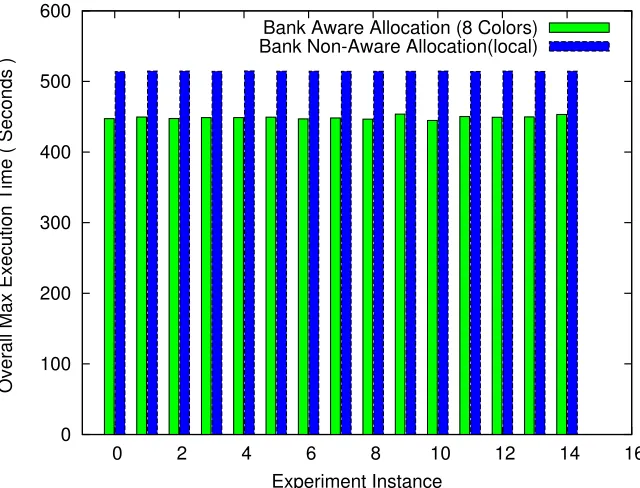
Fig. 2.7 shows the overall maximum execution time per experiment/execution of the
com-posite benchmark for 32 threads and 10 pages per thread. As we compare the plots in Fig.
2.4. RESULTS CHAPTER 2. TARGETED ALLOCATION 0 50 100 150 200 250 300 350 400
0 2 4 6 8 10 12 14 16
Overall Max Execution Time ( Seconds )
Experiment Instance
Bank Aware Allocation (8 Colors) Bank Non-Aware Allocation(local)
Figure 2.7 Composite Benchmark (32 Threads, 10 Pages per Thread)
20% over non-bank aware controller-local allocation was observed on average. This difference increases from less than 3 seconds in case of 2 pages per thread to 60 seconds in case of 10 pages
per thread. The demand for bandwidth increases due to a larger memory footprint. But since
bank-level parallelism increases available bandwidth by reducing the serialization of accesses and cross-interference, we observe that as threads become more memory bound, the impact on
performance of bank-aware allocation increases.
For experimental case 1, we fixed the memory footprint to 10 pages per thread and varied
the number of threads from 8 to 32 in steps of 8, i.e., increments of 2 threads per quadrant.
We observe that the difference between colored allocation and bank-unaware controller-local allocation keeps increasing until 32 threads, and then remains close to 60 seconds (see Fig. 2.6,
Fig. 2.7 and Fig. 2.8). This is due to the fact that each controller has 8 banks per rank, i.e.,
for up to 32 threads we were able to restrict each thread in the quadrant to a separate bank. But as we exceed 8 threads per quadrant, more than 1 thread accesses a given bank leading to
increased contention. Now, as we reduce the number of threads to 8, non-colored controller-local
2.4. RESULTS CHAPTER 2. TARGETED ALLOCATION
0 100 200 300 400 500 600
0 2 4 6 8 10 12 14 16
Overall Max Execution Time ( Seconds )
Experiment Instance
Bank Aware Allocation (8 Colors) Bank Non-Aware Allocation(local)
Figure 2.8 Composite Benchmark (48 Threads, 10 Pages per Thread)
0 20 40 60 80 100 120
0 2 4 6 8 10 12 14 16
Overall Max Execution Time ( Seconds )
Experiment Instance
Bank Aware Allocation (8 Colors) Bank Non-Aware Allocation(local)
2.4. RESULTS CHAPTER 2. TARGETED ALLOCATION
Table 2.1 Standard Deviations for modified IS and STREAM
Benchmark 4 Banks 8 Banks Controller-local
Modified NAS IS OMP 0.06824 0.06272 0.866052
Modified STREAM 2.950072 3.919421 12.63999
Table 2.2 Standard Deviation for Composite Benchmark Execution
Configuration 2 Banks 4 Banks 8 Banks Controller-local Opposite-controller 1 Node 2 Nodes Circular-allocation 32 Threads,2 pages
0.39536 0.57046 0.02552 0.07569 0.22504 0.12855 0.04264 0.03664
8 Threads,10 Pages
– – 1.13342 0.67696 – – – –
32 Threads,10 pages
– – 0.38644 0.19679 – – – –
48 Threads,10 pages
2.5. RELATED WORK CHAPTER 2. TARGETED ALLOCATION
One is bank address hashing. In case of non-bank aware controller-local allocation, we perform 8 kB allocations using Tilera’s API that allocates at 64 kB (page size) granularity.
Effectively, we only access the first 8 kB of each page, for which the bank is randomized due
to bank address hashing. Our colored allocation restricts thread 0 in each quadrant to bank 0 of the closest controller and thread 1 to bank 1 of the closest controller, effectively restricting
accesses to 2 banks. But in case of non-colored allocation, due to bank address hashing, the first
8 kB of the page (which we access) can be any bank (from 0-4), so there is a high probability of more bank level parallelism.
The second, less probable reason is that the number of threads per controller is less than
the number of MDN ports per controller. There are two threads per quadrant and 3 MDN ports per controller. Therefore, any delay due to serialization at ports is avoided.
Table 2.1 shows the standard deviation of the execution times of IS and sustainable
band-width reported by STREAM ADD kernel over 15 executions. We can observe that bank-aware allocation results in tighter bounds for IS and STREAM. Table 2.2 shows the standard
devi-ation over 15 experiments corresponding to the plots of each experiment having 5 iterations for Composite Benchmarks. We observed that for low memory footprint, the allocator yields
tighter bounds. Bank-level parallelism improves performance for higher memory footprint by
increasing the bandwidth (see Figures 2.6 and 2.7), but at the same time we also observe increased jitter (see Table 2.2) compared to controller-local allocation except for 8 banks. We
can also observe that as we increase the number of threads from 32 to 48, the jitter increases
as we change the number of threads from 8 to 32. The decrease of jitter is likely due to in-creased bank-level parallelism. But as we increase the number for threads to 48, the inin-creased
NoC contention and bank sharing counter the performance improvement. For controller-local
allocation, a higher level of serialization takes place as we increase the memory footprint, likely causing a depreciation in performance with reduced jitter.
2.5
Related Work
The idea of DRAM and cache partitioning for maximizing memory throughput and performance isolation at the OS level is explored in several works. In Jantz et al. [Jan13], the primary
objective is to optimize the power consumption and bandwidth by consolidating and relocating pages. This allows the unused parts to be put in a lower power state. The work also introduces an
abstraction of application-level memory coloring, thereby introducing a degree of performance
2.5. RELATED WORK CHAPTER 2. TARGETED ALLOCATION
et al. [Jeo12]. It proposes to optimize power consumption, increase memory throughput and improve performance isolation by means of bank-level partitioning. The OS is modified to
restrict accesses from a given thread/core to a given bank, thereby isolating access streams. Since
bank restrictions reduce the number of banks available per thread, sub-ranking is employed to improve memory bandwidth memory. This is done by breaking a rank (64 bit) into multiple
sub-ranks (8, 16 or 32 bits). Each sub-rank has an independent set of banks capable of holding
different rows. This effectively increases bank level parallelism but does not consider multiple controllers. There are a few key differences. First, they operate at kernel level rather than in
user space. This has the advantage of seamless integration into an application. Second, a rank
is explicitly considered for increasing bandwidth while our focus is on banks and controllers. The third difference is due to the platform. Instead of actual hardware, the evaluation is based
on a simulator. Fourth, the effect of the NUMA allocation policy is not considered. Park et al.
[Par13], another software-based approach, propose to increase memory bandwidth and reduce cross interference in a multicore system by dedicating multiple dedicated banks to different
cores. Page allocation within the dedicated banks is randomized to reduce row-buffer conflicts and to further minimize unwarranted cross-interference. Due to the implicit assumption of
more banks than cores, this approach excels when the number of banks is much larger than
the number of cores. It can also be observed that none of the approaches focus specifically on improving WCET.
Since multicore systems have multiple memory channels, memory channel partitioning is
one potential solution to improve performance isolation. Muralidhara et al. [Mur11] propose an application-aware memory channel partitioning. They consider partitioning memory channels
and prioritized request scheduling to minimize the interference between memory-bound tasks
from cache bound tasks and CPU bound tasks. The drawback of this approach is that it does not consider the priority of tasks. Hence, a hard deadline cannot be guaranteed by this approach.
Apart from software based approaches, there are multiple works on improving predictability
of memory controllers. PRET [Rei11] employs a private banking scheme, which eliminates bank sharing interference. Wu et al. [Wu13] take a similar approach but both approaches differ in
scheduling policy and page policy. There are several other works closely related to our work
[Ake07],[Goo13],[Pao09]. AMC [Pao09] focuses on improving the tightness of WCET estimation by reducing interference via bank interleaving and reducing inferences using a close-page policy.
The drawback of this proposal is that instead of treating banks as resources, it treats memory
as a resource. Akesson et al. [Ake07] present a similar approach to guarantee a net bandwidth and provide an upper bound on latency. They use bank interleaving to increase the available
2.5. RELATED WORK CHAPTER 2. TARGETED ALLOCATION
The drawback of this approach is also is same as that of AMC.
Goossens et al. [Goo13] presents a proposal to improve the average performance of hard
and soft real time system(s) on a FRT (firm realtime) controller without sacrificing hard/firm
real time guarantees. It utilizes bank interleaving and proposes a new conservative closed page policy to maintain locality within a certain window. The drawback of this approach is that it
does not eliminate bank conflicts completely.
Caches also impact performance isolation and there are several studies regarding the same at both hardware and software levels[Kim04],[Nes07],[Lie97],[Lin08],[Zha09],[Soa08],[Din11],
[War13],[Man13]. The basic idea behind software-based approaches is cache coloring. Cache sets
are considered as resources and are managed either statically or dynamically. Mancuso et al. [Man13] suggest a combination of profiling, coloring and lock-down to maximize deterministic
allocation of hot (frequently accessed) pages, thereby reducing interference due to inter-core
cache sharing. There are a few short-comings to this approach. First, this solution is built on the assumption that an identifiable memory access pattern exists. Second, it limits the cache
availability due to lock-down. Third, it does not consider variable memory workloads. Fourth, it does not reduce inter-task interference if multiple tasks share the same core.
Ward et al. [War13] present a solution to reduce WCET and improve predictability for highly
critical tasks using cache coloring, cache locking and cache scheduling. Heuristics are used for coloring, making this approach more flexible than cache partitioning. Ding et al. [Din11] present
a way for performance improvement by reducing last level cache thrashing. They limit the
cache pollution by mapping OS buffers to certain cache regions. CAMA [Her11] is a constant time dynamic memory allocator, which eliminates unpredictable cache pollution to improve
predictability and to yield better WCET analysis. It achieves this by performing cache-aware
splitting and by using coalescing techniques. The shortcoming of this approach is that it does not handle multilevel caches. Liedtke et al. [Lie97] present an application-transparent cache
partitioning approach, thereby improving predictability and performance.
Our work primarily focuses on the impact of bank-aware and controller-aware allocation in a NoC architecture, which makes it significantly different from prior studies to the best of our
Chapter 3
Programming Model Assessment
3.1
Background
3.1.1 NoC Architectures
NoC-based manycore architectures like Tilera [Tili] or Intel Xeon Phi [Mic] provide computing
power via multiple cores. All the data transfers typically occur over the NoC in form of the messages. These messages are packetized with the required flow control or routing information
and are then routed across the network to the required component. Tilera, Xeon Phi and other manycore architectures utilize 2D on-chip interconnects (mesh- or ring-based) instead of
traditional bus-based architectures.
3.1.1.1 NoC
On-chip networks, also known as network-on-chip or NoC, replace the traditional bus topology
with on-chip networks. This means all communication, I/O transactions and memory transac-tions occur via the NoC in the form of messages. Depending upon the architecture in question,
we may have a single or multiple NoC interconnects available primarily to reduce contention.
For example, Adapteva features three networks [Ada], Tilera TilePro64 features 6 networks and Intel SCC [Sccb] features a single network. Therefore, in such architectures efficiency of
par-allelization is constrained by network contention and memory contention. Unlike a traditional system bus, the NoC is generally a switching network where data is split into packets routed
across the network. For example, the Tilera architecture supports a 2D mesh with wormhole
3.1. BACKGROUND CHAPTER 3. PROGRAMMING MODEL ASSESSMENT
3.1.1.2 Cores
Cores generally interact with the network via switches using input and output queues. For example, in the Tilera architecture, each core or tile is composed of a processor engine comprised
of the CPU, cache and a switch engine, which has multiple I/O queues to route packets, i.e.,
connecting the core to other cores and I/O devices.
3.1.1.3 Switches
Each switch is part of the crossbar switch with multiple input and output queues that can be
configured to be connected. Wormhole routing dynamically creates such connections based on
a packet destination.
3.1.2 Tilera Architecture
The Tilera architecture implements a 2D mesh, also referred to as iMesh interconnect, with
specialized hardware, register mapping, multiple networks that provide high bandwidth and low
latency communication channels. The Tilera architecture has six mesh networks (IDN, UDN, CDN, IDN, TDN, and STN). IDN (I/O dynamic network) and UDN (User Dynamic Network)
are two architecturally-defined networks for routing data among I/O controllers and tiles. MDN
(Memory Dynamic Network) is a network for memory data. CDN (Coherence Dynamic network) is used for cache coherence traffic. TDN (Tile Dynamic Network) usage is similar to MDN but
it serves requests for tile-to-tile transfers. The static network is used for data transfer between tiles with fixed routings.
Of these networks, only UDN is accessible to users via APIs and it does not require system
intervention. The NoCMsg MPI abstraction [ZM14] is based on IPC (Interprocess commu-nication) using UDN, where the load is distributed by appropriate domain and sub-domain
decomposition and task/thread placement. The Tilera architecture has a ccNUMA architecture
with per-core L2 cache and a global soft L3 cache (composed of multiple L2 caches) as the NUMA policy is used for page placement and a MESI-style protocol is used for maintaining
cache coherence.
3.1.3 Architectural Implications
Consider task parallelism with fine-grained domain decomposition to maximize core utilization of nodes combined with thread-level decomposition using shared memory within a node. This
3.1. BACKGROUND CHAPTER 3. PROGRAMMING MODEL ASSESSMENT
Any parallel application involves computation and communication. The primary objective of this work is to reduce the communication overhead. In case of a modern HPC system
com-posed of nodes, we mainly focus on topology-aware task placement and domain decomposition
driven by interconnect bandwidth and communication pattern. Then, depending on processor architecture, I/O features, shared memory design (NUMA vs. ccNUMA, L1, L2 and L3 cache),
we can decide on coarse or fine sub-domain decomposition.
Due to architectural considerations, we have following major constraints limiting paralleliza-tion:
• False Sharing;
• DSM protocol overhead (explicit data homing or hash-for-home, described in more detail below);
• ccNUMA architecture imposing latencies and bandwidth;
• NoC contention.
These factors are closely interrelated but we will analyze them one by one. First, false sharing
can generate a significant amount of coherence traffic that may cause NoC contention. False
sharing between cores will occur when data within a cache line is accessed in disjoint chunks by multiple threads, i.e., without actual data sharing. Furthermore, if we assume random thread
placement, there is a high chance that data is scattered across tiles, and subsequent accesses lead
to invalidation and cache coherence traffic across the entire NoC. On the Tilera architecture, this can be triggered by hashing a page across tiles at cache line granularity. To avoid this,
proper data and work division among tasks and appropriate work sharing among threads is
required. Further, proper tiling of loops considering L1, L2 and L3 caches will increase the cache hit rates.
The second factor is data homing. There are three ways to home data in the Tilera
architec-ture: Local homing, remote homing and hash-for-home [Tild]. In local homing, the entire page (64 kB or 16 MB) is homed on a tile accessing the specific memory and any miss is redirected to
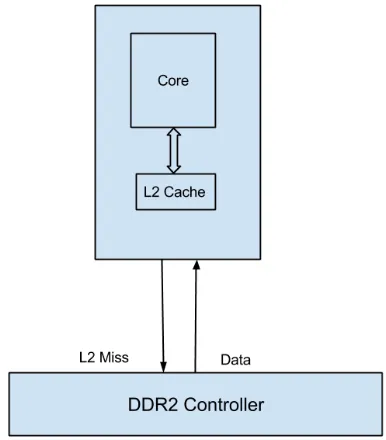
the DDR memory controller. This is the default setting for the stack of processes and threads.
In remote homing, the entire page is homed on a distant tile. In this case, if the miss occurs at the L2 cache, the data is provided by the remote tile where it is homed. If a data access misses
at the remote L2 cache as well, the request goes to memory. In hash-for-home, the entire page is
3.1. BACKGROUND CHAPTER 3. PROGRAMMING MODEL ASSESSMENT
Figure 3.1 Local data homing
3.2. DESIGN CHAPTER 3. PROGRAMMING MODEL ASSESSMENT
the set of tiles. But in case of the hybrid model, it will lead to performance deterioration and unintended network contention. Alternatively, the Tilera architecture provides APIs for explicit
control of data homing at the page level. For example, if a page is shared across all tiles, it is
possible to just hash that particular page across tiles. Data can be dynamically rehomed upon task migration as well. But it is often better to explicitly control data homing or use local
homing. This will help in localizing the traffic within a set of tiles associated with the process
and thus reducing the NoC contention.
The third factor is a ccNUMA (cache coherent NUMA) architecture. The Tilera architecture
has four memory controllers and is a cache coherent NUMA architecture. There are two ways in
which page allocation is performed. If memory striping is enabled, only one controller is visible to Linux and the page (64 kB size) is striped across the memory controller at 8 kB granularity.
If memory striping is disabled, all four controllers are visible and the page is allocated at the
closest memory controller. Since it is a cache coherent NUMA architecture, coordinated homing of data along with task/thread placement can lead to a reduction in network traffic and better
load distribution over the NoC.
An even load distribution among networks is key to maximizing performance. On one
ex-treme, the OpenMP model utilizes shared memory parallelism, where all the networks (except
UDN) are utilized. On the other extreme, we have process-based parallelism, which relies on MPI messages sent over UDN for data exchanges. The level of utilization of NoC meshes varies.
But in case of the hybrid model, the impact of domain decomposition and sub-domain
decom-position among threads within a process has an impact on performance.
Task/thread locality also plays a major role in reducing NoC contention. Appropriate
place-ment of task(s) or thread(s) can reduce the latency in communication and NoC contention.
Another factor to maximize performance in any model is the pinning of processes and threads. Under NUMA policy, it is critical that threads or processes do not migrate. By
archi-tectural requirements, if we use UDN, we need to set the affinity of a process to a particular
tile as it is used for the routing of packets. Processes cannot migrate, but for threads there is no such constraint, so we need to define affinity of threads appropriately and explicitly.
Considering all of the above factors, domain and sub-domain decomposition is non-trivial.
3.2
Design
The key driver behind utilizing UDN for providing an MPI-like abstraction is that it is extremely
3.2. DESIGN CHAPTER 3. PROGRAMMING MODEL ASSESSMENT
Figure 3.3 NoCMsg API design
There are two ways to design an MPI-like abstraction using UDN, interrupt based and
polling based. iLib [Wen07a] is a library that provides basic APIs for data streaming and
mes-saging. Point-to-point communication is supported by iLib and closely resembles MPI semantics but it only supports broadcast and barrier collectives. It is interrupt based and relies on virtual
channels and complex packet encoding. OperaMPI [Kan09] is built around iLib using primitives
to support more complicated collectives like all-to-all, scatter-gather etc.
The existing NoCMsg library [ZM14], on the other hand, is polling based. It is designed
around asynchronous work loops to provide flow controlled and non-flow controlled
communi-cation. At the core are two work loops:
• trysend: keeps polling the send queues to check for any pending send;
• tryrecv: keeps polling and checking on input queues to see if there are any known or unknown receives pending.
These two queues are used for providing flow controlled communication. For non-flow controlled communication, APIs are provided with optional synchronization. These are primarily used to
implement collectives. There are separate queues for handling known and unknown receives. Fig. 3.3 and Fig. 3.4 show the overall design of NoCMsg and OperaMPI, respectively. Due to
the polling-based approach, NoCMsg has lower overheads than OperaMPI as the latter utilizes
3.3. IMPLEMENTATION CHAPTER 3. PROGRAMMING MODEL ASSESSMENT
Figure 3.4 OperaMPI API design
3.3
Implementation
The implementation effort consisted of extensions to the NoCMsg library.
3.3.1 NoCMsg
The current implementation of NoCMsg supports the original set of NAS benchmarks but since they are not hybrid, they cannot be utilized for our assessment. We identified several C and
FORTRAN benchmarks supporting the hybrid model of execution. Our initial set consisted
of CoMD [Com], the NAS Multi-Zone Suite [WJ03], CoSP2 [Cos], HPGMG-FV [Ada14], and LULESH2.0 [Kar13]. We investigated the level of modifications required in the current NoCMsg
library to support these codes, which resulted in adding the following features:
• Support for DOUBLE INT;
• support for MINLOC and MAXLOC reductions;
• support for 64 byte unsigned int (uint64);
• support for byte datatype;
• sendreceive functionality;
• MPI Get count; and
3.3. IMPLEMENTATION CHAPTER 3. PROGRAMMING MODEL ASSESSMENT
UDN APIs only support data transfer in terms of 4 byte unsigned integers, therefore, a forward and reverse mapping of data types needs to be maintained. This mapping was updated to
support the needed data types. While updating the mappings, we also found that mappings
for byte and char need to differ or they may lead to buffer overflow problems. To avoid this buffer overflow, forward and reverse conversion functions were added and other functions were
modified to use these functions instead of directly accessing the mappings. This also increases
the robustness of the APIs.
The introduction of the new data types was made fairly easy via abstractions over data
type mappings. Support for DOUBLE INT and uint64 t type was required by the benchmarks,
so the reduction implementation was extended to cover the new data types. MINLOC and MAXLOC reduction support was also added as part of the extension.
A few benchmarks required Sendreceive functionality, which was layered over Irecv, Isend
and Wait of the NoCMsg API.
MPI Get count, used by CoMD, was designed and implemented using the conversion
func-tions added to support new data types and via extensions of the internal data structures. MPI Test was also implemented along similar lines with MPI Get count functionality.
The NAS Multi-zone and HPGMG-FV required communicator split functionality. All the
APIs and internal functions were modified to handle global and local ranks within a communi-cator appropriately. Sanity checks in the Isend, Irecv and Wait functions were added to handle
inappropriate request handles. We also found that additional flow control, where a blocking
send waits for a receiver to acknowledge the data reception before send unblocks, was violat-ing MPI semantics, so this mechanism was removed completely. Since UDN ensures a lossless
packet transfer, it is safe to assume once the packets are queued for sending they will reach
the destination, so any additional software-based control is not required. Send receive matching logic was updated to only consider the source and tag.
3.3.2 Benchmarks
Two major criteria were considered for selecting a benchmark:
1. Flexibility in terms of process and thread configuration; and
2. The per-thread input should fit within the LLC (Last Level Cache) of each tile.
3.4. EVALUATION CHAPTER 3. PROGRAMMING MODEL ASSESSMENT
assessment of the communication overhead involved. If we can fit the per-thread input within the LLC, cold misses will bring data into LLC, but no other DRAM accesses will occur from
there on. This ensures that we will measure the effect of the NoC on scalability instead of
band-width limitations on DRAM. Keeping these two objectives in mind, benchmarks were chosen (discussed in detail in the Section 3.4). The modifications to benchmarks selected for assessment
were minimal. We replaced the MPI constructs with NoCMsg constructs and modified the tag
values of sends and receives to be within the supported range.
We also needed to distinguish between thread and process affinity. Due to architectural
constraints, the usage of UDN mandates that the affinity of a process, once set to a particular
tile, has to be maintained. When this process spawns threads, they inherit the affinity mask of the parent. Thus, all the threads contend for the same CPU. Using the GOMP CPU AFFINITY
environment variable, a partial solution is possible, but since it is a system-wide setting, it still
led to CPU contention when multiple processes were spawning threads. After investigating libgomp (the Linux OpenMP library), we found that using a Pthread affinity call along with
the Tilera affinity call, we were able to utilize all CPUs and alleviate the contention. But this required modifying benchmarks to set the affinity of OpenMP threads as they are launched.
Thus, explicit calls to set the affinity were added to every OpenMP section as this affinity mask
was not persistent.
3.4
Evaluation
3.4.1 Hardware Platform
We utilized the Tilera TILEPro-64 with 64 tiles/cores, each with a clock speed of 700 MHz with floating point emulation in software. Each core has 16+8 kB private L1 I+D cache(s), a 64
kB private L2 cache and a soft L3 cache of 5 MB, which is created by combining the L2 caches
of all tiles. The board has 4 memory controllers, each supporting 2 GB of DDR2 memory. The virtual L3 cache is directory based, where each page is hashed across a specific set of cores. The
benchmarks and the NoCMsg library are compiled using the Tilera 3.03 MDE tool chain with the optimization level O3 and the fopenmp flag.
3.4.2 Key Ideas
As mentioned previously, the aim of this work is to analyze the three programming models
3.4. EVALUATION CHAPTER 3. PROGRAMMING MODEL ASSESSMENT
indirectly trying to analyze the latencies due to NoC(s). To do this, we need to minimize the LLC cache misses so as to minimize the references to the memory.
Since we need to analyze the communication overhead, we perform weak scaling in all models
(OpenMP, MPI and Hybrid) with inputs per MPI task/thread constrained to the local L2 cache size. In the case of weak scaling, the workload is varied proportionately to the number of cores
to keep the load per core constant, which ideally should result in constant execution time. Using
weak scaling, we can determine how well a problem can scale when increasing the number of cores, which is the objective of this work.
We experiment with 8 to 56 cores in increments of 8. For OpenMP, this translates into 1
MPI task (in case of CoMD) or no MPI task (in case of NAS Multi-zone benchmarks) and varying number of threads from 8 to 56 in increments of 8. For MPI (NoCMsg) only, we vary
the number of MPI tasks from 8 to 56 in increments of 8 and fix the number to threads per
MPI task to 1. For the hybrid case (NoCMsg + OpenMP), two configurations were used. In one hybrid configuration, we fix the number for MPI tasks to 8 and vary the number of threads per
task from 1 to 7 in increments of 1. In the second hybrid configuration, we fix the number of MPI tasks to 16 and vary the number of threads from 1 to 3 in increments of 1. As with weak
scaling, we modify the input sizes to fit within the L2 cache(s).
This approach minimizes all other latencies, e.g., latencies due to memory, which would otherwise dominate and skew the assessment. This exposes the overheads due to the NoC. By
fitting data within LLC, we can study the impact of scaling on a many-core with good locality
and minimize other latencies.
To assess the impact of the DSM (Distributed Shared Memory) protocol at L3 level,
exper-iments are conducted with and without hashing. As discussed in Section 3.1.3, hash-for-home
hashes the page at cache line granularity and distributes it across the configured set of tiles/cores in an effort to reduce load imbalance (primarily by using MDN). This has the potential to
signif-icantly increase performance due to load distribution and increased LLC cache size, but causes
jitter: Even for data that fits into L2 cache, there is a remote access (and thus variable hop count). The resulting contention only gets worse as we increase the number of threads. Even
though MDN has twice the bandwidth of UDN [ZM14], we can often get better performance
with UDN (NoCMsg only) or with UDN+MDN (hybrid model).
The MPI-only and OpenMP-only configurations use the default sequential task/thread
map-ping, but for the hybrid model, a different mapping is used to group threads within a process in
close proximity. Fig. 3.5 shows the hybrid mapping for 8 MPI tasks. We place the communicat-ing threads per MPI task in close proximity (in this case in the same row) to localize contention.
3.4. EVALUATION CHAPTER 3. PROGRAMMING MODEL ASSESSMENT
3.4. EVALUATION CHAPTER 3. PROGRAMMING MODEL ASSESSMENT
task with 16 MPI tasks has half the number of threads (cores) as that for of 8 MPI tasks.
3.4.3 Benchmarks
LULESH2.0, CoSP2, HPGMG-FV, CoMD, LU-MZ, SP-MZ and BT-MZ comprise the initial set
of benchmarks as they support the hybrid programming model. By varying the number of MPI
tasks and threads per MPI task, we can experiment with all three programming models using the same code base. After analyzing data decomposition in the benchmarks and the resulting
memory footprint, HPGMG-FV and CoSP2 were ruled out due to their high memory footprint. LULESH was ruled out due to constraints on the number of MPI tasks. It only supports numbers
of MPI tasks in a perfect cube, and since we only utilize up to 56 cores, experiments for the
MPI only model would be too restricted.
CoMD is used because it is not constrained in terms of process and thread configuration,
and it was possible to reduce the per thread memory footprint to less than 64 kB, which is
the LLC cache size per core/tile of the Tilera architecture. It also supports weak scaling. After analyzing the benchmark code and data distribution among threads and MPI tasks, we found
that at 108 atoms per thread, the number of local boxes per thread comes down to 8, and with
a maximum size of 64 atoms per box, the memory footprint for the data structure containing information on atoms amounts to about 44 kB.
NAS Multi-Zone benchmarks, derived from the original NPB Suite, divide their 3D mesh
input into multiple meshes or zones. Each zone is solved independently. After each iteration/time step, boundary values are exchanged between zones. In case of the MPI or OpenMP model,
each MPI task/thread is assigned zones but in case of the hybrid model, each process is assigned
zones and parallelization within a zone is realized via OpenMP. This approach creates a loose coupling among zones. This suite has three benchmarks: LU-MZ (Lower-Upper Symmetric
Gauss-Seidel), SP-MZ (Scalar Penta-diagonal) and BT-MZ (Block Tri-diagonal) derived from
NPB. In case of SP-MZ and LU-MZ, partitioned zones are identical in size but in case of BT-MZ, the size of each successive zone increases. Assuming 24 double precision variables per
mesh, the memory footprint per thread is calculated to be approximately 42 kB for SP-MZ and
approximately 65 kB for LU-MZ [WJ03].
These benchmarks do not restrict the number of tasks given an input size, which allows us
to analyze performance variation and scalability over varying number of cores under different programming models. For NAS Multi-zone benchmarks, the default input classes do not support
weak scaling. Instead, we derived new problem sizes for weak scaling of SP-MZ and LU-MZ
3.4. EVALUATION CHAPTER 3. PROGRAMMING MODEL ASSESSMENT
Figure 3.6 SP-MZ Input Specifications